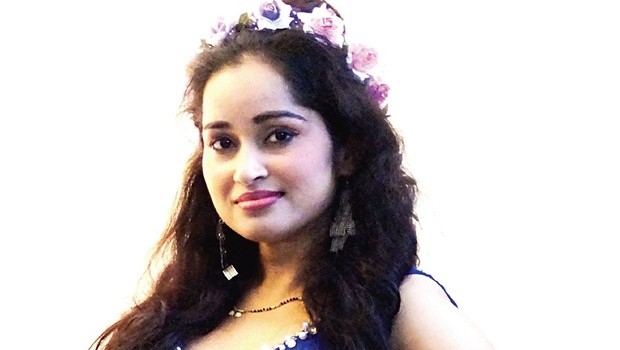
Bengaluru mom Laxmipriya Srivastav bagged the first runner-up and the Mrs Beautiful Smile at Mrs India International contest held in Chennai recently.
The contest saw 40 finalists from across the country. It comprised six rounds and workshops for self-assessment, time management, innovative ways of draping sarees, hair care and styling, followed by yoga and meditation to overcome anxiety and stress before the finale.
Laxmipriya, native of a village near Allahabad, has always admired Sushmitha Sen, former Miss Universe, a single mother, and an independent woman.
Laxmipriya lives in the city with her husband Tanmai and their three-year-old son Vivaan.
She works in Pharmed Limited as Senior Product Manager. Her professional career has been progressive in the past eight years. She has also the title of ‘Junior scientist’ from The National Academy of Sciences India to her credit.
As a teenager, she won a painting competition organised by the Indian Oil Corporation, and represented Allahabad in a play during Natya Mahotsav, a cultural event organised by North Central Zone Cultural Centre (NCZCC).
Writing, painting and acting are among her passions.
She cherishes two years of working with Doordarshan as a 12-13-year-old. Currently, she is editor of her company’s in-house magazine Supermom.
She is also associated with NGOs like Aasra and Global Headstart Mission to address medical needs and contribute to the education of the underprivileged.
source: http://www.newindianexpress.com / The New Indian Express / Home> Cities> Bengaluru / by Express Features / June 22nd, 2016
Maharaja of Mysore Yaduveer Krishnadatta Chamaraja Wadiyar will today tie the nuptial knot with Trishika Kumari Singh , who belongs to a royal family of Rajasthan.
The iconic Mysore Palace Amba Vilas Palace has been decked up for the royal wedding of Wodeyar family scion Yaduveer.
Trishika is the daughter of Harshvardhan Singh and Maheshri Kumari from the Dungarpur royal family in Rajasthan. The marriage ceremony will take place at the kalyana mandapa at the karkataka lagna and savitra mahurat time between 9.05 a.m. and 9.35 a.m.
The elaborate pre-marriage rituals had commenced on June 24.
The groom took a ‘yenne snana’ or oil bath early on Saturday morning, followed by a ‘pada puja’ of Parakala Mutt’s Abhinava Vagheesha Brahmatantra Swatantra Swamy , who is the family’s rajguru.
As per established custom, the rituals began in the Mysore Palace in the presence of Pramoda Devi, the Queen mother and other family elders.
24-year-old Yaduveer was crowned as the ostensible head of the erstwhile Mysuru royal family in a traditional ceremony held on May 28 last year.
source: http://www.timesofindia.indiatimes.com / The Times of India / New Home> City> Bangalore / ANI / June 27th, 2016
Researching historical details can get confusing at times. This story for instance, begins in a Scottish city called Glasgow on a street named after the Saracen people from the Middle Ages. It then gets directed to a Victorian bandstand in a historic park laid out by a military engineer in South India’s tech-hub, Bengaluru. And if you think it’s quite knotted up already, that’s not the end of it. But maybe that’s also the fun of it.
Parks historian and author Paul Rabbitts says that the bandstand (or `band house’ as it was first called) was perhaps inspired by popular 18th century pleasure gardens like Vauxhall in London who also offered music pavilions and exotic entertainment including hot air balloons, tightrope walkers and fireworks. The bandstands were envisioned as a decorative focal point for the park and provided acoustic shelter for the brass, wind and military bands that played there. Their rich decorative elements and curved shapes also seemed to reflect oriental influences like the pagodas and chattri’s from the eastern corners of the empire. The first domed structure was reportedly built in 1861 at the Royal Horticultural Society, South Kensington. The concept soon captured the imagination of 19th century Britain where he says, approximately 1,200 bandstands were built between 1860 and WWII. Though these public parks were primarily designed for relaxation, they were also interpreted as an attempt to `humanise’ the grim townscapes that emerged during the Industrial Revolution.
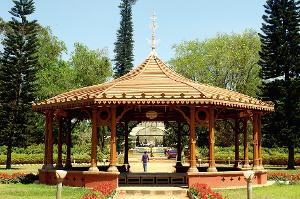
The Cubbon Park bandstand with its traditional octagonal shape sits on the same axis as the Vidhana Soudha, Attara Kacheri and Government Museum. It is said to have been gifted to the park in 1914 by Nalwadi Krishnaraja Wodeyar IV, the Maharaja of Mysore and initially placed near the Seshadri Iyer Memorial Hall. It was shifted to its current location in 1937, over what was once called the Ringwood Circle.
Iron was strong, durable but light. Molten iron could also be poured into pre-fabricated moulds. This enabled accurate replication and extensive repetition. `Cast’ iron therefore became popular for ornamental and commercial purposes. The framework for Cubbon Park’s cast iron bandstand took shape in the Glasgow based Saracen Foundry, owned by architectural iron casters Walter Macfarlane and Company Ltd. The company was set up in a disused brass foundry on Saracen Street in 1851 and soon became a famous designer-manufacturer of ornamental fountains, park and garden seats, conservatories, flower vases, baths, pipes and fittings right up till WWII.
Bandstands fell out of favour following WWII but iconic Macfarlane and Co. Ltd cast iron designs were still spotted around the world. They included the main (northern side) entrance gates to Lalbagh and the conservatory style Glass House.
The Lalbagh bandstand is believed to have been conceptualised during the tenure of Superintendent Mr. William New (1854-1864). He organised the first few `Lalbagh Shows’ around it in the late 1860’s before the Glass House came up in 1890. Mr. John Cameron who succeeded New in 1874 recorded its repair and renovation; a granite platform was also added and the wooden roof was improved.
Old timers recall orchestras and military bands playing regularly at bandstands in the city, including Cole’s Park, while city chronicler Mrs Maya Jayapal mentions that live music was scheduled for the fourth Thursday of every month in the 1920’s. The bandstands now accommodate deep breathing pranayama practitioners in the morning, sleeping somari’s in the afternoon and performances by local school children and classical musicians on weekends. It’s always fascinating to see how our local history runs alongside, intersects with or unites stories of people and places around the world.
The writer is a cultural documentarian and blogs at aturquoisecloud.wordpress.com
source: http://www.bangaloremirror.com / Bangalore Mirror / Home> Columns> Others / by Aliyeh Rizvi, Bangalore Mirror Bureau / June 26th, 2016
About 20 volunteers turned up at the hackathon on Sunday
Bengaluru :
An app that would help the visually impaired catch buses on their own was the highlight of a hackathon held in the city this weekend.
This was one of three hacks that 20 members of Random Hacks of Kindness (RoHK), a Bengaluru-based community, started working on Saturday. The team designing it hopes to help the visually impaired find bus stops, and identify buses that take them to their destination.
“Google Maps is only accurate up to 100 metres,” says 22-year-old engineer Yashaswi Bharadwaj, who is part of the team. “We are working on a code to help them find the exact location using a Bluetooth beacon. It should also have a text-to-voice and voice-to-text interface.”
The hack that he and his teammates come up with can be integrated with an existing source code. “We will also need data about the number of buses to a particular destination, the route numbers, and their expected time of arrival,” he said.
The second phase of the project would involve working on an image recognition system to inform users of the arrival of buses at their destination.
The theme of this edition of the hackathon — perhaps the 14th in the city and 20th in the country, according to RoHK managing trustee Chinmayi S K — was disability.
While the community gets together twice a year for two-day hackathons to work on tech-based solutions to various civic problems — including disaster management and gender-related issues — accessibility and disability have been recurring themes.
“Muthuraj, who works with the NGO Enable India, is here for most of our events,” says Chinmayi. “And we often partner with the organisation that works towards empowering the disabled.”
Yashaswi’s team is counting on the NGO’s cooperation to take the bus stop project forward. “We can’t integrate our hack with the BMTC app because we don’t have their source code,” he says. “But if Enable pitches it as one of their projects, the data will be made available.”
source: http://www.newindianexpress.com / The New Indian Express / Home> Cities> Bengaluru / by Express News Service / June 20th, 2016
The funeral service will be held at St John’s church on St. John’s Church Road at 2.30 pm on Saturday
Aruna Sunderlal (77), the Founder and Managing Trustee of Bangalore School of Music, passed away on Thursday evening after a brief illness. She is survived by her daughter Shefali S. Chandel, son Vikram Sunderlal, and brothers Deepak and Vijay.
The funeral service will be held at St John’s Church, St. John’s Church Road at 2.30 pm on Saturday June 25, said officials at the school.
“It’s shocking. Mrs. Sunderlal was more than the founder of the school. To all those who knew her, she was our mentor,” said Jagadeesh, Director (Operations), Bangalore School of Music.
Aruna Sunderlal was born in Delhi in 1939. She had studied singing privately in England and Germany. She founded the school in 1987. It was the country’s third and youngest formal school for Western music.
Beginning with three students, the school functioned from her home for 22 years. In 2008, she built a 12,000 sq feet building in R.T. Nagar equipped with classrooms, recording studios and an auditorium with support from trustees, board members and music lovers. Over 9,500 students have been imparted formal music education in the school. BSM’s Music Outreach programme has enhanced the lives of over 5,500 underprivileged, physically challenged children through formal music education.
At present, the school boasts of 418 students.
“Music for Peace was her last unfulfilled wish that Mrs. Sunderlal shared with me last week. She was making arrangements to take a bus-load of musicians to Lahore (in Pakistan),” said Chiranjeev Singh, former bureaucrat and writer, who is a trustee of BSM. “Although her friendship mission remains unfulfilled, what the people of Bengaluru need to cherish is her single-handed effort to raise funds to build BSM that will turn 30 in February next year.”
source: http://www.thehindu.com / The Hindu / Home> News> Cities> Bengaluru / by Special Correspondent / Bengaluru – June 25th, 2016
Tradition:Farmers taking their cattle in a procession to mark Kara Hunnime in Amlapur village on Monday.— Photo: Gopichand T.
Kara Hunnime, a festival where farmers worship their cattle and begin sowing operations, was celebrated across the district on Monday. Farmers washed their cattle, oiled their horns and toes, and decorated them using balloons, ribbons, flowers and pieces of copra. Farmers took their cattle in a procession before reaching their farms.
In Amlapur village, farmers organised a running race for bulls.
In Ashtur, M.A. Patil, a farmer and his family performed a pooja to their cattle. Mr. Patil said he was thankful to the rain gods for the initial rain in the district.
source: http://www.thehindu.com / The Hindu / Home> National> Karnataka / by Special Correspondent / Bidar – June 21st, 2016
With China increasingly looking towards India to meet growing demand for areca nut back home, the Central Arecanut and Cocoa Marketing and Processing Cooperative (Campco) Ltd will export two metric tonnes of tender areca nut in the first week of August.
The husk of tender nut is used widely in China to make mouth freshener and other edible items after due processing there.
As per a memorandum of understanding between Campco management and Kou Wei Wang (King of Taste), the Chinese company will depute its experts to the Puttur unit of the multi-state cooperative in the second week of July. The experts will impart training on processing and standardization of products of their requirement, said Konkodi Padmanabha, former president of Campco, who was part of a three-member delegation that visited China last week.
Padmanabha said as per a Campco study, areca nut is grown to the tune of 1.22 lakh tonnes in Hunan province of China annually. “There are around 20 manufacturers of areca nut mouth fresheners across China. Nine out of 26 states in China use mouth fresheners made out of tender areca nut, and the agreement (with Kou Wei Wang) could well open the doors for more imports of the raw material there,” he said.
Noting that the Hunan-based company has capacity to supply only to nine states and is unable to give to the rest due to the lack of raw material, he said the company is producing high-standard value added products compared to other companies that produce areca nut products of different standard. “We will collect data on (other) companies and also meet their demand for all varieties of areca nut grown in India at a future date as and when they raise a demand,” he added.
Suresh Bhandary, managing director, said Kou Wei Wang has indicated its preference for the first quality areca nut for their needs and have indicated a price of Rs 350-400/kg. This will be a good rate for the growers and also provide them financial back up in the eventuality of courts in India banning supari and gutka completely, he said. Further exports depends on how the first consignment due for exports in August is received there.
S R Satish Chandra, president, the Campco Ltd, said, “Demand for areca nut far outweighs domestic production in China. In future, Chinese companies may set up their mouth freshener producing units in India itself.”
Suresh Bhandary, MD, the Campco Ltd, said, “Tender areca nut is boiled for one hour and then dried. Chinese companies have the machines needed for the process. If Kou Wei Wang wants some modification to the machine we have, Campco will do so.”
source: http://www.timesofindia.indiatimes.com / The Times of India / News Home> City> Mangalore / Jaideep Shenoy / TNN / June 22nd, 2016
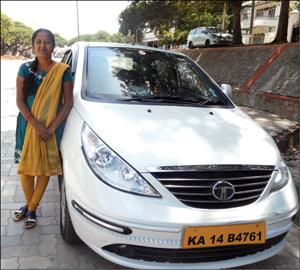
This is the tale of 35-year-old Neetha, a resident of Hebbal in city, who did her Master’s in Sociology from the Open University in 2006, passed Bank services exams and got a job in a Nationalised bank but became a cab driver in the running. She is now working as a cab driver at OlaCabs, a transport company, for the past one year.
Neetha, who says that circumstances forced her to reject the bank job as it was opposed by her family members, is the daughter of retd. KPTCL employee Madaiah and a native of Malavalli in Mandya district, married to one Raju, an employee at KPTCL and a native of Kundapura.
Neetha, who undertakes about 20 trips a day from 6 am to 7 pm in the TATA Vista (KA-14 B-4761) to take tourists to various tourist spots in and around Mysuru like Chamundi Hill, KRS, Nanjangud, Hunsur, K.R. Nagar, Srirangapatna and T. Narasipur, also enjoys her job as the lone woman cab driver in the city.
Speaking to Star of Mysore, Neetha said that she took to cab driving as she felt that it was better to take up a job which helps her earn some money instead of idling at home, which, she claimed, ensured that she was self-sufficient which should serve as a model for other women who waste their time by just sitting at home.
source: http://www.starofmysore.com / Star of Mysore / Home> General News / June 23rd, 2016
Padhma Priya, research scholar. Photo: K.V. Srinivasan / The Hindu
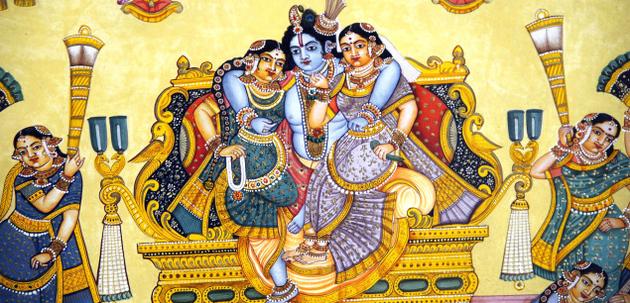
Padhma Priya, who is researching the art of the region, talks to Lalithaa Krishnan about its distinct features.
Describing herself as an amateur artist who grew increasingly interested in the theory and practice of visual art, Padhma Priya allowed her passion for Mysore painting to lead her towards post-graduate studies in Art History from the Chitrakala Parishad, Bengaluru. Her thesis dealt with the ‘Quality of Art Work’. At present, engaged in an extensive research on Mysore paintings, she shares her insights.
What factors contributed to the creation of this distinct pictorial style?
Rooted in the Vijayanagara art tradition, the pictorial vocabulary of the Mysore style was nourished by the versatile talent of migrant artists who worked in different mediums, their intensive, long-drawn training under their gurus and thorough knowledge of Hindu mythology and religious texts helped them compose amazing themes. So, it appears that a deliberate effort has been made by Mysore artists to stand out and create an individualistic style gradually over a period of time.
Mysore painting at the C P Art Center. / Photo: K.V. Srinivasan / The Hindu
What are the chief features that distinguish Mysore painting from Thanjavur art?
The differences are evident in terms of methods and materials used. Thanjavur painting is traditionally executed on a jack wood plank with a ground preparation of tamarind seed powder and chalk, while Mysore painting is done on paper. Both schools use jewellery crafted on a flat surface but their techniques differ. Thematically, they share Hindu mythological characters and tales, but my research shows that the Mysore school has a fantastic visual narrative that no other artists of traditional schools have brought forth.
You collaborate with artists, epigraphers and historians. About their valuable inputs…
The foundation for my research is collecting a large, unpublished, unrecorded database across five districts and five taluks of Karnataka. My field work is a rich digital resource database of themes and narratives, artists of Mysore and other arts and crafts of Karnataka. I am grateful to the Karnataka State Archaeology Department, the district administration, Mr. Murari, whose door-to-door survey helped me to locate rare paintings, Mr. Kharbade DG ,NRLC, Lucknow, my art history teachers Dr. R.H. Kulkarni and H.A. Anilkumar of Chitrakala Parishath, Bengaluru, scholars Dr. Jaisree Narasimhan and Dr. Banumathi for deciphering the content of labels and slokas in the paintings, artists K.S. Srihari, Sridhar and R. Sivakumar, who helped document the traditional methods and materials in Mysore paintings.
Which institutions impart formal training in the art? Can artists move beyond creating reproductions and how affordable are Mysore paintings?
The Chitrakala Parishath, Bengaluru, imparts technical training periodically via short-term courses but the need of the hour is to provide long-term training in both theory and technique. Once the artist has a solid grounding in Hindu mythology, iconography and iconology, he can break away from the cliché of mechanical reproduction and create original art works with rare themes. Depending on size, theme and workmanship, prices begin at Rs. 8000 for a 12’’x 15’’ work, to Rs. 200,000 for larger ones.
A note on the conservation of paintings.
I am a quality consultant in fine arts. Through scientific methods, I help buyers check the quality of the art works. Preventive conservation of paintings is my core research. My two-volume publication on the Mysore school is planned for 2017.
Your personal favourites that rank as must-views?
All the paintings in the Mysore palace, Jaganmohan palace and the CKP museum are fantastic collections.
Unusual collection
A connoisseur with a keen eye and memory for detail, art dealer Vitthal Rao brings 40 years of expertise in the field to bear upon the superb collection of Mysore paintings that graces the main gallery, C.P. Arts Centre. Priced between Rs.10,000 and Rs. 40,000, the collation spans myriad deities that include Siva, Vishnu, Kodanda Rama, Krishna, Saraswathi, Lakshmi, Ganesha and Anjaneya and diverse themes such as Pattabhisheka and Rathi-Manmatha. In an unusual portrayal of goddess Tripurasundari, Lord Narayana is shown assuming the form of a bangle seller who fits the ornaments on her hands, as any mere mortal would be burnt by her touch. Varying depictions of a single deity, Chamundeshwari, reflect the vision of different artists. While Yedur Siddhalingeswara, Kalikamba Viswakarma, Tripura Samhara and Dhruva Narayana are rare pieces, the colossal, exquisitely detailed Koteswara Siva and Viswaroopa evoke awe and wonder.
Antique works from royal houses as well as paintings by contemporary artists B.B. Ramakrishna, K.S. Srihari and Dinesh are on display till 18 June. (Timings: 10 am – 8 pm).
source: http://www.thehindu.com / The Hindu / Home> Features> Friday Review> Art / by Lalithaaa Krishnan / June 16th, 2016
We dine with the founder of Earth Loaf and decode what goes into this Indian-grown artisanal chocolate
After a whiskey chocolate dinner and an interview with David Bello, Earth Loaf’s founder, I’m trying to gather my thoughts, but the bar of chocolate is distracting. Wrapped in candy pink bearing a peacock motif, it’s anything but candy. Deep dark chocolate of Kerala origin, made with palmyra sugar and locally-sourced ingredients, 72 per cent is wood fermented in cedar boxes. The chocolate is dark and slightly bitter, has a fruity finish and a woody earthiness that comes from the cedar wood boxes — a first in many ways.
For the socially conscious consumer, Earth Loaf ticks all the right boxes. The cocoa is single origin, sourced from either Karnataka or Kerala — there’ll be one from Tamil Nadu soon — the sweetener used is local palmyra, the farmers are closely involved in the production and it’s all hand-made. From ‘bean to bar’, as David is fond of saying, it’s a local Indian product — but it took a Londoner with Greek roots to make it.
Earth Loaf, originally, was the name of a bakery in London that David started, and after moving to Mysore with his partner Angelika in 2012, he used the name for the small chocolate-making endeavour that took off. What started as 3-4 kg of chocolate made by hand for friends and family became a registered company that works with cocoa farmers in Karnataka, to create a sustainable, Indian chocolate brand. A one-man show today, Earth Loaf is David’s baby, as he calls it, and he does everything from sourcing cocoa beans to web-designing for the site and even creating the lovely packaging that features a peacock motif from the Chittara art of the Malnad region. Today, David calls Mysore home, and having grown up in South Africa, took to Indian climes like a fish to water. “I love the heat! I thrive in it,” he grins.
Artisan, vegan, raw — there are many labels that Earth Loaf identifies with, but that’s not what its selling point is. For David, it’s simply his vision, translated through fine chocolate. Which is why the bars are specific in their flavours; they aren’t trying to cater to a variety of palettes. “There have been people who tried our chocolate, disliked it or found it too bitter. But they came back, to try another flavour. A second, third, even a fourth time. They are willing to experiment and they keep coming back,” he says. Well aware of the Indian sweet tooth, David is just putting out into the market something he enjoys himself — dark chocolate with some unusual pairings. And there’s also the story behind each bar. David knows the farmers personally, he’s even learnt Kannada to converse with them, and he prices his products a bit on the higher side, because he believes that the farmer should get his fair share. The bars are all processed by hand, from the grinding of the beans to the final packing.
His 72-per cent bars of single-origin raw chocolate are paired with unusual ingredients like gondhoraj– a lemon that’s somewhere between the Italian lemons used to make limoncello and an African kaffir lime found only in parts of Bengal and Assam — smoked salt, dried apricots, nuts and more. David’s background as a mixologist is reflected in how he pairs his flavours, often reworking an idea for months at a time, until he gets it right. “Even when I was bartending back in London, I’d work on a single cocktail, like a Martinez, for about six months till I got it right,” he says. And it’s the same with his fruit pairings. Recently, he’s been trying to infuse a jamun-like fruit native to Karnataka into his chocolate, without much success. “The chocolate keeps overpowering it, so I’m trying different things. I’ve been trying to squeeze the essence out of the rind of the fruit, like how you would a bergamot, but it didn’t work, so now I’m trying to dry the rind, powder it and see if that will work better.”
For a country that’s quite a prolific producer of cocoa, India seems to be relatively new when it comes to the bean-to-bar variety of chocolate. “Cocoa was originally brought to India from Indonesia in 1798, by the East India Company,” he explains, “and India has had varieties of cocoa growing, but it wasn’t until the 1950s that Cadbury decided to push cocoa farming in India and that’s when it took off.”
Much like the coffee culture that came from the West to show us the amazing varieties we have in India, there’s a wave of chocolate appreciation that’s slowly gaining ground. A far cry from the sugared candy bars you see at grocery stores, today’s artisanal chocolate is locally sourced, handmade, has tasting notes that range from woody and fruity to acidic, is affected by the terroir, and lends itself to all kinds of pairings from food to wine and whisky. And this chocolate evangelist from Mysore, is more than happy to introduce the country to its own hidden chocolate treasures.
(A menu pairing Earth Loaf chocolates and Jameson whiskey is available at On The Rocks, Crowne Plaza Chennai Adyar Park till June 26. It is priced at Rs. 2,999 per person.)
source: http://www.thehindu.com / The Hindu / Home> Features> Metroplus> Society / by Elizabeth Mathew / Chennai – June 21st, 2016