Alumni raise Rs 17 lakh for IIMB

Bengaluru :

It’s payback time for 40 MBA students of the 1995 batch of the Indian Institute of Management , Bangalore (IIMB). Twenty-one years after graduation, they all have come together to raise Rs 17 lakh to sponsor a discussion room that was inaugurated at the campus last month.

“We were a batch of 220 students. Years may have passed, but memories of our college days remain quite strong. The plan to give something back to our institute was there for a long time and 40 of us made it a reality this year,” said Raghavendra R, senior director at Hewlett Packard Enterprise.

He said the institute played a major role in bringing the alumni together. “Every growing organization needs funds. Ours being an interactive and engaging batch, recognized this aspect and contributed how much ever we could. We just wanted to do something that the institute as well we could cherish,” he added.

Around 450 former students participated in Anusmaran, the annual alumni meet of the B-school, on Saturday.

“Over the years, Anusmaran has become a part of our lives. We catch up with fellow alumni and share, learn, have fun and enrich our experience. We have tested many formats and reinvented it to make it more relevant and vibrant,” said Navin Kumar, convener of the event, organized by the Bangalore chapter of the IIMB Alumni Association.

Prof Vasanthi Srinivasan, chairperson, Alumni Relations, IIMB, believes that there are two aspects that determine healthy relations between the alumni and their alma mater. “The experience that students share when they study in the institute and the connection they maintain with the institute after they graduate are vital to having a good alumni base. We try to bring our alumni back to the institute in every possible way. Sometimes, we get them for interviewing prospective candidates or for mentoring programmes,” she added.

source: http://www.timesofindia.indiatimes.com / The Times of India / News Home> City>Bangalore / TNN / June 05th, 2016

Bantwal dairy societies milking success

Crossing a revenue of Rs three crore per annum, dairy farmers in Idkidu village of Bantwal taluk have set a benchmark in the history of white revolution in the district.

There are three milk producers’ societies — ‘Amruthadhara’, ‘Amruthasindhu’ and ‘Amruthavarshini’ — situated in Idkidu, Soorya and Mittoor respectively.

Soorya Milk Producers’ Cooperative Society president Dr Krishna Bhat Konkodi said that on an average, the total collection of milk from all the three societies per day is 2,500 litre. Out of the total production, 2,200 litre of milk is contributed to the Dakshina Kannada Milk Union and the rest 250-300 litre is meant for local sale.

With the dairy farmers in the village earning Rs 34 on each litre of milk (including government subsidy of Rs four), the total revenue of diary farmers in the village is Rs 3.10 crore, he said. Today, Amruthadhara collects 985 litre, Amruthasindhu collects 686 litre and Amruthavarshini collects 530 litre of milk on a daily basis. At present, Amruthadhara has 96 active members, while Amruthasindhu and Amruthavarshini have 96 and 67 active members respectively.

The Idkidu Milk Producers’ Cooperative Society began operations in 1995-96 and was the first milk producers’ cooperative society in the region. Branches of the society were opened in Soorya and Mittoor eventually as the milk production increased.

During the inception of Idkidu Milk Producers’ Cooperative Society, there were 28 active members and the annual production of milk was 4,449 litre with an annual net profit of Rs 5,808.

During the fiscal year 2015- 2016 which ended in March, the annual production of milk reached 2,18,402 litre, which comes up to 650 litre per day on an average and the annual profit was Rs 1,82,000.

Krishna Bhat, who was an Associate Professor at Karnataka Veterinary, Animal and Fisheries Sciences University in Bidar, quit his job and took over the society in the capacity of president. As a veterinary doctor, he carries out private practice in the region.

Youth take initiative
Krishna Bhat opined that carrying out diary farming along with agriculture has proved to be profitable. Seven years prior, a diary farmer earned RS 12 on each litre of milk, while today, the price has increased three-fold. Hence, many youth have been adopting diary farming in rural areas like Idkidu these days and migration to towns in search of jobs has reduced to a great extent.

The farmers in the region have been successfully carrying out dairy farming which goes hand in hand with mixed farming. Areca, pepper and plantain are generally grown in the region. Dairy farming has a lion’s share in integrated farming. The farmers have installed gobar gas units in their farms so that gas can be used for cooking and the slurry as manure. The organic manure not only increases the fertility of soil, but also retains the moisture content of the soil for a long time, which helps in times of water scarcity. This is the main advantage of organic manure over chemical fertilisers, Bhat said. The KMF provides Rs 4,500 to 5,500 as subsidy for setting up the gobar gas units to diary farmers, he said. Now there are more than 160 gobar gas units in Idkidu village.

Cattle feed
The Soorya cooperative society has set up an areca plate unit on the society premises. At the unit, plates are prepared out of areca sheaths and cattle feed is prepared from the leftover material of the sheaths. The sheaths that go wasted are chopped into pieces using a shredding machine. The unit started four months ago and is being maintained by the local self-help group. The areca sheaths are purchased from areca growers at Rs one per piece. Two plates can be prepared from a single dry sheath using the moulding machine. The labour cost incurred is Rs one per sheath. There is an expenditure of Rs 2,450 on LPG which is used to run the machines. The rent of the building is Rs 1,000 per month. The packaging costs come up to Rs 610. The machines have been purchased with the Rs 50,000 subsidy given by Nabard.

The areca plates are exported through a tie-up with Eco Vision in Vittal. As many as 9,123 plates and 500 kg of fodder have been prepared since February 1. A plate is sold at Rs 2.5 and the fodder is sold to diary farmers at Rs six per kg. A net profit of Rs 6,461 is earned by the sale of areca plates and 200 kg of fodder. There have been 42 days of man work in the past four months. The fodder prepared from areca is a substitute to dry grass which is generally brought from the Malnad region. Also, it is better compared to dry grass as does not contain any oxalate content or insecticide residue and hence, is safe for cattle, Bhat added.

source: http://www.deccanherald.com / Deccan Herald / Home> District / DHNS / Mangaluru – June 03rd, 2016

The songster’s journey to Tiruvaiyaru

NagarathammaBF03jun2016

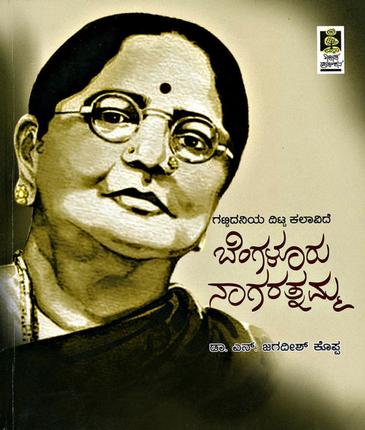
Jagdish Koppa’s book on Bangalore Nagarathnamma is a detailed account of the musician and also the life of devadasis in South India

This is a single question quiz. Name this person from Mysore who was an extraordinary musician, a writer of eminence, an activist, and a philanthropist. No guesses? Another clue. If you are a connoisseur of music, and if you have visited Tiruvaiyaru, you may perhaps know. But if you still have difficulty in answering this question, it is not your fault.

Who determines what is high and what is low in the flow of history? Why do these conscious erasures take place? Gender, caste, class or all of these? If you still haven’t got your answer, then here it is: the exceptional artiste Bangalore Nagarathnamma. She spent her last years in Tiruvaiyaru and donated all her earnings for the maintenance of the dilapidated samadhi of saint Tyagaraja. Yet, her idol in front of the samadhi is locked up and her memory is forced to oblivion. Dr. N. Jagadish Koppa, author of “Gatti Daniya Ditta Kalavide: Bangalore Nagarathnamma” dedicates the first few pages of his well-researched book to the curious obscurity that shrouds Nagarathnamma.

Nagarathnamma is from Karnataka. Born in Nanjanagud to a Devadasi Puttalakshamma, Nagarathnamma was trained in dance and music. During the late 20th century she moved to Madras and through her talent and dedication became a well-known name among connoisseurs. Her grace, etiquette, sharp intellect and strong commitment to the cause of music and women of the Devadasi community, made her a much sought after person in the upper echelons of society. Nagarathnamma has the distinction of being the first woman artiste to have toured 146 towns and cities in South India and created a record with 1235 concerts. Just in Madras alone, Nagarathnamma is supposed to have given 849 concerts. What is even more interesting is the fact that Nagarathnamma earned fame for being the only woman artiste in South India to have paid income tax to the British. She was very close to the top leaders of those times, including C.V. Rajagopalachari. Yet, there is hardly any mention of Nagarathnamma in any books on music, except for passing references. As the author notes, U. Krishna Rao makes a special mention of the “famous dancer Nagarathnamma”. The other references to her are by the Kannada writer D.V. Gundappa and Mysore Vasudevacharya who said “her music has the mellifluousness of a woman and the dignity of a man.” However, V. Sriram’s Devadasi and the Saint, is the only full-fledged work on the adventurous and courageous woman.

Drawing from extensive travel, interviews, various sources and research papers, Dr. Koppa writes a fairly detailed chapter on the Devadasi tradition in south Karnataka. His surmise is that Puttalakshamma may have come from Kolar and her mother tongue was Telugu. Quoting an essay by U. Krishna Rao on dance in the old Mysore kingdom, “most dancers and nattuvanars came from T. Narasipura, Kolar, Mulubagilu, and Chintamani. Over 200 dancers lived in this region and they had scholars who trained them in Sanskrit, theory of performance….” The kings of Mysore, Mummadi Krishnaraj Wadiyar and Chamaraj Wadiyar, offered patronage to these talented women and attached them to various temples across Karnataka. It is said that in a Mulabagilu Temple there were 14 dancers at one point! This flourishing art scene in Karnataka got a blow when Krishnaraja Wadiyar decided to put an end to the devadasi tradition. The anti-nautch movement and anti-dedication movement of 1882 in the North was also the reason for this decision. However, the Mysore kings didn’t abandon the devadasis, they gave them continued patronage, and several of them were inducted into the drama company set up the Kings.

The book traces the life of Bangalore Nagarathnamma in detail, and doesn’t make it an uni-dimensional chronological account. The author, very meticulously, brings alive the social ethos of the times of Puttalakshamma and Nagarathnamma, replete with people and happenings. Puttalakshamma, like several devadasis of her generation, struggles to make her daughter a competent scholar not just of music and dance, but also Sanskrit and Telugu. She takes her to the best of teachers, sells away her gold ornaments, and makes sure that there are no obstacles for Nagarathnamma’s learning. Puttalakshamma moves to Bangalore with her daughter and trains her under the dance teacher Kittanna. She also has special teachers for Telugu, Tamil and English. She learnt music under Bidaram Krishnappa, who taught her Kannada compositions. Nagarathnamma, with her extraordinary talent, earned the goodwill and affection of several masters, including Veene Subbanna.

There are some very interesting aspects in the book. Among them are the vivid description of life in George Town at the turn of the 21st century throbbing with great musicians and equally large-hearted patrons. The most important part of the book is however, Nagarathnamma’s translation of Muddupalani’s Radhika Santhwanam and the furore it created in the literary circles. The earliest reference to Nagarathnamma and Muddupalani are in “Women’s Writing In India”, edited by Susie Tharu and Lalitha. But Dr. Koppa gives a detailed account of the long drawn battle. The other is the major ruckus between the two warring factions at Tiruvaiyaru and how Nagarathnamma had great difficulty in resolving the problem. The narration comes alive when 50 Devadasis arrive in Tiruvaiyaru for a concert at the Tyagaraja samadhi! In both these instances – Radhika Santhwanam and Tiruvaiyyaru — Nagarathnamma’s courage and determination is exemplary. She takes on the male world, and doesn’t let go of justice even in the most difficult times.

While most part of Nagarathnamma’s life was tough and trying, there are some warm moments. Justice Narahari Rao, Nagarathnamma’s patron, was a middle-aged man. He was deeply interested in the arts and had admiration for Nagarathnamma’s talent. After seeking consent from his wife, Narahari Rao, every evening after finishing his work at the High Court, would park his horse carriage in front of Nagarathnamma’s house in the narrow lanes of Nagarathpet in Bangalore, listen to her music and then return home. This became huge news and reached Diwan Seshadri Iyer, who in turn advised him to keep personal matters separate. On his advice, he bought a house for Nagarathnamma in the peaceful Hanumanthnagar and stopped using the official carriage to visit her. He not only admired her music, but encouraged her immensely. She came in contact with writers and big musicians due to Narahari Rao’s high offices. Nagarathnamma toured for concerts regularly. In fact, it was he who advised Nagarathnamma to shift base to Madras, since it was the centre of music. He was a very unusual patron.

The book is a complete account of the life of Nagarathnamma. It also captures the travails, ups and downs of nearly 150 years of the life of devadasis in Karnataka. Their phenomenal love for their art, and their quiet courage to take on the male world is unimaginable. Dr. Jagdish N. Koppa’s book is a value addition to the literary landscape. Its language is simple, its purpose straightforward. He tells the story with empathy and laments the society that we are.

source: http://www.thehindu.com / The Hindu / Home> Features> Friday Review / Deepa Ganesh / Bengaluru – June 02nd, 2016

Bengaluru among top 5 global locations for innovation centres

India has been named among the top five global locations for innovation centres, with Bengaluru emerging as the most favourite destination within the country having four such facilities.

BengaluruBF02jun2016
According to a Capgemini report titled Digital Dynasties: The Rise of Innovation Empires Worldwide, India is becoming a new innovation destination of choice, doubling the number of innovation centres since July 2015 and seeing brands such as Apple, Airbus and Visa locate there.

Silicon Valley, London and Paris, were named as the top three locations for innovation centres, followed by Singapore and Bengaluru in the fourth and fifth place, respectively.

“India has been rising in the ranks of favorite destinations to open innovation centres. Our previous research identified eight innovation centres in India in July 2015. India has since seen eight more innovation centers open their doors,” the report said.

Bengaluru has been the most favoured city with four new innovation centres. Bengaluru is home to several billion- dollar Indian startups such as: Flipkart, InMobi and Mu Sigma, and attracts world-class technology talent and investments.

Among the new innovation centres opened in Bengaluru are: Airbus’ BizLab, which intends to bring together startups and Airbus’ internal entrepreneurs; and Visa, whose new technology center will house 1,000 developers accelerating development of next generation payment solutions.

“Global firms are showing interest in other Indian cities as well,” the report said adding that TriMas Corporation – a diversified global manufacturer of engineered and applied products – opened an innovation centre in Delhi to focus on driving innovation across its range of packaging solutions, while Puratos, a leading global food ingredient company, launched an innovation centre in Mumbai.

The report noted that though Silicon Valley still remains the hub of the world’s most dominant innovation “empire”, the innovation centre phenomenon has continued to spread globally, a number of new ’empires’ have emerged.

“Over the last year, we witnessed the rapid rise of Asia as a destination for innovation centres. Compared to our previous research, Asia has seen a 29 per cent rise in the number of innovation centres being launched,” the report said.

source: http://www.deccanherald.com / Deccan Herald / Home> You may also like / PTI / New Delhi – June 02nd, 2016

Six from Mysuru qualify as BCCI Level-1 Umpires

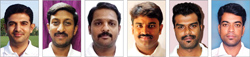
D. Vijeth, R. Madhusudhan, V. Raghunandan, A.M. Anirudha, B.R. Srinidhi Urs & S. Vinu

Mysuru :

Six of the cricket umpires from Mysuru have made the KSCA Mysuru Zone proud by qualifying as BCCI Level-1 Umpires. The Board of Control of Cricket India (BCCI) had recently conducted the examination for the same at M. Chinnaswamy Stadium in Bengaluru.

Among those who qualified as BCCI Level-1 Umpires include D. Vijeth (RBNCC), R. Madhusudhan (Saraswathipuram CC), V. Raghunandan (Young Cricketers), B.R. Srinidhi Urs (Yuvaraja’s College), S. Vinu (FUCC), A.M. Aniruddha (RBNCC), according to a press release from KSCA Mysuru Zone Convenor S. Balachandar.

source: http://www.starofmysore.com / Star of Mysore  / Home> Sports News / June 01st, 2016

Astronomical Observatory at Excel Public School

Reaching the heavens with ease

The Astronomical Observatory at Excel Public School in Hootagalli has been active since two years in observing the heavens effortlessly. It is an encomiastic endeavour by the institution in establishing an observatory to impart excellent astronomy education.

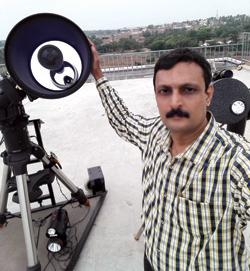
Amateur astronomer Kiran Prasad

Most of the people take at least a passing interest in astronomy; after all, the skies are all around us, and not even the most myopic observer can fail to appreciate the Sun, the Moon and the Stars! But astronomy as a serious hobby is quite another matter. Sky is always the limit. ‘Sky Watching’ is one of the most fascinating, enjoying and thrilling experience. If we witness the sky on a dark, clear night we can see billions of stars.

The sky is the laboratory, observation is the experiment, and eyes are the equipment. A significant amount of basic astronomical science can be accomplished without any observing device other than the human eye. The Astronomical Observatory at Excel Public School (EPS), Mysuru, provides us an opportunity to understand the grandeur of astronomy or essence of sky-watching.

EPS, a part of Excelsoft Technologies Private Limited, a multinational educational E-software solution development organisation, was started in 2009 in the campus of this software company. The School is the brain child of Dhananjaya, Chairman, Excelsoft Technologies and Sudhanva, Chief Executive Officer, Excelsoft Technologies, Hootagalli, Mysuru.

The school has focused on being a state-of-the-art facility with varied field in imparting education to the children from the onset. An Astronomy division was started for the benefit of the children of EPS under the K12 division, which is an extended education based programme that goes beyond the regular text book curriculum.

The idea was to provide quality education to the students and to augment the diverse interests of the individual.

The Astronomy division began to function during the opportune moment of ‘International Year of Astronomy’ in 2009, a worldwide programme where in amateur and professional astronomers from around the world took to their telescopes to watch the celestial wonders of the sky to commemorate Galileo’s 400th year anniversary of observation of Jupiter and its satellites.

For this purpose, as a long term investment at a cost of about Rs. 10 lakh, EPS installed the state-of-the-art 14 inch CGE PRO XLT Starbright equatorial mount Celestron GOTO Schmidt Cassegrain telescope with focal length of 3910 mm/ F11 for the school observatory for regular sky-watching programmes for the children and for occasional public viewing.

Open for general public on a regular basis, it had a huge impact on the minds of the people. The initial Galilean night sky-watching programme proved a definitive platform and impetus for us to reach huge number of enthusiasts in the astronomy field and added value to our approach of providing the best in all fields of education. During that time, it was greatly assisted by Dr. S.N. Prasad, a retired professor of Physics, Regional Institute of Education.

The 14-inch observatory class computer operated telescope is a fully multicoated Schmidt – Cassegrain telescope with multi-coated Plossl eyepieces accessory, which is a very high resolution powered instrument just perfect to see very faint celestial objects up to 14 magnitudes. It has the light gathering power of 2560 times the naked eye limit. The 8-inch Altazimuth CPC 800 GPS integrated telescope being smaller and more portable with focal length of 2032 mm/F10 is quite powerful and has the light gathering power of 850 times the naked eye limit. Both the telescopes can be mounted on a super sturdy steel tripods and dampers and preloaded with 40000 objects in its memory, like NGC, Caldwell, IC, Messier and Abel catalogues. With plenty of interchangeable lenses to go with, the sky is not the limit and with magnification extending more than 400 times, objects such as galaxies, as far as millions of light years, is clearly visible.

The best way to enjoy the beauty of the star-studded night sky is to use our eyes only, without being encumbered with optical aids like binoculars and telescopes. In fact, the wide angle of vision that observation with unaided eye allows is not available if we look through a pair of binoculars or a telescope. Astronomical observations, like any other walk of life today, have been profoundly revolutionised by the “silicon chip.” The CELESTRON 14” is a computer controlled reflecting telescope, where the computer is controlled by an Intel 8052, 12 MHz microprocessor. The Compustar Computer displays the co-ordinates, type, magnitude, size and visual quality of each astronomical object being observed. It incorporates Celestron’s acclaimed Schmidt – Cassegrain optical system. The system has three elements; the Schmidt corrector, a concave primary mirror and a convex secondary mirror. The corrector plate lens looks like a flat window at the front of the telescope. The curved concave primary mirror is situated at the back, and fastened to the centre of the Schmidt corrector plate is the secondary convex mirror which faces the primary mirror. The rugged heavy duty castings used for mechanical components provide vibration free performance.

All this would amount to nothing if there would not have been a dedicated full-time staff to handle the department and conduct all the programmes related to Astronomy. Amateur astronomer Kiran Prasad is the person responsible for this extended education training and regular sessions of in-class lesson and sky-watch is being conducted at the school premises under him. Due to phenomenal growth of the school, the school has now been shifted from its old Excelsoft premises to its own sprawling new campus with its roof top observatory, which is a ideal setting since it is a little out of limits of urban light pollution.

The institution also provides an extensive programme for visual and photographic studies. Visual studies include lunar, planetary and deep sky observations, and intend to lay particular emphasis on near planets and their features like the cloud belts of Jupiter and the rings of Saturn. The photographic studies with their Digital Single Lens Reflex (DSLR) couples to the COMPUSTAR, have found from the past experience with the CELESTRON 8” telescope that the quality of photographs are both superior and aesthetic. On occasion of special astronomical events, many important and useful photographs have been captured by amateur astronomers and student enthusiasts. The telescope is serving not only the cause of school students, also for the student community of other institutions in the city and rural areas.

Over 2000 students and amateur astronomers have availed the facility of the observatory. As the eternal unconquered regions of space beacon man with a challenge, it is the cherished desire of Excel Public School that the students who pass through its portals, gaze in wonder at the breathtaking creations of nature and develop a quest for knowledge and exploration of the unknown.

For those whom the cosmos serves as a source of inspiration, CELESTRON 14” will be the first step of satisfaction to reveal the opulence of astronomy. For further details, contact Mob: 97415-16348 or visit Excel Public School, annex BEML Engine Division, Mysuru.

—Prof. S.A. Mohan Krishna, Amateur Astronomer

source: http://www.starofmysore.com / Star of Mysore / Home> Feature Articles / June 01st, 2016

Kannada Litterateur Dejagow no more

Suttur Seer Sri Shivarathri Deshikendra Swamiji, who paid his last respect to Dejagow yesterday, is seen consoling the litterateur’s son Prof. J. Shashidar Prasad (third from right). Writer Bannur K. Raju, Sanskrit University VC Prof. Padma Shekar, writer K. Bhyravamurthy, MLA Vasu, Kannada Activist M.B. Vishwanath and others are seen.

DejagowBF01jun2016

Mysuru :

Noted senior Kannada writer and former Vice-Chancellor of University of Mysore (UoM), Nadoja Prof. D. Javaregowda, popularly known as Dejagow, passed away at a hospital here on Monday. He was 98.

He leaves behind his son J. Shashidhar Prasad, former Vice-Chancellor of UoM and daughter Shashikala, who is settled abroad. His wife Savithramma had predeceased him a few years ago.

Dejagow was admitted to Sri Jayadeva Institute of Cardiovascular Sciences and Research here on Saturday night after he suffered ‘heart failure.’ Though he was in the Intensive Care Unit of the hospital, his condition worsened on Monday and he passed away around 7 pm, according to hospital sources.

Born to Devegowda and Chennamma couple at Chakkere in Channapatna Taluk of Ramanagar District on July 8, 1918, Dejagow, who completed his education at Channapatna and Bengaluru, was later influenced by poet-laureate Kuvempu.

After earning his MA Degree in Kannada, he served the UoM as Professor and has nearly 400 works to his credit, which included Kabbigara Kava, Ramanatha Charite, Leelavathi Prabandham, Hammu Bimmu, Nenapu Kahiyalla and Purathana among others. Dejagow rose to become Vice-Chancellor of the University in 1969 and served till 1975.

In recognition of his contribution to Kannada, the State Government honoured him with ‘Karnataka Ratna’ and ‘Papma’ awards. He was also honoured with ‘Nadoja’ title.

His key contributions included establishing ‘Prasaranga’ — the publication wing of UoM — said to be the first such experiment in South India and giving a fillip to the study of folklore by introducing the subject in both Under-Graduate and Post-Graduate courses, besides setting up a Folklore Museum in the Manasagangotri campus.

The writer revered poet laureate Kuvempu as his guru and followed him.

Dejagow played a big role in pressurising the Union Government to accord the Classical language status to Kannada and in securing Government’s nod to allow candidates to answer KPSC exams in Kannada language.

Dejagow, who played a vital role in getting the Classical language status for Kannada, had sat on a hunger strike for the cause. He had also threatened to return his awards if Kannada failed to get its due.

He was credited with introducing Kannada as a medium of instruction for UG science courses at Yuvaraja’s College, Mysuru.

The writer was awarded ‘Padmashri’ for his contribution to the literary world. Dejagow is considered, perhaps, the only writer in the country to write preface to nearly 10,000 books.

Dejagow was the only Vice-Chancellor who participated in street protests to further the cause of Kannada, while holding office. He had taken part in agitations demanding Karnataka’s fair share in the Cauvery water dispute and seeking safe release of Kannada matinee idol Dr. Rajkumar from forest brigand Veerappa’s clutches in the year 2000.

A votary of Kannada, he was the Chairman of Akhila Braratha Kannada Sahitya Sammelana held at Bengaluru in 1970. He was also a recipient of Gorur award in 2003.

District Minister V. Sreenivasa Prasad, MP Pratap Simha, UoM Vice-Chancellor Prof. K.S. Rangappa, Karntaka Sanskrit University VC Dr. Padma Shekar, writers Prof. K. Bhyravamurthy, C.P. Krishna Kumar and Malali Vasanthkumar, MLA Vasu, Suttur Seer Sri Shivarathri Deshikendra Swamiji were among the dignitaries who visited the writer’s house in Jayalakshmipuram.

Incidentally, Dejagow died on the same date as that of his wife Savithramma, who passed away 10 years ago on May 30, 2006.

Following Savithramma’s death, Dejagow had instituted an award in her name, which was given to women achievers from different fields every year.

An insightful documentary

‘Kannadada Kattalu Dejagow,’ a 30-minute documentary made by award-winning Director Kesari Harvoo for the Information Department, provides an insight into the life, works and contributions of Dejagow to the cause of Kannada. Besides capturing landmark locations in Mysuru where Dejagow severed in his long career as an educationist and writer, Harvoo had also documented the ambience of Chakkere in Channapatna taluk where he was born and brought-up and the Central College in Bengaluru where he studied.

Prominent works of Nadoja

Dejagow’s works include Sahitya Nayasenana Dharmamruta Sangraha, Lakshmishana Jaimini Bharata, Kanakadasara Nalacharitre, Andayyana Kabbigara Kavya, Chikkupadyayana Rukmangada Charitre, Nemichandrana Leelavati Prabhanda, Janapada Adhyayana, Janapada Soundarya, Janapada Vahini, Janapada Geetanjali.

He has translated novels including Jane Austen’s Pride and Prejudice (Hammu Mathu Bimmu), Krishna Hathi Singh’s ‘With No Regrets’ (Nenapu Kahiyalla), Leo Tolstoy’s ‘Anna Karenina’, ‘War and Peace’ (Yudda Mathu Shanti), Resurrection (Punaruthana) and his autobiography ‘Sahithigala Sangadalli Horatada Baduku.’ He also has to his credit many works on Kuvempu’s literature including Sri Ramayana Dharshanam Vachana Chandrike.

Awards and accolades

Prof. Dejagow has to his credits several awards and accolades including Hon. Doctorate from Karnatak University, Hon. Award from Karnataka Sahitya Academy, Rajyotsava Award given by GoK, Senior Fellowship by Dravidian Linguistics Association of Thiruvananthapuram, Pampa Award by GoK, Nadoja award by Kannada University, Nrupatunga award by Kannada Sahitya Parishat, Karnataka Ratna award – 2008, Chidananda Award, Jishampa award, Allama Sri Award and National Basava Award.

Prof. Nadoja, who presided over the 47th Kannada Sahitya Sammelana at Bengaluru in 1970, has been honoured with several felicitation volumes including Antahkarana, Rasashashti, Dejagow-Vyakti mattu Sahitya, Apurva mattu Namma Nadoja, Amrutavarsha and Kayaka Vibhuti.

source: http://www.starofmysore.com / Star of Mysore / Home> General News / May 31st, 2016
Prabhakaran from state, first IFS officer to scale Everest

PrabhakaranBF31may2016

Deputy Conservator of Forests, Koppal, S Prabhakaran has become the first Indian Forest Service (IFS) officer to scale Mount Everest. After scaling Mt Everest, this 29-year-old officer is planning his next expedition to 8,210 metre-high Mount Cho- Oyu in Tibet.

Prabhakaran was chocked with emotions as he recollected his 40-day experience with the media and forest department officials here on Monday.

In 2015, he had tried to scale Mt Everest from the southern (Nepal) side but could not. The team had to return from Camp One due to earthquake and avalanche.

It was then he decided to attempt from the northern (China) side. Southern side is frequented by many Indians and foreigners, but very few climb from the northern side, with limited rescue operations making it more challenging.

His asthma did not hit enthusiasm. “I was slower than my teammates while climbing. But that did not affect me. I later matched their tempo as all of us were using oxygen cylinders from 7,000 metres above mean sea level. I had consulted doctors who had told me that asthma is not curable, but physical activities help build stamina,” he said.

Prabhakaran was accompanied by Sohail Sharma and Radhika, IPS officers from Maharashtra and Telangana respectively, a tribal boy from Telangana and a single-amputee from Telangana.

“I will never forget the moment I reached the peak. It was a rush of emotions- tears, smile and pride. I knew that it was only half success, the second half was when I returned to the base camp on May 22. Sharma and I were together from Katmandu. We experienced the first mild earthquake there. Later in Lassa, we experienced another earthquake when we were in the hotel room. But still we decided to go for it and the mountains accepted us,” he said.

Prabhakaran underwent a Himalayan mountaineering course in Darjeeling in 2015. In 2016, he was a part of Shekhar Babu’s team, the first civilian to scale Mt Everest from the northern side.

Prabhakaran said his inspiration was Lance Naik Hanumathappa Koppad who was buried under the ice for a week after an avalanche in Siachen and died later in a  hospital. “Last year, I was stuck in ice for two minutes and had a near encounter with death. I salute Koppad,” the IFS officer said. Prabhakaran is a black belt in karate, a kabaddi, cricket, football and basketball player.

He now plans to train youngsters in Koppal region to scale such heights. Principal Chief Conservator of Forests A K Singh said the department will encourage more forest officials to scale peaks.
DH News Service

source: http://www.deccanherald.com / Deccan Herald / Home> State / DHNS, Bengaluru – May 31st, 2016

‘Vietnam King ’ title awarded to city’s Yoga Guru Dr. Raghavendra Pai

Yoga Guru Dr. Raghavendra R. Pai, Founder, Sri Vedavyasa Yoga Pratishthana, Mysuru, seen receiving the award at the 2nd Om Yoga & Wellness Hub Festival, held at Vietnam recently.

Mysuru :

In the culture barter expedition of global leaders around the world, Yoga from India has found itself a revered place across borders in an overwhelming acceptance.

Standing up for the physical, mental and spiritual balance practice, Yoga traces its origin back to the diversely fit cultural land of India.

Last year in his UN address, Prime Minister Narendra Modi suggested to have June 21 of every year dedicated to celebrate this practice as International Yoga Day.

“Let’s pledge to make Yoga an integral part of our daily lives,” he mentioned. June 21 (Summer Solstice), is also the longest day in the Northern Hemisphere.

As the entire world gears up for the 2nd International Yoga Day celebrations in June 2016, countries across the globe are leaving no stone unturned to make it a grand success. Vietnam, much ahead in its vision to promote Yoga, had organised an event to recognise the efforts of Yoga practitioners from India, who have worked hard to promote Yoga across the world.

Vietnam’s Om Yoga & Wellness Hub, a centre for Yoga, Ayurveda and Wellness, along with Sri Vedavyasa Yoga Pratishthana, Mysuru, had jointly organised the 2nd Om Yoga & Wellness Hub Festival, in line with International Yoga Day celebrations, on May 14 and 15, 2016 at Om Yoga & Well- ness Hub by Master Santhosh Cheriyamane, Binh Duong, Vietnam.

The event created two National Records — 81 yoga students and instructors performing 1008 Suryanamaskaras and a 24-hour Yoga marathon under the guidance of Yoga Guru Dr. Raghavendra R. Pai, Founder, Sri Vedavyasa Yoga Pratishthana, Mysuru and Master Santhoshkumar Cheriyamane Anand, Founder, Om Yoga and Wellness Hub, Vietnam.

For their excellence in Yoga, Dr. Raghavendra Pai and Master Santoshkumar Cheriyamane were awarded the prestigious ‘Vietnam King’ title by the Vietnam Book of Records on May 24. The certificates were officially handed over to them by the President of ‘Vietnam Book of Records’ Dr. Nguyen Van Vien and Chief Spokesperson Le Tran Truong An.

The other recipients of these title included Konanavar Somashekhara, Hebbasuru Siddappa Shivappa, Dombara Ganesh, Keri Suresh Kallappa, Annigeri Shivakumar, Yoga instructors from Karnataka and Perumal Selvakumar and Palanisamy Premkumar from Tamil Nadu.

Santosh Kumar Cheriyamane Anand, a Yoga practitioner, originally, hailing from Kushalnagar in Kodagu and Nguyen Thi Thanh Van from Vietnam, co-founders of Om Yoga & Wellness Hub, have popularised Yoga in Vietnam and also successfully established centres across three more cities in Vietnam. At these Centres, 12 dedicated instructors from Karnataka, Tamil Nadu and Kerala are imparting knowledge on not just practising Yoga, but also on Ayurveda and its natural healing methods and processes to those interested in and around the region.

The efforts of these Yoga practitioners in promoting Yoga across the globe is only the beginning of a much bigger dream envisioned by Ministry of AYUSH (Ayurveda, Yoga and Naturopathy, Siddha and Homeopathy) and the UN.

source: http://www.starofmysore.com / Star of Mysore / Home> General News / May 30th, 2016

City’s Kick-Boxing Champion Deia Urs for World Junior Championship in Dublin

First girl from Karnataka to represent India in the event

DeiaBF30may2016

Mysuru :

World Association of Kick-boxing Organisations (WAKO) is hosting WAKO World Cadets and Juniors Kickboxing Championship in Dublin, Ireland, from August 27 to September 3.

Kick-boxers, both boys and girls from all over the world including Africa, Asia, Pan-America, Europe and Oceania will be participating in the events which are divided into 7 categories (Musical Form, Point Fight, Kick Light, Low Kick, Light Contact, Full Contact & K-1).

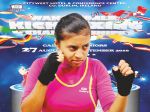
City’s National Champion, 15-year-old Deia S. Urs, who has 2nd Degree Black Belt in Karate and 1st Degree Black Belt in Kick-boxing, will represent India in the K-1 girls category at the WAKO World Junior Kick-boxing Championship. She is the first and the only girl from Karnataka to represent India in Kickboxing at WAKO.

Karnataka Kickboxing Association (KKA) General Secretary C. Ravi said that the selection was based on her performance at the WAKO India National Junior Kick-boxing Championship held recently in New Delhi, where she won a Gold Medal in the girls 15-18 years (- 48 kg) K-1 category. WAKO India President C. A. Tamboli will head the Indian Kick-boxing team.

WAKO India is the member of World Association of Kickboxing Organisations, which is affiliated to Sport Accord & International Games Association (IWGA) and International Olympic Committee (IOC). WAKO India is also member of WAKO Asian Kickboxing Federation and Olympic Council of Asia (OCA).

Winner of the prestigious ‘Prathibha Puraskar’ State Award for her exceptional achievement in the field of Karate, given by Karnataka State Department for Women and Children Development, Deia is trained by Shihan E.S. Kumar of Shuko Kai Shito Ryu Karate Do India of Chennai in Karate, Kobudo and Aikodo.

At present, Deia is trained under her father B.S. Srinath Urs, who has Black Belts in both Karate and Kickboxing.

source: http://www.starofmysore.com / Star of Mysore / Home> Sports News / May 29th, 2016