Artist honoured with award

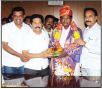
Artist Basavaraj S. Musavalagi being presented the Dhrushya Bhushana Award in Kalaburagi on Friday. —Photo: Arun Kulkarni

Artist Basavaraj S. Musavalagi was presented the Dhrushya Bhushana Award instituted by the Ideal Fine Arts Trust here on Friday.

The award, carrying a purse of Rs. 10,000, a commendation certificate and a shawl was presented to Mr. Musavalagi by the former Vice-Chancellor of Karnataka Law University J.S. Patil. The former chairman of the Karnataka Sahitya Academy Giraddi govindaraj, art critic K.V. Subramanyam, Veeranna Dande and senior artist and the former chairman of the Karnataka Lalitkala Academy V.G. Andani were present. Mr. Musavalagi, who is dean at the Government Dhrusya Kala Mahavidyalaya in Mysuru, popularly known as KAVA, has exhibited his works in different parts of the country and many of his works adorn the walls of prestigious museums, corporate offices and private collectors.

He is an alumnus of MMK Fine Arts College in Kalaburagi.

Prof. Patil said that it was misnomer to call the Hyderabad Karnataka region as backward as it had produced artists, legal luminaries and experts in many fields.

The autobiography of Dr. Andani was released by Dr. Giraddi Govindaraj.

source: http://www.thehindu.com / The Hindu / Home> National> Karnataka / by Special Correspondent / Kalaburagi – February 20th, 2016

Pages from History : South Indian Coinage

by Prof. A.V. Narasimha Murthy, former Head, Department of Ancient History & Archaeology, University of Mysore

I had the good fortune of serving the Numismatic Society of India, Varanasi, as its President, Secretary and Editor. I used to attend the annual conferences of this Society regularly. I once noticed that scholars attending the Varanasi Conference from South India could be counted on finger tips. The reason, I learnt, was that North India was very far and travel would be difficult and many scholars suggested ‘Why not a South Indian Coin (Numismatic) Society be started?’ It was a good suggestion and I contacted Dr. R. Krishnamurthy, Editor of Dinamalar (Tamil Daily) from Chennai and he welcomed the idea but told me that his business as the Editor of a Daily would not allow him to devote full time and energy for this. But he hastened to add, ‘If you can take that responsibility, my full support to you is there.’

Prof. K.V. Raman of Chennai gave me his support. The Head of the publication of New Era, Dr. Srinivasan Srinivasan agreed to print and publish the Journal of the Society on the condition ‘I should be its Editor.’ I agreed and South Indian Numismatic Society came into existence in 1990. So far it has conducted 26 conferences at different centres in Karnataka, Andhra, Tamil Nadu, Kerala. This time it met at Thiruvananthapuram in Jan. 2016. About 150 Numismatists attended.

It was our good fortune that it was hosted by the Centre for Heritage Studies under the Cultural Affairs Department of Kerala. K.C. Joseph, Minister for Rural Development, Culture and Planning, who inaugurated the conference, extended full cooperation to this conference which was a success.

There was a time when barter was the system of trade. People realised its limitation and began using coins. Coins as such have not been noticed in the Indus Valley Culture. However, Rig Veda mentions coins like Nishka, Rukma, Khadi, in the sense of coins. But actually Nishka means a necklace and hence, it has been taken as a necklace made of gold coins (kasinasara). Anyway, that is the earliest coin of our country.

South India had a period which is generally referred to as Sangam age and it was considered as a literary imagination or even bunkum. Suddenly, Dinamalar Krishnamurthy discovered a coin belonging to a Sangam King called Peruvalathi. For the present, this is considered to be the earliest coin of South India. Barring this, the Satavahana (Andhra) coins are the earliest coins of Deccan and South India.

However, we have had uninscribed punch marked coins all over the country including South India and Karnataka. These silver coins had 5 symbols punched on them and one of them represented the government or the king. At this time, Roman merchants came to South India and gave their gold and silver coins and purchased our spices, especially black pepper, which was considered as an antidote for malaria. Thus the large number of Roman coins gave an impetus for the minting of coins in South India.

Kadambas of Banavasi are considered to the actual inaugurators of coinage in Karnataka. They issued what are called Padmatanka coins. A Padmatanka is a gold piece which has a central punch of a lotus or Padma with some symbols and letters like ‘Sri’ with or without the name of the issuer. The Pallavas of Kanchi issued their own coins in gold and copper. This system was continued by the Cholas of Thanjavur. They minted the portrayal of the king with Nagari or Tamil legends. Chola coins have been discovered in plenty as to fill up them, in gunny bags. In Andhra area, Vishnukundins minted coins. In Karnataka, the Chalukyas minted coins and their most popular coin is called Varaha. This word survives even today in traditional parlance. In fact, the coin name Varaha is a contribution of Karnataka in general and that of the Chalukyas in particular.

The Western Gangas of Talakad minted gold and copper coins with elephant as the important symbol. Unfortunately, Rashtrakuta coins have not been discovered in plenty. Later, Chalukya coins have been found in plenty. The Hoysalas minted coins in gold and copper. Vishnuvardhana minted coins with lion and the legend Talakadugonda symbolising the defeat of the Cholas. One interesting coin is the one which has a portrait of Saint Ramanujacharya. The Sevunas or the Yadava coins include those of Bhillama, Singhana and Ramachandra.

Kings of Vijayanagara introduced innovation in coinage. It is not only a golden age but a golden period for Karnataka coinage. Their coinage has been praised by foreign travellers also. They introduced legends in Kannada and Nagari. The most important coin of Krishnadevaraya are the coins representing Lord Venkateswara of Tirumala and Sri Krishna holding a lump of butter in his hands. Krishnadevaraya performed Kanakabhisheka to Balaji of Tirupati by minting gold coins which had the representation of Venkateswara with Sridevi and Bhudevi and his name in Kannada or Nagari. Nayakas of Madura imitated the coinage of Vijayanagara. Their coins contain legends in Kannada and Tamil.

We may turn our attention to the coinage of Muslim kings — the Bahamani dynasty, Adil Shahi dynasty and Barid Shahi Sultans. They minted coins with legends in Arabic and Persian on both sides. Hyder Ali and Tipu Sultan occupy an important place in Karnataka history. Tipu’s innovation in coinage is amazing. He established seventeen mints in different parts of South India and minted coins in gold, silver and copper. He gave each coin a name after the Islamic Saints. His gold coins contain the Persian legend ‘The religion of Ahmad is illumined in the world by the victory of Hyder.’ The reverse has the legend ‘He is the Sultan, the unique, the just, the third of Bahari, cyclic year Azal 2.’

The Wadiyars of Mysore (now Mysuru) began issuing coins with legends. The representation of Hindu Gods by Krishnaraja Wadiyar is unique. They also minted coins with portrayals of lion and elephant with legends in Roman, Kannada and Persian. Once the British took over, they began to follow the British coinage. After independence, the entire country, including South India, is following the system which we are now seeing. Thus, South India followed a unique system of coinage which has a history of over 2,000 years.

source: http://www.starofmysore.com / Star of Mysore / Home> Feature Articles / February 21st, 2016

MCC greets Singapore-Bound Pournamika Leader

Mysuru :

MLA M.K. Somashekar, Mayor B.L. Bhyrappa and other officials yesterday felicitated Pourakarmika leader Mara who left for Singapore.

PournamikaBF20feb2016

Somashekar, speaking on the occasion, lauded the role of Pourakarmikas in Mysuru being named ‘Cleanest City in India’ for second time in a row and added that all efforts would be made to provide them with benefits. Corporators Sunil Kumar and J.S. Jagadish and others were present.

source: http://www.starofmysore.com / Star of Mysore / Home> General News / February 19th, 2016

From Child Artiste to Woman Activist …

Her journey towards ‘Swach’ Bharat had begun before Modi’s Mission

From Reel life to Real lIfe: Rekha during one of her lec-dems at an apartment in city.

Giving up was never an option for this ebullient woman, who was a child actor once and was known by the name of Baby Rekha. She has acted in more than 70 films in Kannada, Tamil and Telugu like Bhakta Siriyala, Tulasi Dalam, Madhura Sangama, Simhada Mari Sainya to name a few.

by Sujata Rajpal

Long before our Prime Minister Narendra Modi’s Swachh Bharat Mission was launched across India, a woman in Mysuru had already started working towards it slowly and steadily. Unaware of Modi’s plan, she had named her organisation SWACH (Segregation of Waste And Composting at Home).

Started in 2013 as a one-woman army, Rekha Rohit visits people’s houses, ladies clubs and apartment complexes (on invitation, of course) to educate residents on how to manage household wastes. Apart from organising awareness sessions on cleanliness, Rekha also trains people on how to segregate waste in various categories and disposing it off accordingly. Besides segregation of waste, she also teaches children and destitute women how to make paper bags.

“I got inclined towards this cause many years ago when I used to travel a lot by train taking my children for various table tennis tournaments across the country. The second class compartments were an eyesore. Dirty wash-rooms, trash strewn all over, passengers spitting anywhere — it was stink and filth all around on the platforms and stations. That instigated me to create awareness about the need for better civic sense,” says Rekha.

Why people in India can’t treat the public property just the way they regard their houses? Is it the lack of civic sense or plain disregard towards one’s surroundings? There is nothing wrong with people but obviously something is not right with the system. Indians lack civic sense only on their motherland. When they go abroad, like everyone else there, they dutifully throw trash in the trash bins and in the absence of a trash bin in the vicinity, they save the wrappers of chips and used paper napkins in the outside pocket of their bag until they can spot a dustbin for depositing the waste where it rightfully belongs. But the moment they land on Indian soil, there is total reversal of behaviour. The civic sense goes for a walk in the woods and these very people litter everywhere.

Come to think of it, each household adds 365 plastic bags to the total waste. Multiply 365 by the number of households in Mysuru and you will be shocked by the amount of waste that only one Tier-2 city is producing. Can such a huge quantity of waste be decomposed naturally?

How is the response to your campaign? I am curious to know.

“When I started, the response used to be very disappointing; women would come up with puerile reasons for not segregating the waste like there is no place in the house to keep two dustbins, the maid servant doesn’t know how to segregate the waste etc. There were days when I used to cry because people shrugged me off wherever I went.”

Despite the cold response, Rekha stayed steadfast in her mission. “The response is much better now, people are aware and understand how important it is to reduce the total amount of waste that we produce,” Rekha says with a glint of hope in her eyes.

She received a lot of encouragement from Dr. M.R. Ravi, former MCC Commissioner, who advised her to continue in her mission despite innumerable road-blocks.

“What I am doing is a very tiny step. If the government sees the waste management as a mammoth problem in future then there is only one solution. Make it mandatory to segregate trash into wet and dry categories, the way it is done in the developed countries. Don’t you see now two-wheeler riders are wearing helmets because it is either wear helmet or pay fine,” says the woman with a contagious smile.

Rekha is now ably supported by K. Sowmya (Gynaecologist and Assistant Professor at JSS Hospital) and K.P. Ganga (Vice-Principal at Queens Institute for Fashion Designing) and, loads of well-wishers from Rotary East who were her backbone in the initial stage of bringing SWACH into action. The organisation has a team of 15 volunteers but many more hands are required to spread the message.

Rekha believes in driving this mission through children. She regularly conducts awareness sessions on cleanliness and waste management for the students of Kalalavadi School in rural Mysuru. If the initiative is taken through children, it is always long lasting. Now children of Kalalavadi School ensure that their village is kept clean.

Giving up was never an option for this ebullient woman who was a child actor once and was known by the name of Baby Rekha. She has acted in more than 70 films in Kannada, Tamil and Telugu. To name a few Bhakta Siriyala, Tulasi Dalam, Madhura Sangama, Simhada Mari Sainya.

“I take it as my duty and contribution to the society. Even if people don’t respond, I feel satisfied that I am doing my tiny bit to make this world a better place for the coming generation,” says Rekha humbly.

“I am nothing without my family,” she says when asked about the family support. “The name SWACH was suggested by my husband,” she says shyly.

Rekha and R. Rohit couple, residents of Chamundipuram, is blessed with two lovely daughters — Ridhi Rohit, who is studying Physiotherapy at JSS Institute and Ruthu Rohit is in 9th at Vidyavardhaka school.

source: http://www.starofmysore.com / Star of Mysore / Home> Feature Articles / February 19th, 2016

Labyrinth of recursive images

AkshayaKavyaBF18feb2016

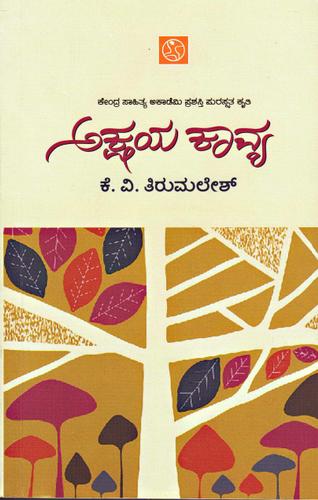
In Akshaya Kavya, poet K.V. Tirumalesh’s award winning work, there are constant meditations on the nature of language, the relationship between word and meaning, and glimpses of the poet’s own life

Akshaya Kavya by K.V. Tirumalesh

Abhinava, Rs. 150

Dr. K. V. Tirumalesh’s first collection of poetry,Mukhavadagalu (Masks, 1968), was written in the Navya or Modernist mode; but, very soon, he began to explore ways of transcending the constraints of Modernism, culminating in his famous Mahaprasthana (1990). Till today, he has published eight collections of poetry, his most ambitious and experimental work being Akshaya Kavya (2010), which has won the Sahitya Akademi Award for the year 2015. Today, though he can loosely be called a post-modernist poet, he declares, “I will not willingly identify myself with any movement” (“My Challenges in Poetry”, Muse India). However, Tirumalesh has also written novels, short stories, regular columns, and criticism besides scholarly works on Kannada grammar and linguistics. Being a bilingual writer, he has written on language and linguistics in English also, his well-known work being Derrida’s Heel of Achilles. A few of his translations from English to Kannada include the poetry of Ezra Pound and Wallace Stevens.

Talking of his Akshaya Kavya, Tirumalesh says, “I would like to call it an epic poem.” In his Preface, he confesses that the voluminous work does not have any “characters, situations, style and grammatical person-tense markers.” We can add that it has no punctuation also.

When one begins to read the work, one finds it a “labyrinth,” full of recursive themes and images.

Loosely, it can be viewed as a brilliant and colourful ‘collage’ of motifs and word-pictures or images. It was Georges Braque and Picasso who practiced this technique of collage with great success in painting, and hence it is no wonder they are often alluded to in Akshaya Kavya. In this world of ‘ever- full poetry,’ fleeting moments of personal experiences, passage of Time, works and characters in Indian and European literatures, philosophers and artists – all jostle with one another. We find here miniatures of philosophers like Buddha and Nietzsche, poets like Vyasa and Dante, literary characters like Draupadi and Beatrice. Interspersed with such word-pictures, there are constant meditations on the nature of language, the relationship between word and meaning, and glimpses of the poet’s own life.

Here are a few representative passages in which the poet reflects on word and meaning, the purpose of poetry and the mystery of poetry.

What is the least demand of the poem from the poet?

Does it demand active involvement in a big social struggle,

in broad daylight, visible to all? Or, total surrender before a great force?

No, none of these; / all these are the domain of actors.

What is required here is purity of everyday – life,

total self-control, not the figure that comes out of the darkness

of the imbalance between speech and action.” (p.64)

“Words sitting near words / what do they say or do?

They are talking with each other / like shy people muttering something.

They are quiet, they pinch each other / touch and embrace each other/

whisper some secret in others’ ears.

They place their hands on the head of others/ and reach out to those sitting away from them / or, they just tease.” (p.201).

There are two long poetic passages at the end of the volume. The first one (pp. 380-409) gives us snippets from Buddha’s life and the way we respond to the Buddha today. The snippets include Buddha’s sermons on the body and soul, Angulimala and Kisagautami episodes, Buddha’s idols, Ashwaghosha’s narrative about him, and such. Importantly, all the teachings and incidents in the life of Buddha are viewed from a critical angle. The last passage (‘What remains is as UsualNow’, p. 458-478), mostly autobiographical, records the poet’s wrestling with words and meanings. A highly emotive paragraph runs thus:

O my very personal god! / You are a witness / to my conflicts/

the ambition to include the entire history/ the intention to hold the sky

on my palm./ You used to laugh and ring warning bells . . .

But I didn’t believe you” (p. 460).

“Not being in the main stream of Kannada, I have been writing such invisible poetry,” Tirumalesh says ruefully in his article “My Challenges”.

I am positive, with Akshaya Kavya and the recognition of Sahitya Akademi, his poetry will become very, very visible.

source: http://www.thehindu.com / The Hindu / Home> Features> Friday Review /  C.N.Ramachandran /Bengaluru – February 18th, 2016

Belagavi-based chef gets TOI Chef of the Year award in Hyderabad

Belagavi :

City based chef Mandaar Sukhatanakar has been awarded with Chef of the Year in the Times Food and Night Life Awards for 2015-16 organized by the Times of India recently at Hyderabad.

It was the first time, People’s Choice Award instituted by the Times of India. In previous year, Mandaar had adjudged as one among top 10 young chefs of India that had published in The Celebrated Chefs of India, a publication of Times Group. Mandaar is the son of late Col. Ajit and Bharati Sukhatanakar from Belagavi.

Born in Belagavi, Mandaar is a graduate with BSc in Hospitality from Institute of Hotel Management, New Delhi. He has trained in the US and Europe and specializes in Italian Cuisine. Currently he is executive chef of The Park Hotel in Hyderabad and controls nine kitchens, which run under him. The award function took place in Hyderabad on 6th February.

source: http://www.timesofindia.indiatimes.com / The Times of India / News Home> City> Mangalore / TNN / February 10th, 2016

7th anniversary of Cauvery Heart and Multi-Speciality Hospital

Renovated and upgraded Emergency Room and Trauma Care Centre inaugurated

Star of Mysore Editor-in-Chief K.B. Ganapathy, who released the educative brochure on emergency care and actions to be taken, during the 7th anniversary celebrations of Cauvery Heart and Multi-Speciality Hospital in Siddarthanagar this morning, is seen with (from left) Dr. R. Vaidyanathan, Director of the Hospital, Dr. G.R. Chandrashekar, Chairman, Dr. H.S. Manjunath Bharghava, Director & Trauma Surgeon and B.J. Sandeep Patel, Facility Director.

Mysuru :

As part of the 7th anniversary celebration of Cauvery Heart and Multi-Speciality Hospital in Siddarthanagar, the renovated and upgraded Emergency Room and Trauma Care Centre of the hospital was inaugurated this morning by Star of Mysore Editor-in-Chief K.B. Ganapathy, who also released the educative brochure on emergency care and actions to be taken.

Speaking on the occasion, Ganapathy stressed the need for humane touch, better interaction between patient and medical personnel.

He appreciated the initiative and efforts of Cauvery Heart and Multi-Specialty Hospital Management, Consultants, Doctors, Nurses, Para medical staff and supportive staff to provide the much sought after emergency care facility.

Hospital Chairman Dr. G.R. Chandrashekar and staff were present on the occasion.

source: http://www.starofmysore.com / Star of Mysore / Home> General News / February 17th, 2016

Engineering students devise kit to rescue babies from borewells

(Representative Picture)

Bengaluru:

With children falling into borewells now a common phenomenon, mechanical engineering students Sharath Babu L, Dhanush Kumar A and Giridhara G set about finding a solution to save those trapped.

They came up with a simple pulley system to lift up babies who accidentally fall into open wells or borewells, giving a humane touch to their budding careers.

Researching the subject, they found that 14 babies had fallen and died in open borewells in 2014. Till the end of 2015, 36 children had died in a similar manner.

“This was around August, when a six-year old boy had fallen into a borewell in Sulikere village in Bagalkot district. The incident moved us, and our teacher also suggested that we try and find a solution,” said Sharath Babu.

ChartBF15feb2016

The three students were then pursuing a diploma in engineering and had to submit a project to get their degree. They are now in the second year of engineering in different colleges in the city. This pulley is better than those used in times of crisis, because it has a camera and LED light fitted in, that enables rescuers to locate the baby in a dark borewell.

“The images captured by the camera can be seen through a computer by people managing the rescue on the ground. We also send oxygen through assistive devices. Once the baby is found, the pulley covers the baby entirely and a balloon-like cushion is remotely swollen to help hold it securely.

There are side covers of the pulley that grip the hands of the victim and it is pulled out through the simple mechanics of a pulley system.

The boys have already shaped a prototype and done experiments to make it a market-ready solution. “But our problem is we’ve devised it out of reused materials like aluminium, cardboard, simple steel strings and a deflated football. We are trying to mobilize resources to develop this product that will save many children in rural areas across India,” said Dhanush.

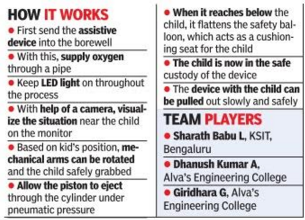
HOW DOES IT WORK?

* First send the assistive device into the borewell

* With this, supply oxygen through a pipe

* Keep LED light on throughout the process

* With help of a camera, visualize the situation near the child on the monitor

* Based on kid’s position, mechanical arms can be rotated and the child safely grabbed

* Allow the piston to eject through the cylinder under pneumatic pressure

* When it reaches below the child, it flattens the safety balloon, which acts as a cushioning seat for the child

* The child is now in the safe custody of the device

* The device with the child can be pulled out slowly and safely

TEAM PLAYERS
Sharath Babu L, KSIT, Bangalore
Dhanush Kumar A, Alva’s Engineering College
Giridhara G, Alva’s Engineering College

source: http://www.timesofindia.indiatimes.com / The Times of India / News Home> City> Bangalore / TNN / February 15th, 2016

M’luru girl tops COMEDK PGET in medical stream

RachelBF14feb2016

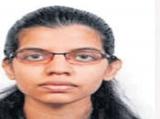
Rachel Althea Sequeira from Mangaluru has topped the Consortium of Medical, Engineering and Dental Colleges of Karnataka’s (COMEDK) Post Graduate Entrance Test (PGET) in the medical stream while Siddharth Datta Bandodkar from Goa topped the dental category.

The results were announced on Thursday and the counselling will begin shortly.
The first three toppers in the medical stream are from Karnataka. Anand K N N and Devesh Sanjeev Ballal, both from Bengaluru, secured the second and third rank respectively. In the dental stream, the second topper is B S Sai Harinath from Telangana and the third topper Shilpi Tiwari from Uttar Pradesh.

The entrance test for admissions to postgraduate medical and dental courses in unaided colleges in Karnataka was held on January 17, 2016. For the first time, COMEDK conducted the test online at 141 centres in 72 cities across the country.

As many as 17,482 candidates applied for the medical test, but only 16,577 of them took it. In the dental stream, the number of examinees was 4,462 as against 4,659 applicants.

Out of the first 1,000 rank holders, 248 had scored more than 70 per cent marks in the MBBS examination, 287 between 66 and 70 per cent, 395 between 60 and 65 per cent and the remaining 70 less than 60 per cent but more than the minimum marks required.

In dental stream

In the dental stream, out of the first 1,000 rank holders, 216  had scored more than 70 per cent marks in the BDS course, 280 between 66 and 70 per cent, 426 between 60 and 65 per cent and the remaining 78 students less than 60 per cent but more than the minimum marks required.

source: http://www.deccanherald.com / Deccan Herald / Home> States / DHNS, Bengaluru – February 05th, 2016

Kamakshi Hospital …

Serving people with compassion

A Role Model for any Charitable Hospital

KamakshiHospitalBF14feb2016

by S.N. Venkatnag Sobers

One of the oldest charitable hospitals in Mysuru is Kamakshi Hospital, a multi-specialty hospital run by Bantwal Sulochana Madhava Shenoy (BSMS) Trust. Located in the heart of the city at Saraswathipuram, the hospital has been catering to the health needs of middle class, lower middle class and the poor.

Star of Mysore and Mysooru Mithra printing unit was close to this hospital, enjoying a cordial relationship with its genial, ever smiling, kind and compassionate Dr. K.R. Kamath as its administrator, till the unit was shifted to its present location in the year 1989.

Kamakshi Hospital is the brain child of philanthropists late Bantwal Madhava Shenoy and Sulochana Madhava Shenoy, the famous Ganesha Beedi Baron of Mysuru, who wanted to serve people by providing them quality health facilities at affordable rates.

The hospital was started on Apr. 23, 1973 with 16 beds and today, it has grown to a 220-bedded hospital, all because of the dedication put in by the Trustees and the members of the Trust.

The foundation stone for the hospital was laid during the 70th birthday celebrations of Madhava Shenoy. After the hospital became operational during April 1973, the first Operation Theatre was started on Nov. 19, 1973. Today, the hospital has nine state-of-the-art Operation Theatres (OT) with expert OT staff to assist the surgeons.

BSMS Trust, which has been managing the hospital, is constantly upgrading the hospital according to the advancements in the medical field. The popularity of the hospital is such that around 300 patients on an average come to get themselves checked at the OPD everyday.

The credit for developing the hospital goes to the previous Managing Trustee M. Vinod Rao, the fourth son of Madhava Shenoy, who served as the Managing Trustee for 10 years.

He is credited for his vision to bring more facilities to the hospital and provide quality health service to the patients. When he took over as the Managing Trustee, the hospital was 96-bedded but on the day he left, the hospital was developed into a 220-bedded multi-specialty hospital.

Vinod Rao’s younger brother Vishwanth Rao, who was the Managing Trustee for more than two decades, is also credited for safeguarding the Trust’s property before handing over the reins to Vinod Rao, who took over for the second time.

Speaking to Star of Mysore, BSMS Trust’s Managing Trustee, the young and dynamic, Mahesh Shenoy, son of Vinod Rao, said that it was because of his father’s vision that the hospital saw a lot of development and emerged as one of the finest hospitals in city.

Significantly, the Trust has never faced problems from the employees as there has always been a cordial relationship in the true spirit of running a charitable hospital.

Vinod Rao, who was an active partner of Mangalore Ganesh Beedi, chose to come out of the business and involve totally in charity and social service works. He has made sure that his children, his brothers and their children are also involved in social service through this hospital. More importantly, it is one of the spacious, airy and clean hospitals in the city. A model for a Swachh Hospital Abhiyan. Surely, Kamakshi Hospital is a role model for any hospital run as a charitable hospital.

The Trust, which is currently run by the grandchildren of Madhava Shenoy, on Founder’s Day every year, makes sure to honour doctors and staff for the service they have rendered to the hospital. Employees, who have completed 25 years of service, are felicitated during the event.

Talking about the future plans, Mahesh Shenoy, the Managing Trustee, said that the Trust has plans to expand the activities of blood bank by adding Blood Components Separation Unit.

“There is also a plan to install an MRI scanner to add to the present facilities. The OPD and the emergency unit will be renovated in the coming days. There is also a need for a bigger and better medical stores to provide medicines 24×7 to patients at the hospital as well as the general public,” he added.

The BSMS Trust will soon take up the construction of another hospital in J.P. Nagar which will provide similar services as the one in Saraswathipuram. The construction of the hospital is set to begin once the clearance is given from the government agencies. Once the hospital is functional, people living in the J.P. Nagar, surrounding areas and villages will be benefited.

Kamakshi Hospital, apart from being known for offering health services at an affordable price, is known for its cleanliness. Though the inflow of patients is more, the hospital authorities have made sure to provide a clean and serene atmosphere for the patients.

The hospital has a total of 400 employees who have been working in different shifts to take care of patients and their needs. A total of 40 consulting doctors visit hospital every day to attend the patients at the OPD from 9 am to 1 pm and 3.30 pm to 7.30 pm.

Dr. K.R. Kamath, the Administrator of the hospital, has been working at the hospital since day one. It has been almost 43 years since Dr. Kamath joined Kamakshi Hospital. Dr. C. Umesh Kamath, who is the Medical Superintendent, has been serving the hospital for more than 15 years now.

Kamakshi Hospital is also visited by many eminent surgeons like Dr. C.G. Narasimhan (General Surgeon), Dr. Ajay Hegde (Orthopaedic Surgeon), Dr. M.G. Anil Kumar and Dr. Kumar (Paediatric Surgeons), Dr. C.D. Sreenivasa Murthy (Physician), Dr. Shivakumar (General Surgeon), Dr. B.S. Jayaraj (Pulmonologist), Dr. Roopa Prakash (Gynaecologist) and Dr. M.S. Vishweshwara (Oncologist).

The BSMS Trust is offering free education at the Bruhaspathacharya School for children from poor background. This apart, the Trust has also plans to start orphanage and old age homes in the days to come. It has also helped around 200 children with various congenital anomalies to undergo procedures free of cost.

source: http://www.starofmysore.com / Star of Mysore / Home> Feature Articles / February 14th, 2016