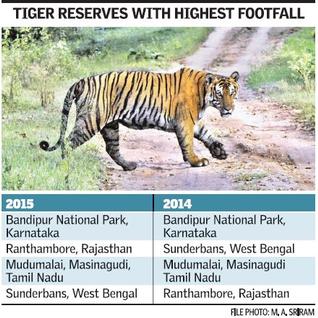
After witnessing an increase in tiger population over the last five years, Bandipur National Park emerged as the most visited tiger reserve in the country, according to a recent study by a travel information portal.
The report by HolidayIQ says that for two successive years, Bandipur National Park was the most visited tiger reserve even as tiger tourism in the country has grown by 230 per cent.
“Based on user interactions on our portal during the travel season of October, November and December last year and this year, the number of visitors to Bandipur National Park has shown a marked increase. The interactions also reveal that tiger tourism is fast growing in the country,” a representative for HolidayIQ told The Hindu .
A senior forest official at Bandipur attributed the popularity of the national park to “increased frequency of sightings” and “accessibility”. He said the national park, which was on the road to Ooty, is a natural choice for tiger tourism. Besides, the tiger population in Bandipur had increased, which translates into higher frequency of sightings.
The Forest Department accommodations can house 88 persons and bookings are almost always full during weekends and holidays, and show 70 per cent occupancy during weekdays. In addition, private resorts can accommodate about 250 persons. The department also organises safaris in the morning and evening.
The tiger population in Bandipur and the adjoining Nagarahole, Mudumalai and Wayanad forests was estimated at 570 in 11,000 sq km of habitat, according to a report on status of tigers in India-2014, which also showed that tiger population in the country had increased from 1,706 in 2010 to 2,226 in 2014.
Wildlife experts in the region believe that Bandipur, which is spread across around 870 sq km, hosts more than 110 tigers.
Meanwhile, the study by HolidayIQ shows that couple travellers account for almost 36 per cent of the visitors to tiger reserves, closely followed by families, who account for 32 per cent, while group travellers account for 28 per cent.
source: http://www.thehindu.com / The Hindu / Home> National> Karnataka / by Laiqh A. Khan / Mysuru – December 16th, 2015
Mayor B.L. Bhyrappa will inaugurate a function organised to present Hoysala awards on the occasion of 16th Anniversary of Hoysala Kannada Sangha and Savigannada Pathrika Balaga at 4.30 pm on Dec.27 at Veene Seshanna Bhavan on Adichunchanagiri Road in Kuvempunagar.
The function, which will be presided by Bharatiya Vidya Bhavan (BVB) Mysuru Kendra Chairman Dr. A.V. Narasimha Murthy will be attended by Prof. Bhashyam Swamiji of Yoga Narasimhaswamy temple in Vijayanagar and Sri Ilai Alwar Swamiji of Vangipura Mutt as guests of honour.
Litterateur Dr. Latha Rajashekar will release a souvenir brought out by Savigannada Pathrika while Deputy General Manager of Canara Bank Dr. S.T. Ramachandra will release the book ‘Kannadada Therannayeledavaru’ authored by Ranganath Mysore.
Writer Dr. K. Leela Prakash will deliver the keynote address. BVB Karnataka Chairman N.Ramanuja, Retired Head of the Department of Mathematics, NIE Dr.K.S.Chandrashekar, President of Hoysala Award Selection Committee K.Raghuram will be the chief guests.
Those selected for Hoysala Award for the year 2015 for their contribution to various fields are: H. Ramachandra (spiritual), MUDA Chairman K.R.Mohan Kumar (culture), S.K.Ananda Theertha (Sports), Srinivas (Co-operation), B.R. Nataraj Jois of Sandhya Suraksha Trust, Gopinath (Astrology), G.R. Parameshwarappa (Sharana Sahitya and Culture), M.D.Gopinath (Education), Doddegowda (Publisher), Sathanur Devaraj (Science literature), Dr. C.G.Narasimhan (Medical and culture), Dr. R.N. Srilatha (Classical Music), Madhuri Thathachari (Culture), Vijaya Sindhuvalli Ananthamurthy (Theatre), Prof. Maleyur Guruswamy (literature), Dr. C. Naganna (Translation) and L.S.N. Achar (Artist).
source: http://www.starofmysore.com / Star of Mysore / Home> General News / December 15th, 2015
‘Integrated Disease Management in Vegetable Crops’
Mysuru :
A free training programme for farmers on ‘Integrated Disease Management in Vegetable Crops’ was jointly organised by Krishi Jnana Vijnana Vedike (KJVV) and Lions Club of Mysore Heritage City recently.
Dr. Vasanth Kumar Thimakapura, the Founder of KJVV and Rajyotsava Awardee, addressed the farmers on how to grow vegetable and fruit crops scientifically without the indiscriminate usage of chemical fertilisers and pesticides.
He elaborated the harmful effects of these not only on the health of consumers but also on the farmer’s cost of production and suggested practical ways to avoid them.
He stressed the importance of using disease-resistant varieties, bio-control agents and environmental-friendly practices of cultivation to get maximum yield.
Dr. Vasanth Kumar suggested farmers to utilise his free plant clinic service in order to increase their productivity and yield.
More than fifty farmers from various parts of the district participated. A few progressive farmers shared their views and ideas during the session.
Dr. Lakshimipathigowda (former Deputy Director General of ICRISAT), Jayaprakash (Public Relations Officer of DRDO), Bannur Narayan (Farmer Leader) and Ln. Jai Prakash (Lions Club of Mysore Heritage City) were among the distinguished guests. KJVV Director D. Bharath and Scientists Dr. Harish, Dr. Yogesh and Dr. Chandrashekar were also present.
For any crop problems, suggestions and information on upcoming training prog., contact Dr. Harish on Mob: 98806-22979 or Dr. Chandrashekar on Mob: 97393-85165.
source: http://www.starofmysore.com / Star of Mysore / Home> General News / December 15th, 2015
Ajit SN recently completed a 45-day world tour where he dived with humpback whales, great white sharks and bull sharks.
Bengaluru :
This Bengalurean spends more time underwater than on land.Ajit SN, a diver and underwater photographer, has completed 190 dives in two years and surprised most dive masters around the world.
It started two years ago when he took a diving course in Sri Lanka with a friend. “It was a spontaneous decision. I knew nothing about underwater photography or diving but I was determined to learn both,” he said.
But it wasn’t as easy as he imagined it would be. “I had to make a huge investment in underwater photography equipment because it wasn’t available in India and had to order it from the US,” he said.
While his friend left after four days into the course, Ajit stayed three more days and completed the advanced open water course which takes divers 30 metres deep.
“I wasn’t allowed to take the camera first.When I did, water leaked into a very expensive camera. Fortunately , the lens wasn’t damaged,” he said. Then followed trips to remote islands off Cambodia and Sri Lanka and Ajit was certified in technical diving. He also got a wreck diving licence but the first time was a near-death experience when he entered the HMS Hermes, a World War 2 British aircraft carrier in the waters off Sri Lanka.
“It was pitch dark and I was 45m below sea level. I had a blackout and began taking in water. I couldn’t even see my dive buddy . I was inside the wreck and saw a beam of light through a hole and began waving my torch.My buddy saw me and quickly put my mask back on my nose. It had got dislodged when I was entering the ship,” he said.
That experience didn’t stop Ajit from exploring other wrecks near Sri Lanka. And snorkelling was on his bucket list. He spent a week in the ocean in the Maldives with certified divers.
“I was in the middle of the ocean when I saw a manta ray circling around the boat. I grabbed my camera and jumped into the water at 9pm. It brushed by me many times. I got a brilliant shot and when I came back to the deck, it was 1am,” he said. That shot was among the top four trending photos on National Geographic Daily Dozens.
source: http://www.timesofindia.indiatimes.com / The Times of India / News Home> City> Bengaluru / by Aditi Sequeira, TNN / December 14th, 2015
Dr. K.N. Amruthesh (right) is seen receiving the National Award from former Chief Minister of Goa, Digambar Kamat, at the awards ceremony held in Panaji, Goa, on Dec.6.
Mysuru :
Dr. K.N. Amruthesh, Senior Lecturer and Principal Investigator at Department of Studies in Botany and Co-ordinator, CSIR/UGC- NET Coaching Centre of University of Mysore, has been given the prestigious “Dr. A.P.J. Abdul Kalam National Award” by the International Institute for the Social and Economic Reforms, Delhi.
This award was conferred for his significant contributions in the field of major agricultural crops’ disease management strategies, especially for his extensive research work on pearl millet downy mildew host pathogen interaction and reporting of two new plant species to the Science, Research Publications and Teaching.
Dr. Amruthesh received the National Award from former Chief Minister of Goa, Digambar Kamat at the Entertainment Society of Goa, Panaji, on Dec.6. The award comprises a certificate, memento and a citation.
Dr. Amruthesh, who obtained his doctoral degree from University of Mysore with Government of India, ICAR Fellowship, completed his post doctoral degree research work at University of North Texas (UNT), Texas, United States of America (USA).
He started his professional career in 2002 as a Senior Scientist with the Danish Government, Copenhagen-funded collaborative research project at the Department of Biotechnology and subsequently was appointed as a faculty in 2004 to the Department of Botany of the Varsity.
Dr. Amruthesh has published more than 65 research articles in the national and international reputed journals and 3 book chapters so far on plant – microbe interaction and disease management strategies. He has successfully guided 7 Ph.D. scholars for their doctoral degree and currently 7 Ph.D. scholars are working under his guidance. He is the Principal Investigator for three research projects funded by DST, UGC and DBT. Dr. Amruthesh is also the recipient of Indian Science Congress Association (ISCA) & Department of Science & Technology (DST)- Young Scientists’ Awards among others.
source: http://www.starofmysore.com / Star of Mysore / Home> General News / Monday – December 14th, 2015
Karman Kaur Thandi (left) and Dhruthi T. Venugopal of Mysuru seen with their women’s doubles runner-up trophy.
Indore :
City’s Dhruthi T. Venugopal teaming up with Karman Kaur Thandi finished runner-up in the women’s doubles event in the ITF $10,000 Women’s Tennis Tournament at Indore on Friday.
In the women’s doubles final, Veronika Kapshay & Anastasiya Vasylyeva of Ukraine the top-seeds beat Dhruthi T. Venugopal & Karman Kaur Thandi of India 6-1, 6-3 in the final which lasted for just 48 minutes.
In the women’s singles semi-finals, Karman Kaur Thandi beat Prerna Bhambri 2-6, 6-4, 6-3 while Ukraine’s Anastasia beat top-seed Katy Dunne 6-7 (4), 6-4, 6-3 and entered the title summit.
source: http://www.starofmysore.com / Star of Mysore / Home> Sports News / Saturday – December 12th, 2015
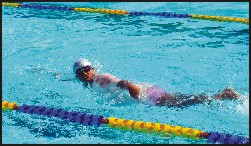
K. Kusuma, Senior Technician in CSIR- Central Food Technological Research Institute (CSIR-CFTRI), Mysuru, who participated in the 15th National Paralympic Swimming Championship -2015 organised by Paralympic Swimming Association of Karnataka (PSAK) at Belgaum recently under the auspices of Paralympic Swimming Federation of India (PARASWIM) and Paralympic Committee of India (PCI), won a bronze medal in 100 mts. Butterfly Stroke under S9 category.
She had also participated in the State-level Paralympic Swimming Championship-2015 held at KLE School, Nagarabhavi, Bengaluru, where she won 4 Gold Medals in 100 meters Free Style, 100 meters Butterfly Stroke, 50 meters Free Style and 50 meters Back Stroke under S9 category.
source: http://www.starofmysore.com / Star of Mysore / Home> Sports News / Tuesday – December 08th, 2015
Photographs depicting the Madras Sappers, who designed the Bangalore Torpedo were part of an exhibition exploring India’s role in the First World War
Over a million Indian soldiers fought in World War I of which 60,000 were killed in the fighting.
First encounter, Bangalore Digging deep, Crossing far
Elke Falat and Julia Tieke put together Digging deep, Crossing far, a series of workshops and exhibitions to throw light on hitherto unexplored aspects of the war.
“The objective is to start a discussion on topics in the first World World that are often neglected in the writing of history, such as the German perspective on the prisoner of war camps or how the non-European world was involved,” says Julia. “This is the first part of a long-term project we will continue in other countries. Through questions and archives, we will get into conversation with artists and through them, the audience on topics like war, nation building, propaganda and recognition.”
First encounter, Bangalore Digging deep, Crossing far
Their stopover in Bengaluru, titled ‘First encounter, Bangalore’, was on display at the Max Mueller Bhavan and the Bangalore Literature Festival.
They will also be taking their work to Pakistan, Morocco Tunisia, Algeria, the village of Wunsdorf and Berlin.
“It is not as though we are revealing something new. Everybody knows what we are talking about, but it is not in their collective consciousness,” says Elke.
One of the focal points of the exhibition is the German Prisoner of War camps near Berlin, on which Julia was conducting research for a radio programme.
“I stumbled upon the image of a postcard showing the first mosque built in Germany which was in the camp. Then I found articles by academic institutions which were involved in research on the type and history of sound archives in the prisoner of war camps,” she recalls.
“I thought it was a contemporary topic, it can relate to so many things like the German call for jihad or the relationship between the so-called Western world and Islam. The idea was to involve artists so they would work with the material in different ways and try to get into conversation about what it means.”
These camps, explains Elke, hosted a constellation of Colonial soldiers from North Africa and British India, even Bangalore. And so the exhibition in Bangalore featured four artists who each explored different perspectives of the war in the context of India.
Surekha, a Bangalore-based artist, explored the city’s connection with the war through ‘Black Pepper & Red Pepper’, a series of photographs depicting the role of the Madras Sappers, who designed the Bangalore Torpedo war weapon and the Mysore Imperial Army. The artist captured the bravery and skill of the Indian soldiers; the socio-political context of the war, through the code words ‘Red pepper’ for British soldiers and ‘Black pepper’ for the Indian soldiers; and depictions of the Indian soldiers in the war.
“The photographs printed on aluminium are quite uncanny. They are clear yet capture the passage of time. The people in the photographs appear like ghosts. Viewers will be able to understand what happened just by looking at the photographs, it is almost like a history lesson,” says Elke.
The exhibition featured yet another Bengaluru-based artist, Ayisha Abraham, whose grandfather fought in the war. Through a deconstructed photograph, Ayisha explored the consequences of a self-transformation of identity on his heritage.
Artist-author Sarnath Banerjee offered a national perspective through his notice boards titled The reduced history of the First World War, 2015. Through his series of black and white drawings, he captured scenes from the war featuring the Indian independence as well as the racial contexts.
While Gilles Aubry, a Berlin-based Swiss artist, known for his research on the history of sound, explored the Indian prisoners’ recordings in the German prisoner of war camps. He presented two tuning forks, of the note ‘A’ and the sound ‘Om’ which play in between the recording of a Hindi song sung by an Indian prisoner. He also presented the recording of a voice reciting a translated list of words recorded in the camps.
“His work is a reflection on what these techniques of recording tell us about science, the grammar of power and the knowledge of Colonial practices. He presents a link between Berlin and India,” explains Elke.
source: http://www.thehindu.com / The Hindu / Home> Features> MetroPlus / by Harshini Vakkalanka / Bengaluru – December 07th, 2015
‘It has been developed after a three-year research and will take a year for field trial’
College of Fisheries here has developed a kit for detecting residues of a particular pesticide in fish and shell fish.
It could detect residues of chlorpyrifos in fish and shell fish, according to K.M. Shankar, Dean (Fisheries) of the college.
Speaking to media following demonstration of the kit at the college on Thursday he said chlorpyrifos was extensively used in agriculture.
Its residues could join water sources such as ponds and rivers at any time, due to human activity. With this, fish cultured in ponds came into contact with this pesticide.
Those engaged in in-land fisheries, exporters, and fish consumers could use this kit for detecting the pesticide content.
He said the kit has been developed following a three-year research. It would take one more year for field trial. Using the kit, a sample could be tested with in 10 minutes.
Field trial
Mr. Shankar said that if the technology was to reach consumers it would have to be transferred to a company for developing the kits. The company would have to conduct the field trial. The college would have to take steps for technology transfer.
The kit, which is yet to be named, was developed with funding from the Department of Biotechnology, Delhi and European Union, Brussels.
Earlier, the college had developed a kit called RapidDot for field level detection of white spot virus in shrimp. It has been commercialised through M/s. Virbac Animal Health Care Ltd., Mumbai.
source: http://www.thehindu.com / The Hindu / Home> News> Cities> Mangaluru / by Raviprasad Kamila / Mangaluru – December 04th, 2015
by Prof. A.V. Narasimha Murthy, former Head, Department of Ancient History & Archaeology, University of Mysore
Nanjangud is famous for two reasons: The first and the most important one is the temple of Najundeshwara who gulped poison to save humanity. Hundreds of visitors throng this temple to worship and hence it is one of the most prosperous temples in Karnataka. The second reason is that it is the place of the famous B.V. Pandith whose salt and sweet toothpowder, Soubhagya Shunti and Kasturi pills were famous all over Karnataka. In addition, we may add gulkan, a preparation of rose petals soaked in sugar syrup. In fact, B.V. Pandith grew roses in vast lands in Nanjangud for this purpose.
Such a family has produced illustrious persons who are now serving in different professions in Karnataka. One such person whom I had the good fortune to meet was K.R. Mohan Kumar (Kunigal Ramaswamy Mohan Kumar), the present Chairman of Mysuru Urban Development Authority (MUDA). I had an occasion to talk to him and found his views interesting and I am writing them here for the benefit of the readers.
Mohan Kumar is the son of Kunigal Ramaswamy and Jayalakshamma, a pious couple. It is by accident that he joined politics. In fact, none of his forefathers had even thought of it as a profession. However, from his early days he had an inclination to join politics as he was influenced by Indira Gandhi.
Hejjige Linganna, who was an MLA, recognised his merit and made him Party General Secretary. After two years, he came under the influence of V. Sreenivasa Prasad, who is now a Minister. Mohan Kumar took up the responsibility as the chief of his election campaign. Though he was admired by the members of the party for his useful leadership in Youth Congress, he was not given the ticket to contest the elections. Perhaps to compensate this injustice, he was made the Chairman of Dryland Development Board and in that capacity he did an admirable job. Everybody, who mattered, appreciated his hard work but did not give him a position on the pretext that he was too young. But nobody could prevent him from becoming the KPCC member and Executive member. They wanted to make him Director of Canara Bank and Mohan Kumar politely declined it.
Again a proposal for making him an MLC came up but it was felt that it was meant for a Scheduled Caste candidate and it becomes difficult if an upper caste person is given this coveted post. He met Narasimha Rao, Indira Gandhi and Rajiv Gandhi and all of them sang the same tune that ‘You are too young, please wait till you get your chance.’ Mohan Kumar, being a native of Nanjangud, wanted to contest from that place only but he was told that Nanjangud is a Constituency where a Brahmin cannot win.
Now he has got an opportunity of serving the society by becoming the Chairman of MUDA. It was originally called City Improvement Trust Board (CITB) and was started in 1904 by Nalwadi Krishnaraja Wadiyar. It became MUDA in 1988. Mohan Kumar felt that this is a good opportunity to serve the poorer section of the society by providing them a site to build a house of their own.
After he became MUDA Chairman, he planned the activities for his tenure. On realising that people with huge amounts of money purchased lands in bulk from villagers at a paltry price, developed sites and sold them at exorbitant rates, he thought ‘Why not the Government do it’ and immediately swung into action. He developed Ballahalli Layout of 485 acres with 6,150 sites and as per the Court directions, began distributing them to 1,30,000 applicants. He also introduced Group Housing Scheme where people should live there for ten years and should have seniority.
Out of turn allotment would be done only in exceptional deserving cases as approved by the Committee.
The case of CA sites is another vexed problem. They get the allotment made by influence but have no resources to construct buildings and after years of neglect they become a burden. These sites are allotted for schools, colleges, temples, mosques, etc. Mohan Kumar has promised to wait for years and if it is not used for the purpose for which it was allotted, it will be taken back. This caution has made many organisations to pool resources and take up construction.
Khata is a big problem and people have to walk to the offices hundred times without any tangible results. Literally people used to curse the MUDA. The middlemen used to take advantage of this situation and extracted large amount of money from people. Realising this MUDA introduced e-Khata. Even 300 Khatas were not being finalised then; now it has jumped to about 3,000 a month and people are happy and this has practically ended the bribery. The computer system has made the allotment of Khata, sites etc., highly transparent. Officers cannot keep anything pending when all the rules and regulations are followed in allotment. This has made the officers alert. He requests people to meet him directly and bring to his notice any delay or irregularity which he promises to rectify.
It is gratifying to note that MUDA is not just an allotting body but an organisation to care for the development of the city, which Mohan Kumar is determined to do.
It is not possible to describe all his achievements in this article. As an elderly person I hope Mohan Kumar will see new heights in his career and do more service to Mysuru in particular and Karnataka in general.
source: http://www.starofmysore.com / Star of Mysore / Home> Feature Articles / Saturday – December 05th, 2015