The Karnataka Chamber of Commerce and Industry (KCCI), in collaboration with Dharwad Horticulture Department and Karnataka State Spice Products Development Board, will organize a three day “Chilli Mela” at Murusavir mutt from February 7.
Speaking to reporters here on Thursday, Vasantha Ladawa, president of KCCI, Hubballi, said that the main objective of the event is to provide chilli at reasonable prices and provide a platform to farmers sell their items directly to consumers.
He said that farmers from Dharwad, Gadag, and other districts of North Karnataka would participate in the mela. About 150 shops, displaying different varieties of chilli, would be set up at the mela. Ladawa said that about 150 tonnes of chilli is expected to be sold at the event.
I K Doddamani, deputy director of Dharwad Horticulture Department, said that all measures have been taken to end the menace of middlemen who harass farmers. “Farmers can register by producing their land records or identity cards,” he said.
Horticulture minister Shamanuru Shivashankrappa will inaugurate the mela. Former chief minister Jagadish Shettar, district in-charge minister Dinesh Gundurao and MP Pralhad Joshi will be present at the inaugural ceremony.
source: http://www.thehindu.com / The Hindu / Home> City> Hubballi / TNN / February 06th, 2015
The Fort High School at Chamarajpet in Bengaluru was built in 1907. File Photo: V. Sreenivasa Murthy
INTACH has taken up the structure for preliminary assessment to suggest areas that need restoration
The 108-year-old Fort High School building in Chamarajpet has braved the vagaries of time. The school that was built in 1907 has also witnessed several students graduate from its portals, right from freedom fighter H.S. Doreswamy and political statesman V.S. Krishna Iyer to the former cricketer G.R. Vishwanath.
However, the old building is crying for attention. The clay-tiled roof needs urgent replacement, while the walls are damp due to leakages. The steel and wooden trusses in the building need to be treated, the walls need plastering, and flooring and wooden staircase need work. Even the stucco work on the walls look damaged.
The structure has now been taken up for preliminary assessment by Indian National Trust for Art and Cultural Heritage (INTACH), which will suggest areas that need restoration so as to bring back its colonial grandeur. “We will share our study with the Department of Public Instruction and anyone who is interested in taking up the restoration,” said Meera Iyer, co-convener of INTACH.
There are thousands of such old buildings in the city that can be preserved for value of antiquity. “As per INTACH’s listing, Ulsoor alone has nearly 90 heritage buildings,” she said.
The buildings in INTACH listing are grouped into various categories and grades, as per international standards. This helps identify the heritage potential of the buildings. Some of the buildings that have a public connect are assessed in depth by restoration experts and conservation architects to establish their social relevance.
“Recently, INTACH took up a study in Lalbagh to advice the Department of Horticulture for the restoration of three buildings — Library Building, Krumbigal Hall and Old Aquarium,” Ms. Iyer said.
It is the cost-factor that plays the spoilsport in the restoration of heritage structures, she said, and added that to bring back the bygone glory of a building, one requires not just “a feel for the old”, but also flair to identify the techniques required for restoration.
source: http://www.thehindu.com / The Hindu / Home> News> Cities> Bengaluru / by Ranjani Govind / Bengaluru – February 09th, 2015
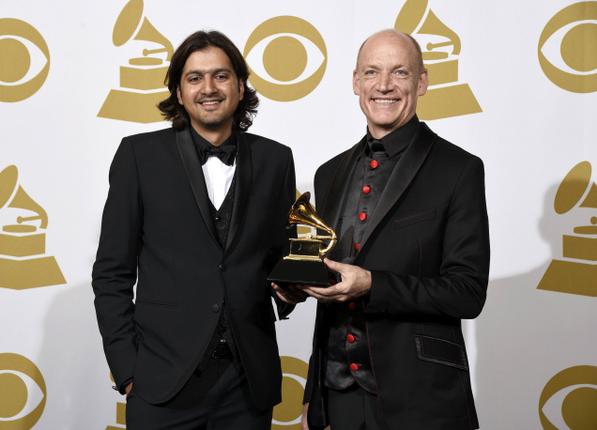
Ricky Kej (L) and Wouter Kellerman of Winds of Samsara pose with their trophy that they won in the new age album category at the 57th annual Grammy Awards in Los Angeles on Sunday. / AP
India-based Ricky Kej’s collaborated album Winds Of Samsara won the Best New Age Album trophy at the 57th Annual Grammy Awards here.
Ricky teamed up with South African musician Wouter Kellerman for the album, which symbolises peace and harmony.
The website of the album describes the project as a “truly global effort”, which draws inspiration from two cultures. The music of the album blends in the creative influences of the cultures to generate a sound of calmness and positivity.
Other albums nominated in the category were Bhakti by Paul Avgerinos, Ritual by Peter Kater and R. Carlos Nakai, Symphony Live In Istanbul by Kitaro and In Love And Longing by Silvia Nakkach and David Darling.
Neela Vaswani poses with the award for best children’s album for “I Am Malala: How One Girl Stood Up For Education And Changed The World” at the 57th annual Grammy Awards, in Los Angeles on Sunday. / AP
Another Indian artist to make it big at the awards this year was Neela Vaswani. She won the trophy in the Best Children’s Album category for I Am Malala: How One Girl Stood Up For Education And Changed The World (Malala Yousafzai). Vaswani narrated the audio version of the book.
However, sitarist and daughter of the late sitar maestro Ravi Shankar, Anoushka, who was nominated for her album Traces of You in the Best World Music Album category lost out to Angelique Kidjo’s album Eve.
source: http://www.thehindu.com / The Hindu / Home> News> International / IANS / Los Angeles, February 09th, 2015
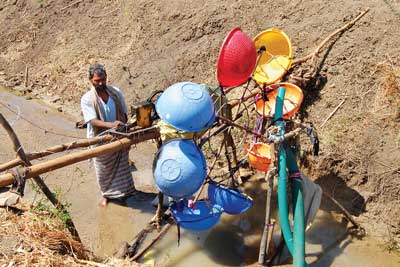
Siddappa, an illiterate farmer from Somapur village in Gadag district of Karnataka, has designed a water mill to generate electricity. Right from conceptualizing to materialisation, the farmer has done everything on his own. He operates the water mill in the canal near his house.
Using timbers, Siddappa prepared a giant wheel that joined at a central hub. There are eight arms, five feet each, extending from the central hub. A plastic bucket is dangled at the tip of each arm. When the water from two pipes gushes into one of the buckets, it generates the pressure that turns the 10-feet wheel in an anti-clockwise motion. The bucket could also be spun in the horizontal plane using a central steering wheel, similar to a teacup ride. As one after another bucket is driven by the flowing water, the first arm declines back to the ground while the other rises in the air. This process spins the black wheel attached to this giant wheel. The spinning black wheel rotates another wheel connected to a dynamo.
A converter converts the Direct Current from the dynamo into Alternating Current. Siddappa claims to have spent a mere Rs 5000 on building the entire apparatus. This is his second attempt to show the villagers that anybody can produce electricity for self-consumption using the resources at hand. “Many people who have canals flowing near their villages don’t know how to use that natural gift. I want to show them all practically that electricity problems can be solved by being creative. There is no need to beg to the government for everything,” he says.
He gets 150 watts of power from this water mill when water flows in the canal. Siddappa claims he can create electricity for the entire village through his machine. But the problem is that the canal in his village flows only for three months a year!
source: http://www.thebetterindia.com / The Better India / Home> Innovation / by N K Suprabha / April 08th, 2011
This article originally appeared in The Sunday Indian (TSI) magazine and has been reproduced here as part of an arrangement between The Better India and TSI. The author, Suprabha Naik is a correspondent with the Kannada Bureau of TSI. Read previous article of this author here.
When was the last time you went to a museum? If you can’t recall, this NGO’s project will help refresh your memory and revitalise the idea in your head
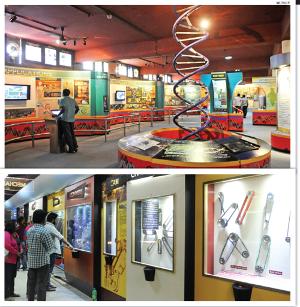
The Visvesvaraya Industrial and Technological Museum attracts 10 lakh visitors per year. (Top right) The National Gallery of Modern Art where they’re are organising new exhibitions, workshops, family quizzes, gallery walks and auditorium programmes to attract visitors
Swords, guns, king’s outfits, utensils, palanquins, artefacts, lamps, artworks… and life itself. Museums are much more than storerooms of strange and fascinating objects from a bygone era, preserved and labelled in glass cases with ‘Do Not Touch’ signs on them. They’re repositories of a way of life, showcasing a history and continuum that has brought us where we are today — whether sociologically or culturally. So why is that most of us rush to visit museums in other countries, but haven’t gone to one in our immediate vicinity since our school days, or without our children and grandchildren? Bengaluru NGO ReReeti, which hopes to transform Indian museums into spaces of learning, delight and meaningful engagement for Indian and overseas visitors, is attempting to answer that very question with a project called ‘Object of my Affection’.
In an effort to contemporarise the museum experience and re-introduce its value to a young audience, ‘Object of my Affection’ invites people to contemplate the value of objects in their home and imagine them in a museum 60 years from now. After all, “citizens get a sense of their ethnological ancestry, their nation’s cultural, scientific, historical, and technological progress through the materials on display at museums,” says Tejshvi Jain, Founding-Director of ReReeti. If you admire an object for its design, functionality or aesthetic appeal, and think it is precious today and may not be in use say 60 years from now, take a picture and upload it to Twitter or email them. Tell them when was the last time you visited a museum and why this object is museum-worthy or valuable to you. Through the exercise, which commences today and will go on for a month, ReReeti hopes to spark a thought process about the purpose of museums and help people look at them anew — as spaces that tell a narrative of a way of life.
More than objects
SK Aruni, City Director of Indian Council of Historical Research Bangalore, believes the time is ripe for such an initiative. Ruing that the revival of museums is not taken seriously, he says, “Each object has its own history, its own growth. But a museum needs to go beyond just labelling and displaying these items,” he believes. That could be done via cultural entertainment, “to show how life was lived at the time” and interactive displays or stories of the way art developed from ancient to modern times, “in art galleries”, he believes.
Great ideas, but not always successfully implemented. DK Chowda, General Secretary, Chitrakala Parishat says, “We have some of the best collections in the world including works by Bengal artistes and folk artistes, leather puppets and Mysore traditional paintings, among others.” He admits there is a need to attract newer audiences by making this a more lively space — by way of storytelling sessions around paintings, audio and visual aids, and a focus on promoting art and culture. “But we need funding and space,” is his refrain. Simple changes — like making the third floor “easier to reach”, and employing guides who can take people through the rich tapestries of the Mysore paintings (“Where did this style start? How did it emerge? What are the myths?”) are his suggestions, and hopes for the art school and museum.
Jain agrees. “Museums are perceived as dull, boring spaces,” she says. But that can be changed, if they work to fulfil people’s needs. She cites the examples of sleepovers in some US museums.
And in the UK, museums such as Tate and Victor and Albert Museum are, every so often kept open till late in the evening, and the look is changed, complete with disco lights and bars. “That attracts youngsters. Architecture students create theme-based activities — like games related to the architecture of the museum.” In Scotland, she recalls a Christmas-themed day at a museum when adults stood in a huge line, excited to make small badges with selfies on it. “In that process, they end up visiting the museum,” she says.
Have activities
It’s a philosophy KG Kumar, Director, Visvesvaraya Industrial and Technological Museum, has been trying to further ever since his return to the institution two years ago. Proudly citing a figure of 10 lakh visitors per year “highest in the science council of museums”, he talks about the various initiatives he has undertaken to make the museum a more interactive space. These include storytelling around exhibits like the spinosaurus, attended by 700 children over two days, multimedia projections, the use of miniature props that add to the storytelling sessions, and the Wright Brothers Flight Simulator that replicated the first flight in 1903, complete with controls.
“Next, I’ll have an exhibition on natural disasters and how to prevent them, a science show using dry ice, an interactive exhibit around the meaning of DNA…” The list is long.
Outreach programmes, he stresses, are necessary to attract audiences. From activity corners to demonstrate small processes in the biotechnology lab to an innovation festival where the public is invited to demonstrate their ingenious daily innovations, Kumar is making an effort to generate interest in museums. “You’ll see a king’s or a Nizam’s outfit on display, with a boring label next to it. Why not create a story around it? When did he wear it and why?” he asks. At the National Gallery of Modern Art, where he is the “borrowed” Director, he is making similar attempts with new exhibitions, summer workshops, family quizzes, gallery walks and auditorium programmes. “There are original paintings, which immediately relate to history, and contain stories of the times they were created — say Partition. We need to tell those stories in a more engaging fashion.”
We can almost see Jain nod. “Museums are holders of tradition and history. Once you make them personal enough, make a connection and make it contemporary, people will see that.” With Object of my Affection, she hopes people start with themselves. “What would you want to preserve for your next generation,” she asks. How can you be proud of your city, your time and your history? “People take selfies every now and then. So we’re connecting it to what is around them with this project,” she says. All of which will finally culminate in an exhibition of things that are important to Bengaluru. There you have it — your very own museum of memories. Not so boring anymore, right?
Object of my Affection: Choose any object from your home: spoon, hair brush, cushion cover, cooking utensil, graphic novel, lamp, whatever strikes your fancy you would want to preserve for the next generation. Click a photo, upload the photo and type ‘Object of my Affection: xyz, tag @ReReeti, use the hashtags #ReReeti #museumworthy and post your tweet. Or email: ReReeti13@gmail.com. All photo submissions will be added to their Flickr account.
source: http://www.bangaloremirror.com / Bangalore Mirror / Home> Columns> Sunday-Read / by Sowmya Rajaram, Bangalore Mirror Bureau / February 08th, 2015
City’s upcoming golfer Pranavi S. Urs, a student of National Public School and a product of JWGC, Mysuru, taking part in the South Zone JWGC Junior Golf Tournament conducted by JWGC on Jan. 31 January and Feb.1 won the Category ‘C’ title with a two-day aggregate score of 153 (79+74).
Aryan Roopa Anand bagged the top honours in the Category A & B with a two-day aggregate score of 155 (76+79). Mysuru’s Dristi Karumbaya secured the sixth place in the Category A & B with a two-day score of 168 (88+80).
Aryan Roopa Anand also won the Category ‘B’ title. Drishti Karumbaya of Mysuru, secured the third place in the Category ‘B’ section with a two-day aggregate score of 168 (88+80).
City’s Disha Kavery secured the ninth place overall in the Category ‘C’ section with a two-day card of 179 (89+90) and finished third in the girls section.
Milind Soni triumphed in the Category ‘D’ with a two-day aggregate score of 184 (96+88). Mysuru’s Vidhatri K. Urs finished 11th overall in Category ‘D’ with a two-day aggregate score of 198 (102+96) and secured the third place in the girls section.
Manoj Sree Ramappa triumphed in the Category ‘E’ section with a two-day score of 69 (34+35).
The Results: Category A & B: 1. Aryan Roopa Anand (76+79=155); 2. Vrushank Balu (87+77=164); 3. Nikhil Pai (87+79=166).
Dr. B. Suresha, Professor, Department of Mechanical Engineering at the National Institute of Engineering (NIE), Mysuru, has been selected for the Best Research Publication Award instituted by Vision Group on Science and Technology, Department of IT, BT and Science & Technology, Government of Karnataka for the year 2014-15.
His research publication titled ‘Investigation of organo-modified montmorillonite loading effect on the abrasion resistance of hybrid composites’ has bagged the award.
This award is being given to recognise and encourage quality research publications in Science and Engineering by the faculty members serving in University Departments, Colleges and Research Institutions in the State. This award carries a prize money of Rs.25,000 and a citation.
source: http://www.starofmysore.com / Star of Mysore / Home> General News / Monday , February 02nd, 2015
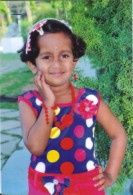
Sreshta K. Raagh is the little old daughter of doctor-mother Preetham and father Raghavendra Ratnakar, a singer better known by name junior Md. Rafi of Mysuru and the granddaughter of late Kannada cine actor Ratnakar Thus, the culture of being inclined towards artistry comes naturally to Sreshta. Being trained in music and musical instruments by her father and in dance and acting at the Chamaraja Film Institute, Mysuru and having participated in various television shows and won prizes, she is a kid too full of energy when it comes to learning anything new. Saying it is quite an achievement to have boldly participated in several television shows and also won a few, all at the age 4, makes Sreshta’s parents feel very proud of her.
Talking of her daughter, Preetham says, “For me, Sreshta has never seemed like a kid of her age till date. I always feel like she is way too mature and sensible for her age as I see that she behaves much like a kid of an older age. Her aims are way too high, her dreams are big and her approach towards them very different. I feel proud of her for all these. Also, she is lucky to be receiving an exposure for all these things, since my husband is a full-time singer and we own an orchestra of our own, thus getting to frequently host several music programmes in each of which she gets a chance to perform.”
The child, who first began performing on stage at the age of 2.2 years, has given over 25 stage performances, apart from appearing in television shows like Chinnara Chilipili, Chota Champion where she won a cash prize of Rs. 25,000 apart from being rewarded with the titles.
The little kid is an LKG student at Pramathi Hill View Academy in city, who is also lucky to have been receiving great encouragement from her school. Says her mother, talking of her school, “I am glad she is very positively encouraged by her teachers too, towards pursuing her interests. —AN
source: http://www.starofmysore.com / Star of Mysore / Home> Feature Articles / February 01st, 2015
Noted Kannada poet Prof. KS Nissar Ahmed. / The Hindu
Bhagavatharu has organised ‘Nityotsava Kavige’ on February 8 to mark the 80 birthday of Prof. K.S. Nissar Ahmed. The event will begin with ‘Nissar Ahmadara geethegalu’ at 10 a.m. and go on till 8 p.m at Nayana auditorium, Bangalore. Dr. Prabhushankar, writer, will preside over the inauguration ceremony.
The event will feature seminars on Nissar Ahmed’s writings, a book release, a musical performance and poetry reading. Nissar Ahmed will be felicitated at 6 p.m. ‘Bhavanubhava Samyoga’, authored by P.V.Narayana, will be released by Prof. Baragooru Ramachandrappa, culture critic.
source: http: //www.thehindu.com / The Hindu / Home> Features> Friday Review / February 05th, 2015
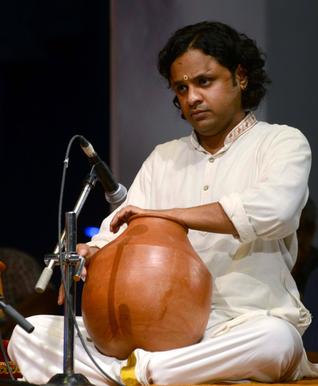
Ghata artiste Giridhar Udupa from Bangalore who bagged the Best Upa-pakkavadya Award from the Music Academy in the 2014 Music Season is just back from a whirlwind tour of concerts across Europe. “I am happy to dedicate this prestigious award to Karnataka as I owe everything to my State where I received lessons,” said the young percussionist who is a regular at the senior slots of the Academy. Udupa is indeed a unique artiste who is at equal ease with Carnatic, Hindustani and global music. Giridhar has been tapping on this Indian clay pot since he was a four-year-old when his father mridanga vidwan Ullur Nagendra Udupa set him on the ‘beat.’ He later honed his skills with Sukanya Ramgopal and V. Suresh. Today, as a 34-year-old, Giridhar has visited 40 countries and has been part of global collaborations on world platforms. “I can’t forget my accompaniment to R.K. Srikantan and Umayalapuram Sivaraman in 2007 at the Music Academy,” recalls Giridhar. “That was a phenomenal accompaniment on the ghata,” Ustad Amjad Ali Khan had commented after a concert, and Giridhar’s adaptation has impressed stalwarts such as Shiv Kumar Sharma, Pt. Jasraj, Vishwamohan Bhat and Sultan Khan in the innovative amalgams.
“I love to be exploratory in my approaches and my travel helps me get familiarised with wide-ranging global beats,” says Giridhar, who heads three European bands dealing with Spanish Flemenco, Polish-based jazz and Irish western music. “I am trying to internalise every rhythm of the world into my ghata and konnakkol, hoping to set in motion innovative ideas…,” says Giridhar.
source: http://www.thehindu.com / The Hindu / Home> Features> Friday Review / by Ranjani Govind / February 05th, 2015