Senior journalist from city Krishna Prasad, who is now the Editor-in-Chief of Outlook magazine, has been nominated as the Member of the 12th Press Council of India (PCI) for a period of three years by the Government of India.
Krishna Prasad, who now lives in Delhi, is part of the 28-member Press Council, which is a statutory body that governs the conduct of print media in the country.
The Council is empowered to hold hearings based on complaints received against print media or initiate action against print media suo motto.
Krishna Prasad, who is one among the six members under the Working Journalists — Editor category — will be in charge of all matters related to English Dailies in India for a period of three years.
Earlier, Krishna Prasad was a Committee Member of Press Club of India for two years. Justice Markandey Katju is the Chairman of the Council.
source: http://www.starofmysore.com / Star of Mysore / Home>General News / Wednesday , October 15th, 2014
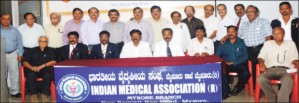
The Annual General Body Meeting (AGM)of Indian Medical Association (IMA), Mysore Branch, was held recently at I.M.A House on New Sayyaji Rao Road here.
The following office-bearers were unanimously elected for the year 2014-2015:
Dr. M.S. Kempegowda, President; Dr. G. Marulasiddappa, President – Election (2015-16); Dr. P. Puttaswamy and Dr. S.B. Prakash, Vice-Presidents; Dr. B.N. Ananda Ravi, Hon. Secretary; Dr. M. Shivanna, Joint Secretary; Dr. Suresh Rudrappa, Treasurer.
Executive Committee Members are: Dr. Dhananjaya, Dr. Sujatha S. Rao, Dr. Y.M. Shiva Kumar, Dr. Chandrasekhar Sosale, Dr. M.R. Shashi Kumar, Dr. Suleman Shamshad Mohammed, Dr. D. Parameshwara Naik, Dr. T.K. Rangaswamy and Dr. N. Chandrabhan Singh.
State Council Members are: Dr. C. Rajan, Dr. N. Chandrashekar, Dr. S.P. Yoganna, Dr. K.B. Gurumurthy, Dr. P. Sathya, Dr. H. Vasudev Naik, Dr. K.H. Basavaraj, Dr. G.R. Jagannatha Babu, Dr. Zakir Ali Khan, Dr. B.R. Anand, Dr. C. Mahadevu and Dr. Murthy.
Central Council Members are: Dr. B.V. Rajagopal, Dr. S. Prasanna Shankar, Dr. B. Ramananda Kumar, Dr. L. Devegowda, Dr. Capt. G.S. Venkatesh, Dr. S.M. Prabhulingaswamy and Dr. A. H. Hareesh, according to a press release from Dr.B.N. Ananda Ravi, Hon.Secretary, IM A, Mysore Branch.
source: http://www.starofmysore.com / Star of Mysore / Home>General News / Monday , October 13th, 2014
Getting a personal photo on a postage stamp is quite simple now with the department of posts launching ‘My Stamp’ scheme some time ago in Bangalore and Mysore.
By paying Rs.300, 12 stamps of face value of Rs.5 could be obtained in just 15 minutes by submitting a photograph. The facility is available at Central post office on Ashoka road here. There is also a facility to be photographed at the post office for which an address proof should be given.
The department has decided to offer a discount of 10% for two sheets of stamps of 12 each and 20% for 100 sheets and more.
Over 350 people are said to have already got their personal stamps printed in city.
More information could be sought on phone numbers 0821-2417303 / 2417306, according to a press release.
source: http://www.starofmysore.com / Star of Mysore / Home>General News / Sunday , October 12th, 2014
Mysore Librarians and Information Scientists Association (MyLISA), Mysore, in collaboration with the Department of Library and Information Science, University of Mysore and Rotary Mysore North, has organised a book exhibition and donation camp on Oct. 13 from 9.30 am.
The camp will be held at the new DIRC Building, Mysore University Library, Manasagangotri (near bus stop).
The camp will be inaugurated by Prof. S. Indumathi, Dean, Faculty of Arts, University of Mysore and former Vice-Chancellor, Davangere University.
Prof. G. Hemantha Kumar of Department of Computer Science, will be the guest of honour. S. Nagaraja, President, MyLISA, Y. R. Manjunath, President, Rotary Mysore North, Dr. M. Chandrashekara, Chairman and Professor, Department of Library and Information Science, University of Mysore and Dr. C.P. Ramasesh, Librarian, Mysore University Library, will be present on the occasion.
Books will be distributed to the libraries of various schools and colleges free of cost. The camp is organised as part of ‘Pusthaka Dasara-2014’ initiative to promote the use of books.
Around 1500 books in various subjects as Chemistry, Commerce, Computer Science, English literature, Economics, Engineering, Food Science, General Knowledge, History, Kannada literature, Management, Medicine, Philosophy, Physics, Religion, Political Science, Science, Sociology, Fiction, Literature and Biographies have been received through donation. A significant number of children’s books have also been donated by the public. A list of books received is hosted on the MyLISA website http://mylisamysore.weebly.com.
Schools and colleges interested to receive the books may contact Dr. M.V. Sunil, Co-ordinator on Mobile: 99864 39832 or Dr. N.S. Harinarayana, Secretary, MyLISA on 97415 33380.
source: http://www.starofmysore.com / Star of Mysore / Home>General News / Sunday , October 12th, 2014
Feeding America, a unique food bank initiative that has redefined food donation and feeding the underprivileged, has been replicated in Bangalore.
Bangalore Food Bank (BFB) was launched in the city on Thursday to coincide with the World Food Day. Supported by Griffith Laboratories Private Ltd and a handful of individuals, the initiative kicked off with Griffith Laboratories making the first donation of ready-to- cook ‘khichdhi’ packets to feed 5,000 people through its NGO feeding partners.
According to BFB director (operations) Meher S Dasondi, food banking is a system that moves food from donors to the needy and is a non-profit distribution enterprise that serves the community through institutional feeding programmes. A food bank acquires donated food in the form of food grains, pulses, oils spices etc, and works as a facilitator between those who have surplus and those who need food. Only dry food can be donated as cooked food has limited shelf life.
Nearly 28 NGOs have partnered with BFB including Auto Raja’s Home of Hope, Mitra Jyothi School for the Blind, and Vathsala Charitable Trust. Individuals and firms interested in food donation can contact Dasondi on 9538035252.
source: http://www.bangaloremirror.com / Bangalore Mirror / Home> Bangalore> Others / Bangalore Mirror Bureau / October 17th, 2014
Sukkanya Ramgopal is India’s first woman ghatam artiste.She learnt from the legendary Vikku Vinayakaram who gave India its first ‘Ghatam Grammy’.She’s the first to create the unique concept of Ghata Tharang playing six ghatams at the same time.And the first to set up Bangalore’s all-woman Carnatic ensemble.
Sukkanya Ramgopal
Sukkanya,who has been invited to perform at the prestigious Madras Music Academy festival with the ensemble the ultimate accolade in the Carnatic domain shares her thoughts on women,ghatam and Carnatic music.Excerpts from an interview:
Tell us about the place of the ghatam in Carnatic music today.
Her guru Vikku Vinayakaram
Things changed for the ghatam after Vikku Vinayakaram.He has given it a place no one has,got it the right attention.Vikku has also made the ghatam internationally popular he’s played with an African ensemble that won him the Grammy,the only ghatam artiste to do so.Thanks to him,ghatam artistes can travel abroad today,which was once unthinkable.Ghatam is number five in Carnatic music vocals,violin,mridangan,khanjira and then ghatam.But,if it is taken more seriously than it was a decade or two ago,it means Vikku made the difference.
Why are there so few women ghatam artistes
It is very difficult to produce sounds from the ghatam.Even men find it difficult! It’s still seen as a ‘masculine’ instrument.Parents have to be convinced there is a future in the ghatam and that women and ghatam go together.
How did you get into it
I started on the violin,then learnt the mridangam.I then heard of Vikku and began to go to his concerts.I was awestruck.I asked him to take me as his student.He said,It is difficult for a girl to produce sounds on the ghatam.You are playing mridangam nicely,why not continue with that At that point,his father intervened.There is no difference between a boy and a girl for the ghatam.Teach her.She’s very hardworking. Vikku’s magic and his father’s perception of me made me his student.
And your family’s reaction
My mother was very encouraging.My father didn’t like it.He didn’t come for the first few concerts.A while later,he got interested and began accompanying me.Gradually,my entire family liked it and backed me all the way.
How do other musicians perceive you,a woman as a ghatam artiste
Generally,musicians are not very happy with women accompanists.It’s a long-held feeling and it’s still there.Even organizers are careful in engaging artistes.That’s why it becomes difficult for me to play with a stalwart like U Srinivas.And where musicians allow me to accompany them,I find the mike won’t be set right! It’s strange there is accommodation but not accommodation in entirety on stage.Shouldn’t all of us be one in a concert
How accepted do you feel in the music world
I do feel accepted.I have the highest ranking on All India Radio and musicians are comfortable with me.I perform at the Ramaseva Mandali at Chamarajpet and Seshadripuram every year.I go abroad too.This apart,I am saying the comfort factor for the woman ghatam artiste in a concert should be complete,no different from the comfort factor other artistes enjoy within the ensemble.
Is that why the all-women ensemble came about
Partly.The stage just had to be more accommodative or I had to find a way out.I found it an allwomen ensemble,the Stree Taal Tharang,was born.We found women for everything mridangam,veena,violin,morching and ghatam.While we do perform in Bangalore,performing at the forthcoming Madras Music Academy festival will be an honour.
How else did you innovate to ensure that ghatam’s up front
The most difficult thing in a Carnatic concert is to make people sit and listen to laya vinayasam.When it is the turn of the mridangam and ghatam,people walk out.I had to find a way out to make them stay,had to innovate.I brought six ghatams together and started playing melody on them at one go.Ghata Tharang is what I call it.It made a difference.People began to sit and listen.It is a first in percussion.No one plays melody on the ghatam.I had promised myself to move the ghatam from number five to number one.I am on the way to do that.Ghatam cannot and will not remain on the margins.
You are a Mathematics degree holder.How does it figure in music
Lekkachara is always fun even if it’s integral to music.What’s better than indulging in permutations and combinations to make phrases I enjoy making korvais thoroughly.
What’s your advice to students
Work hard.There is no alternative.
Do you have a woman student
Interesting you should ask.Very recently,I got my first woman student,the first in my 30 years of playing the ghatam.
Does it say something about women and ghatam
I am happy she has taken up the ghatam.But I’m aware there are very few women who do it.That’s precisely the odds.Braving that speaks for character and conviction.The impression that ghatam is masculine is very fundamental and changing it will be the challenge.
toiblr.reporter@timesgroup.com
source: http://www.mobiletoi.timesofindia.com / E-Paper / The Times of India / Home> Times of India / Prashanth G. N, TNN / August 03rd, 2009
V.K. Jagadish Babu is seen receiving the honour from University President Prof. Dr. Marco E. Grappegia during the convocation of Universita Popolare Degli Studi Di Milano.
City’s V.K. Jagadish Babu, Chairman and Managing Director (CMD) of Sankalp Group and President-Elect of CREDAI (Confederation of Real Estate Developers Association of India), Karnataka, was conferred the Degree of Honorius Causa – Doctor of Philosophy (Honorary Doctorate) in Civil Engineering for his achievements and contributions in the field of Construction Science recently by Universita Popolare Degli Studi Di Milano, Milano, Italy, a top ranking European University.
He is seen receiving the honour from University President Prof. Dr. Marco E. Grappegia during the convocation of Universita Popolare Degli Studi Di Milano.
source: http://www.starofmysore.com / Star of Mysore / Home>General News / Saturday, October 11th, 2014
Artisans from across India have set up stalls in the mela Green Mela to be held bimonthly from December
Mysore :
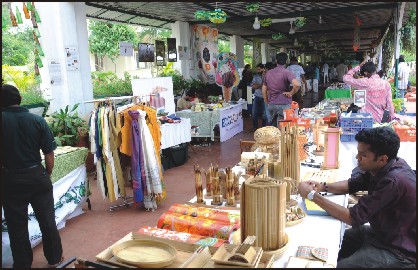
A three-day organic products fair ‘Green Mela,’ organised by The Green Hotel on Hunsur Road began at its premises here yesterday.
The mela was inaugurated by Prof.U.N.Ravikumar, who is well-known in the field of conserving lakes, rain water harvesting and sustainable development.
Speaking to SOM, Prof.Ravikumar said “If rural India has to go on a greener path, urban Indians should lead the path by showing them non-wasteful consumption methods.”
General Manager of the Hotel Mithun said, “I am thrilled by the overwhelming response by the public who are thronging the mela.” He also said that artisans from across India have set up their stalls in the mela and from December onwards the Green Hotel will conduct Green Mela bimonthly.
The products which are on display and for sale at the mela include Avocado pickles, Bamboo pens, Bamboo lamp shades, Coir pots, Natural ice-creams, Organic coffee powder from Madikeri, various types of handmade soaps, Pashmina Shawls, Silk Scarves, Singing Bowls, drumstick tambli – a special drink from coastal region which is said to have medicinal values, Audio CD’s of the songs of Adivasis from Adivasi Munnetra Sangam, Gudlur, Tamil Nadu and other items.
The major attraction at the mela is the Pottery workshop in which public can try and experience making pottery using natural clay. The pottery workshop has programmes like ‘Make your own diya’ and ‘Make your own Ganesha.’
Different varieties of organic authentic teas imported from United Kingdom are also available at the mela which include Peppermint tea, Night time tea – an organic oat flower, lavender and limeflower tea for peaceful sleep, Vanilla chai and others.
There is a very special kind of tea at the Mela called ‘Love Tea’ , which has a tagline ‘a tea to warm your heart’. It is made from organic roses, chamomile and lavender.
The mela is open for public from 11 am to 8 pm daily and will conclude on Oct. 12.
source: http://www.starofmysore.com / Star of Mysore / Home>General News / Saturday, October 11th, 2014
Forty-four year old D.K. Gopal (Left in the picture) is chosen for the prestigious Sri Kalajyothi Award of the Gayana Samaja and would receive it during the Sangeetha Sammelana on October 19. Photo: Special Arrangement / The Hindu
Even as serene Devanahalli may boast of its glamorous international airport, the modest town, located 40 kms north-east of Bangalore, is grounded with an inbuilt pride. The area’s speciality mud has helped carry forward a hoary tradition, the making of the percussion instrument ‘Ghata.’ Devanahalli’s mud is said to possess a composition most suited for pots. And Ghata-making is a 100-year-old vocation being pursued by 44-year-old D.K. Gopal, the only family in Bangalore that has hands-on contact with the clay for making the musical instrument. Nearly 60 pieces are sold in a month and exported too.
Gopal’s family belonging to the Kumbara Beedi of Maralu Baagilu in Devanahalli has always lived alongside the pot-makers of the area, but it is the bond with music that led his forefathers to lay their hands on Ghata-making. “My grand-father Munishyamappa conducted bhajans at the nearby Kumbeshwara Temple every Saturday,” recalls Gopal, who has learnt 20 varnas and 40 kritis and passed exams in music. Gopal’s family even includes violinists, vocalists, tabla-and harmonium players. “My vocal knowledge helps me immensely as we make a variety of Ghatas to suit every shruti,” he says. “My father Krishnappa had specially made a Ghata for the veteran K.S. Manjunath, and later on for Bangalore K. Venkatram too on personal requests,” says Gopal. “One of his deft creations remains showcased in the Government Museum on Kasturba Road even today,” says Gopal.
Just as Manamadurai in interior Tamil Nadu where the musical Ghatas are made, Devanahalli’s pot is a mixture of three varieties of mud gathered from in and around the three lakes of the area for the perfect blend – the Devanahalli kere’s red clay for the sheen, the Bhuvanahalli kere’s dark-toned clay for the conch-like naada, and the Venkatagiri kere’s mix of shades that not only balances the sound, but makes the Ghata strong. “While we mix the three varieties with water, it is in the singularly unique kneading with hands and foot and the addition of metals that makes it compatible for melodic tapping,” explain Gopal and his son G. Mahesh. These craftsmen tap nearly a thousand times on their “sacred pots” with special tools for the “right thickness that brings in the required shruti.” They are meticulously sun-and-shade dried, and then burnt in natural coconut-husk furnaces. It takes 25 days to make a single pot, and they cost anywhere between Rs. 850 to Rs. 2000 a piece.
Gopal and Mahesh explain that Ghata is an instrument purely made from the five elements of Nature. “We start work with a prayer to Lord Kumbeshwara. The Ghata’s resonances – Akaara, Ukaara, Makaara and Omkaara – are considered comprehensive. Most saint-poets as Basavanna, Sarvagna and Kabirdas referred to the ‘Ghata’ as a metaphor to human body in their poems,” explains Gopal.
With the international airport at Devanahalli now, furnaces for baking the pots are not allowed as the process emanates smoke. So Gopal is exploring newer technologies in controlled environment, with a marketing unit set up at Byatarayanapura.
The research
Sumana Chandrashekar, Programme Executive, India Foundation for the Arts, has done a research study on ghata. Sumana, a student of Sukanya Ramgopal says, the Devanahalli Ghata is a lighter one when compared to the Manamadurai instrument. “While both have their unique tonal effects and are equally used in Carnatic music, the Devanahalli Ghata is easier to carry and play on, while the Manamadurai pot is a heavier version that can withstand intense thumps,” she says. Actually, the technique for playing both these instruments have evolved over the years in response to the way these instruments have included their material composition, she added.
Sukanya Ramgopal. File Photo: V.V. Krishnan / The Hindu
First lady ghata player
The first girl to hold the Ghata on her lap in the world of percussion was the 12-year-old Sukanya Ramgopal, a student of the veteran Vikku Vinayakram. Originally from Tamil Nadu, the 57-year-old Bangalore-based Ghata artiste has had to boldly tackle the gender discrimination she witnessed quite often on stage. “My guru nurtured and guided me into the Vinayakram schooling, as well as helped me get used to the heavy Manamadurai Ghata. Today I take part in several percussion festivals across the globe,” she says. Sukanya’s four decade career has helped her lead an all-women ensemble, Sthree Thaal Tharang, where she handles six Ghatas at a time, making them fundamental to the concert.
The Devanahalli Ghata
My father used the Devanahalli Ghata for nearly six decades, says V. Krishna, mridangist, son of the Ghata-ace (Late) Bangalore K. Venkatram. Venkatram, who had one specially made from Krishnappa of the Devanahalli family in the early 1960s, is said to have preferred the Ghata to have an easier entry to performing on stage when there was a dearth of Ghata players and a surfeit of mridangists. Venkatram loved the Devanahalli Ghata as its not-so-thick composition produced defined modulations even with feather-soft touches. Venkatram’s percussion ensemble, Laya Vrushti too helped discover the potential of Indian percussive instruments. His deep study of the Ghata had him once showcase the exceptionally rare low-pitched beats when he accompanied Chembai Vaidyanatha Bhagavatar who had reacted in wonder to say, “This is Ghatoth Ghata.”
source: http://www.thehindu.com / The Hindu / Home> News> Cities> Bangalore / by Ranjani Govind / Bangalore – October 14th, 2014
Gandhi Jayanthi was celebrated at MYRA School of Business, Yelwal, in a befitting manner with a special Interactive Session and discussion with Will Poole, a Social Entrepreneur recently.
Will Poole, a Brown University graduate in Computer Science who Co-founded the Unitus Seed Fund (Bangalore & Seattle) in 2012 with the mission of accelerating BOP start-ups, conducted an interactive session on ‘5 ways to open a VC’s wallet and 3 ways to snap it shut’.
Will Poole inspired the young minds at MYRA to think about becoming social entrepreneurs and starting enterprises that serve the underprivileged. “5 ways to open a VC’s wallet and 3 ways to snap it shut” with a captivating title fired the people’s imagination and attracted a huge audience.
Will Poole showcased how Unitus works towards achieving sustainable and scalable impact that the world needs today. Impact investing, in general, and Unitus in particular, places financial returns on par with, if not above, social impact. However, impact investors differ with the way they approach it – “Finance First” or “Social Impact First”.
It was clear from his talk that entrepreneurs with an unrealistic or overly complex business plan; who lack a team approach and have a disproportionate focus on valuation versus fundamentals are not in his pipeline.
Later the audience shared their views on which Business ideas were great, whose business model was better, and which entrepreneur was more passionate.
The audience comprised BEML officers, Panchayat members from Mydanahalli village, Trustees, governing members, faculty, staff and students of MYRA school.
source: http://www.starofmysore.com / Star of Mysore / Home>General News / Thursday , October 09th, 2014