A vintage photograph showing Sandhya (middle row – third from left) at an event in Vanita Sadana, a women’s development institution in Mysore, contemporaneous with Mahila Samaja and Mahila Sadana.
Sir,
Readers of your curiosity-provoking news report on J. Jayalalithaa’s Mysore roots (SOM dated July 9) may find it interesting to know that her mother Sandhya was a socialite in Mysore, with links to the ruling elite. After leaving Mysore and living for a while in Bangalore, Sandhya settled in Madras and started acting in Tamil films at the instance of her actor-sister Ambujavalli (Vidyavathi).
Sandhya’s pre-screen name was Vedavalli (Vedavathi) and it is said that even Jayalalithaa’s original name was different: it was “Komalavalli.” It is also said that the prefix “Jaya” in the names of her family signifies their association with the Palace.
Jayalalithaa’s grandfather Dr. N. Rangachar, L.M. & S., was a Palace doctor in Mysore and his name is exclusively inscribed on a donation plaque in Mahila Samaja, close to Jayalalithaa’s ancestral residence on 2nd Main Road, Lakshmipuram (the building now houses the Lakshmipuram Sports Club). Dr. Rangachar’s image is also seen in an enchanting mural depicting a group of Durbaris at the Mysore Palace.
This context rekindles memories of the similar, interesting roots of Vyjayanthimala in Mysore. Her mother Vasundhara Devi, a glamorous dancer and Tamil film actress, too, enjoyed direct contacts with the Mysore Royalty. Vasundhara Devi counted the Yuvaraja of Mysore, Kanteerava Narasimharaja Wadiyar, among her admirers, and she and her family were part of the Yuvaraja’s contingent that toured Europe in 1939. Vyjayanthimala’s paternal grandfather Dhati Gopalacharya and step-grandmother M.D. Ranganayakamma founded Mahila Sadana on N.S. Road (near Maharani’s High School) in Mysore.
—S.G. Seetharam
on e-mail / Gita Road, Mysore / 17.7.2014
source: http://www.starofmysore.com / Star of Mysore / Home> Voice of the Reader / July 27th, 2014
SCHOLAR: Dr. R.L. Kashyap. Photo: K. Bhagya Prakash
Harvard-educated Dr. Rangasami L. Kashyap is fascinated by the Vedas and set up an institute to further his passion.
He has a Masters degree from IISc and a PhD. from Harvard. But Dr. Rangasami L. Kashyap is happiest when he is discussing the Vedas and Vedic studies. The Bengaluru-based scholar was recently honoured by the Bharatiya Vidya Bhavan for his contributions to Vedic study, and conferred an Honorary D. Litt by the Karnataka Sanskrit University. He has translated 23,000 Vedic mantras, in 26 volumes. In addition, he has brought out 50 books in what he calls the “Compact Series”, where each book runs to just 100 pages.
But what is interesting is Kashyap has not studied in a Veda Patasala. “My only acquaintance with Sanskrit in the early years was in school; it was my second language. I was taught Sandhyavandana mantras by my father,” he says.
Kashyap was curious about the import of the Vedas, but there was no one to answer his questions. Formal education claimed most of his time. He stood first in the State in his Inter exams, and went on to do BSc in Physics, Masters at the IISc and PhD in Harvard, where he won the Gordon McKay Prize Fellowship, and completed his PhD in less than three years. He became a faculty member at the department of Electrical and Computer Engineering, at the Purdue University, West Lafayette, U.S. He has published more than 250 research papers and guided 50 doctoral students. His doctoral work, ‘Ho-Kashyap algorithm’ is quoted even today in text books. He, along with with Dr.Ho, started the journal IEEE Transactions of Pattern Analyses and Machine Intelligence. And yet ask him if he gives lectures in his field of study after his retirement, and he replies, “Rarely. All my time is spent in Vedic studies.”
When did he start studying the Vedas? He answers, “When I was in the U.S., I first had my scholarship money and later during my tenure at Purdue, I had more money at my disposal. So I bought books on the Upanishads, the Gita, and translations of the Vedas by Griffith and Keith. I was surprised to find that although Rg Vedic mantras are quoted explicitly in the Chandogya and Brihaddaranyaka Upanishads, this aspect was not touched upon by speakers on Vedanta.”
In any case, with all the questions he had, Kashyap was in need of a guru. The visit to the U.S. by Madhav Pandit from the Aurobindo Ashram, Pondicherry, was a godsend. Kashyap was drawn to the work of Aurobindo and Kapali Sastri, and his translations and interpretations of the Vedas are inspired by their works.
Post-retirement, Kashyap set up SAKSI (Sri Aurobindo Kapali Sastry Institute of Vedic Culture) for the revival of Vedic knowledge. He clarifies that SAKSI has nothing to do with the Sri Aurobindo Ashram or with the Aurobindo Society.
What was it that drew him to the work of Aurobindo and Kapali Sastri? “Aurobindo points out that Vedic mantras had a symbolic meaning. Kapali Sastri identified 30 key words such as Agni and Gau, which occur more than 500 times in the Rg Veda. These help you arrive at the deeper meaning.”
But if there are such deeper meanings, does he mean to say that no one had noticed them before Aurobindo did? “The concept is indicated in the Mahabharata. Madhvacharya in his ‘Rg Veda Bhashya’ said that Vedic passages have three meanings – one referring to Gods (Adhidaivika), one referring to rituals (Adhi-Yajna) and the esoteric meaning (Adhyaatmika). Later, Raghavendra Swami looked at the last aspect more elaborately in his work ‘Mantraartha Manjari.’ Aurobindo made a pertinent observation. He said that to understand the Vedas, the Vedas are the only guide.”
Do the Vedas talk of moksha? “By and large, no. Not in the sense in which we understand it. They talk of the divinisation of human beings.”
Is sanyasa recommended by the Vedas as the way to attain such divinisation? “No. Marriage was not regarded as an obstacle to spiritual progress in the Vedas. That idea came much later.” So how did that idea gain currency? “Some people might have felt that they could get more spiritual ideas that way. But the Vedas don’t have this material versus spiritual idea. They emphasise on holistic perfection.”
Kashyap says women were not excluded from studying the Vedas. He points out that of the 400 Vedic rishis, 30 were women. He says that even the words used to describe women seers show the importance they had – Aditi, because she is not dependent (Nirukta 4/22); Vishrutaa, for she is learned, Dhruva, for she is firm and so on. “Even in the Upanishadic times, you have the example of Gargi participating in philosophical discussions.”
Hasn’t the oral tradition been responsible for the preservation of the Vedas? “Oral chanting was an excellent strategy, because manuscripts could be destroyed. Also when people chant in different ways like krama, jata, ghana etc., errors can be detected. So, we had an Error Correcting and Detecting scheme, thousands of years before the West rediscovered it in the 1950s, for computer and communication applications. But the downside was that when invasions took place, patronage for Vedic learning dwindled, and many sakas were lost. Patanjali speaks of 98 sakas of the Yajur Veda. Today, we have only six!”
Veda patasalas keep alive the tradition even today, with emphasis on oral chanting, I point out. “What is the use of just learning how to chant? The meanings are more important. Sadly, even the teachers often don’t know the meanings. In any case, how many students stay for the entire duration of the course? Once they get the hang of things, they leave to become purohits.”
Kashyap says we shouldn’t look at Western solutions to Indian problems. He says that it is wrong to conclude that with the coming of industrial agriculture, fewer people are engaged in agriculture. What has happened is that work has shifted from the fields to the making of tractors and the monotonous work of extraction of oil, to fuel the tractors and harvesters. Kashyap gives statistics to buttress his arguments against the use of pesticides and fertilisers. “In 1948, farmers in the U.S. used 50 million pounds of pesticides, and crop loss was 7 per cent. In 2000, a billion pounds of pesticides was used and crop loss was 13 per cent. So that shows that the bugs have developed resistance. Organic farming, on the other hand, allows insect predator population to have a healthy presence.”
Kashyap practises what he preaches. He has a completely organic farm at the Edumadu village, near Kanakpura, Bengaluru, where he has cows, and grows vegetables and fruits.
•SAKSI has published 160 titles in eight languages.
•SAKSI has its own recording studio, and 18 CDs have been brought out on the Vedas, Upanishads etc. In addition to chanting, the CDs give the meaning too.
•Teachers in schools catering to the poorer sections of society, have been trained by SAKSI, and they teach Vedic chants to their pupils. The children say their memory power and their creativity have improved, as a result.
source: http://www.m.thehindu.com / The Hindu / Home> Sections / by Suganthy Krishnamachari / July 31st, 2014
The 26-member committee has to submit its report within three months
The government has set up a 26-member expert committee, headed by the former Law Minister M.C. Nanaiah, to suggest amendments to the law related to sexual assault cases and enhancement of punishment for the crime.
According to a government release on Wednesday, Mr. Nanaiah will have the Cabinet Minister status. As the chairman of the committee, he enjoys powers to invite opinions and suggestions from experts and officers concerned. The committee is expected to submit its report along with its recommendations within three months from the date of its formation, the release said.
Increase in the incidents of sexual assault on women and children, followed by protests both inside and outside the House, prompted the government to constitute the expert committee comprising legislators, representatives of social organisations and women and children’s organisations, and legal experts.
Legislators Shakuntala Shetty, Y.S.V. Datta, Motamma, Jaimala, Tara, V.S. Ugrappa, Basavaraj Horatti, K.B. Shanappa, Govind Karjol, Tanveer Sait and Vinisha Nero, the former Minister Rani Satish, the former MLC Prafulla Madhukar, Leela Sampige, retired IPS officer Jija Hari Singh, writer Suchitra Rao, journalist Gouri Lankesh, Sangeetha Saxena, Krupa Alwa, Chandramouli and M.R. Hegde are members of the committee apart from four government officials from the departments of Home, and Law and Parliamentary Affairs.
source: http://www.thehindu.com / The Hindu / Home> News> National> Karnataka / Special Correspondent / Bangalore – July 31st, 2014
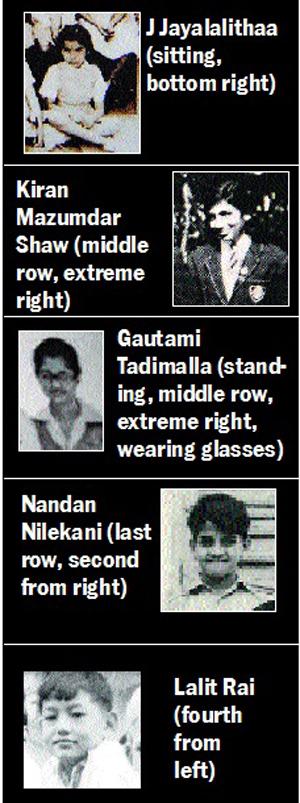
Prestigious schools in the city, Bishop Cotton Boys’ School and Bishop Cotton Girls’ School turn 150. As the schools and the Old Cottonians’ Association celebrate the landmark event through the year, Vidya Iyengar brings you some rare photos of eminent personalities who sat on those benches.
POWERPUFF GIRL J. Jayalalithaa (66) Fatima Jaffer, 68, 7th from left, standing in first row) was a class four student in the early 1950s at the Girls’ School. Her classmate was Tamil Nadu Chief Minister J Jayalalithaa, who studied only in junior school. “I think she was a good student, though I didn’t know much about her. We studied together for a very short time,” she says. Apparently, Jayalalithaa and Jaffer were admitted to the school on the same day — sometime in January (the term back then was between January and December) On Jayalalithaa’s birthday in February every year, sweets are distributed at the school.
FERTILE MIND Dr Kamini Rao (60) Taken in the garden of the Girls’ School in 1962, this photograph of Dr Kamini Rao, the pioneer in the field of Assisted Reproduction in India, shows her in class two. The photograph was taken on Prize day, when she was awarded five prizes. The bright and ambitious student was allowed to come to school in “colour dress”, she recalls, for her outstanding performance.
CHEMICAL POTENTIAL Kiran Mazumdar Shaw (61) We dug out this picture from the school magazine of the ’60s, which mentions that the Chairman and Managing Director of Biocon, Kiran Mazumdar was a senior prefect in 1968. She was part of the games committee (hockey). The 1967 records mention that she was also a junior prefect of the school.
A FLAIR FOR DRAMA Gautami Tadimalla (45) A ctress and Kamal Hassan’s partner, passed out in the early ’80s. Gautami Tadimalla studied until high school in Bishop Cotton Girls’ School. She was a boarder at the school because her doctor parents practiced in Vandiperiyar, Kerala.
INFORMATION-BOUND Nandan Nilekani (59) This is a class photograph of Std 5 B from 1965 which was the centenary year of BCBS. Can you spot business tycoon Nandan Nilekani? Recalling his classmate, CN Kumar (first on the last row), remembers Nilekani as a bright student who’d always stand first in class. He joined in class four from St Anthony’s School. He was part of the Pakenham-Walsh house. “He was there until class six or seven after which he went off to Dharwad,” he says.
MIND OF STEEL General Thimayya The late General Thimayya is a soldier of the Indian Army who served as Chief of Army Staff from 1957 to 1961, the years leading up to the conflict with China in 1962. This picture was taken when the general visited the school circa in as CAOS and met with Rev IL Thomas, Warden, BCBS. A few years later, on retirement from the Indian Army, he went on to command the United Nations peacekeeping force in Cyprus, where he died of a heart attack (1965).
WINNER Lalit Rai (58) A batchmate of Nandan Nilekani, Lalit Rai was a soldier of the Indian Army, who had the task of capturing the strategic heights of Khalubar in the Batalik sub-sector during Operation Vijay in the Kargil War. He was well-known as a football player. Joining the school in class five, he was there until class 10. He was part of the Pope house. Fun and mischievous is how C N Kumar recalls the colonel.
source: http://www.bangaloremirror.com / Bangalore Mirror / Home> Columns> Sunday Read / by Vidya Iyengar, Bangalore Mirror Bureau / July 19th, 2014
Hundreds of tourists visit the famous temples at Halebid which was also known as Dwarasamudra.It was their capital and when they changed the capital to Belur, this place became famous as old capital or Halebidu. Normally, tourists visit the famous Hoysalesvara temple here and enjoy the beauty of the delicate sculptures. Generally people do not even know the existence of three Jaina temples in the same place. Though these three Jaina temples do not exhibit that enchanting beauty of the Hoysalesvara temple, they present another facet of Hoysala art.
Many may wonder how Vishnuvardhana, a devoted Vaishnava was able to build these three temples in his capital Halebid. To understand this we have to just go back to some incidents that happened in the early life of Vishnuvardhana. His original name was Bittideva and was a staunch Jaina by religion. After coming into contact with the great Sri Vaishnava Saint Ramanujacharya, he became a Vaishnava and changed his name Bittideva to Vishnuvardhana. There are no historical records to support these incidents but these legends are very strong and make us believe them. One such legend states that Vishnuvardhana had a daughter by name Hariyaladevi and she was a problematic child physically and mentally from her birth itself. The physicians of the Palace could not cure her and make her normal. At that time Vishnuvardhana who had heard of Ramanujacharya paid a visit to him and narrated him the plight of his daughter. The saint by uttering some mantras cured the daughter of Vishnuvardhana and the latter was greatly imp
ressed by the spiritual power of Ramanujacharya and became his disciple and consequently he changed his name to Vishnuvardhana.
There is another slightly different legend to explain the name Vishnuvardhana. Bittideva had many wives among whom Lakshmidevi was the most beautiful and charming. She was a follower of Sri Ramanujacharya. She used her influence on her husband and converted him to Vaishnavism from Jainism. Naturally Bittideva changed his name also and began to be known as Vishnuvardhana. All these legends have no historical basis but they are strong in the minds of the people and the historians. Though Vishnuvardhana was a Jaina in the beginning and got converted to Vaishnavism, he was tolerant of Saivism which was one of the major sects of the period. This is evidenced by many Siva temples built by him.
The Jaina architecture is based upon Hindu architecture itself but the Jainas made some innovations and changes to suit the needs of their religion. They followed the usual pattern of Garbhagriha, Sukhanasi, Navaranga and Mandapa in a row. They added a pillar in front of the temple and it became unique as Manastambha. The Jaina art can be studied on dynastic pattern as Ganga, Chalukya, Hoysala, etc. That shows their inclination for adaptability. The double storeyed sanctum was an innovation of the Jains. But this did not become popular. The uniqueness of the Jaina sculptural style is the highly glossy polish of the Tirthankara images, even if the structure was built of granite. Another unique feature is the presence of tall metallic images found in many Jaina temples.
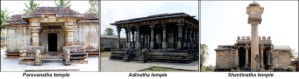
The three Jaina temples in a row at Halebid are dedicated to Parsvanatha (west), Adinatha (central) and Shantinatha (east) Tirthankaras. Parsvanatha was the 23rd Tirthankara (Jaina guru) and many people consider him as the real founder of Jainism. He was the son of Asvasena of Kashi. He lived as a housholder for 30 years and later became an ascetic. After deep meditation for 83 days, he attained the highest spiritual knowledge. He had a huge following of 1,64,000 men and 3,27,000 nuns who were highly devoted to him. He died at the age of 100 years on the summit of mountain Sammeta. Scholars have placed him in 8th century BC.
The temple dedicated to Parsvanatha was built by Bopparaja, the son of the famous Hoysala General Gangaraja. It was built in memory of Gangaraja. At this time the news of the victory (vijaya) over Bankapura was conveyed to Vishnuvardhana and he named the deity as Vijaya Parsvanatha. The temple is built of soapstone and consists of garbhagriha, sukhanasi and a navaranga and a detached enclosure. The square garbhagriha and the walls of the navaranga are decorated with pilasters at intervals. The most important attraction of this temple is the image of Vijaya Parsvanatha which is imposing by its height of 14 ft. The deity has a seven-hooded serpent over his head. The Tirthankara is a perfect yogi or a realised soul with sympathetic and benign smile on his lips. The lathe-turned elegant pillars in the navaranga are highly polished and exhibit mirror-like glossy surface.
The next temple is dedicated to Shantinatha. This is also similar to the first temple. It was built in 1192 AD during the reign of Ballala II (1173-1220). He was the next great king in Hoysala dynasty after Vishnuvardhana. He was born in 1154 AD and was appointed as a Yuvaraja as a child. He began taking interest in administration from his eleventh year. He was ruling for sometime with his mother Echaladevi and subsequently as an independent king. His father Narasimha was weak and was immersed in worldly pleasures. Ballala rebelled against him and after his father’s death, he assumed full powers and defeated many kings including Chalukya and Yadava kings. He was a patron of art and architecture also. He built this Jaina temple dedicated to Shantinatha. It consists of a garbhagriha, sukhanasi, navaranga and a mandapa. The first three parts were built during the Hoysala period while the mandapa was added during the Vijayanagara period. The sanctum has a fine image of standing Shantinatha which is 14ft in hei
ght. The navaranga pillars do not exhibit the glossy quality. Perhaps it was not finished at all.
The frontal mandapa contains granite pillars which are tall but are not artistic as those of the hoysala pillars. But they provide good support to the roof of the mandapa. Before the temple is a tall pillar referred to as manastambha which is similar to garudagamba or nandi kamba of vaishnava and saiva temples respectively. The manastamba is very elegant and indicates the special feature of jaina temple art, and can be seen in all Jaina temples. They can be seen in Sravanabelagola in plenty which is a great Jaina architectural centre not only in Karnataka but also in India.
Sravanabelagola is not only an ancient Jaina centre but also has a large number of Jaina monuments including temples and an evolution of Jaina architectural and sculptural art can be traced. Infact, its history starts from the Chandragupta basadi. The present structure is of a later period but scholars have opined that at that very spot existed the ancient Chandragupta basadi almost contemporary to the migration of King Chandragupta and the sage Bhadrabahu. Even at this great centre we do not come across three Jaina temples in a row close to each other. Thus it is unique feature here at Halebid.
The last temple is slightly smaller in dimension. It is dedicated to Tirthankara Adinatha. It was built in 1138 AD during the reign of Vishnuvardhana. He had a minister by name Mallayya and this temple is his initiative. An inscription is available and it records some historical details. Thus the three temples built by hoysala kings in their capital Halebid gives a hint to the importance given by them to jainism in addition to other religious of the State. This religious harmony of the hoysala period is specially noteworthy. This reminds us of a hoysala inscription which enunciates the equality of all Gods like Siva, Vishnu, Brahma, Budda, Jina, Karta etc. That this was not an empty boast and a lofty idea in theory but was practised in daily life is proved by the temples built by hoysala kings to all the religious faiths of their kingdom. That was the greatness of the hoysala dynasty.
source: http://www.starofmysore.com / Star of Mysore / Home> Feature Articles / July 26th, 2014
City’s noted snake rescuer and wildlife conservationist popularly known as Snake Shyam who has been elected as the Corporator of MCC Ward No. 17 was featured in Daily Mail, a UK tabloid on July 23.
The article in the tabloid says that Snake Shyam, despite being allergic to most anti-venom, catches some of the deadly species in Mysore every day.
It also says that this serpent-lover had been bitten four times and the doctors discovered that their treatments were prompting a severe allergic reaction which could kill him.
That means that Snake Shyam’s next call-out could be his last – but despite the dangers, he refuses to give up.
The article also features photographs of Shyam catching snakes, documenting them, his Maruti Omni Van and video of him catching a snake.
Reaches 28,000 mark yesterday
With the rescue of a Rat Snake at a steel godown in Bannimantap here yesterday, Shyam has so far rescued 28,000 snakes.
Snake Shyam speaking to SOM said that he began catching snakes in 1980 and had not documented them till 1997. He further said that on the advice of some, he began to document the snakes he had rescued from 1997 and has so far rescued 28,000 snakes and released them into their habitat far from urban areas.
He has called upon the people not to kill them, but instead call him on Mob; 94480-69399 and keep a watch on the snake till he arrives.
source: http://www.starofmysore.com / Star of Mysore / Home> General News / July 25th, 2014
Ajai Appachu, Fouaad Mirza and Nadia Haridass, three of Karnataka’s senior show jumpers, would take part in the equestrian event of the 17th Asian Games to be held in Incheon, South Korea, from September 19 to October 4.
Appachu, Mirza and Haridass train in Bangalore’s Embassy International Riding School (EIRS) and have qualified through five trials, qualifiers and competitions which were held from October last year to April this year, said a media release today.
There were five jury members involved in making the selections for each of the competition’s disciplines – jumping, dressage and eventing.
Appachu has earned several equestrian accolades at events world-wide and recently placed second at the Hopetoun Commonwealth Cup in Scotland and is also the chief instructor for budding equestrians at the school.
Mirza, 22, placed fourth at the Hopetoun Commonwealth Cup earlier this year while Nadia has been a consistent performer in the dressage category – representing the country at international meets, the release said.
The equestrian sport has been featured in the pan-Asian sports spectacle since the New Delhi Games in 1982 and to date, Japan leads the honours list, followed by South Korea and India in that order.
source: http://www.business-standard.com / Business Standard / Home> PTI Stories> National> News / Press Trust of India / Mumbai – July 24th, 2014
Chayaa nanjappa National Best Entrepreneur Award From the Confederation of Women Entrepreneurs of India was presented toher in Hyderabad on Monday. |EPS
Bangalore :
From Srirangapatna to Europe, it has been a long and difficult journey for 42-year-old Chayaa Nanjappa. But she has battled the odds and today heads a rural enterprise which produces high-quality honey that sweetens many a home even in Europe and the United States.
As a reward for her hard work, Chayaa was on Monday awarded this year’s ‘National Best Entrepreneur Award’ in food processing by the Confederation of Women Entrepreneurs of India.
Her path to success has not been a smooth one; she had to overcome many an adversity, physical abuse and traumatic relationships. But now, this gentle, self-made woman provides a livelihood for not only many illiterates of Mysore and Mandya districts, but also some tribals across the state. She is also the largest buyer of forest honey from Malayalis and tribes like Siddis and Jenu Kurubas.
She began her journey by setting up a small unit at Bommanahalli with the help of a `10-lakh loan. She then shifted operations to Nanjangud and later, to Srirangapatna.
Today her enterprise Nectar Fresh, which produces monofloral honey, has a capacity of 200 tonnes and is worth `6 crore. It is one of the largest bulk suppliers and packers of honey in the country and falls in the top five bulk exporters of raw as well as processed honey. Nectar Fresh also has the ISO 22000:2005 certification.
Chayaa told Express, “With no work experience or exposure, I started a rural industry in 2007 that could be identified with my hometown, Coorg. After doing a basic course from Central Bee Research and Training Institute (CBRTI), I jumped into the industry completely, sourcing honey from tribes and farmers.” She has 20 mobile apiary vans across the country.
Going International
To earn her brand a significant international presence, she decided to market it as a basket of products, including jams and sauces. The result: it found a place in the European market. “I added jams and sauces to my basket by purchasing pulp from sick units run by women in places like Bangalore and Mangalore, and sourcing fruits like papaya and tomato directly from farmers,” she said.
With exports to Germany and France, Nectar Fresh has broken the monopoly of global companies like Bereenberg, Darbo and Bonne Maman. “We met the stringent standards necessary for approval to export to Germany and made a strong impact by packaging our honey and jam in polypropylene sachets for high quality and shelf life. The European competitors feel threatened by our presence,” said Chayaa, who is now busy tying up with a Saudi Arabian company for the production of jams from dates.
She credited the Karnataka Village Industries Board (KVIB), CBRTI, the Horticulture Department, the Central Food Technological Research Institute (CFTRI), Le Meridien, ITC Foods and a host of others who supported her. “Any small and marginal farmer in Karnataka producing quality honey can contact me. My sole aim is to promote rural products and help women in distress by providing employment opportunities,” she said.
source: http://www.newindianexpress.com / The New Indian Express / Home> States> Karnataka / by Meera Bhardwaj / July 31st, 2014
Anticipating policy support from the Modi government at the Centre, Tata Solar Power (TSP) announced expansion of its manufacturing facility from 125 MW TO 200 MW at Bangalore.
The TSP officials also praised the Commerce Ministry’s initiative of levying Anti-Dumping Duties (ADD) and Domestic Content Requirement (DCR) of solar cells on US, Malaysia and China, as a positive move to level the playing field for the domestic producers.
Ajay Goel, the CEO of TSP, said, “This substantial expansion, in an extremely competitive and price-sensitive sector, is a testimony to the superior quality and global competitiveness of our products. Though the Jawaharlal Nehru National Solar Mission (JNNSM) originally intends to promote domestic producers in the Solar power manufacturing industry, there are barely few takers for such schemes as the cost of capital will still remain high in the presence of cheap flowing from the Chinese market,” he said.
Incidentally, the company officials maintained that it has not received any expression of interest from the Karnataka government, which in recent day has been actively in news for promoting roof-top solar panels for domestic users under Karnataka Solar policy.
source: http://www.indianexpress.com / The Indian Express / Home> Cities> Bangalore / Express News Service / Bangalore – May 28th, 2014
Canara Bank has lanched a unique skill development programme of making stationery and gift items with pressed flowers, craft paper bags designed for women inmates of central prison, Parappana Agrahara, here.
The three-day skill training programme at the women’s block of the central prison was organized under the CSR initiative of the bank. It was meant to engage the women to generate income while within the prison wall as well to equip them to make their livelihood on release.
Canara Bank DGM K Virupaksha assured the women further training support and added that the bank will support in marketing the products made by the women through the high-tech mobile sales van “Nammura Santhe” which is a unique initiative of the bank for helping micro women entrepreneurs in the City of Bangalore.
source: http://www.timesofindia.indiatimes.com / The Times of India / Home> City> Bangalore / M.K. Madhusoodan, TNN / July 30th, 2014