1,069 stage plays … 27 musical instruments … 1 person

‘Namma Mysooru Huduga’ Subramanya Rao!

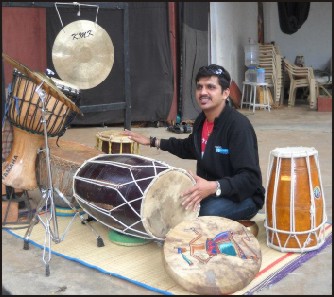
Mysore, as we all know, is famous for its culture and artistic people. Great musicians have been born and brought up here from centuries. Subramanya Rao, who lives in Srirampura of the city, is one such young lad who has attained success early in his life and plays instruments as much as his age ! He is now 27 and plays almost 27 to 28 musical instruments.

by Phalgunn Maharishi
SubramanyaRaoBF 13jul2014

Being born into an artistic family, Subramanya Rao was influenced a lot by his mother who was a violinist and sister, a classical dancer. Subramanya is a graduate from D. Banumaiah’s and also pursued his Diploma in Audio Engineering from SAE Institute, Bangalore.

Subramanya started learning Mridangam under Bhakthavatsalam when he was just seven-years-old which he continued for the next five years. “I always had a keen interest in learning music from my very early age. My desire for the musical instruments led me to Raju Ananthaswamy who was then teaching Karnatak classical music at ‘Natana.’ I had been there to learn Karnatak vocals but instead started laying my hands on tabla and accompanied Raju Sir for nearly seven years,” said Subramanya while speaking about his early music classes.

Subramanya, whom we can consider as a bank of folk musical instruments, plays Djembe, Darbuka, Chende, Dholak, Dufna, Dholki, Tamte, Nagara, Mridangam, Tabla and many other percussion instruments totalling up to 20 and above — all which he can play at a time! According to him, some incidents which took place between himself and his family members have been real inspiration behind his desire to learn different musical instruments. He then explained, “My whole family is into music and my cousins and others used to jam together playing various musical instruments during our family gatherings. When I tried to join them, I was frequently being told to learn music and then touch the instruments. Such incidents helped me make my mind towards learning music.”

Subramanya is an active member of Mandya Ramesh’s ‘Natana’ from the past 11 years and has also worked with Dr. B. Jayashree’s ‘Spandana’ theatre group for a number of plays. He mainly concentrates on theatre music and acting and has worked for 1,069 plays as of now throughout the nation including repeated shows. He and Murali Sringeri have composed music for plays like ‘Dhaam Dhoom Suntaragaali’ which was performed in AHA! International Festival at Ranga Shankara, ‘Noorondu Huli’ and ‘Alilu Ramayana’ with Natana, Mysore. He has also attended Hampi Utsav, Sonda Utsav and National School of Drama’s Bharat Rang Mahotsav with Spandana Theatre Group.

Subramanya said, “My parents have always been my biggest support. Yes! My father was initially not happy with my decision of pursuing a career in music and theatre. He had a feeling of insecurity until I started playing percussion for the early episodes of Ede Thumbi Haaduvenu.” He also added, “Mandya Ramesh and Dr. B. Jayashree have supported me a lot in theatre and when it comes to music, Ravi Shankar of AarKey Creators has always been a backbone for me. Words are just not enough for me to thank them.”

Subramanya has accompanied many great artistes like Shankar Mahadevan, Praveen Godkindi, Ashwath, Praveen D. Rao, Pallavi Arun and Dr. B. Jayashree for their live concerts and albums. He has also worked as a rhythm arranger for many music albums among which “Marathenendare Mareyali Hyaanga,” “Thaaye,” “Ranga Ganapa” and “Bannada Badukina Chinnada Haadugalu” are noted ones. He also has worked with great composers like Harris Jayaraj, Ilayaraja, Shankar Ehsaan Loy and Guru Kiran for their film songs. His recent work was for a Hindi song “Havan Karenge” from Bhaag Milka Bhaag composed by Shankar Ehsaan Loy for which he has played Kanjira.

He also is a part of a renowned Mysore-based folk band known as “Haiklu” for which he handles the rhythm section. Lead vocals are by Nagesh, rhythm guitar by Pradeep Kiggal, bass guitar by Bobby Moyabo and many other folk musicians play on board with the band. The band has so far given several performances in Gokarnothsava, Shivaji Janma Dina at Ravindra Kalakshetra, Adichunchanagiri and Vanaranga to name a few.

While speaking about his work in Kannada Film Industry, Subramanya said, “It is sad, but there seems to be no value for creativity here. Almost all music composers except a few use pre-recorded loops. I am a small person to tell this, but as a musician I would love to be treated well in my own land by our own music composers.”

While speaking about his ambitions and aims in music, Subramanya said, “I am really ambitious to receive the prestigious ‘Ustad Bismillah Khan Yuva Puraskar’ given by Sangeet Natak Akademi. I never apply anywhere, but let’s see where the fate takes me,” with a confident smile. He even commented, “I am interested in teaching music; not in a commercial way but in a social way. I teach music for those children who are not able to pay fees and learn. I am now associated with Mythri Charitable Trust, Nireekshe and Raja Maja by Natana to teach music for such children.” He soon added, “Any such children who are unable to pay fees but interested in carrying forward the folk music can contact me. I would really be happy to teach them. I also admit that I keep travelling across the country and may not be available to teach them on a regular basis, but I surely will find time for them.” Musicians can be found in plenty, but with such great persona are very rare to be seen.

source: http://www.starofmysore.com / Star of Mysore / Home> Feature Articles  / July 08th, 2014

Dr. B R Shetty Honoured with Frost & Sullivan – Lifetime Achievement Award for the Year 2013

frostBF

Dubai, United Arab Emirates (Frost & Sullivan).

Dr. B R Shetty is the Founder & Chief Executive Officer of the Abu Dhabi-based NMC Healthcare and Managing Director & CEO of UAE Exchange. He was recently presented with the Frost & Sullivan – Lifetime Achievement Award of the Year 2013 by Y.S. Shashidhar, Managing Director – Middle East, North Africa and South Asia, Frost & Sullivan and Sandeep Sinha, Vice President – Middle East, North Africa and South Asia, Healthcare & Life Sciences at Frost & Sullivan.

Speaking about the Award, Dr. B R Shetty said, “I feel honoured to have been conferred with the Lifetime Achievement Award. I want to thank Frost & Sullivan for their encouragement and appreciation. Awards such as these are always a source of motivation to dream bigger and achieve higher. They act as the fuel that drives my passion towards serving the society through my professional ventures and personal pursuits.”

Frost & Sullivan Awards are presented to companies and individuals who have pushed the boundaries of excellence in the industry – rising above the competition and demonstrating outstanding contribution to industry and economic growth. Through this award, Dr. Shetty was recognised for playing a pivotal role in development and strengthening of the healthcare sector in the UAE and for his exemplary leadership qualities and involvement in philanthropic activities. Dr. Shetty’s journey is an inspiration to many and exemplifies the power of the human will.

Presenting the Award to Dr. Shetty, Y.S. Shashidhar, Managing Director – Middle East, North Africa and South Asia, Frost & Sullivan, said, “Dr. Shetty’s contribution to the healthcare sector in the UAE is exemplary. Achieving one’s ambition through path-breaking innovation, ability to turn challenges into opportunities and strategic thought leadership to ensure sustainable growth are skills which the Lifetime Achievement Award recognises. We are therefore, proud to present this Award to Dr. Shetty for the phenomenal impact he has made through hard work and perseverance.”

source: http://www.moneylife.com / MoneyLife / Dubai, UAE / July 03rd, 2014

Ten-and-Half Rules to be a good journalist

“Meet or talk to at least one new person, whom you did not know, every day.” 

KrishnaPrasadBF12jul2014

Krishna Prasad, Editor-in-Chief of the national news magazine Outlook, was in city on July 1, 2014 to participate in the PRESS Day celebrations organised by Karnataka Media Academy and the Department of Information at Rani Bahadur auditorium in Manasagangotri. It was Star of Mysore that first discovered the journalist in this talented Mysore boy and published his writings. Later he started out as a stringer for The New Indian Express under the editorship of T. J. S. George while he was still studying electronics in college. He has also worked for The Sunday Observer (now defunct) and The Times of India.

He has edited the English daily Vijay Times (now converted into Bangalore Mirror). He joined Outlook as a reporter and later became the magazine’s special issue editor. In October 2008 he took over as editor of Outlook and now the Editor-in-Chief. Krishna Prasad, who publishes the popular blog, Churumuri, has also instituted the T.S. Satyan Memorial Awards for Photo-journalism (in memory of city’s noted photo-journalist) in association with Karnataka Photo News (KPN), a regional photo news agency based in Bangalore. Here we publish an article titled “Ten-and-a-half rules to be a good journalist” by Krishna Prasad, for the benefit of both the aspiring and working journalists. —Ed

By Krishna Prasad

My father was not a journalist. My mother was not a journalist. Nobody in our family was a journalist. I did not go to a journalism school. Or do a BA or an MA, or get a Ph.D in journalism. No teacher ever taught me how to become a journalist. I have never bought or read a book titled “How to be a Good Journalist.”

I say all this not to boast about myself but to draw your attention to the simple beauty of journalism — “The World’s Best Profession,” according to the Nobel Prize-winning author Gabriel Garcia Marquez — which welcomes thousands of utterly “unqualified” people like me to proudly call ourselves and earn a living as journalists.

This is a power — and a pleasure and a privilege — no other profession offers. Doctors, engineers, bureaucrats, police officers, teachers, beauticians, nurses… all of them have to attend classes, read textbooks, take tuitions, write exams and pass courses before they can “qualify.”

Not us, journalists. We are proud students in the “University of Life.” We are journalists not because we could not become doctors or engineers, but because all we wanted to be was journalists. Passion is the fuel that drives our profession.

Look around you and you will notice that most of India’s most influential names in English journalism are not “qualified” journalists. From George Verghese to T.J.S. George, from Aroon Purie to Arun Shourie, from M.J. Akbar to Vinod Mehta, from Shekhar Gupta to Swapan Dasgupta, from Cho. Ramaswamy to Arnab Goswami… none of them “studied” journalism to become journalists.

Neither did the great Editor-in-Chief of Harijan and Young India, Mahatma Gandhi.

There are fine exceptions, of course, like N. Ram of The Hindu who went to the Graduate School of Journalism at Columbia University, as did Barkha Dutt of NDTV. But, on the whole, it is fair to say that in India, only diploma-holders, graduates and post-graduates in journalism do not become good journalists.

On the contrary, on available evidence, the opposite is true.

To paraphrase the West Indian cricket writer C.L.R. James: “What do they know of journalism who only journalism know?”

This is not to decry the value of journalists holding a formal journalism degree or the fine work being done by specialised journalism schools and colleges in Universities. Just a statement of fact.

Why this is so simple: Journalism cannot be taught but it can be learnt. No one can teach you how to be a journalist but anyone, anywhere — male or female, young or old, urban or rural, rich or poor — can learn how to be a journalist.

This is not a new paradox. Even in the 1930s, the University of Mysore debated whether the subject of journalism should be offered as a course at all, since it is neither an art nor a science.

So, on the strength of having spent 28 years in journalism without a journalism degree, here are 10-and-a-half things which should help any journalist to become a good journalist — or anybody who wants to become a journalist.

10- DO WHAT YOU LOVE: Whether you want to be a political journalist or a business journalist or a cricket journalist or a film journalism, if you do not love what you do, your reader or viewer will not feel your passion. Choose your field not because somebody suggests it but because you want to. Be responsible for your life, don’t blame others for what you become or don’t become.

9- WAKE UP ANGRY, AMBITIOUS: Get the fire in your belly to do something with your life, to set right something in your village, town, city or country. Respond to injustice, inhumanity, corruption. Comfort the afflicted, afflict the comfortable. Don’t think it is somebody else’s job. As Gandhi said, “be the change you want to see.”

8- DON’T BE THE MEMBER OF ANY PARTY, GROUP, CLUB, NGO: Credibility is everything in journalism. Retain your independence. Do not be too close to any politician, businessman, film actor or PRO. Be skeptical not cynical. Don’t mortgage your integrity. It’s like virginity — once you lose it, you have lost it forever.

7- BE CATHOLIC OF WRITERS AND WRITING: Read newspapers, magazines, books, website across the board. Do not read only what you like but what you also do not like. Admire writers/writing irrespective of ideology. In the age of the internet, you have no excuses for your ignorance.

6- FIND YOURSELF A ROLE-MODEL/MENTOR: Have a hero (or heroine) who has been there and done that in journalism. Keep in touch with people who will help you achieve your aims. Meet or talk to at least one new person, whom you did not know, every day.

5- BE A THRIVER, NOT A SURVIVOR: Don’t coast along, don’t be afraid to try out something new. Aim high, dream, have an ambition, set yourself a goal. Take a risk, think big, think differently, don’t be predictable. At the same time, develop the stamina to withstand obstacles and defeats.

4- NEVER WORK WITH SUCCESS/ REWARD IN MIND: Work for fun and satisfaction, the rewards will come on their own. Don’t fall for cheap praise and don’t be stalled by even cheaper criticism.

3- WRITE, DRAW, SHOOT, CREATE EVERY DAY: Eventually your habits become you. Practice makes you perfect. Develop the three Ds — discipline, dedication, determination — and reward and recognition will naturally follow.

2- FEAR NOBODY, QUESTION EVERYTHING: You are in the business to get the answers. Don’t be in awe of big names, power, reputations, status. This business is all about meeting total strangers and asking them questions you wouldn’t ask your parents. There are no stupid questions, only dumb answers. Talk less, listen more. Be humble of your ignorance.

1-CHASE YOUR DREAM: Stop living for others, avoid temptation, life is not all about money. Let your reputation never be under question. It’s true — it’s possible to earn decently and live honourably as a journalist.

1/2 – And this half-rule: IF POSSIBLE, MARRY OUTSIDE THE PROFESSION: There’s nothing more boring and dreadful than waking up with somebody who goes through the same pangs and problems as you.

source: http://www.starofmysore.com / Star of Mysore / Home> Feature Articles  / July 07th, 2014

Kariya Kanbitta , an eye-opening movie on casteism and untouchability

Mysore :

Dr. B.R. Ambedkar Research and Extension Centre and Nele Hinnale together had organised a function at Rani Bahadur auditorium in Manasagangotri here yesterday to mark the screening of the movie ‘Kariya Kanbitta’ directed by Kavitha Lankesh followed by an open interaction.

The movie is based on the book ‘Dana Kayuvavanu’ written by Subbu Holeyar featuring trials and tribulations encountered by a dalit boy in society.

The audience which viewed the movie lauded Kavita for excellent portrayal of the onslaught of casteism and untouchability on dalits in society.

During the interaction, people opined that there was no discrimination between rural and urban areas as far as untouchability was concerned. They added that urbanites refrain from renting out houses to dalits. They commended Kavita for projecting the social system very close to reality.

Felicitating Kavita, State women’s Commission Chairperson Manjula Manasa opined that women in every sector were virtually turning untouchable.

District in-Charge Minister V. Sreenivasa Prasad viewed the entire movie sitting among the audience.

Dr. Ambedkar Development Corporation Managing Director Dr. R. Raju, litterateur Prof. Kalegowda Nagawara, Mysore University Registrar Prof. C. Basavaraj and others were present.

source: http://www.starofmysore.com / Star of Mysore / Home> General  News / July 07th, 2014

Ravi Shankar Prasad meets IT leaders in Bangalore

Prasad discussed concerns of services, products & manufacturing industries; said he’ll stand by the industry

Bangalore on Tuesday hosted Communications and Information Technology Minister Ravi Shankar Prasad  for the first time since his appointment.

Ravi Shankar Prasad
Ravi Shankar Prasad

The event was organised by information technology (IT) body Nasscom and software product think tank Indian Software Product Industry Round Table (iSPIRT). IT leaders raised concerns on policies and doing business in the country. Others shared their ideas on strengthening the Indian IT ecosystem.

The meeting, parts of which were closed-door, was attended by Wipro Chairman Azim Premji; Microsoft India Chairman Bhaskar Pramanik; Microsoft Ventures Director Ravi Narayan; Infosys Delivery Excellence Head Srinath Batni; Mindtree Chief Executive Krishnakumar Natarajan; Mastek Founder Ashank Desai; and Info Edge Founder Sanjeev Bikhchandani, among others.

Referring to his visit to Bangalore as ‘IT Panchayat’, Prasad said this was his maiden trip outside of Delhi ever since he took charge as a minister, which is a ‘signal’ and a ‘mission statement’ with respect to the style of functioning of the new government.

“If you ask me, they (IT industry representatives) did not have much of grievances; what they wanted was a sense of sentimental patronage by me and that’s why I am here, to give them the recognition that I am with you and I stand by you. That is why I am here,” Prasad told reporters at the end of all the meetings.

Prasad, who is also the minister for law and justice, said the newly elected National Democratic Alliance (NDA) government will focus on two major milestones, including broadband connectivity across rural India and electronics manufacturing in the country.

The new government has initiated efforts to speed up the process for setting up of semiconductor chip fabrication (fab) units in the country, he said. “I had personal chats with people behind the fab projects. I have asked them to do it on a fast-track basis and we are going to stand behind them because I realise the potential that once a fab facility is established, India is going to expand enormously in everything from chip design to manufacturing,” he said. He added that the government is looking to create structure like Software Technology Parks of India (STPI) to further incentivise fabs.

The government is currently shortlisting consultants who will appraise the detailed project reports submitted by the two consortiums who bid for the project. Infrastructure company Jaypee Associates and home-grown chip firm Hindustan Semiconductor Manufacturing Corporation (HSMC) lead the two existing consortiums.

While Prasad assured industry representatives that he would look into the matters relating to taxes and duties on electronics manufacturing, he also questioned industry leaders about other reasons why India has been a laggard in the sector. Electronics manufacturing, he said, is “a priority” for the new government, and sought feedback on what can be done to give a boost to the sector.

“Why can’t we manufacture mobiles?” he asked. “I understand there is a duty structure issue, and we are trying to address it, but that cannot be the only reason why the sector did not grow,” he said.

He also said that broadband connectivity to villages is an agenda of great priority for the government.

“When I had joined the government I had made a statement that if Mr. Vajpayee’s government was known for national highway, Mr. Modi’s government will be known for broadband highway,” Prasad said. “Broadband connectivity is an agenda of great priority for us. The Prime Minister has clearly instructed us that we must have broadband in all the villages of India.”

source: http://www.business-standard.com / Business Standard / Home> Economy & Policy> News / by Itika Sharma Punit /Bangalore – July 02nd, 2014

Bangalore to host first Israeli film festival

Project of new Israel consulate to open with classic Israeli tale of Indian Jewish immigrants.

A scene from "Turn Left at the end of the World."
A scene from “Turn Left at the end of the World.”

Israeli cinema continues to find new audiences as Bangalore, India gets its first official Israeli film festival, The Hindu reported Tuesday.

The festival debuts on Wednesday appropriately with the blue-and-white classic “Turn Left at the end of the World,” which recounts the tale of a family of Indian immigrants in a small development town in the Negev and their interaction with fellow immigrants from Morocco.

The year-old Consulate General of Israel in Bangalore is hosting the festival through the end of July jointly with Suchitra Film Society and Bangalore Cultural Partners.

Menahem Kanafi, Israel’s Consul General in Bangalore said he hoped the event would bring Indians and Israelis closer together culturally, according to The Hindu.

“The festival will expose [India to] the facets of life in Israel and point out universal connections between Israeli and Indian art and life,” he told a news conference.
Kanafi said nine films would be screened, including “Footnote,” a 2011 Oscar nominee in the Best Foreign Film Category, and “The Band’s Visit.”

Another film that should appeal to Indians is “Album 61,” a 2013 biopic on Israeli chess player Boris Gelfand, who has played against Indian legend V. Anand.

source: http://www.haaretz.com / Haaretz / Home> Life / Movies & Television / by Haaretz / July 02nd, 2014

Rashmi Mahesh is new Director General of ATI

RashmiBF11jul2014

Bangalore :

Karnataka government yesterday appointed senior IAS officer Rashmi Mahesh as Director General of the Administrative Training Institute (ATI) in Mysore.

It is said that Rashmi, who had busted the seat-blocking scam by many private colleges in admissions to professional courses had helped many rural students in getting seats into these courses had been hurriedly transferred to the Social Welfare Department.

Rashmi, who had gone on a long leave protesting against her posting to the Social Welfare Department, has now been posted as Director General of ATI.

It is alleged that many elected representatives and bureaucrats were involved in the seat-blocking scam which had been cracked by Rashmi.

source: http://www.starofmysore.com / Star of Mysore / Home> General  News / July 06th, 2014

8000 Ayurvedic doctors allowed to practise modern medicine

SUMMARY

In Maharashtra, the BAMS graduates were registered in different schedules based on their educational qualifications.
______________________________________________________

In a huge relief for 8000 Ayurvedic doctors who have obtained their degrees from universities in Bangalore and Goa and have been practising in Maharashtra for the last ten years, the state has now included them in Schedule A of the Maharashtra Medical Practitioners Act and allowed them to practise modern medicine.

Schedule A, A1, B and D of the Act allow ayurvedic and Unani doctors to practice modern medicine. After completing the Bachelor of Ayurvedic medicine and surgery course at Rajeev Gandhi university of health science at Bangalore and Goa universities, students had applied for registration in the Maharashtra council of Indian medicine.

“However we were registered in Schedule E of the Maharashtra Medical Practitioners Act,” says Dr Mandar Ranade, spokesperson for National Integrated Medical Association (NIMA). Schedule E is for those practitioners who do not have a proper institutional background. Hence after completing an institutional degree, getting registered in a schedule for non institutional graduates was not only discriminatory but insulted their qualification, doctors pointed out.

In Maharashtra, the BAMS graduates were registered in different schedules based on their educational qualifications.

“Despite the same degree, curriculum and syllabus these students were registered in Schedule E of the Maharashtra medical practitioners Act,” Dr Suhas Parchure, former president of NIMA, said. He along with others actively led a campaign for the students, as despite residing in various parts of Maharashtra they could not practise modern medicine.
On June 26, the government issued a resolution that included these ayurvedic doctors in Schedule A of the Maharashtra Medical Practitioners Act. “It is a a victory of sorts. These were are institutionally qualified graduates of the Central Council of Indian Medicine recognized colleges and universities and yet they were being discriminated against,” says Parchure.

source: http://www.indianexpress.com / The Indian Express / Home> Cities> Pune / by Express News Service / Pune – July 04th, 2014

City’s Srikantha Rao is Indian ice-skating team coach

Mysore :

Mysorean K. Srikantha Rao, an Ekalavya Awardee and the General Secretary of the Mysore District Roller Skating Association, has been chosen as the Indian team coach for the short course Ice-skating team which will train at Inzel in Germany.

Srikantha Rao will be visiting Germany and will be in-charge of the four-member Indian Ice-skating team’s training camp to be held in Inzel, Germany from July 7 to 20, 2014.

source: http://www.starofmysore.com / Star of Mysore / Home> Sports  News / July 05th, 2014

City’s music scholar Dr. V.S.S. Acharya no more

DrAcharyaBF10jul2014

Mysore :

City’s noted music scholar and State Sangeetha Vidwan awardee Dr. V.S. Sampathkumar Acharya (86), a resident of Lakshmipuram, passed away here this morning after a brief illness. He leaves behind wife Sangeetha Vidushi D.S. Leela, son V.S. Mohanram and daughter-in-law Anjana. Last rites will take place in city this evening.

Profile: Dr. V.S.S. Acharya, after passing BA (Hons.) in History from Maharaja’s College, did his B.Ed and later MA from Benaras University. He got a Ph.D in History from Mysore University. He completed Hindi Visharada also.

Dr. Acharya developed a passion for music literature and has authored several books on music. He has also come out with an encyclopedia on music, making it understandable to a common man. During last Dasara, Dr. Acharya was honoured with the prestigious State Sangeetha Vidwan award given by Department of Kannada and Culture, at a function at the Mysore Palace.

source: http://www.starofmysore.com / Star of Mysore / Home> General  News / July 05th, 2014