A Gandhi who studied in Mysore

by  M. S. Diwakar

A few days ago, I read with interest a news item in several newspapers about Dr. Shanti Gandhi, a descendent of Mahatma Gandhi, contesting and winning a seat in an Assembly district in the United States.

Dr. Shanti Gandhi, son of Kantilal Gandhi and Saraswathi Gandhi, had stood for election on a Republican ticket and he defeated his Democratic rival, Theodore Ensley in the elections held in Kansas’ State. Dr. Shanti Gandhi, a cardio vascular surgeon, had contested for the 52nd Assembly district. He arrived in the United States in 1967 as a medical graduate from Bombay.

This news item immediately triggered my memory and I soon realised that Shanti Gandhi’s father, Kantilal Gandhi, had studied medicine in Mysore.

Both Kantilal and his wife Saraswathi had spent several years in Mysore when Kantilal was studying medicine. They had stayed on in separate houses but would meet both during the day and in the evenings and spend time together and join their neighbours in participating in Gandhian activities, including singing Ram bhajans, debates and discussions.

Kantilal Gandhi’s father was Harilal Gandhi, the eldest son of Mahatma Gandhi. Harilal had always dreamt of making Kantilal a doctor. Kantilal passed matriculate when he was 20 years of age and despite disapproval from the Mahatma, his grandfather, he decided to study medicine in Mysore.

The credit for ensuring that Kantilal chose Mysore to study goes to Sir Mirza Ismail, the then Dewan of Mysore State. Mysore was under the Wadiyars and it was steadily making progress in all the fields. It was also one of the most progressive Princely States in India and Gandhi had a fairly good acquaintance with the then Maharaja and Dewan.

Kantilal settled down in Mysore with his wife. They spent several years in Mysore before Harilal came to see them. Harilal stayed with them for several weeks and enjoyed the company of his family. Mahatma Gandhi too was pleased that Harilal had settled down with his family and wrote to Saraswathi about it.

Mahatma Gandhi also addressed several letters to Kantilal, affectionately calling him Kanti. He affectionately called Saraswathi “Saru.” In one of his letters, he says Mysore is a good choice for him to study as it has produced some brilliant people.

Kanti called his wife Saru. By accounts, Kantilal and Saraswathi led a happy life in Mysore. While Harilal (born in 1888) died in 1948, Kantilal died in 1983. His wife Saraswathi died in Tiruvananthapuram, Kerala, on December 15, 2008.

Dr. Shanti Gandhi happens to be the son of this illustrious couple.

A book, Mahatma Versus Gandhi by Dinakara Joshi and letters by Gandhi to Harilal Gandhi and Kantilal Gandhi will give more details on these aspects.

[M.S.Diwakar of Bangalore can be contacted on Mob: 9880046397]

source: http://www.starofmysore.com / Star of Mysore / Home> General News / June 03rd, 2014

Dornahalli fest from June 4

Mysore :

The annual fest of St. Anthony’s Shrine at Dornahalli in K.R. Nagar taluk will be held from June 4 to 13.

Addressing a press conference here recently, Rev. Fr. Gilbert D’Silva, Rector, St. Anthony’s Shrine said that the nine-day festival will be inaugurated at 6 am by hoisting the flag at the shrine on June 4. About the Shrine:The Miraculous Statue of St.Anthony has an authentic history now covering a period over two hundred years. A humble peasant, while ploughing his ragi field suddenly came across a small wooden statue; and thinking it for a ‘doll’, he gave it to his children to play with.

One night he had a dream in which a friar wearing the same dress as that of the statue appeared to him and told him that the object turned up by his plough was not a ‘doll’, as he thought; but a statue of a revered catholic saint, known all over the world as Wonder-Worker, that he would like to have a special Shrine in his honour in that place of discovery and that he and his family would be blessed. But the farmer, however, turned a deaf ear to this admonition and in the course of a week his bullocks died and two untimely deaths of his children occurred, which he attributed to his negligence to carry out the instructions received in the dream.

A catholic priest who used to come from Pondicherry to visit Bangalore and Mysore once a year recognised the statue as that of St.Anthony of Padua and urged the farmer to carry out the instructions received in his dream. The farmer erected a little shrine in the field where he had found the statue.

Thereafter the farmer began to prosper well and the news spread. The Shrine became the centre of devotion in spite of various obstacles and hardships. People began to flock to the shrine to seek the saint’s intercession in their distress and sorrows. The fame of the Shrine grew fast and soon a catholic village grew up in the environs of the shrine.

Rt. Rev. Msgr. I.H.Lobo, the former parish priest of Dornahalli, began the construction of a new church in 1964. On 13th June, the same year the foundation stone of this huge church was laid by the Bishop of Mysore. On 13th June, 1969 the new Church was consecrated by the Bishop of Mysore.

source: http: //www.starofmysore.com / Star of Mysore / Home> General News / June 02nd, 2014

MELANGE: HIDDEN HISTORIES – The original take one

BRV Theatre has donned many roles from armoury to theatre to defence services canteen. /  Photo: K. Murali Kumar / The Hindu
BRV Theatre has donned many roles from armoury to theatre to defence services canteen. / Photo: K. Murali Kumar / The Hindu

The vintage cinema haunt of Bangalore’s movie buffs, B.R.V. Theatre nurtures memories of a bygone era

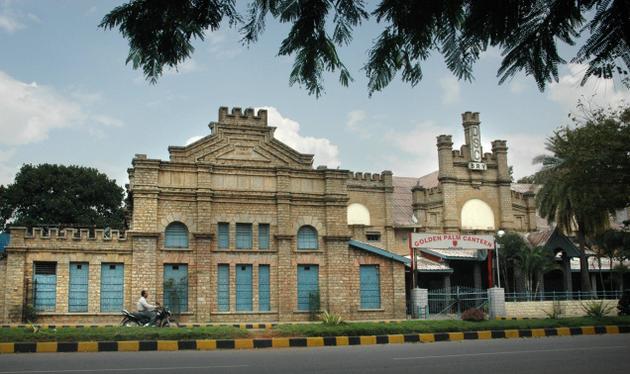
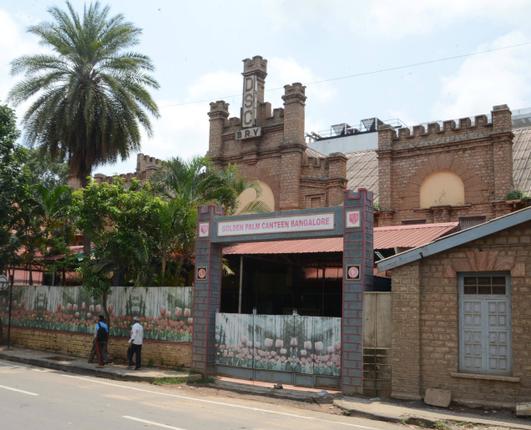
You may have passed by this building almost every day if you have to go through Shivajinagar and yet, the quaint B.R.V. Theatre may have easily slipped your attention. Located at the entrance of Central Street, the present Golden Palm Army Canteen has a legacy that goes back to over a century. While many may know it now as a canteen and Bangalore’s older residents remember it fondly as a theatre, B.R.V. was initially started as canteen/store and armoury of the Bangalore Rifle Volunteers denoting the abbreviation.

The B.R.V was part of the Madras Army and formed on November 21, 1884 and stationed in KGF, Mysore and Whitefield. The unit was later merged Coorg and Mysore Rifles on April 1, 1917 to become the sixth Bangalore, Coorg and Mysore Batallion.

The original building demolished in 1905 and rebuilt to the present tiled-roof stone-covered structure in 1912. Housing a billiards room, reading room, ladies room and a bar on the ground floor and the regimental offices, stores and other rooms on the first floor, the B.R.V. was famous for its main gallery which is 120 feet long and 60 feet wide and easily accommodates 1,000 people.

It’s all in memory The place has donned many roles from armoury to theatre to defence services canteen / Photo: Bhagya Prakash K. / The Hindu

The place has donned many roles from armoury to theatre to defence services canteen. But one of the fondest memories people had of the building before its theatre avatar was the grand balls organised by the YWCA in its initial days on its grooved teakwood floored gallery.

Later, B.R.V. was the place Bangaloreans hung out if they wanted to see the latest English movies in town. A. Premchand, whose father V. Anand was the manager of the theatre from 1960, says the silver screen came to B.R.V. as part of the defence services cinema. “B.R.V. was one of 22 such entertainment hotspots open across India at that time. The first film to be screened here was Ujala in 1959 starring Shammi Kapoor. Opened for public viewing, the city theatre was soon converted into an English movie joint and in 1960, The Captain’s Table, a British comedy film, was the first English movie to be screened here. This was followed up by a David Niven starrer Happy Anniversary, Marilyn Monroe’sThe Apartment and Some Like It HotThe Good, The Bad And The Ugly, the Beatles movies A Hard Day’s Night and Help, the Pink Panther series and The Great Escape were some of the most memorable movies that ran for many months here.”

Prem adds that B.R.V. was the only theatre in those days that was strict about not letting anyone below 18 for adult films. “After dad’s transfer to Madras, the management started to struggle with the film joint and movies were doing well in other theatres like Lido. The theatre eventually shut down and the last movie to be screened was Sean Connery’s James Bond thriller You Only Live Twice.”

Built in the Tudor style of architecture, the building’s gabled entrance-porch and conspicuous battlements is also synonymous with the designs of the Bible Society group of buildings (at the junction of St. Mark’s and Kasturba Roads) and gives Bangalore a very medieval look even today. While the building may have lost their prime status and importance, the legacy and fond memories attached to it will endure in the hearts of the city’s residents.

source: http://www.thehindu.com / The Hindu / Home> Features> MetroPlus> Melange – Hidden Stories / by Allan Moses Rodricks / Bangalore – June 06th, 2014

BR Shetty’s plans for Travelex after Dh6.15bn acquisition

BRShettyBF05jun2014

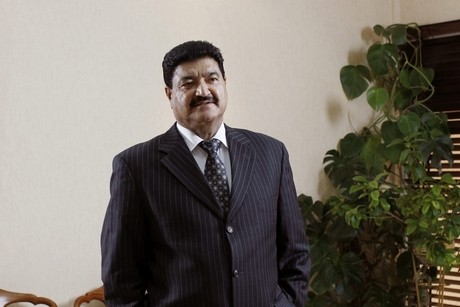
B R Shetty, the Indian businessman and philanthropist who recently bought Travelex for a reported £1 billion (Dh6.15bn), says he is likely to open new stores and may restart Travelex’s remittances business.

“We plan to be in 50 countries in two years’ time,” said Mr Shetty, who is also the chief executive of UAE Exchange. “We’re mainly expecting to expand to richer countries in Asia and Africa.”

Travelex currently has branches in 32 countries, as well as 1,500 outlets.

The two exchange organisations will “not immediately” merge and “will be run independently”, he said. Mr Shetty said he would “not remove anyone at Travelex management”. But he did say there would probably be “opportunities for both businesses to work more closely together”.

Travelex currently has branches in 32 countries, as well as 1,500 outlets.

The two exchange organisations will “not immediately” merge and “will be run independently”, he said. Mr Shetty said he would “not remove anyone at Travelex management”. But he did say there would probably be “opportunities for both businesses to work more closely together”.

He also said the two had different target markets. “UAE Exchange caters for lower and middle-class customers – Travelex is for middle-class and upper-class customers.

“I bought it to expand it, not to reap a short-term reward from it,” he adds. “I’m a long-term investor – I’m not a private equity company. I bought Travelex to expand and nurture the company.”

Travelex recorded an annual loss of £186.4 million, against revenues of £695m at the end of 2013. The company’s financial statements said that was largely due to the debt loaded on to the company when it was acquired by the private equity company Apax.

Mr Shetty’s acquisition was supported by Centurion Investments, the Abu Dhabi investment firm, which contributed funding. Mr Shetty said Centurion’s role was “mainly financial”, but that he would “take advantage of the advisory services that they have to offer”. Mr Shetty was advised in the transaction by Standard Chartered Bank, Evercore, Mena Financial Partners and Linklaters.

An independent public offering for UAE Exchange would be delayed for at least two years, Mr Shetty said.

“We’re still planning to operate the IPO … but we don’t need cash – we have enough cash to sustain the business. Whenever we want to expand further, we’ll go to an IPO,” he said.

Centurion is owned and controlled by Saeed bin Butti Al Qubaisi. The company owns a 40 per cent stake in NMC Healthcare, which Mr Shetty founded. NMC was floated in London in 2012 at a market valuation of £117m. It currently has a market capitalisation of £899m. Mr Shetty retains a 20.3 per cent stake in the business.

The remittances industry is expanding at a fast clip, with total remittances expected to grow at 9 per cent per year, rising from US$414bn in 2013 to $540bn in 2016, according to the World Bank.

New technologies are changing how remittances companies do business. Facebook recently acquired the British start-up Transferwise, started by two Estonian immigrants to the UK, which partners local senders and receivers of currency instead of transferring money abroad. With 100 million Facebook users in India, the company could draw on a large pool of customers for any new money transfer business.

But Mr Shetty is confident that technology will help his remittances business. He points to instant money transfer services as an example of how innovation has benefited his business.

“We have our own innovations,” he said. “New technologies can only benefit the transfer industry.”

abouyamourn@thenational.ae

source: http://www.thenational.ae / The National / Home> Business> Industry Insights> Finance / by Adam Bouyamourn / May 31st, 2014

BookTalk : Modern education in Mysore and Wadiyars’ patronage

BookEducationBF05jun2014

Title : Modern Education and Social Change’ / Author: Dr. M.R. Ravi / Pages : 216 / Price : Rs. 180 / Publisher: Samvahana, Mysore

Modern Education and Social Change’ is an interesting book which focuses on the advent of modern education in the Princely State of Mysore from 1881 to 1947, when the British left India. The book is a part of doctoral study of Dr. M.R. Ravi, who wrote a thesis about modern education in the Princely State of Mysore during the 66 years prior to Independence.

Dr. Ravi, a senior KAS officer serving as the Additional Regional Commissioner in Mysore, narrates about the pivotal role played by Nalwadi Krishnaraja Wadiyar in taking modern education facilities to the poor and depressed, for whom it was a luxury then.

The Maharaja not only established the University of Mysore with separate schools for the Panchamas (depressed classes), but provided reservation for backward class people in government jobs, implemented social legislations like widow remarriage bill, abolishing child marriage, encouraging girls to get educated and providing forum for fair and democratic discussion through the Mysore Representative Assembly. He also built the Krishnaraja Sagar Dam which now quenches the thirst of millions of people, apart from irrigating thousands of hectares of land in Karnataka and Tamil Nadu. It is also a hydel project.

Mahatma Gandhi, recognising the administrative reforms and social concern of the Wadiyar, called him Rajarshi (saintly king) and his kingdom was described by him as Rama Rajya, an ideal kingdom akin to the rule of Lord Rama of Ayodhya.

Author Dr. Ravi, who had worked as a Sub-Editor in Star of Mysore from 1988 to 1992, appeared for KAS exams and emerged among toppers through sheer hard work and determination. This is when he realised the importance of education and wondered how many children in rural regions, despite having latent talents, lead lives of penury for want of proper education facilities.

Prof. B. Sheikh Ali, former Vice-Chancellor of Goa and Mangalore Universities, who wrote the Foreword for this book, says that the author’s thrust is on mass education, focused particularly on depressed classes and women, pivoted in and around Mysore.

Prof. Ali gives credit to the Wadiyar dynasty of Mysore, particularly to Nalwadi Krishnaraja Wadiyar, for the political will that metamorphosised the education scenario in the princely province during the end of 19th century till the mid-20th century.

Prof. Ali writes that the book discusses improvement in the position of women in the State of Mysore.

“Woman is the masterpiece of God’s creativity. Man is energy, woman is love, man is duty, woman is beauty, man is muscle, woman is mercy, man is thinking, woman is feeling. Woman bears the child and perpetuates the human race. Yet at all times, in all places and all cultures, woman has been denied her rightful place,” says Prof. Ali.

Dr. Ravi narrates about how a Brahmin reformer named Gopalaswamy Aiyer, during 1910s, championed the cause of depressed classes in Mysore. As a member of the Mysore Representative Assembly, he countered the attacks and criticisms against the Panchamas by other members of the Assembly and advocated for opening two kinds of schools, one for vegetarians and another for non-vegetarians. He also suggested that the village committees in every village may decide on the kind of school and whether or not the Panchamas must be admitted – a move similar to decentralisation of powers.

An interesting and informative read interspersed with intriguing historical facts, the book also has rare pictures of schools and colleges of yesteryears in Mysore.

About the author

Born and brought up in Mysore, Dr. M.R. Ravi is a multifaceted personality. He has secured 8th rank in BA, followed by gold medals in his Master’s in History and English literature. He has been awarded Doctorate Degree from the University of Mysore.

As a KAS officer, Dr. Ravi is known for people-friendly approaches in solving problems. His 22-year-long public service is spread across 19 districts of Karnataka. Ravi began his career as a journalist and later became a lecturer. Known for integrity and simplicity, Dr. Ravi is an excellent orator who believes in the principle of ‘be good and do good.’

source: http://www.starofmysore.com / Star of Mysore / Home> Feature Articles / May 30th, 2014

JK Tyre & Industries win 40 gold medals at QCFI

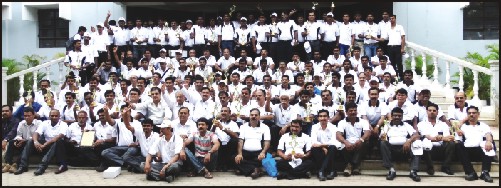
A group photo of the winning teams of JK Tyres at the Qcfi Convention held at Nie premises in city on May 25.

Mysore :

JK Tyre & Industries Ltd., Vikrant Tyre Plant, Mysore, created history by winning 40 gold medals, 9 silver medals and 1 bronze medal — the highest ever medals won by any company — at QCFI (Quality Circle Forum of India) competition held on May 25 at NIE premises here.

JK Tyres also has the distinction of nominating highest number of teams (50 teams), the highest in any such competition of QCFI. G. Rajagopalaih, VP – Mfg (Plant # 2), received the honour on behalf of the participating teams.

Each team comprised 3 members from all sections of people working at JK Tyres including non-permanent and contract labour. The teams made presentations in structured manner of the improvements in processes made in the Plant through various Kaizens & Group exercises. To add one more feather to the cap, G.R. Vinay was honored with ‘Distinguished Facilitator’ award.

source: http://www.starofmysore.com / Star of Mysore / Home> General News  / May 31st, 2014

Pages from history : Indira Belur’s passion for library

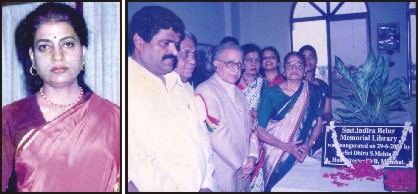
 1) Late Indira Belur 2) A file photo of the inauguration of ‘Indira Belur Memorial Library’ at Bharatiya Vidya Bhavan, Mysore, which adorns the drawing room of Vinuthamma’s residence.
1) Late Indira Belur 2) A file photo of the inauguration of ‘Indira Belur Memorial Library’ at Bharatiya Vidya Bhavan, Mysore, which adorns the drawing room of Vinuthamma’s residence.

by Prof. A.V. Narasimha Murthy, former Head, Department of Ancient History & Archaeology, University of Mysore

A decade ago some of us were visiting houses of friends in Mysore to collect funds for the construction of a building for Bharatiya Vidya Bhavan, Mysore, under the leadership of Dr. Mathoor Krishnamurthy. K.B.Ganapathy was providing wide publicity by publishing the names of donors in his prestigious Star of Mysore and Mysooru Mithra. This enthused the donors. Dr. Mathoor had such a charming personality that he would speak in such a manner that people would not say ‘no’ and contribute donations for the Vidya Bhavan building.

The Mysore people are generally philanthropic and encouraged cultural activities to happen and the result is that we have an imposing building on the Hunsur Road and I do not think that there is anybody who has not seen this building. Thus Mysoreans and others have helped us to establish Vidya Bhavan which runs a school with 1500 students, an MBA (PGDM) College of Management, a school of Fine Arts, conducts monthly music programmes, discourses etc. All this has been possible because of the generous donations of the people of Mysore to whom we are grateful.

At that time, a lady called me on phone and said ‘I would like to contribute rupees three lakhs to Vidya Bhavan. Will it be possible for you to visit my house in Yadavagiri?’ She mentioned the road and said, ‘ask for Kogod House and anybody will show you.’ I jumped with joy. She was none other than Smt. Vinuthamma, a charming lady with a pleasant disposition. Before I could talk to her, she insisted on myself taking breakfast first. Before inviting me she must have told her plan to donate some money to her friends and relatives and the news spread. Many persons either visited her or talked to her on phone. Some others sent some feelers. All of them had an idea of getting an image of God or Goddess be made and consecrated in a temple so that she will get the religious merit (punya).

As she is an Iyengar lady, many offered the suggestion of making sculptures of either Alwars or Sri Ramanujacharya from her donation. But Vinuthamma had a different idea because the donor was her daughter Smt. Indira Belur and the latter had insisted that the money should be used to establish a library.

A highly laudable idea indeed! After hearing this many persons who had shown interest in taking donation suddenly vanished. However, some of them murmured. What is the use of a library? There are many libraries in Mysore and there are not enough readers in them. Most importantly, we have not heard of a crazy idea like this before and she will not get religious merit (punya) by this gift. But, Indira Belur was firm and her mother Vinuthamma was equally firm.

At that time, I had the good fortune of meeting Vinuthamma. When she offered the donation, I immediately accepted it and said a library will be established in Indira Belur’s name: absolutely no problem. She was taken aback by my acceptance and she repeated her library condition over and again. She also cautioned that I should not go back on my words. I re-affirmed and assured her that ‘as per the desire of your late daughter and your own wish to fulfil her desire, I will establish a library in Bharatiya Vidya Bhavan, Mysore and it will be inaugurated by a VIP, most probably our Governor, Dr. T. N. Chaturvedi.’

Before proceeding further, I would like to introduce Indira Belur. After graduating from Mysore University, she did her MBA specialising in marketing. She moved to Madras and became a management consultant and took assignments all over India. In the meantime, she became a consultant to State Bank of India, Bombay. She conducted many programmes in marketing management. Subsequently, she worked with a Japanese company and exported prawns to Japanese market. Subsequently, she became the General Manager for Trans Global Air, U.K. in-charge of South India. I saw this visiting card preserved by Vinuthamma as a memento of her dear daughter. When everything seemed well settled and she was at the top of her career, she became a victim of cancer and passed away in 1998. When she was in the BM Hospital, she celebrated her 50th birthday at the hospital itself. That is how she distinguished herself as a member of the illustrious Kogod Family.She had decided to donate her eyes.

As soon as I received the donation amount, I placed it before the Kendra Committee and apprised it of the details. N. Ramanuja, who was a relative of Vinuthamma, applauded the idea and insisted that the donation should be used for establishing a library in Mysore Vidya Bhavan. As soon as the building was completed, a place was identified for the library and a black granite name plate ‘Indira Belur Memorial Library’ was fixed on the wall. It was inaugurated by Sri Dhiru Mehta, the then Director General of Bharatiya Vidya Bhavan, Mumbai in the presence of Dr. T. N. Chaturvedi. This photograph adorns the drawing room of Vinuthamma’s residence and she proudly shows this to her visitors. Though the loss of a daughter before her own mother is unwelcome, Vinuthamma is proud of the achievements of her daughter and her final decision to establish a library.

This library is just ten feet from my chambers and I daily pass through the library and automatically my eyes go up and look at the name plate ‘Indira Belur Memorial Library.’ Incidentally, library is not just a place where books are stacked, but it is a repository of knowledge. Ancient India was famous for libraries and the Chinese have described the libraries of Nalanda. Chinese scholars used to visit this library for consulting original books (manuscripts) on Buddhism and allied subjects. In the modern period many good libraries have come up. I had the good fortune of visiting British Museum Library in London and Weidner Library (Harvard) which contain excellent and valuable collections. National Library at Calcutta is also a good library. I am a proud owner of a small library which has good books on ancient history and archaeology which I have been using all these days. Maintaining a library is a difficult job because books require daily cleaning and periodical check-up. But a personal library has its own pleasure and advantage.

But, I did not get any clue for the passion and love for library by Indira Belur. Perhaps she understood the secret that library is the source of knowledge and one has to go to that source. Though gifting a library is uncommon, it is welcome and Vinuthamma should take pride in that gesture of her daughter Indira Belur. I would like to say to Indira Belur ‘wherever you are, we remember you with pride and gratitude’ that is the best tribute according to our tradition.

source: http://www.starofmysore.com / Star of Mysore / Home> Feature Articles  / May 31st, 2014

Success Secret: Toppers Stayed Calm in Exam Season

Bangalore :

Apoorva Narayanaswamy was expecting good marks, but she had never imagined she would end up in the national toppers’ league.

A student of St Paul’s English School, Apoorva has scored 98.6 per cent in the Indian Certificate of Secondary Education (ICSE) exams.

“I guess studying and spending some time on hobbies helped me. I watched TV whenever I was stressed,” said Apoorva, a resident of Bannerghatta Road, who studied for three to four hours a day. At the start of the academic year, she would go back from school and study to make sure she wasn’t stressed as exams approached.

Apoorva’s favourite subject is biology and she wants to pursue a career in medicine.

For Shreyas Sudhaman of Sri Kumaran Public School, who scored 98.6 per cent, the results were a shock.

“I was shocked in a positive way, of course. What I believe is if you are consistent and organised in your preparation, it is not impossible to score high,” he told Express.

A resident of J P Nagar, Shreyas is looking forward to becoming an engineer.

“I plan to take up chemical engineering. It can be used in various places,” he said. The Council for Indian School Certificate Examinations (CISCE) considers the best scores in five subjects (best-of-five) to declare the percentage.

In the Indian School Certificate (ISC) exams for Class 12, it is the best of four that is taken for calculation.

Rajat Vadiraj from St Paul’s School secured 98.4 per cent and celebrated it with his family.

“I’ve always loved science since I was a kid. It is very exciting, especially physics and mathematics,” said Rajat, who did not have sleepless nights preparing for the exams. “If you keep calm, it should be easy.”

Dipayan Sinha from Bishop Cotton Boys Schools knows what career he wants to pursue. “Everyone in my family is an engineer and I want to follow them,” said Dipayan, who scored 98.2 per cent.

Studying in Bangalore for eight years, Dipayan’s mantra is hard work, patience and focus. “I don’t keep timetables. I would revise whatever was taught in school the same day,” he said.

With 98.16 per cent in his kitty, Tejas Kumar from Presidency School is chasing two dreams. “I am very good at computers and I think I can develop this into something by becoming a computer science engineer. Further, I want to become an IAS officer and serve the country”.

source: http://www.newindianexpress.com / The New Indian Express / Home> Cities> Bangalore / by Express News Service / May 22nd, 2014

Youngster from city walks the red carpet at the famed Cannes Film Festival

by S.N.Venkatnag Sobers

Every person dreams of walking the Red Carpet at premier film festivals or at least to be a part of the festival in some way or the other. This is a talented Mysorean has had that opportunity.

Vaishak Vasanth Kumar, son of Rajyotsava awardee Vasanth Kumar Thimkapura, city’s renowned Agricultural Scientist, has just fulfilled his dream of walking the Red Carpet at Cannes Film Festival held this year.

A student at the University of Pennsylvania, USA, Vaishak was one among the 30 students selected to be a part of the Cannes Film Festival from the University.

Vaishak has been pursuing his studies in Bachelor of Arts with Political Science and Economics as his major subjects in the University.

Speaking to Star of Mysore, Vaishak said that every year his University gets 30 invitations from the organisers of Cannes Film Festival and the University conducts a selection process which includes writing essays and one-on-one interviews to select the team to represent the University at the Cannes Film Festival.

He added that he was the only student from India and the only non-American to be a part of the student delegation.

“The interview involves writing about the history of cinema and the Cannes Film Festival as well. Only after getting through the two rounds I got an opportunity to be a part the team which visited Cannes,” said Vaishak.

During his 13-day stay in Cannes, the student team was given the task of watching 25 films screened at the festival. But, Vaishak making good use of the given opportunity watched 30 movies one among them was the ‘Winter Sleep,’ a Turkish movie, which won the prestigious PALME D’OR (Golden Palm Award) this year.

He added that it was his first visit to the Cannes Film Festival and said that he got an opportunity to meet the representatives of Warner Brothers and Disney.

Vaishak also added that he also met actors James Mc Avoy of X-Men fame, Jassica Chastian of Zero Dark Thirty fame, Salma Hayek, Zoe Saldana and Indian actors Ranvir Shorey and Shashank Arora.

Speaking about movies, Vaishak said that when compared to Hollywood movies and films from other countries, Indian movies had very little international appeal as it is made only for the Indian audience and it was very hard for the producers to pitch in the Indian movie for international audience.

“There is much more to be done in Bollywood if Indian movies have to be showcased in International Film Festival like the Cannes. The only movie which was showcased was ‘Titli’ of Yash Raj Films. People in Hollywood and film makers around the world take risks while scripting a movie, but in India such risks are not taken. There is a need for film fraternity in India to also give importance for parallel movies compared to the mainstream commercial movies,” said Vaishak.

source: http://www.starofmysore.com / Star of Mysore / Home> Feature Articles /by S.N.Venkatnag Sobers /  May 29th, 2014

We are the biggest southern state now

by: S Shyam Prasad & Sridhar Vivan

Creation of Telangana and AP has restored geographical supremacy to the state 450 years after the Battle of Talikota. We track the journey of the region from kingdoms to modern-day Karnataka

​History was created on Monday with the creation of Telangana, the 29th state in the Indian Union. It marked another change in the contours and boundaries of southern India and although Karnataka had very little to do with the bifurcation of Andhra Pradesh, the creation of Telangana changed the history of Karnataka — ever so slightly.

Karnataka officially became the biggest of the South Indian states in terms of geographical area (the seventh biggest in the country). With an area of 1,91,791 sq km, Karnataka leads the ‘pack’ in the South, followed by what now remains of Andhra Pradesh (popularly called the Seemandhra region) with 1,60,205 sq km of area.

Being the biggest state in terms of area would have been a great advantage in the age of kingdoms, but no longer. Karnataka may gain very little — indeed nothing — from being the ‘biggest’. Political representation in Parliament is based on the population which means Tamil Nadu will continue to have a bigger say with its 39 MPs. Andhra Pradesh will have a diminished voice as its 42 seats would now be whittled down to 25.

But the ‘biggest’ tag does reflect (historically at least) a sort of pre-eminence. From the beginning of the sixth century, empires founded in Karnataka ruled over much of present day Karnataka, Andhra Pradesh and Maharashtra. These included the Badami Chalukyas, Rashtrakutas, Kalyani Chalukyas, Hoysalas and the Vijayanagara Empire.

According to eminent historian S Shettar, the most enduring (in terms of time) dynasties of Karnataka were the Gangas and the Kadambas. But they ruled small principalities. “The biggest imperial house was that of the Rashtrakutas,” said Shettar. “They were the most influential rulers in India of anytime. Samudra Gupta is just highlighted due to North Indian bias. The Kailasanatha temple, in Maharashtra, alone is testimony to their eminence. Their battles reached the Himalayas and Bengal.”

Karnataka-based empires stayed the biggest in the South until the collapse of the Vijayanagar Empire 450 years ago when the hegemony ended. “The Vijayanagara Empire was different in many ways,” said Shettar. “For the first time people speaking Kannada, Telugu, Tamil, Oriya and Marathi were one empire.”

This year marks the 450th anniversary of the Battle of Talikota (also known as Battle of Rakkasa-Tangadi) which put an end to more than 1,000 years of Karnataka’s pre-eminence in politics of south India and the Deccan.

The political pre-eminence led to some of the most famous medieval cities, centres of trade and temples in India. The most famous of these was the Vijayanagara capital — now Hampi — which is said to have taken six months to destroy. Following the battle in 1565, the Vijayanagara Empire continued to exist nominally for nearly a century. Scores of Vijayanagara feudal lords began ruling over petty kingdoms. Kannada-speaking areas were never united again until 1956.

“The 1565 battle was a colossal loss,” said Shettar. “Like the French will never celebrate the Battle of Waterloo, similarly the Battle of Talikota cannot be celebrated. But there is much to learn from defeats. Now some intellectuals and politicians from the Hyderabad-Karnataka region are demanding a separate state. It is because of the belief that there is neglect and also to some extent jealousy. This is similar to the demand for Telangana. But we have to learn from that battle (1565) and stay united.”

Ironically, says Shettar, the fight for linguistic states began in Andhra Pradesh because they felt dominated by the Tamils of Madras Presidency. “In south India, the opposition to linguistic states was confined only to a small extent from the Tamils because they feared losing territory. But slowly there are feelings that linguistic identity is not giving the requisite economical benefits. People of Karnataka are more or less emotionally reconciled to a linguistic state now.”

MOST BORDERS IN SOUTH

With the creation of Telangana, Karnataka now shares its borders with six states —Maharashtra, Goa, Kerala, Tamil Nadu, Andhra Pradesh and Telangana. The state administration has to get in touch with the Telangana as well as the residual Andhra Pradesh for inter- state issues. Apart from river water sharing — for example, Karnataka needs to deal with Andhra Pradesh for Tungabhadra and Telangana for Krishna —and other border issues, the transport body also has to have new agreement on travel.

‘KARNATAKA’ IN HISTORY

* Sanskrit texts: Shudraka’s Mruchhakatika, Varaha Mihira’s Bruhat Samhite, Somadeva’s Katha Saritha Sagara refer to Karnata
* 455 CE: Kadamba king Shantivarma called, “The master of the entire Karnataka region”
* 7th Century CE: Feudatories Rashtrakutas refer to Chalukyan Army as ‘Karnataka Bala.’
* 850 CE: Amoghavarsha’s Kavirajamarga calls land between Kaveri and Godavari as ‘Karnata.’
* 10th Century CE: Rajashekara’s Kavyamimase: Karnataka
* 14-16 Centuries: Vijayanagara Empire referred to as Karnata Empire by its people.
* After Talikota battle the first of the Aravidu dynasty ruler Tirumala Deva Raya called ‘reviver of the Karnata Empire’ in the Telugu work Vasucharitamu.

THE BATTLE OF 1565

The first skirmishes of the Battle of Talikota started on December 29, 1564. It was on January 26, 1565 that a full-scale historic battle took place at Rakkasa- Tangadi villages — near what is Bijapur district today. The five Deccan sultanates of Ahmadnagar, Berar, Bidar, Bijapur and Golkonda defeated the Vijayanagara army, a defeat that resulted in the dramatic capitulation of the Vijayanagara Empire. For more than 1,000 years prior to that battle, Karnataka as we now know it was part of empires such as Badami Chalukyas, Rashtrakutas, Kalyani Chalukyas and later the Hoysalas. These were the largest empires in South India. The loss in 1565 was so severe that Karnataka was to have a united rule again only in 1956. In between, large swathes of Karnataka were briefly united under Hyder Ali. By the time Karnataka was unified post-Independence, the region was under 20 different administrations ranging from the Wodeyars to the British and a host of small principalities.

source: http://www.bangaloremirror.com / Bangalore Mirror / Home> Bangalore> Cover Story /  S Shyam Prasad & Sridhar Vivan / Bangalore Mirror Bureau / June 03rd, 2014