Count, count ’n’ there’s more

P. Subramanyam Setty has a collection of coins and notes that encapsulate nuggets of history.
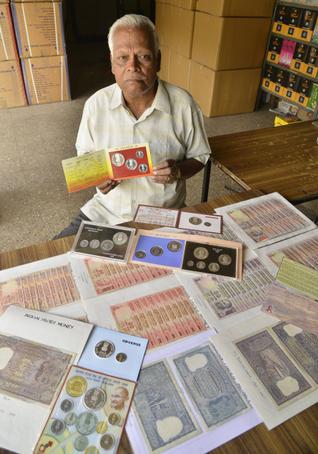
TREASURE TROVE My collection is the rarest, says Subramanyam / Photo: Murali Kumar K. / The Hindu

At the 5th National Numismatic Exhibition that concluded in the city recently, Bangalorean P. Subramanyam Setty, the veteran coin and note collector, was honoured for his impressive collection over the years. At his Vijayanagar residence, heaps of albums with the rarest of notes and coins are neatly arranged and placed in a room that attracts anyone to take a closer look. “At the outset I want you to see the Fancy Number series in my note collection, they are thrilling,” says the septuagenarian, a member of the Karnataka Numismatic Society. The fancy is in the Mahatma Gandhi note series where the denominations from Rs. 1,000 to Rs. 10 bear the numbers 111111 to 999999 and from 100000 – 1000000, — 19 notes in all.

Out of the 136 Star Notes issued by the Reserve Bank of India, Setty has 130 out of them in Rs. 10, 20, 50 and 100. “Star Notes are currency notes issued by RBI for replacement of defectively printed bank notes bearing the star in the number panel for indication. Issued between 2006 and 2014, the present RBI Governor Raghuram Rajan too has issued three Star Notes of Rs.10, and I have many of them issued by former governors, Dr. Y.V. Reddy and D. Subba Rao too,” he explains. Going back to pre-Independence British India Series-1, with a profile portrait of King George VI on the first series of RBI notes issued in 1938 is what Setty cherishes, while his post-Independence Republic India Series – II has a Rs.1000 note issued in 1954 with the Brihadeeshwara Temple of Tanjore depicted on the reverse. “Look at the size, it’s a huge 20 x 13 cms!” exclaims Setty.

“My collection is the rarest. Each of the old and exceptional of the notes costs in thousands to get hold of them. On many occasions we have travelled to the nook and corners to meet people who possess them, and we pay a premium,” says Setty. The Republic of India Ashoka Pillar series with the Chakra depicting the wheel motif of the Konarak Sun Temple issued in 1975 and the Mahatma Gandhi Series issued from 1996 are all available with him. “The one rupee Gandhi series of 1969 and the Rs.2. 5 and 10 issued between 1957 and 1970 stands out in my collection as the RBI stopped one and two rupees in 1995,” he says, the nearly 200 staggering variety with different signatures making up his note collection.

Subramanyam Setty also has an astounding 71 varieties of ‘Commemorative Coins’ up-to-date, issued by the government since 1964. “They are referred to as the uncirculated proof-sets,” he says. While most of these coins are in memory of events or renowned personalities of the country which are mostly in quaternary alloy with 50 per cent of silver along with copper, nickel and zinc, the thousand years of the Brihadeeshwara Temple in Thanjavur is commemorated with a 44 mm thousand rupee coin with 80 per cent of silver in its make-up!

The Platinum Jubilee dedicatory coin of the RBI released in 2010 is a Rs.75 denomination with the RBI monogram of the Tiger. “I am still waiting for the Motilal Nehru and Sant Tukaram coins, it takes six months to one year and we book a year in advance,” says Setty. “I also treasure the Mahatma Basaveshwara coin that I possess.” Born in Andhra Pradesh and settled in Bangalore with an agarbathi business, Setty’s son Sharath Babu and daughter Sharmila are captivated to be part of the note and coin fold, while his other son Varaprasad, a central excise employee, has received several awards for his postal stamp collection.

source: http://www.thehindu.com / The Hindu / Home> Features> MetroPlus> Society / by Ranjani Govind / Bangalore – March 03rd, 2014

Two-day workshop on endangered tribal languages in city

CIIL to document these languages; Dictionaries to be brought out and ethnic knowledge system to be recorded.

(from left) L. Ramamoorthy, Head, Linguistic Data Consortium for Indian Languages, CIIL; P.K. Misra, President, Anthropological Association; C.R. Satyanarayana, Deputy Director & Head, Anthropological Survey of India and Lawrence Surendra, Senior Fellow, ICSSR, at the workshop.

Mysore :

Anthropological Survey of India (ASI) in collaboration with Central Institute of Indian Languages (CIIL) has organised a two-day workshop on ‘Endangered tribal languages in South India’ at ASI’s Manav Bhavan in Bogadi II Stage here since yesterday.

CIIL will take up a mega project under which it will document nearly 500 endangered languages in the country, each spoken by less than 10,000 people. The project has got its nod in principle by the Ministry of HRD and CIIL will collaborate with Universities and Institutes in carrying out the project.

Speaking to media persons, L. Rama- moorthy, Head, Linguistic Data Consortium for Indian Languages, CIIL, said that the work would be taken up under a scheme to preserve and protect endangered languages.

“The objective is to bring out dictionaries and also document and preserve the ethnic knowledge system enshrined in the languages, including folklore. It would also extend to frame grammar rules. Also, experts would give suggestions for revitalisation of these languages. The project would be carried out phase-wise. About 70 languages from different parts of the country would be studied in the first phase and 500 words would be taken up in a span of 10 years,” said Ramamoorthy and added that the study and documentation of each language would cost Rs. 6 lakh to Rs. 8 lakh.

Earlier, P.K. Misra, President, Anthropological Association, Mysore, inaugurated the workshop on ‘Endangered tribal languages-Initiatives from CIIL.’ Speaking on the occasion, he said “Language is embedded in society and culture. It is an important tool to identify people belonging to different communities. The region, inhabited by Jenu Kuruba community, is also home to other communities like Betta Kuruba, Soliga, Yerawa and others,” and added, “The status of language should be understood in the context of society and culture which were not static but under constant change. Even the changing external environmental factors have affected the traditional lifestyle of the tribal people.”

Ramamoorthy, during the workshop, quoting a survey, said that there was no consensus on the status of endangered languages. “While the Census of India 2001 fixed the number as 122, Anthropological Survey of India put it at 323, while a UNESCO report said 196 Indian languages were endangered,” he said and added, “Language is a complex phenomenon and its use is also complex due to the onset of globalisation. We get to know one’s culture through the clan’s name of the community to which they belong. In fact, many languages are known through their communities.” He hoped that the workshop could work out parameters and tools to identify an endangered language.

Lawrence Surendra, Senior Fellow, Indian Council of Social Science Research (ICSSR), who delivered a special lecture on ‘Endangered tribal languages and cultures’ said, “There is a link between language and bio-diversity as they reinforce each other. Language represents knowledge. Endangerment of language is far more serious than that of culture because with the extinction of language, the entire encyclopaedia of knowledge enshrined in that language would be lost forever.”

C.R. Satyanarayana, Deputy Director & Head, Anthropological Survey of India, Southern Regional Centre, subject experts from different Universities and Institutes are attending the workshop which concludes today.

source: http://www.starofmysore.com / Star of Mysore / Home> General News / February 25th, 2014

Felicitation marks 28th death anniversary of freedom fighter R.S. Naidu


RSN Memorial awardees (sitting from left) Senior Advocate M.A. Sampath Iyengar, Sri Kumara Nijaguna Swamiji of Kollegal and Star of Mysore Editor-in-Chief K.B. Ganapathy are seen with (standing from left) artist Dr. Jamuna Rani V. Mirle, District Kannada Sahitya Parishat President M. Chandrashekar, sculptor L. Shivalingappa, KSOU VC Prof. M.G. Krishnan and N.K. Ramesh of RSN Trust.

Mysore :

“R.S. Naidu was a multi-faceted person excelling in every field,” opined Prof. M.G. Krishnan, Vice-Chancellor, Karnataka State Open University (KSOU).

He was speaking after inaugurating a programme organised by R.S. Naidu Art and Cultural Welfare Trust at Nadabrahma Sangeetha Sabha on JLB Road here yesterday to mark the 28th death anniversary of Freedom Fighter and Sculptor R.S. Naidu.

Krishnan said that Naidu joined Youth Congress and worked for its unification. He added that Naidu was also an art patron and a good sculptor.

On the occasion, RSN Memorial award was presented to Senior Advocate M.A. Sampath Iyengar, Sri Kumara Nijaguna Swamiji of Kollegal and Star of Mysore Editor-in-Chief K.B. Ganapathy.

Addressing the gathering, Ganapathy said that Naidu after having worked hard for the society turned a loner towards the end probably upset over the value deficit in society.

He said that though many leaders fought for nation’s freedom only a few are being remembered. Sardar Vallabhbhai Patel, for example, is hardly remembered despite his great contribution for country’s unity. He also lauded the services of R.S. Naidu Trust.

Mysore Art Gallery President and sculptor L. Shivalingappa presided. District Kannada Sahitya Parishat President M. Chandrashekar was present.

Later, a cultural programme was presented by Mahathi Orchestra and M-Modal troupe.

source: http://www.starofmysore.com / Star of Mysore / Home> General News / February 25th, 2014

‘Stories Come Directly to Doctors’

Litterateurs go in search of a story while stories come directly to medical litterateurs (Vaidya Sahitis), said noted litterateur Na D’Souza.

After inaugurating a state-level medical litterateurs conference organised jointly by the Kannada Vaidya Sahitya Parishat and Indian Medical Association, Shimoga branch on Sunday, litterateur Na D’Souza said not many litterateurs have the opportunity to look at life closely like doctors. The experience as a doctor is enough for  literary activities, he said.

“Literature brings recognition to the  writer through the reader. Medicine is a profession while literature is a hobby. Doctors who enjoy both will become a litterateur in their own field,” he said. D’Souza stressed the need to record daily activities and experiences that would help in preserving ideas and knowledge of a medical profession which in the later years might help in the formation of a literary work.

Litterateur cum doctor K A Ashok Pai said more than 300 doctors in the state have contributed to the literary field and Shimoga district stands differently as it has produced more number of doctors cum litterateurs.

Presiding over the function, president of Shimoga branch of Kannada Vaidya Sahitya Parishat C G Keshavamurthy felt the need for the construction of a building for Kannada Vaidya Sahitya Parishat either at Bangalore or at Shimoga .

source: http://www.newindianexpress.com / The New Indian Express / Home> States> Karnataka / by  Express News Service – Shimoga / February 24th, 2014

Sangeetha Kalanidhis of Mysore

KalanidhisBF02mar2014

by M.L. Krishnaswamy

The Madras (Chennai) Music Academy is one of the oldest Music Sabhas or organisations catering to the South Indian or Karnatak style of music in the whole of South India. It’s deliberations or festivals celebrating music in all its variety and glory are conducted in the December month of each year, sometimes reaching out to early January also.

Each year the festival starts in the morning and goes through the day, culminating in a concert in the evening by a senior musician of the day. Each year they have made it a practice to invite a very senior Vidwan or Musician of the day to preside over a function, deliberating on the discussions and nuances of the Karnatak style of music and on the last day, he or she will be conferred with the title “Sangeetha Kalanidhi,” the highest award to be given to any musician of the region comprising the four major States of Tamil Nadu, Andhra Pradesh, Kerala and Karnataka.

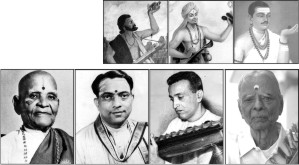
This highly distinctive title — something akin to the ‘Tansen Samman’ in the North has been conferred on four senior musicians of Mysore namely, all late K. Vasudevacharya, T. Chowdaiah, Mysore V. Doreswamy Iyengar and R.K. Srikantan.

This is a great honour for Mysoreans and all of us should justly be proud of the four stalwarts mentioned above. I will write about these four gentlemen in my subsequent series. In fact, the latter two of the above four have been honoured with the Padma Bhushan.

Let me now deviate from the above for a while and write about another forgotten aspect of our heritage city and what our present day Mysoreans’ contributions should be to make Mysore truly befitting to earn that epithet. In this connection, Raga Vaibhav — a nearly decade old — had organised a musical discourse on Saint Thyagaraja last month by the well-known Vidushi Vishaka Hari of Chennai, who gave a splendid performance to a crowded audience of connoisseurs. She exhorted that Mysore should build beautiful Bhavans or Auditoria in the names of the above mentioned four stalwarts.

My suggestion in this connection are as follows:

(i) Purandaradasa, Kanakadasa and Basavanna are the three stellar names in the field of Music and Vachana in pure Kannada language. The former two created what is called ‘Dasa Sahitya’ while the third one created ‘Vachana Sahitya,’ both rich in literary content and philosophical output. We have to commemorate their rich legacy by constructing a beautiful memorial structure in the form of a central circle with three outshoots at 120° apart, each being dedicated to each of the above saints, as is indicated roughly below: and depicting and displaying the photographs, historical evidence and their voluminous contributions to the rich legacy of Kannada literature and music. The central circular building will have a small auditorium with a capacity of 100-200 to stage concerts relating to the above luminaries. The way they have enhanced the content of the Kannada culture is by all means fantastic and the above mentioned structure will be a display-edifice of

their works. This will truly be a notable addition to the heritage title of the city and the discerning tourists, both local and foreign will have a good time visiting this architectural marvel and savo- uring the music and songs of the trio in a compact place with facilities made available accordingly. In course of time, such a centre should become a veritable source of guidance and teaching to young artistes in the field. Audio & video and other adjunct facilities should also be made available in these structures.

(ii) How to fund the above effort?

There are many leading industrial houses in Mysore such as Infosys, Larson & Toubro, N.R. Group and many others who should be persuaded to fund such ventures in a big way on appeals made by the Kannada and Culture Department and Tourism Development Corporation on the Government side and other philanthropic minded connoisseurs of Mysore. As regards the contributions of Basavanna, the Suttur Mutt can be persuaded or requested to associate itself in such a venture in a big way. I am sure Sri Shivaratri Deshikendra Swamiji, the presiding pontiff of the Mutt will not say ‘NO’ to such an appeal. The Departments are focal point to float the idea and should enlist support from the culturally oriented citizens of Mysore. These edifices would surely attract a large number of tourists also.

In this connection, I have to regretfully mention about the tardy progress made by the Government as regards the house of late R.K. Narayan, an English language Novelist of Mysore, who had made a great name in the literary field. Will the authorities wake up now and complete the project?

The Chief Minister of Karnataka is from Mysore and it is not out of place if an appeal is made to him in this respect to launch this project and make necessary budgetary provisions after envisaging the support of the private enterprises as mentioned above. A kick-start can be made and the ball set in motion.

It is very interesting to note here that the three luminaries namely— Purandaradasa (a Nayaka community born by name Krishnappa Nayaka in an earlier avatar before his enlightenment and evolution); Kanakadasa (a Kuruba community man, who strode into limelight after his enlightenment and JagaJyothi Basavanna (a Brahmin by birth, who shunned his sub-caste and founded a new religious order namely, Veerashaivism). The contributions of all the three to Kannada literature and philosophical thought are immense. It is impossible to imagine that how in their absence, the Kannada literary and cultural world would have been poorer in substance and content. It is only proper that the heritage city of Mysore should honour these stalwarts with appropriate memorials.

At this juncture it would not be out of place if, to the list of three persons above mentioned, another name is added: D.V. Gundappa, whose ‘Manku Thimmana Kagga’, a classic by itself and, if it had been translated into English, it would have perhaps hit the portals of the Nobel Committee meriting a prize along with ‘Geethanjali,’ Rabindranath Tagore’s masterly classic which brought him the Nobel Prize for Literature.

Note: We already have three such auditoria named as ‘Vasudevacharya Bhavana’, ‘Veena Sheshanna Bhavana’ and ‘Bidaram Krishnappa Ramamandira,’ all named after three musical greats of Mysore.

source: http://www.starofmysore.com / Star of Mysore / Home> Feature Articles / February 24th, 2014

Country’s First Electric Bus Launched in Bangalore

BMTC launched an electric bus at Shantinagar Bus Station on Thursday; Right: A view of the interiors | Sudhakara Jain

The Bangalore Metropolitan Transport Corporation (BMTC) introduced the country’s first electric zero-emission bus in the city on Thursday.

Although the bus has been in Bangalore for over a month now, it was officially launched by Transport Minister Ramalinga Reddy after getting the required permissions from the Transport Department.

The bus will run on a trial basis for the next three months. During this time, it will operate along various routes, beginning with one from Majestic to Kadugodi that is likely to cost `80.

Plans are also afoot to run the bus along the airport routes. The charging point for the bus is at the Volvo depot at Majestic.

“We will study whether the bus is economical and if it can function efficiently in the city. When the battery is fully charged (six hours), the bus can run for about 250 km, which is ideal for BMTC. However, this needs to be tested. We also need to see how it fares on various roads in the city and which routes are best suited to operate the bus,” said BMTC managing director Anjum Parvez.

Transport Minister Ramalinga Reddy said that though the bus is expensive, it is likely to be a good deal as a long-term investment.

“The bus costs about `2.7 crore and this is expensive. But this is one bus in the entire country. Once the demand for the bus goes up and more people express interest in purchasing it, the rates are likely to come down. Moreover, the research and development wings of various bus manufacturers are working on this and it is some only time before the initial cost of the bus is reduced,” he said.

When asked if the state government would be willing to share the cost or offer subsidies, Reddy said, “We will consider various options if the bus is found to be suitable for the city. At present, it is on a three-month trial and following this, a decision will be taken on whether or not to purchase the bus,” he said. He added that what was important was that pollution levels would be brought down by using electric buses, hybrid or CNG-operated buses. The bus, manufactured by Build Your Dreams (BYD), was brought to India by Utopia Pvt Ltd. At least 5,000 such buses are operational in countries such as the United States, Netherlands, Switzerland and some European countries.

GOING GREEN

Zero emission

No oil required

Costs Rs 2.7 crore (Volvo Rs 88 lakh)

Fare from Majestic to Kadugodi – Rs 80

Runs for 250 km with 6 hours of charging

source: http://www.newindianexpress.com / The New Indian Express / Home> Cities> Bangalore / by Express News Service – Bangalore / February 28th, 2014

Eavesdropping on some Mysore court musicians – 2

Here we present the last part of the column ‘Eavesdropping on some Mysore Court Musicians’ by R.G. Singh of Ramsons Kala Pratishtana…

This photo of Veene Subbanna was taken at the Mysore Palace along with Veena Seshanna.

 Mysore :

Veene Subanna was yet another star in firmament of stars that surrounded Krishnaraja Wadiyar IV.

Veene Subbanna was born with the proverbial silver spoon since not only was he born into wealth but he was also the grandson of Veene Venkatsubbaiah. Venkatasubbaiah was musician at the court of Tanjore and was invited by Krishnaraja Wadiyar III to the Mysore Royal Court.

Subbanna was born in 1854 into a family of musicians tracing their lineage to the legendary Adi Appayya of Viriboni Varnam. Subanna’s grandfather Venkatasubbaiah’s extraordinary skills earned him both honours and lands as gifts.

The untimely early death of his younger brother left Subbanna the sole heir to the vast properties.

Subanna’s music lessons began early under the guidance of his father Dodda Sheshanna from whom he learnt Veena and Mysore Sadashiva Rao who trained him in singing. He, along with Veena Seshanna would practice for long hours. Subbanna often sang along as he played.

Musicians visiting the court of Mysore were invited to perform in Subbanna’s house and Subbanna would honour them with money and rewards several times more than that given by the King himself.

At one concert, Ramnad Srinivas Iyengar, after giving a concert at Subbanna’s house, found that his ring was missing. Subbanna at once brought out his own jewel box and showing the musician several rings requested him to take whatever he wanted. The story is that Srinivas Iyengar chose the most expensive one!

It is believed that Subbanna donated to charity liberally and even gave away his 300-year-old Kanaka Rajata Veena, to his disciple Keshava Murthy !

source: http://www.starofmysore.com / Star of Mysore / Home> Feature Articles / by R.G. Singh / February 23rd, 2014

Bangalore’s 5-year-old kid in Guinness Book of Records for skating

Bangalore :

A five-year-old boy from the city made it to the Guiness Boook of World Records by skating under 39 Toyota Qualis cars in just 28 seconds. The wonder kid, Gagan S, a kindergarten student at Florence School in Basveshwaranagar, achieved this feat last month.

The boy broke the record of Rohan, 9, from Belgaum who skated across 24 cars in 47 seconds.

Gagan’s father Satish works at a washing machine service centre. He said Gagan was always enthusiastic about skating and joined the skating classes just one-and-half year ago.

Gagan’s proud parents hoped Gagan’s achievement would help skating gain popularity in India and more youngsters take up the sport.

It is not the first recognisation of Gagan’s skating abilities though. In November last year, he had won the ‘youngest skate award’ in Belgaum. His parents now dream about sending him to the Olympics.

OneIndia News

source: http://www.news.oneindia.in / Home> OneIndia> News> Bangalore / by Shubham Ghosh / Thursday – February 13th, 2014

Bangalore: Nine from coast get state Media Academy Awards

Bangalore : 

The Karnataka Madhyama Academy Awards were conferred on persons with outstanding contributions to the field of journalism by chief minister Siddaramaiah at a function organized on Monday February 24 at the Banquet Hall of Vidhana Soudha. These awards pertain to the years 2012 and 2013.

Satish U Pai
Satish U Pai


 Surendra S Wagle
Surendra S Wagle


Ravi Hegde
Ravi Hegde


B M Hanif
B M Hanif


Sadashiva Shenoy
Sadashiva Shenoy
 Raghavendra Bhat
Raghavendra Bhat


Chetan Padubidri
Chetan Padubidri


P S Chandrashekar
P S Chandrashekar


Thimmappa Bhat
Thimmappa Bhat

Among the winners were nine from coastal region – Founder of Udayavani daily and managing director of Manipal Media Networks T Sathish U Pai, Chetan Padubidri of Udayavani (Mysore Diganta award for the best human interest article), B M Hanif of Prajavani (Dakshina Kannada), Surendra S Wagle of Vijayavani (Dakshina Kannada), Thimmappa Bhat of Vijayavani (Uttara Kannada), Sadashiva Shenoy (Dakshina Kannada), P S Chandrashekar (Udupi), Ravi Hegde of Udayavani (Uttara Kannada) and Raghavendra Bhat of Kannada Prabha (Uttarakannada).

They were among the 58 journalists to receive the awards. In addition to Satish Pai, Prof H S Eshwar from Shimoga and veteran journalist, H S Balaram, received special prize for lifetime contribution to the field of journalism.

Speaking on the occasion, president of Karnataka Working Journalists Union president, Gangadhar Modaliyar, thanked the chief minister for his positive response to the demand for providing  health insurance to the families of journalists, and raising the honorarium for retired journalists to Rs 6,000 per month.

Minister for information, R Roshan Baig, presided over the programme. MLC, K Govindaraju, secretary of Kannada, culture, and information department, K R Niranjan, director of information department, N R Vishukumar, and academy secretary, S Shankarappa, were present.

In his introductory address, president of the academy, M A Ponnappa, said that the academy has now been functioning more professionally and actively than ever before.

In his address, chief minister, Siddaramaiah, requested the newspaper and television media to lay more emphasis on serving public interest rather that selfish interests. He   asked them to give importance to value-based objective information and investigative reports rather than simply conveying falsified statements of political and other leaders. He also held himself against giving exaggerated coverage to unimportant news items for sensationalizing them.

The special awards carry cash reward Rs 20,000 each and a plaque, while the other awards carry Rs 10,000 in cash and a plaque.

source: http://www.daijiworld.com / Daijiworld.com / Home> Top Stories / by Daijiworld Media Network – (SP) / Bangalore – February 25th , 2014

Minister Ramanath Rai interacts with Mangaloreans in Doha

Doha :

The enthusiastic Mangaloreans who had gathered in the Ashoka Hall at ICC premises on Wednesday February 12 had an opportunity to meet and interact with Karnataka minister for forest and ecology and Dakshina Kannada district incharge Ramanath Rai.

It was the first-ever visit by a Karnataka minister to Doha Qatar. Ramanath Rai was on a private visit, courtesy Kasaragod District Expatriate Association-Qatar.

The interaction with the minister on Wednesday was organized by Karnataka Sangha Qatar (KSQ) along with other Karnataka Associations in Qatar.

The evening began with an introduction by compere of the evening Divakar Poojary, followed by a welcome address by KSQ president Deepak Shetty. Later, presidents of various Associations such as Karnataka Sangha, Tulu Koota Qatar, MCC, Bunts Qatar, KMCA, Billawas Qatar, Kundapur Muslim Welfare Association, and South Kanara Muslim Welfare Association escorted Ramanath Rai and KPCC minority cell general secretary and Central Coir Board member T M Shaied to the dais. All the guests were welcomed with bouquets by KSQ children. Bunts Qatar president Ravi Shetty then presented a brief profile of Ramanath Rai to the gathering.

He was felicitated with a shawl and ‘Mysore Peta’ also presented with a memento by representatives of each of the Associations present.

It was then the turn of Ramanath Rai to address the gathering. Speaking in Kannada, he expressed his happiness on being the first minister from Karnataka to visit Qatar and lauded the unity of Kannadiga expats in Qatar. He then placed before the gathering his plans for Mangalore in particular and undivided Dakshina Kannada in general. He spoke on developing modern infrastructure including construction of better national and state highways which would boost connectivity.

He further said that he was a leader since his days as a student, when he was president of student Congress, Youth Congress, district Congress, as MLA and now district incharge and forest minister. Further, he humbly added that he may not have mega projects to show to his credit but he served the political field with sincerity and honesty, maintaining a clean image, and this is why people of all communities elected him six times as MLA.

Thereafter, he discussed his plans and visions with the gathering, listened to their opinions and assured to implement all that he has planned.

KPCC minority cell general secretary T M Shaied in his address thanked all Kannadigas in Qatar for their contribution to the country by making sacrifices such as leaving their families back home. He requested everyone not to support any communal agendas and urged them to unitedly fight against anti-social elements and build a strong India.

Later a question and answer session was held wherein the gathering was given a chance to discuss various issues with the minister.

To a question on extending the runway at Mangalore International Airport for which land is yet to acquired, he said, “Once the land is acquired, the runway will be extended and wide-bodied aircraft will then be able to land at Mangalore airport without any safety issues. But this is a lengthy and costly process and will take some time,” he added.

A specific query was raised about the proposed ultra mega power plant at Niddodi, to which Ramanath Rai said that the project will never happen and hence there was no need to discuss it either.

On being asked to comment on Aam Aadmi Party (AAP), he said, “Some people promise many things when they are not in power, but when they come into power they try to escape from responsibility.”

For a question on forest and animal protection, he replied, “A couple of years back there were only 3,000 elephants in Karnataka whereas today there are more than 6,000. However, expanse of forest has remained the same.

Further he said the present government has introduced a new scheme wherein those installing solar fence for their land will get 50 percent of the total cost from the government.

On the controversial Yettinahole project, he said the Karnataka government has studied the case and assured that diversion of Netravati river would not have impact on Dakshina Kannada.

Over 200 office-bearers and members from various associations such as Karnataka Sangha, Tulu Koota Qatar MCC, KMCA, SKMWA, KMWA, Billawa Sangha and others attend the gathering.

Abdulla Monu proposed the vote of thanks. Snacks and tea were served to the gathering.

source: http://www.daijiworld.com / Daijiworld.com / Home> Top Stories / by Daijiworld Media Network – Doha / Doha, Thursday – February 13th, 2014