Three Bhatnagar Awards and one Bharat Ratna were awarded to city scientists in 2013. Prof D D Sarma, chairman of the Solid State and Structural Chemistry Unit of IISc, said, “2013 has been a good year for science in India and for the city.”
A research group, led by Prof C N R Rao of Jawaharlal Nehru Centre for Advanced Science, established the most important ingredient for high catalytic activity for artificial photosynthesis that will ‘break’ water to produce high energy, hydrogen and oxygen. This ingredient is a single electron in a particular orbital in the oxides of manganese and cobalt.
The group of Prof D D Sarma of the Solid State and Structural Chemistry Unit of IISc, Bangalore, discovered that manganese ions, dropped in small quantities into semiconductor nanocrystals, such as zinc sulphide or cadmium sulphide, can emit intense colours of all hues from green to red, when excited with UV radiation.
This has huge significance in the field of display and lighting and can change the way nanocrystals are used in practical devices.
Researchers like Yamuna Krishnan, who won the Bhatnagar award this year at NCBS, Tata Institute of Fundamental Research (TIFR), devised a new cell biology technology that can simultaneously measure the pH in two different places in one cell.
In another study, a group led by Prof Arindam Ghosh of the Department of Physics, IISc, who too got a Bhatnagar award this year, established some remarkable properties of a hybrid layer of graphene on molybdenum disulfide, in a recent publication.
source: http://www.newindianexpress.com / The New Indian Express / Home> Cities> Bangalore / January 02nd, 2014
Dr. R. Indira, Chairperson, Department of Studies in Sociology and Director, International Center, University of Mysore, has been elected as Secretary of the Indian Sociological Society for a period of two years from January 2014.
Prof. Indira is the fourth woman to be elected as the Secretary of the Indian Sociological Society in its 62-year-old history and the first Woman Secretary from South India. With nearly 4,000 members, the Indian Sociological Society is considered the second largest professional body of sociologists in the world, after the American Sociological Association.
Prof. Indira has earlier served as the member of Managing Committee of the Indian Sociological Society and the President of the Karnataka State Sociological Association.
source: http://www.starofmysore.com / Star of Mysore / Home> General News / January 13th, 2014
The new single circuit corridor would enable southern region to import an additional 2,100 Mw power
by Dasarath Reddy & Sudheer Pal Singh
Earlier this week, state-owned power transmission utility, Powergrid (PGCIL) commissioned the first of the two 765 Kilo Volt (Kv) Alternating Current (AC) power lines between Sholapur in Maharashtra (western region) and Raichur in Karnataka (southern region) at a cost of Rs 815 crore.
When commissioned, both the lines would finally end the decades of isolation of the southern region’s four states — Andhra Pradesh, Karnataka, Tamil Nadu and Kerala — from the national grid.
PGCIL is claiming that it has ensured a pan-India synchronous grid. This means the ability of the national as well as the regional grids to withstand sudden power surges and tripping has improved. However, it might be too early to rejoice.
Though the transmission corridor has been readied six months ahead of schedule, PGCIL could go slow on releasing the entire capacity as it fears the integration with the power deficit southern region would put the entire national grid at risk if adequate care is not taken.
While the new single circuit corridor would enable the region to import an additional 2,100 Megawatt (Mw) power, PGCIL might partly restrict electricity flow till December this year, according to sources.
“We had information that for the first six months, no commercial operations would be allowed on this line,” said a senior official of Grid Operations in AP Transco. The blackout of the northern region that occurred in July this year made PGCIL cautious as the southern grid, which faces a peak deficit of 8,000 Mw during summer, would make both sides vulnerable in case of seamless integration, he said.
A senior PGCIL official, who took part in the ongoing testing process of the Sholapur-Raichur corridor, admitted the company would release capacity gradually, starting with 50 Mw. “It might take some time before we are really able to put the entire capacity to use,” he said on condition of anonymity. The power ministry is understood to have asked PGCIL to expedite the project to tackle shortages in view of the upcoming general elections. The project was originally planned to be complete by May this year, the official said.
Tamil Nadu is already understood to have entered into long-term power purchase pacts with companies in the northern region to buy 5,000 Mw using the new corridor capacity. Andhra Pradesh had also entered into pacts for the supply of 550 Mw with KSK Mahanadi last year. The second circuit line of a similar capacity is expected to be ready in six months.
An official from AP Transco said the state transmission company might not get more than 500 Mw capacity allocation on this corridor even if the PGCIL releases the entire capacity given the prevailing competition among large southern states. “However, we hope to manage the situation due to additional generation from 2,000 Mw capacity addition in Andhra Pradesh this year. Similarly, the Kudankulam plant in Tamil Nadu would also help that state to ease the power supply situation there,” he said.
Prior to the new corridor, power consumers in the southern region had been grappling with a severe crunch in availability, despite the region housing significant hydro and gas resources. The southern grid had an access to a transmission capacity of 1,300 Mw shared by all four states. The region’s power deficit was (and is) three times and its spot power prices are double of the national average. The region registered a deficit of 12.5 per cent between April and November in the current financial year as against the national average of 4.2 per cent. Spot prices in the region too are currently hovering over Rs 5 a unit, as against less than Rs 3 per unit in the rest of the country.
K Vijayanand, managing director of the state-owned power utility AP Genco, said the new transmission capacity would bring down power prices in the southern region in the long run as it would change the supply-demand situation.
Rajesh Mediratta, Director-Business Development at the Indian Energy Exchange confirmed spot prices in the southern region are higher as compared to other regions because of constraints in power flow. “While the Raichur-Sholapur line will improve connectivity, the benefits accruing from the commissioning of a single 765 Kv AC line in the near future are still uncertain. Transmission capacity will definitely improve when both circuits are in place but till that time, it might be operated without scheduling transactions on this corridor to maintain margins for contingency,” he said.
AC transmission links are less costly and more flexible than Direct Current or DC lines but cannot be used to regulate power flow. However, experts say the new links would improve the stability of the national power grid system. Grid security improves with more inter-regional links that can absorb sudden load variations in the event of tripping.
source: http://www.business-standard.com / Business Standard / Home> Economy & Policy> News / by Dasarath Reddy & Sudheer Pal Singh / Hyderabad – New Delhi – January 04th, 2014
Mysore gives you a sense of rootedness in the largely soulless world you find yourself adrift in. It provides you that much needed anchor and gives you a sense of belongingness. The Mysore-sensibility is inherent, indescribable and distinctive.”
1) Chetan with wife Rajeshwari and son Dhruv. 2) Chetan with the unmanned Google car.
by Nandini Srinivasan
It’s said “Go where you are celebrated — not tolerated.” If they can’t see the real value of you, it’s time for a new start.
Not everyone gets to be celebrated wherever he goes and gets a chance for a new start, though valued amply in the fields he has worked in.
Chetan Krishnaswamy, Country Head – Public Policy, Google India, fits the bill perfectly, moving from being a leading Journalist, to a decision-maker in the world’s most exciting company — Google!
Chetan was earlier the Director – Corporate Affairs at Dell India (2008-2013) and prior to that, was with Intel from 2003. Now, at Google, he steers the company’s initiatives and campaigns in the public policy space and works towards ensuring that Internet penetration grows in India, without regulatory impediments or encumbrances.
Based out of Delhi, Chetan also oversees the company’s range of engagements across key industry associations, think tanks and civil society on issues of relevance. “The Internet is a vibrant mosaic of free expression and enterprise and it is important that it is kept open. All of us have a stake in ensuring that the medium remains that way…” says Chetan.
A Mysorean who enjoys his walks along the Kukkarahalli bund as much as he basks in the soulful tunes of P.B. Srinivas from old Kannada films, Chetan, an alumni of Mysore Maharaja’s College (He won a gold medal in BA and a scholarship. He also met his future wife Rajeshwari Jagtap, who was also doing journalism at Maharajas.) won several accolades in the field of journalism at a very young age, before he got hooked on to the IT bandwagon. His stint with journalism began with Star of Mysore, with his weekly column titled ‘Ordinary People’ which tugged at the hearts of the readers, as it focussed on people in mundane professions — from the morgue-keeper to the newspaper vendor.
In the early days, despite the family legacy and being among ‘The’ men of letters (Chetan is the grandnephew of renowned novelist R.K. Narayan and cartoonist R.K. Laxman), Chetan never did think of writing as a career. He says, “in spite of all the literary credentials within the family, I too had plans to become an engineer which was the most obvious path you took those days. A trip to Mysore changed my thinking. Working for a short stint in a local newspaper like Star of Mysore was the turning point. During those two months of vacation, I stayed at my grandparents place and worked as an intern in SOM and learnt the everyday rudiments of producing a paper, gathering news etc., and this was when I knew there was an obvious affinity towards journalism and probably I should take this up as a career,’’ and adds that this short stint gave him direction to pursue journalism and that’s when he got into a journalism course.
Chetan admits that the Fourth Estate may not be as paying as a MNC job, but it does have its moments of glory, several of them in fact, if you have a flair with words. And he says, working for a leading publication in a small town like Mysore has its own advantage. “Working for a publication in a city like Mysore sustains your interest because the feedback is instant. People recognise you for your writing and the appreciation that comes your way keeps you going. That’s why Mysore has been able to spawn so many journalists. This kind of instant feedback is missing in larger cities,” says Chetan.
That’s some consolation to a Mysorean, who always hears of how the town doesn’t have much to offer to youngsters to build their career. But what is true is that it has a limited set of opportunities and exposure. Chetan does agree. “I agree the Internet has shrunk the world and has opened up more opportunities; but then, in today’s competitive milieu there is a need to mix and deploy your skills in various environments. Maybe for this, Mysore is not the most conducive of places. It just does not offer that range and variety,” but the passionate Mysorean in him is quick to add “having said that it is true that a city like Mysore gives you a sense of rootedness in the largely soulless world you find yourself adrift in. It provides you that much needed anchor and gives you a sense of belongingness. The Mysore-sensibility is inherent, indescribable and distinctive.”
From 1993 to 2003, Chetan worked as a journalist for some of India’s renowned publications, including The Times of India, Frontline magazine and The Week.
In Frontline, as a young cub reporter, he got his cover story in the first six months of his job and was promoted in due course. While covering a string of stories for The Week, he was awarded the magazine’s best reporter award in 1998. And, as a young 28-year-old, he became the Assistant Editor and Head of ‘The Times Technology’ Bureau, the first to be constituted by any newspaper in the country. He wrote a regular column ‘Mousetrap’ on tech-related issues. Chetan also did research for the reputed Fortune magazine and extensively interacted with its contributing writers.
But what made him retreat from a field he was excelling himself in? “Sheer boredom,” says Chetan! “Frankly, I had reached a point where I thought there was nothing new happening. I had written on every conceivable subject and I was getting restless. Seeing my name in print didn’t give me a rush of adrenaline anymore and it was quite surprising because it came at a stage when I was doing very well for myself in the field…”
To get over the phase of listlessness, Chetan started teaching Business Journalism once a week in a local college in Bangalore. “I enjoyed lecturing to this young bunch but also ensured that my cynicism didn’t surface and destroy their idealistic notion of journalism,” says Chetan. “TOI also encouraged me to edit and release two hard bound books on technology which kept me going for some more time.”
Chetan was also recommended by The Times Bangalore management to be part of a ‘think tank’ team headed by Times of India’s reclusive proprietor Sameer Jain. “I was quite keen and enthusiastic to be part of this team. The Times of India flew me into Delhi to meet Sameer Jain, which I did. But due to a host of reasons, I was disappointed when nothing materialised.”
Speaking of his jump from journalism he says, “Later I heard Intel was looking for a person to drive its public affairs division and thought I’ll give it a try.” He says however he was very sure he didn’t want to do media Public Relations. “Just the thought of approaching friends, who were reporting into me previously, to place articles didn’t appeal to me,” says Chetan.
After several rounds of negotiation, I decided to change lanes and got into the corporate world in 2003. My friends wrote me off saying that I would come back to what I did best within a year. I did prove them wrong though.
“It was a totally new world compared to journalism which is so spontaneous, free wheeling and free thinking. As a journalist you enjoy a vantage point of sorts and you do speak from a strength of position. But the new world that I had entered was so dynamic, so different. In the corporate milieu, I had to unlearn and reorient my attitude because here everything was process driven.’’ Transitioning from a vibrant, creative field to a ‘sterile’ corporate environment was a trifle discomfort but not entirely insurmountable. Furthering this point, he recalls, “My boss at Intel, Anjan Ghosh had once told me that if you fail in an assignment even after sticking to the process it’s okay. You will be excused. But if you fail without adhering to the established process then you are mincemeat. I will not be able to save you.”
Chetan’s five-year stint at Intel as Head- Public Affairs and Executive Assistant to Intel India President was marked by several awards and accolades. The change of field was no deterrent as he went on to prove that the hand that wields the pen, can also articulate his thoughts perfectly well verbally as to influence policy makers! Chetan was responsible for all of Intel India’s policy engagements in India and parts of South Asia. Chetan won the prestigious ‘Intel Achievement Award,’ the company’s highest award for driving an industry-wide initiative to influence the Central government in reducing tariffs on PCs in 2004. Hailed as a “role model,” he received the award from the then Chairman Craig Barrett (Less than 1% of Intel employees win this award.)
Chetan then moved to Google and says the company excites as much as it does any youngster and speaking of his work, he says, “Today, there is a constant dialogue happening between the policy makers and the industry and that’s where I come in, the internet as a medium is dynamic and Google is in constant talk with the policy makers to ensure that this medium thrives unhindered.’’
He is excited about Google launching a portal for the general elections. “The portal will assist voters in India. Our intent is to empower voters with all the information they need at a single destination for the upcoming polls. Over time we will add more functionality to enable users to interact and engage with the candidates, so that they are not simply watching from afar, but participating in, engaging with and shaping the political process in a democratic way,” says Chetan.
Chetan has been an active part of both the pre-internet and post-internet era of Journalism. Does he feel the media has seen a dramatic makeover?
“The era of poster boys in journalism is over I think. For good or bad, social media has resulted in the democratisation or flattening of news. Information or news is being generated and thrown up through unconventional modes and methods. In this era of ‘citizen journalists’ you need to develop your own discerning measure to gauge what is relevant to you. Undoubtedly, the sanctity and credibility that you attached to traditional news formats is undergoing a dramatic change. But good and creative journalism will always find a place in a crazy democracy like ours,” says Chetan.
A person who himself was not too sure of which path he needed to take during his formative years, Chetan doesn’t want to sound preachy! But he does have a piece of suggestion for those youngsters who are at the crossroads and for those who feel apprehensive to step out of their comfort zone! “It is very easy to simply say pursue what gives you happiness, which is what it should be, I agree. But, there is a need to be adaptable in this ever-changing world. You need to at times take rational and commonsensical decisions and not get swept away by romantic notions of what life is all about. You need to ruthlessly prioritise to survive in this competitive world whichever field you choose. In fact today, the corporates are more appreciative of individual capabilities and give him/ her the space to experiment and try out their passions. Your professional trajectory needs not be at the cost of your passion.’’
Chetan’s love for Mysore surfaces once too often as he goes on to add, “It is here that cities like Mysore will help you retain your sanity and help you take out time for doing very simple things that you did all your life. Listen to music, go for a walk or just laze around doing nothing.’’
source: http://www.starofmysore.com / Star of Mysore / Home> General News / January 11th, 2014
The recent announcement that Facebook has acquired Bangalore-based start-up Little Eye Labs making it the social networking giant’s first acquisition in India put Bangalore in the global map as the start-up capital of the world.
With costs of setting up start-ups becoming a challenge in the erstwhile capital of the Bay Area in California and given the barriers to immigration and cost of talent, Bangalore is all set to capture this position in the next decade.
Bangalore has a huge talent pool of technology geeks — maybe the largest concentration anywhere in the world who work for global giants like IBM, Microsoft, HP, Dell, Infosys, Cognizant and Wipro to name a few, not to mention the captive technology development centers of large corporate giants like Levers, GE, Samsung, Fidelity and others. Bangalore also plays host to many global product companies for support and research & development of their solutions.
The Bangalore ecosystem is a city chugging against all odds, totally unplanned and living in perpetual chaos with unabated construction being the norm with dust and debris and slow moving traffic.
But Bangalore scores on its climate and wonderful and hospitable locals who welcome people of any nationality with open arms — it used to be called the Garden City but today it can be called as the city of technology. Its Bangalore’s cosmopolitan outlook for more than hundred years that make it the city of choice and has transformed it as the destination for technology in the world.
Bangalore was a technology capital of India long before the advent of information technology companies, it had the first Indian Institute of Science set up here more than 100 years ago, and boasts of the first aircraft factory, the first telephone factory, the first transformer factory, the first modern earth moving equipment factory, the first soap factory, the first electronics factory for defence, the first aeronautical laboratory, first battery powered car and the central power research institute and has many more firsts to its credit.
Given this pedigree Bangalore has the credentials to be the global capital of technology start-up companies of the world and the gold rush has already started. On any Friday evening you can find at least people from a score of different countries putting their plans and thoughts to test at the numerous pubs of Bangalore.
More business and entrepreneurial ideas emanate in the pubs of Bangalore being the capital of Kingfisher India’s largest selling beer. There used to the Beer Drinker’s Association of Information Technology (BAIT ) kicked off by Pradeep Kar, the early poster boy of the technology industry in Bangalore in the mid-90s and the person who brought Bill Gates to Bangalore in another formative era.
If you are not a beer drinker, the locals say you can throw a stone and will hit a Cafe Coffee Day locally known as CCD. The area of Koramangala the residential capital of technology entrepreneurs in Bangalore has a CCD within a 500 meter radius. CCD is another hot place when you want to have a sober meeting and exchange of ideas at a low cost and global ambience. Many companies have taken birth on a tissue paper provided by CCD when they serve your cup of coffee.
All the venture capitalist companies have their operations in Bangalore, even NASDAQ has its Asia office in Bangalore. So realizing funding and value for the start-ups in Bangalore is a breeze whether you want to list at the NASDAQ or exit by selling to another larger player — you can choose the option of cashing in on your efforts.
The local Government provides incubators along with Nasscom, Microsoft provides incubation and number of other companies encourage start-ups within their campus.
So if you have an idea there is not dearth of fructifying your dreams to reality. There there is TIE which is active and not to mention the Open Coffee Club (http://occbangalore.org/).
Bangalore will have one of the best Metro links in Asia and it is a pleasure to travel above street level and reach your destination quickly while the traffic snarls under your feet.
If you have the entrepreneurial urge and the courage and grit to make a difference to the world technology landscape it is time for you to pack your bags and head to Bangalore.
Remember the locals like it to be called as Namma Bengaluru and if you learn a few words of Kannada before you land, your ability to blend will be easier.
Welcome to Bangalore – the Technology Start-up Capital of the World!
source: http://www.informationweek.in / Information Week / Home> News Analysis> Software / by LS Subramanian / Information Week – January 09th, 2014
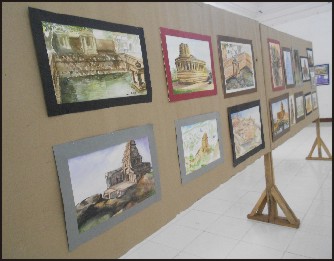
It is a known fact that Chamarajendra Academy of Visual Arts (CAVA) is known for bringing out creative minds. Students of first and second year foundation course of Bachelor of Fine Arts had recently been to a study tour of Badami, Aihole, Pattadakallu, Bijapur and Hampi. While the first year students had been to Hampi, the second year students visited other places.
CAVA students who had been on a 10-day study tour have created the magic on canvas by bringing the historic monuments alive using water colours. Some of the paintings displayed include Durga Temple of Aihole, Mahakuta at Badami, paintings of Lord Vishnu and Lord Narasimha, Stone Mantap at Badami, Stone Chariot and Veerupaksha Temple of Hampi and others.
The panting replicating the temple at Badami had the dominance of red colour as the structures in Badami are constructed using red stones, while, the paintings of Hampi were a little brownish in colour depicting the exact colours of the monuments. The exhibition will be open for public viewing from 10 am to 5 pm at CAVA premises till Jan. 13.
source: http://www.starofmysore.com / Star of Mysore / Home> General News / January 10th, 2014
Party peeps who wanted to have some masti at their New Year’s Eve party made their way to a star hotel in the city for a bash that was naughty and nice.
The Sheraton Bangalore Hotel at Brigade Gateway played host to an Angels and Demons bash, at which they got to boogey to the tunes played by DJs Ronald, D’costa and Savio.
Greeshma and Mithun )
BT spotted Greeshma, Mithun, Rashmita and Riddhima having a great time during the biggest party night of the year. And when closing time came around, everyone left talking about the plans they had made for New Year’s Day.
source: http://www.articles.timesofindia.indiatimes.com / The Times of India / Home> Entertainment> Events> Bangalore / TNN / January 04th, 2013
The above stated quote is so very true in the case of the story below:
It was a casual pilgrimage to Srirangapatna on Sept. 2, 2012, taken out by a family of three — the father, the mother and their 13-year-old son. Anybody visiting the Sri Ranganatha Swamy temple in Srirangapatna make it a point to visit the Cauvery river either before or after going to the temple. So was the case with this family too.
After paying their obeisance to the Lord at the temple, the family went towards the river to rest for a while. Seen there were children enjoying a dip in the water, women washing their clothes, utensils, etc., etc. The son of the family was also taking a dip in waters. At around 10.30 am, suddenly, one of the woman who was washing her clothes, while trying to pick up the clothes, slipped and fell into the river. The woman was physically handicapped and didn’t know how to swim.
The 40-year-old woman named Manchamma, unable to get out of the water, started crying out for help. The woman’s daughter and niece were there at the river bank, not knowing what to do as none of them knew how to swim either. Seeing this, the son, 13-year-old Manoj, swam towards the woman, pulled her by her hair and dragged her till the river bank. Manoj had learnt swimming when he was just 8 years old, swimming in the canal at his village. This proved to be of great help in saving the woman. The woman couldn’t believe what had just happened. She thanked the boy profusely and told him that he was God who gave her life.
This courageous act of Manoj deserves true appreciation and rewards. Accordingly, the State Department of Women & Child Development honoured Manoj with ‘Hoysala Shourya’ award, which was presented to him by the Governor H.R. Bhardwaj on Nov. 16, 2012. Now, this brave act has been identified by the Indian Council for Child Welfare, New Delhi and Manoj will be presented the ‘National Bravery Award 2013’ by Prime Minister Dr. Manmohan Singh in the presence of President Pranab Mukherjee, Vice-President Hamid Ansari, Delhi Governor Lt. Najeeb Jung and other dignitaries on January 26 and he will also be given a chance to take part in the Republic Day Parade at New Delhi.
The award carries a certificate, a gold medal and a cash prize of Rs. One lakh awarded by the Government of India. Apart from these, the Govt. will also provide the gallant children with Indira Gandhi scholarships to pursue either technical or medical courses.
About the boy: S.S. Manoj, a VII std. student of Navodaya School, DMG Village, Gaddige, is the son of S.T. Rajshekar, a tailor at Saligrama and S.K. Aarthi, a teacher at Govt. Primary School in Bangalore. Manoj is presently staying with his uncle Ramesh, residing at KHB Colony, Hootagalli.
Star of Mysore caught up with Manoj recently and congratulated him on his feat. When asked as to how he is feeling on being conferred the Bravery award, Manoj, in a humble way, said that he is really happy and that he would use the scholarship amount to pursue a degree in Engineering. He said that he would donate a part of the amount for the welfare of the disabled persons.
Speaking about his parents, Manoj said that his father, an ordinary tailor, would probably not be able to fund his education, so the scholarship amount has brought in great joy to his parents and his uncle.
source: http://www.starofmysore.com / Star of Mysore / Home> General News / January 09th, 2014
Sreekantham Nagendra Sastry. / Photo: Bhagya Prakash K. / The Hindu
In focus: Sreekantham Nagendra Sastry is keeping an 800-year-old tradition alive through Chintalapalli Parampara Trust.
To the old-timers of Mysore, music and musicians were household names and are cherished memories today . One such legacy is the Chintalapalli parampara, a musical heritage that traces its lineage to nearly 800 years. Today, a grandson is not only carrying on the mantle but has single-handedly developed and established a trust in the name of his illustrious maternal ancestry under whose umbrella thrive nearly 40 music institutions in and around Karnataka , where the academics of music are taught and conducted on the scales of a university. One has to meet Sreekantham Nagendra Sastry to perceive the commitment and missionary zeal.
Music is his birthright while teaching Kannada literature at Maharani College is his profession. A purist in Carnatic vocal music, he has authored many a book on music and musicians of Karnataka even as he trains pupils in its chaste form. With a hectic schedule, he manages to keep the fire of Chintalapalli heritage burning. “My ancestral home in Chintalapalli is on the Andhra-Karnataka border, around 7 km from Hindupur. In the post-Independence reorganisation of States, it came under Rayalaseema. Ironically, my great grandfather Chintalapalli Venkat Rao was awarded a fellowship by the Andhra Sangeet Natak Academy after the State formation as a matter of honour to Andhra Pradesh since he was recognised as a Telugu musician of excellence; this was followed by Mysore felicitating him as their heir since he was ‘asthana vidwan’ of the then Mysore royalty.”
Musical bloodline
The 800-year-old lineage is evident, as Nagendra has possessions that proclaim the veracity of the musical bloodline like the written proclamation (shashana) of Hoyasala King Veera Bhalla’s grant of land and later under the Bahamani sultans, another grant of 13 villages and a conferred title to the Chintalapalli maestro.
“My ancestors were vaggeyakaras (music composers) who moved to Vidyanagara and served in the ‘Lokapavana Vishwavidyalaya’ under the Vijayanagara kings. This apart, my great grandfather belongs to the Thyagaraja parampara having been the sishya of Pallavi Seshaiah who was himself pupil of Nemani Subbayya, Thyagaraja’s direct disciple. Later, the family migrated to various samsthanas like Gadwal and Wanaparthy in lieu of patronage. Finally, they settled down as asthana vidwans of Mysore court — that is my grandfather Chintalapalli Ramachandra Rao and great grandfather too,” he narrates the family history in a nutshell.
Since Bangalore was home to the Chintalapalli musicians, the ancestral fort-like home at the village was a sort of holiday sojourn. The Chintalapalli Parampara Trust that was formed now houses a library of ancient books on music and musicology, memoirs, pictures, research facilities in music and runs a school with a regular teacher, supervised by Nagendra himself. A couple housed in the Gurukul take care of those students who wish to stay back. Everything from first aid kits to general medicines to accompanying instruments like tanpura, mridangam, harmonium are all in place there.
Apart from regular examination, special classes in practical and theory are conducted annually by the trust. Nagendra has a vision to develop the ongoing trust institution into a university. “I have the infrastructure ready and the project proposal has been submitted to the Centre. Already the curriculum on which we are running our 40 institutions is geared to the semester system with our syllabi and exams. Recently we opened a centre at Chikmagalur. We have centres run by my students abroad also. We were affiliated to Lokapavana University. The music courses offered by our Vyshveeka Vidyalayam run by our trust are: Sangeeta Paramapara Pallava (initial course); Parampara Kusuma; Paramapara Saurabha; Parampara Shri and the highest Parampara Nidhi which has a regular and honorary conferring of degree,” he informs.
Place of learning
The convocation replicates the Vijayanagara style where the ancestors’ ‘baton’ (a silver danda with lion head at the top) arrives ceremoniously followed by Guru paadukas; a hamsa-headed brass lamp which symbolises the end of music (spiritual upliftment). A ritualistic Guru puja invoking the ancestors is conducted which marks the ‘Gatikotsavam’. A pledge is undertaken by the recipients of the certificates and awards.
“The examination pattern is modelled on the current trend only as far as hall-tickets issuance goes; the rest is done through drawing lots where the head of one institute invariably ends up at another exam centre thereby arresting malpractices to a large extent,” the teacher in him takes over as he explains. His services to the music community are well-known yet he prefers to maintain a low profile, allowing his work to speak for him.
source: http://www.thehindu.com / The Hindu / Home> Features> Friday Review> Music / by Ranee Kumar / January 02nd, 2014
All in the family: Seen in the picture are (front row from left) Sumukh (kneeling), Padma G. Murthy, Mythili Ramakrishna, G. Ramakrishna, G. Satyanarayana, Nirmala Satya, G. Soumi, Shashank Gowri; (standing from left) G. Ananth, Shruthi Ananth, Spurthi Vinay, G.Vinay, G. Subbanarasimha, Srilakshmi Subbanarasimha, Swamini Varadachaitanya, Deepa, Dr. Asha Shekar, Jayanthi B.G Nath, Suvarna Laxman, M.S. Laxman Rao, Dr. G. L. Shekar, Shamsundar and Vijay Simha.
Mysore :
When families split over trivial issues, here is a family of five brothers and five sisters and their children and grandchildren, living with love and affection.
Gowris of Mysore city, known more through the evening English newspaper ‘Samachar’, edited by one of the brothers, G. Satyanarayana, who have a rich past, assembled last Sunday at Hotel Dasaprakash Paradise in Yadavagiri to felicitate two brothers and a sister, who have crossed 70.
The get-together of over 20 members of the Gowri family was marked with homely and happy atmosphere throughout. The extended family of all the five brothers and five sisters are spread over Mysore, Bangalore, Chennai, US, New Zealand and Australia.
The get-together was arranged chiefly to felicitate G. Ramakrishna, former Director of Tourism, Government of India, now settled in Los Angeles (US), who is on a month-long visit to India, on his 80th birthday. Along with him his next brother G. Satyanarayana (Gowri Satya), former Editor of ‘Samachar’, and his immediate sister, G. Padmavathi, wife of late Gurumurthy, Librarian, Sri Venkateswara University, Tirupathi, were also felicitated. A host of their relatives and close common friends were present.
Candle was lit, cake was cut, the couples exchanged garlands and offered a piece of cake to each other and they were felicitated with Petas (turbans), shawls, fruits and flowers, as per Mysore tradition while their friends recalled their association with them during their felicitation speeches.
Popular All India Radio (AIR) Kannada news reader of yesteryears M. Ranga Rao felicitated Ramakrishna with a Mysore Peta and shawl, while Star of Mysore and Mysooru Mithra Editor-in-Chief K.B. Ganapathy honoured Satya with shawl and educationist Sreepada Rao with turban. R.V. Lalithamba honoured Padma with a shawl, flowers and fruits.
Speaking on the occasion, Ganapathy recalled his close association with the brothers and their journalistic career and expressed happiness over the camaraderie at the get-together. He recalled the cordial relations they had in their journalistic career.
During the brief and informal speeches, Ranga Rao recalled his association with Ramakrishna, when both were working in New Delhi.
Andolana Editor Rajashekara Koti was nostalgic of his friendship with Satya and recalled the contribution of the brothers, and in particular their father late G.L. Swamy, for development of tourism and journalism in Mysore. Though Mysore had several attractions to offer, he deplored that the Government was doing very little for development of tourism, despite repeated demands.
NIE-IT Vice-President M. Sreepada Rao, Consumer activist Dr. S.P. Thirumala Rao and Col. (retd.) Dr. Anand also spoke felicitating the Gowri family members.
Ramakrishna recalled his days in the Department of Tourism in India and thanked all for the felicitations.
NIE Principal Dr. G.L. Shekar, who was chiefly responsible for organising the function, said how the Gowri family, whose strength had grown to about 100 members, is well-knit and maintained cordial relations.
The other first generation Gowri family members are G. Subbanarasimha, Gowri Sunder, Swamini Varadachaitanya (formerly G.L. Gayathri), Rama, Suvarna and Jayanthi.
The Gowri clan of G.L. Swamy and G. Meenakshamma has 10 children, 18 grandchildren and 9 great-grandchildren.
Former MLC M. Sathyanarayana Rao, NIE Secretary S.L.Ramachandra, Writer E.R. Ramachandran, Journalists K.V. Sreenivasan and Prabhurajan were among those present.
source: http://www.starofmysore.com / Star of Mysore / Home> General News / January 08th, 2014