So far, 69-year-old Sudha Durg has helped more than 90 households also get Aadhar cards and senior citizen cards
Government authorities, including the MLA and corporator of Jeevan Kendra Layout in Ulsoor, know that a call from Sudha P Durg always means business. Neither diabetes nor age — she is 69 — deters this grandmother of three from doing what she loves to do: Lending a helping hand to the needy. From shuttling between houses in her locality collecting voter ID card, Aadhar card and senior citizen’s card forms to admitting impoverished children to school, Sudha does it all.
Homemaker Sudha was always restless as a young bride, but in a positive way. Although she loved mothering her children – a son and a daughter – the magnanimous side of hers was compelling. “From a very young age, I tried to do whatever I could for the people around me,” Sudha said with a smile. “We were more privileged than many other people around us, so I couldn’t sit back and do nothing.”
For the last 40 years, Sudha has been involved in social work such as educating the underprivileged — she got 25 children from families of construction workers admitted in government schools in Murphy Town — paying tuition fees for her maid’s children and attending to the needs of the backward classes. About four years ago though, she began championing the importance of voting.
“I would go from house to house, telling people to vote. That’s when I learnt that there were many people who did not have voter ID cards and didn’t even have a clue where to get it made. Many people did not have the time to run around government offices, so I decided to take it up for them,” she said.
Now, all the residents in her layout – 90 odd houses – and many others in neighbouring areas owe a debt of gratitude to her for getting their government documents made. “I started out by helping a few people here and there near my house, but soon, a lot of people came to know about me. They would come to my house seeking help. Since the government officials in my area such as the MLA and corporator know me well, it was never a trouble to get forms.”
Her immediate neighbour Jyothi Verma and her family of seven have Sudha to thank for getting their documents made. “Sudha herself got us the forms. All we had to do was fill those out and stick the photographs which she later came to collect. After a few weeks, our documents were delivered to our home. We did not have to go and collect even voter ID cards. Sudha received them herself and delivered them to us,” says Jyothi.
Sudha has also got residents in the area to contribute to appoint a security guard to watch over the area. Each house donates Rs 100. At the start of his duty every day, the security guard reports to Sudha and he knows better than to miss a single day on the job. Since 1996, beat police tick a register — now a card access system which they swipe — at her house, while pourakarmikas inform Sudha about their leave, and she accordingly informs everyone else.
While several other residential areas in the city suffer from parking problems, Sudha has streamlined parking in Jeevan Kendra Layout.
MH Naagthe, inspector, Ulsoor police station, lauds Sudha’s crime awareness initiative. “I always say prevention is better than detection. Sudha has been actively attending the workshops organised at the police station and is very knowledgeable about crime and the importance of being alert. She goes back and relays our messages to the residents, thus tutoring them on how to prevent crime.”
Backing Sudha in her noble cause is her husband Prabhakar Rao Durg as well as their son, daughter and their families. “She has been doing social service for the last 40 years and I know she loves everyday of her job. I help her out in any way I can like keeping a record of the amount collected from the society, payments, etc.,” says 77-year-old Durg.
source: http://www.bangaloremirror.com / Bangalore Mirror / Home> Bangalore> Others / by Tapasya Mitra Mazumdar, Bangalore Mirror Bureau / November 20th, 2013
Organ receiver now runs foundation for organ donation.
Reena Raju (second from left), is the first woman in Karnataka to undergo a heart transplant. – A Veeramani/DNA
Reena Raju, the first woman from the state to undergo a heart transplant four years ago, is now running an organisation, Light a Life, that raises funds for and spreads awareness about organ transplantation.
“The best way to honour a donor is by living life to the fullest and making it worthy,” says Raju, as she celebrates the 4th year of her rebirth, post the transplant.
The awareness drives and funds raised have helped many patients across the country. The six patients who received free life saving medicines and over 75 patients and their family members who received counselling, remain thankful for the support.
“Everyone knows that transplant is a costly affair. But the ones who want to save lives of their loved ones often miss some critical information – of the challenges and cost involved in post transplant care,” she pointed out.
“A kidney transplant can cost anywhere between Rs5 lakh and 15 lakh and patients who sell their property and jewellery to manage this expense are then left with nothing to look after the post transplant expenses.”
Jayaram G, a second year B Com student who underwent a kidney transplant agrees.
“I only wanted to live. But I had no organ and no money. My parents are labourers. After the surgery, I realised that the anti-rejection drugs that I need to take everyday to ensure that the new organ does not get rejected by my body are very expensive.”
He is currently being given free medicines by Light a Life. The other challenges they are exposed to is that of infections.
“Maintenance and care are so crucial,” says Mayanna K, a 41-year-old kidney recipient and farmer, “After the surgery, I now know that life has become very difficult. I have to take so many precautions and care to maintain the organ and avoid infections. Even a fever can lead to an organ failure.”
Mayanna managed to undergo the transplant and avail medicines at subsidised rates from a government hospital and is now receiving free medicines for a year from Raju’s foundation.
Manikantan A, a cable operator from Chennai earns less than half of what he needs to spend on post-transplant medication, and so decided to reduce his dosage of the immuno suppressant drugs which led to many complications.
For a transplant to be viable, it should be affordable and people should be completely informed about the extra care, regular tests and the side effects that the medicines could bring, Raju said.
The first heart recipient in the country to complete a 5.7km marathon and 8km cyclathon, Raju did not allow anything to take her life away from her.
“The most thrilling experience was parasailing and underwater sea walk that I recently went to. Isn’t it wonderful that one could take one’s donor heart to the sky and the sea bed?” the adventurous woman asked. Awareness about transplant is not just in terms of financial or medical aspects.
There are a bundle of myths waiting to be busted, she explained.
“Many patients reject organs because they think their feelings and emotions will be changed with a new organ coming in, which is ridiculous. And religious views such as ‘eye donors will go to heaven without eyes’ and ‘bodies must be cremated within a certain period of time’ stops a donor from helping the needy.”
The 32-year-old also believes that Indians are givers and if we can spread sufficient awareness and make the system of transplantation transparent, people will come forward and donate.
source: http://www.danindia.com / DNA / Home> Bangalore> Report / by Shruthi EN / Place: Bangalore, Agency: DNA / Wednesday – November 20th, 2013
Prof. C.N.R. Rao with wife Indumathi in Bengaluru —DC/R. Samuel
Bengaluru:
Professor C.N.R. Rao’s office at the Indian Institute of Science in Bengaluru received a steady stream of visitors all through Sunday morning. Chief Minister Siddaramaiah was the first to arrive, at 8.30 am, followed by a brief interaction with the media.
A visibly exhausted Prof. Rao then retired to his study, where friends and well-wishers continued to drop by.
“I even got a phone call from someone at 1 am,” he told us, later. Why the rush? On Saturday afternoon, Prof. Rao, one of the foremost authority on solid states and materials chemistry, was conferred the Bharat Ratna, India’s highest civilian honour, felicitating decades of breakthrough research, 1,600 papers and 45 books.
In came Dr Roddam Narasimha, one of the country’s most prominent aerospace scientists and a dear friend to Prof. Rao. Dr Govindarajan Padmanabhan, Prof. Balram’s predecessor as the director of the Indian Institute of Science, the AGP and Prof. Kumar, and former director, Raman Research Institute, were also among the elite list of visitors.
Meanwhile, we were ushered into another room to speak with Prof. Rao’s wife, Indumathi, about the CNR Rao Educational Foundation.
The Foundation was formed back in 2005, the year Prof. Rao won the prestigious Dan David Prize for Science, a million-dollar grant. “We decided to use that money to give back to society,” said Mrs Rao.
The CNR Rao Hall of Science, Madan Mohan Malviya, was funded by the Ambani Trust. Each year, the Foundation honours two teachers, one from Karnataka, usually from a Kannada medium school and one from across the country.
“It’s not just what they do in class, but what they do outside of it, to enthuse their students,” Mrs Rao explained.
Prof. Rao celebrates his birthday each year (June 30) by organising a Teachers’ Day, of sorts, with lectures and a music concert. “Music is very important to us,” Mrs Rao added, with a smile. Why? “It’s so beautiful, don’t you think?” she replied.
The Foundation has remained, with intent, a tiny organisation, run on very low funding. “We don’t want to ask anybody for money and besides, I’m the one who has to manage it, which I really can’t do anymore,” Mrs Rao admitted. The couple is nearing eighty now and although they do seem full of beans, age has undoubtedly taken its toll.
The Foundation has worked with over 60,000 children since it was formed, with an average of about 2,000 students each year. “We work with rural children in particular, because they are so motivated and talented, but have no opportunities,” she said.
Prof. Rao, who was born into an educated middle-class family, attributes his success entirely to education. “We had no godfathers,” he remarked.
Nearly an hour later, we are allowed in to Prof Rao’s office. His little study is piled high with bouquets, hiding a most eclectic collection of books. Being of the firm belief that you are what you read, I rummaged only to find books on Persian poetry, music and art lying side by side with heavy volumes on Science.
I’d learned, through the grapevine at the Institute, that Prof. Rao had a green thumb.
“I’m the official tree planter,” he agreed, happily, saying he’s planted over 20,000 trees in his lifetime. Not too long ago, four trees on the border of the IISc campus were uprooted because the branches got in the way of a high-voltage wire.
“All they needed to do was trim the branches, but they cut down the trees. I was outraged and nobody said anything!” he said.
“I created a forest here, but they’ve gone and put a road there and done all kinds of foolish things,” he added crossly. “The JNCASR campus is beautiful. I don’t allow vehicles to drive through either. I like to stay in harmony with nature.”
We return to a question that first arose the evening before — should the government do more to bridge the gap between industry and research? “The industry isn’t interested in funding research,” said Prof. Rao. “In other parts of the world, nearly 60 per cent of the research being done is funded by private companies.” It is a little known fact that Prof.
Rao received a $5 million grant from Sheikh Saud of Saudi Arabia. “We met at a conference once and he really seemed to like me,” Prof. Rao explained. “Soon after, he flew down to JNCASR and gave me a grant, with no strings attached!” The Sheikh paid him another visit only last month.
“Wealthy Indians are more interested in funding universities abroad. Ratan Tata has done nothing for IISc yet, for instance. Give me three or four million dollars,” he said suddenly, “I’ll set up a university as good as Harvard.”
It doesn’t take him long to meander towards his second favourite thing in the world — music. “I listen to Hindustani classical music,” he said, delving into the small mountain of bouquets to locate his music collection —which includes cassettes, by the way! It has become customary for Prof. Rao to bring well-known musicians down to the institute, the most recent being Pt Amjad Ali Khan.
The conversation slowly veers back to science and the Bharat Ratna award. Will the award give careers in science and research a touch of glamour? Prof. Rao dismisses the idea. “Science doesn’t involve glamour for me,” he said at once. “All that matters is asking the right questions.” Prof. Rao is currently working on artificial photosynthesis, which he hopes to recreate in his lab. “I want to create material that is ordinarily useless, but which can be made to absorb sunlight.”
At the age of 80, Prof. Rao still manages to publish an astounding 30 papers each year, more than most scientists still in their prime. “I work all the time, I’m always writing something. I actually dream about how I’m going to phrase a particular sentence,” he said.
Back in 2007, Prof. Rao raised many eyebrows, by saying that IT employees are like coolies who work for wages without producing any significant intellectual material. Did Narayana Murthy call to congratulate him? “No,” he said. “I don’t call him; he doesn’t call me.” The Infosys Foundation has started giving out a Science Prize, we ventured helpfully.
“That’s not a very good prize,” Prof. Rao retorted. “There are far more deserving scientists. Besides, the Infosys Foundation tends to laud Indian scientists who are working abroad. They don’t need the help, while scientists in this country do,” he said angrily. “Narayana Murthy’s committees are full of nepotistic relationships.”
Prof. Rao then wades into an ocean of nostalgia for a little while, talking about Rajiv Gandhi, whom he served as Chairman of the PM’s Advisory Council from 1985 to 1989. “He was a wonderful man,” he said, staring glassily into the distance. “People would portray him as a party person, but he was a teetotaller.
He was also quite the moralist. The day he was assassinated was one of the saddest in my life,” he said, adding, quite succinctly, “I really admired Indira Gandhi too. She had class,” he said. Does that mean today’s politicians don’t have class? “Today’s politicians are a bunch of crazy guys,” he replied.
“Just look at the sort of language they use and the way they talk about women. The mindset in our political class today is that women are merely sex objects,” he said, a look of disdain marring his otherwise smiling face for a moment.
As the conversation drifted in and out of a plethora of issues, science, it seemed, was foremost on Prof. Rao’s mind. Funding science, he remarked, is last on the government’s priority list. “At best, we get about 20 per cent of the funding we require. I’ve never had political patronage and I’ve never sought it either. Politicians are here today and gone tomorrow.”
Prof. Rao’s Foundation does try to fill this void by promoting scientists from some of the least developed nations.
“We do offer grants of up to Rs 5 lakh each year,” he said. His family has been sending urgent messages to his study, beckoning him for lunch at once, so we take our leave too. What we did get, in the end, was a glimpse of the man behind the science – a remarkable man he is, too. All that’s left to say is this, “Professor Rao, you’ve done India proud.”
source: http://www.deccanchronicle.com / Deccan Chronicle / Home> News> Current Affairs / DC / by Darshana Ramdev / November 18th, 2013
Linguistic Society of India (LSI) President Prof. Anvita Abbi is seen lighting the lamp as CIIL Director Prof. Awadesh Kumar Mishra, New York State University’s Prof. S. N. Sridhar and others look on.
Mysore :
The three-day 35th annual and first international conference of Linguistic Society of India (LSI) commenced yesterday at the premises of Central Institute of Indian Languages (CIIL) on Hunsur Road here which has been organised jointly by CIIL and LSI.
The conference is being attended by 200 delegates from 18 countries which features paper presentations and discussions.
Inaugurating the conference, CIIL Director Prof. Awadesh Kumar Mishra said that the institute was striving to develop small languages. He opined that all linguists should work together to promote and develop all the Indian languages. He contended that education was mandatory in all the languages for an overall development.
Presiding over the programme, LSI President Prof. Anvita Abbi opined that language of North Eastern States were rich in culture which need to be developed fully. She suggested linguists to also focus on research in the field.
New York State University’s Prof. S.N. Sridhar delivered the keynote address on ‘The world of a multilingual: An Indian perspective.’
LSI Secretary Dr. Shailendra Mishra, Conference Co-ordinator Dr. L. Ramamurthy and others were present.
source: http://www.starofmysore.com / Star of Mysore / Home> General News / November 28th, 2013
The commercial ties between the US and India stretch back to 1792 when President George Washington, the first US President, sent an official envoy to the city of Madras and established a permanent presence in city. Ever since, both the countries have recognised the enormous potential of cultivating this partnership. US remains the leading investor in India, both in terms of projects and jobs generated. Foreign Direct Investment from US firms created more than 355,000 jobs between 2007 and 2011. IT industry dominates the sector, with 60%-70% of our revenues coming from the US, said S. Nagarajan, Chairman, CII Mysore.
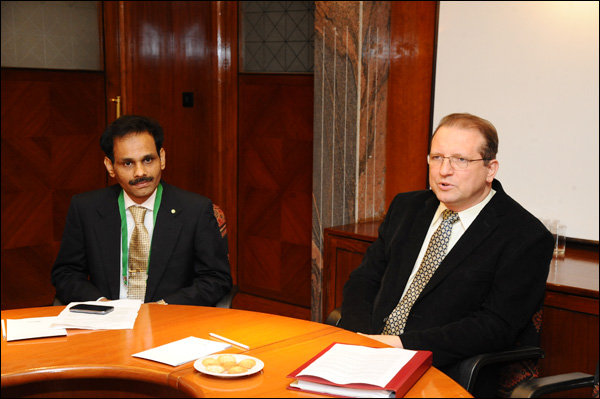
With this background, CII Mysore is organising an interactive session with Dr. Rajan Natarajan, Deputy Secretary of State, Policy & External Affairs, State of Maryland, USA, on Nov. 28 at Hotel Quorum in city at 5 pm.
Dr. Natarajan will address and interact with industries on US-India Technology Partnership; How to do business with US; New Markets and Investment opportunities for Indian Companies.
Dr. Natarajan was appointed as the Deputy Secretary of State by Governor Martin O’Malley in June 2011. He is the first Indian born-American, who currently holds the highest administrative position in the US and in Maryland’s history. His portfolio include representing the Governor and the Secretary of State at designated public events, advising the Secretary on external affairs, fostering and promoting international diplomatic mission, building public, private and business partnerships, FDI and trade promotion, enhancing educational and institutional collaborations, facilitating technology commercialisation.
In addition, he is responsible for advancing international Sister-State programmes in more than 13 countries that include (China, Japan, Brazil, India, South Korea, Liberia, Nigeria, South Africa, Turkey, Vietnam, Estonia, Ireland, and Russia), coordinating legislative and executive branches of government agencies, policy development and legislative approval, monitor policy implementation, and overseeing the Maryland International Consortium. He is also currently serving as a Member of the Governor’s International Advisory Council.
source: http://www.starofmysore.com / Star of Mysore / Home> General News / November 27th, 2013
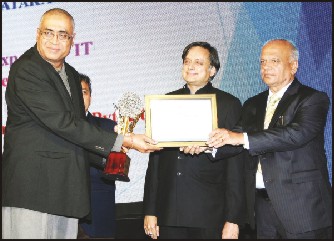
SPI CEO Sid Mookerji is seen receiving the award from S.R. Patil, Minister for IT, BT, Science and Technology as Shashi Tharoor, Union Minister of State for Human Resources, looks on.
Mysore :
Software Paradigms Infotech Pvt. Ltd. (SPI) has received the coveted ‘Highest IT Exporter-IT Services’ award for Mysore region (2012-2013). This award is conferred by Government of India and Department of IT, BT & ST, Government of Karnataka, in association with STPI.
The ‘Highest IT Exporter-IT Services’ Award is one of the most prestigious recognitions received by software companies for making a significant contribution to the total software exports of the country.
The award was presented to SPI CEO Sid Mookerji at Bangalore IT Biz-2013 recently. The trophy and certificate were presented by Shashi Tharoor, Union Minister of State for Human Resources and S.R. Patil, Karnataka Minister for IT, BT, Science and Technology, Planning and Statistics.
SPI was declared the Highest IT Exporter from the region in 2009-10, 2010-11 and 2011-2012. SPI had also received the Certificate of Excellence Award in IT exports 2003-04 and 2004-05.
“We are delighted to have won the Highest IT Exporter award for the fourth consecutive year. This establishes us as a leading IT player in tier II cities. SPI has been growing steadily both organically and inorganically; we have made two acquisitions this year. We will continue to deliver best of breed solutions that address the evolving business needs of our customers,” said Sid Mookerji.
source: http://www.starofmysore.com / Star of Mysore / Home> General News / November 27th, 2013
President Barack Obama plans to nominate Dr. Vivek Hallegere Murthy, the Indian-American head of a doctors group that promotes his signature healthcare law to be the next US surgeon general.
Murthy is a hospitalist at the Brigham and is co-founder and president of Doctors for America, a Washington, DC-based group of 16,000 physicians and medical students that advocates for access to affordable, high quality health care.If confirmed by the Senate, Murthy will replace Regina Benjamin, who was appointed by Obama in 2009 and left her post last summer.
The job focuses heavily on public health issues.Murthy was appointed to the President’s Advisory Group on Prevention, Health Promotion, and Integrative and Public Health in 2011. The prevention group was created as part of the Affordable Care Act health reform law.
His group, Doctors for America, was originally called Doctors for Obama and helped to campaign for Obama’s election.
Murthy co-founded VISIONS Worldwide in 1995, a non-profit organization focused on HIV/AIDS education in India and the United States, where he served as President from 1995 to 2000 and Chairman of the Board from 2000 to 2003.
Murthy received a BA from Harvard University, an MBA from Yale School of Management, and an MD from Yale School of Medicine.
“I am confident that these outstanding individuals will greatly serve the American people in their new roles and I look forward to working with them in the months and years to come,” Obama said in announcing Murthy’s appointment along with three other key posts.
The announcement came shortly after Obama acknowledging that his administration “fumbled” in the troubled rollout of his healthcare law offered a fix that would allow insurers to keep for another year people on plans that were to be cancelled for not meeting minimum standards under the new law.
In the midst of mounting criticism of the troubled healthcare website, former President Bill Clinton had Tuesday suggested that Obama should make sure Americans can retain their current health insurance plans, even if it means revamping the Affordable Care Act.
“I personally believe, even if it takes a change to the law, the president should honour the commitment the federal government made to those people and let them keep what they’ve got,” Clinton told OZY, a news website.
Murthy, though was born in London and shifted base to the US later, he has links with the Hallegere village of Mandya district.
source: http://www.deccanherald.com / Deccan Herald / Home> International / by Agencies / Washington – November 15th, 2013
“The Indo-German relations have grown considerably over the last six decades, especially in scientific cooperation aiming to serve the welfare of the people. Both countries are now emphasizing to promote international research cooperation to benefit human health,” said Hans-GuenterLoeffler, Deputy Consul General of Germany in Bangalore.
Loeffler addressing media persons at the inauguration of International Humboldt Kolleg on “Bench to bedside translational research: Potential benefits of interdisciplinary collaboration” beingorganized by Clinical Embryology department of Manipal University with support from Alexander von Humboldt Foundation, Germany and German Consulate General, Bangalore, said it is known to the world how much India has progressed and Germany was keen for more mature partnership in science and research.
Interdisciplinary research benefits all and it is possible for both countries to improve the speed and efficiency of transfer of knowledge between basic research, which is very strong in Germany and India, clinical research and application,” he said.
One ministry alone in Germany, the ministry of education and research, spends 5.5 billion Euros to promote cooperation between universities, institutions and industry focused on centres for health all over Germany for most important diseases, cancer, cardiovascular, diabetes etc.
The Humboldt Foundation is a non-profit organization established by the Federal Republic of Germany to promote international research cooperation. It enables highly qualified foreign scholars to have long-term association with German institutes. Earlier recipients of this award include Noble laureates, philosophers and well-known scientists. Humboldt Foundation sponsors Humboldt Kollegswhich is primarily aimed at conducting interdisciplinary meetings to address key research problems.
“Germany is a potential hub for advanced research. Many research and funding organisations offer excellent funding opportunities and ideal conditions for foreign scientists in all fields,” said professor Micheal Bader from Berlin who was a plenary speaker in the Kolleg.
“The very idea of holding the ‘Humboldt-Kolleg’ is that it provides a platform for young researchers and experienced scientists from different disciplines to interact, discuss and find out commonalities among their research interests. These meetings make the base for a long term scientific interaction and especially students are benefited. More than one hundred eminent scientists from top universities and research institutes in Germany and India are participating in the meeting” said Dr Satish Adiga, convener of the conference and a Humboldtian at KMC Manipal.
“The Kolleg offers a great opportunity to learn and discuss how India, Germany and other countries are involved in translating experimental research to clinical applications,” said Dr Vinod Bhat, Pro Vice Chancellor of Manipal University in his presidential address.
National Research professor and Padma vibhushan awardee Dr M S Valiathan, highlighted the need of translational research to benefit patients in his keynote address.
Dr Sudhakar Nayak, Associate Dean of KMC Manipal welcomed the gathering and Dr Guruprasad Kalthur, associate professor in Clinical Embryology proposed vote of thanks.
source: http://www.daijiworld.com / DaijiWorld.com / Home> Karnataka / by Media Release / Bangalore, Saturday – November 16th, 2013
“Let us reject superstitions and at the same time retain our strong beliefs,” observed District Kannada Sahitya Parishat President M. Chandrashekar.
He was speaking at the “Acharya Sri Vidyaranya Rajyotsava award” presentation function organised by Himalaya Foundation at the Institution of Engineers Hall on JLB road in the city on Sunday.
The Himalaya Foundation’s initiative to institute the award in the name of Vidyaranya, who was the inspiration behind the Vijayanagar empire, is really commendable, he said.
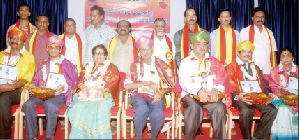
Seven eminent personalities — Senior Journalist Krishna Vattam (Journalism), Dr. M. Dejamma (Educationist), Advocate O. Sham Bhat (Religious Service), Dr. C. Sharath Kumar (Medicine), Sharath Jois (Yoga), Somasekhar Gowda (Social Service) and Shyamala Murthy (Literature) were presented the awards.
A Kavigoshti (poets meet) also was held on the occasion. Ramanahalli Bhavaikya Basava Kendra’s Basavalingamurthy Swamiji graced the occasion.
Former District Sahitya Parishat President Maddikere Gopal, Himalaya Foundation’s N. Ananth, District Brahmana Mahasabha President B.R. Nataraja Jois and others were present.
source: http://www.starofmysore.com / Star of Mysore / Home> General News / September 26th, 2013
Imran Khan, a resident of Tumkur, had been bedridden for the best part of 12 years after nearly 200 kg of steel fell on his back when he was visiting a construction site.
The 28-year-old lost all hope of walking again till he found out about Ilaj bit Tadbeer (regimental therapy), a little-known system of unani medicine involving massage, cupping and leeching using herbs. Imran underwent 14 months of continuous treatment at the National Institute of Unani Medicine (NIUM), which falls under the Ministry of Health and Family Welfare. Now, he has started walking with support.
The story of Tousif Ahmed from BTM Layout is similar to Imran’s. Tousif injured his spine in an accident in Andhra Pradesh in January 2012 in which his uncle died.
“I was told by a private hospital that I would not walk again and would be bedridden for the rest of my life. But with intervention from NIUM, I am moving in a wheelchair and also walking with crutches,” he said.
Tousif has been receiving treatment at the Institute for the past four months. He is currently shooting videos of recovering patients at NIUM in order to make a short film.
“I had wanted to set up a call-centre after getting my BCA, but the accident crippled my dream. But as I can move again, I have set a target of five months to walk out of this hospital,” he said.
Dr D A Muzzaffar Bhat, resident medical officer of NIUM, said the centre was focusing on neuro-rehabilitation. This included attending to patients who suffered from stroke, myopathy, epilepsy, motor-neuron disease, Parkinson’s disease, hemiplegia and paraplegia. He said NIUM takes up cases referred from other hospitals like NIMHANS.
He referred to the successful treatment of Mohammed Farooq, who was admitted to Victoria Hospital after meeting with an accident. He was bedridden for eight months with no sensation in his lower-back. Farooq started treatment at NIUM in January and is now walking with the help of crutches.
“No surgeries are done here and our approach is to develop cells and strengthen nerves and muscles,” Dr Bhat said .
Options for Cerebral Palsy Aditya Kholi greets you with a smile and offers a chair to those who approach him and only when he tries to walk, do people notice a problem.
Aditya is a child who was born with cerebral palsy and could hardly move his legs. His father Mahesh Kohli, an IT professional, had quit his job in Dubai to research treatment options for Aditya, when a friend told him about Ilaj bit Tadbeer.
After five months of treatment, Aditya can now sit comfortably and also fold his legs and walk.
source: http://www.newindianexpress.com / The New Indian Express / Home> Cities> Bangalore / by Mohammed Yacoob – Bangalore / November 18th, 2013