Cultural extravaganza ends on a majestic note


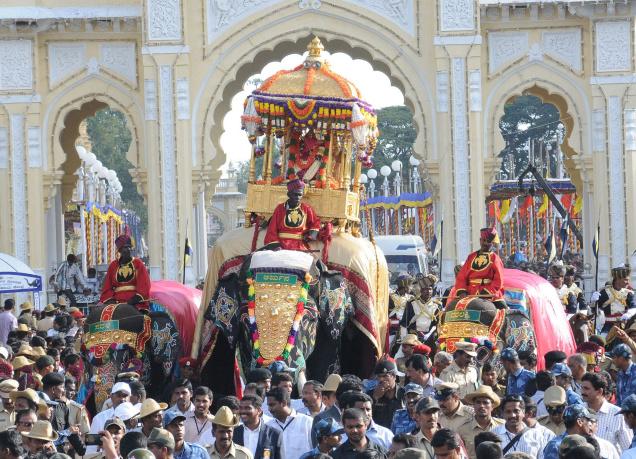
GRAND FINALE:Arjuna, flanked by Sarala and Varalakshmi, carrying the golden howdah with the idol of Goddess Chamundeshwari during the Jamboo Savari in Mysore on Monday. / Photo: M.A. Sriram /  The Hindu
GRAND FINALE:Arjuna, flanked by Sarala and Varalakshmi, carrying the golden howdah with the idol of Goddess Chamundeshwari during the Jamboo Savari in Mysore on Monday. / Photo: M.A. Sriram / The Hindu

A magnificent cultural extravaganza unfolded at the Mysore Palace here on Monday signalling the culmination of the 10-day Dasara festivities as the lead elephant, Arjuna, carried the golden howdah with the idol of Goddess Chamundeshwari as part of the Jamboo Savari to the amazement of the crowd on its way to Bannimantap.

Chief Minister Siddaramaiah, who arrived by a KSRTC bus, accompanied by district in-charge Minister V. Srinivas Prasad and other Cabinet colleagues, offered puja to the Nandi Dhwaja at 1.20 p.m. near the Sri Kote Anjaneya Swamy temple to signal the formal beginning of the Jamboo Savari. The caparisoned Naupat-elephant Gajendra and Nishane-elephant Balarama, joined by pachyderms Gopi, Prashanta,Vikrama, Harsha, Vijaya and Srirama, marched in tandem as onlookers, who included a number of foreigners, cheered them till they exited the palace gates.

A nonchalant Arjuna flanked by Varalakshmi and Sarala, marched on majestically, immediately after the 21-round cannon salute.

PUJA

Mr. Siddaramaiah, Mayor N.M. Rajeshwari and others showered flowers on the idol of Goddess Chamundeshwari in the golden howdah as Arjuna and company commenced the march from the precincts of the palace at 4 p.m. to bring the festivities to an end this year. The large crowd relished the moments and cheered the cultural tropes. Dasara marks a highpoint in Mysore’s cultural history even as the heritage buildings, monuments, temples, mosques and churches add to its glorious past.

The procession was a gala mix of tableaux accompanied by cultural troupes heralding the cultural diversity of the State.

Russian artistes under the banner of Brahma Kumari ashram from St. Petersburg, those depicting the royal families from Vijayanagar in Bellary where the Dasara festivities have their roots, Wadiyars of Mysore, Kempe Gowda of Bangalore and the Darbar of Ibrahim Adil Shah of Bijapur showcased their skill in front of an appreciative crowd which savoured the beauty of it all.

Some of the cultural troupes were stead-walking by a man dressed as Veerabhadra, Beesukamsale, Jaggalagi Mela, dummy dancers, Koragara Nritya, Donne Varase, Dollu Kunita comprising women participants, Lambani Nritya, Karadi Majalu and Chitaki Bhajan depicting sequences from the epic Ramayana.

Earlier in the day, the scion of the Mysore royal family, Srikantadatta Narasimharaja Wadiyar, performed puja to the Banni tree on the premises of Sri Bhuvaneshwari temple inside the palace as is the custom.

source: http://www.thehindu.com / The Hindu / Home> News> National> Karnataka / by Jeevan Cinnappa / Mysore – October 15th, 2013

Akashvani : National Integration through music

(From left) Akashavani Mysore Asst. Station Director Dr. Anand V. Patil, Asst. Director Programmes G. Raja Lakshmi, Head of Office V. Srinivasan, Nada Brahma Sangeetha Sabha President K.V. Murthy and Programme Executive M.Raghavendra.

by S.R. Krishna Murthy

The Akashvani Sangeeth Sammelana is an annual musical event, organised by Akashvani, since 1954. In earlier days, it was a two-day festival on the second Saturday and Sunday of October, in major stations and a one-day event on the second saturday of October in other stations. Since some years, it has become a one day event conducted throughout the country on the same day, sometime during the end of September or during the middle of October. A happy note of this music festival is that the artistes from different parts of the country will be performing in other parts of the country, which is an effort in creating National integration. The artistes selected to perform not only feature regular and famous artistes, but even the upcoming artistes who are given equal prominence. This gesture definitely lends a supporting hand, in encouraging these youngsters.

Major stations will conduct the event every year and other stations will be holding the event turn by turn. This year, the programmes will be broadcasted from the National hook-up of Akashvani, for nearly forty-four days, from Oct. 19 to Dec. 11, at 9.30 pm on some days and 10 pm on other days, depending on that day’s schedule.

The Mysore edition of the Akashvani Sangeeth Sammelana 2013 was organised at Vasudevacharya Bhavana of Nada Brahma Sangeetha Sabha, on Sept. 29. It had two concerts, a Hindustani flute recital by Nityananda Haldipur, Mumbai, accompanied by Ravindra Yavagal on Tabla and the other, a Karnatak vocal recital by A.S. Murali of Chennai, accompanied by T.K. Padmanabha (violin), Tanjore Subramanyam (mridanga) and A.S. Shankar (ghata).

Akashvani Sangeeth Sammelana always evokes sufficient interest among the music fraternity and the auditorium was full with music enthusiasts.

About Nityananda Haldipur He is an ‘A’ Grade artiste of AIR and Doordarshan. He took to music at an early age and had the fortune of being taught by stalwarts like his father Niranjan Haldipur and Devendra Murudeshwar, both disciples of Pt. Pannalal Ghosh, Annapurna Devi (daughter of Ustad Aladdin Khan). Nityanand has participated in all the major events in India. In 2010, Nityanand Haldipur was given the highest award for his contribution to Indian classical music by Sangeeth Natak Academy, New Delhi. 

He began serenely the Alap of Raag Puriya. The Gat in Vilambit was in Rupaka Taal. His methodical presentation, smoothly breathed life into each note of the raga. The intermittent usage of phrases like RSNSR, SNDNS, added sweetness to the melody. Druth Gat was set to Teen Taal. Totally the delineation of Raag Puriya testified the flautist’s penchant for exploring a raga to its fullest. The next thirty minutes was Raag Jhanjooti, in Madhya Laya and Druth, both in Teen Taal. He concluded the concert with a Dhun in Mishra Pahadi.

The second programme was the Karnatak vocal recital by A.S. Murali of Chennai. The first rendering Ganapathi Enna Paliso (Nata-Adi-Prasanna Venkata Dasa) was for balancing the sound system. The broadcasting part began with Smaraneyonde Saalade (Malaya Marutha-Adi-Purandara Dasa). Two ragas were taken for delineation. First was Dharmavathi with an enthusiastic alapane, followed by the Kruti Bhajana Seyarada of Mysore Vasudevacharya. He did a Neraval at Niravadhi Sukhadaayakuni, with a short Swara. The second was Shankarabharana, with another good Alapane, leading to the Kruti Enduku Peddula of Thyagaraja with a Neraval at Veda Shastra Tatvarthamulu, followed by another set of good Swara. In between he sang Kamalaambaa Samrakshatumaam (Ananda Bhairavi-Mishra Chapu-Muthuswamy Dikshitar), the first of the Navaavarana Kruti. He concluded the concert with Paalaya Shree Mantraalaya Nilaya (Yaman Kalyani-Adi-Ananda Dasa). It may be a fact that the singer is accustomed to singing in Akashavani. Therefore, there was no rapport with the audience. It looked as though he was singing to the mike.

At this juncture, I would like to point out one odd phenomenon. The auditorium was full when the programme began. But, as soon as the Hindustani recital was over, nearly forty percent of the audience, mostly Hindustani connoisseurs, just walked out en-mass, just like our opposition members in the Assembly, walking out of the hall, if the ruling party does not agree to their point of view. Nobody can force someone to listen to something, which th ey do not relish. The audience could have sat for some more time, at least as a mark of respect to the next artiste.

source: http://www.starofmysore.com / Star of Mysore / Home> Feature Articles / by S. R. Krishna Murthy / October 15th, 2013

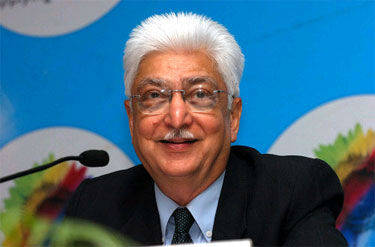
Azim Premji wins Business Leaders Award in UK

London :

Well-known Indian IT czar and philanthropist Azim Premji  has received the Asian Business Leaders Award in the UK.

“For both his business acumen and his notable contributions to Indian social causes, Mr Premji is a very well-deserved recipient of the Asian Business Leaders Award,” UK business secretary Vince Cable said in his welcome address at a ceremony yesterday.

(Well-known Indian IT czar…)

“With 40 per cent of the world’s High Growth Markets located in Asia, it is more important than ever to recognise the role of Asian businesspeople in contributing so much to the strength and breadth of the UK economy ,” he added.

The chairman of Wipro Limited  joins the likes of former Tata Group chairman Ratan Tata and Lord Green, UK minister of state for trade and investment, as a recipient of the honour presented by Asia House, a non-profit pan-Asian organisation based in the UK.

The annual award recognises individuals who embody the principle of ‘Servant Leader’ – economic success and professional excellence accompanied by moral leadership and service to society.

“We are delighted to honour a business leader admired greatly by the Asia House community. Azim Premji has achieved outstanding success as a global business leader. He has demonstrated a lifetime commitment to social and education issues through both organisations and people making him a most deserving recipient of the Asian Business Leaders Award,” said Sir John Boyd , chairman of Asia House.

The award itself was presented to Premji by Britain’s Foreign Office minister, Hugo Swire.

source: http://www.articles.timesofindia.indiatimes.com / The Economic Times / Home> News> News by Company / by PTI / October 15th, 2013

Dasara with unique flavour

The invocation ceremony or "Bodhon" of Goddess Durga being performed on Maha Shashthhi in Bangalore on Thursday. (Suryarshi Mitra/EPS)
The invocation ceremony or “Bodhon” of Goddess Durga being performed on Maha Shashthhi in Bangalore on Thursday. (Suryarshi Mitra/EPS)

With just three days left for the Dasara festivities to conclude, any celebration that is held in the city, is usually in the shadow of the world famous Mysore Dasara festival and the procession on the Vijayadashami day. With most people flocking to Mysore, Mangalore and their hometowns, festivities are either being held at homes in a localised manner depending on the state to which they belong.

Over the years, Bangalore has changed a lot and the Dasara festival too is celebrated with a distinctive regional flavour, be it from Gujarat, Bengal, Rajasthan, Punjab, Tamil Nadu and Uttarakhand. With each community celebrating in its traditional way, the citizens too partake in this festivities which is so diverse from the local culture. If it is Durga Puja, people flock to the pandals set up by the local Bengali associations in Malleswaram, Banaswadi and other areas while, if it is the Navaratra of the Gujaratis, the locals love taking part in the Garba and Dandiya that is held at the Bangalore Palace grounds as well as various residential areas. Joint celebrations are very popular in gated communities and huge apartment complexes be it in Domlur, JP Nagar or Marathahalli.

However, in some areas of Bangalore, one can still see Dasara festivities in the old areas like Chickpet, Cubbonpet, Munnireddy Palya when people throng the pandals and enjoy the nine-day festival.

The famous JC Nagar Dasara is nothing but a nada habba with people from all communities taking part which culminates with a grand procession on the Vijayadashmi day.

According to the organisers, this time, the festivities are on a large scale with more than 80 chariots taking part in the procession.

Any festival brings with it special menus and lip smacking sweets and savories. And Dasara in Bangalore means getting a chance to taste the unique flavours from different states and communities. We bring you some flavours from Bengal and the north.

Blessed be the bhog

There is no disputing a Bengali’s love for food. Durga Puja is no time to make an exception for it.

That food stalls at the various community puja pandals make brisk business and have people thronging for the varied delights of Bengali cuisine, shockingly so to others since it includes non-vegetarian fare, is well documented. What fewer know is the draw of the pujo-er bhog.

Partaking in what has been served as a meal to the goddess during her stay in her maiden home – it is believed that Durga is visiting her baaper badi (father’s home) with her four children Lakshmi. Saraswati, Kartik and Ganesh – is the highlight of Durga Puja.

source: http://www.newindianexpress.com / The New Indian Express / Home> Cities> Bangalore / by Express Features – Bangalore / October 12th, 2013

Kite-flying competition in Mysore

The ring kite, one of the highlights of the kite-flying festival held during Dasara in Mysore on Friday./  Photo: M.A Sriram / The Hindu
The ring kite, one of the highlights of the kite-flying festival held during Dasara in Mysore on Friday./ Photo: M.A Sriram / The Hindu

Total of Rs. 75,000 in cash awards awaiting winners

Kites of different colours and shapes soared high and took to the clear blue skies in the backdrop of Chamundi Hills and Lalitha Mahal Palace during the Dasara kite festival held on Friday.

The two-day event – being held on the Lalitha Mahal Palace helipad grounds – will also include a kite-flying competition on Saturday. It was introduced as part of the festival to revive the practice of kite-flying, which is reckoned to be going out of vogue among the modern generation.

The cynosure of all eyes at the festival was the ring kite while the inauguration saw a kite depicting the colours of Karnataka Flag with an image of Chief Minister Siddaramaiah inserted in the middle.

Highlights

Gopal, a renowned kite flyer from Gujarat is one of the special invitees. The festival will also see a kite fitted with 360 LED lights that will soar come dusk. Participants in the kite-flying contest will be classified under different categories depending on their age. A total of Rs. 75,000 in cash awards is waiting for the winners. The highest amount – Rs. 10,000 – will be given to winners in the group category.

Free kites will be provided.

source: http://www.thehindu.com / The Hindu / Home> News> National> Karnataka / by Special Correspondent / Mysore – October 12th, 2013

Rahul Dravid: An unsung hero makes a quiet exit

RahulCF29oct2013

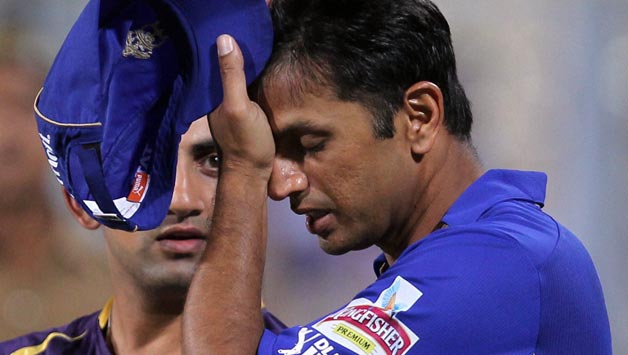
Rahul Dravid made a quiet exit after the CLT20 2013 final © PTI By Baiju Joseph

Rahul Dravid has largely been in the shadow of Sachin Tendulkar , despite his humungous achievements right throughout his career. And that is how it was till the very end. When the Champions League Twenty20 (CLT20) 2013 final ended the other day, Tendulkar got a hero’s farewell, while Dravid — bidding a final adieu to the game — made a quiet and unceremonious exit. Dravid would have taken it in his stride, like he has all along in his career.

Dravid does not have the magnetism of Tendulkar, the cockiness of Virender Sehwag , the aesthetics of VVS Laxman , the swagger of Sourav Ganguly  or the bludgeoning power of MS Dhoni . What he has is quiet confidence — in large measures — which helps him get the job done.

Whatever the situation, Dravid would always be the first one to put his hand up. There cannot be a better example of a team man who has taken up multiple responsibilities with such selflessness and effectiveness. He has done virtually everything a person can possibly do on a cricket field. He has bowled, kept wickets, opened the innings, functioned as finisher, has been a phenomenal slip catcher. You name it, he has done it, and what’s more. If it’s done by Dravid, it would be perfect. Take any great match from the last decade that India won: Hyderabad and Taunton 1999, Kolkata 2001, Adelaide 2003, Rawalpindi 2004, Dravid always had a hand in while others walked away with the glory.

Unlike other seniors in the team, Dravid readily agreed to bat at any position, be it Tests or One-Day Internationals (ODIs). It speaks volumes about his versatility and the ability to put the team interests before self. He was the go-to man in every sense of the word. Captains knew that if no one else was willing to take up a challenge, there was always Dravid to turn to.

Here is a man who has been the epitome of sustained excellence in an international career spanning 16 spectacular years, over 500 matches for the country and scoring 24,000 runs and 48 hundreds. He has also been exemplary in his conduct on and off the field — arguably India’s greatest-ever cricketing ambassador. The gems that he mouths are sheer delight to the ears: be it the Bradman Oration or insightful interviews in the media. It’s a pity while one great cricketing son is heaped in hosannas, another cricketing son — not far behind in terms of cricketing excellence and achievement — is largely ignored as both say sayonara to the game.

(Baiju Joseph is a Bangalore-based Junior Scientist at a Bio-Informatics firm who is deeply passionate about cricket and likes to bowl fast whenever he gets an opportunity to ply his cricketing skills)

source: http://www.india.nydailynews.com / NYDailyNews.com / Home> News> Desi / Monday – October 14th, 2013

City-based boxer is Olympian Vijender Singh’s coach


The team of boxers that left for Kazakhstan yesterday morning from Patiala, Punjab, to take part in the World Boxing Championship.

Mysore :

City resident C.A. Kuttappa, serving as Subedar in the Army, is the official coach for Olympian Vijender Singh, who won the bronze medal for India in the 2008 Beijing Olympics.

The duo, along with nine other boxers and two more coaches, is participating in the World Boxing Championship being held at Almaty, Kazakhstan, from Oct. 11 to Oct. 27. The team had undergone training at the Sports Authority of India (SAI) in Patiala, Punjab.

Kuttappa, a resident of Gokulam in city and hailing from Chenanda family, has been a coach for the Indian team since May 2009, which participated in Grand Prix Boxing championship at Czech Republic, World Boxing Championship in Italy, 19th Commonwealth Games in 2010 at Cuba, CISM World Military Games in 2011 at Brazil, 62nd Services Boxing Championship in 2012 at Pune and other major championships.

He has won many gold and silver medals in national level boxing championships since 1994.

When SOM spoke to Vijender Singh recently, he was full of praises for Kuttappa (his coach) and said that he aimed for the gold medal in the next Olympics. He is currently focusing on “speed.”

“I loved individual sports since childhood and was fascinated with martial arts. I then chose boxing,” said Vijender and added that if he were not to pursue boxing as a profession, he would have become an Army soldier. Vijender is serving as Deputy SP in the Punjab Police Department.

source: http://www.starofmysore.com / Star of Mysore / Home> Sports News / October 12th, 2013

City biker Tanveer emerges champion

Four wins out of nine earns him Best Rider Award

(Left): 1) Tanveer in action on his KTM bike at the racing event held in Bangalore on Oct. 5. (Right)  2) The victorious Tanveer is seen holding the trophy high
(Left): 1) Tanveer in action on his KTM bike at the racing event held in Bangalore on Oct. 5.
(Right) 2) The victorious Tanveer is seen holding the trophy high

Hunsur :

Curiously watched by more than 10,000 motor racing enthusiasts from different parts of the State, Mysore city’s biker Tanveer cornered glory by winning four out of nine races for motorbikes organised by Bharat Sports Club, Hunsur, at the grounds adjacent to the bypass road behind Talent School in the town on Thursday.

The organisers had barricaded the entire track besides making elaborate security to ensure that no untoward incident occurred during the races and they had also made arrangements for treatment to those injured during the event.

All the nine races organised for the day saw exciting moments as many participants got tossed off their bikes and some even suffered injuries.

While Tanveer was adjudged the Best Rider for his four wins his Bike Tuner Zabiulla of Motor Racing Workshop was awarded the Best Tuner award.

Prizes and trophies were distributed to winners in the evening by AICC member Prem Kumar, Industrialist Amarnath, Municipal member Ayub Khan, Sampath Kumar, Chotu Aslam, Anand, Narayana Rai and Chikkaswamy.

Results

New Boy’s Class: Hamid of Hunsur-First, Rizwan Khan of Hassan-Second and Syed Salman-Third.

Novice Class: Imran Pasha of Mysore-First, Mohammed Salman of Hassan-Second and Syed Sadiq of Virajpet-Third.

Hunsur Local Class: Hidayat of Hunsur-First, Sameer-Second and Sharukh Qureshi-Third.

Hunsur Open Class: Sharukh-First, Nayeem &Nayaz-Second and Sajid Ahmed-Third.

Intermediate Class: Rakesh-First, Athiq-Second and Rizwan-Third.

Four-Stroke Class: Tanveer of Mysore-First, Rajendra of Shimoga-Second and Nathan Nelson-Third.

Expert Class: Tanveer of Mysore-First, Rajendra-Second and Shahbaz Khan-Third.

Open Class: Tanveer of Mysore-First, Mahesh of Cochin, Kerala-Second and Rajendra-Third.

Indian Open Class: Tanveer of Mysore-First, Rajendra- Second and Mahesh of Cochin-Third.

source: http://www.starofmysore.com / Star of Mysore / Home> Sports News / October 12th, 2013

Pages from history : The magic spell of Dasara

by Prof. A.V. Narasimha Murthy, former Head, Department of Ancient History & Archaeology, University of Mysore

All roads lead to Mysore, the royal city, because it is the time of Navaratri also called Dasara and Mysore is glittering with electric lights. Infact ancient Dasara of Vijaynagara times was glittering with gold and gold but our Dasara has substituted electric bulbs in place of gold. Even this is a luxury and a symbol of pomp. Actually it is called Sharannavaratri or Navaratri during the autumn season as different from Vasantha Navaratri which is celebrated during spring. In the former, nature also plays a role with good climate and the season of flowers and hence flower show is also held during this period. Navaratri is basically the celebration in honour of the mother Goddess, called by different names according to the role assumed by her in destroying the wicked demons who were tormenting the good people. It has been so arranged by our ancient people that the pre-navaratri fortnight is called Pitrupaksha or the fortnight of the ancestors culminating in the Mahalaya Amavasya on which day even the poorest of the poor offer prayers to their ancestors. Thus the ancestors are worshipped first and then comes the Navaratri, the worship of the mother goddess.

According to mythologies, the goddess amalgamated the power and prowess from gods Vishnu, Shiva, Brahma and Agni so that she could destroy the powerful demons. These demons had obtained boons from the same gods that they should not be killed by ordinary methods and persons. Hence the goddess had to assume special forms by ingenious combinations which could not have been imagined by the demons while requesting the boons. Thus the arrangement was such that the validity of the boons was not disturbed and vanquishing of the wicked demons also took place. The work Devimahatme describes in details the various forms of supreme goddess like Mahishamardini (demon Mahishasura), Kali (Madu and Kaitabha), Chamundeshwari (Chanda and Munda), Raktadanti (Demon Danti), Durgi (demon Durga), Bhramani (demon Aruna) etc. Of all these goddesses, Mahishamardhini, Durgi and Chamundeshwari are more popular. In fact as it is well known, our city Mysore got the name from Goddess Mahishasuramardhini, the vanquisher of the demon Mahishasura. Its ancient name was Mahishapura or Mahishuru which got corrupted by the British as Mysore. In fact southern Karnataka was referred to as Mahishamandala and this name found mentioned during the period of Ashoka almost 2,200 years ago.

Another significant feature of Navaratri, is the exalted position given to Kannike or unmarried girls. They are supposed to be personifications of the Goddess of Navaratri. They are to be worshipped as Kumari, Trimati Kalyani, Rohini, Chandike, Shambhavi, Durgi, Subhadra and Kali. Each one of these forms was worshipped and presents given to them and it is believed that the great Goddess would be pleased by the worship of the unmarried girls.

It is of interest to note that the Goddess of Navaratri was worshipped by epic heroes also. It is said that Sri Rama worshipped the goddess before going to fight Ravana and achieved success. Mahabharata heroes also worshipped the goddess and took out their weapons of war which they had hidden under a Shami (banni) tree and started their victorious march. Our kings of historical dynasties were not slow to imitate Sri Rama and the Pandavas in this respect. Unfortunately the history of Navaratri festival celebrated by the pre-Vijayanagar dynasties is not known to us as it has not been recorded. But we are fortunate that many foreign travellers like Nikitin, Barbosa, Abdul Razzak, Domingo Paes, Nuniz etc. who had the good fortune of participating in the Dasara festival as special invitees of various Vijayanagara kings have described in glorious terms even the minutest details of Dasara held during the period.

The most luxurious Dasara of the Vijaynagara period was held during the reign of Krishnadevaraya, the most distinguished emperor of this dynasty. The foreign traveller Domingo Paes was an eye witness to the Dasara of Krishnadevaraya which was celebrated for nine days from Sept. 13 to 21, 1529 AD. Its luxury and pomp can be estimated by the presence of gold images of gods and goddess and the rich gold ornaments worn by royalty and common women who attended the celebration. The speciality was that celebrations took palace both in the day time as well as during nights. One the tenth day called Vijayadashami, Krishnaradevaraya held a review of the army of the State. It was an occasion for Krishnadevaraya to exhibit his military strength in public.

The Wadiyars of Mysore are the cultural successors of Vijayanagara and hence celebrated Dasara on the pattern of Vijayanagara. Raja Wadiyar (1578-1617) celebrated Dasara at Srirangapatna and codified the rules and regulations in this regard. He even ordered that Dasara should not be stopped even if there was a death in the royal family. During the days of Kanteerava Narasaraja Wadiyar, Dasara became more glorious. Dasara became a grand affair during the period of Krishnaraja Wadiyar III in Mysore.

During the period of Krishnaraja Wadiyar IV Dasara became a great spectacle and attained fame even abroad and it became world famous. Then came Jayachamarajendra Wadiyar who continued the traditional Dasara in a glorious manner. The last Dasara of this type was held in the year 1969.

The Vijayadashami procession held on 10th day popularly known as Jambo Savari was the greatest attraction. Govinda Vaidya (1648) refers to it as Jambi Savari, meaning a procession to Banni tree. It is said that there was an elephant in London Zoo and it was called Jambo and hence British called it Jumbo Savari and in course of time it became Jumbo Savari.

This is all history and at present Dasara is celebrated as Naada Habba with the procession of the idol of Chamundeshwari.

The government is trying to make it more attractive by innovative additions. But is lacks religious fervour and traditional glory of the days of the Wadiyars. In spite of all these changes, Mysore Dasara is attracting people in large numbers. That is the magic of the word Dasara.

source: http://www.starofmysore.com / Star of Mysore / Home> Feature Articles / by Prof. A.V. Narasimha Murthy, former Head, Dept. of Ancient History & Archaeology, University of Mysore / October 12th, 2013
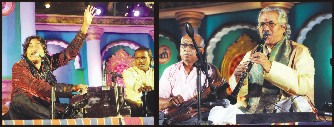
Sufi music by Mukhtiyar Ali mesmerises audience at Amba Vilas Palace

Sufi singer Mir Mukhtiyar Ali performing at the sprawling Palace premises. 2) Pandit Narasimhalu Vadavati of Raichur presenting clarinet recital at Amba Vilas Palace.

Mysore :

The Sufi music rendered by Pandit Mukhtiyar Ali from Rajasthan stole the show at the cultural programme organised by the Dasara Cultural Sub-Committee at Palace premises here yesterday.

The Sufi music and hindi songs rendered by Ali literally mesmerised the crowd to an ecstatic level that the full gathering stayed back for the whole programme even after one hour of the Palace illumination was switched off. The added attraction was Ali explaining the meaning of the songs during the programme.

Previous to that Pandit Narasimhalu Vadivati presented a delectable clarinet recital in Hindustani style.

Also included were a presentation of Veeragase dance by Basaveshwara Yuvaka Sangha of Shimoga and Bhangra dance by artistes from Punjab.

District in-Charge Minister V. Sreenivasa Prasad, MLAs Vasu and M.K. Somashekar, AICC member Motamma and others were among the audience enjoying the programme.

source: http://www.starofmysore.com / Star of Mysore / Home> General News / October 12th, 2013