The buses are cost-efficient, like other battery-powered vehicles | EPS
Come July and BMTC commuters from Shantinagar depot can look forward to travelling in Bangalore’s first battery-powered bus.
With rising fuel costs and increasing pollution, the BMTC is getting into an agreement with a private company, Utopia Automation and Control, for a three-month field trial of the bus, named K-9. If K-9, which costs an estimated `2 crore after a 40 per cent subsidy, can handle Bangalore’s speed breakers and pot-holes, the BMTC will work out the purchase details.
“Our buses, on an average, travel about 220 kms across the city. If the bus cannot meet this requirement, commuters could be stranded and we want to avoid this,” BMTC managing director Anjum Parvez told Express.
Currently operational in China and manufactured by BYD Auto Co Ltd, the K-9 is said to be able to travel up to 250 km after charging the battery for about 3-6 hours. It is air-conditioned and has a seating capacity of 33+1, and can reach speeds of up to 90 km per hour.
“In three months, we hope to get an idea about the quality of the bus, its capability to cope with the traffic and whether the operational cost of the bus is worth the investment,” said Parvez.
With over 5,000 K-9 buses plying in countries such as Australia, the Netherlands and the USA, Vishwas Shetty, director, Utopia Automation and Control, is confident that their buses will pass Bangalore’s test.
“We had to make a couple of changes to the bus to ensure that it was able to operate on Indian roads — for instance the ground clearance had to be increased to comfortably go over speed-breakers. Before the bus is brought to India, it has to be cleared by the Automobile Research Institute of India. This usually takes about two months. But the tests should be cleared by the end of May,” he said.
Shetty said a complete charge of the bus requires about 400kW of electricity. “A readymade kit is available, which will be installed at the Shantinagar depot. It takes about two days,” he said.
Shetty said the buses are cost-efficient, like other battery-powered vehicles. “Operation costs are very low — about Rs 4 per km. For a Volvo A/C bus, this is `18 per km. Apart from charging the bus and changing tyres, there are hardly any other maintenance costs. It does not even require oil,” he points out.
source: http://www.newindianexpress.com / The New Indian Express / Home> Cities> Bangalore / by Merlin Francis – Bangalore / March 16th, 2013
DELIGHTED BUNCH: The Karnataka team which won the 64th Rangaswamy Cup senior National hockey championship in Bangalore on Thursday. / Photo: G.P. Sampath Kumar / The Hindu
Karnataka rode on Deepak Beijawad’s insatiable appetite for penalty corners to capture the 64th senior National hockey championship here on Thursday.
Karnataka has won this Rangaswamy Cup (donated by The Hindu group in 1951) for the first time since the inaugural edition in 1928.
At the floodlit KSHA Stadium, Beijawad (who has converted eight penalty corners and one penalty stroke in this tournament) pulled the host through with a brace, after the teams were tied at 1-1 at half-time.
The captain’s first goal came three minutes into the second-half, with a thunderous flick at the left post. Twenty minutes later, another penalty corner was awarded to Karnataka. This time, Uttar Pradesh had a plan to counter Beijawad. Diwakar Ram was positioned to man the left post, but the ferocity of the shot saw the ball thud into goal off Ram’s stick.
Earlier, an electric run by K.R. Umesh brought Karnataka the lead. Off a pass from Bijju Yirkal, Umesh dribbled the ball from just inside the half-line all the way into the ‘D’. A quick halt, followed by a reverse-flick, flew past the Uttar Pradesh goalkeeper.
A goal of equal quality brought Uttar Pradesh level. From the edge of the box, Imran Khan lifted his head for just a moment to take stock of his position, and then came down hard with a powerful hit.
The Beijawad show then began, and it was curtains for Uttar Pradesh.
In the 3rd-place play-off match, an instinctive goal by Victo Singh took Mumbai past Punjab in a match which was decided in a penalty shootout.
The Karnataka team received Rs. 1 lakh from L.T. Nanwani, the owner of World Series Hockey team Chennai Cheetahs, and R.K. Shetty, the IHF Chairman. The runner-up was awarded Rs. 50,000 by the same duo (in an individual capacity). The winner also received Rs. 1 lakh from the KSHA, who wished to honour the team for clinching this prestigious trophy for the first time in its history. A further Rs. 25,000 was presented to the team by KSHA office-bearer, N.S. Basavaraj.
3rd place play-off: Mumbai 2 (Upendra Pillay, Vikram Singh) bt Punjab 2 (Sanjeev Kumar 2) (Extra-time score: 0-0, Mumbai won in penalty shootout).
Individual prizes: Best goalkeeper: Sudhir Dixit (Mumbai), Best defender: Deepak Beijawad (Karnataka), Best half-back: Y. Nagasrinu (Karnataka), Best forward: Satwinder Singh (Punjab),Top goal-scorer: Victo Singh (Mumbai, 12 goals), Player of the championship: Diwakar Ram (Uttar Pradesh).
source: http://www.thehindu.com / The Hindu / Home> Sport> Hockey / by Ashwin Achal / Bangalore – May 17th, 2013
Maradona’s former club will become the first Latin club to do this
Bangalore:
Club Atlético Boca Juniors, one of the premier football clubs in the world, Wednesday launched the first ever Boca Juniors Football School India (BJFSI) here.
Juniors, home to legendary football stars like Diego Maradona, Gabriel Batistuta, and more recently Carlos Tevez and Juan Roman Riquelme, will be the first Latin American football club to launch a football school in India. Boca Juniors is one of the most successful and popular football teams in Argentina, and one of the most successful in the world, having won 43 official titles to date. Internationally, the team has won 18 international titles.
Boca Juniors plans to take the BJFSI around the country with the first school being launched in Bengaluru. BJFSI will run the football school on an ongoing basis round the year and provide progressive training to the students through weekly classes following Boca Juniors methodology. All these classes would be administered by coaches from the Argentine club.
Additionally, there will be periodic football camps, customized school camps and Boca Juniors Chairman, Daniel Angelici was excited to bring the Argentinean style of football to India.
Angelici commented: “We are thrilled to bring BJSFI to India. Football is growing in popularity in India year by year and we strongly believe we can play a role in developing the sport. As a country, India not only has a wealth of young talented children who are extremely passionate about football, but a genuine desire to learn and apply new skills and knowledge.
“Our style of football is completely different to the rest of the world and we hope to pass this on to the young generation here. It needs to be positive, inclusive, structured and above all create a fun in safe learning environment in order to nurture young talent.
“Our style is more open and attacking, has flair and more entertaining to watch. The coaches in BJFSI will instill the same playing style to the students from an early age.
The first Summer Camp will be held June 10-14 at Ascendas ITPB Ground here for the aspiring footballers aged from 4 to 18. There will be an exclusive Corporate Camp for Parkites of Ascendas ITPB June 18 and 19.
Trainings for ongoing Football School will commence from July 13 at various centres in Bengaluru.
source: http://www.gulfnews.com / Gulf News / Home> Sport> Football / by IANS / May 15th, 2013
The national men hockey team’s core probables will start their training camp at the Netaji Subhas Southern Centre (NSSC), Bangalore on Thursday to prepare for the FIH World League Round 3 (Semi-Final) to be held at Rotterdam, Netherlands from June 13 to 23.
The camp will be on till June 4.
Indian men’s team performed well at the recently-concluded preparatory tour to The Netherlands, where it had defeated the national side twice and also played five games against top clubs of The Netherlands.
India qualified for the FIH World League Round 3 (Semi-Final) by winning all the matches of the Round 2 tournament held at Major Dhyan Chand National Stadium here in February.
The FIH World League Round 3 (Semi-Final) is a qualification tournament for the FIH Men’s World Cup 2014 to be held at The Hague, Netherlands.
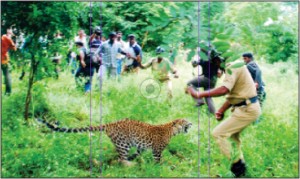
Nagesh Panathale, Senior Photojournalist of Vijaya Karnataka newspaper here in city has won a gold medal in an international photography competition organised by Jodhana Photojournalist Society at Jodhpur in Rajasthan.
Nagesh Panathale has been awarded Gold Medal in Journalism category for his photo titled ‘Leopard Attack’ [see pic. above]. A total number of 8,164 photographers had participated in the competition from 50 countries around the world.
Previously, Nagesh had also won a gold medal in a competition organised by the same organisation in 2011.
source: http://www.starofmysore.com / Star of Mysore / Home> General News / May 13th, 2013
Jude Felix, founder, Jude Felix Hockey Academy —R. Samuel.
Bengaluru:
Every morning at the crack of dawn, rain or shine, the children from St Mary’s Orphanage forget their woes and cares as they troop out onto the field brandishing their hockey sticks, feeling on top of the world. No matter what the world throws at them — and most of them have seen far too much — for 90 minutes every morning, their dreams seem within arm’s reach.
The children are coached by one of India’s most renowned hockey players, Arjuna awardee, Olympian, and former captain of the national hockey team, Jude Felix, founder of the Jude Felix Hockey Academy, a charitable trust that promotes hockey among underprivileged children.
Helping children had always been at the back of his mind, says Felix. “I didn’t have the money to do anything, but I wanted to teach them what I knew best.” The need to revive hockey among the youth was also growing — the sport’s glory was fading fast as cricket took over the streets of India.
It all fell into place through a chance remark four years ago. Felix, who wanted to sponsor a dinner at St Mary’s Orphanage on Christmas Day, told the then director, Father John Anthony that he would like to coach the children in hockey. “Father John loved the idea. It was nothing short of a miracle, really.”
A prominent group of philanthropists promised help and the academy spluttered to a start. But it didn’t last long. The group lost interest in the project and Felix was left in the lurch. “There was only one man who stood by me at the time,” said Felix. That man was Shanmugam P., who has worked with the underprivileged for 12 years. He helped the JFHA get back on its feet.
“We had no idea how to start a trust at the time, but we met some like-minded people who really played a big role,” said Shanmugam. “Jude was like a role model and mentor to us, we all looked up to him.”
Starting an academy was not the intention at the time. All they wanted to do was teach kids hockey, something they would never have had the chance to learn otherwise. The field adjoining Marianiketan School, where the children from the orphanage studied, was covered in rubbish, save for one small patch, where the practices began.
It took one month of gruelling hard work to level, clean and convert the field into one of the finest pitches in the city. The JFHA, which now has six trustees on its board, is fuelled entirely by goodwill. Volunteers donate water and juice during hockey matches, others donate banners and trophies. “We don’t take money, we just ask people to contribute in any way they can,” says Shanmugam.
Father John provided the budding team with a small kit room and friends helped collect equipment. Equipment was a tremendous challenge as it is expensive. Things looked bleak until JFHA received a contribution of a 100 hockey sticks from an anonymous donor.
“We still use those sticks and because of them, we have equipment for 200 children now,” said Shanmugam. Meanwhile, Felix’s old friends began to look him up as well. International hockey player Tushar Khandekar and his uncle Subodh donated 60 hockey sticks to the academy, which started out with about 40 children. “Manufacturers also stepped up because I had not collected royalties for using their equipment,” Felix said. “So our kids had the best shoes, the best hockey sticks and the best equipment by far.”
In time the school team started doing very well at tournaments and the boys got their first taste of victory. “We had two boys selected for the Sports Academy of India. One boy, Rajendra, represented the state in the sub junior level,” says Felix. Now, the children needed competition, to play against the best. “Our kids were never invited to the more prestigious hockey tournaments,” said Felix. That’s how the JFHA hockey tournament came into being two years ago.
Playing under floodlights, the children competed against teams from Singapore and a team from Ananthapur supported by the Spanish hockey team. “I have seen tournaments the world over and this is absolutely world class,” Felix says proudly.
Volunteers come in from the Community Involvement Programme in Singapore and twice a year from the Kelly School of Business to spend time with the children.
“The kids are so excited by the game and some of them are extremely skilful,” says Felix. Despite this, the discrimination they face is daunting. “They are smaller than the rest, and although that doesn’t matter, the bright people on our selection committee look for tall, athletic people, so our children lose out,” Felix added.
Even so, hockey is more than just a game to these children. “You can see the difference in the way they talk and carry themselves,” said Felix. He started out with a good thought and a small ambition, but has managed to create, even for a sport that has lost much of its popularity, a world class academy. “We don’t know what traumas these kids have seen, but sport is a miracle healer,” says Shanmugam.
source: http://www.deccanchronicle.com / Deccan Chronicle / Home> News> Current Affairs / by Darshan Ramdev, DC / May 13th, 2013
‘Sangeetha Kala Acharya’ Vidushi Neela Ramgopal (second from left) is seen presenting Prof. G.T. Narayana Rao award to young violinist Vid. B.K. Raghu along with Lakshmi Narayana Rao (extreme left), wife of late G.T. Narayana Rao, at a function in city last evening. Others seen are Madhuri Thathachari of Bhramara Trust, Dr. V. Prakash, Hon. Director of Research Innovation and Development, JSS Mahavidyapeetha and B.S. Sridhar Raje Urs, President, Krishna Seva Samithi Charitable Trust, Gokulam.
Mysore :
“Mastering music is a long-drawn process with dedication and strenuous practice with the assistance of a good guru,” opined Dr. V. Prakash, Hon. Director of Research Innovation and Development, JSS Mahavidyapeetha and former CFTRI Director.
He was speaking as chief guest at a programme organised by the Bhramara Trust of Y.T. and Madhuri Thathachari at Alwar Kala Bhavan in Gokulam 3rd stage here yesterday to mark the presentation of Prof. G.T. Narayana Rao (GTN) award to outstanding young instrumentalist in Karnataka in Carnatic music.
Dr. Prakash said that to learn yoga, music, meditation and dance, a teacher was essential and such art should be learnt and rigorously practised for years to excel. Referring to music, he added that it was a culture in itself which should be first understood.
The GTN award was presented to violinist Vid. B.K. Raghu by Sangeetha Kala Acharya Vidu. Neela Ramgopal of Bangalore. The function concluded with a violin recital by the awardee B.K. Raghu accompanied by Vid. P.S. Sridhar on mridanga and Vid. V.S. Ramesh on ghatam.
source: http://www.starofmysore.com / Star of Mysore / Home> General News / May 12th, 2013
The 220-year-old Tipu armoury will be the first structure in the country to be shifted without breaking or altering its structure | EPS
After three years of persistent efforts, the Railways has obtained the Archaeological Survey of India’s (ASI) clearance to shift Tipu Sultan’s armoury at Srirangapatna to lay the second railway line under Bangalore-Mysore Doubling Project.
South Western Railways chief administrative officer Adesh Sharma said, “Now, we have obtained all the clearances required to shift the armoury.”
“As none of such structures have been shifted till now in the country, we may have to search for a company which has partnership with foreign construction companies to shift the structures without breaking them. We may invite tenders to shift the armoury very soon,” he said.
Relocation to Pre-identified Site
The 800-tonne armoury will be lifted without disturbing its structure using jacks and it will be shifted to an pre-identified site that is around 150 metres away from its present location using some advanced machines.
Tipu’s armoury is a protected monument under The Karnataka Ancient and Historical Monuments and Archaeological Sites and Remains Act 1961.
The state’s Department of Archeology cleared the shifting of the monument nearly three years ago after the Railways found it impossible to change the alignment of the new line.
As it is located within 300 metres of Lord Ranganath Temple at Srirangapatna, a national monument, and is protected under The Ancient Monuments and Archaeological Sites and Remains Act 1958, the Railways had to obtain a clearance for shifting it from the Archaeological Survey of India.
At the behest of the Railways and the state government, the Institution of Engineers had suggested three methods of shifting the monument to retain its originality. They are—demolishing the monument and replicating it with the same material, cutting the monument into huge blocks and replicating it by pasting the blocks with the special glue and shifting the monument as it is.
The Railways and the state government had agreed to shift the monument as it is after obtaining the necessary clearances.
source: http://www.newindianexpress.com / The New Indian Express / Home> Cities> Bangalore / by N R Madhusudhan – Banglaore / May 14th, 2013
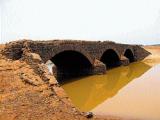
The drastic reduction of water quantity in Bhadra backwaters this summer, reveals several interesting historical facts to those who are history enthusiasts. The remains of Lingapura arch bridge, Old Shimoga road, connectivity routes narrate century old stories.
N R Pura which was earlier called as Yedehalli was part of Lakkavalli taluk till 1882.
Yedehalli was sub-taluk till 1897 and it was named as Narasimharajapura from the day Narasimharaja Wodeyar visited Yedehalli in 1915. This area was considered as the centre of paddy cultivation as paddy was grown here in highest quantity in the State prior to the construction of Bhadra dam. With the construction of Bhadra dam submerging the agricultural land in the backwaters, the generation old rich culture, economy and connectivity routes to different towns were destroyed.
But, now the decrease in the quantity of water in backwaters has opened up the remains of the past, narrating the good old stories. Lingapura arch bridge in the backwaters can be viewed if one travels for about five kilo meters from the taluk centre via Old Shimoga road. Though the bridge was submerged in water 60 years ago, the bridge is still intact, showcasing the technological proficiency. The bridge was built using pure Indian technology century ago during the British administration.
Old road
One could reach Shimoga by travelling for about 38.4 kilo meters by travelling on this old road. But now one has to travel for about 55 km in the long route to reach Shimoga. Elders in these villages remember the bus stand that located near the arch bridge from where they used to board the bus to travel to Shimoga.
If one visits this area, one can witness the gravel road that connects Shimoga, reminds people’s existence in Haleda Nivasa, Devale Koppa, Lingapura villages, Koteda Nivasa temple, Ganapathi temple and Venkataramana temple.
Recollecting the good old days, a senior villager L Nagaraj says that his family owned land in Kanakalli village. Everyday three buses belonging to Shankar Company used to ply to Shimoga. But many villagers including him had to lose their land due to dam construction.
The fertile land and the rich heritage of this Malnad region was destroyed with the construction of the dam, that in turn helped to solve drinking water crisis.
source: http://www.deccanherald.com / Deccan Herald / Home> District / N R Pura, DHNS / May 13th, 2013
Krishna Bhupathi, former tennis player and father of Indian tennis star Mahesh Bhupathi, who was felicitated by the Mysore Tennis Council at a function held at Windflower-Spa and Resorts here yesterday, is seen with (from left) K. Raghav Prasad (Treasurer, Mysore Tennis Council), Dr. N.M. Srinivas (Hon. Chairman, Mysore Tennis Council), M. J. Charan (Tournament Director), M. V. Pramod (Secretary), P.S.Vastrad, Commissioner, Dept. of Archaeology, Museums & Heritage, K. B. Ganapathy, Editor-in-Chief, Star of Mysore and R. Nagaraj, President, Mysore Tennis Council.
Mysore :
C.G. Krishna Bhupathi, a former tennis player and father of Indian tennis player Mahesh Bhupathi, was felicitated by the Mysore Tennis Council, which organised “Vidhyaashram Mysore T3-2013 South India Inter-Club Tennis championship” for Tennis Academies/Club, at a function held at Windflower-Spa and Resorts in Nazarbad here last evening.
Krishna Bhupathi was felicitated by P.S.Vastrad, Commissioner, Dept. of Archaeology, Museums & Heritage, with a shawl, Mysore Peta and a memento.
K. B. Ganapathy, Editor-in-Chief, Star of Mysore, was the chief guest. Dr. N.M. Srinivas, Hon. Chairman, Mysore Tennis Council, R. Nagaraj, President, Mysore Tennis Council, M. J. Charan, Tournament Director, M. V. Pramod, Secretary, K. Raghav Prasad, Treasurer and other office-bearers were present.
Speaking on the ocassion, Krishna Bhupathi became nostalgic and remembered his olden days. He expressed his gratitude to the organisers for having invited him and honoured.
He said the concept of T3- tennis was excellent as it would improve and popularise the game to a greater level.
He said that in November his son Mahesh Bhupathi would be launching an International T3- tennis tournament in the Asian- level with greats like Pete Sampras and Agassi taking part.
K. B. Ganapathy, who also spoke, lauded the efforts of Dr. N. M. Srinivas, who is striving for the upliftment of the game in Karnataka, especially Mysore.
He also praised Krishna Bhupathi’s contribution to the society in giving to the world of tennis a champion tennis player like Mahesh Bhupathi, who has won the hearts of many a tennis fans.
P.S. Vastrad, in his address, said the contribution of Krishna Bhupathi as a tennis player and then as father of the Indian tennis player Mahesh Bhupathi, was immense and wished him well in his future exploits. Eleven teams participating in the tournament were given mementoes on the occasion.
The valedictory of the championship, which began yesterday at Cosmopolitan Club, will be held at the Club today at 4.30 pm with Krishna Bhupathi as chief guest.
source: http://www.starofmysore.com / Star of Mysore / Home> Sports / May 12th, 2013