‘Shreshta Kala Pracharak’ award to Dr. Vasundhara


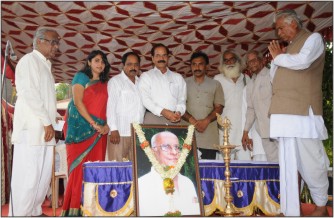
Renowned danseuse Dr.Vasundhara Doraswamy receiving the “Shreshta Kala Pracharak” award from Kalaimamani Dr.Saroja Vaidyanathan of Ganesha Natyalaya, New Delhi, recently.

Mysore :

 The world-renowned danseuse from city Dr. Vasundhara Doreswamy was conferred the coveted Shreshta Kala Pracharak award by Padma Bhushana, Kalaimamani Dr. Saroja Vaidyanathan, founder Director of Sri Ganesha Natyalaya, for her immense contribution to the field of Bharathanatya in a glittering function held at Kamani Auditorium, New Delhi, recently.

Her services in the field of Bharatanatya included her long standing world-renowned performances, scholastic teaching, mind-catching choreography et al, which were lauded by the selectors.

It was a great honour to her and a pride to Mysore, as Vasundhara Doreswamy is the only dancer from Karnataka to be honoured with this award till now.

This national award is given away annually to eminent personalities in different fields of arts.

Apart from Dr. Vasundhara Doreswamy, the awardees this year included veterans Dr.Kapila Vatsayana, Art Historian and Researcher, Chairperson of Indira Gandhi National Research Centre, New Delhi; Dr. Kiran Seth, Chairman, SPIC-MACAY, New Delhi and S. Krishna Murthy, Chairman, Surya Art, Theatre and Film Society, Tiruvananthapuram, Kerala.

The disciples of Vidushi Dr. Saroja Vaidyanathan presented some rare items from Bharatanatya repertory in honour of the award recipients.

source: http://www.starofmysore.com / Star of Mysore / Home> General News / May 05th, 2013

Pages from history : Narasimha idol’s journey : Pakistan to Haridwar

By Prof. A.V. Narasimha Murthy, former Head, Department of Ancient History & Archaeology, University of Mysore

One of the memorable contributions of Kulapati Dr. K.M. Munshi is starting of a fortnightly journal, popularly known as Bhavan’s Journal which has readers all over the world. Dedicated to life, literature and culture, the journal is sought after by common people as well as scholars. This journal’s issue dated 31, March 2013 contained an article written by a senior journalist Dilip Chaware (pages 35-42) and I thought that it would be really interesting to our readers also. Hence inspired by this article I am narrating this journey of Narasimha idol from Multan (Pakistan) to Haridwar (India).

About 200 years ago, there lived a Brahmin Ganeshabhatta Joshi in Sangameshwar and he migrated to Pune to take up a job. His family deity was Lord Narasimha. One day he had a dream in which God Narasimha appeared and told him that he has been lying under a cactus shrub in Kashi and wanted Ganeshabhatta to build a temple for him. Ganeshabhatta and his wife went to Kashi, discovered this image of Narasimha and brought this to Pune and built a small temple for it. After the death of Ganeshabhatta, nine generations have been worshipping this image. How this image reached Kashi is still a mystery. Perhaps to avert a Muslim attack, some well-meaning person may have hidden this image under a cactus shrub.

Recently, Anantharao Joshi, the present descendent of Ganeshabhatta heard a rumour that there was a Narasimha temple at Multan in Pakistan which had some stone idols. Encouraged by this news, Joshi wanted to visit Multan and find out the truth for himself. His sons who were abroad came forward to finance his desire of visiting Multan. Luck also favoured him as a five-day cricket match between India and Pakistan was arranged at Multan in 2004. Joshi got the visa easily to go to Multan under the pretext of witnessing the cricket match.

With the help of his friends, he established contact with a person named Hussain Gardezi, an agriculturist in Multan. Though a Muslim, he had a soft corner for the purpose of Joshi’s visit to Multan and promised all help. Joshi reached Multan in Mar. 2004 and as per the desire of Gardezi, stayed in his house.

Gardezi was very affectionate and provided vegetarian food to Joshi. Thus Joshi was not only comfortable but was also happy by the warmth and affection shown by some of the people of Multan. He also met a local Hindu who had kept two idols, one of sage Vyasa and the other of goddess Lakshmi. Out of fear of the iconoclast neighbours, he had kept them in his bank safe locker. Joshi was very happy to see both the idols stealthily and offered worship.

On enquiring, it was discovered that there was a Hindu temple at a place called Prahladapura and the authorities of Pakistan changed its name as Kilabagh. The Narasimha temple was located at this place. Without giving much publicity, Joshi and friends went to this place where they saw a temple in complete ruins and its materials being used to build a mosque at the same spot. They jumped over the compound of the mosque and entered into the temple. Joshi had a mixed feeling of sorrow and joy at the same time; sorrow because the temple had been destroyed and joy because seeing the ruined parts of the temple of god Narasimha. The stone sanctum (garbhagriha) was 15ft square with a height of 20ft. It also had a pradakshina space. He saw a 15ft. tall stone pillar from which came out Lord Narasimha to kill the demon Hiranyakashipu. However, Joshi was disappointed that he did not see the image of Lord Narasimha.

Then Joshi met a retired Commissioner by name Rana who took the former to the Multan city library. Both searched for relevant books. Finally, they came across a book written by Sayyad Aurlab Ali Gilani titled Muraga-e-Multan (1938). It gave a good description of the temple and referred to the idol of Narasimha which had rubies fixed for his eyes. It was a wealthy temple and was repaired in 1876. After the partition, the temple was destroyed and the saint Mahant Baba Ramananda took the image and kept it in Fatechand Gurudwara for safety, near vegetable market. Later the Gurudwara was also destroyed. Rana requested the Pakistan Government to permit him to rebuild the Gurudwara. But the Government did not grant permission.

Highly disappointed, Joshi returned to Pune. While talking to an elderly person by name Godbole, he got the clue to meet Dr. Shawab Lalit of Shimla. He introduced him to Batra, an active member of the Multan Seva Sangh which is still in existence. Batra informed Joshi that the Narasimha image is safe at a temple in Haridwar and was in daily worship.

What actually happened is equally interesting. There was a saint Narayanadas Baba at Multan who knew about all these things at the temple. When some people destroyed the temple, this Baba packed the Narasimha idol in a wooden crate and was trying to load it into a plane leaving for Delhi. Suddenly an unruly group moved towards the crate and were about to destroy it. Having no other alternative, Baba pulled out his revolver and threatened to kill them. The people vanished and the crate with the Narasimha idol was loaded into plane and safely reached Delhi. As planned earlier, it was taken to Haridwar and was consecrated in Narasimha Dham temple.

The standing marble image of Narasimha is 4 ft. tall; it has a lion face and is holding the demon Hiranyakashipu in his two hands tearing out his stomach. Vishnu, Lakshmi and Prahlada are at the bottom. Though I had been to Haridwar, I did not know that this was the Multani Narasimha and missed seeing him. So, when you go to Haridwar do not forget to pay your respect to this idol of Narasimha. Thus Narasimha has come back to his own country escaping from the clutches of iconoclasts. Thus the Haridwar Narasimha temple is unique and has a saga behind it.

sources: http://www.starofmysore.com / Star of Mysore / Home> Feature Articles / May 04th, 2013

Vedantha Hemmige remembered on his 2nd death anniversary

HemmigeBF10may2013

Mysore :

“Vedantha Hemmige, who was a bundle of energy throughout his life for any movement, was a model politician too,” said former MLC D. Madegowda.

He was presiding over a programme organised at the Freedom Fighters Park premises in Subbarayanakere grounds here yesterday to mark the 2nd death anniversary of freedom fighter Vedantha Hemmige.

Madegowda pointed out that Hemmige was an amicable person for every one who had a fighting spirit even in distress situations. He regretted that money was ruling the society now.

Freedom fighter Revanna, speaking on the occasion, recalled that Hemmige was instrumental in holding the Freedom Fighters’ Association members together during a period of dissidence. He added that Hemmige had all the qualities of a true leader who never showed pride even when he was a legislator.

Freedom Fighters’ Association President D.N. Jagadish, working President Dr. M.G. Krishnamurthy, Secretary M.R. Ramasesh, District Kannada Sahitya Parishat President M. Chandrashekar, FPA India President Maddikere Gopal, Bhargavi Hemmige (daughter-in-law of late Hemmige), Prof. P.V. Nanjaraj Urs, former Mayor Purushotham and others were present.

source: http://www.starofmysore.com / Star of Mysore / Home> General News / May 04th, 2013

Bangalore: Christ School gets Centum Results in SSLC

Bangalore :

A prominent school run by the Catholic minority community, Christ School, Bangalore, has turned in an exemplary performance registering Centum results in the SSLC examinations.  Of the total of 229 students, who appeared for the SSLC examination, as many as 78 have come out with distinction while 135 got first class and 16 students passed out in the second class.

Fr Shaju Varghese Pellissery, Principal

Tobin Varkey Simson secured the highest marks of 612 out of the total of 625; Suhas K C got 609 followed by Shirisha B. Reddy (606), Apoorva V. Patil and Pavithra D (601). Fr Shaju Varghese, Principal, congratulated all the students and wished them a very bright future.

Christ School, Bangalore, is run by the fathers of the Carmelites of Mary Immaculate (C.M.I) through a registered body, “Christ Educational Society, Bangalore”, whose president is the Rector of Dharmaram College, Bangalore.

The continuous effort put in by teachers with able guidance of management has helped the school to record centum results in SSLC which is a commendable achievement by the students and the management.

The school currently operates two campus for Kindergarten and ICSE headed by Fr. Shaju Varghese and the other campus for state syllabus headed by Fr. Augustine with total strength of 4400 students which include state and ICSE.

Christ school is quite well-known in Bangalore with good infrastructure, lung space, and affordable.

Fr Varghese has served the Church and society in various capacities like Parish Priest, Superior and Principal across India. Before taking charge as the principal of Christ School, he had served at Chennai for a few years. He is a MA (Christian Studies), MA (English) M.Ed; NET; PGDCA and served as Vice Principal and Administrator, for 4 Years at Chavara Vidya Bhavan Matriculation Higher Secondary School, Coimbatore, Tamil Nadu, as Principal and Teacher, 5 years at Christ Matriculation Higher Secondary School, Poonamallee, Chennai., as teacher for 1 Year at Don Bosco School, Kokrajhar, Guwahati, Assam; and has taught B.Ed candidates at Lisieux College of Education, Coimbatore for one year and later joined as Principal of Christ Schools (both Christ State and ICSE Schools), Bangalore in 2011.

For more details about contact: 41116360, e-mail: shaju.varghese@gmail.com /Address: Christ School Road, Dharmaram College P.O., Bangalore 560 029.

source: http://www.daijiworld.com / DaijiWorld.com / Home> Karnataka / by Special Correspondent, Daijiworld Media Network – Bangalore / May 09th, 2013

Bangalore: Old township, all dressed up and shipshape

 Straddling the highway to Hyderabad, the birthplace of Kempe Gowda is now among the fastest growing localities in the city.

The brick kiln which was once a famous landmark in Yelahanka, is surrounded by apartments today. The brick tower is retained as a unique landmark.

Thanks to the construction of Bangalore International Airport near Devanahalli and the housing boom along the Bangalore-Hyderabad highway, areas that are part of the Yelahanka constituency are among the favoured destinations for both aspiring home owners and commercial establishments.

Realtor hyperactivity in the area which is part of Bangalore’s history, has pushed up prices of land to crores of rupees an acre. Areas such as Sahakarnagar and Judicial Layout are homes to the middle-to-upper income group.

Buzzing with activity today, Yelahanka was one of the oldest townships in Karnataka and was part of Vijayanagara empire. Legend has it that Kempe Gowda, the founder of Bangalore, was born in Yelahanka and was a feudatory of the area during the reign of Krishna Devaraya of Vijayanagar empire.

Till a decade ago, Yelahanka was primarily home to farmers, but its profile has changed a lot with construction of Bangalore International Airport. It had 2.25 lakh voters in 2008 elections. Now, 16,817 eligible voters have enrolled their names.

Yelahanka has a number of lakes to its advantage, the most prominent being the Yelahanka lake. Yelahanka Satellite Town is considered as the best maintained residential areas in Bangalore. By many accounts, the area has the most number of parks in the city. The major roads connecting Yelahanka with the city are Bellary Road, Doddaballapur Road and Yeshwanthpur Road. It houses major security establishments such as the Air Force and BSF stations, and industrial units such as Rail Wheel Factory, Astra Zeneca Pharmaceuticals, Gogo International, Federal-Mogul Goetze (India) Limited, Ranflex India Pvt. Ltd. and Hobel Flexibles.

Some of the educational institutions such as the Nitte Meenakshi Institute of Technology, Sir M Visvesvaraya Institute of Technology, BMS Institute of Technology, Seshadripuram College, Reva Engineering College, Ryan International School, Delhi Public School, Poorna Prajna School, Srishti School of Art Design and Technology, NMIT and medical colleges Infant Jesus College of Nursing, SB College of Nursing are in this area.

Yelahanka Old Town is a home for thousands of powerloom weavers  from Andhra Pradesh. With more than 18,000 votes, they are expected to play a key role in the election.
As for candidates, SR Vishwanath, the sitting MLA,  is seeking re-election on a BJP ticket. Gopalakrishna is the Congress candidate and Chandrappa is trying his luck on a JD(S) ticket. The constituency has four BBMP wards – Kempe Gowda, Chowdeswari, Atturu and Yelahanka Satellite Town. All these wards are represented by BJP corporators.

Despite corruption allegations, Vishwanath of BJP is confident of winning election. He cites development works taken up during the last five years as the reason for him to be bullish about the success in the election. “I did a lot for this constituency. I want to do more if they elect me in this election again,’’ said Vishwanath.

source: http://www.dnaindia.com / DNA / Home> Bangalore> Report / by Y. Maheswara Reddy / Place:Bangalore, Agency:DNA / Thursday – May 03rd, 2013

Bangalore 1st city outside the US to hold a Stanford programme

Bangalore has beaten Paris and Beijing to be the first city outside of the US to hold programmes by Stanford Graduate School of Business.

The Silicon Valley-based business school will start its Stanford Ignite programme for professionals at the Infosys Campus in the city in August. It means professionals looking for part-time management courses from Stanford can avail of them sitting right here in the city.

Blair R Shane, associate dean, Knight Management Center, Stanford University, says Bangalore was selected mainly for three reasons: “Firstly, it has a critical mass of engineers and people with technical expertise, exactly the kind of candidates we are looking for. There are many entrepreneurs here than other places, something just like in Silicon Valley. And Bangalore, like India, has a growing economy.”

After Bangalore, Stanford will take their programme to Paris in September and Beijing next year.

The programme is mainly for professionals with roughly 5-15 years work experience and who are from backgrounds like engineering, medicine and physics. Even individuals currently enrolled in master’s, PhD, MD or any other postgraduate and non-business programmes can get enrolled.

However, says Shane, the programme is not open to professionals who currently have a background in business or have an MBA.

“Basically for people with an entrepreneurial and innovative bent of mind. For those who want to start out on their own or even those who plan to develop products within their existing corporations are all welcome,” says Bethany Coates, acting assistant dean, global innovation programs, Stanford University.

For their first batch Stanford is looking for about 30-50 candidates. If it attains successful conclusion, we can look at making it an annual programme for Bangalore, says Coates, “and later also take it ahead to other metros in India.”

In the US, Ignite, which has been running for seven years, sees about 140-150 candidates participating annually.

Coates says 30-50 is a reasonable number to start off in Bangalore and could increase going ahead. “Along with getting to learn business from Stanford, candidates can also interact and network with Stanford alumni and professors,” says Shane.

source: http://www.dnaindia.com / DNA / Home> Bangalore> Report / by DNA  Correspondent / Place:Bangalore, Agency:DNA / Thursday – May 02nd, 2013

Giving back to nature

SankaraBF08may2013

Shankaraa Foundation organised a grand event to showcase the talent and culture of Karnataka at its  premises on Kanakapura Road recently.

This programme was the culmination of the summer workshop, held in association with the Dwaraknath Reddy Institutes for Knowledge Foundation and Association for Voluntary Action and Services.

Shankaraa Foundation worked with 60 gifted children from the slums of the State. This event consisted of different performances by the children that varied from classical to folk forms, and was an exciting conglomeration of dance, music and theatre. It showcased the enthusiastic and undying spirits of these children.

The programme consisted of students performing traditional folk forms, which included pooja kunitha, pattada kunitha, maramma, dollu kunitha and tamte.

A theatrical presentation mixed with dance, ‘The Giving Tree’, choreographed by Rasshme Hegde Gopi, was also staged at the event. This simple, yet moving parable by Shel Silverstein, was adapted in a different style, by mixing dance and music.
The simple message was about nature suffering because of human greed. ‘The Giving Tree’ comprised of children doing various art forms like yakshagana, bharatanatyam and more.

Rasshme Hegde Gopi says, “The concept behind ‘The Giving Tree’ is that children understand the connection with nature, and appreciate nature which nourishes us and shelters us. We also aim to help them understand the need to respect and nurture nature back in return.”

The evening’s performance was followed by an odissi recital by Meera Das and group.
They performed different pieces that left the crowd impressed. Starting with Jagganatha Mangalam, an invocation to Lord Jaganath, the performance moved on to desh pallavi in raga desh; sakhe, a piece about Radha’s conversation with her friend about wanting to meet Krishna again and Dashavatar, a group composition depicting the various avatars of Lord Vishnu.

The performance concluded with Shanti Mantram, a piece about salvation.
Sangeeta Sarita, a Hindustani music recital by Sangeeta Katti and her group followed next, where she performed a lot of classical ragas in film music.

Suvarna, a participant at the workshop, said, “Earlier, folk and classical forms and their names were just words to them. But now, we are able to identify the difference between different forms. Also, it was a learning experience to be able to teach younger children, what we had learnt.”

Ragini another participant, added, “The theatre performance made me realise how selfish we are, and how we should care for nature.”

Arjun S, another participant said, “I had heard of dollu kunitha before, but getting a chance to learn and perform it was a great experience. There was the initial worry about hands hurting but with practice I got used to it.”

source: http://www.deccanherald.com / Deccan Herald / Home> Supplements> Metrolife / DHNS / May 03rd, 2013

Come listen to the golden oldies

Bangalore :

Want to listen to Hindustani classic music of Gauhar Jaan, the first Indian musician to record on the gramophone in 1902 or the first recording of the national anthem by Vishwa Bharati Chorus or the speeches by Mahatma Gandhiji, Subhash Chandra  Bose and HH Aga Khan III.

Head straight to Voices of India, the first audio exhibition of vintage recordings, organized by the Archive of Indian Music (AIM) in association with the Alliance Francaise on the latter’s premises in Vasanthnagar from May 10 to 17.

According to Vikram Sampath, whose brainchild AIM is, the exhibition will be held under seven categories – Hindustani classical music, Carnatic classical music, theatre music, folk music, early cinema, devotional and patriotic music and voices.

The visitors will have the pleasure of listening to Gangubai Hangal, Kesarbai Kerkar, Inayat Khan (sitar), Bundu Khan (sarangi), Kannada theatre of old Mysore (Bidaram Krishnappa and Rachappa), Bangalore Nagarathnamma, one of the earliest south Indian musicians to record on the gramophone in 1904, Bengali folk music, Tamil folk (Kavadi Chindu), K L Saigal from the movie Tansen (1943), Indu Bala from the movie Ankh ka Taara (1932), violin-flute duet by T Chowdaiah and T R Mahalingam, G N Balasubramaniam, Narayan Stuti by Juthika Roy and Kamal Dasgupta, Kaloo Qawwal (qaawaali), Wahidan Bai of Agra singing a naat in praise of Prophet Mohammad, speeches by Gandhiji, Tagore, Kazi Nazrul Islam and Sohrabjee Dhondee of Parsi theatre. It provides a kaleidoscope of the rich musical legacy of our country.

Vikram said there will be an exhibition of all these personalities with their rare photographs and biodata. The visitors can see the exhibits and listen to music and voices of their choice through a cell phone or a computer at the exhibition. The exhibition is open from 10am to 7pm from May 11. The entry is free. It will be inaugurated on May 10 at 6.30 pm.

HIGH TRACK RECORD

Archive of Indian Music (AIM) is a non-profit trust that seeks to digitize and preserve old and rare gramophone records of our country. The primary objective of AIM is to preserve the voices of ancestors and make them easily and electronically available through an online portal for researchers, musicians, students of music and the public at large.

AIM currently has collected close to 10,000 records and a range of gramophone records. TV Mohandas Pai is patron of AIM. The tracks can be listened to free of cost on.

source: http://www.articles.timesofindia.indiatimes.com / The Times of India / Home> City> Bangalore> Indian Music / by S Kumar, TNN / May 04th, 2013

The vintage man

He’s only 30, but he has a penchant for cycles double his age. Sharath S Namburi’s house is a treasure trove of all things ancient and historical.

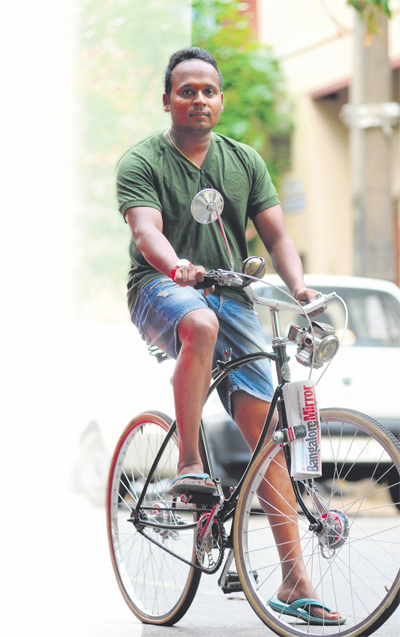
 When Sharath S Namburi came across the skeletal frame of a cycle he didn’t let it pass; it’s not in his nature to go past a bicycle without giving it a second look. When he saw the date of the make on the chassis he realised that he’d hit pay dirt. It was a bicycle used by the British Army in World War II; a cycle that was ridden during Hitler’s regime in 1939; a cycle that had an enviable ‘riding history’. It took Namburi 6 months to restore this 10 kg beauty. This BSA bike now occupies prime position in Namburi’s home in Malleswaram.

Spot Namburi on namma streets, riding this cycle that was ridden during Hitler’s regime in 1939 / Bangalore Mirror
Some people collect coins or stamps, but Namburi, an entrepreneur, collects cycles. He says about his unique habit: “People have all sorts of collections like coins, stamps and stickers, but collecting cycles was rare and I decided to go for it.“ He owns four vintage cycles, apart from five other vintage cars and bikes. Two of the cycles belong to the 40s and another one has a tax card that reads 1968-69, Bangalore City Corporation. Back then cycle owners had to pay road taxto the government.
Recounting the story of how he got hold of the BSA cycle belonging to the Hitler era, Namburi says, he got “the baby” from a 65-year-old cycle dealer, Azeez on Mysore Road for Rs 9000 in early 2012 and spent Rs 40,000 restoring it. All the parts of this restored cycle are original; some are imported from London. The oil lamp (1901) and the double bell are from Joseph Lucas company. The seat is an original dark brown and leather. The newspaper holder on the right side rod of the wheel is of horse brand. There is a cycle pump attached to the rod that sits in a vertical fashion between the legs. The seat is Brooks make. The dust cap is made out of brass. The cycle tires are 25-years old and white-wall tires. A striking feature of the cycle that you cannot miss is the tool kit attached to a rod in the front. The reflector is different as the back of it is made out of tin as opposed to the plastic ones we get today. Mohammed Ismail, a mechanic, did all the painting and gave the finishing touches to this 1939 bike.
And yes, Namburi rides this bike to work in Rajajinagar at least twice a week; he does it with such elan that it would’ve made it’s first owner proud. He says when he is on his bike it is hard for people not to notice him. “It’s the older generation that notices me the most. They are astonished to see someone young on a cycle so ancient.”
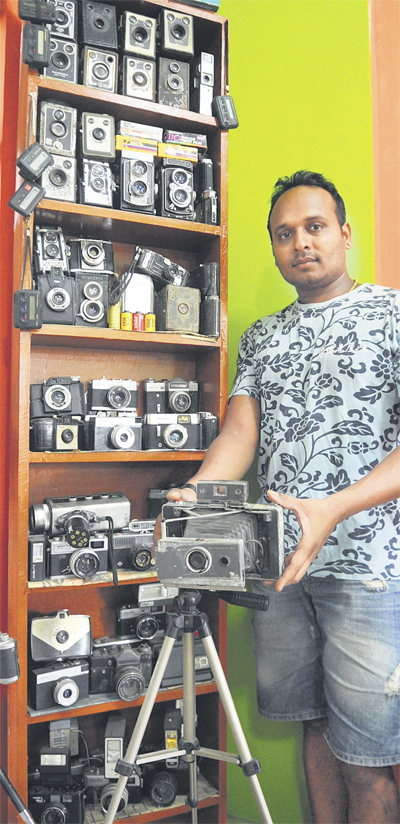
But this 30-year-old has always had a penchant for all things vintage. He owns 480 watches, the oldest being a Swiss make from 1895 and is worth Rs 15-20,000 today; 144 cameras and the oldest is an Eastman Kodak from 1901, apart from oil lamps, a 1962 air gun and more. Collecting things has been his passion since the time he was a school boy. He would collect world cup chewing gum cards, trump cards, matchboxes and more. “I still have all of that,” he says. But the ‘collector-bug’ in him was born when his grandfather gave him an HMT watch when he was in class 7. Namburi feels that as a collector it is important to be at the right place at the right time if you want to get your hands on the right vintage.

Namburi’s oldest camera is an Eastman Kodak from 1901 / Bangalore Mirror
Namburi lives by the adage, ‘Junk is old and old is collectible’ to the extent that he even has posters around his house proclaiming this truth. Perhaps to remind his wife so that she doesn’t throw anything during spring cleaning. “There’s something about holding old stuff…it can’t be replaced. You can use old stuff and it will never die out on you,” he says. “I won’t sell anything.”
To pursue his hobby of collecting vintage cycles, watches and other interesting paraphernalia, Namburi feels that he requires only patience, time, money and luck. “If you see something somewhere and like it, you should grab it. It won’t be there the next time,” he says.
Currently, Namburi is restoring two baby cycles for his one-and-a-half year old son,Tejal S Namburi, who he says will continue his legacy; it’s an Indian make that was used in photo studios as a prop in the sixties. And yes, it was a limited edition cycle.

source: http://www.banglaoremirror.com / Bangalore Mirror.com / Home> Bangalore> Home> Sunday Read> Story / Special / by Khushali Madhwani /  Sunday – May 05th, 2013

Bangalore-bred Chris Pfeiffers steal the show at PES College of Engineering

In low airfare PES College of Engineering in Mandya organises a stunt biking show titled Wheeled Evolution 2013

PesBF06may2013

Saravanan Parth, a second PUC student always loved working with motorbikes. But, what can he do with a motorbike? How can his career be lucrative if he studies motorbike?

He found his answers recently when he attended a stunt biking show at PES College of Engineering, Mandya.

To encourage automobile engineering and love for automobiles, the PES College of Engineering in Mandya organised a stunt biking show recently. Titled Wheeled

Evolution 2013, the event had a stunt show by a team called LSI (Legendary Stunts Inc) and Dirt Battles, a dirt biking competition.

“We performed a no-front wheel wheelies freestyle circle, an international stunt performed in X Games,” said Mohammad

Kasheef, member of LSD. The team took about five years to perfect stunt biking, and has performed at various colleges to encourage students to take up automobiles engineering along with stunt biking.

“We work on bikes. We modify them and we rectify them. Since we know our bikes in and out, we know what safety measures we have to take before we start doing stunts on them,” explained Mohammad Zakir, who rides a Pulsar.

“We have a Dio, we have a Pulsar. One is a geared vehicle the other is not. But we perform stunts on both,” said Raza Mehedi Ali, who performs stunts on the Dio.

“We are completely opposed to stunts on the roads. We never practice on freeways or main roads. We have a small place and we practice there with every safety equipment in place. Helmets, arm guards, knee guards, neck protection, shin protection, shoes and if needed harnesses are all used even during practice sessions,” said Kasheef.

source: http://www.dnaindia.com / DNA / Home> Bangalore> Report / Place: Bangalore, Agency: DNA / Tuesday, April 30th, 2013