New garden for Mysore Palace

Rs. 43 lakh for four acres landscaping

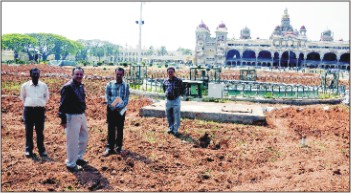
Caption: Palace Board Deputy Director T.S. Subrahmanya and others taking a look at the work going on for the gardens at Palace premises.

Mysore, Feb. 18

The beauty of the world-famous Amba Vilas Palace is to be further enhanced with a garden on four acres of land, work on which has already commenced.

The total cost of the garden is Rs. 43 lakh. Tenders were called for laying the garden an year ago when Harsha Gupta was the DC. However, the work was stalled in view of Dasara.

The tender has been awarded to Uthaiah Mangalaraman Company and it has been asked to complete the work in the next three months, said Palace Board Deputy Director T.S. Subrahmanya.

As part of the project, the two fountains on either side of the Palace front region, that are more than six decades old, will be repaired and made to function on a daily basis.

Retaining walls of stones will be constructed along the borders of the garden to prevent flowing away of soil during rains.

The garden measuring 16,400 square metres will have lawns of a variety of grass, more than 50,000 varieties of plants, shrubs and vines of tropical regions.

The soil will be mixed with 25 per cent of chemical fertilisers, 50 per cent farmyard manure and horse dung. The entire garden will be barricaded with granite slabs and small pools of 10ftx10ft will be created as part of the landscaping, with a walkway.

During the tenure of former DC Harsha Gupta, the authorities talked about a garden on the lines of the Moghul Garden in Delhi. But now the plan has been changed and the garden will be laid out in Mysore style as was prevalent during the reign of Mummadi Krishnaraja Wadiyar.

Rain water harvesting

Plans are on the anvil to set up a rain harvesting unit with a storage capacity of one crore litres, said Subrahamnya and added that in the first phase, a rain water harvesting unit with a capacity of six lakh litres has already been established at the Palace premises.

source: http://www.StarofMysore.com / General News / February 18th, 2012


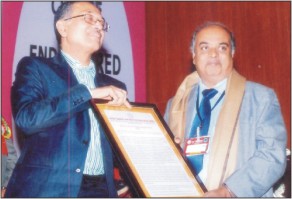
JSS Doctor bags Oration Award

Caption: Dr. Nataraja receiving Dr. R.K. Oza Oration award from the Vice-Chancellor of Hyderabad University.

Mysore, Feb. 16:

Dr. N.P. Nataraja, Director, JSS Institute of Speech and Hearing in city, has been awarded Dr. R.K. Oza Oration National award, at the 44th annual conference of Indian Speech and Hearing Association, held recently at Hyderabad. The award was instituted to honour successful entrepreneur in the field of speech and hearing from India and consists of a citation and trophy.

Dr. Nataraja is a scientist, trainer and a pioneer in voice among the Indian Speech Language Pathologists. He has contributed tremendously in escalating the field of Voice Disorders, Speech Sciences and Forensic Speech Analyses. He was conferred with Bharat and Dr. Ratna Oration awards in 1999 at the 31st Indian Speech & Hearing Assn. Conference, Chandigarh. He was also awarded LVA Oration award at the 1st Annual Conference of Laryngology and Voice Association named as Laryngology Update 2012 in Mumbai on Feb. 4 and 5. The award has been instituted to felicitate leading Phono-surgeons and Speech Language Pathologists who have contributed in the field of Laryngeal Disorders, Voice Restoration.

source: http://www.StarofMysore.com / General News / February 16th, 2012

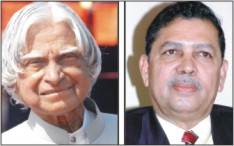
Rs.1 crore Jindal prize for Dr.Kalam, Santosh Hegde

Caption: Dr. Kalam, Justice Hegde

New Delhi, Feb.16:

Former President A.P.J. Abdul Kalam and former Lokayukta of Karnataka Justice N. Santosh Hegde have been selected by the Sitaram Jindal Foundation for S.R. Jindal Prize for their outstanding contributions in their respective fields.

The prize amount carries a cash of Rs. 1 crore. Sitaram Jindal Foundation will felicitate 25 other achievers also at the award ceremony to be held on Feb. 23.

S.R. Jindal Prizes will also be awarded for crusade against corruption, rural development and gallantry.

Patron of the Foundation Sitaram Jindal said, Dr. Abdul Kalam has been selected for the award for his contributions in science and technology while Justice Santosh Hegde will be honoured for his extraordinary service in social development.

source: http://www.StarofMysore.com / General News / February 16th, 2012

Home is where the house is

One of the oldest houses in Bangalore stands witness to the rich lives of six generations — both inside and outside its walls

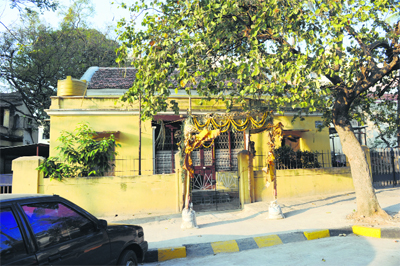
If a person lives for 100 years or more he/she is called a centenarian. What do you call a house that’s 115 years old? Simply…House No.253.

The beige coloured house on IIIrd main, Chamarajpet, sits on the quiet lane like a great-grandpa on  an easy-chair, watching the world go by with a I-have-seen-it-all gaze. The house has been around much before the people, who walk past it now, became a ‘creation’ in God’s workshop. It has seen horses cantering on the roads; macho Sunbeams and Moris Minors driving past its gate, followed years later, by modest Fiats, Marutis and now the boxy Swifts, like the one parked in front of the house. It has witnessed servitude and freedom; it has seen births, deaths, marriages and separations. For 115 years House No.253 has seen life in its varied hues –both inside and outside its walls.
This 19th century house is one of the oldest properties in Bangalore, owned by the original allotee’s family. Measuring 60 ft by 108 ft it was allotted to Kasturi Rangachar in 1896 by the government for Rs 200. The original house number was 171, which later changed to No. 234, 250 and now No. 253. The oldest document of this property dates back to July 9, 1930 — a tax-paid receipt for Rs 12 and 8 annas, issued by Bangalore municipality, signed by a Shanbhog.
It’s a classic
The solitary stone bench at the entrance is typical of houses of a bygone era; windows on either side of the five-door entrance, high roof, signature rose wood doors, black kadapa kallu flooring, spacious rooms sandwiched between thick walls, long verandahs, the attic-cum first floor with a mini-wooden ladder attached to it and the sweet-water well in the backyard amid coconut and mango trees… it is reminiscent of a simpler time when home was the axis of one’s life.
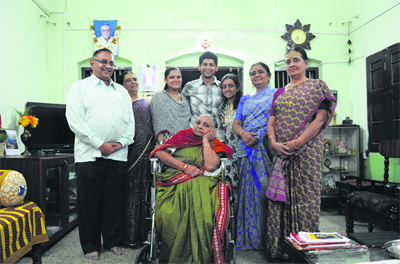
The house is now occupied by Rangachar’s sixth generation family: matriarch 84 year old P Kamalamma lives here with her sons and daughters-in-law. She has six grand children and eight great grand children, some live with her. The spacious four-bedroom house has hosted around 30 family weddings.
The III main road where the house is located was initially 80-feet wide and called Iyengar Street as majority of the residents were from the Iyengar community. “It’s probably the oldest property on this street that is still retained by the original allottees’ family,” says D Vijaykumar, 61, the youngest son of Kamalamma. “Over the years, the family grew, but not once did we think of dividing the property.” Barring a few minor repairs and painting, the house has not been altered at all. The sheen on the  kadapa kallu flooring shimmers —even after 115 years!
Only after the death of Kamalamma’s husband, a few years back, a hunt for the property papers began since the sons wanted to change the title ownership to their mother’s name. Kamalamma’s two daughters-in-law, Ramamani and Sumathi, were entrusted with the job. They laid their hands on the 1930 tax-receipt and traced the property entry in the records in the revenue office. Subsequently, the urban land survey office issued them a certificate of ownership.
In 1992, as the family grew the existing space shrunk. The brothers decided to build three-apartment units in the large backyard. “We didn’t want to make any alterations to the old house,” says Vijaykumar. “But, we also wanted to be in the same compound. Our parents allowed us to construct the flats without dividing the property.” While two brothers shifted to the newly built apartment, Vijayakumar and his wife continued living in the old house with his mother.
Barring some old age related ailments and a recent hip bone fracture, the octogenarian Kamalamma is agile. She crossed the threshold of the house as a new bride in 1944. Pointing to an old black and white picture of the older generations, Kamalamma says, “Many died of epidemic diseases that were common those days.’’
The 6,480 sq ft space purchased for Rs 200 in 1896, is worth around Rs 10 crore now. Several TV serial directors approached the family to let the house on rent for shooting. But the family refused.
A few days ago, House No.253 welcomed the sixth-generation’s youngest grand daughter-in-law, Sahana. Now, the 115-year-old house is getting ready to welcome the ninth great-grand child of the family; gurgles and giggles will once again fill the ancient rooms and the kadapa kallu will gleam under tiny baby feet. Yet another chapter of life will begin under the roof of House No.253.
source: http://www.BangaloreMirror.com / Bangalore / Home> Sunday Read> Special / Sunday, February 16th, 2012

ASI celebrates 150th Anniversary

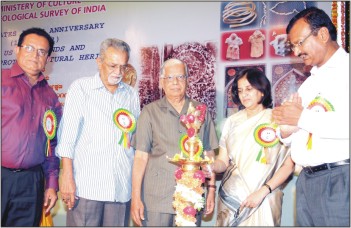
Caption: Juthika Patankar, Additional DG, ASI, lighting the lamp to inaugurate the 150th anniversary celebrations of ASI in city this morning as (from left) Dr. T.S. Ravishankar, Director-Epigraphy of ASI, Dr. K.V. Ramesh, Prof. A.V. Narasimha Murthy and Dr. S.V. Venkateshaiah, ASI Regional Director, look on.

Mysore, Feb. 13

The Archaeological Survey of India (ASI), a pioneering subordinate office under the Ministry of Tourism & Culture, celebrated its 150th anniversary at Panchavati, Gymkhana Auditorium of AIISH on Bogadi road here this morning.

The programme was inaugurated by Juthika Patankar, Additional Director General of ASI, New Delhi.

Speaking on the occasion, she said that the Department had conserved 3,677 monuments all over the country and more such works were on. In view of the challenges faced by the ASI owing to the importance given to heritage and culture, the entire Department will be restructured and the staff will be trained in management skills, she said and added that steps will be taken to fully equip the ASI. Suggestions of scholars will be considered before taking any major decisions, she assured.

Prof. A.V. Narasimha Murthy, former Head, Department of Ancient History and Archaeology, Mysore University, speaking as the chief guest, said that the ASI was like Varaha avatar (incarnation of boar) of Lord Vishnu who dug out planet earth out of the ocean between his tusks and restored it to its proper place in the universe. Similarly, ASI digs out information from ancient times to educate the people. ASI has been rendering yeomen service in preserving the cultural heritage of the land for posterity, he added.

Dr. S.V. Venkateshaiah, Regional Director (South) of ASI, speaking as a chief guest, said that the department has been extensively working for conserving ancient monuments.

An exhibition comprising photographs of the monuments restored by ASI, showing how the monuments were and how they look after restoration, has been organised at Panchavati, which can be viewed by the public.

ASI Director Dr. T.S. Ravishankar (in-charge, Epigraphy Department) said that the Directorate of Epigraphy, Mysore, with its two zonal offices located in Chennai and Lucknow, is engaged in copying, deciphering, editing and publishing the texts.

The office has collected more than 74,000 inscriptions of different scripts and languages from around the country.

source: http://www.StarofMysore.com / General News / February 19th, 2012

Lifetime Achievement Award for Dr.(Brig) R.S. Rajan

Mysore, Feb. 13

Dr. (Brig) R.S. Rajan, Director of Administration, Vivekananda Institute of Leadership Development in city was honoured with the Lifetime Achievement Award-2012 for his contribution to the specialty, the association and the community at the recently concluded Cardio-Thoracic Surgeons meet in Kolkata.


Dr.R. Sundara Rajan graduated from Banagalore Medical College in 1964 and joined the Army Medical Corps in the wake of the 1962 Chinese aggression. He served the Army and the country with distinction for 36 years and reached the rank of Brigadier before taking voluntary retirement in 1999.

During his Army Service, he served in Ladakh and Sikkim at different times while also making steady progress in the Academic field, specialising in Surgery and Cardiothoracic Surgery. He went on study leave to New Zealand to hone his skills under the legendary Sir Brian Barratt-Boyes and returned in 1981.

He soon took over as the Head of the Department of Cardiothoracic surgery at Military Hospital (Cardio-Thoracic Centre), Pune which is affiliated to the Armed Forces Medical College. As its Head over the next 14 years, he trained all the cardiothoracic surgeons of the Army, Navy and Air Force.

Dr Rajan was known for his passion for teaching both undergraduate and postgraduate doctors as also nurses and paramedics. For his distinguished services, he was awarded the Visihta Seva Medal (VSM) in 1999.

Dr. Rajan took interest in other centres of cardiac surgery as a teacher and made valuable contribution to the Indian Association of Cardiovascular & Thoracic Surgeons as an Executive Committee Member and later its President in 1995.

Since his retirement, after a stint with Tata Tea as its Chief Medical Officer at Munnar, he remains active in the field of Community Health and Development Issues in various NGOs. Currently, he is the Director of Administration at the Vivekananda Institute for Leadership Development, a part of Swami Vivekananda Youth Movement, an organisation with which he has been associated for the last three years.

source: http://www.StarofMysore.com / General News / February 13th, 2012

Christ College Wins Natl.Moot Court Contest

Mysore: Feb. 13

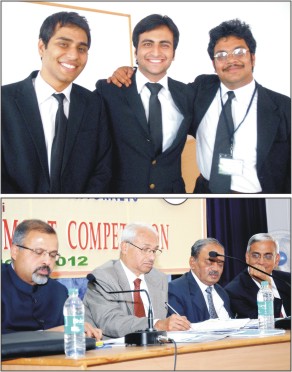
Christ Law College from Bangalore won the two-day National-level moot court competition on ‘Corporate Taxation’ conducted by Surana and Surana International Attorneys and JSS Law College at JSS Law College’s Silver Jubilee auditorium here yesterday.

National Law School of India University is runner up

Caption: 1) Winning Smile:Ajay Kumar, Chahat Chawla and team researcher Roshil Nichani of Christ College, Bangalore, who won first prize in the national moot court competition held at JSS Law College in city. 2) High Court Judges D.V. Shailendra and Praveen Chandra and others seen during the valedictory function of National moot court contest yesterday.

The National Law School of India University (NLSUI) from Bangalore, who keenly contested for the title, had to settle with the runner up trophy. In all, teams from 44 law colleges from all over the country participated in the national level competition, the second in the series. Apart from the trophies, the winner got Rs. 25,000 as cash prize while the runner got Rs. 14,000.

The final rounds were judged by High Court Judges Justice Shailendra Kumar and Justice N. Anand, Padamchand Kincha and Director of Income Tax (International Taxation) Praveen Kishore Prasad of Bangalore.

Ajay Kumar of Christ College, later speaking on behalf of his team, said that such competitions help in honing the skills of students and improve knowledge in the subject. “Such things cannot be learnt in classrooms,” he said. Other members of Christ College team are Chahat Chawla and researcher Roshil Nichani. The National Law School of India University team consisted of Deekshitha, Shreya and Siddarth.

source: http://www.StarofMysore.com / General News / February 13th, 2012


Rare literature on Islam, Hinduism in Tipu’s collection

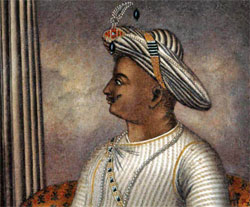
A rare Persian translation of Mahabharat prepared on the order of Emperor Akbar, religious literature both on Islam and Hinduism and manuscripts from the huge collection of Tipu Sultan’s library are some of the items which have been catalogued for future generations.

The National Archives of India has catalogued these manuscripts for the use of academicians and scholars and seven volumes of the acquired documents will be released by Vice President Hamid Ansari tomorrow.

The catalogues from Persian were translated into English with the help of the Iran Culture House which extended its technical support regarding digitisation of the manuscriptsThese catalogues have also been translated by them in Persian and published in English as well as in Persian.

The descriptive catalogue comprises of more than 190 manuscripts which throws light on the Oriental life and culture, covering different faiths and religions, manners, arts, custom and philosophy practiced in the world.

The catalogue has been classified in five groups — Religion, History, Language, Literature and General. The first group of the catalogue deals with religious and Sufi literature, both on Islam and Hinduism and a copy of the Persian translation of Mahabharata, prepared on the order of emperor Akbar under the supervision of Abul Fazal.

Besides, Su’ al-o- Jawab-i-Dara Shikoh Wa Baba Lal, a treatise containing the conversation between Prince Dara Shikoh and Baba Lal Das of Kaithal on the life and doctrines of Hindu Faqirs and Kashf al-Mahjub, the oldest systematic work on the theoretical and practical doctrines of Sufism by Abul Hasan Ali bin Uthman bin Ali al-Hujwiri are some of the highlights of the catalogue.

The history group covers outstanding works of historians and litterateurs including works on India like Tawarikh-i-Firuz Shahi by Shams-i-Siraj Afif, Akbarnama and Ain-I Akbari by Abul Fazal, Majmu’a-i-Khuwrrami and Shah Jahan Nama by Bahadur Singh. 

The accounts of the neighbouring countries of Iran and Afghanistan and the European people have also been covered in the group and Tarikh–i-Alam Ara–Ara-i-Abbasi, a history of the life and region of Abbas of Safawi dynasty of Iran by Iskandar is very important work of the period. 

The catalogue of Manuscripts of the Fort William College Collection in the National Archives of India comprises several rich manuscripts, including a large number of invaluable books and rare manuscripts from the plunder of the huge collection of Tipu Sultan’s rich library. 

The collection was brought to Calcutta in 1799, following his defeat and death at Srirangapatnam. 

This rich collection has 8 sections which contain 17 sub-sections, ranging from eastern and western religions, language, literature, history, medicine, animal husbandry, astrology etc. 

In this catalogue, only Persian and Arabic manuscripts have been included although manuscripts in Bangla, Hindi, Sanskrit, Urdu are also available in the collection.
Besides, these publications, the Iran Culture House would hand over digital copies of 400 Arabic and Persian Manuscripts in the C.D. form to National Archives of India during the book release function.
source: http://www.DeccanHerald.com / Home> National /New Delhi, Feb 15, 2012, (PTI):

ASI @ 150

“Preservation means maintaining the fabric of a place in its existing state and retarding deterioration”

— Article.1.6, Burra Charter, 1979.

Established by the farsighted British under the British archaeologist Alexander Cunningham in 1861, the Archaeological Survey of India (ASI) has been working towards the protection and preservation of the ancient monuments and antiquities which abounds in our vast country. Since its inception, it has been digging and discovering precious historical sites and deciphering and describing thousands of important inscriptions. The work done by ASI has received praise from foreign governments which have invited ASI for the conservation of their monuments. In this Weekend Star Supplement, Star of Mysore offers a peek into the works of ASI, which is now in its sesquicentennial year. 150 years of digging, deciphering and protecting history
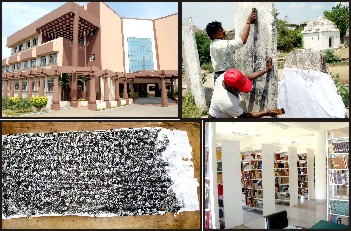
Caption: 1) The Puratatva Bhavan in Hebbal II stage in city which houses the Headquarters for the Directorate of Epigraphy (Sanskrit & Dravidian inscriptions and coins) of ASI. 2) Field photo of ASI staff copying inscription and taking estampage. 3) Ratanpurva Asokan Edict. 4) Library at ASI, Mysore.

Archaeological Survey of India (ASI), under the Ministry of Culture, was set up for archae-ological researches and protection of cultural heritage of India. For the maintenance of ancient monuments and archaeological sites and remains of national importance the country is divided into 24 Circles. ASI, which is primarily responsible for the antiquities of our country, has many branches like Conservation, Pre-history, Excavation, Science (conse-rvation and chemical treatment), Horticulture and Epig-raphy. The Mysore centre located at “Puratatva Bhavan” in Hebbal II Stage is the Headquarters for the Directorate of Epigraphy (Sanskrit & Dravidian inscriptions and coins) and was started in 1967. The Headquarters for Arabic & Persian inscriptions and coins is located at Nagpur. The Mysore centre also houses branches like Excavation, Horticulture, Science and Conservation.

Directorate of Epigraphy for Dravidian and Sanskrit inscriptions

Established by the pioneering British savants, the city branch renders service in tracking down a large number of inscriptions. So far this branch has copied nearly one lakh inscriptions from across the country and more than one third of them have been published by it.

Inscriptions are the main source materials for reconstructing the history of our vast country as they describe contemporary events, thereby imparting authenticity to the history based on them. Perhaps there is no subject which these records have not covered. Inscriptions throw light on political, religious and commercial compacts, law and justice, trade and commerce, construction of temples, installation of images and excavation of wells, tanks, rivers, etc.

In common parlance, epigraphy is the study of writings engraved on stone, metal and other materials known as inscriptions or epigraphs. India is very rich in epigraphical wealth and inscriptions are available from Kanyakumari in the south to Kashmir in the north. The annual collections of all their inscriptions are brought out in the centre’s Annual Report. Some important inscriptions are critically edited in a research journal called Epigraphia Indica. Besides these two, the texts of inscriptions are printed in vernacular languages in yet another departmental publication called South Indian Inscriptions. Besides these, Sanskrit inscriptions of some of dynasties that ruled over North India are published in another publication Corpus Inscriptionum Indicarum.

In addition to these publications, the department is conducting awareness programmes to kindle awareness about the importance of inscriptions by conducting exhibitions. Staff members also visit schools and colleges and deliver lectures about the importance of inscriptions and the need to preserve them for posterity. The Epigraphy Office has also a big library with rich collections of rare books totaling to over 26,000.

Importance of Epigraphy

Several dynasties ruled over large territories of the Indian sub-continent, from imperial Mauryan dynasty to Vijayanagara and post-Vijayanagara dynasties and they have left a rich legacy of inscriptions to us. Indian history would have been veiled in obscurity but for these inscriptions. In fact, Indian history sans epigraphy is nothing short of fairy tales. They are found engraved on rocks and boulders, temple walls, on coins, vessels, shells, copper-plates, pots, bricks, wooden pillars, tablets and other objects.

Some of important dynasties that ruled over North India are the Mauryans, Sungas, Kshatra-pas, Guptas and south India dynasties like Kadma-bas, Chalukyas, Rashtrakutas, Hoysalas, Cholas left behind a huge corpus of inscriptions both in stone and in copper-plates. Karnataka alone can boast of Asokan edicts at Maski (Raichur), Sannathi (Gulbarga), Gavimatha (Koppal), Siddapura, Nittur (Bellary) and Jatingaramesvara. We know the name of the Mauryan emperor Asoka only from Maski, Nittur and Odegolam.

We know that Karnataka was a part and parcel of the great Mauryan Empire only by the availability of these edicts. Today if we know about the great Asoka conquests, political career, pious nature, encouragement to Buddhism and his philanthropic activities, it is because of his edicts which were engraved on rocks and pillars throughout this country. Again the golden age of north India under the Gupta rulers are known only from the inscriptions left behind by them. We would have drawn blank the history of the Kadambas, another ancient dynasty which ruled over Banavasi but for these inscriptions. Chalukyan ruler Vikramditya II’s inscription at Kanchipuram reveals that he defeated the Pallavas and captured the city of Kanchipuram and he was magnanimous enough to donate all the wealth which he pillaged in the city back to the God of the Kailasantha temple at Kanchipuram.

Harsha’s defeat at the hands of the Chalukya Pulekesi II is known from inscription. Many times boundaries of an empire are determined by the availability of the inscriptions of the ruler of the empire. The Chola’s conquest of South Karnataka is known from inscriptions that are found in Kolar district. The great Vijayanagara ruler Krishnadevaraya’s conquests and achievements are recorded only in inscriptions. His special devotion to the God of Tirupati and his generous gifts of valuable ornaments again are known from inscriptions.

Likewise the Talagunda inscription sketches the early history of the family Kadambas. The Aihole prasasti of Pulakesin II which narrates in detail the political career of this Chalukyan king refers itself to the composer of the record Ravikirti, a Jaina poet, who claims equal fame to that of Kalidasa and Bharavi the legendary poets. The Uttiramerur inscription of Parantaka Chola describes the qualifications prescribed for the aspiring persons who wished to serve in the local committees, mode of elections, qualifications, disqualifications and other details elaborately.

In a Vijayanagara inscription there is a graphic account of how learned scholars in all branches of sacred studies assembled and signed a document which forbade Kanyasulka and Varadakshina in any marriage arrangement and threatened punishment by the king and social exclusion from the community for parties receiving either. Another inscription of the same period records that the emperor settled the disputes between a Vaisnava Jeer and a Jain teacher by making them agree to be friends and raise no points of dispute.

Inscriptions do not deal with mere conquests and annexations of territories. They are much more than that. The famous Tirumukkudal (Tamil Nadu) inscription of Virarajendra refers to a Vedic college and the subjects studied therein, teachers and their remuneration. So also, Ennayiram inscription of Rajendra I which gives a detailed list of subjects that were taught, teacher’s qualifications and allowances received by them. Salotagi inscription of Krishna III records the constr-uction of a shala (college) by his minister Narayana. The record states that the shala attracted students from all over India to pursue their studies.

Recent findings: Inscriptions continue to come to light from all quarters and new inscriptions are discovered every day. Recently a very big copper-plate of the Chola ruler Rajadhiraja I from a place called Indalur in Tamil Nadu came to light. It is the biggest copper plate ever discovered and contains 86 copper sheets and runs into 1,700 lines. It records that the Chola ruler Rajadhiraja (1018 1054 A.D.) granted villages to the Brahmanas to create settlement. He then went to the battlefield to fight with the western Chalukyan king Ahavamalla in the Battle of Koppam. He was killed and his brother Rajendra defeated the Chalukayn army and returned home triumphantly. He then ratified the land grant made by his brother. It contains enormous details about land transactions and revenue administration of the Cholas. The 11th century Sanskrit inscription discovered at Mallapuram district in Kerala throws light on the rulers of Kerala of the times.

Brahmi script: Inscriptions are available not only in our vast sub-continent but also in countries like Sri Lanka, Burma, Thailand, Borneo, Nepal, Java, Tibet, Afghanistan and Pakistan which once formed parts of Greater India. It is interesting to note that the scripts used in the inscriptions found in these countries were evolved from the Brahmi script. These inscriptions are found engraved in different languages and script. The earliest script (300BC-300 AD) that is found employed inscriptions in Brahmi script and are in Prakrit language. Brahmi is the mother of all scripts. From this script all the other scripts of both North and South India evolved. Archaic inscriptions that are engraved in Brahmi scripts are available in the caves of Tamil Nadu and most of Asokan records are engraved in Brahmi scripts.

Although Sanskrit is the oldest language of India as found in Vedic literature, the language of the earlier written records is Prakrit. After the period of Asoka, the use of the Prakrit language continued in inscriptions for a few more centuries. In North India Prakrit was replaced by Sanskrit by the end of 3rd century AD. Sanskrit continued to be employed in the inscriptions of all parts of India along with regional languages in the subsequent centuries. At the same time different regional languages began to appear in the inscriptions from different regions in different periods. The copper-plate charters of the Pallavas, Chalukyas, Pandyas and Cholas are written in both Sanskrit and their regional languages. Inscriptions that are found abroad are in Sanskrit language.

Excavation Branch

The Excavation Branch – VI, Mysore, of ASI was established in 2001 with the positing of Dr.J. Varaprasada Rao, Deputy Superintending Archaeologist. Later Dr. Jitendra Das, Superintending Archaeologist, was posted as Head of Office and functioned from Bangalore for a few years. Though it was established in 2001 it started functioning with a few administrative staff posted in September 2009 and after the allotment of funds for the financial year 2009-10 in Nov. 2010. With minimum staff posted to this branch headed by M. Mahadevaiah, Superintending Archaeologist, explorations were conducted from 2010 in South India.

Sites located on the Bhima valley include Ranamandala, Gurusanagi, Hadigimadra in Gulbarga district, Kurgodu, Badanahalli & Lakshmipura in Bellary district and Periyakadambanur in Thanjavur district. Archaeological finds found from these sites ranges from prehistoric to medieval period.

This branch has conducted excavation at Kurugodu, Bellary District during 2010-11 and submitted a brief report on the same to the Directorate and the excavation for the current season has started from January 2011. Exploration conducted at Kurugodu has brought to light Palaeolithic hand axe for the first time from this site and Iron Age megalithic habitation at the excavated site. The important finds from Kurugodu include terracotta figurines of human and animals, microliths, steatite and shell beads in large number, copper and iron objects etc.

Horticulture Branch

The Garden branch of the Archaeological Survey of India is a specialised branch responsible for conservation of archaeological gardens and environment around the centrally protected monuments. It is not only monuments which show the civilisations but the heritage garden is also an expression which is the result of human relationship with nature reflecting various civilisations.

The Garden branch of ASI is maintaining gardens of various styles from sacred grooves to orchards, courtyard gardens of Havelies to Palaces, Fort and Tomb gardens.

Another important point is that several heritage gardens have exclusive important old plant material, which is not found in local areas. It proves the import of plant material from different parts of world by the builders of these gardens. These areas are also a part of heritage to be preserved along with monument to avoid extinction.

The Horticulture Branch is maintaining 504 gardens at present, including gardens around the world heritage monuments. There are over 3,684 centrally protected monuments and sites in the country and so far environmental conservation of around 504 monuments have been done.

History of Horticulture Branch: The Horticulture Branch was created in Archaeological Survey of India in 1950. Before the creation of this branch, the gardens around the monuments of Delhi and Agra were maintained by CPWD/PWD and State Horticulture Department of Uttar Pradesh on deposit basis. However, these departments were not maintaining the gardens according to Archaeological principles.

As a result, a proposal to have an independent garden branch in the Survey was mooted by Sir Mortimer Wheeler, the then Director General of the Survey. Later on, this resolution was also endorsed in the Central Cabinet represented by Maulana Azad, the then Education Minister (when ASI was under the Ministry of Education-1949). On the approval of this proposal, the garden branch came into existence in 1950. The branch started with eight gardens around the monuments of Delhi and Agra. Consequently, two separate garden zones were carved out with their Head Quarters at Delhi and Agra in 1958.

In 1963, a separate zone with head quarters at Mysore was created for the gardens in South India. In 1982 the Zonal Office was elevated with the Deputy Superintending Horticulturist in addition to Assistant Superintending Horticulturist. Later, a separate Division was created with Head Quarters at Bhubaneswar, for the gardens in States of Orissa, Bihar, West Bengal and North East region.

Activities: Horticulture Division No-III, Mysore, has 26 sub-divisions and 126 gardens are being maintained under this division spread over the entire South India. Out of these, 22 gardens are at World Heritage sites in three States — Goa, Karnataka, Tamil Nadu.

Science Branch

The Mysore zone of Science Branch was established in 1976 for giving greater impetus to about 518 centrally prote-cted monuments, paint-ings, archaeological museum objects, excavated objects etc., under the jurisdiction of Bangalore Circle (218 monuments) and Dharwad circle (300 monuments) in Karnataka. This Zonal office has executed many important scientific conservation works in two world heritage sites at Hampi and Pattadakkal and also in places like Belur, Nanjangud, Shravanabelagola, Srirangapatna, Halebeed, Aihole, Karkala, Bidar, Shimoga, Melukote, Nagamangala, Mullur, Marehalli, Thonnur, Hale Alur, etc.

To cover more monuments, a new Science wing has been functioning at Dharwar since 2008.

The unique symbols of our civilisation are preserved with as little intervention as possible and without altering or modifying in any way the authenticity of their original charter. Scientific research is carried out to ensure the stability as well as the proper conservation of cultural heritage.

The conservation techniques adopted depend on the preliminary investigation which includes the knowledge of the physical nature of the object, constituent of the materials, Architectural characteristics, production techniques, state of decay and the factors that induce or could induce decay.

Conservation Branch

The chemical treatment given by the members of the Conservation wing to the Hindu temple at Angor Wat and of Buddha statues at Bamiyan near Kabul (since vandalised by the Talibans) are shining examples of the work executed by the Conservation Wing of the Survey. It has taken up important excavations at sites such as Kusinagara which provided an archaeological basis for Buddhist history. It recovered Lion Capital at Sarnath, which has become a part of National Emblem. It unearthed key evidence at urn burial site at Adichchanallur which highlighted the unique features of the Iron Age in south India. One of the greatest work in ASI’s history was the 1921 discovery of Indus valley sites at Harappa (by Daya Ram Sahni) and at Mohenjodaro (by R.D.Banerji).

The 150th anniversary of ASI at Mysore will be held on Feb. 13 at 11 am at Panchavati, Gymkhana Auditorium on Bogadi Road.

Director’s Corner

Director Dr. T.S. Ravishankar obtained MA (Sanskrit), MA (Ancient History and Architecture) and Ph.D from the University of Mysore. Having joined the Epigraphy Branch of the ASI as an Epigraphical Assistant, he has served for more than three decades in different positions and is presently the Director of Epigraphy (I/c).

Dr. Ravishankar has established his expertise in deciphering Sanskrit inscriptions and also early coins. He has worked as an expert Numismatist from Archaeological Survey of India at Delhi customs office to examine the coins. He has participated in many important archaeological excavations at different places, an important one being that at Ayodhya.

Speaking to Star of Mysore, Dr. Ravishankar said that although the Mysore branch was started in 1967, it was shifted to its present building around three-and-half years back. The Centre, apart from research also concentrates on teaching, focusing on PG and Ph.D students who wish to take up research at ASI. “We have a vast library and original copies of inscriptions totaling to over one lakh which the students can refer to. Also the staff will guide them in their respective subjects when needed,” he said.

source: http://www.Starof Mysore.com / Feature Articles / February 11th, 2012
 

Pages from History: Glory, Thy Name is ASI

By Prof. A.V. Narasimha Murthy, former Head, Department of Ancient History & Archaeology, University of Mysore

The print and electronic media have been very active in giving publicity to the 150th celebrations of Archaeological Survey of India (ASI). This great department was established in 1860-61 with Alexandar Cunningham, generally considered to be the first Director General.

Actually first he was appointed as Surveyor with a salary of Rs. 450, field allowance of Rs. 250, plus a share in the antiquities to be discovered by him. Subsequently he was appointed Director General, which post is being continued till today mostly occupied by archaeol-ogists and sometime IAS officers. Thus it has a long tradition.

Archaeology is not a popular word and most people find it difficult to pronounce. It means the science of the past. To make its meaning more easy, my teacher used to say that archaeology is the root and history is the fruit, there by showing that history depends upon archaeology to become meaningful. If a literary text states that a king’s palace had golden doors, archaeologist would interpret it as gold was known and the king had a palace! Thus archaeology requires a proof or evidence.

Archaeologist is generally compared to a detective who, with the available artifacts, solves a problem or a riddle and gives flesh and blood to history.

Archaeologist is also made fun of for his way of working. R.K. Narayan’s joke is famous. Two archaeologists were working at an ancient site. One of them found some metallic wires and he immediately exclaimed, these people knew electricity. The other one did not get anything and he announced that they knew wireless.

But archaeology is more serious and a methodical academic discipline all over the world which brings dead civilisations alive. Archaeology includes many categories such as prehistory (before the invention of writing), inscriptions (on stones and copper plates), coins, architecture, sculpture, paintings, bronzes — thus all objects created by man. These antiquities are generally buried under the earth and archaeologist digs them out in a methodical manner, analyses and interprets them and passes them to the historian to write a continuous history of the men and period during which they were made.

This is the journey of man through the ages in all walks of life and this is generally referred to as culture or civilisation.

This is what the ASI is doing for the past 150 years in a methodical manner. Perhaps taking a global view, it can be said with certainty that best served country from the point of view of archaeology is India itself. We should be grateful to Britishers for this contribution and this tradition has been nurtured ably our own Indian archaeologists.

Archaeology has been making use of scientific tools in an amazing way. Carbon 14, dendrochronology Potassium-Argon, spectroscopy are some of the methods which have made archaeology a science. Non-destructive methods are used to analyse coins and even determine the source of the metals used for making coins. Aerial photography has been a great boon in exploration had location of remnants of monuments. Archaeological chemistry has made great prog-ress. Ancient paintings of Ajanta, Tanjore etc. have been given a new lease of life by archaeological chemists. The Tanjore temple has two layers of paintings and our chemists have been able to remove the upper layer of painting and transplant them to a different place and allow us to see the Chola paintings of the early period. Hundreds of bronzes have been given chemical treatment.

Transplantation of temples from one place to another is a great contribution of archaeologists. Thus many destroyed temples have been rebuilt with the same original pillars, sculptures and other architectural members. Our expertise in this field is so good that many foreign countries have invited our archaeologists to conserve their monuments including Angkor. Thus Indian archaeology is going global.

The Horticulture Branch of ASI is providing proper environment to beautiful monuments by providing carpet-like green lawns and gardens to enhance the bea-uty of the monuments. Now laws have been made more effective so that unnecessary and ugly constructions which are an eye-sore to the monuments are removed. More and more monuments are being added to the list of world heritage monuments which bring in thousands of international visitors to our country.

A large number of museums both at excavated sites and location of temples and mosques have been established. Their educative value cannot be overestimated. A large number of authentic guide books and scholarly works have been published to educate our youth. Though the Head Quarters of ASI is in New Delhi, it has various branch offices to look after the monuments.

Mysore is the Head Quarters of the Epigraphical Branch. Inscriptions all over the country are copied and about one lakh estampages are stored here for the study of the historians.

It is my good fortune that I started my professional career in ASI in 1957. At the instance of my guru Prof. K.A. Nilakantha Sastri, a special interview was conducted at Madras by B.K. Thapar, who later became Director General. Unfortunately I could not continue in ASI beyond three years, as I had to go to Harvard University on a Fulbright Scholarship where I worked under Movius Jr. and Dr. Wiley. After returning from Harvard, I joined Mysore University and taught archaeology in addition to research for over 35 years. I have contributed many students to ASI who have distinguished themselves as archaeologists.

The Bangalore circle had organised a function to celebrate 150th year of ASI last month where I was honoured with a plaque which referred to it as an award of excellence in discovering the ancient glory. This give me the satisfaction that I have served my motherland through archaeology.

In this process I had the good fortune of knowing the savants like A. Ghosh, M.N. Deshpande, B.B. Lal, Thapar, Debala Mitra, M.C. Joshi, Jagatpati Joshi, D.C. Sircar, K.R. Srinivasan, Shivara-mamurthy, Krishnadeva, V.D. Krishnaswamy, Soundararajan, T.N. Ramachandran and others.

I have seen 100th and 150th year of ASI. Thus I pay my homage to ASI and its dedicated officers and salute them.

source: http://www.StarofMysore.com / Feature Articles / February 11th, 2012