Cisco’s New Healthpresence Focuses on Rural India


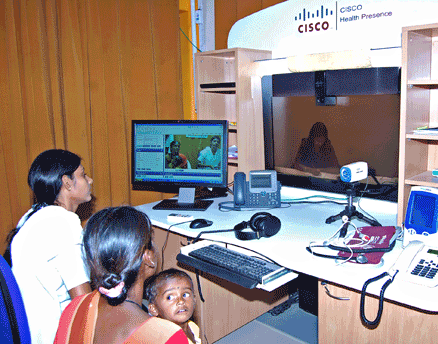
A village woman in K’taka is shown using Cisco’s HealthPresence. (photo courtesy of Cisco)

U.S. technology giant Cisco Nov. 14 unveiled the second generation of its platform for telemedicine, known as Healthpresence, focusing its efforts on India where at least 175 million rural dwellers lack access to any health care services.

Healthpresence allows physicians in several countries to remotely conduct consultations with patients who may be hundreds of miles away. In India, private hospitals, the defense sector and state governments in Karnataka and Madhya Pradesh have signed on to use Healthpresence; the service is already available in 11 districts and can be accessed by up to one million people.

“In India, there’s a huge mismatch between the availability of doctors and where they’re needed,” Vishal Gupta, vice president and general manager of Cisco Global Healthcare Solutions, told India-West by teleconference from Bangalore, where he is based. Patients must often travel hundreds of miles to see a physician, he said, noting that the need for doctors and specialists is most acute in rural India.

“We want to be the ATM of healthcare services,” said Gupta, envisioning Healthpresence kiosks in a variety of rural and semi-urban settings, such as malls.

An earlier version of the product, which was released two years ago, required Cisco’s Telepresence, a high bandwidth platform. But the version of Healthpresence rolled out by Cisco last week can be used on low bandwidth platforms, including desktop computers.

Healthpresence 2.0 features the flexibility to be used across several platforms, from a high-end Telepresence-based system, to a low bandwidth version which is portable and can be used in a mobile medicine van, said Gupta, noting that bandwidth is still an issue in many remote parts of India.

The new version of Healthpresence can be maintained on a server by a service provider who provides repairs and updates to the system, eliminating the need for an in-house IT specialist and lowering the overall cost, said Gupta.

Healthpresence patients sit in a special consulting room – known as a primary health care center – which has a screen allowing them to see their doctor, and specialized diagnostic equipment including a digitized stethoscope which allows a doctor to listen to his patient’s heart and lungs remotely.

A digitized torch and otoscope allow the physician to remotely examine a patient’s ears, nose and throat.

Healthpresence can also be used by specialists.

Sunita Maheshwari, a Bangalore-based pediatric cardiologist and founder of RxDx, which uses Healthpresence to connect to patients in the low-income district of Raichur in northen Karnataka, said Cisco’s product works very well in telemedicine.

“We were skeptical at first, wondering will rural India’s villages accept such technology. But they’re really thrilled because they have a doctor out there for the first time,” the Indian American Maheshwari, who was trained at Yale, told India-West.

RxDx remote clinics provide primary care doctors from 9 a.m. to 5 p.m. on a walk-in basis, and appointments can be made for consultations with specialists. The clinic has a staff of 70 physicians, with a mix of specialties, including pediatrics, and serves about 600 patients a month in Raichur, which is an overnight train journey from Bangalore.

Maheshwari – dubbed the “Queen of Hearts” by India Today magazine – said she hopes to next hook up with practices in remote states such as Bihar to provide Healthpresence services there. She estimated that one-quarter of India’s 700 million village dwellers – 175 million people – currently lack access to any healthcare services.

The Osmania University alumnus said the desktop version of Healthpresence was very scalable and could be used anywhere. “I could be sitting anywhere and treating patients not just in Raichur, but also in Tanzania,” she asserted.

The need for access to healthcare in India has gone up phenomenally with the advent of chronic diseases in the population. The country accounts for 60 percent of the world’s heart disease patients, according to data released last year by the World Health Organization, and is home to 35 million diabetics, the largest number on the globe.

Cancer is also on the rise with almost 400,000 people in India dying each year from various types of the disease. The overall oncology market is growing at about 20 percent per annum, Pradeep Jaisingh, founder and CEO of New Delhi-based International Oncology, told India-West in June.

Gupta stated that the Indian government has shown its commitment to telemedicine, promising to increase funding to public health care.

And in September, Sachin Pilot, India’s young Minister of Communications and Information Technology, unveiled a plan that would lay out 500,000 miles of optical fibre throughout the country, bringing high-speed connectivity to every remote area of India within the next two years.

source: http://www.indiawest.com / News> US Indian / by Sunita Sohrabji, Staff Reporter / December 01st, 2011

‘The Romance of Indian Coffee’ released

Mysore, Nov. 30-The newly-launched book titled ‘The Romance of Indian Coffee,’ authored by the Bangalore-based senior journalist P.T. Bopanna, offers a 360-degree view of Indian coffee — the fascinating history of coffee, many charming facets of coffee culture, its symbiosis with nature and what makes coffee such a captivating brew.

The book highlights how Indian coffee is unique and stands out in the global market. Unlike the coffee produced in other countries, Indian coffee is totally shade-grown and is much in demand internationally.

The author has chronicled the contribution of Ivor Bull, the British planter from Coorg, who conceived the idea of the ‘pooling system’ to save the coffee industry during the Second World War.

For those interested in the variety of ways in which coffee can be prepared, a separate chapter has been devoted in the book on how to prepare a good cup of coffee, especially South Indian filter coffee. Recipes for other interesting and popular coffee concoctions, including recipes for making coffee liqueur have also been included.

There is an interesting chapter on how the pioneering British coffee planters spent their days in the estates in 1880s. The book also deals with the current issues that threaten planters — deforestation, climate change, fluctuating prices and man-animal conflict.

Brand specialist Harish Bijoor, who has a vast experience in the coffee industry, has written the foreword for the book. Among those who have contributed articles for the book include, agriculture scientists, Dr. Anand Titus Pereira and his wife, Mrs. Geeta Nanaiah Pereira, who have been working diligently on their model coffee farm on sustainable technologies.

The book has been published by Prism Books Pvt Ltd, Bangalore, and is priced at Rs. 270.

Bopanna’s other books include ‘Rise and Fall of the Coorg State,’ published in 2009; ‘Discover Coorg’ published in 2006; ‘Dateline Coorg,’ a compilation of his articles on Coorg in the last two decades and ‘Coorg: Land of Beauty and Valour,’ a coffee table book, published in 2010.

Bopanna runs www.coorg tourisminfo.com, the first news and tourism portal of Coorg. He may be contacted on Mobile: 93424-30141.

source: http://www.starof mysore.com / General News / Wednesday, November 30th, 2011


D’Souza and Richa make a big splash

Karnataka, which has been in the forefront for some years now, expectedly ruled the pool by emerging the overall champion. It also won the men’s and women’s team championships. Over to S. Sabanayakan.


MANOB CHOWDHURY

Aaron D’Souza in the 200m breast stroke event. The Karnataka swimmer won five gold medals and set three records. He was adjudged the Best Swimmer of the Meet.

As the curtain came down on the 65th National Championships at the Veer Budhu Bhagat Aquatic Stadium in Ranchi, the purpose of organising such an important meet was largely met thanks to some stirring performances by the country’s top swimmers.

The five-day meet, held in excellent conditions, proved to be a big success, especially considering the fact that the capital of Jharkhand was hosting its first swimming Nationals. Four National records and 15 meet records were set in swimming while one meet mark fell in diving, which was a rare occurrence particularly since the discipline has never caught the imagination of the aficionados of the sport in the country.

The fact that the meet was the final event of the SFI (Swimming Federation of India) calendar this year did not in anyway affect the performance of the participants.

There was no doubt as to who would dominate the meet. Karnataka, which has been in the forefront for some years now, expectedly ruled the pool by emerging the overall champion. It also won the men’s and women’s team championships. Maharashtra finished second in the overall standings, followed by Railways and Tamil Nadu.

The Railway divers were in complete control as they won the team championships in both the men’s and women’s sections.

The two stars of the meet were Aaron D’Souza of Karnataka and Richa Mishra of Police. The duo walked away with the ‘Best Swimmer of the Meet’ awards. Both won five individual gold medals and set three records each.

Of the three records that Richa broke, one was a National mark (400m freestyle).

The talking point of the meet though was D’Souza who finished within the Olympic invitation qualifying time of 1:51.59s in the 200m freestyle. He stunned the sparse gathering by clocking 1:51.38s. The effort proved to be in vain for the 19-year-old Bangalore collegian as the championship was not one of the qualifying meets recognised by the world swimming body, FINA.

Nevertheless D’Souza showed that he was capable of attaining the Olympic qualifying time. Only two Indian swimmers, Veerdhawal Khade and Sandeep Sejwal, have qualified for the London Games.

Another youngster who made a big splash was Saurabh Sangvekar, also of Karnataka. The 17-year-old, who relishes the 1500m, 800m and 400m freestyle events, posted personal best times in winning gold medals. The gangling boy, who was born in Thane, near Mumbai, but lives in Bangalore to get quality coaching, made rapid strides to achieve the twin records. Possessing a calm persona, Sangvekar will be aiming to make it to the London Olympics. His 15:51.10s in the 1500m freestyle was nearly eight seconds off the Olympics qualifying time of 15:43.74.

“In the last five months, he managed to shave off eight to nine seconds over the distance and I expect him to attain the required time much before the London Games,” said the National coach, Pradeep Kumar.

Sandeep Sejwal of Railways too made a terrific impact by winning three gold medals, all with record times, and a silver medal. The 22-year-old, who trains under Nihar Amin in Bangalore, achieved the Olympic invitation qualifying mark (1:02.92) in the 100m breaststroke event with a time of 1:02.62 at the FINA Worlds earlier this year. He put up a far better performance here, clocking 1:01.97s. The effort only underlined Sejwal’s dedication and determination.

PTI

Richa Mishra with the five gold medals she won at the Nationals. She also won the ‘Best Swimmer of the Meet’ award.

Despite dominating the women’s category, Karnataka was yet to find a swimmer who could challenge the supremacy of Richa Mishra, the reigning queen of Indian swimming. The 27-year-old CRPF inspector has, over the years, been in complete control of her events barring the odd defeat that she suffered in Jaipur last year.

The Karnataka swimmers found out much to their chagrin that winning medals by the dozen was one thing, but conquering Richa another.

Among the young talent on view the most outstanding was A. V. Jayaveena of Tamil Nadu. The petite girl, daughter of a noted Tamil actor Vijayakumar, came into the limelight when she was only 13 years old during the 34th National Games held in Ranchi. She went one step ahead at the Nationals here to emerge the fastest breaststroker. Jayaveena won the 50m breaststroke event in a meet record time.

Tamil Nadu also had another talented swimmer, M. Raghavi, who won two gold medals in the 100m and 200m breaststroke events. The 17-year-old won a hat-trick of gold medals in the 200m event and picked up the 100m gold for the first time.

Tamil Nadu, thanks to its excellent junior development programme, is a State to watch out for in the near future.

The decline of Maharashtra in the senior section was a cause for concern indeed. Like Bengal, Maharashtra had ruled Indian swimming at one time. Lack of proper coaching and infrastructure might have forced many a talented swimmer to shift base to Karnataka, but there’s no denying the fact that Maharashtra still has plenty of talent.

Aditi Dhumatkar is one such swimmer who would make Maharashtra proud in the days to come. The present crop of sub-junior swimmers would certainly help Maharashtra regain its past glory.

However, for Bengal there is no such hope as the state federation is torn by factional feud. Just one medal in the men’s section (a bronze in relay), three bronze medals in diving and a fourth place finish in women’s waterpolo is a poor reflection of Bengal that had not very long ago produced swimmers of the calibre of Bula Chowdhury among others.

MANOB CHOWDHURY

Saurabh Sangvekar of Karnataka in action in the men’s 1500m freestyle. The 17-year-old set National records in the 1500m, 800m and 400m freestyle events.

The emergence of Anshul Kothari from Gujarat, the fastest man of the meet, and the presence of Talasha Prabhu of Goa, the fastest woman of the championship, only highlighted the efforts of individuals from these States.

One of the biggest employers of sportspersons in India, the Railways, almost seemed to recover from the slump it has suffered in recent years. It was expecting to take the men’s team title but was overwhelmed by Karnataka. According to a prominent coach the public sector major needs to offer a better package in order to attract the best of talent in the country.

In diving Hrutika Shriram of Railways has been winning the three events — highboard, 3m and 1m springboard — since 2005. That she managed to improve upon her own 1m springboard record of 202.95 points set in 2006 with an effort of 212.15 points only highlighted the lack of attention to this most neglected event.

“Diving is a precision event and coaching support is very vital,” said Hrutika. “Divers need better coaching, infrastructure and practice facilities,” she added.

GOLD MEDAL WINNERS

Men — 50m freestyle: Anshul Kothari (Gujarat) 24.08s. 100m freestyle: Aaron D’Souza (Karnataka) 51.15s (NMR; Old: 51.43s by D’Souza, 2009). 200m freestyle: Aaron D’Souza 1:51.38s (NMR; Old: 1:53.36 by D’Souza, 2009). 400m freestyle: Saurabh Sangvekar (Karnataka) 4:01.35s (NR; Old: 4:01.83s by Rehan Poncha, 2009). 800m freestyle: Saurabh Sangvekar 8:12.57s (NR; Old: 8:23.08 by Mandar Divese, 2009). 1500m freestyle: Saurabh Sangvekar 15:51.10s (NR; Old: 15:56.96s by Mandar Divase, 2009) 50m backstroke: Aaron D’Souza 27.23s (NMR; Old: 27.46s by M. B. Balakrishnan, 2010). 100m backstroke: Rohit R. Havaldar (Karnataka) 1:00.48s. 200m backstroke: Rehan Poncha (Karnataka) 2:07.85s. 50m breaststroke: Sandeep Sejwal (Railways) 28.35s (NMR; Old: 28.93 by Sejwal, 2011). 100m breaststroke: Sandeep Sejwal 1:01.97s (NMR; Old: 1:04.26 by Sejwal, 2009). 200m breaststroke: Sandeep Sejwal 2:16.37s (NMR; Old: 2:17.92 by Sejwal, 2010). 50m butterfly: Sarma S. P. Nair (Railways) 26.13s. 100m butterfly: Aaron D’Souza 56.02s. 200m butterfly: Aaron D’Souza 2:02.22s. 200m individual medley: Rehan Poncha 2:07.95s. 400m individual medley: Rehan Poncha 4:35.59s. 4x100m freestyle relay: Karnataka 3:34.55s (NMR; Old: 3:37.63s by Karnataka, 2009). 4x200m freestyle relay: Karnataka 7:58.36s (NMR; Old 8:02.56s by Karnataka, 2010). 4x100m medley relay: Railways 3:56.06s (NMR; Old: 3:56.98 by Railways, 2010).

Women — 50m freestyle: Talasha Prabhu (Goa) 27.52s. 100m freestyle: Surabhi Tipre (Karnataka) 1:00.28s. 200m freestyle: Richa Mishra (Police) 2:07.29s (NMR; Old: 2:07.92 by Nisha Millet, 2003). 400m freestyle: Richa Mishra 4:25.76s (NMR; Old: 4:28.97s by Richa, 2009). 800m freestyle: Richa Mishra 9:06.31s (NR; Old: 9:10.96s by Richa, 2010). 1500m freestyle: Surabhi Tipre 17:46.38s (NMR; Old: 18:00.64s by Richa Mishra, 2007). 50m backstroke: Fariha Zaman (Karnataka) 32.13s. 100m backstroke: Arti Ghorpade (Maharashtra) 1:08.75s. 200m backstroke: Arti Ghorpade 2:28.59s. 50m breaststroke: A. V. Jayaveena (TN) 35.48s (NMR; Old: 35.63 by Saba Sait, 2004). 100m breaststroke: M. Raghavi (TN) 1:18.55s (NMR; Old: 1:18.66 by V. Tejaswini, 2006). 200m breaststroke: M. Raghavi 2:48.39s. 50m butterfly: Pooja R. Alva (Karnataka) 29.56s. 100m butterfly: Pooja R. Alva 1:04.20s. 200m butterfly: Pooja R. Alva 2:22.28s. 200m individual medley: Richa Mishra 2:25.33s. 400m individual medley: Richa Mishra 5:05.17s. 4x100m freestyle relay: Karnataka 4:08.96s. 4x200m freestyle relay: Karnataka 9:04.80s. 4x100m medley relay: Karnataka 4:36.37s (NMR; Old: 4:39.62, 2009).

DIVING

Men — Highboard: Tushar Gitaye (Railways) 325.85 points. 3m springboard: Ramanand Sharma (Maharashtra) 322.85 points. 1m springboard: T. Hariprasad (Railways) 286.95 points.

Women — highboard: Hrutika Shriram (Railways) 233.55 points. 3m springboard: Hrutika Shriram 215.10 points. 1m springboard: Hrutika Shriram 212.15 points (NMR; Old: 202.95 by Hrutika, 2008).

WATERPOLO

Men’s champion: Services; Women’s champion: Kerala.

Best swimmer: Aaron D’Souza (men); Richa Mishra (women).

TEAM CHAMPIONSHIP

Swimming — Men: Karnataka (164 points); Women: Karnataka (163 points).

OVERALL CHAMPION

1. Karnataka (327 points), 2. Maharashtra (176), 3. Railways (143).

TEAM CHAMPIONSHIP

Diving — Men: Railways (30 points); Women: Railways (26).

source: http://www.tssonnet.com / Aquatics> National Championship / SPORTSTAR vol.36, no.49, Dec 08th, 2011
 

In regal splendour

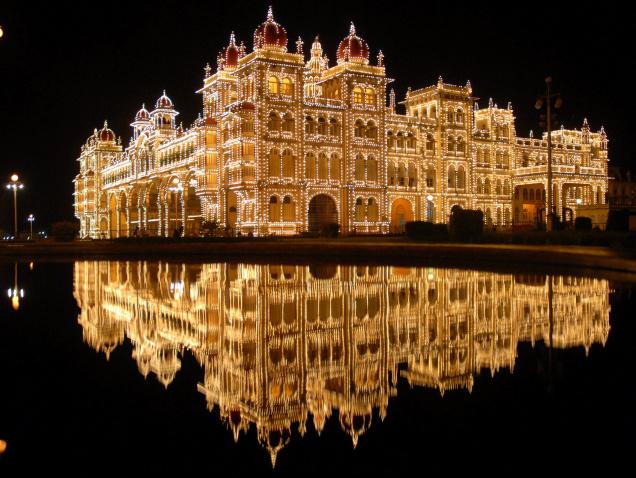
Twilight wonder: The illuminated Mysore Palace. Photo: M.A.Sriram

Magnificent and historical, the Mysore Palace is protected by the Karnataka Archaeology Department. The royal residence would mark a century next year.

Reckoned to be the most popular monument in the country after the Taj Mahal (in terms of the number of visitors), the Mysore Palace draws close to three million tourists every year and the numbers are increasing.

Constructed to house the royal family of Mysore as the earlier wooden palace was ravaged and destroyed in a fire in 1897, the existing palace will complete 100 years in 2012 to mark which the State Archaeology Department plans to have a series of events and have it declared as a protected monument.

There are references to the maharajas of Mysore living in a palace in some of the texts belonging to the Mysore royal family such as Srimanmaharajaravara vamsavalli (annals of the Mysore Royal Family) while a description of the wooden palace has been provided in the Mysore Gazetteer, which notes that it was a constructed in the Hindu style with little or no trace of European influence, according to Dr. M.S. Nagaraja Rao, the former Director General of Archaeological Survey of India, and who has authored a book on the Mysore Palace for the benefit of tourists.

But it is the new palace whose construction started in October 1897 and was completed in 1912 that beckons the tourists and beggars description. It was designed by Henry Irwin who was the consulting architect of the Government of Madras and also went on to design the Viceregal Lodge at Simla.

The palace is an example of the Indo-Saracenic style of architecture and is a three-storeyed structure whose façade comprises nine impressive arches — three on each side flanking the giant central arch that is supported by two smaller arches.

The central portion has a dome that towers to a height of 145 feet and the entire palace facing east, is surrounded by a fort. The main gate of the Fort leading to the palace is Jayamartanda Gate which is massive in proportion and is sublime despite its size.

As one walks into the interiors, the visitors are ushered into the Kalyana Mantapa which is embellished with 26 murals capturing the glory of Mysore Dasara, and further on the visitors enter the durbar hall called the diwan-e-aam which is about 155 feet in length and 42 feet wide.

The Diwan-e-khas is also called Amba Vilas and is lavishly embellished with inlay work, intricately carved designs filled with ivory. The then Maharaja Krishnaraja Wadiyar IV who reigned from 1902 to 1940 entrusted the responsibility of beautifying the Amba Vilas section to the renowned artist K. Venkatappa, according to Nagaraja Rao.

The palace has an impressive collection of objects of art including the model of the original wooden palace but the most famous of the exhibits is the golden throne and the golden howdah. The golden throne is, however, not open to the public throughout the year and is exhibited only during the Dasara. In addition, there is the armoury containing an exhaustive collection of weapons of the ancient and the medieval times but this is not open to the public at present.

In view of its magnificence the palace is a must-see in the tourists’ itinerary and for those who wish to savour its grandeur, the official website www.mysorepalace.tv provides a 360 degree panoramic images to whet the appetite.

The Mysore Palace is illuminated on Saturdays, Sundays and during public holidays and presents a majestic sight like no other. The palace is embedded with 96,000 to 100,000 bulbs for the illumination purpose and was installed in the early 1920s, according to the palace authorities. The cost of illuminating the palace for one hour is about Rs. 25,000 to Rs. 30,000 at the current power tariff.

The throne

The golden throne which is exhibited only during the Dasara, is among the prized possessions of the Palace. Its origins are steeped in mystery and there are beliefs that the golden throne belonged to the Pandavas and it was Vidyaranya — the preceptor of Harihara I, one of the founders of the Vijayanagar empire in the 14th century A.D. — who retrieved it from Penugonda in Andhra Pradesh. It passed on from the rulers of Vijayanagar to the Wadiyars who were the feudatories of the Vijayanagar rulers. There is another theory that it was gifted by the Mughal Emperor Aurangazeb to Chikkadevaraja in 1700 A.D.

Fort gates

Of all the gates to the fort surrounding the palace, the Jayamartanda Gate is architecturally sublime. The central arch is about 60 feet in height and has a width of 45 feet. Made of concrete and granite, it provides a panoramic view of the front portion of the palace. The other gates are named as Balarama, Jayarama, Brahmapuri, Karikal Thoti and Varaha.

source: http://www.thehindu.com / Life & Style> Kids / by R KrishnaKumar / November 28th, 2011


Guv presents ‘Prathibha Puraskar’ to Mysore city skater

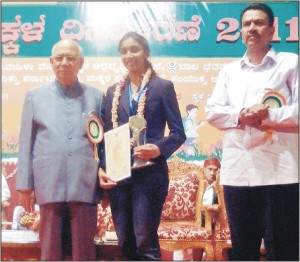
City skater Reethu Dinesh seen with Governor H.R. Bhardwaj and Women and Child Welfare Minister C.C. Patil in Bangalore yesterday.


Mysore:

City skater Reethu Dinesh received the State-level Prathibha Puraskar in sports category (multi-talended) by Governor H.R. Bhardwaj at a function organised by the Women and Child Welfare Department as part of Children’s Day at Bal Bhavan in Bangalore yesterday.

A 10th std. student of JSS Public School in Siddartha Layout, Reethu is the first artiste to have performed Bhara-tanatya Rangapravesha on skates.

She secured 7th position in the 14th Asian Roller Skating Championship held at Kaohsiung Chinese Taipei in July 2010. She also won two silver medals in Asian ice skating championship at Taipei, Taiwan during Oct. 2007.

She is the daughter of R.N. Dinesh, a resident of Siddhartha Layout in city.

source: http://www.starofmysore.com / General News / November 15th, 2011


Innovative PHOTO EXPO Opens


Caption: Sculptor and founder of Mysore Art Gallery L. Shivalingappa is seen explaining about the photographs on display at the Gallery yesterday as Heritage Dept. Deputy Director Dr. J.V. Gayatri, Show Organiser S.F. Husseni, Theatrist Narayan Kikkeri and artist Jamuna Rani Mirle look on.

Mysore:

An innovative exhibition of over 5,000 photographs of colour formation of light diffracted off the surface of a waste Compact Disc (CD) titled ‘Amoorth’ opened at Mysore Art Gallery at 12th Cross on Ramanuja Road here yesterday.

Artist and photographer S.F. Husseni has come up with this unique expo which is open from 11 am onwards and concludes on Nov. 15.

Husseni, a native of Mysore intends to organise the unique photo expo in other cities during the coming days to showcase the art.

Journalist Ravindra Bhat pointed out that Husseni had come out with a new concept which triggered the imagination of the viewers.

Heritage Deputy Director Dr. J.V. Gayatri, Theatrist Narayan Kikkeri, Artistes Basavannachar, L.S.N. Achar, Vijayalakshmi, Sundaresh, L. Shivalingappa and others were present.

source: http://www.starofmysore.com / General News /November 12th, 2011


Shabbir and Prathima triumph

Shabbir Dhankot of Tamil Nadu and Karnataka’s Prathima Hegde held their nerve to emerge champions in the Aircel 23rd National Tenpin bowling championship at the StarCity Centre here on Sunday.

ALL SMILES: Shabbir Dhankot and Prathima Hegde winners of the National Tenspin bowling championship.      The Hindu

Defending champion Shabbir handled the pressure better than Aakash Ashok Kumar of Karnataka in the two-game final, each played on short and long oil, to clinch the title by a mere eight points.

Aakash matched Shabbir initially before a ‘gutter ball’ saw him finish 11 points short of Shabbir’s 190 at the end of the first game. In the second, Shabbir upped his strike percentage and even had a ‘turkey’ to finish at 213, leaving Aakash the tough task of getting a ‘double.’

After a strike, Aakash managed only nine pinfalls to fall short by eight points.

With this victory, Shabbir became the second player to successfully defend his title in the history of the National championship. Karnataka’s Vijay Punjabi achieved the feat in 2007 and 2008.

The women’s final was equally exciting. Prathima trailed by 59 pinfalls after the first game against Tamil Nadu’s Sabeena Saleem, played on long oil. However, she turned things around in short oil to register a narrow win and claim the title.

After trailing 146-205 in the first game, Prathima, with a turkey and a double, tallied a high score of 233. Sabeena needed a double in the last frame but managed only a strike and a five.

Earlier, Shabbir beat Delhi’s Vikesh Veer Jain 423-335 to reach the final. In the Eliminator, Akaash got the better of fellow State player Huned Khokhar 435-385. He then proceeded to defeat Vikesh 436-403 in the second qualifier.

In the women’s section, Prathima beat Sabeena 397-320 to reach the final. In the Eliminator, Delhi’s Anuradha Sarda eased past Maharashtra’s Nicole Campbell 383-304.

The second qualifier saw Sabeena winning a cliffhanger 318-317 against Anuradha.

source: http://www.thehindu.com / Sport> Special Sports / by Special Correspondent / Bangalore, November 13th, 2011


First animated children’s film in Kannada

Bangalore:
It’s November 14 again, but this year’s Children’s Day promises something different for those in the State. ‘Chintu’s Skool,’ the first animated film in Kannada for children, will be screened at the 17th edition of the International Children’s Film Festival which begins in Hyderabad on Monday.

Produced by Kolors n Motion Studios Pvt Ltd, in association with Shree Mahalakshmi Combines, the film tries to bring about social transformation via animation.

Says Sheshagiri Yelameli, a documentary maker and the director of the film: “We have used elements of magic and fantasy with the underlying message that by teaching others, education can be made accessible to all classes of society. Mahatma Gandhi, Swami Vivekananda and even actors Shivarajkumar and Upendra come in their animated forms, showing children that hard work is the key to success.”

Anand Kidambi of Kolors n Motion says the film will be screened for the first time in Karnataka at the JSS Mutt, Suttur, on Monday to around 3,500 children in the Mutt’s state-of-the-art auditorium.

Theatreperson, singer and Rajya Sabha member B Jayashree is the chief guest. This will be followed by shows at Eeshwari and Srinivasa theatres in Bangalore the next day. Made entirely in the studios of Bangalore with more than 30 BFA and DFA holders from Davangere, Gadag and the City working on it, ‘Chintu’s Skool’ has music by V Manohar, lyrics by M N Vyasarao.

Actor Ramesh Arvind and others have lent their voices to the characters.   The producers plan to take the film to schools across the State soon. For more details, contact info@kolorsnmotion.com

source: http://www.deccanherald.com / Home> Entertainment / DHNS / Bangalore /  November 13th, 2011

KIMS – the First Hospital to do Robotic Colorectal Surgery in India

Though there are four Robos in India (Delhi, Mumbai, Bangalore and Hyderabad), KIMS is the first in the country to use robotics help to do surgery.

Surgeons at KIMS performed a rare surgery called robotic colorectal surgery, for the first time in India. The surgical team comprised Dr Surya Nalamati, Senior Surgeon, Henry Ford Hospital, Detroit US; Dr M BV Prasad, Consultant Surgical Gastro Enterologist; Dr Ravichander, Surgical Oncologist; Dr Lakshmikanth, Surgical Gastro Enterologist of KIMS Hospital. The procedures were of two to three hours duration.

Robotic colorectal surgery benefits the patient immensely. They benefit from a much smaller surgical incision, which leads to less pain and a shorter recovery time. Most common patient benefits include: significantly less pain during recovery, less blood loss during surgery, less complications during surgery, less scarring after surgery, shorter hospital stay, a quicker return to work and daily activities, often better clinical outcomes, preserves sexual function, preserves bladder control and higher quality of life after surgery. Thus, robotic colorectal surgery is the most upcoming branch in the medical treatment. More than 10,000 procedures have been reported across the globe in the last 10 years, since robotic assisted surgeries were introduced.

Robotics-assisted surgery has several advantages. One of the most important advantage is that the incisions made during surgery are tiny and hence the recovery from surgery is extremely quick. Fast healing time is a hallmark of this surgery. Rapid recovery from surgery is not only better for the patient, but it is also less expensive for society. Some other advantages of robotic surgery are precision, miniaturisation, decreased blood loss, less pain and lesser hospital stay. The surgery can be conducted quickly and safely with negligible blood loss.

KIMS had initiated a drive in June 2011 urging the use of robot-assisted technology, in a bid to help and save patients suffering from plethora of problems like urology (prostate, kidney, and urinary bladder) and gynaecology surgeries. They had also recommended it for other specialties such as ENT, cardiac surgery, gastro intestinal surgery and liver resections.

EH News Bureau

source: http://www.expresshealthcare.in / Home> Market> Article / November 2011


New Mangalore Port Handles Record Containers in a Single Voyage

Media Release

Mangalore, Nov 14:

A record qty of 1512 TEUs  handled at New Mangalore Port  in a single voyage in the container vessel- M.V. TAMPABAY  which called at the Port on 9-11-2011.  This is the highest number of containers ever handled at the port from a single voyage surpassing the  earlier record of 1436 TEUs handled on 3-7-2009 from the vessel M.V. ELBE TRADER.  Out of the total 1512 TEUs, 934 were imports and 578 exports.  Major items of import are raw cashew and export consists of coffee, cashew kernels, fish and fish products, candles, etc. M/s Atlantic Shipping are the Feeder Line Operators and M/s Delta Infralogistcs Pvt. Ltd.(HML) the agents of the vessel.

Chairman Dr. P. Tamilvanan has stated that the port is witnessing steady growth in container traffic thanks to the pro-active marketing efforts made by the Port management coupled with the infrastructure addition created during the past few years like expansion of container yards, container handling equipments like reach stackers, increased number of reefer plug points, concretization of roads, simplified documentation system etc.  This has yielded positive results in fostering the container movement to the port from the hinterland which is evident from the fact that from 9646 TEUs handled in 2005-06, it has grown to 40,158 TEUs in 2010-11.  During the current year 2011-12(as on date) 30,454 TEUs handled as against 25,709 TEUs handled during the corresponding period of previous year.

Container traffic at NMPT got a shot in the arm when the first consignment of 40 feet container with Garments/Linen exported through New Mangalore Port on 7-3-2011 in the container vessel M.V. OEL TRUST.  The consignment of 4237 packets of cotton processed garments/linen produced at the Hassan SEZ by M/s Himatsingka Seida Ltd.  has been exported to USA.  This is for the first time garments are handled at the Port.  The Mainline operators are M/s CMA CGM and the handling agents M/s Cargolinks. The total transit time will be 28 days.

Shri P. Tamilvanan, Chairman has attributed the handling of this new cargo, hitherto moving through neighbouring ports, to the pro-active marketing efforts  made by the Port  at various locations of the hinterland during the last few years coupled with the Infrastructure additions made for the smooth handling of containers.  He has added that the above garment unit , which is a 100% export oriented one  is expected to move their entire consignment of export to the tune of 25 TEUs per month through New Mangalore Port.   The container traffic at the Port has crossed 36000 TEUs during the current year(as on date) with a growth rate of 27%.

source: http://www.daijiworld.com / Monday, November 14th, 2011