A towering figure in the world of letters, Udupi Rajagopalacharya Ananthamurthy, who died on Friday, was modern in his sensibilities and intellectual underpinnings in his literary works questioned many deeply-held beliefs.
Like his literary works, Ananthamurthy’s strong political views were also striking, often landing him in unseemly situations and controversies. A multi-faceted personality and rated as one of the best writers in the country, 82-year old Ananthamurthy has won acclaim from critics and fans alike.
In his literary life, the Kannada writer has won the Padma Bhushan in 1998, Jnanpith award in 1994, the state Rajyothsava award in 1984, while his nomination for the 2013 Man Booker International Prize brought him to the attention of a Western audience. He was also the Vice-Chancellor of Mahatma Gandhi University in Kerala during late 1980s.
A socialist in political belief, he also tried to dabble in politics contesting the Lok Sabha and Rajya elections once each unsuccessfully and courted controversies quite often with his views that generally were against BJP and Sangh Parivar.
At the height of the recent Lok Sabha poll campaign, Ananthamurthy had said he would leave the country if Narendra Modi becomes Prime Minister but later did a U-turn, saying the remark was made when he was overcome by emotion.
“That was too much to say because I can’t go anywhere except India,” he had said but his remarks had raised the hackles of BJP and many others who questioned his “intolerant” attitude and disrespect towards a possible popular mandate in favour of Modi.
Ananthamurthy had said if Modi comes to power it may result in a “shift in our civilisation.” “I have a feeling that we may slowly lose our democratic rights or civil rights when there is a bully. But much more than that when there is a bully we become cowards.”
source: http://www.indianexpress.com / The Indian Express / Home> India> India-Others / Press Trust of India, Bangalore / August 22nd, 2014
Aliyeh Rizvi used to run a niche design store called Native Place many years ago. It encapsulated her love for handcrafted traditions, nostalgia and fading remnants of culture. She took to passionate blogging subsequently to revisit everything that Bangalore stands for. Native Place no longer exists as a physical space but it is now a “collaborative mind space that works to build awareness of Bangalore’s local history and culture through curated experiences, travel writing and city based collaterals. It explores ways in which information can be used to create meaning and build a deeper connect.”
In a chat with City Express, she talks about the many projects she has undertaken to keep the memory of a genteel city alive that is now being overtaken by change at every level.
Poignant memories
The best memories I have are of Bangalore’s trees and gardens, and a life lived among them. Avenues were awash with different colours all through the year, jacaranda petals fell on our shoulders as we passed. Large family picnics were organised in Cubbon Park and Lalbagh when the weather was good. I miss the beautiful bungalows that had lovely large gardens: fruits, flowers and scented plants. I miss the Queen of the Night that bloomed after sunset, scenting an entire lane with its fragrance. We made passion fruit juice and gooseberry jam from our own fruit trees and compound walls had moss! Which means it was traditionally a cold, damp climate where early morning baths were always accompanied by shivering!
A Turquoise Cloud
I blog and write offline about the Bangalore I grew up in, to save it from vanishing. The city is my home and I am rooted in it. My blog, A Turquoise Cloud, is an archive of information and stories about local culture, city people and our symbolic spaces. The city I grew up with was being knocked down rapidly and it was becoming increasingly difficult to connect with it physically. Houses I had played in were now hi-rise buildings. The local grocery store I stopped at for sweets after school had disappeared. Trees were cut down, roads had changed. Streetscapes in the city were altered forever. I felt a terrible sense of displacement in my own hometown. I could not recognise or identify with it anymore.
That’s why we old Bangaloreans spend so much time in sentimental nostalgia and B&W photographs. It’s our only way of coping with loss.
So where does one go to find this other Bangalore? I chose to recreate it online, where it can stay virtually untouched. ATC is a space where I create a context for the present through memories, images and stories of the city. I choose to focus on the present, by giving it a meaning through the past.
historical connect
One of my most memorable projects was as Curator, Centre for Public History, Srishti School of Art Design and Technology where I co-facilitated a successful Public History Project titled ‘The Tiger Comes to Town’ to commemorate the 150th anniversary of the Archaeological Survey of India. The focus was the Bangalore Fort in Bangalore’s busy Kalasipalayam area and its role in local history during the 18th Sultanate, the time of Tipu Sultan, and the Third Anglo-Mysore War of 1791.
It aimed to reconnect the public with their local heritage sites through deeper engagement, build awareness and instil pride in the same. It combined elements from oral history, design, academic enquiry and performance so students could look at multiple ways to engage with the site during the course of the project. The outcome was a true city project in more ways than one.
breakfast specials
One of my most popular posts was the Bangalore Breakfast Special, since the and the eating out-breakfast tradition is so unique to our city. I wrote that Bangaloreans love their breakfast and discuss it intensely.
Replies flooded in with suggestions to try other favourite joints, NRIs posted with intense nostalgia for iconic restaurants mentioned, more discussions about food happened, vows to visit, and even arguments over the best idlis-and dosas! Like I said, we are obsessed with our tiffin! It is always wonderful when people write in with comments and stories of their own, volunteer to share information and photographs.
We also have a page on Facebook for daily interactions and information. The blog allows you to access information by usage (eat, breathe, know) and geography (north, south, east). All posts are research intensive and constructed to provide comprehensive information, painstakingly collected, in one place.
It often takes days to track down information, locate people or join the dots, but it has to be done. In this space, I can now see the Bangalore I know and love.
Back to Native Place
Native Place is the seed of an idea which will hopefully grow into a larger organisation where people interested in the city can work together on creating new formats for city history and culture based projects- through documentation, interactions, performance and information based collateral.
Perhaps knowing a little more will build a relationship, create protectiveness and then generate the ownership we require so badly right now. Our website will be up soon and city based activities will hopefully start with the onset of the festive season.
source: http://www.newindianexpress.com / The New Indian Express / Home> Cities> Bangalore / by Express News Service / August 19th, 2014
M.S. Subbanna, Assistant Sub-Inspector (ASI), City Armed Reserve (CAR) Police has won the CM’s Vishist Seva Medal for the year 2014.
Currently, Subbanna is serving the Chamundi Commando Force. He is the son of M.V. Subbajetty and Rangamma of city. He joined Police service on Jan. 31, 1977 and has served in Palace Security and at MM Hills. The coveted honour has been bestowed on him in recognition of his honest and good service.
source: http://www.starofmysore.com / Star of Mysore / Home> General News / August 17th, 2014
Alternative form of medicine with Chinese origins gets its own association for promotion
Cupping therapy, an alternative form of medicine with Chinese origins, is trying to find its space in the city. The International Cupping Association of India was officially inaugurated on Tuesday, and Dr Badruzzama Nadeem, a practising Unani physician who is the moving force behind it, has plans to take it to Chennai, Bhubaneswar, and Patna by the end of next month.
Cupping is an ancient practice where heated cup-like devices are used to create suctions on the skin. These suctions are believed by practitioners to not only detox the body but also help relieve pain in the spinal cord, neck, and shoulder region.
Dr Nadeem explained, “When suction is applied, blood from a radius of three centimetres from where the cup is placed is sucked into the bump.” Practitioners believe that ‘impure blood’ gets collected in one place and blood circulation gets better once the cup is released. They also hold that the method detoxifies the body.
Cupping can be broadly classified into two types — dry and wet. While dry cupping is practised using suction cups made of silicone, rubber, or fibre where the air is sucked out, wet cupping follows the same process except for the little incision made in the bump for ‘impure blood’ to trickle out — a procedure known as controlled bleeding.
A third form of cupping is fire cupping. Here, a cotton ball is soaked in 70 percent alcohol which is then held by a pair of forceps and lit. The lit cotton ball is then placed into the cup and removed as soon as it is placed. Practitioners say the process removes oxygen from inside the cup. It is then placed on the skin quickly to create a small amount of suction as the hot air inside the cup cools.
Dr. Nadeem founded the association, which was inaugurated by Health Minister UT Khader, in a bid to increase awareness. “At the moment there are not more than 65 practitioners in Bangalore,” he said.
INEXPENSIVE, AND HOT
Cupping as an alternate form of therapy is yet to catch on in Bangalore, despite being inexpensive. Treatments can rangeanywhere from Rs 100 to Rs 500 for dry cupping. “Since wet cupping requires experts, it can range from Rs 200 to Rs 1,500. At the moment we get six to seven patients a day, most of them due to word of mouth,” explained Dr Nadeem.
source: http://www.bangaloremirror.com / Bangalore Mirror / Home> Bangalore> Others / by Tapasya Mitra Mazumder, Bangalore Mirror Bureau / August 20th, 2014
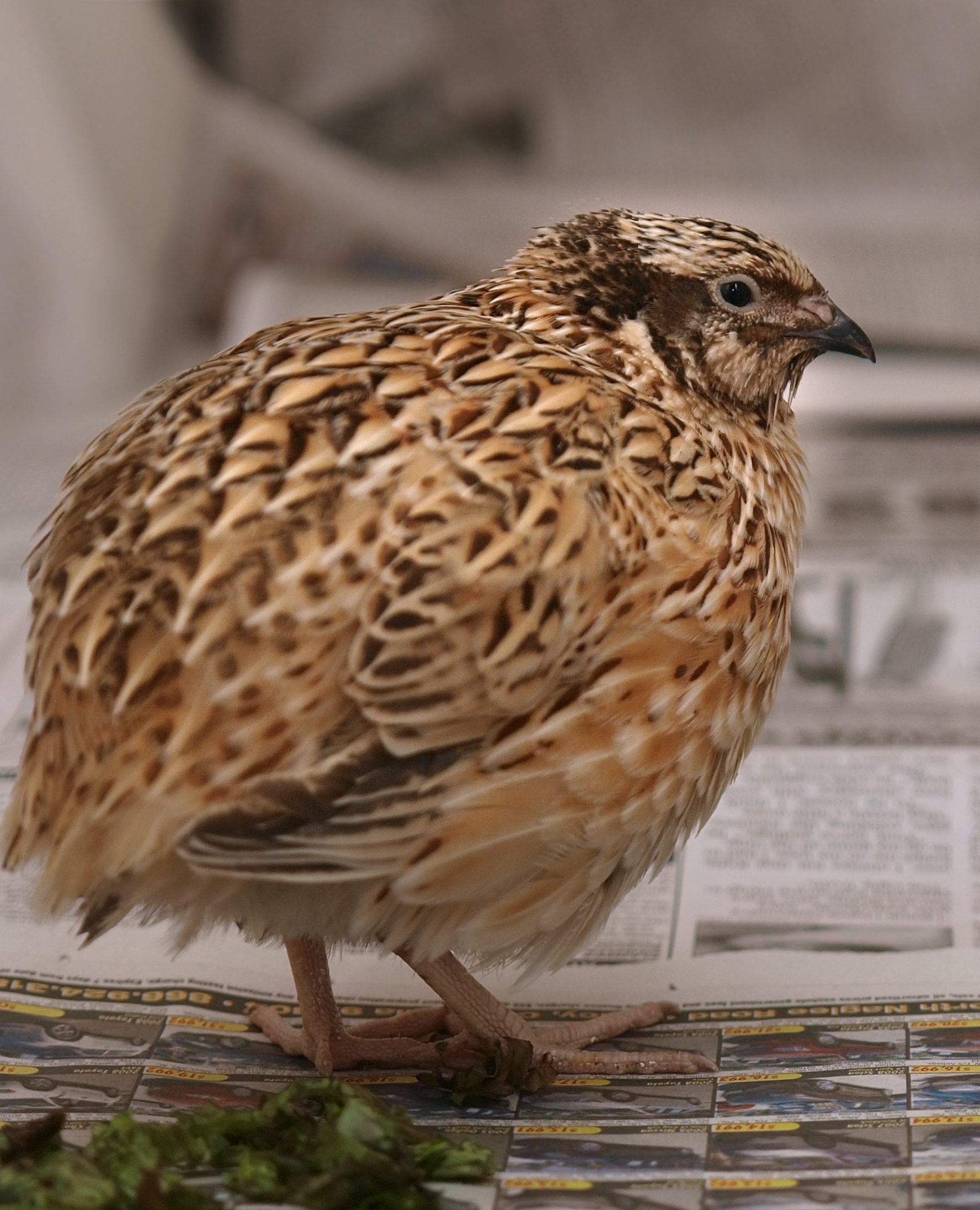
It’s official. Rearing and selling Japanese quails is not illegal in the state anymore. The state government has lifted a three-year-old ban, after a recent directive from the Centre removed Japanese quail from schedule IV of The Indian Wildlife Protection Act (TIWPA). Till recently, the state forest department not only prohibited rearing and selling the bird, but also booked those who sold it. All this even as neighbouring Tamil Nadu allowed Japanese quail farming, including farming and trading.
Demand is high for quail meat and eggs / Photo: en.wikipedia.org
But with the Centre’s directive in July, followed by the state’s order withdrawing the prohibition in August, it’s hoped that the long prevailing confusion over Japanese quail among breeders, wildlife volunteers, and pet traders will finally come to an end.
Farming and trading in Japanese quail (known as gowjala hakki locally) was in disarray as forest officials, as well as the forest department’s investigative cell, constantly raided outlets selling meat and eggs, both of which are in demand. Not stopping there, even those who brought Japanese quails and their eggs from neighbouring states were booked by forest sleuths here. Traders faced repeated harassment in the form of stock seizures and booking of cases under various sections of TIWPA.
NO LICENCE REQUIRED
The sleuths had justified their actions based on a September 2011 directive from the Centre, which asked state governments not to issue fresh licences either for Japanese quail farming or to expand existing facilities. The directive had cited the inclusion of Japanese quail in schedule IV of TIWPA.
As a result, thousands of people who wanted to set up quail farms in the state, as well as retailers who wanted to sell quail eggs, found their applications in limbo. The new order has dismantled the licensing system.
State Forest Department brass confirmed that there is no more need for a licence, which was mandatory till recently. Chief Wildlife Warden and Principal Chief Conservator of Forests (PCCF), Karnataka, Vinay Luthra, told Bangalore Mirror: “Japanese quail has been removed from all the schedules of TIWPA. Henceforth, no prior permission is needed to rear or trade in it. There is no need for a licence either.”
Rearing and selling Japanese quail will henceforth be hassle-free in the state, experts said. “Definitely this order is a boon to this sector. Quail is a very good bird to rear as poultry. The demand for Japanese quail meat and egg is high, and the trade has scope for expansion. With the ban gone, hatcheries will get eggs and chicks without any trouble,” said Prakash Sannamani, a doctorate holder and specialist in Japanese quail.
source: http://www.bangaloremirror.com / Bangalore Mirror / Home> Bangalore> Others / by Chetan R, Bangalore Mirror Bureau / August 21st, 2014
Bellur Krishnamachar Sundaraja Iyengar may never have become a famed global yoga guru, had he been attentive in his English class. Iyengar, who failed his English exam in class 10, didn’t go on to college; he took up yoga.
On Wednesday, the tiny village of Bellur in Kolar district of Karnataka, with a population of around 1,000, paid homage to the man who was born here 96 years ago. As news of BKS Iyengar’s death spread in the morning, the village folk assembled in front of the grama panchayat building in tribute.
The Brahmin boy from this dusty village had to move to Bangalore at the age of six for a formal education, as the nearest school was 20km away. This had always rankled Iyengar, who would tell his scores of disciples that all children should have a proper education.
VS Nagesh, principal of Ramamani Sundaraja Iyengar Composite Junior College, told TOI that had BKS passed his SSC examination, he would have gone on to college and maybe opted for a government job. “In that case, yoga would not have reached the rest of the world,” said Nagesh.
BKS had always dreamt of developing Bellur as a global yoga centre, and was working out the modalities, helped by his elder daughter and lone son, who have also taken up yoga.
A frequent visitor to Bellur, he was here last April for the 150th ceremony of his late father and took part in the Anna Santharpane. He spent a couple of weeks at the village, said Govindarajalu, administrator of the trust running his institutions. Former Prime Minister HD Deve Gowda met Iyengar here in May and learnt a few yoga lessons from the master.
His youngest daughter, BJS Savitha Raghu, who lives in Bangalore, said it was her father’s dream to provide a good education and healthcare facilities to children. This led to a primary school in Bellur, started in 1967 in memory of his parents. A high school was started in 2005 for his wife Ramamani, and today, the Bellur Krishnamachar Seshamma Smaraka Nidhi Trust runs the Ramamani Sundaraja Iyengar College.
The Trust has also set up a charitable hospital, taken up renovation of temples and other developmental activities.
BKS leaves behind six children and thousands of disciples across the globe. Family insiders say the deaths of two of his sons-in-law in the span of a year may have affected his health.
source: http://www.timesofindia.indiatimes.com / The Times of India / Home> City> Bangalore / TNN / August 21st, 2014
The aircraft lands on a narrow piece of land that leads straight to a valley. And that valley was where an ill-fated aircraft had crashed a few years ago. That is all I could think of during my descent into Mangalore. I held onto to the sides of the chair and hoped that I would live. It was a smooth landing and for once I was grateful for that sharp brake. Once out of the airport, I caught a cab and headed out to the hotel.
But I wasn’t ready for what was coming next. On steep roads, swirling down the hill was like going down a softie curl. And then my first glimpse of the glimmering city. It looked beautiful.. laid out in front of me like a carpet of twinkling lights. I passed by a group of people – a large family with adults and children. I wondered what they were doing so far from the city at 9.30 pm, and then I saw a plane in the distance. It made sense. With heads lifted and upturned faces, they watched the flight come closer and got their fix of the day.
And that got me thinking about Mangalore. In my first 30 minutes here, I had moved from extreme fear to delight to warm-fuzziness. It had a small-town quality that made me wish for more.
Historically Mangalore is grand, Tipu Sultan had been here. It has had an important place in history. But what had happened to it now? Was it just another mid-sized city, now? I didn’t associate it with the grandeur of a big city or a city that had dynasties fighting for it. I associated Mangalore with crime and communal tensions, and that was all I knew about it. But surely Mangalore is much more than that.
The next morning, with just four hours before I made my way to Kasargode, the actual destination of the holiday, plans had to be remade. Maps were scrutinised and the reception lady thoroughly grilled. The plan was finalised- the day would include Sultan Battery, the College Chapel, the Mangaladevi temple and a stop at Ideal Cafe since everyone was raving about it.
The driver of my car was not from Mangalore. He had no clue where Sultan Battery was. He tried asking local people who didn’t seem to be very clear either, but were aggravated that I did not know how to pronounce the word ‘battery.’
Then Google Maps came to the rescue. On the way, Mangalore refused to let me get surly by tempting me with vistas of green spaces and simple but beautiful houses.
Sultan Battery is situated on a bend along a river as it snakes through to the sea. It seemed to have a very strategic position, overlooking both sides of the river. Built by Tipu Sultan, this was a watch-tower to see if anyone was crossing the river and coming over with dark intentions.
Built with black basalt rocks, with viewing holes lining the entire wall, the structure seemed almost too simple in today’s complex understanding of war and defence. But then you put on the perspective of more than 200 years ago, and it seems that the location was indeed perfect for the purpose.
With every dynasty’s uprise, there is growth and also destruction of legacies. Legend has it that the rocks used to build this watchtower could have come from places of worship though no one knows for sure.
There were a few ships next to the river and we decided to go and take a look. It was a ship-building yard. It took them three months of hard work to make just one ship and then she took off, to prove herself worthy of the toil.
I watched the imposing Vajralaxmi enter the water for the first time in awe. Though there were some other ships too that looked gorgeous. Funnily these ships looked battle weary even though they were all brand new. These were meant to serve as fishing trawlers and were not built to be gleaming and swanky.
I left Sultan Battery and made my way to the College Chapel. Again, no one knew where it was, and even Google seemed flummoxed this time.
It took me around 20 minutes to find a person who could give me directions. Important note to self: don’t call a chapel just a ‘chapel’, when it’s called ‘College Chapel’.
I got to go on a lovely personal tour courtesy the person-in-charge. The entire place is painted beautifully, and when I say entire… I mean every inch! What looks like marble at first glance is not, it’s art. What seems like a painting on a curtain and hanging on the wall, is also a painting. The illusions go on and on.
It was time for lunch and stomachs were grumbling all around. And so the next destination was Ideal Cafe! The food was okay, nothing exceptional but it was definitely the coolest restaurant in Mangalore and everyone with some time to spare seemed to be there.
The filter coffee that everyone praised was not that great. It had a rough, burnt taste with some of the coffee residue at the base. They say that’s how Turkish coffee tastes, so there might be some who like it.
But if you are someone with a sweet tooth, skip a meal to just have ice-cream at Ideal Café. It was simply fabulous.
The last stop in Mangalore was the Mangaladevi temple. This is the temple that Mangalore is named after, so it had to be seen. A large temple, it was quiet and peaceful all the more as it was shut for the afternoon. We weren’t allowed inside as the Gods were sleeping and so we were asked not to disturb them.
Mangalore was quaint. A neat and clean city that still seems enveloped in the past and happily so, given the rapidly changing face of every city in the country. I wouldn’t say it surprised me, but it didn’t disappoint. It was small, roads were relatively peaceful and the streets were still lined with houses exuding old-world charm.
source: http://www.newindianexpress.com / The New Indian Express / Home> Cities> Mangalore / by Bhavani Blogs / August 21st, 2014
Open your eyes to alternative, energy-efficient technologies
It could be anyone who could be part of this training. From farmers of Anekal wishing to build their own home, to a mason from Uttarakhand or an IT professional trying to understand the effectiveness of using mud.
Starting on Thursday, Gramavidya will conduct a three-day training programme on ‘Alternative and energy-efficient building technologies’ at the Rajiv Gandhi Rural Housing Corporation Koushalya Shaale, Kengeri.
“A cross-section of those interested gather from across the country for the sessions — consisting of lectures, audiovisual presentations, hands-on training and interactive open-house discussions,” says M.R. Yogananda, who has a doctorate in Civil Engineering from IISc., who spearheads the training. Gramavidya, a non-profit society, promoted by a group of professionals and academicians, disseminates building technologies for sustainable livelihoods. The experts are pioneers in construction methods, who have popularised cost-effective technology throughout the country in renowned constructions like the Auroville.
“We need to disseminate as much information as possible. After all, even professionals who pass out of engineering colleges seem to be uninformed about constructions that are quake-resistant. Energy-intensive beam and column structures are not everything. Interactive sessions can re-invent forgotten vernacular approaches,” says Mr. Yogananda, who is also the consulting engineer of Mrinmayee, offering research and lab-testing facilities for stabilised mud-blocks.
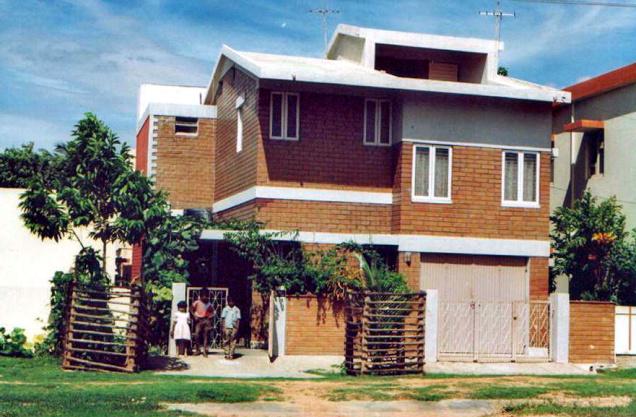
In the mid-1980’s Mr. Yogananda’s house in Jayanagar, built with stabilised mud blocks, became a curious model for people to “wait and test it out in all seasons” as the fear of going in for mud construction was mocked at. No sooner, the house was projected as India’s example of mud revival at the Festival of France in HUDCO’s national seminar. “My house is nearly 30-years-old now, and can go on for generations with its earthy sheen,” says Mr. Yogananda.
For details, 26582970 / 94489 26442 / gramavidya@gmail.com
source: http://www.thehindu.com / The Hindu / Home> News> Cities> Bangalore / by Ranjani Govind / Bangalore – August 21st, 2014
Jaganmohan Palace is one of the Palaces located in Mysore city. The Palace was constructed by Krishnaraja Wadiyar III in 1861 and was the home for the Royal family after the Mysore Palace was burnt down in a fire accident. It has now been converted into an art gallery and a function hall. The Palace is one of the seven Palaces of the Royal City of Mysore and one of the most beautiful contributions of the Wadiyars to the City.
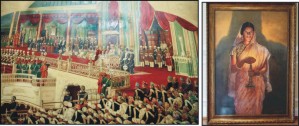
The huge pavilion in front of the Palace was used for holding meetings of the Representative Assembly and the Convocations of the University of Mysore. The installation of Krishnaraja Wadiyar IV took place in this pavilion in 1902 and was attended by Lord Curzon, the then Viceroy and Governor General of India. The Art Gallery houses the prestigious collection of paintings of Raja Ravi Varma, a great artist of Thiruvananthapuram, who had carried out an assignment for Maharaja Krishnaraja Wadiyar IV in 1904.
In 1915, the Palace was converted into an art gallery, which was later renamed in 1955 in the name of Jayachamarajendra Wadiyar, as the Sri Jayachamarajendra Art Gallery. Jayachamarajendra Wadiyar converted the Palace into a trust and opened it for public viewing.
The Palace is built in traditional Hindu style and has three stories. In 1900, an external facade with a hall behind it was added to the Palace. This facade has three entrances and the entablature has religious motifs and miniature temples crafted on it. The walls of the interiors are painted with murals. These mural paintings which follow the traditional style of the Mysore School of painting depict the Dasara scene and the canvas depicting the sequence of the Jumbo Savari stretches across three walls. This mural is the earliest known picture of the Mysore Dasara and has been painted using vegetable dyes. A family tree of the Wadiyars tracing the lineage of the royal family is also painted on a wall. Two wooden displaying Dashavatara, the ten incarnations of Lord Vishnu is also present in the Palace.
The art gallery contains one of the largest collection of artefacts in South India. Most of these artefacts are paintings, prominent among which are those by Raja Ravi Varma, some of which demonstrate scenes from the Hindu epics, Ramayana and Mahabharata. The collection of paintings in the gallery exceed 2000 in number and these belong to different Indian styles of painting like Mysore, Mughal and Shantiniketan. 16 paintings of Raja Ravi Varma were donated to the gallery by Jayachamarajendra Wadiyar. Another important painting present here is the ‘Lady with the Lamp’ which was painted by the artist Haldenkar and is placed in a dark room where it is the only exhibit. This is to give an illusion that the glow of the lamp is illuminating the face of the woman. Some other painters whose works are exhibited here include Nikolai Roerich, Svetoslav Roerich and Rabindranath Tagore. Other exhibits here include weapons of war, musical instruments, sculptures, brass-ware, antiques coins and currencies. Some other uni
que artefacts exhibited here is a French Clock which has a mechanism in which a parade by miniature soldiers is displayed every hour; beating drums mark the seconds and a bugle marks the minute. Paintings made on a grain of rice which can be viewed only through a magnifier are also displayed here.
Jayachamarajendra Art Gallery has collection of several Indian artists and Western artists as well. While, the paintings of Raja Ravi Verma is a delight to art connoisseurs there are also few paintings from western artistes which comes a huge surprise for the visitors.
‘Crucifixion’ by P.P. Rubens and miniature paintings by L.Gunov introduces visitors to the western paintings. The art gallery also houses many Mysore Style Paintings that are visual treat to watch.
A new hall was built in 2003 because there was insufficient space available to exhibit all the paintings. The original paintings of Raja Ravi Varma which are over 100 years old were restored by the Regional Conservation Laboratory (RCL). Syrendri, Victory of Meganath and Malabar Lady were some of the paintings of Ravi Varma that were restored. Even the murals on the walls had been damaged because of water seepage and these were also restored by RCL. The auditorium of Jaganmohan Mohan Palace is also used by organisations for the conducting cultural programmes.
The Jaganmohan Palace is being maintained by Sri Jayachamarajendra Art Gallery Trust which has been working continuously to maintaining the building as well as the artefacts. —VNS
source: http://www.starofmysore.com / Star of Mysore / Home> General News / August 16th, 2014
The Murty siblings have something in common, beyond sharing a famous surname. Rohan Murty and sister Akshata Murty are emerging as ideapreneurs, focusing on business and socially-driven innovation.
Rohan, son of Infosys co-founder NR Narayana Murthy and a junior fellow at Society of Fellows at Harvard University, has extended his sabbatical from Harvard and is looking at some “exciting ideas” in India. Akshata is funding social innovation through Stanford University.
“I am staying put for a few months since Harvard has agree d to hold my position open until January. I have time to decide what I’ll do next. I have a few exciting ideas I’m working on by myself,” he said. Akshata and Rohan own 1.41% and 1.38% in Infosys that translates into Rs 2,920 crore and Rs 2,864 crore respectively.
Murty took leave from Harvard to work as his father’s executive assistant when the Infosys board requested Murthy to return from retirement and lead the company for a second time last year. In the past, Rohan has written several academic papers, including one about an algorithm called Satya that he and two colleagues developed. It allows spectrum owners to sell or sub-lease unused or under-utilized spectrum in a seamless way, ensuring there’s no interference to the owner’s own operation.
Some sources said he’s actively involved in Murthy’s family office Catamaran Ventures which has offices in the US and the UK. More recently, e-commerce behemoth Amazon and Catamaran Ventures floated a joint venture to help small and medium businesses join the online bandwagon. Catamaran holds a majority 51% stake in the venture, Taurus Business and Trade Services.
Catamaran Ventures, a Rs 600 crore fund launched in 2010, has invested in companies like Hector Beverages, Ace Creative Learning, Healthsprings and NRB Bearings in India. More recently, Catamaran Ventures UK bought a stake in UK-based Hallmarq Veterinary Imaging that offers commercial magnetic resonance imaging systems to diagnose equine lameness.
Akshata and her husband Rishi Sunak, who are directors in Catamaran Ventures UK, are supporting social ventures.
Murty and Sunak, who did their MBA from Stanford, have made a substantial gift to support the Center for Social Innovation at the Stanford Graduate School of Business that offers social innovation fellowships to help individuals launch social ventures. Their contribution will fund the centre’s Social Innovation Fellowship programme.
“I come from a family of entrepreneurs – my mother on the social side through the foundation and my father on the corporate side. I was raised with a view that entrepreneurship can change people’s lives,” Akshata was quoted as saying in an article on the Stanford Graduate School of Business website. She’s on the board of trustees of Claremont McKenna College in California and also the founder and CEO of Akshata Designs that produces con temporary women’s clothing.
source: http://www.timesofindia.indiatimes.com / The Times of India /Home> by Shilpa Phadnis, TNN / August 17th, 2014