Tyre manufacturer MRF Limited will provide free rain guarding materials to about 7,500 rubber farmers in Chikkamagaluru, Kodagu, Udupi and Mangaluru.
MRF stated on Monday that they have identified seven cooperative as well as rubber processing societies in the state for implementing this programme.
“With four months of heavy rainfall, marginal farmers in Karnataka are unable to eke out their living by tapping rubber as they are unable to afford rain guarding materials. Seeing their plight, MRF has now stepped in deciding to extend support to such farmers” said a press release.
“We have decided to cover 8,005 hectares of rubber plantations in Karnataka with more than 32 lakh rubber trees for rain guarding this year,” said Arun Mammen, vice chairman and managing director of MRF Limited.
source: http://www.timesofindia.indiatimes.com / The Times of India / News> City News> Bangalore News / by Christin Mathew Philip / April 24th, 2018
This year, they turn 150 with much ceremony, as is their custom and continue to be bearers of the city’s history.
The 150-year anniversary will be marked by celebrations that continue through 2018.
Winston Churchill’s questionable commitment to paying his bills was embedded in the history of Bengaluru after his noteworthy visit to the Bangalore United Services Club in the 1800s. This debt was amply repaid by Prince Charles when he visited the place, by which time the BUS club was known to Bengaluru society as the Bangalore Club.
This year, they turn 150 with much ceremony, as is their custom and continue to be bearers of the city’s history. Much has changed, of course and the club’s architecture is now a fusion of the historic and the contemporary with as elite a membership as ever.
Formerly known as the Bangalore United Services Club, it was formed exclusively for British officers in 1868. The building that became the club house had been constructed in the 1850s. Until then, the club was restricted to the British and it was only after Independence that Indian army men slowly began to use the premises.
“We’re always working to balance the old and the new,” says Mr Girish Punja, President of the Bangalore Club, who walked a battery of media personnel through the property on Tuesday afternoon. The club’s military history still has prominent display, with awards and weapons on display at the Club House. Animal skins and horns pay tribute to the glorious hunting days.
The Burma Bell stands between the Club House and the annexe, another proud piece of history. The stone plaque beside it tells the story of Brigadier Hill, who sold his Polo court and donated the money to the club. The Bell itself is from Burma, where it was struck down by lightning in a temple. “The priests took it to be a bad omen and left it on the streets. Fortunately, it made its way to the club thanks to Brigadier Hill, who brought it here from Madras.” The vineyards in the lawns alongside are 150 years old – this chunk was preserved and re-installed after the walkway was built.
Of course, modernity had to be acknowledged and Bangalore Club installed what is now one of the city’s oldest swimming pools. The Billiards Room, Gym, squash and tennis courts give members the amenities they need, the library contains 20,000 books and periodicals from around the world.
That’s not all. As Bengaluru struggles with water shortages, sewage problems and encroached lake beds, the Club is the model of sustainability. Their sewage treatment plants see to most of their landscaping needs, leaving so much water in excess that the Club administration has considered sharing it with neighbouring buildings. “It has a capacity of 60,000 litres,” says Mr Punja.
“Neighbours have asked us to share this water with them but our gardeners say it can be used to convert concrete surfaces in the club house into lawns. The gardens are a prized possession and are declared winners every year by the Lalbagh Horticultural Society.
The 150-year anniversary will be marked by celebrations that continue through 2018.
source: http://www.deccanchronicle. com / Deccan Chronicle / Home> Nation> In Other News / Deccan Chronicle / April 18th, 2018
Bengaluru’s Kempegowda International Airport | Pic courtesy: BIAL
For runners of marathons and other such racing events, the prospect of running on a smooth and endlessly flat airport runway is incredibly tantalising. In fact, there are airports in the United States which allow their airfields to be turned into racing tracks surrounded by family and friends cheering loudly from the sidelines. JFK has an annual fundraiser called “Run on the Runway” where an active runway hosts a 5K race by holding off landing and take-offs for a few hours and diverting all airplanes to a secondary runaway on the day of the event.
Now runners in India too can gloat about racing on the runways. If all goes according to plan, Bengaluru’s Kempegowda International Airport will be the first-ever Indian airport to host a 10K run on May 8, as part of its 10th year anniversary celebrations. Organised by Bangalore International Airport Limited (BIAL), the Runway 10K is open to all adults, although they will be required to submit details of their “past accolades” at the time of registration, so that serious runners are given preference. Entries will be accepted till April 30 and the racing event will only allow a total of 100 participants. The race starts at 12:45pm and ends at 2:15pm.
An initiative like this is likely to generate a barrage of inquiries. To begin with, this is not a marathon run, affirms a BIAL spokesperson. “It’s a 10K race and it’s going to be done on an active runway. It will take place on a Tuesday afternoon which is when our airport is closed for its weekly scheduled maintenance,” says the spokesperson. Frequent fliers to and from the city will know that every Tuesday, the Bengaluru airport is closed between 12:30 and 3pm for maintenance and clean-up, and flights are not scheduled in this time period.
The airport has the DGCA approval for this run. Special airport entry passes will be handed out to selected participants only, and because this isn’t a spectator event, the highly secure zone will not permit family and friends of the chosen runners.
Can the victors look forward to any prizes? “Not really. It is basically about the joy of being associated with a run like this, because it’s never happened before (in India). It’s just aspirational to be a part of it. Because the airport is restricted to people who are travelling, this gives us an opportunity to open up to others as well,” says the spokesperson.
source: http://www.theweek.com / The Week / Home> Leisure> Lifestyle / by Sneha Bhura / April 24th, 2018
One of Bengaluru’s most well-known saxophonists, Raman is all set to perform this week in the city.
Raman has recorded and toured with many international and national artistes like Fleetwood Mac’s Jeremy Spencer, Vision Authentique, Jazz revivals, Chronic Blues, Tribal Chaos, East West encounter and more.
He is known for jazz, Indo, retro and Bollywood music and has a solo set up where he mixes his sax with his own electronic music and has people listening, singing along and dancing the night away.
Watch him perform at 1Q1 on April 25, 8 pm.
source: http://www.timesofindia.indiatimes.com / The Times of India / News> Entertainment> Kannada> Music / April 22nd, 2018
Arun Kumar (second from right) with his mother Manjula, father Shivanna, and Akshay Rao of Sankalpa Gopalswamy College.
S. Arun Kumar of Sankalpa Gopalaswamy College in the city, who is awaiting his II PUC results, is the son of Shivanna, a banana seller at Nanjumalige Circle, and Manjula, a daily wager.
A II PUC student from a humble background has done his parents and teachers proud by qualifying in the Kishore Vaigyanik Protsahan Yojana (KVPY).
KVPY is an ongoing National Programme of Fellowship in Basic Sciences initiated and funded by the Department of Science and Technology, Government of India, to attract highly motivated students to pursue basic science courses and research in science.
S. Arun Kumar of Sankalpa Gopalaswamy College in the city, who is awaiting his II PUC results, is the son of Shivanna, a banana seller at Nanjumalige Circle, and Manjula, a daily wager.
He was brilliant
“We found that he was brilliant and put him through competitive examination coaching conducted by a dedicated cell in our college to train students. And he excelled,” said Akshay Rao, Academic-in-charge in the college.
Based on his performance, Arun is expected to get admission at IISc. based on merit. He will pursue an integrated pure science course leading to a PG. During the course of his study, he will receive scholarship which will be enhanced periodically till the completion of his postgraduation, according to Mr.Rao.
Apart from Arun, two other students – Riya Pearl Menezes and A. Akanksh Manjunath – from the same college have also cleared the KVPY exam and interview by a panel of top scientists at IISc. The college authorities are confident that they will easily make it to either IISc. or Indian Institute of Science Education and Research (IISER)
“The best and the brilliant minds are opting for professional courses. Hence, the government has introduced this scholarship programme to draw young minds to pursue pure science courses. This will ensure the growth of best scientific minds to undertake research and development for the country. Arun Kumar, Riya and Akanksh have proved their potential,” Mr. Rao said.
source: http://www.thehindu.com / The Hindu / Home> News> States> Karnataka / by Special Correspondent / Mysuru – April 23rd, 2018
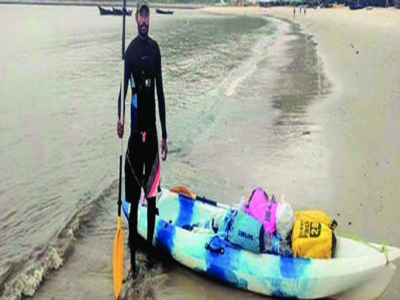
The coastal stretch of Karnataka has played host to several adventures and unique expeditions. Buoyed by the pristine beaches, a 28-year-old has now embarked on a solo kayaking expedition from Karwar to Mangaluru, clocking at least 240 km in 12 days.
Sushant first arrived in the city a decade ago from Bihar, to pursue engineering. The brochure-blue beaches cast a spell on him, and Sushant began investing time and energy in the water. Eight months ago, he bid adieu to his engineering profession and turned into a full-time kayaking instructor operating from Mulki. Sushant has now taken out nearly a couple of weeks off his busy schedule to explore everything the coast has in store for him.
The idea struck Sushant a month ago while kayaking with a friend in Gokarna. “It was such a memorable experience that I wanted more of it. I fancied an idea to kayak beside the virgin beaches and camp on the shores. I downloaded satellite views online, identified beaches and I was almost there,” he told STOI, after ending the fourth day of his expedition.
Sushant carries goods and groceries weighing approximately 40 kg with him. Sushant cooks his food himself. He lights his stove on the shores after the day’s kayaking, and relishes simple, delicious and wholesome food such as dal. “I carry a gas stove and a cooker among other appliances. I carry dal, rice, masala for khichdi and ghee for taste. I cook enough for dinner and breakfast the next morning. I consume protein bars in the afternoon, so I don’t lack nutrition. The apples that I have been carrying may last for three more days. I may visit some restaurants after that,” he said.
As he has been rowing for almost 12 hours a day, and venturing as far as 3 km in the sea, Sushant has found friends in dolphins. “I watched them play for at least an hour. They are magnificent,” he said.
Sushant, who began his expedition on April 16, is scheduled to sign off in style at Mulki, the place that changed his life forever, on April 27.
source: http://www.timesofindia.indiatimes.com / The Times of India / News> City News> Mangalore News / by Chethan Misquithi / TNN / April 22nd, 2018
Central Government-recognized technology startups incubator, Sandbox Startups invests in three of the incubated companies under NIDHI-SSS funding backed by the Department of Science and Technology, Government of India. Funding will enable the startups to graduate to the next level in terms of technology and this will take them to a better position to raise funds for further growth.
NIDHI-SSS (National Initiative for Developing and Harnessing Innovations-Seed Support System) is an umbrella program targeting at startups which aims to nurture knowledge-based and technology-driven ideas into successful startups. They also provide financial assistance to startups whose ideas or products offer promise and are designed to address novel problems. The three startups which received funding under the NIDHI-SSS are: Freshboxx Services Pvt.Ltd., a supply chain e-Commerce startup; Wide Mobility Mechatronics Pvt. Ltd., which offers end-to-end machine vision and inspection designed for different industries; and Microchip Payments Pvt. Ltd., a Hubli-based startup that offers reliable digital payment solutions.
C M Patil, CEO, Sandbox Startups, says, “Most entrepreneurs struggle hard to raise the angel or seed funding during the early stages and this fund from NIDHI-SSS is like a boon for the entrepreneurs in the ecosystem. We at the Sandbox Startups are building an entrepreneurial ecosystem in non-metros. Because of our geographical location, it is more difficult for entrepreneurs here to raise funds. We are thankful to the DST for this fund allocation which would help organizations like our Sandbox Startups, a central government-recognized technology business incubator, to invest against equity and build a self-sustainable model wherein we can co-create entrepreneurial culture in our ecosystem. With this funding mechanism in place, it allows us to invite the investment firms to co-invest in the startups associated with us, which in turn will help more mission-driven entrepreneurs.”
Founded in 2008 by Deshpande Foundation, Sandbox Startups is a Hubli-based global incubator which supports impactful entrepreneurs from tier II and tier III cities with seed funding, mentoring, network support, tech assistance, co-working space. It joined hands with Department of Science and Technology, Government of India in 2015-2016 and they’ve incubated more than 70 startups and aided almost 300 budding entrepreneurs.
Incubated three years ago, Freshboxx is an online fruits and vegetables enterprise that caters to customers in tier II cities and operates in B2B and B2C segments. With a network of over 10,000 farmers, Freshboxx saw an exponential growth rate after the incubation. Rohan Kulkarni, CEO of Freshboxx, says, “We want to enable a unified supply chain from farms to stores and our next focus will be to leverage machine learning, Artificial Intelligence and data analytics for improved decision making in understanding the needs of our customers. We are in talks with potential institutional investors to raise funds.”
In 2016, Sandbox Startups incubated Wide Mobility Mechatronics that delivers digital scanning services to industries like food, automobiles and electronics. It also provides internal inspection of products using X-Rays,cameras and digital radiography. Shekhar Basavanna, CEO of Wide Mobility Mechatronics, comments, “Sandbox, I would say, has first of all brought in an understanding of looking into all aspects of growing a start-up, making us realize that making a product/materializing a concept is just a part of the work done.”
On the other hand, Microchip Payments’ mobile-based payment application and point of sale device helps users to make payments without internet connectivity. The product gained appreciation from Massachusetts Institute of Technology, DCB Bank and others. Speaking about his startup journey, the company’s CEO & CTO, M. Farhanuddin Firaq says, “Post demonetization, we saw that one of the major problems that people faced in making online payments was poor internet connections. We started working on this idea and were supported and incubated at Sandbox startups.” Adding further, he says, “Today, we are proud to say that we are the world’s first company to build a completely non-internet powered digital transaction mobile application and a point of sale device.”
source: http://www.siliconindia.com / SiliconIndia / Home> Top News> Business / by SiliconIndia / April 19th, 2018
The institutions that have the equipment will provide access to researchers through an online reservation system. | Photo Credit: Reuters
Easy access to expensive equipment
Soon researchers in any college or institution and research organisations can check, reserve and have easy access to even expensive research equipment and facilities anywhere in India, thanks to the efforts by the Centre for Nano Science and Engineering (CeNSE) at the Indian Institute of Science, Bengaluru.
The centre is in the process of collating information about scientific and research equipment and facilities available at academic institutions and research organisations across the country.
Online reservation
The portal — Indian Science, Technology and Engineering Facilities Map (I-STEM) — will soon become operational. The government green signalled the project last month.
The institutions and organisations that have the equipment and facilities will provide access to researchers for both academic and non-academic work through an online reservation system.
‘Many benefits’
“This initiative will have many benefits. It will provide access to researchers to any equipment or facility that has been procured using public funds, the equipment will be better utilised and it will avoid duplication of expensive equipment as much as possible,” says Dr. Sanjeev Kumar Shrivastava of CeNSE and one of the two researchers who came up with this idea. “Sharing expensive equipment can bring down the cost of doing research in India.”
Putting to rest the fear that this initiative may come in the way of premier institutions which are just coming up from procuring essential equipment, Prof. Navakanta Bhat, chairman of CeNSE and the principal investigator of the I-STEM project, says: “Each institute will need certain equipment that is absolutely necessary and essential for regular use. It is not at all the intent of this initiative to stop such institutes from procuring equipment but to ensure that each instrument is better used.”
“We are trying to replicate the Indian Nanoelectronic Users Programme (INUP) model at CeNSE and IIT Bombay that has been in operation since 2008 to provide access to sophisticated device fabrication and analytical equipment to any academic researcher in the country. I-STEM is inspired by our positive experience with INUP,” says Dr. S.A. Shivashankar, visiting professor at CeNSE and the other person who is the brain behind this initiative.
The idea of starting a national network was shared with Dr. R. Chidambaram, former Principal Scientific Adviser.
The proposal was formally sent to the government in November last year.
source: http://www.thehindu.com / The Hindu / Home> Science / by R Prasad / Chennai – April 19th, 2018
Buildings like Fort High School were built by my ancestors but this heritage isn’t just a family legacy, Wadiyar said.
Mysuru Royal Family scion Yaduveer Krishnadatta Chamaraja Wadiyar inaugurating the restoration work of Fort High School in Bengaluru on Thursday (Image: DC)
Bengaluru:
The 110-year-old Fort High School received a new lease on life on Thursday morning. The Bengaluru Chapter of INTACH will begin restoration work on the building, which was set up in 1907 and constructed in the Mysorean style.
“The restoration will be carried out over a period of one year with a cost of Rs 2.5 crore,” said Meera Iyer, co-convener, INTACH, Bengaluru. Mysuru royal family scion Yaduveer Krishnadatta Chamaraja Wadiyar inaugurated the work on Thursday morning, recalling the contributions of his ancestors, who were patrons of art, culture, education and architecture. “This school represents the Mysorean design that was brought into the architectural vocabulary of buildings erected in the 1900s,” he said.
“As the restoration takes place, it will also inspire the younger generation to appreciate and care our heritage. Buildings like Fort High School were built by my ancestors but this heritage isn’t just a family legacy. It is a legacy of the people and we must celebrate it together,” Wadiyrar said.
A sprawling courtyard in front and numerous other motifs recall a vernacular style of architecture, Meera said. “On the other hand, you have the pillars and the facade, which is very colonial,” she added.
With its slanting roofs and colonnaded facade, Fort High School is one of the oldest buildings in Bengaluru and like other heritage structures, has been facing the brutal onslaught of development.
INTACH’s involvement with the school began back in 2012, when they realised it badly needed restoration. However funding was hard to come by, until a chance meeting with their current sponsor, Basant Poddar.
“We have got permission from the Department of Public Instruction to restore the building,” Meera said.
“All the ideals, wants, aspirations of our collective ancestors, the architects and the governments were poured into constructing those buildings. Preserving and re-invigorating them is important so that we can pass on this heritage to future generations,” Wadiyar added.
With World Heritage Day just gone by, here is a crowdfunded project to disseminate information amongst children of Bengaluru about their city’s contribution to World War I
German troops manning a machine gun post from a trench at the Vistula River in Russia during WWI
If something has to be for the community, it has to be with the community or better still, from the community. This is the concept ReReeti, an outfit that works with museums. This is the centenary year of World War I, with events being mounted across the world. ReReeti, too, is prepping for an interesting project. With White Pepper – Black Pepper: India in WW1, ReReeti wants to raise awareness amongst children in the city about Bengaluru’s contribution to the global war fought over 30 nations between 1914 and 1918. To raise funds, ReReeti is looking for contributions from corporates through CSR but it also experimented with crowd funding.
It kept a target of IRs. 1 lakh and on the website www.smallchange.ngo, asked people to donate anywhere between IRs. 201 to IRs. 3001. The target was achieved in 10 days. “Of course, the entire budget is IRs. 30 lakh but we wanted to get the community involved. We wanted to see if the people felt a need for such a discourse and with their response, it seems they do,” says Tejshvi Jain, Founder-Director of ReReeti.
Bengaluru can certainly do with some more light on its connection with the First World War because there is very little known about it. Through the project, interesting facts such as around 1.5 million Indian soldiers fought in the First World War, Bangalore Torpedo, a path-clearing device invented by the Madras Sappers being in use even today and many more will be brought out.
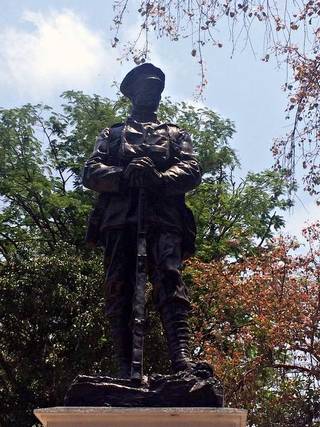
“The State of Mysore didn’t just send troops but also money and animals but so little is known about it. There are WWI monuments inside St. John’s complex like a cenotaph and statues of unknown soldiers inside the National Military Memorial in Vasanth Nagar. This project will be all about people, places, events, science and warfare and popular culture,” explains Jain.
The project has three components — travelling exhibition, online archival source and lesson plans on WWI. From August 2018 onwards, the exhibition co-curated with students, will travel to around 12 schools across the city. The exhibition will be experiential and at the same time have loads of information to share. The online archival source is being envisaged as a one-stop shop for all the content related to the World War.
_______________________________
The legend of Grey Mule
According to Jain: ‘The Grey Mule’ was enlisted in 1891 and saw 31 years of service. He served in Egypt and Palestine between 1915 – 1918. While returning in 1921, many mules were sold in Egypt but Colonel Bassett interceded and obtained special permission to bring him back. On returning he was pensioned and allowed to roam free in the lines as an honoured war veteran. During the 150th anniversary reunion, he headed the march past of pensioners accompanied by the same sapper who had worked with him 33 years back. He wore his colours and got a standing ovation. It was his last parade. He passed away in 1933. He was buried in the unit lines at the Regimental Centre (Bangalore). His hooves were used to make ink stands – 2 in Bangalore (Regimental mess and Monkey House) and 2 in UK.
____________________________
Very little is out there about India’s contribution to WWI and whatever little is there is scattered. The aim is to bring all the links under one roof to make the information accessible. The lesson plans are about storage for anyone across the world to access the information.”
Jain was inspired during her Art Think South Asia Fellowship in the UK where she saw communities getting involved to engage with local histories.
source: http://www.thehindu.com / The Hindu / Home> Entertainment> Art / by Shailaja Tripathi / April 19th, 2018