Peek into how the lords lived in their manors at Nisargadhama

Mangaluru:

Guthumane (village headman’s house in Tulunadu of yesteryears), which will open at Dr Shivarama Karantha Pilikula Nisargadhama on Friday, will offer a time-travel experience for visitors and become a must-see spot in the tourism circuit, according to authorities. With do-it-yourself elements interwoven into static display of artefacts, Guthumane will offer a peek into the socio-religious-cultural history of Tulunadu.

While offering a sneak preview of the Guthumane for select invitees on the occasion of Bisu Parba on Thursday, authorities of Pilikula Nisargadhama and the district administration said that the house will have a research team that scans public feedback and make changes to items displayed, hold theme-based exhibitions, while retaining the intrinsic charm of all things inherent to the Guthumane.

B A Viveka Rai, chairman of the sub-committee on Artisan Village at Nisargadhama that includes the Guthumane, said changes will come on a regular basis. “We have already noted down a few problems in the present set up. This includes keeping the video kiosks close to each other. We will shift one kiosk to other part of the inner quadrangle,” he said. Voice quality on ‘Ajji Kathe’ display is not up to the mark and the story will be re-recorded to give visitors a better feel, he added.

Creative artist Shashidhara Adapa and his team with expertise in setting up museums, have scoured length and breadth of Tulunadu from Baindoor to Kasargod to get original items used in the past. One such item is the ‘Pattada Mancha’ (royal cot) that rests majestically on front verandah of the Guthumane.

Li kewise, Shashidhar sourced a cane basket used by yakshagana artists to transport items. It was sourced from Kollur after a long search for people who weave such baskets now. “It has taken the team headed by Rai at least eight months of work including two months of basic research, lots of interactions and agreements to get everything in place,” Shashidhar said .

For Sreenivas Sasthan of Karnataka Kala Darshini, Bengaluru, getting the yakshagana figurines from both Thenkathittu and Badagathittu styles measure up to human exactness was a task that brought out the best in him. “It was a worthy effort,” Sreenivas said, noting that pictures of a Yakshagana artists were taken in eight different angles and the human likeness was created using fibre glass.

source: http://www.timesofindia.indiatimes.com / The Times of India / News Home> City> Mangalore / Jaideep Shenoy / TNN / April 15th, 2016

Mysuru Memories …: Y. G. Krishnamurti : An Unsung Hero of Indian Independence

1) Y. G. Krishnamurti [17.2.1916 - 19.1.1977] 2) From left : Nehru’s sister Krishna Hutheesing, S. Radhakrishnan, First CJI - Pathanjali Sastry & YGK.
1) Y. G. Krishnamurti [17.2.1916 – 19.1.1977] 2) From left : Nehru’s sister Krishna Hutheesing, S. Radhakrishnan, First CJI – Pathanjali Sastry & YGK.
by Dr. S. N. Bhagirath and N. Balasubramanya

Another illustrious and unheralded hero of Mysuru city, who deserves to be remembered during the Centenary Year of Mysore University, is Y. G. Krishnamurti (YGK). He was born on 17th February, 1916 at Yelandur to parents Gopala Sastry and Lakshmi Narasamma. After his initial education at Yelandur, the family moved to Mysuru for the higher education of their children. Y. G. Krishnamurti studied B. A. and M. A. (English Literature) at Maharaja’s College from 1934 – 1938. He was a great college debater and a favourite student of Principal J. C. Rollo, S. Srikanta Sastri, B. M. Srikantaiah and A. R. Krishnasastry.

YGK was attracted by Gandhian philosophy. The call for freedom made him come out of the class room and involve himself deeply in the agitation for Independence. He became a student leader, who often led processions, conducted hartals and delivered fiery and revolutionary speeches in Subbarayana Kere along with K. C. Reddy and others. He often got arrested by the Police and got locked up in Mysuru Jail. Once during the exams, when Principal J. C. Rollo noticed that YGK was absent, he went to Mysuru Jail and got him released temporarily, so that he could write his exams. He took YGK in his car straight from the jail to the examination hall.

One evening Prof. B. M. Srikantaiah came to the house of YGK (No. 310, D. Subbaiah Road, Mysurue) to show his Kannada translation of English romantic poems titled “Honganasugalu.” YGK was not at home. Prof. B. M. Srikantaiah sat in front of the house on a bench and waited for his pet student. The family members of YGK invited B. M. Sri inside, but he preferred to wait out. YGK came home at 10 pm and was shocked to find his professor waiting outside. Before sending to the press the manuscripts, B. M. Sri wanted the critical approval of YGK for his translated poems! After graduating from Maharaja’s College, Y. G. Krishnamurti wrote a biography of Mysuru’s Grand-Old-Man Tathaiah — M. Venkatakrishnayya in 1933.

Soon after leaving the University, YGK went to Bengaluru and worked as a Private Secretary of Sir M. Visveswaraiah (MV) for two years on a salary of rupees seventy-five. This invaluable apprenticeship under Sir MV led to his work “Sir M. Visveswaraiah – A Study” (1941) with a foreword by Sir Purushottamdas Thakurdas. During the freedom struggle, YGK (without exaggeration) was very close to Pt. Jawaharlal Nehru, Sardar Patel, S. Radhakrishnan, Netaji Subhas Chandra Bose and K. M. Munshi. In 1938, the historic Haripur Congress convention took place. Netaji Subhas Chandra Bose won the election against Mahatma Gandhi’s conscience candidate Pattabhi Seetaramaiah. YGK edited “Haripur Congress souvenir” with a special message from Netaji Subhas Chandra Bose. YGK was a prolific writer with more than fifty books to his credit. His book “Independent India and a New World Order” (1943) which was earlier mentioned in Star of Mysore on 3.4.2016 had a foreword from S. Srikanta Sastri, which attracted the attention of Joseph Goebbels during Second World War. YGK wrote such works as “Constituent Assembly & Indian Federation” (1940) with a foreword by Pt. Jawaharlal Nehru and introduction by S. Srikanta Sastri and “Indian States and the Federal Plan” (1939) with a foreword by Bulabhai J. Desai. His works on Federalism and separation of powers laid the foundation for Indian Constitution. He also wrote political biographies like “Gandhi Era in World Politics” (1943) with a foreword by Sir S. Radhakrishnan, “Rajendra Prasad – His Personality and Philosophy” (1952) with a foreword by Dr. S. Radhakrishnan, “Jawaharlal Nehru – The Man and his Ideas” (1942) with prefaces by Bulabhai J. Desai and Mrs. Rameshuri Nehru, “Gandhism will survive” (1949) with a foreword by Rameshuri Nehru and “Back to Sanity” (1945) on Gandhism with a preface by Babu Rajendra Prasad.

YGK, after India gained independence, did not seek either political power or any munificence from the Government of India. As a close associate of Pt. Jawaharlal Nehru, Sardar Patel and others, he could have easily become either a Cabinet Minister or an Ambassador. Somehow, YGK, around 1952-53 got disillusioned with the Indian political scenario. He left India and went to Nepal on an invitation from His Highness King Mahendra. He spent rest of his life writing books on Nepal such as, “His Majesty King Mahendra”, “King Mahendra: Poetic Values and Technique”, “The Mahendra Era: Radio Nepal”, “Rani Aishwarya”, “Topography of Nepal”, “Political Ideology of King Mahendra”, “His Majesty King Mahendra Bir Bikram Shah Deva (An Analytical Biography)” and “King Mahendra – The Poet” (1969). For his services to the country of Nepal, he was awarded the highest title accorded to a foreigner – “Gorkha Dakshin Bahu -II” by King Mahendra in 1969.

Y.G. Krishnamurti pursued “Hata Yoga” in Nepal and he had remained a bachelor. On October 23, 1974 in Cochin, Kerala, a total solar eclipse took place. YGK performed a great Hata Yoga feat by sitting in an open ground and gazing at the Sun from the beginning to the end of Solar Eclipse (for a total duration of ninety minutes) and his eyes were apparently not damaged. This yogic feat was certified by Dr. Mathew, an ophthalmologist of Cochin, who examined YGK’s eyes before and after the event. YGK also repeated this feat later at Ankola. In 1969, he wrote a book on Yoga titled “The Great Yogic Sermon.” YGK has donated his library, art collection and manuscripts to a Charitable Trust in Kathmandu. He suffered a massive heart attack at the age of sixty-one on 19th January, 1977 in Kathmandu. His death was reported extensively by Indian newspapers like The Hindu, The Indian Express, Prajavani, Deccan Herald and Sadhvi on 20th January, 1977. A great patriotic son of India died in a foreign land bereft of any homage from friends and relatives. Mysuru city and Yelandur village ought to immortalise this great Kannadiga either by erecting a statue or naming a Circle or Street after YGK. The birth Centenary Year of YGK (2016) coincides with the Centenary Year of University of Mysore.

source: http://www.starofmysore.com / Star of Mysore / Home> Feature Articles / April 16th, 2016

Prof. CDN Memorial Day observed at Dhvanyaloka

CDN Memorial Award presented to two distinguished scholar-teachers

Prof C.N. Srinath (extreme left), Director, Dhvanyaloka, is seen with guest speaker A. Madhavan, former Indian Ambassador and CDN awardees Dr. S. Ramaswamy & Dr. G.S. Balarama Gupta.

Mysuru :

The Prof. CDN Memorial Lecture for 2016 was delivered by A. Madhavan, former Indian Ambassador, at Dhvanyaloka here on April 12.

Recalling his long and intimate association with Prof. C.D. Narasimhaiah (CDN), Madhavan described him as not merely an extraordinary teacher but also an extraordinary human being who strongly believed in time-honoured values eloquently testified by his Autobiography N for Nobody.

What made the occasion more significant this year was the giving away of Prof. CDN Memorial Award (consisting of a citation and cash award of Rs.10,000) instituted by Dhvanyaloka to two distinguished scholar-teachers and also former disciples of Prof. CDN — Dr. S. Ramaswamy, formerly of Bangalore University and Dr. G.S. Balarama Gupta, formerly of Gulbarga University — in recognition of their contributions to Literature. The Awards were presented by Madhavan. The award money for the current year was donated by Krishnamurthy, formerly of Vyshya Bank, Mysuru.

In his Acceptance Speech, Dr. Ramaswamy recounted Prof. CDN’s legacy with particular reference to his journal The Literary Criterion. If that was a moving tribute to his teacher, Dr.Balarama Gupta also remarked how he was inspired to start his own journal JIWE, thanks to Prof. CDN.

Prof C.N. Srinath, Director, Dhvanyaloka, who earlier welcomed the gathering, introduced the guests and also observed that Prof. CDN had demonstrated convincingly how a single teacher could have all that immense potential to achieve so much in his life.

Since the occasion also marked the release of the Special Number of The Literary Criterion on F.R. Leavis, reputed critic and mentor for Prof. CDN at Cambridge, Prof. Srinath remarked that this “confluence” of events made the programme unique. The evening wound up with the screening of a documentary on Prof. CDN’s life and achievements, produced by June Gaur and Dr. H.S. Shivanna.

source: http://www.starofmysore.com / Star of Mysore / Home> General News / April 16th, 2016

Lifetime Achievement Award

Dr. M.P. Manjappa Shetty Masagali, former Associate Director of Kuvempu Institute of Kannada Studies, Manasagangotri and a resident of T.K. Layout in city will be conferred Karnataka Samskrutika Parishat’s ‘Lifetime Achievement’ award at the State-level Karnataka Vaibhava programme to take place at Kannada Sahitya Parishat, Pampa Mahakavi Road, Chamarajpet, Bengaluru at 11 am on Apr. 17.

For details contact Mob.: 98805-40451.

source: http://www.starofmysore.com / Star of Mysore / Home> In Brief / Friday – April 15th, 2016

Six ladies from city enter into Guinness Book for Creating ‘Largest Crochet Blanket ’

From left: Vasanthi Bhaskar, Sujatha Badri, Navaneetha Jayaram Shetty, Devaki Ranganathan and Lalitha Suresh displaying the Guinness Certificates.

Mysuru :

Six women from Mysuru were among the 2,500 women from across India, who recently made it to the prestigious Guinness Book of World Records for having created the ‘Largest Crochet Blanket’ measuring a staggering 11,148 square metres in size.

This was a pan-India initiative by the Mother India’s Crochet Queens Group, with women from many cities contributing towards this record.

Those from Mysuru who contributed to this world record are: Vasanthi Bhaskar, Lalitha Suresh, Kamalamma Sathyanarayana (not in pic), Navaneetha Jayaram Shetty, Devaki Ranganathan and Sujatha Badri.

The blanket, created by members of the Facebook group Mother India’s Crochet Queens, is made up of 8,000 individual pieces and is the size of one-and-a-half football fields, making it more than three times as big as the previous Guinness World Record, created by a group in South Africa.

This massive blanket was later segregated into 5000 individual blankets and donated to NGOs across the nation, according to Vasanthi Bhaskar.

The Facebook group was started by Chennai resident Subhashri Natarajan in August 2015 to connect with fellow knitting enthusiasts.

The project was a beautiful combination of social media and the old world charm of crochet, says Subhashri.

source: http://www.starofmysore.com / Star of Mysore / Home> General News / Friday – April 15th, 2016

IISc innovations: Saltwater lamp sensors to check heart, lungs

Indian Institute of Science, Bangalore

Bengaluru :

The Indian Institute of Science (IISc) which has recently been ranked the best university in the country has been buzzing with research innovations for years. In the latest, TOI looks into four innovations that are taking shape at, or, come out recently from the 107-year-old institute.

Solar water purifier & saltwater lamp

An IISc start-up, SuryaGen, has come out with a low-cost solar water purifier and a salt water lamp.
Professor Vasant Natarajan, from the Department of Physics in IISc, whose brainchild SuryaGen is, said: “The solar water purifier can transform water from any source – be it from sea, river, pond, wells, or even water collected from rain – into potable water.”

Impure water is evaporated using solar energy and the vapours are condensed to pure water on a cold surface. This leaves behind bacteria, heavy metals, arsenic, fluoride and other impurities. It can produce 1.5 litres of potable water from 3 litres of impure water.

The saltwater lamp, he said can power 12 LEDs with just half a litre of water and 2 tablespoons of salt. It is suitable for remote areas where grid facility is not available.

Novel sensor to check on heart & lungs

A team of researchers have developed a novel sensor they claim can simultaneously measure both cardiac and respiratory activities. The new device is non invasive, and can be wrapped around a person’s chest. It can help in early clinical diagnosis of many conditions associated with lung and cardiac health. The device is robust, portable, shock-proof, non-electric.

Called the Fibre Bragg Grating Heart Beat Device, it is based on an optical fibre sensor known as a Fibre Bragg Grating. S Asokan, Professor at Department of Instrumentation and Applied Physics led the team. They’ve also developed sensors for various healthcare applications including measuring blood pressure, cardiac markers, blood glucose levels.

“The simultaneous detection of cardiac and respiratory activities with a single device helps in decoding the abnormalities connected to lungs and heart dysfunction. One of the most desirable advantages of this instrument is that it can be used for the detection of original heartbeat shape (Nascent Morphology),” says K Chethana, a member of the team.

Bacteria-free water

With deaths due to water related diseases on the rise globally, high efficient water filtration that is affordable is gaining importance. A research team at IISc claims to have a solution. It has designed a membrane which can almost eliminate bacterial contamination from water.

The newly designed membrane is made of polyethylene, which has several advantages like low cost, strength, durability and stability. It also prevents biofouling – accumulation of micro-organisms on the membrane, which blocks the membrane and increases the overall time, cost and energy required for water purification.

To make the three dimensional porous membrane, the scientists mixed the polyethylene oxide (PEO) with polyethylene during the manufacturing process, and later created tiny pores. Biocidal agents are chemical or biological agents used to kill unwanted organisms.

A large portion of the porous membrane is covered with graphene oxide sheets which are efficient and safe biocidal agents with potential to kill bacterial contaminants. Unlike other biocidal agents like silver, graphene sheets are non-leaching and non-depleting and thus are safe for use in filtration procedure.

source: http://www.timesofindia.indiatimes.com / The Times of India / News Home> City> Bangalore / Chethan Kumar / April 11th, 2016

Playgrounds is best short film at Los Angeles fest

Proud entry:M.D. Pallavi and Shamik Sen Gupta’s Playgrounds was made on a shoestring budget of Rs. 3.2 lakh.

Kannada Sugama Sangeeta and theatre artist M.D. Pallavi and Shamik Sen Gupta’s Playgrounds was adjudged the Best Short Film at the prestigious Indian Film Festival of Los Angeles (IFFLA) held from April 6 to 10.

The 18.08-minute short film has been selected for screening at eight international film festivals held across the country so far, besides winning gold in the Asian New Force category at 21 Incubator for Film and Visual Media in Asia (IFVA) Festival, Hong Kong Arts Centre.

Jigmet Wangchuk, cinematographer of No One Killed Jessica, handled the camera for Playgrounds . The story is woven around the child of migrant labourer in the booming metropolis. This toddler falls asleep in an auto while in a game of hide-and-seek. When the driver discovers the child, he sets about trying to return her to the parents. “It is a game of survival in a concrete arena,” says the log line of the film.

Playgrounds was made on a shoestring budget of Rs. 3.2 lakh and has been shot in suburban streets, low-income class neighbourhoods, streets, hospital, construction sites, and workers’ shanties juxtaposed against and separated from a massive building complex by a deep moat, emphasising the divide. “While in some of the locations we had permission to shoot, in several others we had to shoot discreetly,” said Ms. Pallavi.

It took some three months for the director duo to write the script. “We shot the entire film in seven days. Since the film commences in the evening and ends after midnight, we had to shoot mostly at night with very little artificial lighting,” she explained.

Interestingly the film has various languages – Dakhani Urdu and Tamil besides Kannada. “It is our intention to make a multilingual film to capture the authentic soundscape of the Indian urban spaces where you don’t hear one but multiple languages,” she said.

“We are surprised on learning about the award. We could not go to Los Angeles to receive it because of financial constraints,” Ms. Pallavi said.

source: http://www.thehindu.com / The Hindu / Home> News> Cities> Bengaluru / by Muralidhara Khajane / Bengaluru – April 13th, 2016

Miss India 1st Runner-Up’s Mysuru connection …

ShrushtiBF12apr2016

Femina Miss India 1st runner-up Sushruthi Krishna (extreme right) is seen with Femina Miss India winner Priyadarshini Chatterjee (centre) and 2nd runner-up Pankhuri Gidwani.

Mysuru :

Sushruthi Krishna, who was crowned as first runner-up in Femina Miss India pageant held on Saturday (Apr.9), has Mysuru connection.

The 22-year-old Architect Sushruthi was born in Mysuru and then moved to Bengaluru where her father M.S. Krishna is a businessman. Her mother Jayashree Krishna is a native of Mysuru. Sushruthi’s maternal grandparents Ganesh Iyer and Kameshwari are residents of Vijayanagar 3r stage in Mysuru.

After completing her studies in DPS, Bengaluru, Sushruthi Krishna received her bachelor’s degree in Architecture from RV College of Engineering in Bengaluru. Speaking to SOM, Ganesh Iyer expressed his happiness and said that it was because of his grand-daughter’s hard work that she could achieve the feat.

source: http://www.starofmysore.com / Star of Mysore / Home> General News / April 12th, 2016

From Austin Town to China

FootballBF11apr2016

A Kannada documentary traces the journey of underprivileged footballers from Bengaluru to China. The film, which won a national award, went largely unnoticed

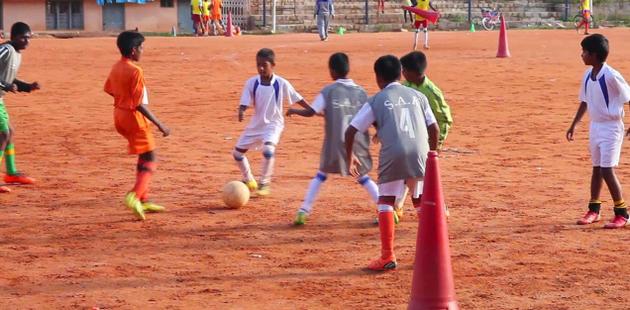
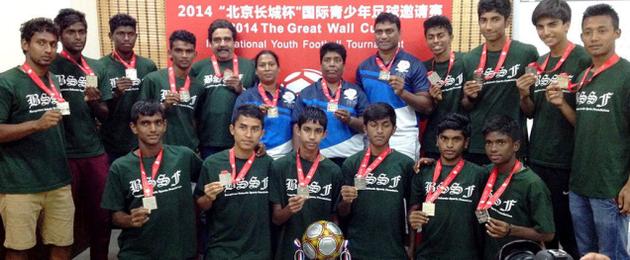
A team of 14 boys from the shanties of Austin Town, who love football over anything else in their lives, recently created history by representing Bengaluru at the Great Wall Cup at the Olympic Nest in Beijing.

These underprivileged kids participated in an event where 30 countries competed for the trophy and returned with the runners-up cup. Their parents work as sweepers, maids, band members who play at funerals, and cooks in smalls hotels.

Moved by the spirit of these boys, Jacob Varghese, who has earlier directed Kannada hits like Savari, and Prithvi starring Puneeth Rajkumar, made Dribbling with their Future, a Kannada documentary on these children.

The film got the award in the Best Exploration/Adventure film category at the 63rd National Film Awards this year, but was lost in the cacophony of larger films.

According to Jacob, Dribbling with their Future documents the journey of the children to realise their dream of playing at the Great Wall Cup. Jacob believes his film should speak, rather than its creator.

“It is up to the audience to interpret and relate to it,” he says. So far he has made two short films –Andhyam (the story of a hangman), which went to many international film festivals, and Putti (the story of a seven year old girl, and her grandmother in a drought-hit village).

AustinTownBF11apr2016

Excerpts from the interview:

What made you want to move away from star-driven features to a documentary like this?

I was never in awe of any actor and I always treat them as a part of the crew. For me, they are mere actors and never stars or heroes.

There are a lot of people I come across in my life, doing extraordinary work, which makes them real heroes, unlike our reel heroes. And these people go unnoticed. Documentary filmmaking helps me bring their story into the limelight. That is really exciting.

What made you make a film on this particular subject?

The determination of the boys, who are all younger than 15, and participated in the football tournament crossing all hurdles, touched me to the core. The boys in Austin Town love to play football, at a time when boys of their age opt for cricket, which is more remunerative than football. I wanted to attempt making a documentary as there are so many compelling stories you see around, which need to be told. That’s why, when I heard of these boys, who come from underprivileged backgrounds, and learnt of their passion for this sport and the struggle they underwent to fulfil their dream, I decided to document their journey from Austin Town to Beijing.

Did you enjoy making this documentary?

I loved this aspect of filmmaking as a documentary filmmaker — the independence, no boundaries and framework for the shoot — I was comfortable with this genre. This allows me to explore newer avenues of filmmaking.

Had you expected an award for this film?

No, not at all. If I get an award, it is well and good. At the same time an award doesn’t make any difference to the approach I have towards life and filmmaking.

Why do you think your film went unrecognised?

Yes, there was confusion regarding the language of the film. The film has a voiceover in English and this led to all the confusion. I again wanted to make it clear that Dribbling with their Future is a Kannada documentary, as some people even now think that it was not a Kannada film. I didn’t want to publicise the award — it came my way. I made a film and the jury recognised that.

source: http://www.thehindu.com / The Hindu / Home> Features> MetroPlus / Muralidhara Khajane / Bangalore – April 11th, 2016

Bengaluru Musician in John Lennon Contest Finals

Bengaluru :

Sandeep Boniface, a city-based musician, has been shortlisted for the coveted John Lennon Songwriting Contest.

His composition Moments of Bliss has been selected as one of the three entering the final round for the award. He is a music composer, singer, keyboardist and music teacher at Canadian International School, Bengaluru.

The contest, named after the former Beatles singer, was started by Lennon’s wife Yoko Ono in 1997. It is a platform for amateur and professional musicians across the globe.

Over the years, Sandeep got many offers to sing for Bollywood films, thanks to his association with musicians from around the country. However, he did not go down that road. “I did not want to cater to a particular market. I wanted freedom to make my own music,” he says.

Being nominated for an international prize has been a dream come true, says Sandeep.

“It is also a privilege to rub shoulders with fellow finalist and Grammy Award winner Ricky Kej,” he says.

Sandeep started learning piano at a very young age and performed for the first time at the local church when he was 10. “One of my earliest influences was the band Bee Gees. I was fascinated by their compositions and the harmony in their music,” he says.

Subsequently, works of French composer Eric Serra created an impact on him.

As a singer, Sandeep learnt a lot from Rab Halford, lead vocalist of the heavy metal band Judas Priest, and Pakistani singer Nusrat Fateh Ali Khan.

He has sung and composed music for numerous radio jingles, TV commercials, documentaries, films and plays. He has also worked with organisations like Nimhans as a music consultant. A couple of months ago, he set up his own recording studio named DJ Nitro Production.

“Winning the award will help me reach out to a global audience,” he says.

source: http://www.newindianexpress.com / The New Indian Express / Home> Cities> Bengaluru / Express News Service/ April 07th, 2016