It is to mark the 25th anniversary of the annual flower and fruit show
More than one lakh varieties of flower and fruit from across the country are on display at the 25th edition of the annual flower and fruit show being held on the premises of the Horticulture Department here. It has been organised by the Department of Horticulture and the District Horticulture Association.
According to official sources, the association was formed in 1981 to create awareness among the people on different varieties of flower and fruit grown in the State.
The show also focuses on the steps that growers should take to get more yield by utilising the available resources in the district.
The major attractions at the show are flower arrangements depicting Shravan Kumar, who devoted his life for serving his parents and Gautham Buddha.
Different varieties of flower such as orchids, carnation plants, cockscomb, celosia, lilies, salvia, cosmos and pentas are on display.
More than 10,000 saplings of each variety have been exhibited. Farmers from six taluks of the district have been given the opportunity to exhibit the best quality fruits and flowers grown on their land. “It took five months for the authorities to make preparations for the show and develop the garden on the premises of the Horticulture Department,” sources said.
The authorities have also organised competitions such as rangoli, essay writing, drawing, singing, and preparation of fancy dresses by using flowers and fruits.
Prizes would be given to winners of these competitions on the concluding day.
source: http://www.thehindu.com / The Hindu / Home> National> Karnataka / by Pradeepkumar Kadkol / Chitradurga – January 31st, 2016
Sitting from left: AKKA Vice-President Sharath Bhandari, founder-President Amarnath Gowda, Joint Secretary Yamuna Nagaraj, incumbent President Raj Patil and former President Dr. Halekote Vishwamitra, who were felicitated at a function organised by Kannada Abhimani Balaga in city on Wednesday, are seen with folklorist Prof. Kalegowda Nagawara, former MP A.H. Vishwanath, writer Gubbigoodu Ramesh and others.
Mysuru :
The office-bearers of Association of Kannada Kootas of America (AKKA) were felicitated at a function organised by Kannada Abhimani Balaga at Nagamma Nagaraj Kalyana Mantap in Vishweswaranagar in city.
Speaking after inaugurating the function, former MP A.H. Vishwanath lauded the role of AKKA in spreading the aroma of Kannada in America. Recalling his visit to USA for the AKKA meet chaired by its Founder- President Amarnath Gowda a couple of years ago, Vishwanath said that AKKA is doing its best to introduce Kannada language and culture to Americans.
He further said that Amarnath Gowda, a lawyer by profession, was always keen on resolving issues concerning Kannadigas in America.
AKKA President Raj Patil in his address, said that AKKA was introducing a tour package for Kannadigas visiting AKKA conferences in USA. Pointing out that efforts will be made for issuing passport, visa and travel arrangements through local travel agents, he said that more details will be hosted in the website shortly. He further said the next AKKA meet will take place in Atlantic City, New Jersey, USA from Sept. 2 to 4 this year.
‘Pouranika Ranga Chavadi’ President Sangapura Nagaraj, who delivered the keynote address, gave a brief on the activities of AKKA and Kannada Abhimani Balaga.
AKKA founder-President Amarnath Gowda, incumbent President Raj Patil, former President Dr. Halekote Vishwamitra, Vice-President Sharath Bhandari and Joint Secretary Yamuna Nagaraj were felicitated. Later, AKKA office-bearers honoured farmer Gowregowda of Chikkakoppalu village in K.R. Nagar Taluk, Ravi Varma School of Arts Principal H. Krishnamurthy, Vyjayanti Chitrakala Mahavidyalaya Principal Shivakumar and Charan of Karunamayi School for the Specially-abled. Littérateur Prof. Kalegowda Nagawara spoke on the topic ‘The relevance of Kannada literature in other countries’.
Writer Gubbigoodu Ramesh presided. Karnataka Nataka Academy member B.M. Ramachandra, former District Kannada Sahitya Parishat President M. Chandrashekar, former Secretary K.S. Shivaramu and teacher C.T. Dharmapal were present.
source: http://www.starofmysore.com / Star of Mysore / Home> General News / January 29th, 2015
The Devannahalli fort, which stands 35 kms away from Bengaluru, is older than the city itself by 37 years.
The fort has been occupied by different dynasties over time. It was built in 1501 by Kempegowda’s ancestor, Malla Baire Gowda. But in 1747, in a battle led by Nanjarajaiah, the dalwai of Mysore, the clan lost it to the Wadiyar dynasty. Marathas later claimed it and lost it back to the Mysore state, in a siege led by Hyder Ali in 1746.
Arun Prasad, from Discover Bangalore Project, says that though Hyder captured the fort, it was his son Tipu Sultan who was responsible for modelling and building the Pulkad fort.
The town surrounding the fort was meant to be a a centre of learning and arts. “The Devannahalli town was supposed to be a place for learned artisans and intellectuals to inhabit,” says Prasad.
Devannahalli was a town typical of the time, with protected farmlands and fields. A lake, behind the fort and seen from the bastions, was meant to serve the needs of the inhabitants.
Today, the lake is dried up and is a sad sight to notice. Prasad blames it on poor urban planning. Earlier, a highway used to pass through the western part of the town. Now, a road has been built, which passes over the lake. A good portion of the lake was used up for it.
“The lake has always been rain-fed. But the new road cut the lake away from the adjoining canals and channels,” says Prasad. “The rain water could not flow in and the lake dried up. The vast area of 400-500 kms metres has only weeds and little water due to rains. You can also spot some tattered measurement devices, which was a failed attempt to study the level of water in the lake.”
Pics: Pushkar V
Bastions
Built on a higher ground, the bastions were used to keep a watch out for the enemy. The fort is 30 to 35 feet high and bastions, along the fort, are placed at equal distance from each other. “The bastions have well protected chambers, used by soldiers. The gun points are holes in the wall which can still be seen today. They are built from lime and brick. The holes were used to keep guns during the war,” adds Prasad.
Tipu’s Birthplace
South-west of the fort, there is memorial with a board, which proclaims that Tipu was born here. A six-foot-tall enclosure marks the spot.
When Tipu was born in 1750, his father Hyder Ali was engrossed in a battle. His mother, Fatima Fakhr-Un-Nisa, was secretly ushered into a carriage to give birth at the fort, as it was considered a safe place. However, she ended up giving birth inside the vehicle, right outside the fort. The monument is built over this birth spot.
A pond was built under the administration of Purnaiah, the then Dewan of Mysore. It is a beautiful pond with the stones and excavations intact. “The water is used for rituals and festivals,” says Prasad. “People take baths here as well.”
Pics: Pushkar V
Temples
Inside the Devannahalli fort, there is the Venugopalswamy temple. The temple, which was built in the Vijaynagara style, has several depictions from the Ramayana on the walls. “At the entrance, the two horsemen are believed to belong to the Western Ganga dynasty (which ruled 350 and 1000 AD),” said Prasad.
Pics: Pushkar V
There are sculptures of seamstresses, as you enter, from the same era. The north and south walls have sculptures showing Rishyasringa being brought from a forest to Ayodhya accompanied by dancing girls. There is also a scene of Vishwamitra caught in a an archery battle with Rama. The south wall has ten incarnations of Lord Krishna and Rama’s father performing a sacrifice.
The fort gate and the fort walls are crumbling and there are scribblings on the walls. There is no security at the entrance and anyone can walk in. The commercial establishments all around have failed to preserve the authenticity of the past. “An ASI (Archeological Survey of India) office is located at the entrance, which is always closed and does not provide much information,” says Prasad. “The fort area needs to be protected by ASI and does not come under the corporation. The northern gate is crumbling as well.”
How it Began
Refugees on the run from Kancheepuram settled down near the Nandi Hills. Legend has it that Rana Baire Gowda, their leader, was told in a dream that he had to build a settlement in this region. This family goes by the name of Morasu Wokkalu. His son Malla Baire Gowda founded Devanahalli. Kempegowda also belongs to this family.
source: http://www.newindianexpress.com / The New Indian Express / Home> Cities> Bengaluru / by Seema Prasad / January 28th, 2016
Dr C. Ganesh Pai, Professor and Head of the Department of Gastroenterology and Hepatology, Kasturba Medical College and Hospital, Manipal has been awarded a research grant of Rs 49.92 lakh for the project titled: “Thiopurine Therapy in Inflammatory Bowel Diseases: Optimizing Existing Strategies”.
The research is funded by the Department of Science and Technology, Government of India. Inflammatory bowel diseases (IBD) are a group of incurable chronic intestinal diseases that contribute to a lot of suffering.
Currently available treatment options work well at best in half the patients suffering from these conditions leaving thereby a large unmet need.
The project is expected to identify ways of improving the proportions of patients who benefit from currently available, affordable drugs belonging to the class of thiopurines and also decrease the adverse events from these drugs. The research will also lay the groundwork for designing newer drugs related to thiopurine compounds which are more effective in IBD.
Medical Superintendent and COO of Kasturba Hospital Manipal Dr M Dayananda said: This type of funding is available only for established research leaders to pursue ground-breaking, high-in-tensity projects that open new directions and advancements in their respective research fields. Selection of Gastroenterology and Hepatology Department at Kasturba Hospital depicts the advanced treatment modalities and quality of care for patients provided here.
Dr. Krishnamurthy Bhat, Head of Pharmaceutical Quality Assurance, Manipal College of Pharmaceutical Sciences, Manipal University is a co-investigator on the project, which runs for three years.
source: http://www.timesofindia.indiatimes.com / The Times of India / News Home> City> Mangalore / by Stanley Pinto, TNN / January 22nd, 2016
Art historian Gail Levin on the influence of Indian art and culture on American art and artists
Swami Vivekananda was probably one of the earliest and most notable influences on American artists, who garnered several admirers after his landmark address at the Parliament of the World’s Religions. Coincidentally, it is a globally renowned Indian artist, Jitish Kallat, who commemorated the 108th anniversary of the famous speech by lighting up the steps of the venue which is now the ‘Art Institute of Chicago’ with the text of the speech in his famous ‘Public Notice’.
That’s how Gail Levin, art historian and distinguished professor of 20th Century art and contemporary art at the City University of New York, began her lecture on “An overview of the Influence of Indian Art and Culture on American Artists from the World’s Colombian Exposition to Contemporary Art” at the National Gallery of Modern Art (NGMA).
The exposition she refers to is the same Parliament of the World’s Religions which was part of a world fair.
“One of them is Marson Hardley whose work I have studied extensively. He has emblems or symbols that refer to India in some of his paintings from 1913,” says Gail, who is in India as a Fulbright scholar.
Some of other influences on American art are Raja Ravi Varma, and Rabindranath Tagore who is linked to the Japanese curator Okakura Kakuzo and Isabella Stewart Gardner.
“My project was to study the mutual culture of Indian American artists, how they influence each other and how their culture influenced art,” she explains.
“For a long time I wanted to see Indian art so I can teach better. Every time I looked at a book on Asian American artists it was always about the Far East and there is little on South East Asia, especially because India is a such a huge country and there are so many Indians in America.”
After having written several books on artist Edward Hopper and studying feminist artists like Judy Chicago, Gail wants to devote the end of her career studying and writing about Asian art influences.
“My lecture outlines the book that I am planning to write on India. I never fully understood the symbolical references to Indian art. It is only when you get to know people that you learn about culture. I have been staying in Kerala the past few months and I learnt a lot, yet, feel I learnt so little compared to what there is to know.”
But then her trip took an unexpected turn when she met Kerela-based, Cholamandal-groomed artist Sajitha Shankar, whose work drew parallels with the work of Judy Chicago, notable for her ‘Dinner Table’ installation at the Feminist Art Centre in Brooklyn, New York. She has now completed the draft of a book on Sajitha and plans to organise an exhibition of her works.
“At first I thought she may be influenced by Judy because both their works feature the triangular ‘Kali Yantra’ symbol. But I know that she was not,” explains Gail.
What Gail also discovered was while American art was notably influenced by Indian culture, there wasn’t much American influence on Indian art. “American art wasn’t well known outside America until the second half of the 20th Century.” Gail talks about how artists like Maurice Stern, Theresa Bernstein, Roy Lichtenstein have been influenced by various aspects of Indian culture, often spiritual.
“The Sarabhai family of Gujarat invited several American artists to India including Charles and Ray Eames who helped found the National Institute of Design. Jackson Pollock and his contemporary Philip Guston were deeply influenced by the teachings of the Indian spiritual teacher J. Krishnamurti.”
source: http://www.thehindu.com / The Hindu / Home> Features> MetroPlus / by Harshini Vakkalanka / Bengaluru – January 22nd, 2016
New Mangalore Port Trust (NMPT) has given fillip to industrialization in Karnataka by means of offering most comparative rates as compared to other major ports. The port has given all facilities to encourage coastal movement of traffic and now is the first Indian port to start the Ro-Ro service from Mangaluru to Hazira port, noted P C Parida, chairman, NMPT at the Republic Day celebration organized by the port at Dr B R Ambedkar Stadium, Panambur here.
Port has registered growth of 15% in container traffic. Based on Boston Consultant Groups report, port has taken steps to increase container traffic further and further develop container terminal by outsourcing container handling. Port has taken up upgradation of fire-fighting facilities to handle VLGCs and it shall be operational by September. NMPT is planning to have LNG terminal which shall be operational in 2017. This will facilitate citizens get clean fuel at cost effective rates.
To encourage agro products, port has already commissioned two warehouses and one is under construction. Under the green city project, the process of commissioning a 350-kW roof-top solar power plant is under progress which will meet the power requirement of administrative building, hospital building and guest house and street light. Port has planned to commission 5-mW solar power plant by November 2016 which will meet power requirement of the port.
Long pending demand of locals for fisheries harbor is in planning stage and work may commence from last quarter of this year. Under corporate social responsibility scheme, port has contributed Rs 98.5 lakh for providing LED street lights on the national highway from KIOCL junction to Bykampady. A similar project from KIOCL to Thannirbavi village too is under consideration, Parida said, thanking the employees for their participation in Swachh Bharat Abhiyan.
source: http://www.timesofindia.indiatimes.com / The Times of India / News Home> City> Mangalore / by Jaideep Shenoy, TNN / January 26th, 2016
All reserved coaches of Mysuru-Varanasi Express to bear Braille signage
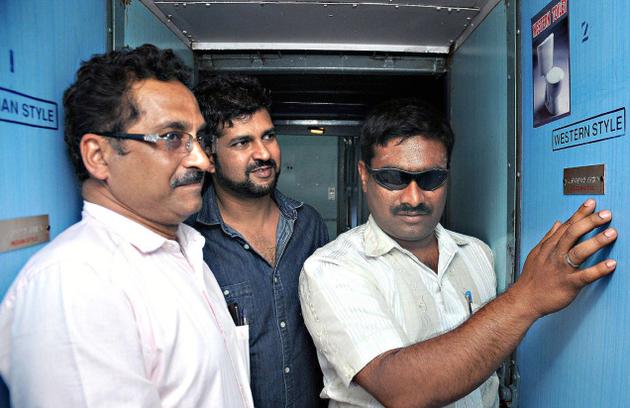
The Mysuru-Varanasi Express will become the country’s first Braille-embedded train. The bi-weekly express (Train No. 16229/16230), which chugs out on Tuesday, will leave Mysuru for Varanasi on Tuesdays and Thursdays.
It has been provided with metallic Braille signage indicating berth numbers, location of alarm chains, toilets, and emergency windows. There are also instructions on how to operate the emergency exit windows. The initiative has been financed by Mysuru MP Pratap Simha from the MPLAD fund.
Though the Puri-Delhi Purushottam Express was the first train in the country to have a Braille-embedded coach, the Mysuru-Varanasi Express will be the first in the country where all reserved coaches have been embedded with Braille signage, said Rajkumar Lal, Divisional Railway Manager, Mysuru Division, South Western Railway.
Braille signage has been introduced on one rake of the express and it will soon be introduced in the second rake as well. The Chamundi Express and the Mysuru-Talguppa Express are the other two trains that will be provided with Braille displays after this, Mr. Lal said. “The plan is to extend the facility to all reserved coaches of long-distance trains in a phased manner,” he added. Braille signage indicating the coach number is next on the agenda.
The Braille signage indicating berth numbers and location of toilets will be of great help to the visually-challenged travelling on the Mysuru-Varanasi Express.— PHOTOS: M.A. SRIRAM
Netravati, a visually-impaired person, welcomed the initiative and said that it will help them identify the seats or berths without seeking help from others. “We will be more independent as sometimes, people do not respond to us as they tend to be in a hurry to locate their berths,” she said.
source: http://www.thehindu.com / The Hindu / Home> National> Karnataka / by R. Krishna Kumar / Mysuru – January 26th, 2016
Seen in the picture are Muay Boran Champions (from left – squatting) Harish S. Gouli, B. Ravi, K.G. Prajwal Deep & A.M. Arjun with Coach KRU. Chethan M. Ashwathama (standing).
The 1st South Indian Muay Boran Championship, organised by Muay Boran Association of Kerala under the aegis of Muay Boran Association of India, was held on Jan. 9 and 10 at Salem Marthoma Auditorium, Kayamkulam, Alappuzha District, Kerala.
More than 300 participants of 25 different clubs from Kerala, Andhra Pradesh, Telangana, Tamil Nadu and Karnataka took part in the tournament which tested the strength, stamina and skills of the fighters.
Muay Boran Fighters of Kimura Fight Club, Mysuru, who took part in the tournament, won one gold and three silver medals.
They also won the 2nd Runner-up Trophy of the Championship. Besides these, the Kimura Fight Club was awarded the 8th Best Club of the Tournament.
K.G. Prajwal Deep won gold in the below 80 Kg category. In the Muay Boran Title Belt Fight, Prajwal Deep lost his bout against Kerala opponent and had to be content with the Runner-up title.
Harish S. Gouli, B. Ravi and A.M. Arjun won silver medals in the below 75 Kg, below 63.5 Kg and below 67 Kg category respectively.
All the fighters are trained by Kimura Fight Club Chief Coach and Trainer KRU. Chethan M. Ashwathama, who is an expert in Muay Thai, Muay Boran and Brazilian Jiu Jitsu. He has been trained at the Tiger Muay Thai Academy,Thailand and is training students from the past six years. He has a KRU Degree (Master in Muay Thai) from the Muay Thai International Association and is accredited by the Thai Ministry of Education, Thailand.
source: http://www.starofmysore.com / Star of Mysore / Home> Sports News / January 25th, 2016
A group photo of the roller skaters who won gold medals in the 53rd National Roller Sports Championships Speed Skating event held at Pune from Jan. 15 to 20. Seen are (from left) Rea Elizabeth Achaiah, Suraksha R. Shetty, M. Harshitha, Aditya S. Rao, Sanjith Gowda, Varsha S. Puranik and Kalpana Kuttappa.
Mysuru :
Mysuru roller skaters, representing Karnataka in the just concluded 53rd National Roller Sports Championships Speed Skating event held at Pune from Jan. 15 to 20, returned with a rich haul of medals — 17 gold, 15 silver and 6 bronze medals.
Varsha S. Puranik won 5 gold medals in the women’s section, while Rea Elizabeth Achaiah won four gold and one silver, M. Harshitha won three gold, Aditya S. Rao won two golds, two silver and one bronze, Akash Aradhya won two gold, two silver and one bronze, Suraksha R. Shetty won one gold and one silver, Deeksha Devangi won one silver and one bronze and Kalpana Kuttappa won one silver and one bronze medal respectively.
The team was accompanied by Ekalavya Awardee coach Srikanth Rao.
source: http://www.starofmysore.com / Star of Mysore / Home> Sports News / January 25th, 2016
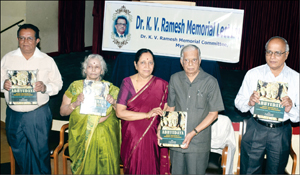
Prof. A.V. Narasimha Murthy (second from right), Chairman, Bharatiya Vidya Bhavan (BVB), Mysuru, released the Commemoration Volume “Abhyudaya” brought out in honour of late Dr.K.V.Ramesh, an erudite scholar and an epigraphist of international-fame, edited by Dr.T.S. Ravishankar (extreme left) and Dr. S. Swaminathan (extreme right), at function in BVB premises in Vijayanagar here recently under the auspices of K.V.Ramesh Memorial Committee, Mysuru.
Prema Ramesh (second from left), wife of late Dr. K.V. Ramesh and Kamalamba Narasimha Murthy are also seen.
The volume contains a detailed bibliography of Dr. Ramesh’s research work and his bio-data.
It has been embedded with 72 pearls (research articles penned by scholars from all over India and abroad).
Published by Bharatiya Kala Prakashana, Delhi, the book is priced at Rs.4,000
source: http://www.starofmysore.com / Star of Mysore / Home> General News / Monday – January 25th, 2016