The app allows healthcare professionals who handle TB patients to calculate the right BMI and nutrition levels.
Bengaluru :
After N-TB app developed by a Mangaluru professor and his team gained popularity among doctors and Revised National Tuberculosis Control Programme (RNTCP), the team has been approached by the Ministry of Health to upgrade the app and make it more patient-friendly.
The developer of the app, Anurag Bhargava, professor of medicine at Yenepoya Medical College in Mangaluru, says, “The present app is definitely of help to the doctors and nurses advising dietary counselling, which is a major part of treatment of persons with Tuberculosis (TB). We need to upgrade the app to make it more people-oriented.”
In the new app, according to sources, the Ministry of Health also plans to include ‘Nikshay programme’, where registration and monitoring of TB Patients will take place online.
“The existing NT-B app provides information on nutrition, as under-nutrition could prove to be fatal for those with TB. This is the critical indicator that will be shown in the app, to help in dietary counselling. The app also demystifies dietary counselling by calculating the nutritional value of food. Weight is an indicator that is often monitored when treating TB, but height too is critical in getting the actual picture,” explains Bhargava.
The app allows healthcare professionals who handle TB patients to calculate the right BMI and nutrition levels. This app was developed based on the guidance document on nutritional care and support for patients with tuberculosis in India, that was released by the RNTCP last year.
source: http://www.newindianexpress.com / The New Indian Express / Home> States> Karnataka / by Chetana Belagere / Express News Service / February 07th, 2019
Recognition: The award winners with Azim Premji, chairman of Wipro Ltd. | Photo Credit: Special Arrangement
They include a team each from a Belagavi school and a Bengaluru college
Fourteen schools and 10 colleges from various parts of the country have bagged the ‘Wipro Earthian Awards 2018’. The awards were presented to the winners by Azim Premji, chairman of Wipro Ltd., on Saturday in recognition of their sustainable thinking. Government High School, Sambra, Belagavi district, and BMS College of Engineering, Bengaluru, are the winners from the State.
A press release states that 1,300 entries were received for the 2018 edition of Wipro Earthian programme.
“The teams from schools demonstrated their understanding of biodiversity and water through a combination of activity and essays. The teams from colleges submitted their entries on the themes of water, waste, and transportation in the urban context,” states the press release.
The entries have increased threefold since the inception of award in 2011. “The programme so far has engaged with over 55,000 schools and colleges, 1.3 lakh students and 13,000 teachers across the country. The winning institutes will get an opportunity to engage with Wipro collaborative programmes on sustainability. Anurag Behar, chief sustainability officer, Wipro, said, “The eighth edition of the award involved an outreach to schools and colleges in 29 States and two Union Territories, including those in remote locations such as Ladakh, Dras, Kargil, Sunderbans and the Nicobar Islands for the first time.”
source: http://www.thehindu.com / The Hindu / Home> News> Cities> Bengaluru / by Special Correspondent / Bengaluru – February 10th, 2019
The Angadi family, owning 125 acres of ancestral farm land in Kiresur village of Hubballi taluk, has been doing joint family farming for several years.
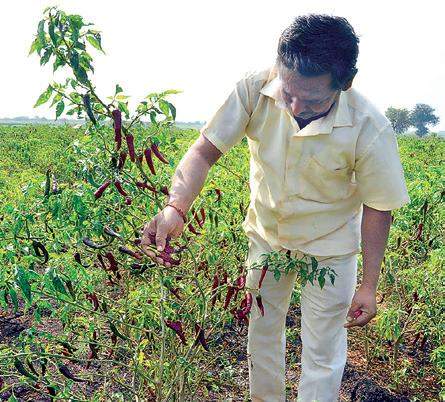
Top and left: Women from Angadi family work at their field at Kiresur village near Hubballi. Bottom left: Basavaraj Angadi inspects organically grown chilli crop at his field | D Hemanth
Hubballi :
True role models they are. They live under one roof and work together on the field. All the 50 members of this joint family are at work in their fields at the first light. What’s more, they have converted nearly 70 acres of farmland into organic farming fields and are aiming to do more. They believe that this ‘green’ cultivation produces nutritious food without destroying the environment.
The Angadi family, owning 125 acres of ancestral farm land in Kiresur village of Hubballi taluk, has been doing joint family farming for several years. Elders of the family state that they have been cultivating since last seven decades and they switched over to organic farming five years ago due to drought in the region. And the results were surprising.
Kiresur village, located about 18km from Hubballi, is taking a leaf out of Angadi brothers’ method and trying to switch over to organic farming. The neighbouring farmers have realised that this type of farming requires less amount of water.Basavaraj Angadi, one of the family members, says that they have stopped using chemical fertilisers for four years now. “We grow chilli and chickpea (chana) on our land by using organice manure. We use the decomposed vegetables and other kitchen waste as manure. After we switched over to organic manure, the yield has increased by 20% every season. We are happy with both quality and quantity,” he says.
The village comes under the irrigation map of Malaprabha river basin. But as the area is facing drought for last few years, the farmers are not getting water in time. Several times the water released in the canals does not reach the village, or it is too late for the standing crops when the water arrives.“We are able to address the water scarcity issue by using organic manure. Usage of chemical fertilisers kills the soil strength. But the organic manure strengthens the soil and improves the yield as well. We are getting additional 5 quintals of harvest every season,” Basavaraj Angadi says.
Hanumanth Nagavi, another family member, says that after attending a seminar organised by the Agriculture department, the family decided to go in for organic farming. “We have no labour issues as all the women from the house help us in fields. They lend a helping hand whenever required. During harvest season, we do take labourers from outside. But as 50 members of the family do farming together, we have never felt a shortage of hands,” he adds.
This doesn’t mean that youngsters in the family are only occupied with farming. While they do help on the farm, they are also excelling in studies. Two of them are studying engineering in Bengaluru and daughter of Basavraj Angadi is pursuing MBBS in Davanagere college.“We used to spend a lot of money on chemical fertilisers. But after switching over to organic farming, we are saving money and also getting good yield. Already a dozen farmers in our village have adopted organic manure for their crops,” says Basavaraj Angadi.
Many in the village agree that this family is indeed an inspiration. Says Pradeep Badiger, a farmer from Kiresur village, that he was inspired by the success story of Angadi brothers and wanted to adopt organic farming in his field. “I am motivated by the Angadi family and have stopped using chemical fertilisers since one year. This year I am hoping for a better harvest,” he says.
GREEN CAUSE
The joint family in Kiresur village near Hubballi has been practising organic farming for the last five years The family has largest farmland in the village with 70 acres under cultivation out of 125 acres
source: http://www.newindianexpress.com / The New Indian Express / Home> Cities> Bengaluru / by Kiran Balannanavar / Express News Service / February 10th, 2019
Juniors category winners Rohan Rajeev Bharadwaj, and Samir V. Murthy of Kumaran Children’s Home CBSE, with Seniors category winnners Vishnu Ram Sampathkumar and Dhyan Vyas of National Public School, Indiranagar, with Inder Sain Baluja, General Manager, Syndicate Bank; Dheeraj Kumar, Regional Director, Aakash Educational Services Ltd.; Bhaskar, Area Sales Manager, Eveready Industries Ltd.; and Chaitra, Soulfull – South Brand Head. | Photo Credit: K. Murali Kumar
19th edition saw 614 teams participate in juniors and seniors categories
Billed as one of the most popular quiz contests in the country, The Hindu Young World Quiz competition, was held at Chowdiah Memorial Hall here on Tuesday. The 19th edition of the event was open to school students in two categories – juniors (from class 4 to 6) and seniors (from class 7 to 10).
Juniors category
The team from Sri Kumaran Children’s Home (CBSE), Mallasandra bagged the top prize in the juniors category. The SKCH team of Samir V. Murthy and Rohan R. Bharadwaj was tied with the team from National Public School, HSR Layout, in the penultimate round with 50 points. The SKCH team garnered 20 points in the ‘Shoot Out’, the last round to emerge victorious with 70 points. They received trophies, merit certificates from The Hindu and bicycles and goodie bags from sponsors.
The NPS, HSR Layout team of Aron Mondal and Neelkanth S. took the first runners-up position, while the team from Delhi Public School Bangalore South of Adithya N.M., and Anubhav S., took the second runners-up position.
After the preliminary written round, six teams made it to the on-stage final round.
The teams from KLE Society’s School, Rajajingar, Deens Academy, ECC-Whitefield and Vidyashilp Academy, Yelahanka finished in fourth, fifth and sixth positions. They received trophies and certificates from The Hindu and goodie bags from sponsors.
Seniors category
The team from National Public School, Indiranagar, led from the beginning eventually to win the competition with a grand total of 199 points in the seniors category. The NPS team of Vishnu Sampathkumar and Dhyan Vyas won the competition for the second consecutive year. They received trophies, merit certificates from The Hindu and bicycles and goodie bags from sponsors.
The team from Bethany High School, Koramangala of Vasanth K. J., and Rishab Nanda took the first runners-up position with 120 points. The team from Presidency School, R.T. Nagar of Ananya Patil Rao and Daksh Shettar took the third position with 92 points. The teams from Sri Vidya Kendra – The Smart School, Machohalli, National Public School, Koramangala and Presidency School, Nandini Layout took the fourth, fifth and sixth positions. They received trophies and merit certificates from The Hindu and goodie bags from sponsors.
Prize distribution
Inder Sain Baluja, general manager (PR & Publicity), Syndicate Bank, Dheeraj Kumar, regional director, Aakash Educational Services Ltd., Bhaskar, area sales manager, Eveready Industries India Ltd., and Chaitra, brand head (South), Soulfull, gave away prizes to the winners. Quizmaster V.V. Ramanan hosted the show. In all, 240 teams in juniors category and 374 teams in seniors category from schools across the city participated.
Sponsors
Syndicate Bank was the presenting partner. The event was powered by Eveready Industries India Ltd. Arrow Publications Pvt. Ltd. was the knowledge partner. Frog Bikes was the national gift partner. Aakash Educational Services Ltd. was the education partner in Karnataka.
The nutrition partner was Soulfull, the gift partners were The Children’s Place and Naturo, the snack partner was Unibic, the refreshment partner was Hotel Adyar Ananda Bhavan and the beverage partner was Bejois.
source: http://www.thehindu.com / The Hindu / Home> News> Cities> Bengaluru / by Sudhindr A.B. / Bengaluru – February 07th, 2019
Two students from MVJ College of Engineering have developed a device called ‘bBook’ that converts text into braille in real time.
The students took five months to create the device
Bengaluru :
Two students from MVJ College of Engineering have developed a device called ‘bBook’ that converts text into braille in real time. Once a person with a visual impairment places the device over the text, it uses the six pins on its surface to convert the text.
A small camera in the bBook is used to scan text, which is then processed and the data generated is used to drive a braille unit. This unit gives the input character equivalent to braille. “A person can also download the latest news articles. A specially designed audio interface will be available, which will enable the user to use voice-control,” said Rohit Natesh, a student at the college.
The device can also be connected to mobile phones in order to receive notifications from the bBook application. It works in three speeds – slow, medium and fast – that is 4 seconds, 2.5 seconds and 1.5 seconds. They have been working on the device for five months now. “It has been a pleasure to work with my students. We hope to receive more feedback from blind schools,” said Desikan Srinivasan, assistant professor at MVJ College of Engineering.
source: http://www.newindianexpress.com / The New Indian Express / Home> Cities> Bengaluru / by Aarthi M / Express News Service / February 06th, 2019
Visitors at the museum on Monday. | Photo Credit: V Sreenivasa Murthy
The Archives was inaugurated on Monday
The Archives, an informal museum of sorts that records the history of the National Centre for Biological Sciences (NCBS) and contemporary biology research in the country, was inaugurated on Monday.
It has been set up in a 1,500 sq.ft. space in the Eastern Lab Complex (ELC) in NCBS, and includes reading rooms, exhibition areas and a professional recording room for oral history interviews and podcasts. The Archives has been shaped by over 40 students and professionals between 2016 and 2018.
It is free and open to the public.
From manuscripts and negatives to books and scientific equipment and field and lab notes, The Archives aims be a collecting space that enables ‘diverse’ stories of biological research, says a release.
For now, The Archives has five manuscript collections, seven institutional collections, two artefact collections, two bibliographic collections, and an oral history collection.
The caption was corrected for a spelling error
source: http://www.thehindu.com / The Hindu / Home> News> Cities> Bengaluru / by Staff Reporter / February 04th, 2019
The massive engine whirrs beneath your body, wind strikes your face and your hair whips around you.
Meeta and Amit Walavalkar applied for adoption in 2016
The massive engine whirrs beneath your body, wind strikes your face and your hair whips around you. Every action has an immediate consequence when riding, according to Meeta Walavalkar, whose life motto is to live in the moment. However, the 40-year-old mother of three has not gone riding in the last 45 days.
On December 17, 2018, Meeta, her husband Amit, and their two sons welcomed their three-year-old daughter, Shambhavi, into their home. “My husband and I were so busy with all the paperwork at the time that we did not actually take in the fact that one of the ten children inside was going to be our daughter. We were more concerned about how she would react to coming home or if she would have any language barriers,” said the owner of Soul Bakery, which supplies organic food to Chennai and Bengaluru.
However, she said her two sons, Ved and Darsh, were inside, spending time with their new sister. Shambhavi, who came to Bengaluru from Chattisgarh. Now, she’s seen her 13-year-old and 10-year-old sons become protective of their sister.
In March 2016, after attending an inner engineering workshop with Sadhguru, the Bengaluru-based NGO consultant and her husband came away feeling lighter – spiritually and mentally. Meeta told her husband that she wanted to adopt a girl child, and Amit was onboard. After some discussion with her family, they applied for a girl child through the Central Adoption Resource Authority system, and two-and-a-half years later, they brought their daughter home.
Her name, Shambhavi, is the energy form consecrated in Sadhguru’s ashram in Coimbatore, said Meeta, who is a follower who can perform pujas. The day before Shambhavi came home, Meeta reminded her sons to express any concerns without fear of judgment.
The three-year-old loves school, and wakes up every day excited to learn. “She comes home before they boys do, and asks when her bhaiyas will come home. Before, the boys would come home, eat something, and go out to play. Now, they spend some time with their little sister before going,” said Meeta.
Coming from a family with many male children – Meeta’s father had two brothers, as did Amit’s father, and she has two sons – Meeta has found little changes in her parenting. “With the boys, if they fall and hurt themselves, I just have to put a little dettol and send them off. I’m not used to mollycoddling my children, but Shambhavi wants to be held and cuddled if she falls,” said Meeta.
There was some hesitancy from her and Amit’s parents initially. Meeta had a bustling daily schedule, and caring for a child would take up a lot of time. When the topic was broached to her parents, Meeta’s father was averse to the concept. “Now, he videocalls every other day to see her. You know the Queen song Bohemian Rhapsody? She calls out to him the same way they sing ‘Mama…’ in the song. So she’ll go, ‘Ajuba…’ and call out for him,” said Meeta.
Shabhavi has a high emotional intellect for a child her age, said Meeta. “The other day, my father called, and he had hurt his hand. He showed it to her, and she was very affected by it. She came into our room crying, saying that her Ajuba was hurt,” said Meeta. Another trigger for Shambhavi was when her plate was taken away from her, as in the funds-strapped orphanage she grew up in, that was a sign of having no food.
Meeta and her husband know that eventually, Shambhavi will want to meet her parents. “All I hope is that the process goes as smoothly as possible, for her. We will be there with her, of course,” said Meeta.
It’s too soon to plan for the future, she said. Meeta is not one to live in anything but the present, but for one instance – “When we ride, I take the youngest and Amit takes the older one. Now with Shambhavi, we need to figure out a way to take all of them when we go riding next.”
source: http://www.newindianexpress.com / The New Indian Express / Home> Cities> Bengaluru / by Rochana Mohan / Express News Service / February 04th, 2019
Padma Shri R.B. Patil, who established North Karnataka’s first comprehensive centre for cancer in 1977 from voluntary donations, passed away in Hubballi on Saturday. He was 93.
He is survived by a son and two daughters, who are all doctors.
A native of Angadageri in Basavanabagewadi taluk of Vijayapura district, Dr. Patil came to Hubballi after completing his education in England and continued to see patients until recently before his health deteriorated.
The mortal remains of the surgeon were kept at his nursing home in Vidyanagar, Hubballi, for people to pay tributes.
His son, B.R. Patil, said the funeral will be held at his native place on Sunday. Journalist Patil Puttappa, former Chief Minister Jagadish Shettar, former Chairman of Legislative Council Basavaraj Horatti, Minister C.S. Shivalli, former Minister Vinay Kulkarni, MP Pralhad Joshi, MLC Pradeep Shettar, Srinivas Mane, MLA Prasad Abbayya and several others have mourned his demise.
source: http://www.thehindu.com / The Hindu / Home> News> States> Karnataka / by Special Correspondent / Hubballi – February 03rd, 2019
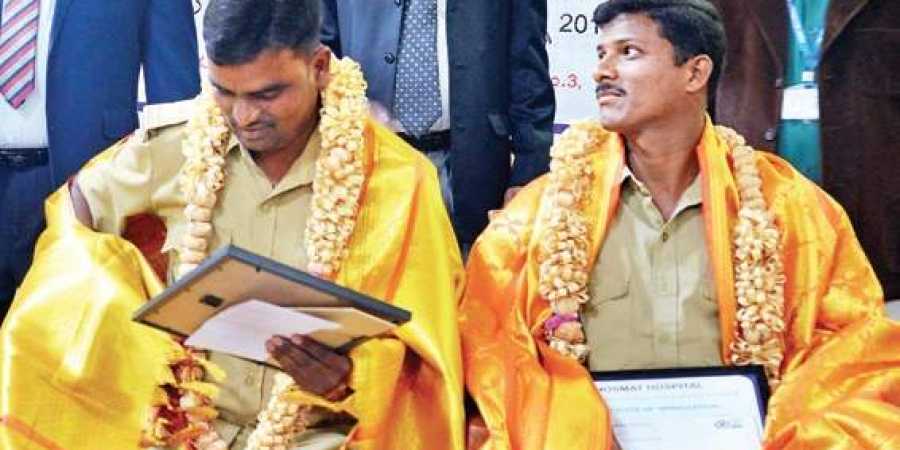
The duo were felicitated with the ‘Good Samaritan Award’ by HOSMAT Hospital on Saturday. This is the second such appreciation the duo has received and they are very happy.
Bengaluru :
Little did Gangadhar (29), a BMTC driver, and Srinivas, a conductor, think that their Good Samaritan act of saving a constable’s life will bring them so much appreciation and calls from people across the state.
The duo were felicitated with the ‘Good Samaritan Award’ by HOSMAT Hospital on Saturday. This is the second such appreciation the duo has received and they are very happy.
“From an auto driver who wanted to write our names on the back of his auto to our MD of BMTC, we have been appreciated,” said Gangadhar, who has been a driver with BMTC since the past six years, and a native of Hassan.
Recalling the day, Gangadhar said, “On December 29, around 8pm, after finishing our duty, we (he and the conductor) were heading towards Nelamangala from Yelahanka when we saw a crowd of people. I stopped the vehicle thinking people were waiting for a bus but then I noticed a severely injured man in a pool of blood. There were severe injuries on his head and over 50 onlookers were standing there taking videos.”
He continued, “We immediately shifted the victim into the bus and went to the hospital.”
HOSMAT Hospital’s chairman and chief of Orthapaedics, Dr Thomas Chandy who presented the awards to the duo, appreciated them for their courage and kindness.
“It is rare that we find such people. HOSMAT sees at least 25 to 30 accident cases every day and we come across at least 20 per cent of people who would have died due to people not risking to bring them to the hospital on time. Such compassion is needed,” he said.
source: http://www.newindianexpress.com / The New Indian Express / Home> Cities> Bengaluru / by Express News Service / February 03rd, 2019
A company delivers 10 to 12 day old plants that are rich in nutrients and anti-oxidants
Akash K. Sajith was theVice President of Customer Experience and Analytics at a firm when his life changed a couple of years ago, after both his parents became very ill.
This resulted in Akash starting to think about the nutrition value of the food we consume and the manner in which it is prepared. “I realised that good food is vital for good health. Real food is about trust and transparency. It is about ensuring quality and traceability at every step. We set up Living Food Company to provide the food we can trust and to meet a need to take control of our food production systems.”
Microgreen dreams
With his co-founders, Niranjan and Shikha, Akash decided to grow micro-greens, 10 to12-day old plants that are extremely rich in nutrients, antioxidants, essential vitamins and minerals. The Living Food Company grows and delivers the produce to households across the city and sells it to hotels such as the Hilton, Shangri-La and top chefs in the city.
Akash says, “We focus on growing highly nutritious micro-greens such as kale, broccoli, mizuna (Japanese mustard), pink radish, red chard and 15 other varieties. They are a rich source of vitamin A, B, C, E, proteins, calcium, iron, zinc, potassium, magnesium and folic acid. These essential nutrients are often neglected in our diets and the living greens help correct these nutritional imbalances. We aim at making these nutrient-rich foods affordable and accessible for the average urban Indian consumer and democratise access to super-foods.”
Describing the greens, Akash says, They are usually about one to three inches long and come in a rainbow of colours, which has made them popular in recent years as garnishes with chefs. We have climate-controlled hydroponics and aeroponics farmsdesigned to eliminate soil contamination, enhance nutrition and preserve taste and flavour, making us one of the first climate-smart and sustainable farms in the country.”
There are daily and monthly subscription packs. “We deliver across the city. Koramangala, Whitefield and Indiranagar are areas where we have a good subscriber base. I am sure this will become more popular in the time to come.”
source: http://www.thehindu.com / The Hindu / Home> Life & Style / by Nikhil Varma / February 01st, 2019