Mysuru chaiwala’s daughter makes city proud, marches at Republic Day parade
Chandana M R was the lone female participant from Mysuru district and was selected from a pool of 1,800 candidates under the Karnataka and Goa NCC Directorate after rigorous tests.

Mysuru :
It was a day of pride for tea vendor Rajendra Kumar when his daughter, a first-year diploma student, marched with the NCC contingent at the Republic Day parade at Rajpath in New Delhi on Saturday.
Chandana M R was the lone female participant from Mysuru district and was selected from a pool of 1,800 candidates under the Karnataka and Goa NCC Directorate after rigorous tests. “It was a proud moment for me sitting in the humble tea shop to say that my daughter marched for the country at the Republic Day parade,” said Rajendra, who runs Vani Tiffins, a small tea shop near Kuppanna Park in the city.
Chandana’s mother Pushpalatha was elated as she spoke about her daughter. “To have my daughter march in the parade was a great moment for me,” she added. According to Pushpalatha, it was her daughter’s determination that helped her achieve this feat. “Last year too she tried, but she could not clear it. This year, she worked hard and she made it,” the proud mother said.
Speaking to TNIE from New Delhi, Chandana said, “It was beyond what I had even dreamt of. Many people were cheering as we marched, we all cried out of joy after the march past. To have marched along with the heroes in our armed forces is a great achievement for me.”
Chandana, who wants to become an army officer, said the opportunity has given her more courage to pursue her dreams. “Defence Minister Nirmala Sitharaman herself came to our camp and encouraged us. We also attended a tea party at the Army Chief’s house. We will also attend a dinner party with our President. All this has affirmed my dream to become an officer in the Army,” added Chandana.
Apart from Chandana, two youths — Dharma and Manja — from the city also marched with the NCC contingent in the Republic Day parade. After the state-level trials, nine girls were selected for the parade to represent state and Goa.
source: http://www.newindianexpress.com / The New Indian Express / Home> States> Karnataka / by Ajith M S / Express News Service / January 27th, 2019
31
Yakshagana singer Agari Raghurama ‘bhagawatha’ passes away

Noted Yakshagana singer-cum-director ‘bhagawatha’ Agari Raghurama passed away here on Sunday. He was 83 and is survived by three sons and a daughter.
Mr. Raghurama, from Surathkal, died in a private hospital in the city at about 10.30 a.m., family sources said.
Hailing from a family of Yakshagana, his father, Agari Srinivasa, was also a well known ‘bhagawatha’ of olden days.
Mr. Raghurama had quit the government job after serving as a clerk in the Education Department for nine years to become a professional artiste. He worked as the ‘bhagawatha’ in the erstwhile Mahammayi Krupaposhita Yakshagana Mandali, Surathkal for three-and-half decades.
Mr. Raghurama had a typical style of singing which became popular as ‘agari shaili’. Some of the contemporary ‘bhagawathas’ in Tenku Thittu school of Yakshagana now sung in the same style to carry it forward.
He was the contemporary of doyens of Yakshagana late Sheni Gopalakrishna Bhat, late Malpe Shankaranarayana Samaga, late Tekkatte Ananda Master and late Puttur Narayana Hegde.
source: http://www.thehindu.com / The Hindu / Home> News> States> Karnataka / by Special Correspondent / Mangaluru – January 27th, 2019
29
Tree cheers to the forest man of Mysuru
Ramesh, a 42-year-old resident of Chandagalu, has undertaken the Herculean task of converting Karighatta Hill, located in the reserve forest area near Srirangapatna, into a huge green patch.

Mysuru :
Unperturbed by the scorching sun, balancing a 20-litre water container on his shoulder and carrying another one in his hand, Y Ramesh walks uphill every day — to water saplings in the forest.
Ramesh, a 42-year-old resident of Chandagalu, has undertaken the Herculean task of converting Karighatta Hill, located in the reserve forest area near Srirangapatna, into a huge green patch. Right from filling the cans with water to sprinkling it on the saplings, Ramesh, who runs a business of delivering water containers to customers, does all the work by himself.
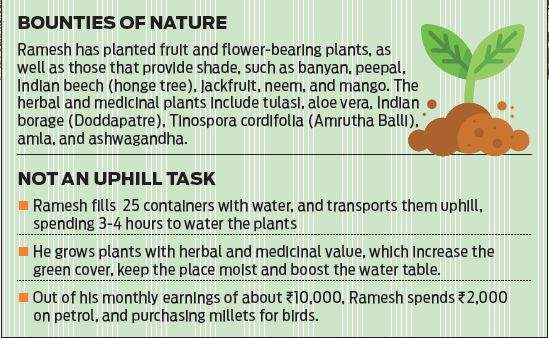
He follows the same daily routine from December to the monsoon season, carrying the unusable or broken containers in his goods vehicle (Tata Ace Zip), and going to the bottom of the Karighatta Hill, where river Cauvery flows. He fills 25 containers with water, and transports them uphill, spending 3-4 hours to water the plants. Ramesh waters 80-100 saplings a day. He has also placed placards at several places on the hill, which carry messages to conserve forest, wildlife and environment.
Now hailed as a local hero, Ramesh, however, had to endure sniggers as well as scepticism from others. “People, including my family members, laughed at me for lifting water from the canal and carrying it to water the plants,” he says. “Some said I was behaving abnormally, while some others asked me to be careful of the burning sun, as I may suffer health issues. Now, things have changed. Many people voluntarily come forward and plant trees here.”
Among his ardent supporters now is his wife, Anupama. “I used to discourage him earlier, but over the years I have started to love to accompany him in my free time. I help him in writing slogans, and loading empty containers in the vehicle,” she says. “He motivates villagers to plant trees on special occasions, and give saplings instead of other gift items during functions.”
Ramesh has devised his own ways to employ the method of drip irrigation on the hill. He cuts the 20-litre water can, with its lid screwed on, into two parts, and drills holes in them to use them to water multiple saplings. He even makes use of 1-litre and 2-litre water bottles discarded by tourists for drip irrigation.
Besides planting saplings, he also cleans the surrounding areas so that growth of vegetation is stimulated. He grows plants with herbal and medicinal value, which increase the green cover, keep the place moist and boost the water table. Ramesh collects the saplings from the forest department, and maintains them for a year. Some of the saplings planted by him a few years ago are now fully-grown trees, towering to even 10-feet height.
Ramesh has also placed a small container on the hillside to feed birds.His daily routine began years ago as a bid to oppose the traditional practice among villagers in Srirangapatna to torch the forest near the hill every February. It was a part of their ritual, where they pray to Lord Sri Venkateswara for prosperity, and ask him to bless them with children, wealth and health. It’s because of this practice that the hill got its name, Karighatta (kari means black and ghatta means hill in Kannada).
“The blind belief has been, Neena Betta Suttu Kappu Maduthivi (We torch your hill and make it black),” says Ramesh, talking about how he decided to educate villagers and put an end to the practice. “I was deeply moved to see small animals, such as snakes, cats, squirrels and birds, getting burnt to ashes in the man-made forest fire in 2011. I first started planting trees and later decided to visit the villages and educate people about the importance of the forest. Later, I started asking them not to burn the forest area. I request them to make a small plot and perform their rituals without harming the jungle.”
The villagers now join forces with him in the initiative. “Ramesh is bringing together students, social activists and other like-minded people to plant saplings and educate others not to burn the forest,” says B Somnathpura, a village head. “Some of them are voluntarily joining him in his endeavour. For the last four years, he has been visiting the villages in January, making announcements on loudspeakers, asking people not to set the forest on fire, and educating them about the importance of trees,” he adds.
Ramesh also urges tourists to maintain cleanliness in the region and not to spoil it by throwing garbage. “My only aim is to continue planting the forest for the rest of my life and increase the greenery,”he says.
source: http://www.newindianexpress.com / The New Indian Express / Home> States> Karnataka / by K. Rathna / Express News Service / January 27th, 2019
27
A local answer to cane crisis
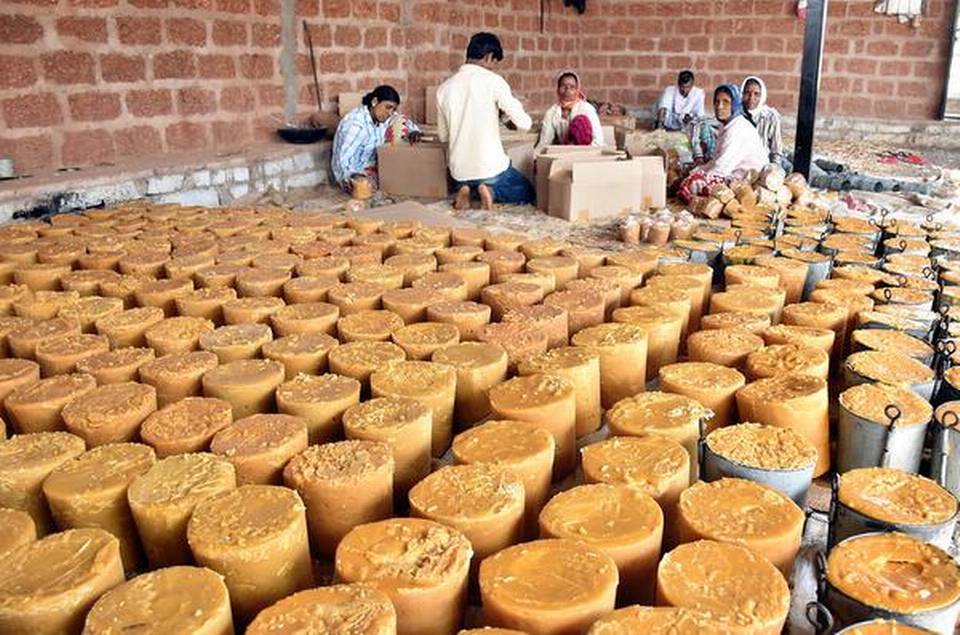
A small jaggery unit assures growers a hassle-free harvest and timely payment
While sugarcane farmers are still bogged down by settlement of dues from cane factories, growers in around 10 villages around Rajapur in Chittapur taluk of Kalaburagi district have found alternative avenues to sell their produce. Skirting the factories, they are now going to a local jaggery unit which promises a hassle-free harvest and timely payment.
Sudhakar V. Patil, once a sugarcane farmer himself, set up a jaggery unit in Rajapur investing ₹25 lakh in 2017. The unit can crush 30 tonnes of cane a day. Last year, the unit crushed around 2,000 tonnes and is expected to get more business this season. Farm scientists believe that replicating such experiments could go a long way in solving the cane crisis.
Till last year, the cane growers of these villages were having a tough time. There was no sugar factory within a 100-km radius and mills would take their produce only by the end of the season. Many complained that they had to bribe factory agents to get their crop harvested and transported early. Then, there was inordinate delay in payment. The situation was so bad that some farmers chose to set their fields ablaze than wait endlessly for factories to take the crop.
“I purchase cane from the farmers paying ₹100 less per tonne than what the sugar factories pay. Yet, farmers prefer to sell their crop to me as I am prompt in paying them. I clear the dues within 40 days. Sometimes, I pay in advance as well,” Mr. Patil said.
Raju Teggelli and Vasudev Naik, farm scientists attached to KVK (Krishi Vigyan Kendra), view it as an “effective model” to address the cane crisis.
They are open to offering guidance to those who come forward with similar initiatives. They have opened a small retail outlet on KVK premises in Kalaburagi for selling the jaggery produced in Mr. Patil’s unit.
“Large problems can have local solutions. People with relatively better financial stability should come forward to establish small agro-processing units in rural areas. Such initiatives help both farmers and local entrepreneurs. It can generate job opportunities too,” said Mr. Teggelli.
Mr. Patil employs 25 persons at his unit of which 15 are skilled jaggery makers from Uttar Pradesh; the rest are locals. Jaggery makers are paid at ₹230 per each quintal of jaggery they produce. They together make around 20 quintals of jaggery a day.
Mr. Patil believes in minimising middlemen in the marketing chain. Nearly two-thirds of jaggery produced in the unit is sold directly to retailers and the rest to wholesalers.
He has also formed some teams to sell the product directly to consumers in the nearby villages. He now plans to create his own brand and make jaggery-based products soon.
source: http://www.thehindu.com / The Hindu / Home> News> States> Karnataka / by Kumar Buradikatti / Kalaburagi – January 25th, 2019