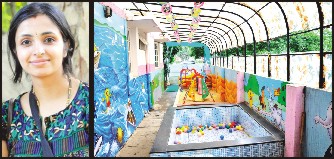
Treading on a different path …

ManasaRaoBF20sept2013

Children mean life to many. But she restructured her life for them. From pursuing Master’s in one of the most interesting Science subjects and working in a renowned scientific firm to taking a U-turn with the idea of doing something else altogether and establishing a playschool of her own, she has come a long way. Doing it all at a young age of 28 is what makes it an achievement.

Manasa Rao, a budding achiever from city, is based at Bangalore where she went chasing her dreams about six years ago. Having completed her schooling at Mysore and Masters in Biochemistry at Manasagangotri here, she too like many youngsters in city relocated to the Garden City in search of a job. And in the year 2009, she found herself placed as a junior scientist at the Jawaharlal Nehru Centre for Advanced Scientific Research and two years later went on to become a scientist in a world renowned healthcare company at Bangalore. But a little while later did she realise that her interests were something else altogether — children, child growth and the edification of early growers and thus decided upon coming up with something of her own for them.

In 2011, she set up a preschool of her own with the franchise of a leading preschool group, thus turning out to become a young and budding entrepreneur. “Starting up a business of your own with no prior experience is no mean task and it took me quite a bit of time to understand and get into the swing of things,” says Manasa, adding, “But as I learnt the art of managing things, it all turned out to seem exciting. Waking up each day to see the smiling faces of little learners full of enthusiasm is a feeling so wonderful that I forget everything else around me as I enter the centre.”

While she initially started with the admission of less than six children for day care, play group, nursery, junior and senior KG education programmes, the centre began picking up with time with over 70 children pursuing various programmes at it currently.

Ask her what she feels about the growth of herself and the education centre in these two years and she replies, “I am happy and it gives me a sense of satisfaction. However, having blend with so many little ones all of different nature, I now yearn for more knowledge in the area of child growth and education.”

Married to Vishnu Kumar, an engineer and a mother of a one-year-old, Manasa feels she is still quite young to be known the ‘principal’ of a school, and says, “I might have achieved things but I still have a lot more to learn and a long way to go. I have a sense of responsibility towards these children and their parents who come to me with loads of questions about children and their growth and education.”

Hence, the young entrepreneur’s next venture is to research upon the area of child education, child psychology, special children and their needs. “With that I will get to know children even better and can provide for them better,” she says.

But does she miss being a scientist? “At times, yes. I miss working as a scientist and learning new things in the area of Science. But guess this is a field that has been teaching more than what I would have learnt as a scientist. The little ones teach me so many things that I have not known as an elder myself in all these years,” she gushes.

The playschool is based at HSR Layout in Bangalore. —AN

source: http://www.starofmysore.com / Star of Mysore / Home> Feature Articles / September 17th, 2013

From Beans to Bricks

Brigade Group Founder speaks to SOM

1) M.R. Jaishankar 2) Brigade Sparkle at J.P. Nagar

Mysore :  

Brigade Group, unlike most developers from Bangalore, has not ignored Mysore and has had a number of projects in the city. M.R. Jaishankar, Founder and CMD of Brigade Group, spoke to SOM during his visit to city recently to inaugurate the Company’s latest project.

by S.N. Venkatnag Sobers

Having come from a family of coffee growers in Chikmagalur, M.R. Jaishankar completed his degree in Agricultural Science from the University of Agricultural Sciences, Bangalore and then secured an MBA degree from the University of Mysore. He worked as a management trainee at the UB-MEC Batteries after which he started his own company MLR Industries in 1980. The company manufactured Chicory. MLR industries, under the leadership of Jaishankar, went on to become the largest supplier of Chicory to Brooke Bond India Limited.

In 1984, Jaishankar decided to diversify into real estate and launched his construction company ‘Brigade Enterprises Limited’ with a grand construction of Brigade Towers during October 1986, which at that time was the tallest building constructed by a private developer.

When asked why he chose the construction business, he says because it was viable.

“Any business is 80 percent common sense coupled with hard work and good use of opportunities. Right decisions at right time in the interest of the company with no selfish motive will always help in the growth of a business”, says Jaishankar.

He then adds, “Though we had a presence in Mysore, here too we have become the first company to build the tallest apartment complex Brigade Horizon.”

Sharing his idea on housing for the middle-class sector, Jaishankar said that the prices of land have gone up which has resulted in rise in prices of the apartments. “The Government should come forward and provide lands at a cheaper rate so that the private developers come forward to construct affordable houses”, he added.

KPL and Brigade Group

Brigade Group was one of the Karnataka Premier League (KPL) franchise owners, Bangalore Brigadiers. The franchise was bought for a whopping USD 1.1 million. Though, first two seasons were conducted in 2009 and 2010, the tournament has not been conducted since 2011 owing to misunderstanding with KSCA authorities.

Sharing his experience on KPL, Jaishankar said “from the beginning itself KPL was a badly conducted tournament.” He then added, “Even the present committee too did not take much interest in solving the issued related to KPL.”

When asked whether Brigade Group would still want to be a part of KPL, Jaishankar mentioned that it depended on the planning and handling of the tournament. He said that the tournament should be conducted with a good intention.

“We have an open mind. But, everything depends on what the KSCA offers to the franchise and promotions on the tournament”, said Jaishankar.

Speaking of his company’s plans for Mysore, Jaishankar said that they are also coming up with two luxury hotels — one on New Sayyaji Rao Road with 150 rooms and other on KRS Road. This apart, the group is also coming up with another apartment project on Nanjangud Road shortly.

source: http://www.starofmysore.com / Star of Mysore / Home> Feature Articles / by S. N. Venkatnag Sobers / September 13th, 2013

Sakaala extended to Mangalore University colleges

Seats will be reserved for students excelling in art and culture; students to get TC in four days, says VC

Students of Mangalore University can get transfer certificate in four days after submitting applications and marks cards in three days from the date of announcement of results.

Vice-Chancellor T.C. Shivashankara Murthy told reporters that Right to Services Act (Sakaala) had been extended to all the 195 colleges coming under the university. Mangalore University and other universities in the State came under the Act since August 16.

As many as 14 services are being provided in a time-bound manner by the colleges. It includes transfer certificate and duplicate of admission letter (four days), conduct and study certificates (two days), issuance of marks cards and bus passes (three days). A.M. Khan has been appointed the nodal officer who will be looking at the implementation of the Act in the University and its affiliate colleges.

source: http://www.thehindu.com / The Hindu / Home> News> Cities> Mangalore / by Staff Correspondent / Mangalore – September 01st, 2013

Man who makes Howdah Elephant comfortable

PashaMahoutBF18sept2013

Mysore :

Jumboo Savari, the finale of Dasara festival is no doubt the prime attraction in city especially the golden howdah being carried by a mighty humble elephant.

Many are unaware of the intricate preparations to be made before the howdah could be mounted on the back of the elephant.

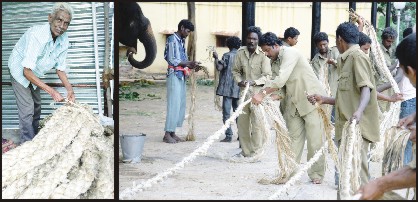
The howdah is actually placed on a thick mattress which is fastened to the back of the elephant using jute ropes.

The mattress is actually a combination of three different layers colloquially called Gaadhi, Namda and chapu.

The bottom layer Namda is actually a combination of gunny cloth and white cotton cloth woven together to get a soft texture.

Over Namda is Gaadhi which is a huge square gunny sack stuffed with wild grass grown on the bank of lakes.

Chapu is the top most layered thick cloth cover.

In short the three layer mattress is supposed to provide a firm soft support for the howdah and make the bearer elephant comfortable to carry the heavy load for a good distance.

The unsung hero instrumental in making the mattress is Pasha, a mahout of elephant Sarala who retired in 2006 but has also been doing this job of stitching the three-layer mattress right from 1971. His passion for the job and love of elephants has been recognised by the Forest Department to still keep him on the rolls. Pasha’s father Sultan too was a mahout for the Pattada Aane Hamsaraja of Jayachamaraja Wadiyar.

Pasha does not just make Namda, Gaadhi and Chapu but also weaves the thick jute rope from strands which takes about three days to make.

Speaking to SOM, Pasha said that he would begin making the jute rope ten days before Dasara. He added that he has been training other mahouts to make the mattress and rope. However he said that he was not happy to be in the forest all through and wanted his son Mansoor not to step into his shoes.

source: http://www.starofmysore.com / Star of Mysore / Home> General News / September 12th, 2013

Made by Martha

A basketful of yum: Fusing recipes from the USA and Europe with Indian flavours / Photo: Murali Kumar K. / The Hindu

Martha Kohlhagen, who settled down in Bangalore and runs a gourmet enterprise. She makes preserves, sauces, and desserts

Chicken breast stuffed with apple and onion relish, lemon tarts made with lemon curd, pannacotta vanilla cream dessert using caramel sauce, fresh vegetable salad with orange vinaigrette and chicken and pesto pastry. Such delicious food was prepared at Foodhall in 1 M.G. Road recently by Martha Kohlhagen with Chef Lynn Clemente, from Vivanta by Taj Whitefield. They also shared insights on what goes into preparing a good continental meal.

Martha, from Colorado in the United States, made Bangalore her home six years ago. “I first came to the city with an IT firm,” says Martha. But her interest in food led her to start her own company, Martha’s Preserves, in the city, which offers gourmet preserves, sauces, and desserts.

With continental restaurants mushrooming at every corner of the city and shows like MasterChef becoming increasingly popular, the interest in continental cuisine has been growing.

“There’s a huge market and interest in continental food. It’s a question of how you go about it. Where do you get ingredients? You have to pay attention to and look for what products are available in the market,” says Martha, who launched Martha’s Preserves in December last year.

“I have taken traditional recipes from the US and Europe and blended Indian flavours within them. My most popular products are my pineapple chilli jams, pomegranate orange marmalades, chocolate and pesto sauce. I have introduced French caramel sauce and fig and raisin jam. All of my products are an infusion of flavours of different cuisines.”

All the products of Martha’s Preserves are a 100 per cent natural, with no preservatives. “And it’s good, good food. I don’t compromise on the quality of my products. Each bottle is full of fruit and vegetables” adds Martha.

Gourmet food to her is about using the best ingredients to bring out the best flavours. “There is a difference between eating and really enjoying food. Gourmet food is about enjoying what you eat and saying ‘wow, that’s really good!’ It goes back to the quality and care in making the product.”

Martha speaks of what constitutes continental cuisine, and says depending on how you prepare it, there is something for vegetarians in it too. “It’s primarily preparations of meat and vegetable. If you are a vegetarian, you can expand on the vegetarian part — it’s a good balance of various types of food in one meal. The main course must be as good as the accompaniments and vice-versa. You can stuff the same things in a zucchini as you do in a chicken and it tastes equally good. All my products are vegetarian. But the lemon curd does have egg.”

Martha’s facebook page, Martha’s Preserves, also has recipes, which suggest ways in which you could use her products. You could also visit her website www.marthasfoods.com

source: http://www.thehindu.com / The Hindu / Home> Features> MetroPlus> Food / by Sravasti Datta / Bangalore – September 01st, 2013

India is the place to be, say home-bound doctors

Bangalore :

After technology sector, it’s the health sector in Bangalore that is witnessing a reverse brain drain. Across fields-nephrology, general medicine, pathology, orthopaedics and oncology among others, doctors are returning to India in general and Bangalore in particular.

On an average big medical hospital chains in the city each get 8 to 10 applications every month from Indian doctors in the US, the UK, Canada, Australia and Singapore. “I interview one doctor a week. And in the last six months I have got 12 applications for jobs from doctors abroad. They are all in their 30s,” says Dr H Sudarshan Ballal, medical director, Manipal Hospitals.

The scene is no different at Sparsh Hospital on Narayana Health City campus where chief orthopaedic and hospital head Dr Sharan Patil scrutinizes at least 10 applications every month from doctors in the UK, Australia and the US.

“There is no bigger canvas to paint yourself than in medicine. Two decades ago when doctors left India, the opportunities were few. Today opportunities outweigh frustrations. After the training, they want to return,” says Dr Patil, who himself spent five years in the UK before returning to the city to become a doctor-entrepreneur.

Ten of the 40 orthopaedicians at Sparsh are those who have returned from abroad. “I began to feel I was making no difference in my job and decided to leave Australia. I find it more satisfying here. But it is good to study and train abroad for some time,” says Dr A Thomas, spine surgeon, who practised for five years at St George Hospital, University of South Wales.

Hospital honchos are seeing the trend only in the past five years. In many hospital chains of Bangalore, the entrepreneurs are doctors themselves who left practice in the dream country where they were and came back home.

For Dr Ajai Kumar who worked at the Anderson Cancer Hospital in the US, India is evolved and it’s an experience doctors don’t want to miss out on. “The country I left in the 1970s is astounding now. It has all the infrastructure and there is no dearth of training. So what is the excuse now?” says the oncologist, who started the HCG chain of hospitals in India after spending nearly two decades in the US.

The alarming growth of cancer is also one factor drawing doctors to Bangalore. Dr Ajai gets about 15 applications from doctors in the 30-40 age group every year. From paediatric oncologist to hepato biliary surgeon at HCG, the specialists who have returned to Bangalore are from across the spectrum.

Ask Dr Pallavi Rao, pathologist, who got back to Bangalore from the UK with her radiologist husband Dr Srikanth Narayanaswamy, why she took the call. “We were there from 2005 to 2012. We chose to come back home as it stopped exciting us there,” she says.

Ditto with Dr Rekha Bhatt who joined the Manipal hospital after winding up her practice in the US. “Go there to study but get back here. India is the place to put your studies to use,” says the pathologist.

For many, it is the learning experience that matters. There is no TB, dengue or malaria in western countries. “For doctors, especially youngsters, treating diseases that are prevalent means more exposure. India is a great lab for doctors because of the sheer size and the number of surgeries we do,” says cardiologist Dr Devi Shetty.

“Coming back was no compromise for me. I began to feel that Bangalore was in no way inferior to other countries, especially in my area of specialization,” says endocrinologist Dr Karthik Prabhakar who left for the UK in 1998 only to get back to the city.

For many the dream of foreign shores is over. As a child, one of India’s top nephrologists Dr Ballal dreamt of going to the US and working there. He worked towards his dream and at 21, got his green card to do his MD in nephrology and critical care. “I was not keen on coming back. In 1991, I reluctantly returned. I told myself I will give two years to decide if I want to go back. The first few months were miserable. Twenty years on, I have no regrets. I will never leave India.”

source: http://www.articles.timesofindia.indiatimes.com/ The Times of India / Home> India> HCG / by Seethalakshmi, TNN / September 03rd, 2013

Mudhol hounds help 300 families in hunt for livelihood

MudholBF16sept2013

Hubli: 

The Mudhol hound, which was on the verge of extinction, has become a source of livelihood for hundreds of families in Bagalkot district. The breeding of these hounds has helped improve the living standards of several poor dalit families after the government set up a separate research centre in Timmapur village of Mudhol taluk. These hounds are one among the 32 such breeds recognised at the international level.

The Mudhol Hounds Research and Information Centre has been encouraging breeding and reproduction by providing puppies to more than 300 dalit families in Bagalkot.

The centre is also supplying food and free medical care to these hounds apart from training the beneficiaries who can sell the puppies. The families involved in the breeding exercise is on the rise as there is a heavy demand for Mudhol hounds from various parts of the country and abroad.

“A family can easily earn upto `3 lakh a year if it has three female and a male hound. The cost of each puppy has gone up to `7,500 from just `1,000 two years ago. We will help more dalit families become self-reliant by breeding the hounds and selling them if the government provides more assistance”, said head of Mudhol Hounds Research and Information Centre Dr Venkangouda Doddagoudar.

These dogs were brought to India by Persians, Arabs and Afghans several centuries ago. The hounds are known for their ability to endure extreme weather and for their hunting skills. There are people involved in breeding of hounds in several villages in Mudhol, Bilagi and Jamkhandi of Bagalkot district. People arrive from various parts of the country to buy these hounds during the dog show  held every year.

“The maintenance of Mudhol hounds is economical as these hounds eat very less. They sleep less during the night and can identify a scent quickly”, said Rajendra Chandanshiva who belongs to a family involved in the breeding of these hounds for the last three centuries since the Mughal era.

source: http://www.deccanchronicle.com / Deccan Chronicle / Home> News> Current Affairs / DC  / by Vittal Shastri / September 04th, 2013

Formula Manipal 2013 team returns with honours

The team of 25 students participated in competitions in Germany and Czech Republic; bagged second prize in cost and manufacturing.

Members of Formula Manipal 2013 team with the formula racing car designed by them. - DNA
Members of Formula Manipal 2013 team with the formula racing car designed by them. – DNA

Formula Manipal 2013, an annual student project of building their own formula racing cars for international racetracks students of Manipal Institute of Technology (MIT), has earned the second prize in a prestigious event in Germany.

This year, for the first time, the team comprising 25 students, participated in competitions in Germany and the Czech Republic. The team did well in both places and even bagged the second prize in cost and manufacturing in the content in Germany.

The team consists of 25 undergraduate students led by Aakhilesh Singhania (team leader) and Rishu Raj Singh (team manager). Over 23 countries participated in Germany. This was the first-ever podium finish for a Formula Manipal team.

This was the fifth time formula cars have been built and tested by the students of MIT on the international racetracks. The competition was been organised by the Society of Automotive Engineers (SAE).

Improving upon last season’s design, the team innovated and came up with a more compact design this year with reduced weight and lighter bodywork. The students used a Honda CBR 600RR engine and also incorporated a Drexler Differential along with electro-pneumatic gear shifting. The team also used a custom made  driveline and uprights, thus giving them a competitive edge.

Before participating in the competition, the team carried extensive testing on the FMX3 both in India and abroad. In India, they tested the car at a local karting track. Testing was also done in Austria at the Red Bull Ring with Joanneum Racing Graz of UAS Graz, which has helped the team perform at the competitions.

In the Cost Event, the team had to make a cost report including a bill of materials and components used. This report is then scrutinised by the judges and a discussion at the competition with the Cost Judges around the team’s vehicle is held.

This evaluates not only the cost of the car, but also the team’s ability to prepare accurate engineering and manufacturing cost estimates. And finally, a ‘real case’ scenario is held and students will have to respond to a challenge related to cost or manufacturing of the student vehicle.

The team cleared tech inspection on the very first day and also did quite well in the dynamic events. They achieved an acceleration of 4.62 seconds in the acceleration at FSG.

Formula Manipal also participated in Formula Student Czech Republic and made history by becoming the only Indian team to complete in endurance for the Formula Student Season 2013, fetching them an overall rank of ninth in the event.

Doing so, it also became the only Indian team to complete endurance with electro-pneumatic gear shifting.

The ambassadors were applauded and appreciated by renowned judges of the formula world including Claude Rouelle, the president of Optimum G and Pat Clarke, renowned bike racer.

Formula SAE (FSAE) is a competition organised by the SAE for students. The challenge for the students is to design and manufacture a formula race car with specific design and safety considerations as per the guidelines laid down by FSAE. The different cars competing at the event are evaluated on quality of design and performance.

Competitions is held in 10 different zones around the globe.

More than 2000 engineering students participate from over 23 countries to showcase their technical.

source: http://www.dnaindia.com / DNA / Home> Bangalore> / Report / by DNA , Place:Manipal, Agency:DNA / Tuesday – August 27th, 2013

City’s Skanray wins Top 100 Asia award

Vishwaprasad Alva (right), Managing Director, Skanray, is seen with Alex Vieux, Chairman, Red Herring, at the awards ceremony in Hong Kong.

Mysore :

Skanray Healthcare, located at KIADB Industrial Area in Hebbal here was declared winner of 2013 ‘Red Herring top Asia award’ at a ceremony held in Hong Kong on Sept.5.

Vishwaprasad Alva, Managing Director, Skanray, received the award from Alex Vieux, Chairman, Red Herring.

Red Herring announced its Top 100 awards in recognition of the leading private companies from Asia, celebrating these startups’ innovations and technologies across their respec- tive industries.

Red Herring’s Top 100 Asia list has become a mark of distinction for identifying promising new companies and entrepreneurs. Red Herring editors were among the first to recognise that companies such as Facebook, Twitter, Google, Yahoo, Skype, Salesforce.com, YouTube, and eBay would change the way we live and work.

“Choosing the companies with the strongest potential was by no means a small feat,” said Alex Vieux, publisher and CEO of Red Herring. “After rigorous contemplation and discussion, we narrowed our list down from hundreds of candidates from across Asia to the Top 100 winners. We believe Skanray embodies the vision, drive and innovation that define a successful entrepreneurial venture. Skanray should be proud of its accomplishment, as the competition was the strongest it has ever been.”

About Red Herring

It is a global media company, which unites the world’s best high technology innovators, venture investors and business decision makers in a variety of forums, including print, online and exclusive events worldwide. Red Herring provides an insider’s access to the global innovation economy, identifying new and innovative technology companies and entrepreneurs. Its Red Herring 100 awards for North America, Europe, Asia and Global have recognised more than 5,000 companies in their early stages, including Baidu, Google, eBay, Skype.

About Skanray

It is one of the fastest growing medical devices and solutions company that is spreading globally and aims at becoming the world’s largest primary and Mass healthcare devices, technology and solutions company. It recently set up a design centre in Europe for advanced product technology just after announcing its investments into its Brazil operations.

source: http://www.starofmysore.com / Star of Mysore / Home> General News / September 10th, 2013

The Higher Octave

In 1992, legendary Hindustani classical khayal-style vocalist Padma Vibhushan Pandit Mallikarjun Mansur was diagnosed with cancer. While doctors gave him 48 hours, he lived for another 15 days, in which he packed two concerts. He became one with his art and the last concert, which marked an end to a career spanning over six decades, was aired on the radio. Pandit Mansur sang in Raag Malhaar for his final performance.

To commemorate his death anniversary, sarod player Pandit Biswajit Roy Choudhury and vocalist Priyadarshini Kulkarni will perform at Rang Malhaar, an annual tribute concert being held today in the city. The concert is being organised by The New Age Foundation.

“I would undoubtedly rank him among the top five vocalists of all time,” says Roy Choudhury, who trained with Ustad Amjad Ali Khan, and then became associated with Mansur until the latter’s demise. Recounting his first encounter with Mansur, Roy Choudhury says, “I was training under Ustad Khan in Delhi. In 1981, Mansur came to Delhi for a concert and my guru asked me to take care of Mansur’s hospitality. I had gone to receive him at the station and on our way back, I asked him a few questions about music. Gregarious as he was, he engaged in an insightful conversation and made me feel as though we were on the same plane of knowledge and consciousness. He could simplify the most complicated things.”

Roy Chowdhury adds, “Mansur had a similar effect on music. He sang ragas that were rarely touched. Ragas such as Sakh and Bhaduri Todi, which are an amalgamation of ragas, were the kind of sounds Mansur dabbled with. He sang the signature ragas of the Jaipur-Atrauli gharana and made them sound simple.”

Kulkarni says that the Jaipur-Atrauli gharana, to which Mansur belonged, is known for intellectual singing. He adds, “Though the singing is intellectual, because of the complexity, it is aesthetic. Mansur simplified notes by singing them effortlessly. I became witness to his mastery when during a concert, he lingered on a higher octave of ‘sa’, and the sound that rose from his mouth was one with the note being played on the tanpura. Once could barely tell the difference.”

source: http://www.indianexpress.com / The Indian Express / by Rushil Dutta / Sunday – September 01st, 2013