More than 500 trained in areas of sorting, setting stones and polishing jewellery that sells in high street
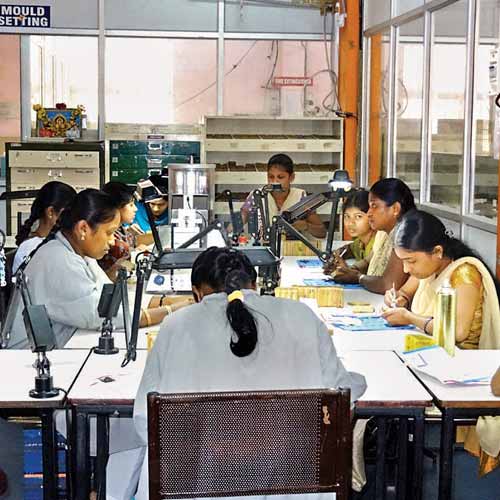
Rural women in Hosur are trained to sorting and crafting jewellery, which later find its way to big jewellery showrooms
Shahina Begum might have studied only up to class 10 from a local school in Krishnagiri. Today, she sits on the board of a company that crafts jewellery lined up in showrooms in Bangalore.
Well trained in basic accounting, cash-book maintenance, Tally and elementary computers, Shahina manages to make a cool Rs10,000 every month – a far cry from her existence years ago, when getting a decent meal was hard for her family that depended on occasional work as labourers.
Shahina persuaded her parents to allow her to join Meadow, a small private company that trained local women in crafting gold and diamond jewellery. Here, she not just acquired jewellery-making skills, but also accounting and computer knowledge.
Starting at a monthly Rs2,000, she gradually worked her way up, and “now I am able to support my brother’s education,” she says.
Like Shahina, over 500 women from around Hosur are engaged in various aspects of jewellery making, including waxing, stone sorting, stone setting, polishing and so on.
While some start with an income of Rs4,000 per month, others end up earning as much as Rs11,000-13,000 with experience.
“It is satisfying to know that the jewellery we had worked on is sold through showrooms in places like Bangalore by well-known brands,” says Manju, who handles a team of 50 women, whose roles involve diamond setting and quality inspection.
What was earlier a male dominated sector with karigars from North India using their skills to craft out attractive rings, bracelets, earrings and necklaces, now empowers women from poor households with little education.
“We had to convince the gram panchayats to send the women, give them technical training, and then deploy them,” says G Suresh, CEO, Meadow.
Incorporated in 1998 with 24 women, Meadow today functions like any other private company, complete with a board of directors, an executive committee, accounts department and shareholders. But unlike other companies, most of the 511 employees of Meadow, like Begum and Manju, are women.
“Women in rural areas have hardly any job opportunities.
Many are school drop-outs. Initially they made chapathis for Titan employees. We felt if their skills are upgraded, they could do well with jewellery,” says Elangovan A, manager, studded outsourcing, Titan jewellery, that has outsourced part of the jewellery making to these women.
Recently, a delegation from South Africa visited the women at Meadow, says Suresh. “They are now planning to adopt the concept in their country.”
source: http://www.dnaindia.com / DNA / Home> Bangalore> Report / by Priyanka Golikeri / Place:Bangalore, Agency:DNA / Wednesday – August 21st, 2013
Well-known veteran Konkani writer and dramatist Joe D’Souza passed away peacefully at his residence on Thursday September 5. He was 87
Joe D’Souza hailed from Karkala and was residing in Everard Nagar, Sion. Fof the past 5 decades, he has been known among people for his social service.
In Mumbai, he founded Karkala dramatic association and encouraged several drama artistes by staging shows in various places. He was recognized as a prominent theatre artiste for writing dramas, directing them and acting in them too.
His wife Eliza D’Souza passed away last December. She was also a drama artist.
For his immense service to Konkani theatre, Konkani Welfare Association, Sion honored Joe D’Souza with the title ‘Konkani Ratan’ in October last year.
He is survived by his daughter.
Janet Lawrence D’Souza, vice-president of Maharastra minority commission, prominent Konkani drama actor Kamalaksha Saraf, John D’Silva, president of Fudar Prathisthan, Lawrence Rony D’Souza, vice-president of Bombay Catholic Sabha, Harry R Sequeira Ferrar, convener of Konkani Welfare Association, Sion, working president John Rebello, president Dulcin Furtado, vice-president Leena Pinto, secretary Dennis D’Souza, treasurer Molly Harry Sequeira among others condoled Joe D’Souza’s demise.
source: http://www.daijiworld.com / Daiji World / Home> Mumbai / by Rons Bantwal / DaijiWorld Media Network – Mumbai / September 05th, 2013
She started doing what anybody does for a living out of no muse but mere necessity. But today, her story can be nothing short of an inspiration to many. Having gotten into something that probably not many women would venture, she has proved that a woman can do anything, if only she has a will to do so.
Thirteen years ago, city’s K.S.Geethashree Rao began her career as a sales and marketing manager for undergarments at a leading branded inner-wear industry in city. With time she did her best to increase the sales of the products of the company and even ensured that Mysore did the 2nd highest sales. However, as the sales increased, the company slowly started dictating terms and ignored Geethashree, although it was because of her hard work that the company gained good profit.
It was then that she decided to quit her job and start an undergarments retail unit of her own – ‘Sugeeth’ in the year 2004. She herself took up the responsibility of sales and marketing for Sugeeth. And today, as a result, her company is doing well, with a total turnover of Rs. 3,00,000 a year.
Talking about the difficulties faced in the field initially, Geethashree explains, “In 2004 I set up my own retail unit, marketing undergarments of different brands in the city. Being a woman, it was no easy job roaming around places from shop to shop, marketing the products. Most companies prefer men to do the marketing job as it is too laborious. But I kept all the inhibitions aside and decided to prove my worth in the area.”
“While on job at the previous company, I had faced all kinds of hurdles like running around shops to take orders and distribute products myself since we wouldn’t find enough labourers to do so and at times, even ended up stepping into Police Stations and court several times to fight bounced cheques. All such incidents thoroughly ascertained me into the field of marketing even before I started my own unit”, she said.
However, “all this can be possible for a woman only when she is willing to come out of her comfort zone, take risks and face all odds that come her way, be it any business, making it successful is no easy task. One has to sacrifice all her desires, but at the same time, also make sure that she has enough time to spend with her family and also take care of personal life,” opines Geetha.
“My children were little too when I started working, but I made sure that I finished my work, and reached home by 5 pm, so that I could help them with their studies and also spend some quality time with them,” said Geetha.
“Today, after thirteen years, I have accomplished my goals, settled and contented, I have now stopped marketing rigorously as I have my own set of customers and have also started taking stitching orders. All of this would have not been possible without the support of my husband and my two sons,”said a proud Geetha.
Her store is located at Jayanagar. —AN
source: http://www.starofmysore.com / Star of Mysore / Home> Feature Articles / August 30th, 2013
(1) iPrint 3D printer is seen printing a 3D design at the college. The gear wheels used in the printer was also printed using iPrint 3D printer developed by them ( 2) City’s young innovators (from right) Nikhil Furtado, T.S. Rachith, M.S. Abhishek and Gaurav seen with Prof. Manjula, Associate Professor, Department of Physics, Vidyavardhaka College of Engineering.
Mysore :
Final year students of Vidyavardhaka College of Engineering in city have developed what they claim as the country’s first 3D printer called “iPrint 3D.”
Nikhil Furtado, a final year Mechanical Engineering student of the college, said that 3D printing is a process of making a three dimensional solid object of virtually any shape from a digital model which is achieved by using an additive process, where successive layers of materials are laid down in different shapes. 3D printing is also considered distinct from traditional machining techniques.
He said that this technology is used in the fields of jewellery, footwear, industrial design, architecture, engineering and construction (AEC), automotive, aerospace, dental & medical industries, education, geographic information systems, civil engineering and many others.
Explaining about the process of printing, he said that 3D printing is also called “additive manufacturing” because it uses an “additive process” as opposed to what is called a “subtractive process.” To explain the difference, he gave an example of a sculptor chiselling a block of stone — he said that the sculptor chips away until he has the sculpture just as he wants it, and then throws out what’s been whittled away. The sculptor began with a block of material and then subtracted from it which is a subtractive process.
But in additive manufacturing, the 3D printer doesn’t take anything away — it simply creates each bit of the object where it needs it, layer by layer, successively, in an additive process.
He said they have just taken the technology and developed a low cost 3D printer that can print 3D models that are designed on 3D Modelling software (CAD). In its pure dimensions, this printer can print anything within a build area of 20x20x20cm with either PLA (Poly Lactic Acid) or ABS (Acrylonitrile Butadiene Styrene) and added that the 3D printer works on the same principle as a CNC machine.
Nikhil said that each 3D-printed object begins with a digital Computer Aided Design (CAD) file, created with a 3D modelling program. The digital file sends instructions that the 3D printer understands; the software then slices the design into hundreds or thousands of horizontal layers. The 3D printer reads this file, and proceeds to create each layer exactly as per the specifications, resulting in a three dimensional object.
When asked about the inspiration behind this invention, the group said that the idea to build a 3D printer occurred to them a year ago , but started working on the project only in May and finished it by August. A major part of the time (2 months) taken was to procure the components, from India and abroad. The time taken to assemble the machine and calibrate it was three weeks.
The team which developed iPrint 3D are: T.S. Rachith, Gaurav and Nikhil Furtado, final year students of Mechanical Engineering with the able support of M.S. Abhishek, alumnus of the same college, Karan Seth, VP, Corporate Affairs & Marketing, Mumbai and Chetan M. Rao & and S. Manoj, final year students, Electronic Design & Deployment, NIE IT. The iPrint 3D printer will be launched in the college tomorrow.
When enquired about their future plans, they said that plans are “to commercialise the printer and make it accessible to the general public and to take 3D printing to the masses.” He further said that they will be creating awareness by conducting workshops and demos at various conferences and colleges, one of them being the ‘ZONAL NASA Conclave’ which will be held in city from Sept.5 to Sept. 7 at the University School of Design, Mysore University.
For details,email: contact@iprint3d.co
source: http://www.starofmysore.com / Star of Mysore / Home> Feature Articles / August 30th, 2013
The premium variety of mushroom is being grown only in a few countries such as Japan, China and South Korea
Seeds of weather friendly strains are ready for commercial cultivation
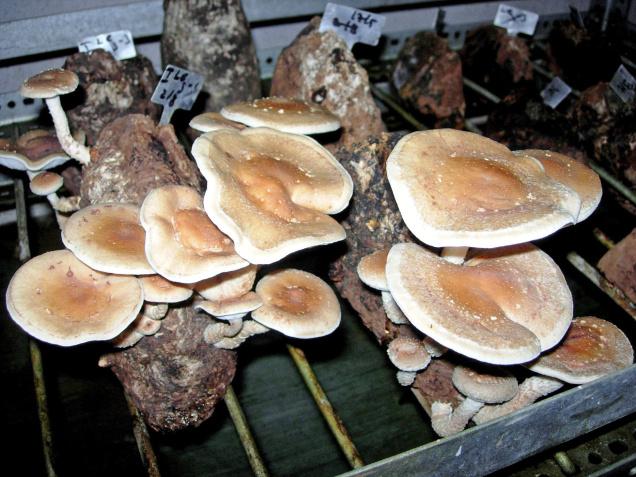
Shiitake, the premium variety of mushrooms being grown only in a few countries such as Japan, China and South Korea, is now ready for cultivation in Indian cities, including Bangalore.
The Bangalore-based Indian Institute of Horticultural Research (IIHR) has developed new strains of this mushroom suitable for cultivation in the country.
Known for their medicinal properties, especially anti-cancer use and cholesterol-reduction ability, these varieties are now available at Rs. 1,200 a kg in Bangalore as they are being imported. “It may cost only about Rs. 50 a kg if we grow them here,” says Dr. Meera Pandey, principal scientist, Mushroom Research Laboratory, IIHR.
Dr. Pandey, who spearheaded the efforts to develop the weather-friendly strains of Shiitake, told The Hindu: “We have not only developed protocols for cultivating this variety in the Indian environment, but also produced the seeds for their cultivation. Those interested can buy these seeds from us if they book in advance.”
These varieties are normally grown in a situation where the temperature is below 25 degrees Celsius. Dr. Pandey said they could be cultivated in areas in and around Bangalore without any artificial temperature control from July to January/February when the temperature is normally cool.
She feels that north-eastern states, barring Assam, are highly suitable for cultivating Shiitake in the natural environment. Similarly, the IIHR is also planning to popularise them in Oooty, Coonoor, Chickmagalur, Kodagu and Kodaikanal.
The IIHR mushroom laboratory has also developed a technology to grow these premium mushroom varieties at homes through ‘ready-to-fruit’ bags.
These bags will have mushrooms which are about to sprout and all that you need to do is keep them at a place away from direct sun light and sprinkle water for about a week to 10 days. This will yield about 250 to 400 grams of mushrooms in two batches, Dr. Pandey says.
This can only be done from July to January/February if they are being grown in natural environment in and around Bangalore. While the prices of the ready-to-fruit bags for Shiitake varieties are yet to be fixed, she says it is expected to be in the range of Rs. 20 to 40. Those interested in buying Shiitake ready-to-fruit bags can contact Dr. Pandey on 080-28466420-Extension-347 during office hours (email: meera@IIHR.ernet.in).
source: http://www.thehindu.com / The Hindu / Home> News> National> Karnataka / by B. S. Sathish Kumar / Bangalore – August 17th, 2013
Yet another roof-top delight where one can sit, relax and enjoy the city’s good weather along with some good food and let time melt away.
Located atop a heritage structure in V.V. Mohalla’s Gokulam road, Melt, a pizzeria is already turning out to be a popular roof-top restaurant. The decor is simple and sober yet classy and the food served is mouth-watering Italian delicacies.
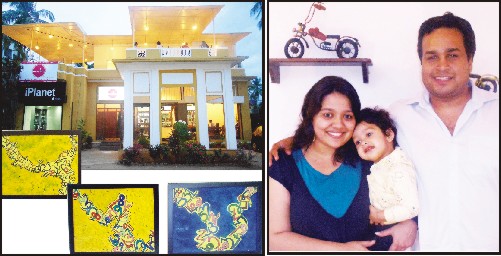
Melt is the outcome of an enterprising couple, Neha and Ratan Singh, one interested in art, and the other in food. “We want to offer Mysoreans tasty food but more importantly it must also be fresh,” says Ratan, a hospitality Graduate from Switzerland.
“Though it is more of a Pizzeria, we are open to taking customised orders. We even make butter chicken if requested. “We want the customer to be satisfied,” says Ratan.
Their pizza named ‘Loaded’ on the menu, made with homemade tomato sauce, chicken, ham, sausages, onions and mozzarella and the vegan pasta with fresh veggies and white sauce has already become their signature dish.
Also while you devour the food, if you happen to catch a glimpse of colourful paintings all around the pizzeria, do not miss to compliment Neha, Ratan’s wife, for having painted them. Neha, who loves painting, has also designed the decor. This seems to be a family involved in their pizzeria as their two-year-old daughter Kiara, is often seen running around. While parents cook-up recipes that melt in our mouth, looks like the daughter melts customer’s heart.
Melt offers services from 11 am to 11 pm.
source: http://www.starofmysore.com / Star of Mysore / Home> Feature Articles / by Ambika Nagaraj / August 29th, 2013
At affordable prices, AyurVaid is treating those below the poverty line with its blend of ayurveda and allopathy practices
“Earlier, my impression of ayurveda was that it is full of grandma’s remedies and not scientific” —Rajiv Vasudevan, Founder / Photo. RA Chandroo
Started 2006
Location Bengaluru and Kochi
Initial investment Rs 55 lakh
Social impact Provides quality ayurvedic healthcare to the poor at subsidised rates
***
A frail looking Mini Shaji sits on a bed in the corner of the general ward of AyurVaid’s hospital in Bengaluru. Wearing a brick red nightgown, Shaji’s painfully thin frame looks devoid of all energy, but there is a glimmer of hope in her eyes. Six months back, the 36-year-old Shaji, who suffers from rheumatoid arthritis, could not move without the help of a walking stick. A friend directed her to the AyurVaid centre at Ramamurthy Nagar. After 10 days of in-patient treatment, Shaji can now walk slowly without a stick. Though still weak, she’s now hopeful that the weight she lost because of her ailment will be regained too. Her doctor, Rashmi Johnson, says she suffers from rheumatoid arthritis, joint pain, swelling and deformity of joints. The doctors at AyurVaid have treated Shaji in the traditional ayurvedic way and she has discontinued her allopathic treatment of two years. The good news is that the pain has gone. Johnson says Shaji will need to repeat this treatment for 15 days every six months till she is cured. “She has started walking but we cannot cure the deformity once it is formed,” she says.
AyurVaid uses traditional methods of ayurveda, which translates into “life-knowledge”, to treat patients at its three hospitals in South India. It’s the first Ayurvedic hospital to get the National Accreditation Board for Hospitals & Healthcare Providers (NABH) certification, usually given to allopathic hospitals for conforming to prescribed standards of hygiene and operating processes. Interestingly, AyurVaid’s treatment methodology is a blend of ayurveda and allopathy. While it relies on classical ayurveda for treatment, its hospitals also use modern tools such as lab tests and scans, and sometimes refer cases to allopathy doctors, whenever required.
Its founder Rajiv Vasudevan, 50, stumbled onto ayurveda by chance. A BTech in mechanical engineering from NIT Calicut, he began his career with ISRO, before proceeding to do an MBA from IIM Calcutta. Vasudevan worked in the corporate sector briefly before joining the Kerala government as CEO of Technopark, Thiruvananthapuram, where he was responsible for the formulation of Kerala’s IT policy. In 2003, Vasudevan was appointed special officer with the Government of Kerala with a mandate to devise a road map for development of biotechnology in the state. This put him in charge of authenticating and validating ayurveda drugs. “Earlier, my impression of ayurveda was that it is full of grandma’s remedies and not scientific,” says Vasudevan, who began to realise the holistic healing potential of this ancient stream of medicine.
Ayurveda has more relevance now than ever before, says Vasudevan, pointing out that the healthcare market today is dominated by acute tertiary and emergency care, with no concept of prevention. At most, there is primary prevention in the form of health check-ups. But, he says, the main requirement is secondary and tertiary prevention. “Say, somebody has the beginning of arthritis or asthma. How do I prevent it from becoming a full blown acute condition? This is where ayurveda can play a role.”
Under the same facilities, the treatment cost at AyurSeva is 60% of what it is at AyurVaid
Taking centrestage
Vasudevan started AyurVaid with Rs 55 lakh, pooled from his own savings, along with friends and family. The first hospital opened in Kochi, in 2006, followed by two more in Bengaluru, one in Mumbai’s Dharavi, Asia’s largest slum, and one in Chennai. Dharavi was an attempt to develop an independent ultra low-cost yet viable model that would serve the healthcare needs of bottom-of-the-pyramid patients, but the 18-bed hospital closed in June last year after three years of operation. “The problem was we could not get enough patients because the poor usually go to a doctor only for emergency treatment, which ayurveda does not provide,” says Vasudevan. Its day-care centre in Chennai, too, closed down due to issues faced by its local partner.
Ayurvaid now has three hospitals, two in Bengaluru and one in Kochi, with total 51 beds, 17 doctors, 24 nurses and a patient base of over 35,000. These cover all major specialities including orthopaedics, neurology, dermatology, gynaecology, ophthalmology, auto-immune disorders and gynaecology. Treatment is segmented into two groups — AyurVaid and AyurSeva — both offered in the same facility. While the former is intended for middle and upper-middle class patients, AyurSeva is aimed at being affordable to the poor. “We follow a cross-subsidisation model,” says Vasudevan. An AyurVaid patient pays Rs 300 per consultation, while an AyurSeva patient pays Rs 100. The treatment cost for AyurSeva patients is 60% of what an AyurVaid patient will pay. AyurSeva patients are identified as those with a BPL card, or those who can prove that they can’t afford treatment.
While AyurSeva patients are admitted in the general ward, AyurVaid patients have the option of either opting for a general ward or private rooms. Nursing and doctors charges too are subsidised, although there is no change in method of treatment.
For now, there are more AyurVaid patients walking in, helping offset the hit on margins due to AyurSeva. The average price of treatment for an outpatient is currently about Rs 1,500 per day.
Due to low capital involved, AyurVaid broke even in just three years
Making a case
While lifestyle diseases is commonly associated with those living in urban pockets, Vasudevan believes the poor are equally susceptible to such chronic diseases. “The moment the poor get some money in their hands, that goes into food. They end up having rich oily food from the street, which leads to ‘lifestyle disease’. When they fall ill, they are unable to work, leading to poorer food choices,” he says, adding that this is a vicious cycle and it is important to extend ayurveda treatment to the poor.
Though government-run hospitals have made their presence felt, Vasudevan points to the generally poor conditions in such hospitals as a reason why healthcare needs better models like his. “What is really free is a question in government hospitals. For the money you pay unofficially to people, you don’t get quality treatment. There is no reliability and accountability,” he says.
However, the absence of medical insurance has been a deterrent. Though IRDA formally notified that insurance companies may cover ayurveda care provided in government or NABH accredited ayurveda hospitals, Rashtriya Swasthya Bima Yojna (RSBY), a government-run health insurance scheme for the poor, which provides for cashless insurance for hospitalisation in public and private hospitals, does not include ayurveda treatment. Vasudevan feels that RSBY is critical to help ayurvedic treatments reach the poor, given that over 35 million BPL citizens are already covered under the scheme and the poor will have a very good option to consider for their chronic diseases. “Take sciatica or osteoarthritis for example. Without ayurveda coverage, a person may be compelled to go in for surgery [IVDP surgery or TKR] by an allopathy specialist. Surgery can be obviated in such cases through ayurveda, at a significantly cheaper cost, faster recovery and superior medium to long term outcomes,” he says.
Though challenges abound, for now there seem to be takers for Vasudevan’s business model. Acumen Fund, a non-profit venture philanthropy fund that invests in social enterprises in South Asia and Africa, has invested Rs 6 crore in AyurVaid in phases since 2008. According to Sachindra Rudra, director, Acumen Fund India, the investment was to help the firm expand its cross-subsidy model for treatment of chronic medical conditions using an appropriate integration of ayurveda and allopathy in a patient-centric, quality conscious and process-oriented approach.
As of FY13, revenues were Rs 3 crore, with pharmacy sales accounting for 20-25%, consultation income for 10% and the rest coming from in-patient and out-patient service fees. In the healthcare industry, where break even typically happens in six-seven years, AyurVaid broke even in three years. Vasudevan attributes this to the low capital investments needed in ayurvedic hospitals. In a regular allopathic hospital, each bed costs Rs 75 lakh to Rs 1.5 crore, while an ayurveda hospital bed costs Rs 3-8 lakh. “We hope to be profitable as a company in four or five months,” adds Vasudevan.
Vasudevan plans to use the hub-and-spoke model to expand — one hospital with in-patient facilities in the city, supported by four day-care hospitals. “We want to start with the Bengaluru cluster and set up four more in-patient hospitals and 12-16 satellite day-care centres,” he says. The idea is to have hospitals everywhere, instead of having one large hospital in one part of the city. Though with 14.2 million people living below the poverty line, Karnataka itself is a huge market, over the next 18-24 months AyurVaid plans to replicate the Bengaluru model across Mumbai, Delhi and Chennai, and is looking to raise around $5-10 million in a second round of funding.
Yet another opportunity that AyurVaid is looking to tap into is to become a ‘diabetes specialist’ with focus on prevention, reversal and management of diabetes and diabetic complications. “With India emerging as the diabetes capital of the world, with over 70 million diabetics, and many undiagnosed/emerging diabetics, AyurVaid with its root cause management approach has clear advantages to offer,” says Vasudevan. But he will need a proactive government on his side to achieve what he has set out to. Whether that happens or not remains the million-dollar question.
source: http://www.business.outlookindia.com / Outlook Business / Home> Entrepreneurs> Health-Medicine-Fitness / Section: Enterprise / by Shabana Hussain / August 31st, 2013
City Skaters Varsha S. Puranik and Sanjana Srinivas have been selected for the prestigious Ekalavya Award to be presented by the Government of Karnataka in Bangalore tomorrow.
Varsha S. Puranik, a 2nd year MD student at the JSS Medical College, is coached by Srikanth Rao, who himself is an accomplished roller skater.
Speaking to Star of Mysore, Varsha expressed her happiness on being selected for the prestigious Ekalavya award.
Varsha is the daughter of Sriramkrishna, a retired Manager of Indian Overseas Bank and Tara.
Sanjana Srinivas, another roller skater from city, who is selected for Ekalavya award, is currently pursuing her engineering in Electronic and Communication (E&C) at PESIT, Bangalore.
Sanjana was part of the team which won the bronze medal at the Asian Ice Skating championship.
She has represented India at the world championships. She has also won national individual championship twice. She is the daughter of city-based businessman Srinivas and Savitha.
The Department of Youth Services and Sports (DYSS) is expected to make an official announcement of 17 names of sports personalities who have been selected for the Ekalavya award this evening.
The award carries Rs. 2 lakh cash prize and a citation. The award is presented every year to commemorate the National Sports Day (Aug. 29) which is observed to mark Hockey legend Major Dhyanchand’s birth anniversary.
source: http://www.starofmysore.com / Star of Mysore / Home> General News / August 28th, 2013
The designer also holds 3 Limca Book of Records, one each in India Book of Record and Asia Book of Record for his innovations.
It is said that necessity is the mother of inventions, but here is an innovator from city who says that he invents for passion and not for awards.
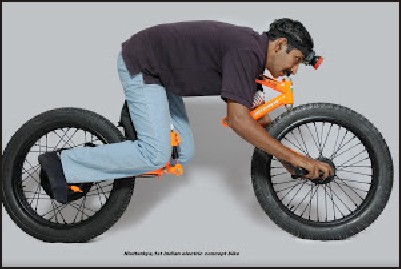
Santosh, a motor bike design enthusiast, who lives in Saraswathipuram, has come up with an electric-concept bike.
Santosh completed his ITI in Electronics from NIE in city and works at Reckitt Benckiser, a pharmaceutical company, as a technician but his real love is motor cycles.
Santosh has named his electric-concept bike as ‘Nisttarkya,’ which means ‘Unimaginable’ in Sanskrit.
The bike weighs 40 kgs with both wheels size at 3.00×18″ drives on 36 V, 350w hub motor and is powered by three 36 V rechargeable batteries.
The most noticeable feature of ‘Nisttarkya’ is its riding position. It has two shock absorbers, one for the front, one for the back and headlight mounted on the rider’s head.
The riding position is so peculiar that it makes one wonder as to how it is possible to ride it at all. But Santosh says, that is why it is a ‘concept’ bike. It will have to be further refined and fine tuned before it can reach marketable potential.
Santosh, speaking to Star of Mysore, said: “all the parts of the bike were made at home for which I have been working for the past 18 months. Though the design looks simple to naked eyes, there is a lot of technology involved in it and my friends have helped me a lot.”
This shy natured innovator said that he was not behind any records but simply loves motor cycles. Incidentally, his father Jeevandhar is also an ardent bike enthusiast.
Santosh, in order to pursue his passion, used to participate in rallies, where he learnt technology and design. “You learn a lot when you get your hands dirty in mechanics,” he says.
Speaking of viability, Santosh says he spent Rs. 60,000 to built Nisttarkya and is thankful for all the assistance he got from his friends.
For now, Nisttarkya runs for 30 kms with an hour of charging but one has to keep a watch for the potholes and take a few breaks during the ride.
Santosh can be contacted on e-mail: santhosh.bikes@gmail.com.
source: http://www.starofmysore.com / Star of Mysore / Home> Feature Articles / by S. Kenneth Shishir / August 28th, 2013
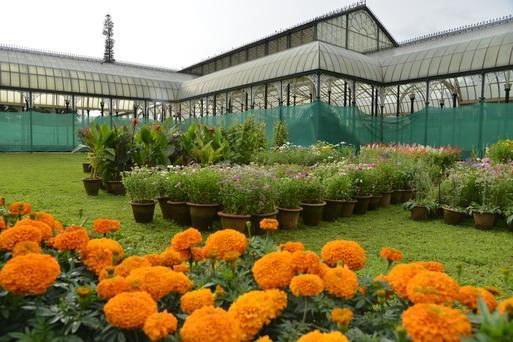
The largest lung space in Bangalore, covering a sprawling 400 acres, Lalbagh is now home to 1,916 species./ Photo: Murali Kumar K. / The Hindu
Around 25 species of ornamental and fruit-bearing plants will be introduced
New species of ornamental, medicinal, commercial and fruit-bearing trees are to welcome you on your next visit to Lalbagh Botanical Gardens here.
The over 200-year-old garden is to get around 25 new species from the National Botanical Garden, Kolkata.
“We have brought species…that could suit Bangalore’s climate,” deputy director of the gardens J. Gunavanth told presspersons here on Monday. “We are identifying space across the gardens to plant them, as there is a space crunch,” he said.
Among those being introduced are palm varieties such as thatch, gingerbread, cabbage, feather, feather duster, desert fan, Nicobar and ruffled fan palms. Some other plant species are velvet apple, star apple, Hanuman phal, brush cherry, as well as poon, empress, olive bark and locust trees. Most of these species are natives of South America, tropical Asian countries, the U.S., Australia, New Zealand and Africa.
REPLACEMENT
This comes even as around 50 to 60 species are planned to be replaced. Some of these trees are more than 100 years old. “An old tree fell last week and many others are old,” Mr. Gunavanth added.
DIRECTORY
The largest lung space in Bangalore, covering a sprawling 400 acres, Lalbagh is now home to 1,916 species.
The Horticulture Department plans to come out with a handbook or directory of plants in the gardens for the benefit of visitors. “Endangered species that are over 100 years old will be featured in the handbook,” Horticulture Department Director D.L. Maheswar said.
source: http://www.thehindu.com / The Hindu / Home> News> Cities> Bangalore / by Staff Reporter / Bangalore – August 06th, 2013