Now is the best time to visit Shivanasamudra

A view of Bharachukki waterfall. /  Photo: M.A. Srirram
A view of Bharachukki waterfall. / Photo: M.A. Srirram

Tourists and local people alike from Mysore and surrounding regions are thronging the famed Shivanasamudra Falls, about 70 km from here, following copious discharge from the Krishnaraja Sagar and Kabini reservoirs.

Shivanasamudra refers to the twin falls of Gaganachukki in Malavalli taluk of Mandya district and Bharachukki in Kollegal taluk of Chamarajanagar district which are separated by a few km. Shivanasamudra is located about 145 km away from Bangalore.

A view of the Gaganachukki falls. / Photo: M.A. Srirram

With the combined discharge from the KRS and the Kabini reservoirs in excess of 1,00,000 cusecs, the sight of water gushing down the gorge and plunging into the depths below with a roaring sound is a feast for the eyes. Mist engulfs the entire place when the water is in full flow, lending an ethereal beauty to the falls.

The rate of outflow from the KRS was at about 60,000 cusecs while it was at about 40,000 cusecs from the Kabini reservoir in H.D. Kote taluk. The discharge has remained more or less constant since the last 24 hours due to good inflow into the reservoir and hence Shivanasamudra has come alive in full glory.

Inflow

On Saturday, inflow into the KRS, as measured at 6 a.m., was at 50,049 cusecsand inflow into the Kabini reservoir was at 31,298 cusecs.

Both the Cauvery and the Kabini (also called the Kapila) meet at the Triveni Sangama in T. Narsipur taluk of Mysore district and beyond this point of confluence, the river is referred to as the Cauvery and hence Shivanasamudra is also called as the Cauvery Falls.

Ranked 45

Incidentally, Shivanasamudra has been ranked 45 among the world’s top 100 waterfalls by the World Waterfall Database (www.worldwaterfalldatabase.com). The website goes on to state that it would easily be among the world’s top 10 waterfalls but for the fact that the river has been harnessed. The fact that the river splits into two to form two falls could also be a factor in reduced visual appeal and grandeur compared with other great falls of the world. But none of this matters when the river is in spate as at present.

The visitors’ flow to the falls began as the monsoon picked up momentum. The number of tourists visiting the falls increased in the last couple of weeks following continuous discharge from the Kabini reservoir. With the KRS having attained its full reservoir level of 124.8 feet (but the level was maintained at 123.25 feet on Saturday for safety purpose) and excess water being released from the dam, the volume of water at the falls will be high.

source: http://www.thehindu.com / The Hindu / Home> News> Nation> Karnataka / by R. Krishna Kumar / Mysore – July 28th, 2013

Expecting immortality from medical treatment is untenable : Dr. Javeed Nayeem

Dr. K. Javeed Nayeem being felicitated by SRIAN Envisions’ founders Dr. Anil Sangli (extreme left) and Sripad Sangli.

Mysore :

High cost of medical education, exorbitant investments on state-of-the-art medical equipment and peer pressure have resulted in the medical profession turning into business style, observed senior Physician Dr. K. Javeed Nayeem.

Doctor-patient relationships were sacrosanct until a few decades ago but it is no longer so now-a-days nor is it easy to restore that kind of connect between the two, he bemoaned.

Speaking as the chief guest in the educative and musical evening at Jaganmohan Palace auditorium here yesterday on the theme ‘Changing Scenario in The Doctor-Patient Relationships’, Dr. Javeed Nayeem presented an insight into the decline in the relationships between the healers and their patients. Expecting immortality from the medical treatment on the part of the patients as well as their family members was at the root of disenchantment resulting in straining the relationships, he added.

Doctors not empathising with their patients, provisions under medical insurance and rulings by Consumer Disputes Redressal Courts without members having medical background also contributed to poor doctor-patient relationships, he explained, while pleading for restoring the same. The event was organised by SRIAN (Scientific Research Innovations in Advanced Neurosciences) Envisions’ founders Dr. Anil Sangli and Sripad Sangli in their series of similar educative programmes. P. Rajendra Prasad, Superintendent of Police, Chamarajanagar, as the guest of honour and Vidushi Dr. Sukanya Prabhakar as a special invitee took part in the event and made presentations of their points on the theme.

The organisers explained the aims and objectives of the programme focussed on health and wellness of our society based on scientific research, medical advances, music and financial planning by organisations, administrations and individuals in all walks of life.

Dr. Anil Sangli pointed out that communication played a pivotal role in mutually rewarding doctor-patient relationships. Positive interaction marked by trust, hope and compassion between the two sides leads to positive outcomes, he said.

Sripad explained the birth of new area of scientific pursuit namely Neuro-economics or Neuro-Finance, while providing an insight into the benefits of financial planning in life’s situations of uncertainty.

Rajendra Prasad spoke on the ‘Law and Order situations in doctor-patient relationships’, tracing the episodes to different perceptions of doctors and patients. Dr. Sukanya Prabhakar presented a lec-dem on ‘Music as a catalyst in improving societal relationships.’

Vidu. Veena S. Pandit rendered invocation. Vidu. G. Rajalakshmi Sridhar and S. Subramanya compered. Songs sung by renowned playback singer late Mohammed Rafi were rendered by Sripad Sangli and H.P. Vijayeendra Rao, Junior category winner of Edethumbi Haaduvenu programme of 2006.

source: http://www.starofmysore.com / Star of Mysore / Home> General News / July 29th, 2013

Bangalore: St Joseph’s graduates get tips for success from entrepreneur

Bangalore:

A successful entrepreneur and mentor Claudius Pereira, founder and Managing Director of System Tech Pvt Ltd, provided valuable tips to the new post-graduate diploma holders  in business management of the St Joseph’s College of Business Management to strive for success by starting from their strengths as that alone would pave the way for overcoming any weakness and realize their ultimate dreams.

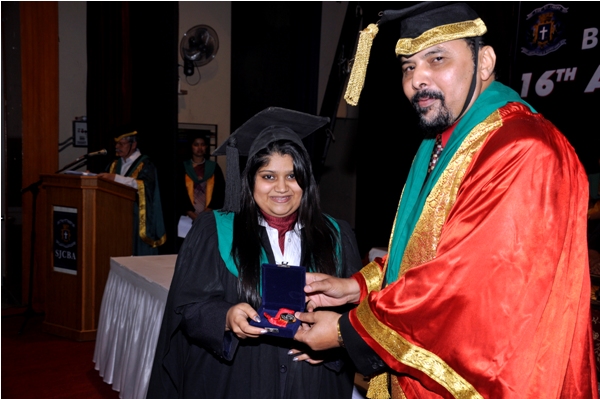
He was delivering the 16th Convocation Address of SJCBA, after the Chairman of the Governing Council and Rector of St Joseph’s Institutions in Bangalore Rev Dr Stany D’Souza presented the post-graduate diploma certificates to 110 of the 120 students – the other 10 being conferred the diplomas in absentia at a solemn and glittering function.

claudiusBF03aug2013

Claudius Pereira, the author of the book on his family saga,”Echoes of Footprints,” that created history with book launches in the three countries of India at Bangalore, UK and USA, advised the students to dream big because all great careers generally start with big and great dreams, which need to be pursued with passion, determination, dedication, decisiveness and right aptitude.

”Success does not come to you by itself. You need to go and work for it,” Pereira said pointing out that he was speaking from experience as he himself had come up from utter poverty to achieve success and prosperity which also included failure.

Pereira, who claimed that he had started with a measly monthly salary of Rs 300 to establish three successful companies and tasted failure, said the Josephites should never be discouraged or disheartened by failures because failures provided valuable lessons to learn from the mistakes and strive for success.

”Don’t ever give up in the face of adversity or setbacks because failures are and should be the stepping stones for future successes,” he said asserting that, ”there is no gain without pain.”

In his presidential address, Rev Dr Stany D’Souza emphasized the importance of education in the transformation of self and the world by teaching new things and also in learning them so as to help in the formation of individuals and future citizens.

”Life is about growing and picking good habits as transformation cannot be achieved without changes in ideas, attitudes, beliefs and priorities,” Fr Stany D’Souza said stressing the need for not allowing negative attitudes to dominate the hearts and minds for the development of healthy society.

StJospehsBF03aug2013

The overall gold medal for first rank was given to Amitha M R, silver medal to Sahana B S and bronze medal to Rahul Laxman. The gold and silver medal winners in management were Amitha M R and Anita K B, financial marketing Sharon Flavia Misquith and Deepak Hegde, human resource management Shana B S and Rahul Lakshman and operations management Amitha M R and Joselyn Pereira .

The 16th Convocation function got off with recitation of the readings from three Holy Scriptures – Bible, Quran and Bhagawad Gita – by students. Prof Edwin Castelino, Dean, presented the annual report for the year 2012-13. Prof Vandana Nair compered the entire programme. Prof Venkatesh Raj proposed a vote of thanks.

source: http://www.daijiworld.com / Home> Top Stories / by Daijiworld Special Correspondent / Daijiworld Media Network – Bangalore / July 21st, 2013

Banding the Anglo-Indians

David S. White
David S. White

Your recent reference to the Naval Hospital and the Gun Carriage Factory (Miscellany, July 8) did not mention that these were located in what was called New Town and which was once a major area of Anglo-Indian settlement, messages William Rodrigues. Indeed it was, what with not only the Naval Hospital and Gun Carriage Factory but also Central and Egmore Stations, the General Hospital and the Corporation, all favoured places of employment of the Anglo-Indians of the time, working as railwaymen, mechanics, overseers, nurses and secretaries.

More significantly, this area hosted the David S. White Memorial Hall and the offices of the Anglo-Indian Association of Southern India, the headquarters of the Anglo-Indians of South India. The Hall, the offices and the grounds of the Association were where the Hotel Ramada Chennai and a portion of its neighbour, the CMDA’s second block, have come up. In a small site here, the Association’s offices still remain, I’m told.

Responsible for banding the Anglo-Indians of South India together was David S. White who was an officer in the Directorate of Public Instruction. Curiously, he is better remembered in Bangalore where he established what was once a major Anglo-Indian settlement, Whitefield.

White was a founder member of the first Anglo-Indian association, the Eurasian and Anglo-Indian Association founded in Calcutta in 1876. Then, for some unstated reason, he broke away and founded in 1879 the Anglo-Indian and Domiciled European Association of Southern India. Today, there are eight other associations in South India and, together with what White founded, they teamed together in 1892 as a federation of Anglo-Indian associations mainly in Southern India. Some of its members also belong to the now Delhi-headquartered All India Anglo-Indian Association, but the majority are with the southern federation. The All-India association grew out of the 1876 association thanks to Henry Gidney’s leadership in the 1920s.

What the reason for the schism responsible for the break-up in Calcutta was I’m not very clear, but it certainly continued because of the attitude of Frank Anthony who succeeded Gidney who had been trying to effect a patch-up. Anthony had no time for those who were called Feringhis, were mainly dark of complexion, and spoke Malayalam, Tamil or Konkani. These descendants of the Portuguese found no favour with Anthony who refused to accept them as Anglo-Indians and turned down the applications of their associations to join the All-India Anglo-Indian Association. This only strengthened the Federation in the South that had its roots in White’s association and spread in South India.

White himself helped to establish the associations in Mysore and Coorg and persuaded the Maharajah of Mysore to grant nearly 4,000 acres east of Bangalore to establish an Anglo-Indian settlement. Whitefield in time grew with several from the Kolar Gold Fields adding to its numbers.

Today, the number of Anglo-Indians in Whitefield has diminished, but it is still more than in White’s home beat, New Town, now a forgotten name in south Vepery.

source: http://www.thehindu.com / The Hindu / Home> Features> MetroPlus / July 22nd, 2013

JSS conducts national-level workshop on Speech and Hearing

R. Mahesh, Director- Medical Education Division, JSS Mahavidyapeetha, seen lighting the lamp during the inauguration of a national-level workshop held at JSS Institute of Speech & Hearing in city recently. Others seen are (from left) Dr. C. Basavaraju, Registrar, University of Mysore, Dr. M.N. Nagaraja, Director (Technical), Dr. S.R. Chandrashekar Institute of Speech and Hearing, Bangalore and Dr. N.P. Nataraja, Director, JSS Institute of Speech and Hearing, Mysore.

Mysore :

A national-level workshop on “Speech specific auditory evoked potentials and its applications” was held under the aegis of JSS Institute of Speech and Hearing in city recently.

The workshop was inaugurated by Dr. C. Basavaraju, Registrar, University of Mysore, who was the chief guest. Dr. M.N. Nagaraja, Director (Technical), Dr. S.R. Chandrashekhar Institute of Speech and Hearing, Bangalore and Dr. N.P. Nataraja, Director, JSS Institute of Speech and Hearing, Mysore, were the guests of honour. The inaugural function was presided over by R. Mahesh, Director- Medical Education, JSS Mahavidyapeetha.

The guests were introduced to the audience by Wasim Ahmed, Lecturer, JSS Institute of Speech and Hearing.

Dr. Basavaraju, addressing the gathering, said that though technological advancements were easily accessible to the rich, the poor and underprivileged sections of the society were far from getting the benefits. He opined that the advanced facilities shouldn’t be restricted only to the cities but should also reach the rural sectors with easy accessibility as there is a huge population which is in need of these facilities.

He further added that the founders of the Indian Constitution also found the importance of speech thus stating it as a fundamental right of every citizen. Hence, he enunciated the need to provide hearing testing facilities, hearing aids and other necessary devices at affordable prices and even try to provide them free of cost.

Dr. M.N. Nagaraja delivered the key note address in which he underlined the significance of using speech as a stimulus to evaluate the neural pathway of the auditory system.

Sudha P. Nair, Lecturer in Audiology, JSS Institute of Speech and Hearing, proposed a vote of thanks. A total number of 80 delegates from various speech and hearing institutions in the country participated in the programme. Guest faculties from Manipal University, All India Institute of Speech and Hearing, SRC Institute of Speech and Hearing and Bharatiya Vidyapeetha- Pune delivered lectures during the two-day workshop.

The participants were provided with hands-on clinical training regarding the various test procedures.

source: http://www.starofmysore.com / Star of Mysore / Home> General News / July 28th, 2013

Soudha to come alive. History buffs, book your copy

State government to bring out a coffee table book on the building that defines Bangalore.

Kengal Hanumanthaiya and Jayachamaraja Wodeyar inspecting Vidhana Soudha construction work.

The magnificent Vidhana Soudha may draw ‘oohs’ and ‘aahs’ from visitors to the city, but the man responsible for the constructing the imposing mansion that seats the legislature and the government in Karnataka, had to face the face the ignominy of an indictment from an inquiry committee that found him guilty of wasting tax-payers’ money on the building, during its construction.

Kengal Hanumanthaiya, then chief minister, who made it the mission of his life to build the structure which is considered among the grandest legislature buildings anywhere in the country, was indicted by a committee appointed by himself, and headed by the then leader of the Opposition, JM Imam, the then accountant general and the then general manager of the State Bank of Mysore, BV Narayana Reddy.

The committee finished its work in six months and came out with a 222-page report after questioning over 200 people. The anecdote and many other interesting ones are contained in a coffee table book that the state government is set to bring out. The 324-pager, commissioned by the state government and written by veteran journalist CM Ramachandra, was completed three years ago, but was not released for some reason or other.

The book explains how Kengal, as he was known, had to go face a litany of allegations during the construction of the Soudha, including criticism within the party of spending scarce public resources on a building rather than focus on social and economic development.

Once, Kengal had to defend himself against such a charge in the presence of then union minister for community projects SK De at a public meeting held at the Town Hall in the city. De, considered confidante of prime minister Jawaharlal Nehru, was reportedly unhappy with the state government’s failure in implementing community development projects, but Kengal defended himself vigorously, asserting that construction of Vidhana Soudha was his top priority.

Prisoners from the central jail in the city were used in the construction of the building, and as Kengal was making an inspection tour during the construction along with Kadidal Manjappa, the future CM, one of the prisoners attacked him with an iron rod, the book says, adding that a man called Puttaswamy from Chikkaballapur saved the chief minister from serious harm.

Before starting the construction, Kengal visited the House of Commons building in London and similar structures in Sweden and Norway, as well as buildings in Mumbai and Delhi. The book, which contains rare photographs, recalls that Prime Minister Pandit Jawaharlal Nehru laid the foundation stone on July 13, 1951, and it was inaugurated on October 14, 1956.

source: http://www.dnaindia.com / DNA / Home>Bangalore> Report / Place:Bangalore, Agency:DNA / by Y Maheswara Reddy / Sunday – July 14th, 2013

Police Commissioner fetes brave trio

City Police Commissioner Dr. M. A. Saleem is seen distributing certificates of appreciation to the three alert citizens (from left) Raghu Kumar, Manjunath and Mohammed Nayaz at his office yesterday as CAR DCP R. Prabhashankar looks on.

Mysore :

City Police Commissioner Dr. M.A. Saleem yesterday distributed certificates of appreciation to three alert citizens Raghu Kumar, an engineering student, Mohammed Nayaz, a businessman of Gayatripuram and Manjunath, a cook at the City Dog Squad, who displayed exemplary courage in nabbing a fleeing chain-snatcher in the city on Wednesday.

It may be recalled that the trio had chased and apprehended Mahesh, who was fleeing after snatching gold chain from Indravathi, a housewife near Chamundi Vihar Stadium in Nazarbad Police limits on Wednesday in broad daylight.

Dr. Saleem further explained that 65 cases of chain snatching had been reported in the city over the past six months alone and added that the accused had been arrested in two cases.

He further said that measures had been initiated to check crimes as done in Bangalore South division by deploying 65 Police personnel on night patrolling.

He also added that it has been decided to enroll Traffic Wardens who will be deputed to man traffic at important junctions for at least four hours in a week.

CID to probe Green Buds case

The City top cop further said that Criminal Investigation Department (CID) will probe the cases relating to the alleged cheating of thousands of investors by Green Buds Agro Farms. He said that cases of cheating against MD of the firm B.L.Ravindranath had been registered at various districts in the State besides Mysore city which necessitated a CID probe.

source: http://www.starofmysore.com / Star of Mysore / Home> General News / July 26th, 2013

Guiding light to better health


Saraswathy Ganapathy: ‘Health is inextricably linked to everything else — caste, women’s status, education.’ / The Hindu

On a quiet lane in J.P. Nagar I Phase, a whirlwind is at work. Amid colourful piles of handmade paper, Saraswathy Ganapathy, project director of the Belaku Trust, is answering phones, scribbling notes, directing volunteers, and scrutinising a turtle-shaped stuffed toy that, to the women that made it, is a means to a better life.

Her energy is contagious and her passion for Belaku, a non-government organisation that aims to improve the lives of the villages of the nearby Kanakapura taluk, is unlimited.

“Just 15 km from Bangalore, women were slapped in local hospitals for making sounds during labour, were terribly undernourished, working yet feeding babies, and being deprived of a responsive system and birthing advice owing to changes in the traditional family. It was so inequitable,” Dr. Ganapathy says, remembering the late 80s and the 90s in the taluk.

A trained paediatrician herself, birthing practices and women’s healthcare became a major concern for her. Armed with initial funding from the World Health Organization, Belaku began work in 1995, and went on to deal with local superstitions, a deluge of social and healthcare issues, political apathy and interestingly, its own struggles. “We discovered that we didn’t have all the answers and that it was all about learning from each other.”

Seeds for Belaku

For Dr. Ganapathy, it’s been a long journey to Belaku: from a childhood “lived across India” with a doctor mother, to going to medical school she “never wanted to”, a 15-year stint in New York City, life in Mumbai, which she “disliked”, to finally settling with her husband, playwright Girish Karnad, in J.P. Nagar (a wilderness in the late 80s) because of “a beloved rain tree whose branches covered the entire plot”.

And, she says, since then, feeding, birthing and health practices in Kanakapura taluk (connected to J.P. Nagar by the winding Kanakapura Road), have improved, and Belaku itself has grown.

Three income generation units — Ushe, Deepa and Kirana — owned and administered by the women of the taluk themselves, make stuffed fabric toys, trendy recycled paper jewellery, embroidered and block printed pouches, stoles, and Belaku’s highly successful handmade paper stationery.

The women earn Rs. 75 to Rs. 180 a day, working six days a week.

Importantly, women have been trained as ‘gelatis’ (friends), mentoring others in basic health and birth care practices.

Young women watch their mothers being successful, working women and negotiate for a college education instead of an early marriage.

“At the end of the day, you realise how health is inextricably linked to everything else — caste, women’s status, education. But the system grinds along and doesn’t seem to acknowledge that it is there for the purpose of serving people. Things may not change in my lifetime, but at least there’s a glimmer of hope.”

source: http://www.thehindu.com / The Hindu / Home> News>  Cities> Bangalore / by Aliyeh Rizvi / July 19th, 2013

Muay Thai is this city lad’s passion


A snapshot of a video of Mohammed Zulkharnain Beig who represented India arriving to participate in the Muay Thai World Championship in Thailand recently.

Mysore :

Mohammed Zulkha- rnain Beig is a 20-year-old Muay Thai fighter from city with a Pro-Amateur Muay Thai World Championship bronze medal to his credit. He fights at the Academy of Martial Science in Krishnamurthypuram and is being trained by Kru. M.N. Vikram.

He has been at the Academy of Martial Science since around three years and has been involved with kickboxing since around 14 years of age.

A resident of Bannimantap in city, Zulkharnain studied upto 7th standard at St. Matthias School in Bannimantap and later pursued his studies at Qatar and completed his education (equivalent to PU) there. He wants to do a course in Hotel Management.

Eldest son of Ayub Beig, a Mechanical Engineer working at Doha, and Bibi Sara, residents of Bannimantap, Zulkarnain has a younger brother Zafeen Beig who is studying seventh standard at St. Matthias School in city.

Star of Mysore caught up with young Zulkharnain who has huge ambitions in the sport of Muay Thai. Excerpts:


SOM: How did you initially get into Muay Thai martial art?

Zulkharnain: I started learning Muay Thai for fitness, self-defence and moreover I wanted to be a boxer and felt happy when I learnt that Mysore had a Thai kick-boxing training centre in which I soon got enrolled.

SOM: What do your family and friends think of the sport which you have chosen to pursue?

Zulkharnain: My friends think it is cool, quite a few of my friends want to join as well. My family are very supportive and encourage me.

SOM: You train at Academy of Martial Science. What’s it like training there?

Zulkharnain: Training at Academy of Martial Science is good. My coach Vikram trains me for three days a week and I follow it up for three hours in the morning and three hours in the evening on the remaining days. I am happy to be part of the Academy and I’ve learnt so much there.

SOM: You had a very successful year in Muay Thai. What can we expect from you in 2014?

Zulkharnain: In 2013, I won the fight against France in the world championships and achieved a bronze medal. I was one among 650 fighters from 79 countries to achieve this feat. I will be competing in the Amateur and Pro-Amateur World Championships to be held in the year 2014 to bag the title.

SOM: Why do you fight and what motivates you?

Zulkharnain: I fight because I love it. I train so hard that if I could fight every weekend I would, and it makes me happy. I love winning and I learn when I lose. My trainer Vikram and my family motivate me to fight.

SOM: What was the reaction of your friends and family members when you told them that you were selected to participate in the World Championship?

Zulkharnain: Everyone among my friends, family and relatives were shocked when I told them about the selection and they were in for a shock again when I told them that I won the bronze medal at the championship. I am proud to represent my Mysore, my club and my country India.

SOM: What is Muay Thai to you and what has it taught you?

Zulkharnain: To me Muay Thai is a weapon for self-defence and a sport. It has taught me confidence, patience, hard work and very importantly, discipline in life.

SOM: Your message to youngsters who want to take up this as a sport or for self-defence.

Zulkharnain: My message to youngsters, especially girls is, get trained in Muay Thai as it helps in many ways especially for self-defence, good health and to lead a disciplined life.

Speaking on trainers, Zulkharnain’s coach Vikram said that a trainer first needs to be trained properly and correctly to inculcate both physical and mental discipline among their students.

source: http://www.starofmysore.com / Star of Mysore / Home> Feature Articles / by  S. Kenneth Shishir / July 25th, 2013

Reviving the record

Vikram Sampath
Vikram Sampath

The rich Indian traditional Carnatic and Hindustani music in the form of vocal and instrumental found its way to reach the common man in the early 1900s through the Gramophone and LP records or Long Playing records. But with the advent of magnetic tapes, CDs, mobile phones, and other technological innovations, the Gramophone and LPs became more of a collector’s item.

Many treasures of great music by eminent musicians like Ustad Bade Ghulam Ali Khan, Ustad Salamat Ali Khan, Gangu Bai Hanagal, M.S.Subbulakshmi and a host of others recorded in the form of the LPs were lost and it called for some initiative by passionate people to preserve whatever could be.

That is when Vikram Sampath, a tech savvy young Bangalorean and a music aficionado took up up the mammoth task of archiving the music of yore. By digitising original recordings and making it available to music lovers at the click of a mouse on a digital platform, Vikram’s mission, Archive of Indian Music (AIM) is a comprehensive and honest approach to wards preservation of some of the gems of Indian music.

The challenges

“The first challenge of the project was the collection of LPs of different genres of music from different sources across India. Then we had to evaluate the quality of the records. The process of conversion to the digital format and finally uploading to the public domain through a website involved using top class technology,” says Vikram.

Collecting rare LPs from different parts of the country, spreading across genres, was indeed a tough task for Vikram and his team. He says, “The first ever Indian gramophone record was made in the year 1902 by Gauhar Jaan. I had a collection of a few hundreds of LPs to begin with. It was an absolute team effort to collect LPs from different parts of India, in different languages cutting across the genres of music.

Today, we are in possession of a huge inventory of LPs which include speeches of famous personalities.”

Bringing Gauhar back

Vikram, who is also a published author of three major books- ‘Splendours of Royal Mysore’, ‘My name is Gauhar Jaan! – the life and times of a musician’ and ‘Voice of the Veena: S Balachander, a biography’, stumbled upon an LP of Gauhar Jaan, when doing research on his book on the Mysore royals. “Gauhar was an extremely gifted Hindustani vocalist and it was her music that inspired me to initiate AIM,” says Vikram.

Giving shape

During his visits to Berlin, Vienna and other European countries, he was exposed to the technology of archiving of music content and that was the triggering point for him to give concrete shape to the project.

“Initially I proposed the concept to the Government of India, but the response was lukewarm but I was lucky to get help from Mohandas Pai of Manipal group. It has been a great journey in the world of music which has connected me to a team of dedicated music lovers,” he says. To listen to the preserved music, visit www.archiveofindianmusic.com.

source: http://www.newindianexpress.com / The New Indian Express / Home> Cities> Bangalore / by R. Manjunath Chavan    rmchavan@newindianexpress.com / ENS – Bangalore / July 13th, 2013