Museum of love

AmulyaBF07apr2013

Amulya Shodha’, a museum in Shimoga, was built by a retired history lecturer, Khandobarao, in memory of his wife. The history lecturer now plans to expand the museum and make it the go-to  place for all students of history. Nrupathunga S K reports.

Inscriptions, coins, monuments, manuscripts, all stand as testimony to the many events in history. As we turn over the pages of history, we come across many kings, who took to the battlefield to either retain their kingdom or to expand it.

Speaking of love, though, only one king comes to the memory of most Indians — Mughal emperor Shah Jahan, who built the Taj Mahal in memory of his wife Mumtaz Mahal. This monument has been a source of inspiration for lovers across the globe for several centuries. It’s not surprising then that H Khandobarao, retired history lecturer, better known as ‘Shah Jahan of Shimoga’ was inspired by this emperor.

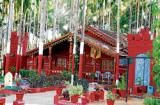
He has built his ‘Taj Mahal’, a museum named ‘Amulya Shodha’, on a one-acre farm near Lakkinakoppa circle on N R Pura road, 12 km from Shimoga in the fond memory of his wife, Yashodha, who was also history lecturer. She passed away in 2007 due to kidney failure.
‘Amulya Shodha’, as the name itself suggests, is an invaluable search for lost values and culture of the bygone days. It showcases rare paintings of Ravi Varma, coins, inscriptions, manuscripts, weapons, all used by popular kings. The history professor collected these artefacts from various parts of the country.

He wants to create awareness among youth about the significance of lost heritage, culture of the previous era through his museum and thus aspires to make youth more aware of our culture and heritage. Apart from this, it also spreads the fragrance of his deep love for beloved wife Yashodha.

Khandobarao did his schooling and college in Shimoga. Yashodha was his neighbour during his college days. Both of them studied at the Sahyadri College together. Acquaintance turned into friendship, and later, love. They got married in 1972. Khandobarao began his career as high school teacher in 1968.

After serving for nearly five years, he was promoted as a history lecturer for National Pre-University College in Shimoga.

His wife worked as a history lecturer at Kamala Nehru Women’s College. His wife would often say that the Taj Mahal was not only a symbol of true love, but also the soul of true lovers. Inspired by her thought, he made up his mind to build a museum on a one-acre farm after the death of his wife in 2007.

Khandobarao is seeking financial assistance for the development of this museum. He has appealed to people’s representatives, including former chief minister B S Yeddyurappa, in this regard. But, his efforts have failed to produce desired results. Khandobarao feels the museum is turning into a mere godown, owing to the presence of a large number of artefacts. He plans to expand it.

But he is short of funds to execute his plan. He has already submitted a proposal to the Centre along with his plan seeking Rs 3 crore for the development of this museum. He wants this museum to remain a symbol of true love and a school of history for future generations.

source: http://www.DeccanHerald.com / Home> Supplements> Spectrum / April 02nd, 2013
IIM-Bangalore toppers to pay back, chart new course

Bangalore :

He is an ardent follower of ‘early-to-bed and early-to-rise’ philosophy. Probably that helped Raghavendran S get a gold  medal for securing first rank in the Post GraduateProgramme (PGP) in management at IIM-B’s 38th convocation on Monday.

Raghavendran, a native of Thiruvallur near Chennai, now dreams of starting a school for children. “I don’t have any short-term plan. I will work for 10-15 years, but after that, I want to start a school in a semi-urban area, which will focus more on curricular activities. I believe I have achieved this goal today because I was lucky to receive the right support and guidance. There are many such talented children in India who can achieve such goals if guided early in life,” he says.

Balagopal Ravibalan, a former employee of  Infosys  and winner of ‘Best All-round Performance’ gold medal, wants to put India on top of the world by using his experience he plans to gather working in the US. “I will join a company in  New Jersey . I want to work there for a few years and come back to India. In the past, people used to go abroad and stay there. Now people go abroad, gather experience and come back to utilize that for our country’s development,” says Ravibalan.

Pankaj Dhake (2{+n}{+d} Rank in PGP) and Mohammed Qasim want to use their work experience for development goals. Nirmal Purohit, gold medallist in Executive Post Graduate Programme in Management (EPGM), wishes to work in the field of research and insight.

Only two women  figured among the gold medalists this year. Adeeba Ansari, a young engineer and gold medallist in electronics and instrumentation from Indore, says: “I want to be a leader in marketing.” Shilpi Lal, gold medallist in Best Academic Performance adds: “Right now I want to be happy and content with what I have achieved.”

Among the 560-odd graduates, 29-year-old Prakash P stands tall. A paraplegic, he graduated in PGP and will join a top company as an associate business analyst. “I cleared CAT with 98% in the second attempt. I believe clearing the test was more difficult than graduating from IIM-B, because the faculty here is very cooperative and guided me well.”

source: http://www.articles.timesofindia.indiatimes.com / Home> City> Bangalore / TNN / April 02nd, 2013

Kannadigas make a mark by displaying their rich tradition

Visakhapatnam :

Their culture and cuisine is very different from that of Vizag and they account for just a small portion of the city’s population. However, the 300-400 Kannadigas, who are mostly concentrated in and around the Gurudwara junction in Vizag, have made the Port City their home.
The Kannadigas are chiefly employed in public sector undertakings such as the steel plant and banks, as well as enterprises such as the Railways and the Navy.

This culturally active community displays its rich traditions and heritage at the Kannada Kala Sangam in the city through programmes such as folk dance and theatre, including Yakshagana and Bhootkala, and also through the celebration of Ganesh Chaturthi and Mosurukudike (Sri Krishna Janmashtami), with the world-famous Carnatic music featuring during festivals. Artistes are also flown in from Karnataka to perform at the Kannada Kala Sangam on special occasions, said Vijaya Kumar, the joint treasurer of the Sangam.

Vishnumurthy Bhat of Udupi in Karnataka, who is in the city for the last seven years and is employed with a nationalised bank, is the secretary of the Kannada Kala Sangam.

“I have extended my stay here by postponing my transfer because my children are studying in the city. Vizag has good schools and hence I’m not in a hurry to rush back to work at my native place,” said Bhat.

The Kannadigas are a floating population here and try to make the most of their stay in the city. “We get everything here except perhaps the Kannada cuisine in restaurants,” he quipped.

That is one of the few things that the Kannadigas, who are in love with the beauty of the city, miss — the cuisine from various parts of Karanataka such as Mangalorian food, Mysore sweets and Bangalore cuisine.

“Each part of Karnataka has its special cuisine, such as the neer dosa (wafer-thin dosa kneaded with water), kori roti (dry rice flakes in chicken gravy), semedaidya and of course the famous Mysore-Pak sweets. There are hardly any authentic Kananda eateries in the city,” lamented Mangalore’s D Deepak, an employee at a corporate house who has been in the city for the last four months.

“The food here is quite different from our part of the country. We use a lot of coconut and banana in our food, including the use of coconut oil. However, overall, I’m enjoying my stay in the city,” he said.

Though the culture and cuisine are vastly different, Kannadiga brother-sister duo B Madhushree and B Srinidhi are all praise for the city and her warm people.

“I could learn Telugu in less than a month because of its affinity with our language and I have many Telugu friends and neighbours who are warm-hearted, soft and polite. I also like the scenic beauty of this tourist place,” said Madhushree, a class eight student of Sri Satya Sai School and a Carnatic classical singer.

For her brother Srinidhi, an intermediate student, it’s the perpetual peace and clam prevailing in the city and non-congested roads that helps Vizag score over other cities. “I’ve been in the city since the fourth standard but have never seen any political unrest or major problems in the city. The city also has good academic institutions. However, the biggest turn-off is the industrial pollution, which is getting worse with each passing year,” said Srinidhi.

source:  http://www.articles.timesofindia.indiatimes.com / Home> City> Visakhapatnam / by Sulogna Mehta, TNN / March 31st, 2013

Book Talk : Sightless, but not Visionless

BookBF06apr2013

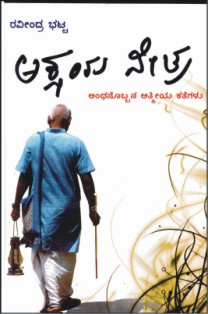
The author of Akshaya Netra, with name and fame in media circles for his lucid presentations about persons and events in which they figure, is in more than one sense the book’s ‘ghost author.’

On his own admission, he embarked upon the task of narrating about an individual who dared his visual impairment (being blind) by leading a life that mocked at the disability, having convinced himself that if he did not record what the central figure of his work, Prof. M.S. Venugopal, went through in life that would amount to a betrayal to the society. The narration in first person makes Venugopal the ‘true author’ of the work, but for his being sightless.

The author has captured the saga of life’s vicissitudes that the subject (Venugopal) of his book faced with aplomb by adopting the anecdotal route as narrated to him from memory. In that sense, the work is a hybrid case of an autobiography not actually written by its own author.

The crisp script presented in 10 concise sections generates a feeling in the reader that Venugopal is himself narrating his travails and ultimate successes in all his pursuits in a one-to-one communication. While his realisation of being sightless is told in a matter-of-fact outlook, his triumphs of achieving his goals in life are told with consummate humility.

The reader is served a sumptuous fare of details of innumerable occasions that Venugopal braved to the extent of visualising those trying occasions as crystal-clear graphics. Once begun, it is well-nigh impossible to put the book away until page 112, its last page.

Prof. Venugopal, now a familiar figure among the literati of Mysore, through the pen of his biographer Ravindra Bhatta, may be inclined to agree with the thought of this reviewer that his message to everyone in society is this: It is a terrible thing to see and have no vision. The world may be full of suffering, but it can also be full of overcoming. Also, avoiding danger is no safer in the long run than outright exposure to that danger (a quote from Helen Keller, the legendary deaf-blind icon). —BRS.

source: http://www.StarofMysore.com / Home> Feature Articles / March 31st, 2013

Lighting up lives of the underprivileged

Dharwad :

Karnataka Vikas Grameena Bank which covers nine districts of north and coastal Karnataka has come up with a scheme to attract students to school in association with Selco Solar Company, under a programme called “Light for Education”, which is being implemented in a few government schools.

According to a study, about ten percent of the children who go to government primary schools do not have electric lights in their homes. It is more so among the nomadic tribes, who go from place to place. It is their children who suffer the most as they are forced to read in the dim light of an oil or kerosene lamp. This nips most of their aspirations and creativity in the bud.

“Not only that, using kerosene lamps is dangerous as well, as we have heard of incidents of lamps falling on dozing children leading to fatal accidents. It is in this background that the bank has decided to help students with safe lights,” said KVGB chairman Sambasiva Reddy.

Under the programme, 50 students are identified and given solar lamps. The importance of this programme is that the batteries of these lamps can be charged only at the school where charging unit will be placed. The unit is a large one which can charge up to twenty five batteries at a time. Since the lamps can be charged at the school, children who use the lamps should necessarily come to school for charging. Lamps are made of good quality but since it cannot be charged independently, there can be no malpractice and it cannot be sold by unscrupulous persons and even by drunken parents. The lamps will be given to children studying in fourth standard and they can use it till they complete their seventh standard.

The Bank and Selco Solar Company have cast a responsibility on the school to maintain the solar charging panel and to keep track of the fifty solar lamps given to their students. The lamp and the solar panel will be serviced by Selco Solar Company.

The first beneficiary under the said scheme is the Government Kannada Primary School No.7, situated on Savadatti Road, Dharwad which has sheltered only students of poor background.

source: http://www.articles.timesofindia.indiatimes.com / Home> City> Hubli / by Gururaj Jamkhandi, TNN / March 31st, 2013

Holi celebrated with gusto in Gulbarga, Bidar

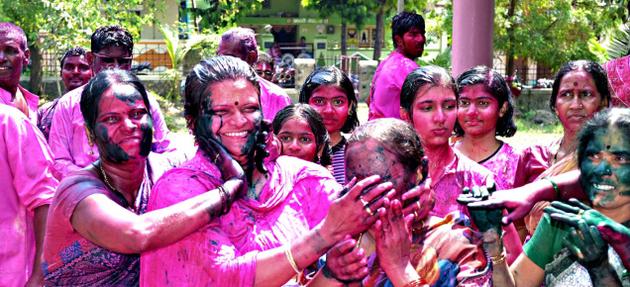
In the thick of it:Members of a youth club participating in a ‘dahi handi’ competition in Bidar (top); women celebrating Holi in Gulbarga on Wednesday.— Photos: Gopichand T. and Arun Kulkarni / The Hindu

The city was awash with colour and life came to a grinding halt as people celebrated Holi on Wednesday.

A festive mood prevailed in the city throughout the day. Shops, business establishments and hotels downed shutters, and public and private vehicles were off the road until evening, as youngsters and revellers took to the streets in the morning itself.

No untoward incident was reported anywhere in the district.

The government had not declared a holiday on Wednesday and attendance at its offices was thin.

Nationalised banks suspended operations for the day.

Competition

Bidar Special Correspondent writes:

Holi was celebrated with joy across the district on Wednesday. Some residents set up temporary shelters to provide drinking water to revellers. Several NGOs distributed buttermilk and lemon juice, while yuvak mandals put up tents and served snacks.

The members of a youth club organised a ‘dahi handi’ competition in the old city.

holi2BF05apr2013

Official reception

Government employees gathered at Durga Darshini, the Deputy Commissioner P.C. Jaffer’s residence, to play Holi.

There, they were met by Dr. Jaffer, Ujjwal Kumar Ghosh, zilla panchayat Chief Executive Officer, and Sunil Panwar, Deputy Conservator of Forests, among others.

Bandeppa Kashempur, MLA, joined a group of Lambani women in their dance in the celebrations organised outside his house. Residents of villages and tandas in the taluk participated in the celebrations there.

Rahim Khan, MLA, played Holi with villagers who visited his house on Ring Road.

source: http://www.TheHindu.com / Home> National> Karnataka / by Special Correspondent / Gulbarga, March 28th, 2013

Grit and gumption help student achieve rare feat

Dharwad :

Coming from a poor agriculturist family in a parched village of Harlapur in Kundgoltaluk of Dharwad, ShridharBhandiwad could not have dreamt of having a lucrative job in a software company in Bangalore. But his determination to convert the challenges into opportunity has helped him achieve what was once considered impossible.

A fresh engineering graduate, Shridhar is now a software engineer working for BEL at Bangalore and earning a salary package of Rs 6.4 lakh per annum. What is more commendable is Shridhar bagging four gold medals for securing highest marks in the BE Computer science course.

Shridhar, son of Yallappa Bhandiwad and Sulochana did his schooling at Government Kannada Medium School in Harlapur and secured 91 per cent of marks in SSLC. He joined Karnatak Science College in Dharwad for PUC but money was a major constraint to pursue education further.

With an annual family income of Rs 15,000, Yallappa was unable to fund his son’s education. It was at this time that a friend Arvind Joshi informed Shridhar about NGO Vidyaposhak which is helping the deserving economically weak students to pursue education.

Shridhar’s efforts to contact Vidyaposhak clicked. Once in the ambit of Vidyaposhak, Shridhar had no worries over financial arrangement till he completed his BE. Vidyaposhak which studied his family background, economic status and academic performance ensured that he was helped with funds and study materials.

He got 72 per cent in PUC II year science and could get a seat at the University BDT College of Engineering in Davanagere for BE in computer science.

Shridhar did not disappoint those who helped him. Studying hard he managed to remain a topper during the course and secured highest aggregate marks (87.45 per cent) in B E final year and also highest marks in Computer Science subject and won four gold medals.

“But for the support from Vidyaposhak I could not have achieved anything. Right now I have some loans to be cleared and soon I want to start donating to Vidyaposhak,” Shridhar said.

Shridhar wants to do his MTech and help the needy.

source: http://www.articles.timesofindia.indiatimes.com / Home> City> Hubli / by Gururaj Jamkhandi, TNN / Dharwad, April 01st, 2013

Bangalore’s gift to the Nightingale of India, Lata Mangeshkar

Artist Yashwanth Hibare has painted a 30 x 40 size portrait of Dinanath Mangeshkar, father of Latha Mangeshkar which he plans to present it to the melody queen in Mumbai on  April 24. | EPS
Artist Yashwanth Hibare has painted a 30 x 40 size portrait of Dinanath Mangeshkar, father of Latha Mangeshkar which he plans to present it to the melody queen in Mumbai on April 24. | EPS

Artist Yashwanth Hibare holds no degree in Fine Arts but today among many awards and accolades, he has also won the title of  Chitrakala Ratna. In 2010, he was honoured with the Rajyotsava award. But now, he has a pursuit.

Now at 70, the artist has painted a 30 x 40 size portrait of Dinanath Mangeshkar, father of Latha Mangeshkar which he plans to present it to the melody queen in Mumbai on  April 24.

“I just came to know that the Mangeshkar family would be holding the death anniversary of their father. So, I decided that it was an appropriate day to gift my painting. I have been in touch with the family and have apprised them about the painting and I will be presenting it on this day,” said Yashwanth.

His interest to do this particular portrait was basically because he was mesmerised by the history of this famous person. “I got to hear  about this great personality through my friends. I heard that Dinanath had struggled a lot in life and had to go through lot of difficulties in taking care of the family along with his elder daughter Lata Mangeshkar. They were singing on railway  platforms for their living. I had tears in my eyes when I heard about it. That’s when I made up my mind to do the painting,”  he revealed.

Although Yashwanth has done around 4000 paintings in the past few decades, he has never presented his art form to anybody. “This will be my first painting that I am gifting to somebody. I wanted to do this portrait 11 years ago but was unable to get a photo till now. The actual picture was only up to shoulder length. I created the rest and added instruments since he was a good musician,” said Yashwanth, who feels it is a small gift to the lady who has done so much for India. “After all the initial struggle, Lataji has achieved in her own way for which she has received national and international acclaim. This is just a small gift from my side,” he stated.

Going back to time

Yashwanth started painting when he was just seven. Today, at 70, he is still exploring the art form. “I consider my father Thippaji Rao, a tailor by profession as my guru.  I am completely illiterate because I never attended any school. I remember as a child, my father asked me to draw pictures of Lord Hanuman on a slate and later he drew it for me which I kept on copying. From then on, I have been holding on to the brush,” he said.

Yashwanth, a native of Bidar has been in Bangalore for decades now and earns a living through his paintings. He is popular for his holistic approach to his paintings as he concentrates mostly on mythological themes and famous people. “I am more into realistic art which I picked up from my Guru SM Pandit. I follow his art form in my paintings. My paintings are often displayed at Chitrakala  Parishath and recently, I showcased my art at Chitra Parse,” he said.

source: http://www.newindianexpress.com / The New Indian Express / Home> Cities> Bangalore / by A. Sharadhaa / ENS – Bangalore / April 04th, 2013

Music and dance reviews

MusicBF03apr2013

Tribute to music

The ESSAE Music foundation had organised music concerts – a veena and a vocal – by young artistes of Bangalore.

First Ashwin Anand opened his Veena recital with the Kambodhi swara jathi. It has charana and is practised on a daily basis by artistes of Mysore School. The Karnataka Kaapi Swara Jathi is known for its very difficult sangathies, set to khanda atha thala and ‘Ateetha Edupu’! ‘Neerajakshi’, the Saveri varna in jhampe thala is shining with datu swaras. The keertane ‘Inthashodha’ is one of the best compositions in the raga Rishabhapriya. He concluded his veena recital with the legendary jinjoti thillana. It was a classical treat sans gimmicks.

Impactful rendering

S Ramani and K S Giridhar, disciples of S Shankar, senior musician, opened their vocal with the Bhairavi swarajathi. ‘Mayamelara’, the Natakuranji varna in Khanda Triputa, was full of ‘Ragabhava’. ‘Rama Ninnu’, the Anandabhairavi keertana, was small in size but was rendered with good impact. ‘Nadiridiri Dheem’ – the Thodi thillana is a less-known composition and concluded with ‘Shiriye’ in jinjoti. These young artistes presented compositions of Veena Seshanna impactfully. M P Aditya on violin and B R Srinivas on Mridanga supported them.

Pleasing vocal

The Bangalore Ladies’ Association had organised music and dance programmes on Saturday evening in connection with its Golden Jubilee celebrations.

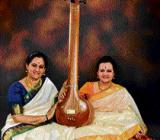
Triveni Saralaya and Kavitha Saralaya, popularly known as ‘Saralaya Sisters’, who gave a vocal duet, were accompanied on the violin by M S Govindaswamy, on mridanga by V S Rajagopal and on ghata by M A Krishnamurthy. Their opening piece itself had the right tempo and the ‘Akhilandeswari’, the popular kruthi on Devi, was also pleasing. Their treatment had a touch of class and the ‘Rama Rama Guna Seema’ reverberated with good sangathies.

With their good voices and neat presentation, they earned the appreciation of the assembly. ‘Hari Kunida Namma’ was lively and the ‘Maitrim Bhajata’ is a favourite patriotic song.

Hunnime Sangeetha

It was the turn of Dr Vaishaly this time to perform in the series ‘Hunnime Sangeetha’ at the ‘Kadu Malleswara Udyanavana’. Clear rendition of raga with subtle ambience and the subsequent aesthetic articulation for Rageshree showed her prowess and competence.

Her methodical approach to the raga (Vilambit Ek Taal and Drut Teen Taal) with an aesthetic touch brought a composite picture of the melody. A number of Kannada compositions – both devaranama and vachana – followed, with popular appeal. Maadi Maadi Kettaru (Basavanna), Aadalu Pogona Baro Ranga (Sripada Rajaru) Baraiah Ranga (Purandara Dasaru), Kayada Kattaleya (Akkamahadevi) – were bristled with melodious sangathies. Panchakshari Hiremath and Hanumanthappa Hugar accompanied on Harmonium and Thabala, respectively.

Evocative, crisp dance

Nirupama Rajendra, the popular dancer, who is well versed in both Bharathanatya and Kathak, gave a solo Bhara­t­h­a­n­atya recital. A Ganapathi Stuthi gave her a bright start. The opening, with Kannada lyrics, was followed by the well known ‘Mudaka Rathna Mo­d­a­kam’. She performed with gay abandon, in the ‘Lokadharmi’ beautifully.

The piece de resistance, however, was a piece from the ‘Kumara Sambhava’. The well-known story was depicted with lively visuals, and had crisp movement and of course was attra­c­ted by Karnas, a result of intense research by Dr Padma Subram­a­n­yam. The ‘Vatsalya Bhava’ was well-depicted in the evergreen devaranama ‘Jagadodd­a­rana’, dramatising the situations with visual appeal. The concluding thillana in Kadan­a­kutuhala (Dr M Balamurali Krishna) was crisp and evocative.

source: http://www.DeccanHerald.com / Home> Supplements> Art Review / by Mysore M. Subramanya / April 01st, 2013

City lad represents champion state cricket team for deaf

guruBF03apr2013

Mysore :

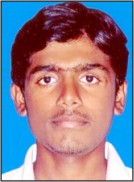
K. Guru, a student of 6th Sem. Diploma in Electronics and Communication Engineering, JSS Polytechnic for the Differently Abled played in the First National Deaf T-20 Cricket Championship held from Jan. 29 to Feb. 3 at Secunderabad representing the Karnataka State Cricket Team for Deaf.

The Karnataka team won the Championship. The Principal has congratulated Guru on behalf of the Polytechnic.

source: http://www.StarofMysore.com / Home> Sports News / March 29th, 2013