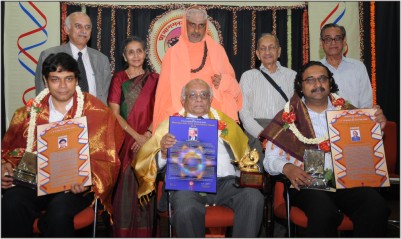
Prof. Y.T. Thathachari awards of Bhramara trust presented to scientists

BhramaraoBF27mar2013

Caption:  From left: Prof. Debabrata Goswami, Dr. Chidambaram and Prof. P.S. Anil Kumar (seated), recipients of Bhramara Trust awards instituted in the name of Prof. Y.T. Thathachari, are seen with Dr. V. Prakash, Madhuri Thathachari, Suttur Seer, Dr. B.A. Dasannacharya and Prof. R. Srinivasan at the awards presentation ceremony held at Rani Bahadur auditorium in city yesterday.

Mysore, Mar. 21 :

The Bhramara Lifetime Achievement Award, instituted by Bhramara Trust of Y.T. & Madhuri Thathachari, was presented to Dr. R. Chidambaram, Principal Scientific Advisor to the Govt. of India and Chairman of the Scientific Advisory Committee to the Cabinet, at a function held at Rani Bahadur auditorium of the Bahadur Institute of Management Sciences in city yesterday.

The Prof. Y.T. Thathachari Prestigious Research Awards for Science, also instituted by Bhramara Trust, were presented to Prof. P.S. Anil Kumar from the Indian Institute of Science, Bangalore and Prof. Debabrata Goswami from the Indian Institute of Technology, Kanpur.

The awards, comprising Rs. one lakh cash, a citation and memento, were presented by Suttur Seer Sri Shivarathri Deshikendra Swamiji.

Dr. B.A. Dasannacharya, former Director, Inter-University Consortium – Department of Atomic Energy Facilities and Dr. V. Prakash, Hon. Director of Research Innovation and Development at JSS Mahavidya Peeta were the chief guests.

Dr. Chidambaram said in his acceptance speech that the scientists must contribute their mite to the progress of knowledge. Alluding to the Higgs Boson experiment that discovered the God Particle, Dr. Chidabaram said that apart from many Indian scientists involved in the experiment, India had contributed 40 million dollars for the machine in which protons were made to collide in a specially constructed tunnel underground. “But the origin of the universe still remains a big question,” he said.

Regarding the restrictions on scientists’ works, Dr. Chidambaram said, “You do not ask Sir C.V. Raman or Ramanujam to submit a project report and set up a committee to decide on whether the project should be funded or not. A scientist must be given the freedom to carry out research works without posing hurdles.”

Dr. Dasannacharya, while introducing Dr. Chidambaram to the guests, said that he had known the scientist for exactly half a century while serving at the Bhabha Atomic Research Centre. “America had always denied frontline computers to India. Then the BARC got the advanced computers from Norway,” he said and added that Dr. Chidambaram had developed a parallel computer system at the BARC, which, despite being a major achievement, was not appreciated by those in power.

Bhramara Managing Trustee Madhuri Thathachari, the driving force behind the awards meant to bring to fore achievers in the field of science, said in her welcome speech that this might be the last in the series of annual awards presented in the name of Prof. Y.T. Thathachari. She also suggested that newspapers must dedicate a column for scientific research.

Prof. R. Srinivasan, Trustee of Bhramara Trust and brother of Madhuri Thathachari, spoke about the selection process for the awards.

The programme began with chants by residents of Parasara Gurukulam, followed by hymns sung by Annapurna Srikanth, all-India 3rd rank holder in CA exams.

Jyothi proposed a vote of thanks.

source: http://www.StarofMysore.com / Home> General News / March 21st, 2013

Yesteryear’s HMT is a collector’s delight today

Bangalore :

Those were the days when Bajaj scooters used to capture the middle-class imagination. As did Ambassador cars and HMT watches. Bangalore-based businessman Nikhil Tivari was in high school when his mother gifted him a HMT Rajat automatic watch in the 1970s.

Like the scooter, there was a waiting period for the Rajat — of over 10 months. Tivari’s mother booked a Rajat by paying a few hundred rupees as advance. “The watch could have been a future keepsake but it was stolen,” says the watch connoisseur, who owns over 40 one-off timepieces and popular brands.

But Tivari got lucky the second time when he bought an HMT Astra digital watch in the early 1990s. “I was one of the first 20 customers to own an Astra, which then cost Rs 392. They were selling it in the black market in Delhi for Rs 1,000. Long before luxury brands came into the country, HMT was the timekeeper of the nation. You would wear it with pride,” says Tivari, who treasures his HMT watch.

HMT is in a bad way, but many young watch lovers today love the idea of owning and investing in vintage HMT watches. The value of some of its brands has appreciated from a few thousand rupees to a couple of lakhs.

Working man’s timekeeper

Chennai-based Mukund Sivaraman owns 15 HMT watches, including a few Pilots and Janatas. These are popular for their 17-jewel manual wind mechanical movements. The jewels may not be of great value and are mainly used to reduce metal-to-metal friction. “I am fascinated by the mechanical movements, more so because they work like a machine. The Pilot and Janata were very affordable and represented the working man’s watch of the 1970s and 1980s. You could get them for less than Rs 1,000,” says the director of software consultancy firm Banu.com.

Sivaraman said collectors across the world are making enquiries for HMT’s mechanical watches. “They last a lifetime and are much cheaper than mechanical watches from Seiko,” he said. The mainspring does the magic and it’s hand wound.

For UK-based software professional Nimish George, his HMT watch has become a family heirloom. His grandfather James Puthuran, then 90, gifted it to him as an anniversary gift 50 years ago. “It still works perfectly,” says George.

HMT watches have become a talking point on many discussion forums like forums.watchuseek.com, PMWF.com (Poormanswatchforum.com) and thewatchforum.co.uk. Bangkok-based Christopher  Sisti, in a blog post last year, described HMT watches thus: “They look retro with a vintage feel, which is very cool if you ask me. The watches being mechanical is cool too, because for that price ($12) you could only get a cheap battery watch in America.”

VD Wadhwa, director of All-India Federation of Horological Industries, says he still treasures the HMT Janata watch he bought when he was in school. “HMT’s automatic watches powered by the Miyota movement from Citizen were hugely popular among watch enthusiasts for their durability and accuracy,” he says. Wadhwa has over 100 watches in his collection.

In keeping with time

* HMT set up a watch manufacturing unit in Bangalore in collaboration with Citizen Watch Co, Japan, in 1961

* First batch of hand-wound wrist watches was released by then Prime Minister Pandit Jawaharlal Nehru

* Launched India’s first automatic day-date, quartz, Braille, ana-digi watches

* In 1975, the watch factory in Bangalore was expanded to manufacture main spring, hair spring and shock-absorber components. With this, HMT totally acquired the technology of mechanical watch-making

* Set up manufacturing facilities to produce 2 million watch components in Tumkur (1978) and Ranibagh (1985)

* Tumkur factory was partially converted to manufacture quartz analog watches in collaboration with Japanese watchmaker Citizen

(Source: HMT website and internet)

source: http://www.timesofindia.indiatimes.com / Home> City> Bangalore / by Shilpa Phadnis, TNN / March 25th, 2013

150th anniversary celebrations of ‘ Sarada Vilas ‘

Former President of India Dr. A.P.J. Abdul Kalam will inaugurate the 150th anniversary celebrations of Sarada Vilas Educational Institutions at a function organised at the college Centenary Hall in city on Mar. 23 at 11 am.

SaradaBF26mar2013

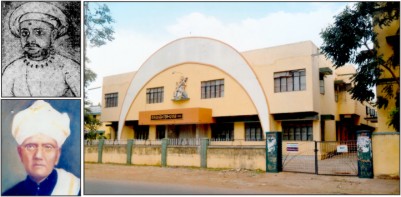
Caption:    Founders Bhakshi Narasappa and Venkatakrishnaiah (Tataiah)

About the institution: A little more than 150 years ago, in 1861, a new star took birth in the educational realm of the then State of Mysore. It was founded by Rao Bahadur Bhakshi Narasappa, who enjoyed the confidence of the then king Mummadi Krishnaraja Wadiyar and was named Sarada Vilas Anglo-Sanskrit Pathashala which was housed inside the Palace temple premises. The Pathasala had the credit of being the first private school in the then Mysore State.

Both Mummadi Krishnaraja Wadiyar and Rao Bahadur Bhakshi Narasappa were fully aware of the value of education and hence nurtured the school in every possible way which had just 20 students in the first year but grew from strength to strength quickly.

As the strength increased, the space inside the temple was not sufficient to accommodate the students. Narasappa volunteered to shift the school to his own building at Makkaji Chowk, popularly known as Bhakshi Narasappa Choultry and was financially assisted by K. Seshadri Iyer, the then Dewan of Mysore. The school found itself in a tight spot owing to the demise of Narasappa and resignation of the Head Master Mandikal Ramasastri. To overcome all administrative and financial problems faced by the school, the Government of Mysore set up a Committee in 1899 with M. Venkatakrishnaiah, affectionately called ‘Tataiah,’ as the Hon. Secretary. Tataiah was committed to the cause of education and took the responsibility of strengthening the school which ultimately turned it into a model school.

As more and more students joined the school, once again the constraint of space became an acute problem and the king of Mysore permitted the school to use the first floor of Lansdowne Building.

Tataiah, who recognised the need for a high school, strived hard and founded the Boys High School in 1919. He desired to house the school in its own building and succeeded in getting a sprawling campus in Krishnamurthypuram. The High School was shifted to a new building in Krishnamurthypuram and he rendered yeomen service to the school as Hon. Secretary of the Committee till his demise in 1933.

The legacy of Tataiah was carried forward by M.S. Ramaswamy, who took over the mantle from Tataiah and transformed his vision into reality while S. Ramarao took charge as the Hon. Secretary following Tataiah’s demise and strived to take the institution to greater heights.

Ramaswamy, who had big dreams, got the govt. approval and founded the Intermediate College in 1945. He continued his hard work with great vigour and was responsible for starting Degree College in 1952 and served as its Principal for 20 years. In the year 1954, Sarada Vilas Law College was started, which was the second Law College in the State at that time. Sarada Vilas Teachers College was started in 1963 and in 1992, Sarada Vilas College of Pharmacy came into being.

The management, which felt the need to impart education to girls, started an exclusive High School for girls in 1961 which was a milestone of Sarada Vilas Educational Institutions and started Pre-Primary and Higher Primary School in 1992. Now under the umbrella of Sarada Vilas Educational Institutions, there are various schools and colleges which cater to the educational needs of students of all ages. The objective of Sarada Vilas is to give quality education at affordable cost to all sections of society as it believes in creating good citizens who in turn will strive hard to create a good society. Sarada Vilas offers PG course in pure Sciences like Physics and Chemistry, and Applied Sciences like Microbiology and Biotechnology and is sure to go a long way in helping students acquire higher degrees and pursue research.

source: http://www.StarofMysore.com / Home> General News /March 20th, 2013

Uni-, multi-, it’s your choice honey

HoneyBF25mar2013

An interested visitor at the Honey Festival in Bangalore on Saturday. /  Photo: V. Sreenivasa  Murthy / The Hindu

If you are looking for the rare unifloral honey, head to Lalbagh Botanical Gardens where the two-day Honey Festival is under way. Unifloral honey in lychee, cajanus, clover, acacia and ajwain are among those that are on display, along with multilforal honey that is commonly available in the market.

Unifloral honey, sourced from different parts of the country and processed here, has a distinct flavour that the multifloral honey lacks. Though expensive (some cost double that of normal honey which costs between Rs. 200 and Rs. 250 a kg), these uniflorals are in demand.

Drawing interest

Not only is the festival one of its kind in the city, it will provide you with a glimpse of honey production and processing. The body suit, face mask, hive tools, box stand and migration kit have been displayed to help the public understand all aspects of apiculture.

Also on offer is a combo of honey with bun, fruits, ice-cream, dry fruits, gulkand and tea. “We have tried out various combinations of honey that is tasty and healthy. Those who have tasted them are giving us good feedback,” said J.D. Shivakumar of Prakruthi, which is planning to open an outlet in Kalyan Nagar here to promote the combo brand.

The festival, at M.H. Marigowda Memorial Hall in Lalbagh, has attracted a number of honey producers, processors, traders, co-operative societies, research institutes and universities. Apart from the direct sales of honey and honey-based products, the festival also has an interactive workshop on promotion of apiculture in the State.

Principal Secretary, Department of Horticulture, M.K. Shankarlinge Gowda, said though there is an annual demand for 8,000 tonnes of honey, the State is able to produce just about 4,000 tonnes. “Karnataka has the potential to produce 10,000 tonnes of honey annually and apiculture needs to be promoted among farmers,” he added.

source: http://www.TheHindu.com / Home> News> National> Karnataka / by Staff Reporter / Bangalore, March 24th, 2013

Hariharan to sing at Orion Mall

Fans can look forward to an evening with some of the best musicians in the country at the Orion Mall in Yeshwantpur on Saturday. It will be the penultimate stop in the largest travelling music festival with over 100 artistes across 12 cities for Idea Jalsa.

The event will feature performances by playback singer Hariharan, followed by a mandolin performance by U. Srinivas.

Idea Jalsa began in 2006 as a concert tour across 39 cities featuring more than 20 regional languages and featuring more than 700 artistes and covering more than 55 genres of music, a press release said. The aim of these concerts is to package and market Indian classical music forms to a younger audience.

Durga Jasraj, founder of Art and Artistes and who currently serves on the board of advisers in the Union Ministry of Culture, said: “Our endeavour is to showcase Indian music across cities by providing a platform for audiences to discover the treasures of Indian music that has a rich legacy.”

The programme will be webcast live on www.youtube.com/indianmusicforsoul and on www.facebook.com /JalsaMusicForTheSouls.

The event is free and passes can be picked up at various Idea Cellular outlets. The concert begins at 7.30 p.m.

source: http://www.TheHindu.com  / Home> News> Cities / by Staff Reporter / Bangalore, March 22nd, 2013

General Body meeting of SIPMA held

SipmaBF24mar2013

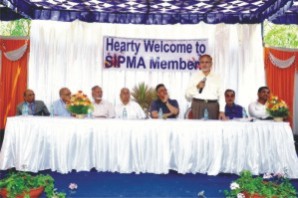
Seen in the picture are (from left) K. Shankara Krishnan, K.G. Bhat, Abbas S. Vagh, Hariraya Kamath, SIPMA President P.K. Mayan, Moiz Vagh, Siraj Asgarali and Secretary Hitendra J. Kothari at the AGM of SIPMA.

Mysore, Mar. 18

The general body meeting of The South Indian Plywood Manufacturers Association (SIPMA) was held on Mar. 16 at the premises of Hunsur Plywood Works in Hunsur. It was attended by about 100 members in which Moiz Vagh of Hunsur Plywood Works briefed the members about the present raw material scenario and manufacturing conditions and spoke about the history of Hunsur Plywood Works.

Feroz Asger Ali of Mufaddel Timber & Allied Products introduced and spoke about the contribution of the senior members to the industry and the Association.

The following senior members were felicitated for their contribution to the industry and the Association: Abbas S. Vagh of Decorative Laminates (I) Pvt Ltd., Mysore; K.G.Bhat of Indian Plywood Manufacturing Company, Mumbai; Hariraya Kamath of Karnataka Plywoods, Sullia and K.Shankara Krishnan of Kutty Flush Doors & Furniture Co., Chennai. The meeting was presided over by President P.K. Mayan of Western India Plywoods.

Secretary Hitendra J. Kothari of J.K. Industries, Mangalore proposed a vote of thanks.

source: http://www.StarofMysore.com / Home> General News / March 18th, 2013

Preserving history on inscriptions for posterity

InscriptionsBF23mar2013

By Dr. T.S. Ravishankar Director (Epigraphy)

The Epigraphy branch which has been in existence in Mysore since 1966, celebrated the completion of its 125th year on Mar. 14, . It is one of the oldest institutions of our country. Located amidst sylvan surroundings in a beautiful and imposing building at Hebbal, this branch is silently ushering in a revolution in the academic history of our country. It is one of the important wings of Archaeological Survey of India.

Realising the importance of the inscri-ptions which are abundantly available in every nook and corner of our vast country for writing the history of India, the farsighted Britishers established this branch in 1886 at Bangalore. Since then this branch has been copying inscriptions and publishing them. These inscriptions are useful in unraveling the history of our past. In fact, we do not know anything about the activities of our mighty rulers of the past but for these in-scriptions. So far, nearly 75,000 inscriptions are discovered and copied by this department and many more ought to be copied.

India is singularly rich in epigraphical wealth. Inscriptions found in our sub-continent are far-flung in time and space. As a source of Indian history, inscriptions are very important because in most cases they describe contemporary events, thereby imparting authenticity to the history based on them. Several dynasties that ruled over large territories of Indian sub-continent right from the imperial Mauryan dynasty to Vijayanagar and post-Vijayanagar dynasties left a rich legacy of inscriptions to us.

Important dynasties that ruled over different terri-tories of India like Mauryas, Kshatrapas, Guptas, Vakatakas, Kadambas, Chalukyas, Rashtrakutas, Cholas, Seunas, Pandyas, Hoysalas, Vijayanagara and Wadiyars have left behind a lot inscriptions in the form of stone inscriptions and copper plates which are useful in reconstructing the history of not only these dynasties but also their territory.

In fact, we hardly know anything about the great Mauryan ruler Ashoka but for his edicts which are available in various parts of our country. Most of his edicts address him only as Devanampiya and Piyadasi and his original name was not known until the discovery of Maski, which is in our State and which calls him as Ashoka. We know this emperor had a name Ashoka only from this edict. Again Nittur, Odegolam and Sannathi in Karnataka yield edicts of this great ruler, which clearly proves the spread of his empire if not, at least that Ashoka wanted to spread his message of Dhamma here.

The golden age in Indian history under Gupta rulers can be understood from their inscriptions such as Allahabad pillar prasasti, Mehrauli iron pillar and others. We know activities of the Kadmaba kings only from the inscriptions engraved by them. We know their capital Banavasi was a centre of learning and culture only from their records. Likewise, the Aihole inscription of Pulakesin II which narrates in detail the political career of the Badami Chalukayan king refers itself to the composer of the record Ravikirti, a Jaina poet, claiming equal fame to that of Kalidasa and Bharavi.

The celebrated Uttiramerur of inscriptions of the Chola ruler Parantaka I (921.C.E.) describes how elec-tions for the local civil govt. were conducted. The earliest reference to a dancer is found from an inscri-ption from Jogimara cave (3rd Cen B.C.E). It mentions one Sutanuka, the temple dancer and her lover Devadatta, a sculptor from Varanasi. Kudumiyanmalai (Tamil Nadu) inscription is one of the earliest inscri-ptions on music. It belongs to the seventh century C.E. and it records the musical notes as understood and practiced during the time of the Pallavas.

The development which the art of music had reached in 11th century B.C.E. can be gathered from an inscription of Chalukya king Vikramaditya from Galaganatha, Haveri taluk and district, which mentions a certain Mokhari Barmmayya, a musician of high order, entitled Batti-saraga bahu kala Brahma (skilled in thirty-two ragas).

The character and personality of the great Vijayanagara emperor Krishnadevarya is known from inscriptions left behind by him. Apart from being political documents these inscriptions also throw welcome light on the social, economic, religious and cultural life of the people of the past.

These inscriptions are written in different scripts like Brahmi, Kharoshthi, Siddamatrika, Nagari, Telugu-Kannada, Tamil, Grantha etc; and the languages employed being Prakrit, Sanskrit, Telugu, Tamil etc.

This branch was served by eminent savants and scholars both from India and West who copied these inscriptions after under-going many perils. They made striking contributions to the cause of Indian Epig-raphy. Western scholars like Hultzsch, J.F. Fleet, Stenknow, Buhler, and Kielhorn apart from Indian scholars like Venkayya, Krishna Sastri, K.V. Subrahamnya Aiyer, N.L. Rao, Panchamukhi, P.B. Desai, D.C. Sircar, G.S. Gai, K.G.Krishnan, to cite a few who had made enormous contributions in this field. These scholars by their disinterested labour and hard work brought to light these valuable records and published them in their official journals. These journals have been regularly coming since 1887. These inscriptions are carved not only on the temple walls, but also on rocks, boulders, coins, vessels, shells and clothes. Though on the face it looks like scribbling by ignorant people or some mysterious scripts of bygone ages, they are the real history carriers. They are the real history books.

It is the bounden duty of every indivi-dual to preserve the records for posterity. Unfortunately, these records are subject to vandalism and are destroyed daily in dozens by ignorant and unscrupulous elements. It is a matter of grave concern.

Not long ago, a very important rock edict of the great Mauryan king Ashoka at Odegolam, Bellary District, was reduced to mere rubble by ignorant villagers who set fire to this rock by piling up heaps of grass. Every day and every hour, the village smith is probably in some corner of some village melting down a precious copper plate in the possession of some private family for its metallic value.

At Amaravati in AP, after rubbing out all inscriptions and sculptures, the carved stupa slabs were used in construction. Many times, stones of old and dilapi-dated temples with inscriptions are utilised by PWD for building bridges or culverts. Inscribed stone slabs, not forming integral parts of structures and lying loose in the villages and towns, stand the danger of being misused as washing slabs or stepping stones and many times they are used in place of bricks for constructing walls. Again when the old temples undergo renovation or repair, the old inscriptions are either destroyed or covered with thick paint.

The walls of the inner prakara of the famous Srirangam temple in Tamil Nadu which has a lot of inscriptions are now covered with shining black granite. And the walls of the same temple are covered with oil paintings of religious marks, nama or conch or chakra completely obliterating inscriptions. In TN, quarrying of hills which contain archaic inscriptions destroy them completely.

The rapid pace of urbanisation and industrialisation has a deleterious impact on the extant monuments. Several monuments are either displaced or destroyed for accommodating skyscrapers, factories and apartments. Recently, near Chennai an ancient Chola temple of 11th century was to be destroyed for laying a highway but luckily the project was abandoned in teeth of opposition. It is disheartening to note that most of the monuments which could boast of hundreds of inscriptions in the last century could have only 50% of this now, as the other half were mutilated either due to vandalism or exposure to vagaries of nature.

All conscientious citizens should serio-usly reflect on this aspect to preserve these records. We will do a great disservice to the cause of history, if we neglect these valuable inscriptions and allow them to vanish. It is amazing to note that our ancients were endowed with a better sense of history than us. They realised the importance of inscriptions. The pious Chola queen Sembiyan Mahadevi (940-1012 C.E) renovated many old temples. Whenever she undertook repair or renovation of any temple, she scrupulously preserved all the old inscriptions and got them rewritten on the walls once the temples were reconstructed. In this way she preserved many old Tamil inscriptions and she also put up inscriptions to that effect.

The Epigraphy branch arranges photo exhibition of inscriptions periodically as part of cultural awareness programmes in different places to enlighten the people about the importance of inscriptions and the need to preserve them.

Public are sensitised that whenever any historical object like stone inscription, copper plates or hoards of coins are found or being destroyed they should immediately report the matter to the Tahasildar or the Police Station. The temple authorities should be enlightened to preserve these records and they should advice the devotees not to destroy or vandalise the sculptures or inscriptions by applying oil or sindhur, out of their “intense devotion.”

Colleges should conduct periodical tours for students of history to the villages where monuments are located and educate them.

Whether it is government agency, any institution or individual, it is the collective responsibility of all to preserve our rich heritage — architectural, sculptural or epigraphical.

source: http://www.StarofMysore.com / Home> Feature Articles / March 17th, 2013
Encouraging aspiring entrepreneurs

EntrepreneursBF23mar2013

Every person aspires to become an entrepreneur, while some succeed others falter. The National Entrepreneurship Network (NEN), which is the leader in entrepreneurship education, has been encouraging engineering colleges to start E-Cells throughout the country to encourage students to grow as entrepreneurs.

One such Entrepreneurship Cell (E-Cell) is Aspera at the Vidya Vardhaka College of Engineering (VVCE), which was started in the year 2005 but was officially launched in 2007 with the name ‘Prerana.’ Later, the name was changed to ‘Aspera’ in 2009. Aspera has been actively taking part in activities conducted by NEN since its inception.

Speaking to Star of Mysore, Aspera Co-ordinator Prof. Manjula Murthy said that NEN had been guiding students in term of starting a new business, connecting the budding entrepreneurs from college to various industries and also to investors.

Aspera has been conducting activities throughout the year. This apart, regular meetings are conducted every Saturday where students come out with their idea of starting a new business. This is where seniors take the lead and guide their juniors to start their own business under the umbrella of Aspera, she said.

There are different concepts under which the meetings are conducted. There is a concept called ‘100 Rupees’ where the budding entrepreneur is given Rs. 100 which he/she has to invest and use the same money to purchase raw materials and come out with a product. They should also market their product and convince the consumers to purchase the product. This apart, members of Aspera also discuss about new business ideas and problems related to the college.

“The idea of starting a business is not to make profit, but to make students understand the functioning of the market and learn about the difficulties that they would have to face once they are out of the college,” said Prof. Manjula Murthy.

During the E-Week-2013, Aspera conducted workshops, seminars where opportunities available in the neighbourhood were discussed. Many of the students showed their interest to take up agro-based startups such as starting vermicompost enterprise and similar businesses. Aspera was also crowned Champion Runner-Up by NEN during E-Week-2013.

On-campus activities during E-Week included “Startup Mysore” in which students from different disciplines were selected for mentorship to start their own ventures. The crown of this success story has been rewarding. They were declared the Champion Runner-Up by NEN during the current E-Week after a thorough audit by the hosts of the championships, NEN, cutting across more than 600 institutions along the length and breadth of India.

Currently around six companies are being run under the umbrella of Aspera — a) Dil Ke Paas, b) Hidden Reflections, c) Go Tee, d) Tech Ambush, e) Reviewer’s Guild, f) Illusions — which have been guided by NEN, seniors and college.

Tech Ambush: Tech Ambush is a website which was started by Adithya, Saurabh and Nagarjun, all students of VVCE. The website was launched in March, 2013 and it gives information about the latest Android, Windows phones, Blackberry news. The website also provides information about apps, new gadgets, games and other development in the field of technology.

Interested can visit www.techambush.com.

Hidden Reflections: Founded in Nov. 2010, Hidden Reflections is a one-stop printing, designing and media solutions company based in Mysore. It specialises in all types of printing, designing, merchandising and media solutions for events, businesses, organisations, causes and individuals. It provides marketing solutions in all shapes and sizes like billboards, t-shirts, pamphlets, visiting cards, newspaper ads, etc. The company also designs and maintains websites and produce promotional videos.

Hidden Reflections is managed by the students who have the passion to innovate, achieve and explore new trends in media, marketing and advertising. Recently, the company also took up event management and music management assignments. It is being managed by Nikhil Furtado, III year, BE (Mech).

Go Tee Apparel: GoTee Apparel strives to create the perfect t-shirt, hoodie, or other apparel, specialising in both customised and bulk orders. It deals with t-shirts, sweatshirts, hoodies, jerseys, caps and other apparel. Every product is customisable according to the need of the customers and available in any range. The company has also released t-shirts with its own designs. It was founded by Nikhil Furtado, S. Impana and M. Ashwin, all engine- ering students.

Illuzions: Illuzions is a designing company which was started by Niranjan during Feb, 2012. Currently the company has been taking assignment related to web designing, graphic designing and interior designing.

Reviewers’ Guild: Reviewers’ Guild is a website which is being managed by Abhishek Bhat. It was launched a couple of years ago and has been getting good response from the public.

The website basically has reviews about gadgets, movies, books, games and new trends in the market.

Abhishek has also been managing V-Think, an e-newsletter about VVCE. Interested can visit www.reviewersguild.com to get to know about latest books, movies, gadgets and other products in the market.

Dil Ke Paas: Dil Ke Paas is a company started by M. Abhishek during his days in the college. He passed out of the college during 2011 and was working for a company till recently. Later, he quit his job and started his own business. Abhishek creates unique greeting cards which are a combination of his mechanical skills and art works.

Abhishek has also come out with a dehusking machine which works on both manual and electrical mode. He said that he had work on the machine before letting it into the market.

Apna Mess: Apna Mess is a canteen which is being run by Manish Kumar, a 6th semester Computer Science student. Manish Kumar started the mess to cater to the needs of North Indian students who find it difficult to adjust to the South Indian food.

The canteen has been serving around 60 students who visit the place every day to have their breakfast, lunch and dinner. The food is offered at reasonable price and it has been doing well since the day of its inception.

The students said the college had been supporting them in their endeavours. Prof. Manjula said that Aspera was looking out to come out with technology-based products. “We want to come out with technology-based products, materialise the product and also patent it. Further, we are looking forward to come out with software and environment-based products in our future endeavours,” she added.

With Vidya Vardhaka College lending its support to the students, one can expect more number of entrepreneurs emerging out of the institutions.

source: http://www.StarofMysore.com / Home> Feature Articles / by S.N. Venkatnag Sobers / March 17th, 2013

From top cop to ‘general’, Bidari makes the transition

BidariBF22mar2013

Bengaluru:

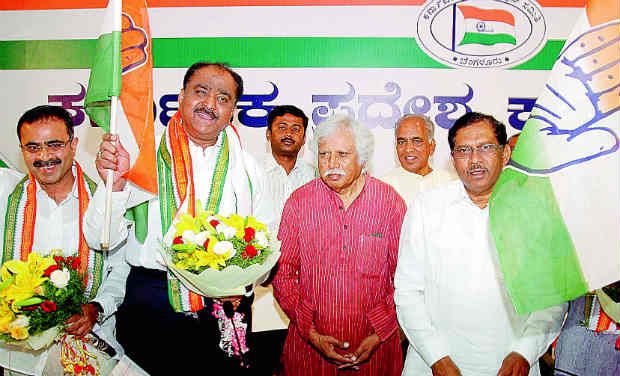
Former DG and IGP, Shankar M. Bidari on Monday declared that he was like a ‘well-equipped wartime general’ and was ready to serve the Congress in any capacity.

Speaking to reporters after joining the  party at the Karnataka Pradesh Congress Committee office here, Mr Bidari  said, “Throughout  my life, I had  general like abilities to lead from the front. It is upto the party to decide my role as I know the Congress has always respected its leaders and given them their due share.”

He said he had joined the Congress without any pre-conditions because of its ideology. “I worked in various capacities as a policeman. I am proud that during my 32 years in the force, I served the common people to the best of my ability. Though I am now retired, my heart tells me to keep working for the people,”  he explained.

Taking a swipe at newly founded parties like KJP and BSR Congress, Mr Bidari caustically remarked that of late, many leaders were  busy building parties without any ideology and only to satiate their egos.

“I am a man of principles. I declare that I will neither quit the Congress nor join any other party,” Mr Bidari said. While welcoming two more prominent personalities, Professor K.E.  Radhakrishna and Panacea Hospital chairman, Dr C. Jayanna, along with Shankar Bidari into the party fold, KPCC president, Dr G. Parameshwar said, “Their entry will strengthen our base. These  leaders will prove to be assets in the days to come.”

source: http://www.DeccanChronicle.com / Home> News> Politics / DC  / March 19th, 2013

Dr. Basavaraj Sabarad receives Shivarathreeshwara award

BasvarajAwardBF22mar2013

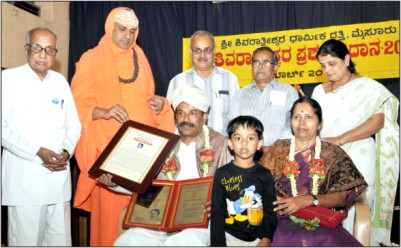
Caption: Sri Shivarathri Deshikendra Swamiji presented the award to Dr. Basavaraj Sabarad and his wife as researcher Dr. M. Chidananda Murthy, critic Dr. M.S. Ashadevi and others look on.

Mysore, Mar. 16 :

“Vachana Sahitya should not be just read as a subject to get medals and prizes but the values of the same should be advocated in life,” opined senior Researcher and litterateur Dr. M. Chidananda Murthy.

He was presiding over a programme organised jointly by JSS Mahavidyapeetha and Sri Shivarathreeshwara Religious Endowment for the presentation of Sri Shivarathreeshwara award at Rajendra Bhavan, JSS Hospital premises yesterday.

“Vachana Sahitya should be understood deeper to comprehend the intrinsic social values. It can rejuvenate people in despair. While learning any subject, the teacher is always on the top and the student much below but as the latter picks up knowledge, the gap should reduce. One day the student may take over bringing immense satisfaction to the teacher.”

The award carrying a cash prize of Rs. 25,000 was presented by Sri Shivarathri Deshikendra Swamiji to Dr. Basavaraj Sabarad, Head of Kannada Study Centre, University of Gulbarga, for his book ‘Sharanaru Matthu Dampatya’.

Speaking on the occasion, Dr. Sabarad pointed out that writers of Vachana Sahitya had referred to women in a social way and not in any bad form as alleged or claimed by a few people.” Critic Dr. M.S. Ashadevi spoke on the book.

source: http://www.StarofMysore.com / Home> General News / March 16th, 2013