Prof. Hampana lauds contribution of Jainism & Jain literature to Kannada

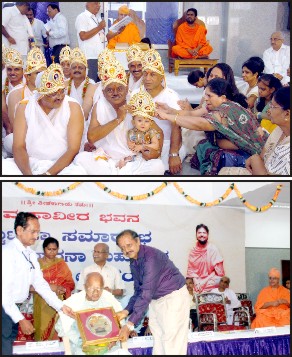
Caption:  Picture shows the Digambar Jains, adorned with crowns, who participated in Kalpadhruva Aradhana Mahotsava at the newly-inaugurated Mahaveer Bhavana in city yesterday in the presence of Sri Charukeerthi Bhattaraka Swamiji, Sri Bhuvanakeerthi Bhattaraka Swamiji, D. Surendra Kumar, National Working President of Bharatiya Jain Milan and others. Picture shows Mysore Digambar Jain Samaja Vice-Presidents N. Prasanna Kumar (left) and B.S. Santosh Kumar felicitating Prof. Dejagow as Prof. Hampa Nagarajaiah and Dr. Padma Shekar look on.

Mysore, June 12

Though members of Jain community are committed to non-violence, it does not mean that they will tolerate anything, said eminent Jainism scholar Prof. Hampa Nagarajaiah (Hampana).

He was delivering the presidential address at a felicitation held as part of the two-day inaugural function of Mahaveer Bhavana in Srirampura here yesterday under the auspices of Digambar Jain Samaja and Mahaveer Bhavana Nirmana Samithi.

Though injustice should be fought against, it should not become a reason to get into violence. Gandhiji’s non-violent way of protest against the British which paved the way for India’s independence should be a model to all, he opined.

Let the Mahaveer Bhavana, instead of being just a building and kalyana mantap, be a platform to honour those who strive for the welfare of Jain community, Nagarajaiah wished.

He lauded the litterateurs for spreading the words of Lord Mahaveera among all generations, adding that Jainism always gave due prominence to literature and art. Jainism showed that Kannada which was earlier mainly a spoken language, could also be used in literature.

The tradition of building a library with each Basadi showed the Jains’ love for literature and it has continued even in the midst of many changes. The very idea of Mutts came from Jainism. A place where apart from the spread of religious thoughts, children were also imparted teaching came to be known as a Mutt, he averred.

Veteran litterateurs and scholars Prof. D. Javaregowda, Dr. C.P. Krishnakumar, Dr. T.V. Venkatachala Shastri, B.S. Sannaiah, Seetharam Jagirdar, G.G. Manjunath, Dr. Taranath, Dr. K. Anantharamu, Pt. P. Nagarajaiah, Prof. Jeevandhar Kumar Hothapete, A. Anandkumar, Dr. Y.C. Bhanumathi, Dr. Saraswathi Vijayakumar and Dr. Padmavathamma were honoured on the occasion.

Speaking on behalf of the honourees, Dr. Dejagow said Jain culture was the foundation for the culture of Karnataka. Pampa, Ranna and other poets who authored many volumes in Kannada language were Jains. The culture and literature found in Karnataka are not present anywhere else in the world. There are more than 4,000 poets, 500 Yakshagana poets and on an average 20 books are published everyday, he added.

Saying that he always advices politicians to read literature, which is turned down by them as they say that they cannot politick if they read, Dejagow added that people should read books of Pampa, Ranna and other poets, through which the country would become prosperous.

Kalpadhruva Mahotsava

Earlier, at the Kalpadhruva Aradhana Mahotsava celebrated for two hours, 24 silver kalashas were adorned in front of the stage and abhisheka was performed to the idols of 24 Theerthankaras simultaneously.

Mysore University Prakrit and Jainology Department’s Dr. Padma Shekar was the chief guest. Shravanabelagola Digambar Jain Mutt’s Sri Charukeerthi Bhattaraka Swamiji and Kanakagiri Digambar Jain Mutt’s Sri Bhuvanakeerthi Bhattaraka Swamiji conducted the rituals.

Chinmay Vishwasen Jain invoked. Arun Pandit compered. H.P. Prasad, Director, Digambar Jain Samaja and Convenor of Publicity Committee, proposed a vote of thanks.

Digambar Jain Samaja President S.N. Prakash Babu, Mahaveer Bhavana Samithi Working President M.A. Sudheer and others were present.

source: http://www.StarofMysore.com / General News / June 12th, 2012

Five Personalities selected for ‘Basavashri’ Award

Mysore, June 12

Five distinguished personalities have been selected for “Basavashri-2012” award by Sharana Mandali, 5th Cross, Anikethana Road, Kuvempunagar in city:

1. Senior officer Dr. C. Somashekhar, who is currently serving as the Director of Agriculture Marketing Department at Bangalore.

2. A.S. Sadashivaiah, Chairman, Karnataka State Pollution Control Board.

3. Rajashekara Koti, Editor of Andolana Kannada daily.

4. Dr. R. Balasubramaniam, Founder of Swami Vivekananda Youth Movement.

5. K.N. Basavaraj, Veteran Theatre Artiste of Mysore.

The awards will be presented by Suttur Seer Sri Shivarathi Deshikendra Swamiji at a function to take place on the evening of June 17 in city, according to a press release.

Dr. C. Somashekar began his career as a lecturer at KLE College, Bangalore, before joining government service. He was secured in various capacities including as Deputy Director of Food & Civil Supplies Department at Dharwad, Assistant Commissioner at Mangalore and Housing Board Secretary.

A.S. Sadashivaiah hails from Tumkur district. He earned his Diploma from the Indian Institute of Forestry. He has delivered many lectures and presented papers in many countries on issues concerning forest. He retired as the State’s Principal Conservator of Forests. He is currently the Chairman of Karnataka State Pollution Control Board.

Rajashekara Koti is a veteran journalist and Editor of Andolana, city’s Kannada daily. Koti has over four decades of experience in Kannada journalism. He has many awards to his credit for his service to journalism field.

Dr. R. Balasubramaniam, the founder of Swami Vivekananda Youth Movement (SVYM), is a social activist and an expert in leadership development training.

After completing his MBBS degree in Mysore, Dr. Balasubramaniam got his M.Phil from BITS, Pilani and Master of Public Administration degree from Harvard University. He has been assisting the Lokayukta in unearthing many irregularities and scams in the PDS system and health sector of the State.

K.N. Basavaraj, a veteran theatrist, has been involved in the theatre field of Mysore for over six decades. He has also served in the famous yesteryear drama troupes such as Gubbi Company, Honnappa Bhagavathar Company etc.

He was accorded the Kalarathna award by then Chief Minister Kengal Hanumanthaiah. He floated his own theatre group Kannadambhe and has performed plays all over the State.

source: http://www.StarofMysore.com / General News /  June 12th, 2012
India’s first ‘Sky Wheel’ to come up on Expo Grounds in city

Now riders can enjoy the panoramic view of city and its surroundings within 20 kms

Mysore, June 14- The country’s first Sky Wheel, a modernised version of the Giant Wheel, will be installed at the Dasara Exhibition Ground premises and will be available for joy-rides during this Dasara, announced Karnataka Exhibition Authority (KEA) Chairman B.P. Manjunath here yesterday.

Addressing a press conference here, Manjunath said that the Sky Wheel will be constructed at a cost of Rs. 30 crore. There will be more than 30 air-conditioned and well-furnished cabins with seating arrangements for four persons each. The rider will get to enjoy a panoramic view of the city and its surroundings within a radius of 20 kms.

Places of tourist interest like the Ranganathittu bird sanctuary, Srirangapatna, Brindavan Gardens in KRS, Chamundi Hill, Nandi statue, Mysore Palace, Zoo and the Karanjikere lake can be seen with a bird’s eye view from the Sky Wheel, said Manjunath.

This Sky Wheel would be the third in the world, after the London Eye and Singapore Skyer.

An area of two acres is earmarked for this project, work on which would begin in 15 days and completed in four months, said Manjunath, adding that the project was approved at the Global Investors’ Meet held in Bangalore recently.

Innovative Studio Private Limited, which has set up the Innovative Film City in Bidadi, will construct the Sky Wheel, he said.

While the entry fee per person will be fixed in the range of Rs. 500 to Rs. 600, a decision on family packages and students’ discount would be taken later, Manjunath said.

source: http://www.StarofMysore.com / General News / Thursday, June 14th, 2012

‘Fruit-Bearing trees help survival of birds’

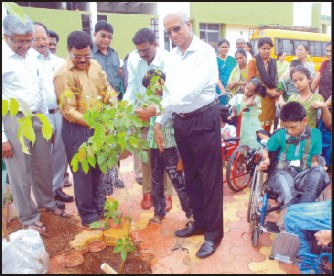
Caption: Zoo Executive Director B.P.Ravi watering a sapling at the Vanama-hotsava programme at Snehakiran School for specially-abled children in Bogadi here on Wednesday. SVYM founder Dr. R. Balasubramanyam, Snehakiran Spastic Society President A. Raghunath and others along with the children of the school look on.

Mysore, Jun 15- Planting saplings of fruit and flower bearing trees will help in conserving bird species, opined Zoo Executive Director B.P.Ravi.

He was speaking at the Vanamahotsava programme organised at Snehakiran school for specially-abled children at Bank Colony in Bogadi here on Wednesday.

Ravi said that we have trees that bear fruit twice in a year and neem and sandalwood trees attract more than 25 variety of birds.

He said society should be ready to accept specially-abled children and parents should ensure that these children are trained in such a way that they can lead a life without depending on others.

Swami Vivekananda Youth Movement founder Dr. R. Balasubramanyam, Snehakiran Spastic Society President A. Raghunath, Secretary A.P. James, K. Abraham, Principal Chitralekha and others were present.

source: http://www.StarofMysore.com / General News / Thursday, June 15th, 2012

ORI conservation work to be completed by August

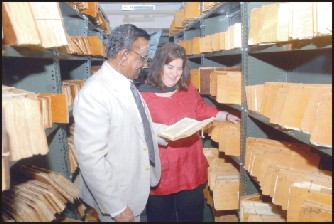
Caption: Corinna Ybarra Arnold, Acting Public Affairs Officer, US Consulate-General, Chennai, seen with ORI Director Vid. Shivakumaraswamy in city on Wednesday.

Mysore, June 15- Oriental Research Institute (ORI) Director Vid. Shivakumaraswamy has said that the ongoing repair works at the Institute would be completed by August. It may be mentioned, the US Consulate-General, Chennai, had provided a grant of $ 50,000 in January this year for the conservation of the heritage building that houses palm leaf manuscripts.

Corinna Ybarra Arnold, Acting Public Affairs Officer, US Consulate-General, Chennai, who was in city on Wednesday, paid a visit to the ORI to apprise herself of the work in progress and to gather additional information about the institute.

According to ORI Director, the focus of present exercise is to ensure that the leaking roof of the heritage structure is repaired so that manuscripts are not damaged. Nearly 70,000 palm leaf manuscripts are housed here.

Apart from repairing the roof, the glass works of the structure would be replaced and minor repairs carried out, he added.

As it was a heritage structure neither the façade nor the profile of the building would be altered, he said.

The ORI was constructed in 1887 to mark the golden jubilee of Queen Victoria’s ascension to the throne and was converted into a library in 1891.

source: http://www.StarofMysore.com / General News / Friday, June 15th, 2012

Docs on call for seva

DFS is a platform for volunteers from the medical and non-medical professions to help the needy

December 26 2004, tsunami struck the southern coast. Dr Dayaprasad G. Kulkarni was an intern at a hospital in Kolar. He raised about Rs 2 lakhs and went with a couple of his doctor friends to Nagapattinam to help with the relief work. After which he “knew I had to do something more.”Armed with a MBBS degree from the Devaraj Urs Medical College, Kolar, he did a stint with Doctors Without Borders in Chattisgarh treating villagers who were affected by the Naxal presence there.  “I realized that there were international doctors working these areas, but our own Indian doctors were absent,” says Dayaprasad. “In fact, there are so many international organizations like Red Cross and iVolunteers but specifically for the medical fraternity, there isn’t anything on a national scale.”

After a master’s degree in clinical research from UK, Dayaprasad  returned to India and  started an organization for the children and people from the marginalized society – Madhyama Prasaran and Scientific Research Foundation. Dayaprasad met  with Venkatesh Murthy, founder of the Youth For Seva, and was soon associated with Doctors For Seva (DFS).  He speaks of DFS: “Doctors For Seva was created in 2010 to change the mindset of how healthcare is perceived. Years back, doctors were respected for the services rendered. Today, it is about which hospitals they are associated with. Plus, in healthcare significant amount of money is spent in tertiary care (terminal days) rather than primary and preventive healthcare. The main ideology behind DFS is to create a  platform wherein doctors, nurses and anyone in the medical or the non-medical fraternity can volunteer to help provide better healthcare. This also includes homeopathy and Ayurvedic practitioners as well.”
DFS identifies areas needing healthcare, arranges for resources and creates a database of volunteers. It also interacts with the government for facilities and infrastructure. “The idea is to involve the neighborhoods as far as possible,” says Dayaprasad. He is excited about their flagship project Doctor At School that started off in Bangalore last year. He explains: “Doctor at School involves identifying a government school in the neighbourhood and finding volunteers – doctors, hospitals and pharmacies to serve here.” The project has one general pracitioner or pediatrician assigned to a school.  He/she along with other volunteers conduct general health checkups for the children at the school during the first three months. Volunteers will hold year round general health awareness programmes every weekend at the school. The following three months will see follow-ups with elective procedures (like deformity correction) taken up. Malnourished children are given supplements. Another three months,, children come up with skits and plays that are related to health care topics. The last three months being school holidays are used for maintaining records and other administration work. “As far as possible, we try to keep things absolutely free for the patients. Neighbourhood hospitals are requested to lend their facilities for free. The best part is that after a year, we now can scale it up anywhere in India. Those interested can use our handbooks detailing the processes involved,” says Dayaprasad. Today the project covers 100 schools.
Dayaprasad has consciously taken the path of community service. “I live with my parents so food and boarding is taken care of. An honorarium comes from my work at Jagruthi Trust, a home for HIV children, and Youth for Seva. I really don’t need much to live,” he says. A theater enthusiast, he has done several plays on the healthcare theme and short films on child abuse and homosexuality. His aim for DFS is simple: Get people involved for something as basic and important as primary healthcare.
If you want to know more about Doctors for Seva contact 9632306256 or send an email to info@doctorsforseva.org. They are also on Facebook.

source: http://www.bangaloremirror.com / Home> Sunday Read>  City> Special / Bangalore Mirror / by Jayanthi Madhukar / Sunday, May 27th, 2012


An evening with ‘the’ VOICE

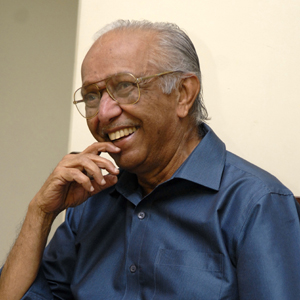
He was the city’s first RJ. His popularity was unprecedented (an envelope with just ‘B.R.Shivaramaiah, Bangalore’, scribbled across it would reach him without fail). The septuagenarian takes Manasi Paresh Kumar down his memory lane

It was sometime in the 70’s. Ravindra Kalakshetra was bursting at the seams with bell bottoms and bee hive hairdos. The screaming audience jostled for shoulder space; extended necks tried to catch a glimpse of the man who brightened their mundane existence every week like a warm hug on a cold night. And there he was –a lean man with plump side burns. The hall erupted into  maniacal celebration. Soaking in the din of adulation was B R Shivaramaiah –the man with ‘the ‘golden voice; a voice the crowds knew as Uttara Bhadra; a voice that mesmerised the airwaves every Tuesday at 8.30 PM. He was Bangalore’s pioneering radio jockey.

Talking about that day, which was a celebration of his 25th week of radio success, the now  77-year-old B R Shivaramaiah recalls: “I was specially out-fitted for the evening with a dark suit and multi-coloured floral shirt. I was introduced on stage with booming music, then the spotlights framed me… It was crazy. Today, it seems surreal that people were so much in love with a voice on the radio. I got marriage proposals by the dozen from women much to the annoyed amusement of my wife…”
An income tax officer by profession, Shivaramaiah’s voice was discovered by chance, when Gubbi Veeranna’s son Shivanand praised his diction (which had irritated him then) instead of his acting when he had performed in A S Murthy’s first production Adhyakshate in 1959. He went on to act in several radio dramas after that, which his family heard on their neighbour’s radio. “Radio was a luxury at that time. I managed to buy my first radio only in 1970.”
In 1973, Shivaramaiah began his golden innings on the radio with the show Gana Sourabha on  Vividha Bharati.  Uttara Bhadra, his alter ego, on the show became so popular that the show itself came to be identified by that name. “Can you imagine an RJ, with a name like Shivaramaiah, becoming popular?” he asks, laughingly. No we can’t. Even  Shivaramaiah couldn’t understand how someone with an “old-man-sounding-name” became a popular RJ. “We actually called the character Maathina Malla (meaning smooth talker), but it didn’t sound right. I chose the name Uttara Bhadra, which was my birth star and ran with it. It just caught on,” says the man who later made the country’s first documentary film on the income tax department’s processes in the nineties – as part of the IT department’s initiative to become people friendly.
Today, Shivaramaiah is an A grade artist with AIR. “Radio compering in India at that time meant a very flat voice that had to stay somber and unemotional regardless of whether you were talking about a song or reading the news, except for an odd Amin Sayani (who worked for Radio Ceylon) who did things differently. So when we started the trend of ‘mad talk’ with emotion and humour, our listeners connected with the content and the program became a raging hit,” he explains.
The show which was the brain child of Gopinath Das and Jagannath of Prabhat Kalavidaru studios, was actually a sponsored program by Byrappa Saree House in the city -an extended commercial. The owner of the showroom Eshwarappa wanted something funky to catch the attention of the people. So the duo came up with the idea of this talk show intersperced with songs and mentions of the shop. “Many people don’t know this, but I was not the original voice for the program, the first couple of episodes that aired had someone else hosting the show and the writer was also a different guy. But it had not clicked with the audience yet. I and the late H N Dwarkanath (the writer of the show) came in when the pair had not turned up one day,” recalls Shivaramaiah. The trio of Shivaramaiah, Dwarkanath and Jagannath (who was the sound engineer for this show) brought magic to the air waves and then there was no looking back. 

Each episode stretched the imagination and tickled the funny bone of the listeners all the while promoting the sponsor. “One episode was about a cricket match between current apsaras (filmstars) and retired apsaras (mythical Rambha, Menaka and Urvashi) with Chitragupta as the umpire. We plugged the sponsor saying that the women looked stunning in their sarees from the shop as they played the game. Another episode was about a woman who appeared as a premonition to me after I ate too many chilli bondas. In one episode that was aired close to the Ganesh festival, I played almost twenty five characters from Mahabharata, both male and female,” recalls Shivaramaiah. He would begin the show with a plethora of greetings at the speed of a bullet train and end the show with – “Will see you next week, take care. These were things unheard of at those times,” says Shivaramaiah who hardly rehearsed before the recording. “We recorded on Sundays from 12 in the night till three in the morning at Prabhat Studios. Then technology meant spool recordings and you had to be perfect with your tenor and bass. There was little you could do technologically if the voice  modulation was not right, unlike today.”

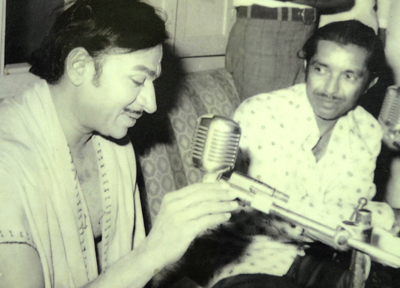
The show’s 25th week saw Dr Rajkumar share unbeknown personal anecdotes. “He was shooting for the movie Babruvahaan in Chennai. We had carried all our recording equipment from here. We were actually given only half an hour with him, but he ended up talking for more than three hours. From why he named Shivarajkumar as Nagaraj Shivaraj Puttasamy to how Parvathamma was actually called Pappachi, we spoke about everything at length. He even sang for us without any music, which he had never done.”
And suddenly it all ended without a warning. “The sponsor had enjoyed tremendous popularity with the show. His business had gone through the roof and I guess one day he decided not to produce the show anymore,” he recalls. So after five successful years the show, Gana Sourabha or Uttara Bhadra as it was popularly called was pulled off the air. “I don’t remember what the last show was because I did not know it was the last show. We had recorded a couple of other episodes as well, but then had to can them. So there was no formal goodbye as such,” he says. Also, by then, television was slowly taking over people’s imagination. Today all that Shivaramaiah has to remember his RJing days by are recordings of three episodes of the show. “Nobody had a tape recorder those days and I am not sure if AIR has the recordings of it. I doubt Prabhat also has the recordings of the program.”
As the city rediscovers its love affair with the radio, the man who started it for us, has no doubt that there is still a market for such a show despite the cosmopolitan mix of audience.  “There are no barriers for quality programs,” he says. Shivaramaiah is still among the most respected theatre artists of Kannada stage, works in television gives his voice to the radio and is one of the best known comperes for music shows. Though it rankles his family that he hasn’t been recognized by the government, the man himself shrugs off the apathy. “I miss the adulation of my listeners more than anything else.”
source: http://www.bangaloremirror.com / Home> Sunday Read>  City> Special / Bangalore Mirror / by Manasi Paresh Kumar / Sunday, May 27th, 2012

Mother takes up studies for daughter’s sake

The 4O-year-old widow who had studied up to Std VIII is now in the final year BA and wants to learn to ride an autorickshaw, so that she can take her spastic daughter to college every day without any problem

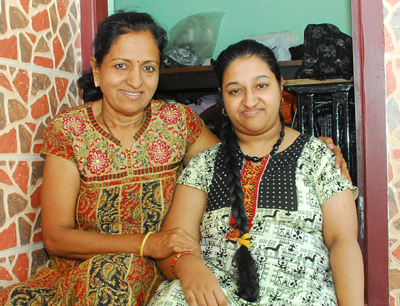
Forty-year-old Shashi has struggled hard to bring up her 17-year-old spastic daughter Vaishnavi. Besides working hard for a living, the single mother who had studied only up to Class VIII, even attended evening school so that she could teach her daughter in the morning. Today, the mother-daughter duo are doing their graduation together and both aspire to become lecturers.

Vaishnavi was born in Udupi. At the time of birth she was a healthy baby, but within a week’s time, lost weight and had no strength in her hands and legs. At that time, her parents lived in Bangalore, where the father ran a business. “Doctors at Nimhans said there was no cure for the disorder. Yet, we kept trying with oils and massages. Till she was eight years old, I used to carry her,” said Shashi.
Vaishnavi was also diagnosed with a hole in her heart. “The operation would have cost Rs 2 lakh, so we took her to Puttaparthi, where free treatment was provided. Luckily the operation was successful,” said Shashi.
“Eight years passed by. A friend suggested that I recite a prayer everyday to my daughter. I would make my daughter sit on the bed with pillows around and read out the prayer. One day she just stood up and tried to walk. That was the only development till date. Sadly her father was not with us to see her walk,” she said.
After the death of her husband, Shashi moved with her daughter to Mangalore with her life’s savings of about Rs 2 lakh and bought a small flat in Shaktinagar for Rs 1.75 lakh. It was from here that the most difficult part of her life began. She had no income and with her education, getting a job was tough.
A friend advised Shashi to take the test for insurance agents. “The study material gave me a shock as I knew very little English. But I took up the challenge for my daughter’s sake. Though I did not understand anything, I mugged up the questions and answers. I cleared the exam.”
Shashi locks her daughter inside the house when she goes out. “I am used to it. I wait for my mother to come back to have lunch because I can pick up and eat only what she leaves on the floor or table,” said Vaishnavi.
After Vaishnavi turned 14, she too wanted to go to school. “I visited several schools for admission. While schools for the differently abled turned her away saying that they were for mentally challenged children, others said Vaishnavi won’t be able to adjust with normal children.”
“It was then I heard about St Aloysius night school where classes are held from 5.30 pm to 9 pm. The principal was very encouraging.
He said my daughter needed to attend classes everyday, otherwise she would fall short of attendance. That was not possible, so I told them that I could attend the class and then go back and teach her at home. The headmaster, Praveen Hridayaraj, agreed. I found it really tough in the beginning. But I did not give up. If I gave up, my daughter would never study,” Shashi said.
In 2009, both the mother and daughter passed SSLC with good marks and decided to go to college. “Considering my age, the college asked me to go for II PUC directly, while my daughter was admitted to I PUC. Financially we were struggling. St Aloysius College helped by not charging fees till date,” Shashi said.
Shashi is now studying in final year BA and her daughter is in the second year. The college provides them auto fare. “Convincing autorickshaw drivers is a big challenge. So I want to learn to ride an auto so that I can drive my daughter to college if I manage to arrange for funds and buy an auto,” Shashi said. She can be contacted over ph: 7204651798.

source: http://www.bangaloremirror.com / Home> News> City> Story / Bangalore Mirror / by Deepthi Shridhar in Mangalore / Sunday, May 27th, 2012

Digital eyes that ‘speak’ for the blind

Four engineering students juxtapose character recognition and text-to-speech technologies to help visually impaired students

Braille is the script used by the visually impaired. The pitfalls of the script are that not many books are printed in that form. There is just one fortnightly magazine in the country, but it does not reach the interiors.

The problem is that it is not cost effective to print novels or general knowledge books in Braille. In order to overcome this problem, four students of M S Ramaiah Institute of Technology — Abrar Ahmed, Anil L P, Harish Kumar B and Sadikul Amin — have come up with a device which can recognise printed text and reproduce the same in voice format, in a chosen language.
The students took up this project — named Eyes That Speak — following visits to schools for visually impaired persons in and around Bangalore. They were disappointed by the facilities provided. They came up with a device that juxtaposes the concepts of OCR (Optical Character Recognition) and text-to-speech. OCR is a field of research in artificial intelligence and computer vision. It allows computers to recognise alphabets without human intervention. It is crucial to the computerisation of printed text, which can be electronically searched, stored compactly, displayed online and used in processes such as translation, text-to-speech and text mining.
The goal of text-to-speech is automatic conversion of text to spoken form. This field of speech research has witnessed significant advances over the past decade with many systems able to generate output that closely resemble a natural voice.
Harish explained the working of their device. “A small web cam is used to capture an image of the printed text. The image is processed to make sure
that the text is clear before it is passed on to the OCR algorithm, which enhances the red-blue-green image and sends it to a specially designed application for processing. The application uses two steps. It analyses the text lines, breaks each word and recognises the language before giving the output through an audio device,” he said.
Sadikul said, “The aim is to increase the accuracy of the OCR. We can satisfactorily say that our model can recognise even slightly tilted text.”
Anil said, “Our case study concluded that there were limited facilities for reading for the visually challenged. Eyes That Speak is aimed at providing easy solutions to the reading problems faced by visually impaired students, but it has more potential.”
“OCR is widely used in many other fields, including education, finance, and government agencies. Our model can also be used to process cheques in banks without human involvement. In order to save space and eliminate sifting through boxes of paper files, documents can be scanned and uploaded on computers,” added Abrar Ahmed.
source: http://www.bangaloremirror.com / Home> News> City> Story / Bangalore Mirror / by Purushotam Rao and  Jinil M / Sunday, May 27th, 2012

Art for Ever After

Her first show in Mumbai, opened to rave reviews. Now she is set to debut in the city, where she spent her childhood and initial years planning her art career. Iccha Bhojani, artist and independent designer will open her show, Ever After in Bengaluru this weekend.

Inspired by the Bahai faith, Iccha’s work showcases the philosophy of life. “My work talks about the service aspect of a human being’s life. The gap between the eternal and material world is something that is always bridged by the soul. The progress of our soul is directly affected by our service to the world and people. I have tried to express this through my work,” says the artist. Looking beyond the regular, her works are a culmination of different processes. “I photograph and then I make a collage and sketch on it,” says the artist. Starting at `20,000, her show will exhibit 35 works.

Talking about her love for art, Ichha admits that it was here in Bengaluru that she found her love for art. “It was at Mallya Aditi School that my career began. My art teacher Ms Surekha would always encourage me. I was not the bright one but was the naughty rebel in class,” she reminisces adding, “This city is the best that could’ve happened to me in my childhood. The morals and values I have been imbibed with could have never been found in other cities.”

While she loves to paint, Ichha confesses that her best job was with Sathya Paul a few years ago. “I was in charge of doing up the windows —basically it was a visual merchandising job. I had so much fun coming up with a summer window or the monsoon concept and working on displaying the sarees. The window was my canvas. I worked for their Delhi and Mumbai stores,” says the artist. With a strong belief in divine powers, Ichha lives her life to the fullest, she loves to watch movies and read books. “I particularly like the Daughters of Arabia series. I like the way the life of princesses is captured through these stories,” she says.

For the past one year, Ichha has been focusing on her show. But with the current art scene, she says the market is tough for newcomers. “Galleries are not waiting to jump at my work. It is contemporary and is in mixed media. My plan ahead is to approach galleries and show my work. It is going to be tough but I have faith,” says Ichha. Her next plan is to work on a series of works based on the theme of equality of men and women. “It is something that I have been pondering over and would definitely work on it,” she concludes.

source: http://www.DeccanChronicle.com / Home> Tabloid> Potpouri / by Ayesha Tabassum / DC, June 11th, 2012