KEA has a tech trick up its sleeve: Online admissions to PU colleges

The Karnataka Education Board is all set for a virtual revamp. With the Karnataka Pre University Education Board giving its nod to the online admission process of PU Colleges, the era of online progression seems to have dawned upon the state. Following the success models of Andhra Pradesh, Delhi and Chandhigarh, the Karnataka Examination Authority (KEA) has shed light on its plans of making CET counselling for seat allocation online.

The objective is to increase transparency and reduce hassles for students and parents. Online admission into PU colleges, which has already seen implementation with application forms available online, has been lauded by many as a preferred change. But will a similar fate await the proposed CET online counselling too?

The proposed process involves annual verification of documents and testimonials of students in helpline centres after the declaration of CET results; issue of an individual ID and password to each student through which the online portal can be accessed; entry of a student’s choices in terms of college, category, course and discipline. He can opt for more than one course too though he will be required to prioritise his options. For example, a student can enter options of engineering and medicine, but he must prioritise if he should enter engineering or medicine as his first option.

This will happen in three rounds, with a seven-day gap to exercise the available options, during which a student can either take admission, seek a better option or surrender his seat to apply in the next round of counselling. The surrendered and non-allocated seats will be pooled in for the next round of counselling. Seat allotments will begin with medical, followed by ISMH (Indian Systems of Medicine and Homeopathy), engineering and architecture.

Though the suggested process seems infallible, the big question is its practicability. Students across the state have their anxieties and confusions, which are leading to unfounded speculations.

Reflecting the concerns of many students, Anagha K, a student of Deeksha Integrated PU College (PCMB), who is awaiting her CET results, said: “The primary concern is the list of choices that one has to provide. A lot of thought must be put in, and several permutations and combinations must be done with regard to the priority list. If we go wrong in preparing this list, our future is at stake.”

Piyush Sharma, a student of Kumaran’s PU College (PCME) said: “There is uncertainty as we wouldn’t know whether or not we’re really in merit for a particular course in a particular college. The only source we have of finding out is the previous year’s seat matrix, which has its set of limitations”.

The FAQs on the website clarify doubts. But a lack of confidence in the ability of the process, apprehension owing to its first time and uncertainty of technical glitches have caused alarm and panic among students.

According to the website, a student can enter as many options as she likes. Also, she can change his options as many times, within the stipulated date.

Ameen Mudassar, career counsellor and director, CIGMA India, said that this kind of options list would result in a superficial demand for top colleges, for every student, irrespective of his merit, would want to try his luck at getting into the top colleges.

He said: “The KEA should roll out the process much in advance. They must ensure there is no deficiency in communication of the procedure to students. Infrastructure issues like the software, servers, etc should be taken care of.”

There seems to be unequivocal optimism over one aspect though. This step would solve the issue of seat blocking. Elaborating, Mudassar said: “Previously, a student could block seats in various institutions simultaneously. Such unclaimed seats would eventually become management seats, much to the disadvantage of meritorious students.”

The current proposal aims to solve this.

Another major concern is about students who are not fortunate enough to acquire computers or computers with internet facilities and those without the know-how of using them. A total of 6 lakh students appeared for the II PU exams this year, of which 1,83,093 were from rural areas. Of a total of 1.2 lakh students who appeared for CET this year, a major chunk was from the rural parts of the state. These students will be left in the lurch if the process of online counselling does not implement modalities for a horizontal inclusion of these factions. Helpline centres and kiosks for aiding such students are proposed.

The country has seen much of the education process shifting gears to go virtual. It is time saving, convenient and reduces spatial divide of many students. Exams like IIT- Humanities (IIT HSEE) and CAT have gone online. Though there were initial glitches, experience is honing them for the better. Common Law Admission Test (CLAT) and AIEEE counselling have also gone online, without many hiccups. Online processes are definitely a move forward, but proper and handy information, accessible communication and helplines putting in that extra effort for an inclusion of the disadvantaged student community and finally, but most importantly, ensuring a fail-proof technology and software are the ingredients that would make it an effective potion.

source: http://www.dnaindia.com / Home> Analysis> Report / by Pragati KB / Place: Bangalore / Agency: DNA / Monday, May 28th, 2012
Where fear ends, learning begins

As frustrated students turn their backs on the many marvels of science, it wouldn’t be too far from the truth to say that theory can really bog down even the most enthusiastic spirit. So, children digress from the idea of innovation, preferring to pick an engineering degree or a media course over a life of research and discovery.

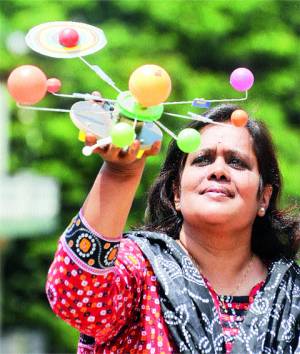
When Dr Sujata Virdhe discovered the many joys of experiential living, there was no stopping her on her journey to her dream. She quit a job at the Indian Space Research Organisation where she worked as a scientist in the fields of satellite power systems, solar energy and indigenisation of electronic components for two decades, and decided to follow her dream.

Dr Sujata Virdhe —R. Samuel

To open the eyes of every child to the magnificent universe of which we are all a part, where miracles happen every day should we choose to see them.

Catering to children between the ages of 10 and 15, the Sunday Science School (SSS) has already received a wonderful response from Maharashtra, where it was first started. The first branch in Bengaluru was set up in Domlur, with the second being inaugurated in Vijayanagar on Sunday. Dr Virde is looking at centres in Mysore, Dharwad, Hubli, Mangalore and Udupi.

“Eminent educationists feel that there is a need for hands-on learni of science, which is made unduly complicated by definitions and descriptions. This takes away the real beauty of the subject and students not only lose interest but become terrified by science,” says Dr Virdhe.

Hence, the science-by-doing module, which is aimed at kindling a love for science and research in every child. “Trained science communicators can communicate science using our readily available practical material to prepare our children for logical, rational and scientific thinking,” Dr Virdhe says.

It all started when Dr Virdhe met students whose parents were very worked up about their children being unable to grasp even the simplest scientific concepts. “I took them to the kitchen and taught them, which was when I discovered experiential learning and how important it is,” says Dr Virdhe.

Driven by a deep interest in the subject, Dr Virdhe began to collect information from textbooks for 7th grade to 12th grade children, designing her own syllabus to make learning science as hands-on and fun as possible. “The SSS wouldn’t have happened without my brother, Suyash Dake, who quit a lucrative IT job in Pune to help me realise my dream,” she says.

As a hobby, Dr Virdhe began designing tools and toys that would teach children science in the most fun way possible. “I happened to give some students a practical workshop on photovoltaic cells, which is how I knew that my passion was designing toys to teach children.”

While there are many, many products out there that can help children learn, most don’t reach them at all, for parents are simply too busy to bother. “We want to fill this gap in parenting because many parents don’t really have the time to spend with their kids,” she says.

At SSS, children are provided with all the materials they need and asked to conduct experiments with them. While the kids are given the help they need, they are, for the most part, allowed to
figure things out on their own. “We have two hours a week and when I see how engrossed the children become, it makes me want to take this to schools, too.”

Parents these days, feels Dr Virdhe, simply don’t have the time to run around for their children. Even if they are willing to do what it takes, finding materials is so hard to do and involves so much
running around that the task is given up on even before it is begun.

The first level makes sure that the children are given a strong foundation, while Level 2 has more
in-depth experiments in electronics, electromagnetism, apex microscopes and the like. “It’s like high school science and a lot more,” explains Dr Virdhe.

Dr Virdhe says the response in Maharashtra was overwhelming and has motivated them to push the dream even further. As children are allowed to explore their boundaries at their own pace, the ultimate aim of education is slowly achieved, for kids are not left with truckloads of information through which they must navigate. Instead, they are left with a tool far greater than that — imagination.

source: http://www.DeccanChronicle.com / Home> Channels> Cities> Bengaluru / by Darshana Ramdev / DC, Bengaluru / May 28th, 2012


“Develop latent talent to be a successful Entrepreneur ”

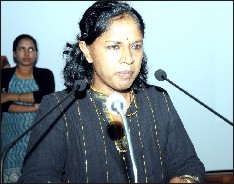
Caption: Ashita Prabhushankar, a successful entrepreneur in the US, delivering a special lecture at JSS Women’s College in city yesterday.

Mysore, May 25

“Listen to your conscience if you want to become a successful entrepreneur. Shed all your inhibitions and come out of social confinements. Learn to take embarrassing situations in your stride and learn from your failures,” adviced Ashita Prabhushankar, a successful entrepreneur in the USA.

She was delivering a special lecture on the topic, ‘My experiences as a woman entrepreneur in US’ at JSS Women’s College in Saraswathipuram yesterday.

Ashita, daughter of noted Kannada litterateur Dr. Prabhushankara, is an alumnus of the college.

“Each individual will have a latent talent which needs to be identified and developed. Thus, anyone can attain success in any endeavour,” she said.

“However, to become a successful entrepreneur, he or she must have worked under another entrepreneur for at least five years,” said Ashita, adding that during her years as a student, her leadership traits were more prominent than academics.

College Principal Prof. N.P. Padaki welcomed. Student Pratheeka compered. Director Dr. K.S. Rajashekar was present.

source: http://www.StarofMysore.com / General News / May 25th, 2012

AVN couple celebrate golden jubilee of marital bliss

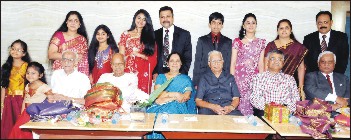
Caption: Historian Prof. A.V. Narasimha Murthy and his wife Kamalamba (sitting centre) are seen with their family members and (sitting from left) NIE Founder-Chairman M.A. Sampath Iyengar, litterateur Dr. D. Javare Gowda, Star of Mysore Editor-in-Chief K.B. Ganapathy, Bharatiya Vidya Bhavan Karnataka Chairman N. Ramanuja.

Mysore, May 27

A huge number of friends, relatives and well-wishers had gathered at Silent Shores Resort on the outskirts of the city last evening where a programme was organised to mark the 50th wedding anniversary of renowned historian and researcher Prof. A.V. Narasimha Murthy (AVN) and Kamalamba.

The occasion also saw the release of two books written by Prof. AVN. While NIE Founder-Chairman M.A. Sampath Iyengar released the book Namo Narasimha, Star of Mysore Editor-in-Chief K.B. Ganapathy released Ithihasada Putagalinda.

The couple, dressed immaculately, exchanged garlands and cut a cake. To give a traditional touch, Sampath Iyengar, who is also the Chairman of Lakshmi Venkataramanaswami Temple Committee in Vontikoppal, offered the temple Prasad to the couple and blessed them.

Litterateur Dr. D. Javare Gowda, Bharatiya Vidya Bhavan (BVB) Karnataka Chairman Ramanuja, Academy Newspapers Executive Director Ralie Ganapathy, former Mayor Vasu, Dr. K. Rajashekar, writer Latha Rajashekar, litterateur Dr. T.V. Venkatachala Shastri, publisher Chayapathi, denseuse Tulasi Ramachandra, BVB (Mysore) Treasurer A.T. Bhashyam, Kodagu Assistant Commissioner M.R. Ravi, Editor of Tamil newspaper Dinamalar Krishnamurthy and others were present.

Prof. AVN’s son Dr. A.N. Santosh Kumar, daughter-in-law Roopashri, daughter Dr. Savita, son-in-law Dr. Rajan, grand children Meghana, Mayur, Sheela, Smitha, Aishwarya and Archana were present.

source: http://www.StarofMysore.com / General News / May 27th, 2012

State records lowest growth rate

Thiruvanthapuram:

Kerala has recorded least growth rate in the fish production during the years 2004-05 and 2010-11, according to an independent research and analysis by the apex industry body of the Associated Chambers of Commerce and Industry of India (Assocham).

According to the survey, the fish production in the state has come down from around 8.66 lakh tonnes in the year 2008-09 to the current level of around 6.82 lakh tonnes. Karnataka has emerged as the leading coastal state with highest growth rate in fish production.

With around five lakh tonnes of annual fish production, Karnataka accounts for almost six per cent of the overall fish production in the country which is currently estimated at 91 lakh tonnes. Besides, in value terms, the fisheries sector in Karnataka is worth around Rs 4,000 crore.

Amid leading coastal states in India, Andhra Pradesh ranks second in terms of growth in fish production with a Compound Annual Growth Rate (CAGR) of about eight per cent and with over 13.5 lakh tonnes of fish production annually.

West Bengal (4.85 per cent), Tamil Nadu (4.47 per cent), Gujarat (3.37 per cent) and Odisha (3.25 per cent) are other leading fish producing states in India which recorded fish production growth rate in between three and four per cent.

Goa has registered a negative growth rate of fish production of around minus 33 per cent as the fish production has slipped from a whopping 9.9 lakh tonnes in 2004-05 to the current level of just 94,000 tonnes mostly due to over-exploitation of fisheries resources.

source: http://www.ibnlive.in.com / Home> South> Southern News / Thiruvananthapuram / The New Indian Express, Express News Service / may 25ht, 2012


NIMMA NEIGHBOUR: She can cure you with plants

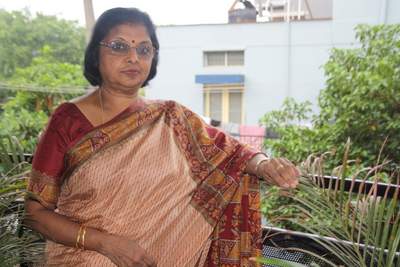
Dr Prathibha Vinay is a doctorate in botany, and resident of JP Nagar since 1997. From 2002 onwards she has dedicated herself to promoting medicinal plants. She even planted them at JP Nagar’s Dhanwantari park.

In 2002, she founded TULSI (Treasure and Utilise the Life Sustaining Ingredients of Nature) an NGO that promotes medicinal plants for health and raises awareness on conservation of such plants.

Dr Pratibha Vinay at her residence.

Pratibha earned her doctorate degree in Palynology-a super speciality in Botany in 1972. Later she was awarded Post Doctoral Fellowship at Bangalore University -Department of Botany in 1973. In the due course she was also invited by Washington University, St Louis, Missouri USA as Research Associate Professor around 1975. She is also the first non-physician member of the Indian College of Allergy and Immunology.

TULSI is dedicated towards educational programmes to various user groups, promoting medicinal plants for family health care and creating awareness, conservation and sustainable utilisation of it.

Pratibha’s has even authored a book, First Aid by Nature in 2007. In March 2012,  the same book was translated and published in Kannada asPrakruthiyindha Prathama Chikitse.

Her late husband P M Vinay was the CEO of Mallaya Hospital-Bangalore and Wellington Hospital, Chennai.

Meet the impressive Dr Pratibha

How did you develop interest in medicinal plants and herbs. In general, what are the benefits of these plants?

Being a student of botany and having specialised in palynology and airborne allergens, I thought there was a call to bring the awareness of preventive and curative properties of Medicinal plants that our nature has provided as a solution for every ailment.

The knowledge of medicinal plants as healers dates back since the origin of man. Ironically humans in their quest for materialistic gains have forgotten that health and discipline are the basic insignia of life. Medicinal plants can be used for common ailments and also as first aid in primary health care. These medicinal plants and trees not merely facilitate people in breathing healthy air but also prevent spreading of highly communicable, dreadful respiratory and allied maladies like tuberculosis, asthma, bronchitis, sinusitis, allergic rhinitis, lung cancer amongst others.

Tell us about TULSI.

TULSI has worked for various civic parks and unutilised public parks and private lands planting medicinal herbs and plants. I conduct workshops on the Awareness of Primary Health Care and Home Remedies for common ailments. A practical demonstration of simple home remedies is given.

Among school children, I inculcate them a sense of clean environment care. I also give them saplings and plants to grow, to encourage a better utilisation of the natural resources.

The UGC has approved a syllabus for a Certificate Course in BioDiversity and Role of Medicinal Plants in Primary Health Care as a career oriented programme. I had proposed this. Today it is being applied in some colleges in Bangalore where I am invited as visiting professor to teach the subject.

Where in Bangalore people can avail these plants?

Dhanavantri nursery at Bangalore University Campus; Foundation for Revitalisation of Local Health Traditions (FRLHT) Jarakabande, Bangalore; Biological Research Centre, Bannerghatta Road; Lalbagh Nursery and also a few private nurseries.

Do you think indigenous medical traditions are dying in Bangalore? In the age of allopathic medicines where do you place the role of herbal plants and medicines?

As our government is also encouraging holistic approach for the treatment at the hospitals, people are getting aware of the usage of the indigenous medical traditions more so in Urban areas. Hence I do not think the usage of traditional medicines are neglected nor forgotten as both allopathic and traditional medicines are parallel.

There are lot of parks in Bangalore, can this space be used?

Yes the park spaces can be utilised. A directory of the plants should be posted at the parks giving their botanical names/common names and their uses for public information.

One favorite place you would often like to go in bangalore.
I like visiting Lalbagh gardens

Other than spreading awareness about medicinal plants, what is your favorite past time?
I read books on spiritual masters for their inspiration and their guidance on human services.

Dr Pratibha’s ready reckoner for some common ailments using home remedies.

Hair Loss and dandruff

Paste of red Hibiscus flowers and few leaves along with hand full of leaves of Wedelia Chinesis (Peeta Bhringaraja) when applied to the scalp for about 20 minutes and washed will relieve dandruff when used twice a week over a period of 2 months.

Sinus-Headache

Turmeric root burnt over a flame and fumes inhaled through the nostrils alternatively for 5 minutes twice a day, will reduce the sinus problem.

Pimples and black patches

Paste made from a handful of fresh mint leaves(Pudina) along with a teaspoon of turmeric powder and a one teaspoon of lime juice when applied to the face and left for 20 minutes and then washed will reduce the black patches and pimples.

Ulcers in the mouth

1gm of alum dissolved in water to be gargled once a day before meal.
Gargle mouth with fresh unboiled milk once a day.

For Flatulence and gas

Mix 1 gm of rock salt with 5 gms of fresh ginger chewed together twice a day during morning and night will reduce flatulence.
One glass of lime juice made with water mixed with one pinch of cooking soda taken once a day will reduce the problem.

Constipation

One ripened banana (Pachha bale) eaten along with 2 pinches of cardamom in the night will relieve constipation.

21 May 2012

Abhishek Angad is a Staff Journalist at Citizen Matters.

source: http://www.bangalore.citizenmatters.in / Home> Conversations> People> JP Nagar / buy Abhishek Anjad / Citizen Matters / May 21st, 2012

Subir Roy: What’s in a house name?

The environs of East Bangalore railway station were once the edge of town, where those who wanted to live in spacious suburbia chose to build. Today, a succession of names like Cooke Town, Richards Town and that of a neighbourhood presumably founded by a certain Mr D’Costa form a quaint little enclave of gentility within a city now sprawling way beyond.

Many of the houses are gone, and first-generation apartment blocks took their place years ago. When all the other distinctiveness of the neighbourhoods also disappears, what will probably survive is a way with house names. I have discovered this while walking and exploring in the early morning, trying to get to know the new area where I currently live. In the stillness when nothing happens, the house names – by turns winning, inappropriate and telling – make things come alive.

They indicate these are neighbourhoods of mixed communities of the better-off, who value their Anglicised upbringing and sometimes wish they were in some picture-postcard location in the West. And the fact that the streets are well preserved – and mostly spotlessly clean – underlines the clout and resources of their current residents.

A stolid apartment block is called Favourite Chalet, although it has none of the petite prettiness of one such at home in its Swiss surroundings. Silverdale is not in a valley by a long chalk, but on a plateau, if you want to be particular. One of the older apartment blocks, Oxford Greens, evokes none of the features of the Oxfordshire countryside but is plainly dull, with an equally dull garden upfront. Maxim’s is distinctive in its use of steel and the way an upper floor has been built — but has nothing in common with one of the most famous Paris restaurants of the last century, with its signature interior décor. There is an obvious desire to live well and in keeping with the times; but one apartment building puts it all upfront by naming itself Live in Style.

Not all house names, though, seek to conjure up far off places. Some simply say what most people would want their homes to be. A very large apartment block near an intersection bears the legend Oasis. Don’t we all want to come back home to one? Then there is Graceland, which could be anywhere, if it is home to people with some old-fashioned grace.

Hutchins Manor could not have been more appropriately named, standing where Mr Hutchins must have lived in some style, in a manor of sorts, once upon a time — considering the road was named after him. And, of course, there is nothing to beat East Mansion, which is both a decent pile and in what was the eastern edge of town. In being precise, if prosaic, Syed Sardar Mansion wins hands down.

Some houses could not have been better named and give an idea of the kind of people within their walls. Chitrakoota is distinctive, full of modern straight lines softened by a lot of overhanging green. Kottarathil looks not entirely unimpressive and offers no reason why its owner should not see himself living in a palace of sorts.

Shanthi Nilayam could be anybody’s home, considering we all look for peace when we come there at the end of the day to rest our tired feet. And who can quarrel with someone who has named his modest home, a bit prosaically perhaps, House of Sunshine? On the other hand, there is Mukadam Manor, which holds its head high — almost literally. At one end of the area, The Anchorage gives a mooring to all habitats around it — though, at first glance, you may wonder if its resident longs for the adventure and arctic cold of Alaska’s foremost city.

If you ask me to pick the winners, then almost near the top comes Anugraha; the gentleness in someone seeking your blessings is difficult to better. Which is why maybe there are two houses bearing that name. In the same league will be Halcyon. It is those memories that keep you going at the end of the day, isn’t it? Since it is all about home, neatly painted Homeland with its profusion of potted plants must be an abode for rested souls.

But for the all-time winner, I have to go out of the area to Museum Road where resides magical Abracadabra. What fun people must be there inside! I am determined one day to knock on the door and demand to see a rabbit pulled out of a hat.

source: http://www.Business-Standard.com / Home> Opinion & Analysis / by Subir Roy / May 19th, 2012

Braving odds, they come out with flying colours in SSLC exams

Mysore:

The inmates of the government-run girls’ home here, who had to go through the dark realities of life, have come out with flying colours in the recently-held SSLC examinations.

Sindhu of Chitradurga secured the highest marks – 488-while Niveditha scored 412 out of 625 marks. Except one, all the 13 students appeared for the exam emerged victorious.

Girls’ home superintendent Geethalakshmi told TOI that Sindhu had struggled hard in life after her father died when she was young.

Her mother Poornima was shattered after the death of her husband Chandru. Later, she got admitted all her four girl children to government rehab centres in Hassan, Bijapur and Udupi.

Sindhu was relocated to Mysore from Hassan centre a year ago. As per her request, all her sisters were also brought to Mysore centre later. Lavanya, Ranjitha, Hemalatha, Kavitha, Niveditha, Mamatha M, Shobha S, Lakshmi N, Vidya, Kalaveni and Nirosha too had to face many challenges in their life. This success is a morale booster for them who are now hoping for a better future.

ODANADI INMATES SHINE

Six out of seven inmates of Odanadi Seva Samsthe passed the SSLC examinations this year. Rathna, who had worked as a bonded labour for two years, was one among them. Saraswathi, Nischitha, Manjunath, Ganesh and Hema are the other students. Odanadi is working for the welfare of sex workers and their children.

BLINDNESS, NO HINDRANCE

All the four students of Helen Keller Blind School in Mysore secured first classes in the examinations.

Mahadevaswamy secured the highest marks in the school with 443 marks. Prathap bagged 439 marks while Rameshnayaka and Nataraju B secured 420 and 419 respectively.

Mahadevaswamy and Prathap scored 98 marks in mathematics. Nataraju B managed to score 97 in social studies.

source: http://www.timesofindia.indiatimes.com / Home> City> Mysore / TNN / May 18th, 2012

Fashionista in the making

To wear lingerie that fits perfectly, is a dream come true for a woman, and this young NIFT student aims to do just that. 20-year-old Pooja Upadhyay just bagged the Triumph International Award in Mumbai and come October, she will be representing India in the finals at Shanghai.

Designing and art always inspired Pooja, who never thought about a career in fashion until a few years ago. “My father encouraged me to pursue fashion as a career and there has been no looking back ever since.” Though based in Mumbai, Pooja’s maternal and paternal grandparents hail from the state and she is enamoured by what the city has to offer to the world of fashion. “Bengaluru has a huge market for fashion and people are clued in to the proceedings. It’s just a matter of time before the city will be reckoned as a fashion hub in India,” claims the young design student.

The award came as a complete surprise to Pooja. She contested with several people across the country and was chosen in the top ten for the finals. “We had to depict duality in our design. I have combined the dragon and butterfly coming together in my lingerie design. I also had to consider the flow of the garment, since lingerie has to be well-fitting and accentuate a woman’s curves. The idea is to make the garment sensuous, not vulgar.”

Inspired by designers like Alexander McQueen, Ritu Beri, brands like Victoria’s Secret among others, Pooja too aims to launch her own fashion line one day. “Making the cut in this industry is not easy. Apart from a unique sense of design, you also need to have excellent social skills.” One particular designer who inspires her is, “Manish Arora. He was the artistic director for Paco Rabane and that’s very inspiring. Indian designers are being recognised by international brands.”

So what does it take to carve a niche in this fiercely competitive industry? “From what I’ve seen, handmade creations are deeply valued. At the turn of the millenium, trends were leaning towards the sporty side. Solid colours and bold cuts dominated the fashion preference. Now, people are inching towards surface ornamentation. It’s challenging and opens up a window of opportunties.”

Pooja has spent a good number of weeks in interior Karnataka, researching on local art and design. “My personal favourite is the lambani design. I would love to incorporate them in my work in the future.” In her spare time, Pooja loves shopping and reading up on the latest fashion trends. “I also sing, but that’s only in front of my close friends!” adds the bubbly youngster with a laugh.

source: http://www.DeccanChronicle.com / Home> Channels> Lifestyle> Fashion / by Sindhuja Balaji / DC, May 17th, 2012


US varsity honours Narayana Murthy

Tampa (Florida) May 16

The University of South Florida has honoured Infosys founder N.R. Narayana Murthy with the Global leadership and Free Enterprise Awards for his leadership and contributions to the international business world.

Presenting Infosys chairman emeritus Murthy with the awards at the Patel Centre for Global Sustainability here Monday, USF President Judy Genshaft praised him for his entrepreneurial spirit, according to a university press release.

Earlier, in an informal conversation with past and present students, Murthy said because of his middle class background, it was not as difficult for his company to maintain its values as it might be for the mass of people eking out a living.

‘You need a spirit of sacrifice and you need to have trust,’ he said.

Murthy explained how the company’s ethos has its roots in the very first meeting held at his house in Mumbai with his six fellow founders. Their discussion was focused on profitability.

Murthy focused their attention on ‘seeking respect’, ‘living in harmony with society’ and making sure ‘you don’t shortchange your customers,’ he said. When you do those things, ‘revenue will come. Profit will come’.

In response to a question from about the chances of Murthy entering politics, he mentioned his preference for ‘rational discussion’ and the difficulty the political world offers for such and expressed some hesitation.

Kaushal Chari, chair of the USF information systems and decision sciences department, said Murthy’s story is inspiring for students.

‘He’s a world-class business leader,’ said Chari, who leads a study abroad trip to India every year for business students.

IANS

source: http://www.india.nydailynews.com / Home> News> Desi News / Wednesday, May 16th, 2012