The World Skills Competition organised

Bangalore:

Brigadier Adolf S Pinto, Deputy General Officer Commanding of Karnataka and Kerala Sub Area inaugurated ‘The World Skills Competition (Southern Region)’ in culinary arts, bakery and food and beverage service at the Army Institute of Hotel Management in the city recently.

Various colleges and institutes affiliated to National Council of Hotel Management and those affiliated to AICTE took part in the event. Monika Sharma and Suraj Pamar of the Army Institute of Hotel Management, Bangalore, won the first prize and second prize respectively in Food and Beverage Service category.

The winners will take part in the national-level competition to be held at New Delhi on June 30 and the finals will be held at Leipzig Trade Fair at Germany from July 2 to 7, the officials said.

Organised by the Amsterdam-based World Skills International, the competition takes place in different countries once in every two years. Gold, silver and bronze medals are presented to winners in the different categories. The competition was held earlier in Japan in 2007, Canada in 2009 and London in 2011.

source: http://www.ibnlive.in.com / South> Southern News> Bangalore / The New Indian Express , Express News Service / April 03rd, 2012


XCyton Launches New Diagnostic Tool – Syndrome Evaluation System

Over the next twelve months XCyton plans to expand across all metros in India

(From L-R) Dr Latha Lakshaman, Director and Dr BV Ravi Kumar, Chairman & MD, both of XCyton Diagnostics , Dr Kiran Mazumdar Shaw, Chairman & MD, Biocon, Dr Prem Pavoor, Associate Director FIL Capital Advisor (India) and Dr Ketan Patel, Principal, Fidelity Bio-sciences

XCyton Diagnostics has launched Syndrome Evaluation System (SES) which will result in the effective treatment and saving of lives.

XCyton’s Syndrome Evaluation System (SES) allows for the immediate identification of multiple organisms inclusive of bacteria, viruses, fungi and parasites, in a specific test from a single sample. This process provides the clinician with a fast, definitive assessment of a patient who is presenting a set of symptoms common to multiple pathogens.

Dr BV Ravi Kumar, Founder Chairman and Managing Director of XCyton Diagnostics says, “My belief that lives can be saved and disabilities can be prevented if the diagnosis is made early during the infection led to the creation of SES. It is inhuman not to apply available scientific knowledge to counter oppressive illnesses. In life style diseases, people can take complete control of their health. In case of infections it is not possible. I empathise with that
fact. ”

In one sample, one test, all the probable causative agents that can cause a syndrome can be diagnosed through SES, in a short duration of just seven hours, thus leading to early initiation of appropriate therapy and reduction of death and disability.

Dr Kiran Mazumdar Shaw who heads leading biotechnology enterprise, Biocon, has personally invested in XCyton. She believes that molecular diagnostics is the medical technology of the future and development of SES is a significant milestone in the history of molecular diagnostics.

XCyton is now backed by Fidelity Growth Partners India (FGPI) which is the India focused private equity arm of Fidelity Worldwide Investment.

Features of SES:

  • Fast – Takes seven hours while conventional tests take more than 72 hrs
  • Accurate – Higher detection rates , 4 times more than the conventional tests i.e 15 per cent vs 75 per cent
  • Direct demonstration of the pathogen can be treated straight away
  • Physician can rule out or rule in an infection, as they test for spectrum of bugs at once
  • Cost effective – Reduces multiple tests and reduces ICU stay
  • Specific – All studies showed that it does not detect false positives among various types of controls

EH News Bureau

source: http://www.ExpressHealthcare.in / Home> Market> Article / April 2012

Kalam moots integrated healthcare

Bangalore:

India’s Missile Man, former president APJ Abdul Kalam has some advice for the healthcare sector. He wants the entire sector to integrate itself so as to evolve a specialized healthcare system. “Medical colleges normally deal with diagnosis and treatment of diseases only when the patient is ill. I feel the university has to specialize in integrated healthcare system. Every doctor, every dentist, nurse, pharmacist, traditional practitioner , paramedical staff has to be equipped with knowledge of the integrated medicare system. RGUHS should consider this and transform the syllabus accordingly,” Kalam said in his speech at the 14th convocation of Rajiv Gandhi University of Health Sciences here.

Regarding medical education, Kalam said in a competitive environment, the focus should be research and teaching. “Institutions should promote research and teaching. Good teaching emanates from research. The teacher’s love for research and experience in research are vital for the growth of an institution. A university is judged by the level of research work it accomplishes. This sets in a regenerative cycle of excellence,” Kalam added.

Dr C N Manjunath, director of Sri Jayadeva Institute of Cardiovascular Sciences and Research Centre, Bangalore, and retired DIG H F Naicker, a yoga expert , were awarded ‘Doctor of Science’ honorary degrees. The function was attended by governor H R Bhardwaj, who is also Chancellor of Universities, and 82 medals were given to students who excelled in medicine, dental science, pharmacy , nursing and Ayush.

Toppertalk

They were all smiles. Their hard work has finally paid dividends, and they had the honour of receiving medals from former President APJ Abdul Kalam. Toppers Dr Vishwanath K Pai and Dr M Joshi Arun Bharat had some commonalities: both studied in Mangalore and both secured eight gold medals each. While Pai studied medicine at AJ Institute of Medical Sciences, Gujaratbased Bharat studied dental science at AB Shetty Memorial Institute of Dental Sciences.

“I want to do MD in medicine,” said Pai, acknowledging the support of his family members and faculty. Bharat wants to do an MDS in periodontics.

Dr Pooja Prakash Prabhu has the distinction of getting four gold medals, the highest in female category. A student of JSS Medical College, Pooja hails from Mangalore. While crediting her success to her parents, both doctors, Pooja wants to study MD (Paediatrics).

source: http://www.articles.timesofindia.indiatimes.com / Home> City> Bangalore / TNN / April 01st, 2012

How the rulers ensured orderly growth for Mysore

When Mysore was taking steps to check haphazard growth, the municipal body helped the administrators deliver it. And the rulers put in charge some of the finest administrators to lead the municipal body, earning it an honour of sorts: Two dewans of Mysore state headed the municipal body before they rose to the head of the princely state.It’s been 150 years to the municipal administration in the princely town which has evolved into a mini-metro, and flipping through the pages of history reveal some interesting details. When Maharaja Nalwadi Krishnaraja Wadiyar was ruling the state, the government started the practice of appointing an administrator to lead the five-decades-old municipal body, which had elected representatives, to manage the affairs, indicating its seriousness about the growth of the city.

In 1906 — when the practice was started — the administrators named M Kantharaj Urs as the president of the municipal council, who was at the helm of affairs till 1910. The able administrator later went on to become the dewan in 1918, a post he held till 1922. He had served as the deputy commissioner of Mysore among other important assignments before being tasked to manage the municipal affairs of Mysore. Between 1924 and 1927, N Madhava Rao headed the administration at the municipal council, and was elevated to be dewan in 1941. Rao was appointed as chief secretary after he moved out of the municipal, council and later became a member of Rajya Sabha. At one point, the president of the municipal body was also heading the City Improvement Trust Board set up in 1902 to ensure that the city’s growth gets a unified command.Interestingly, when the instructions were issued for the constitution of a municipal body in April 1861, the town’s population was 45,000.

Mummudi Krishnaraja Wadiyar was the ruler then. The instruction specified that people should be consulted on works to be implemented and about the tax structure and that they should also have a say in the administration (by giving representation to people). To give effect to these principles, a committee was formed in July 1862, which eventually got Mysore municipal administration. The committee was headed by superintendent of the Ashtagram division. Five officials and three non-officials were appointed as members. The panel included a Hindu and a Muslim and the official members included the executive engineer, the amildar of Mysore taluk and Sar Ameen of Mysore.Surprisingly, the tax to maintain sanitation was abolished while the improvement of the roads and drains received primary attention.

T G Lakshmana Rao, who served as the president of the municipal council in 1914, notes in his work ‘Handbook of the City of Mysore’ that “a market was also constructed and some street lights provided.” According to him, within eight years from the setting up of the body, the resources started to flow as the Mysore government asked the civic body to collect property tax with a rider that town police wing should be looked after by it. Within a span of 10 years, revenue of the body, which was Rs 25,000 in 1862, doubled. By 1890-91, the civic body started to extend grants-in-aid to educational institutions.It was the civic body that decongested Mysore Fort removing the houses inside. In 1888, the municipal body was given legal framework by Maharaja Chamaraja Wadiyar. The then dewan was K Seshadri Iyer.

After Independence, the practice of appointing president to head the body was done away with and P Seetharamaiah was elected president (1948). Shortly after the body turned 100, it got a woman president — Soundaramma Venkatesh — in 1963.

source: http://www.timesofindia.indiatimes.com / Home> City> Mysore / by H M Aravind / TNN / April 01st, 2012

City Artist’s logo selected for ‘Sakala’

Wins Rs. 50,000 prize


<strong>Mysore</strong>, Mar. 31:

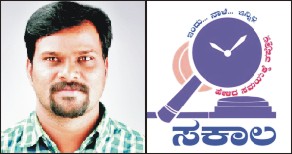
City artist Balaswamy’s logo has been selected for Sakala, the State government’s ambitious initiative aimed at providing timely services to citizens under the Karnataka Guarantee of Services to Citizens Act 2011.
The government had invited entries of logos for the initiative. Over a thousand participants had taken part in the contest, in which Balaswamy’s concept won the government’s approval.
Chief Minister D.V. Sadananda Gowda presented Balaswamy with a cash prize of Rs. 50,000 for creating the logo during the inauguration of Sakala recently.
Speaking to Star of Mysore, Balaswamy said that he had sent three designs of logos and his design based on ‘Time and Law’ (see above) was selected.
Family members of Balaswamy, who came to know about his interest in arts when he was studying PU at St. Philomena’s College in city, brought him an application from Chamarajendra Academy of Visual Arts (CAVA) and enrolled him there after PU.
After completing two years foundation course at CAVA, he took up Bachelor in Fine Arts (BFA) with specialisation in Applied Arts and completed his graduation in 1997 besides working in many advertisement agencies as designer in Bangalore.
He again came back to Mysore and completed his Master in Fine Arts (MFA) in the year 2004 with Sculpture as his specialisation.
He said that he is one among the five artists who created logo for University Grants Commission (UGC) and regretted that he could not go to collect the certificate which was presented by former President Dr. A.P.J.Abdul Kalam in the year 2003 owing to financial constraints despite having been invited. Balaswamy said that the news of his logo being selected was given by Mamatha, Joint Director, Department of Information over phone and added that he was delighted with the news. At present, Balaswamy is working as a freelancer in city.
He may be contacted on Mob:99003-00038.
source: http://www.StarofMysore.com / General News / March 31st, 2012

National – level ‘Rally De Mysore’ on Apr.1

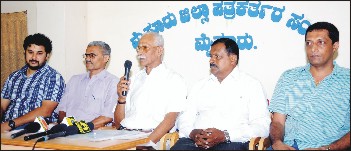
Caption: Kodava Samaja Cultural & Sports Club President M.M. Karumbaiah addressing a press meet at Patrakartara Bhavan this morning. Others seen are (from left) ace racer Lohit Urs, Club Treasurer P. Raja Poovaiah, Vice-President M.M. Kuttappa and Hon. Secretary B. Rathan Ponnappa.

Mysore, Mar. 28

Rally De Mysore, a national level bikes and cars rally, will be held in city on Apr. 1, under the joint auspices of Kodava Samaja Cultural & Sports Club (KSC&SC), Mysore and Indian Motor Sports Club (IMSC).
Mysore’s ace racer Lohit Urs, who is in-charge of the rally, provided details about the rally at a press conference held at the Patrakartara Bhavan today.
The event is run in accordance with Federation of Motor Sports Clubs of India (FMSCI) which is the governing body for Motor-sports in India.
The event will start from The Roost hotel on Hunsur Road in Mysore at 9 am on Sunday (Apr. 1) and conclude in the same place by 6 pm, said KSC&SC President Mechanda M. Karumbaiah, adding that Police Superintendent R. Dilip will flag off the rally.
City Police Commissioner K.L. Sudheer will give away prizes during the valedictory function to be held at the same venue in the evening.
The rally will cover a distance of 140 km around Mysore and pass through interior roads near Yelwal, Bilikere, K.R. Nagar and Hunsur. The main sponsors are Graviti 9.
The rally is run on Time Speed Distance (TSD) format. In this event, the main focus is on navigation rather than speed. The competitors are given the route map and the speed at which they should cover the distance.
source: http://www.StarofMysore.com / General News / March 28th, 2012

‘Bhramara Awards’ presented to eminent Scientists

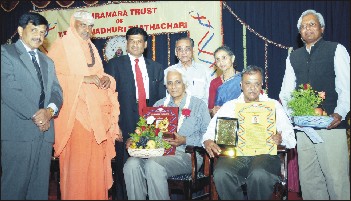
Caption: Scientists Dr. Tej Pal Singh and Dr. Debashis Mitra being presented with the Bhramara Awards at a function held at Sri Shivarathri Rajendra Bhavan in JSS Medical College last evening. Others seen are (from left) JSS Medical College Principal Dr. H. Basavana Gowdappa, Suttur Seer Sri Shivarathri Deshikendra Swamiji, KSOU VC Prof. K.S. Rangappa, Bhramara Trustee Prof. R. Srinivasan, Managing Trustee Madhuri Thathachari and Director of National Centre for Biological Sciences, Bangalore, Prof. K. Vijayaraghavan.

Mysore, Mar. 29

Dr. Tej Pal Singh, Distinguished bio-technology research professor of AIIMS, New Delhi, was conferred with the prestigious Bhramara’s Lifetime Achievement Award instituted by the city-based Bhramara Trust of Y.T. & Madhuri Thathachari at a function held at Dr. Shivarathri Rajendra Auditorium in JSS Medical College on Mysore-Bangalore road here last evening.
Dr. Debashis Mitra, Scientist in National Centre for Cell Science, Pune, was presented with the Prof. Y.T. Thathachari Prestigi-ous Research Award for Science while JSS Medical College Principal Dr. H. Basavana Gowdappa was presented with the endowment prize for the Best Research Paper. This endowment prize is for the faculty or PG student of JSS Medical College who present the best research paper.
Karnataka State Open University (KSOU) Vice-Chancellor Prof. K.S. Rangappa spoke as the chief guest.
Prof. K. Vijayaraghavan, Director of National Centre for Biological Sciences, Bangalore, delivering the presidential address, praised the initiative of Bhramara Trust for creating a link between the society and the achievers in the field of science and fine arts.
“Researchers and artists get to do what they love to do and get paid for it too. But, despite being paid by the people, they seldom get the due recognition. This drawback has been made good by organisations like the Bharama Trust,” he said.
He also praised the JSS institutions for grooming the younger generation into useful citizens of India. “India has the largest population of Under-15 who need proper education and jobs. If groomed properly, they would be a boon for the world; if not, they might be a disaster for the world,” he opined.
Suttur Seer Sri Shivarathri Deshikendra Swamiji, who inaugurated the programme earlier, said in his benediction address that the scientists were noble souls who dedicated their entire lives to the service of mankind. Mentioning about the general notion that researchers cannot be good administrators, the Seer lauded the administrative skills of Prof. Rangappa as the KSOU Vice-Chancellor, despite being a chemistry research scholar.
The Seer also appreciated the presence of some well-known personalities of the city among the audience by naming some like industrialist K.V. Murthy, Bharathiya Vidya Bhavan, Mysore Kendra Chairman Prof. A.V. Narasimha Murthy, danseuse Dr. Vasundhara Doreswamy, art critic S.R. Krishnamurthy, litterateurs, auditors, etc.
Yesterday being the 30th wedding anniversary of Dr. Tej Pal Singh, he and his wife Dr. Meera Singh, Deputy Director General, Indian Council for Medical Research, were felicitated by the Seer.
Managing Trustee Madhuri Thathachari welcomed. Trustee Prof. R. Srinivasan explained about the selection process. Annapurna Srikanth rendered the invocation. Jyothi proposed a vote of thanks.

source: http://www.StarofMysore.com / General News / March 29th, 2012

Sharing experience…: with love… from the land of Golden Gate bridge-3

On May 30, 1995, Star of Mysore had published a news item titled PUC: City gets 2 ranks in which two students B.S. Manjula of JSS College for Women (9th rank in Arts) and B.S. Suryanarayan (9th rank in Science) were featured.


Now, after 17 years, Manjula, a regular reader of Star of Mysore, has written about her experiences at San Francisco State University from where she obtained an MA in Economics.

Currently residing in Fremont, California, Manjula is working as a Research Analyst at Steele Foundation, San Francisco (home to the famed Golden Gate Bridge).

She is the daughter of late Bhadraswamy, a reader at Government B.Ed. College, KSOU and Amrutha. Here we publish the third in a series of her articles which she sent to SOM, saying ‘My day begins with Star of Mysore!’

Daly City Bart became part of my life throughout San Francisco State University (SFSU) days. The impression it left on my mind is something unique. Even today, whenever I see a Bart train (Bay Area Rapid Transit System) whistling through the wind like a tea kettle, I go down the memory lane, riding Bart, re-calling my long association with it.

Bart is a fast-moving train which stops for a few minutes at every station for passengers to board and get off. It was my only means of transport to the University. I travelled from Fremont to Daly city, one-and-a-half-hours one way, weekly four days. SFSU is located on Daly city border. So from Daly City Bart station to the University, SFSU shuttle which would ply every 15 minutes would take us to the University free-of-cost.

I spent time either “relaxing” or observing people. There were people attired in business suites reading a book or working on their laptop as they travelled to San Francisco. There were students chit chatting with their friends, young mothers with the baby still sleeping in the stroller, beautiful women gently applying make-up and sometimes bubbly school kids visiting some place of interest with their teachers.

Morning 8 to 9 and evening 5 to 7, the train would be full to the brim with tired Indian software engineers, a heavy bag dangling from their shoulders obviously containing a laptop. If there were any baseball matches in the Oakland Coliseum (Stadium), the train would be swarmed with men wearing green T-shirts and green caps, even during 10.30 in the night! There were sometimes beggars begging with decency — “Ma’am could you spare some change please.”

I travelled most of the time off peak hours, closing my eyes, relaxing, unmindful of surroundings and co-passengers. Because of this “relaxing” habit, I landed in many embarrassing situations.

Once it so happened, while returning home I dozed off. I was supposed to get down at Bay Fair station and transfer to the Fremont Bart as there were no direct trains after 7 pm to Fremont from Daly City. When I woke up, I was in Castro station which was way ahead of my destination. I immediately got down from the Bart and boarded the San Francisco train. This time, without fail, I got down at Bay Fair and took a Fremont train home. I reached home at 9.30 pm instead of 8.30 pm. In another such “relaxing moment,” I lost my cell phone worth 200 dollars !

Vending machine Vs long queues

I couldn’t help but compare American transport system with our own Indian transport system. Passengers can buy tickets without any hassle by depositing money in the vending machine or get it from any departmental stores like Safe-way or Rallies. When entering the station, just swipe the ticket at the gate and voila ! you are in.

But Indian railway stations are packed all the time. People should enter the station one hour before they begin their journey only to buy tickets standing in queue getting pushed by all. You are lucky if only pushed by people! Recently, I read that online counters are being introduced in India where you can book your tickets in advance. Thanks to the former Railway Minister Laluji ! I had great expectations from Dinesh Trivedi, a trained pilot, highly educated and widely travelled politician, who was sacked last week for taking a bold step which could have improved the Indian Railways.

During peak hours, like our KSRTC and local trains in Mumbai, Bart was also crowded, but I never saw passengers standing on footsteps of a bus or dangling from the windows. Bart doors once closed could not be opened, unless the driver wished to. Another thing that struck me was punctuality of the system. Trains would arrive and depart exactly at the announced time. The driver would announce the approaching station a few minutes before he entered the station so that the passengers could get ready to disembark the train and there would be no delay in continuing the journey.

Cleanliness is another remarkable feature. There were cleaners wearing hand gloves who came in and cleaned the Bart from time to time at several stops, collecting newspapers and empty plastic cups littered on seats or floor.

Poverty in ‘God’s own land’

Bart train was a home to many homeless and old folks who did not have their own place to live. Often I came across such people who travelled from one end to the other just because they wanted to remain inside the train which was a safe refuge to them from the chilling cold and rain. They slept like a log unaware of the climate while the driver announced our arrival at the Daly City station, the last stop in the line.

Poverty or homelessness was not new to me. It was poverty in America, ‘God’s own land’ that was new to me! Even today several people are under the assumption that US is heaven and there is no poverty in there. People with signboards asking for money, people sitting or sleeping with all their belongings in big plastic bags is not uncommon, especially on the streets of San Francisco. They look like a bundle of rags, no life left in their eyes. The problem has worsened with the collapse of housing market, increasing foreclosures and unemployment in the face of recession. Like any other government, the US government is also trying to help these people in the low rungs of the ladder. How far they have been successful, that is a big question mark with increasing numbers carrying sign-boards on the streets.

Understanding ‘Manku Thimmana Kagga’

I got acquainted with some students who were travelling like me to the University everyday by Bart, who later on became my good friends. One day, I was waiting for the Fremont Bart after I finished my economics class. It was around 6.45 pm. I felt someone pulling my sweater and turned to find a Sardar standing, grinning like a Cheshire cat. He was my classmate Surinder Singh (name changed) who was also enrolled in the same graduate economics class as I were. He was about to graduate the next semester. I had never spoken to him earlier. I would literally run soon after the class to catch my Bart since I was always in a hurry to reach home for I had other responsibilities as a woman.

“Hi,” I greeted him.

“Are you travelling to East Bay?” he asked.

“Yes, to Fremont. You?”

“I stay in Oakland… You come all the way from Fremont! Boy, that’s long commute. I often visit Fremont… I come to the Indian restaurants in Fremont and visit Naz Cinemas to watch Hindi movies,” he replied.

By that time, Fremont train arrived and we hopped on to it. Many times he travelled with me in Bart passionately talking about his ambitions. Surinder was born in India but he migrated to US when he was 9 years old with his parents. He was working for a non-profit organisation in Oakland. Though he spent most of his life in US, he still retained love and respect for India. After his graduation, he wanted go to India and do research in sociology. His eyes gleamed whenever he spoke about his research.

Alas, fate had other plans in store for him. After the semester, I rarely saw him as he finished all required courses. When I heard about him again, he was dead.

It was my last semester in the school. I was sitting in the lab working on my research paper. A Japanese friend of mine came and asked me, “Hey, do you know Surinder?”

“Yes I know him. He was with me in Public econ and Macro class. It has been a long time since I met him. What is the matter?” I questioned.

“He is dead,” he said with a grief-stricken voice.

“What? Surinder is dead? How did he die?” I could not believe he was dead. My friend explained that Surinder was in Hongkong with a group of protesters, protesting against WTO. He returned home safely, but after a week, he died in his apartment alone. He must have caught some infectious disease there which caused his death. My friend even showed me a website in which many of Surinder’s friends had paid their homage.

I was shocked to hear about his death. He was too young to die. He aspired to take up the cause of underprivileged and downtrodden. His death left me with many unanswered questions. Was he in pain when he died? Did he want to see his near and dear ones and talk to them at that moment? Did he want to complete his unfinished tasks before he left this world? What was his fault?

He had vanished like that Cheshire cat in Alice’s Adventures in Wonderland leaving behind only his smile hanging in the air.

“That’s the way of life. Everyone has to go one day. Birth and death, pain and pleasure, childhood and old age — no one can ever escape from this cycle,” my husband said when I narrated the incident to him.

“Yes I know, it is inevitable. But it is so hard to accept that he is no more,” I said.

“Yes, I know, it is hard to believe. Accept it or not, that is the eternal truth and we must live with it,” he declared.

There was this song from Manku Thimmana Kagga playing on our music stereo in the car—”Baduku jataka bandi, Vidhi adara saheba; Kudure neen, Avanu peldante payanigaru; Maduvego masanako hogenda kadegodu; Pada kusiye nelavihudu mankuthimma.”

[Meaning: Life is a horse driven cart, fate its driver,

You’re the horse, passengers in it decided by God,

Go wherever fate decides, either to burial ground or marriage hall,

When stumbled, God will support you.]

source: http://www.StarofMysore.com / Features/ Tuesday, March 27th, 2012
Respect the Girl Child: Prema Cariappa

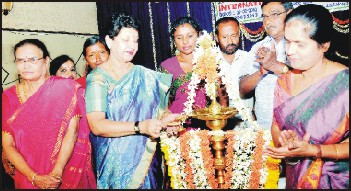
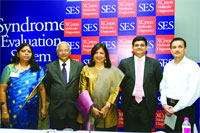
Caption: Prema Cariappa, Chairperson, Central Social Welfare Board, inaugurating the International Women’s Day celebration organised by Karnataka State Social Welfare Board at Rajendra Auditorium in JSS Hospital premises here recently. Others seen are State Board Chairperson Vinoda Nataraj and Karnataka State Women’s Development Corporation Chairperson Sarojini Bhardwaj.

Mysore, Mar. 28

“Members of the Indian society need to shed the ancient notion that only male issues can support us in our old age and that one attains ‘sadgati’ after death only if one is the a parent of a male child,” said Prema Cariappa, Chairperson, Central Social Welfare Advisory Board, New Delhi.

Speaking after inaugurating International Women’s Day celebration held under the aegis of Karnataka State Social Welfare Board at Rajendra Bhavan in city on Monday, she said that women are playing a pivotal role in the development of the nation and the country; but in spite of this, they are being discriminated.

She further said that even today, the birth of a female child is considered shameful. Even though girls excel in education they are being discriminated in the fields of higher education, professional courses and employment.

“The need of the hour is to educate girls. She said that the social evils like dowry etc. have ruined the society. Women are being burnt alive if dowry is not given. Police and judiciary seem to be helpless in stopping these crimes. Govt. is taking appropriate steps for the development of women but it is the duty of the voluntary organizations to come forward to work in the field of social work,” she said and opined that local elected representatives need to work towards eradicating this discrimination.

Board’s chairperson Vinoda Nataraj, State Women’s Development Corporation Chairperson Sarojini Bhardwaj and Women and Child Welfare Department Deputy Director N.R. Vijay were the chief guests.

source: http://www.StarofMysore.com / General News / March 28th, 2012

Tale of two cities

MULTIPLE CITY

Inscribed on the grains of sand, somewhere in the hour-glass of time, is the story of Bangalore, a story that has intrigued many. There are stories within stories of the multiple city that Bangalore is.

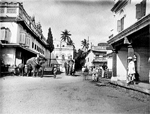
SIGHTS OF BANGALORE in the 1900’s. Clockwise from top left: A typical street with turbaned men and women ( Photo courtesy: Jane Smith, England , Missionary Fred Goodwill’s, grand daughter and Jones Ebinesan,  Western Australia).

A common thread that runs through the City’s centuries-old history is that of the constant pete-Cantonment parallel, and the story of the City’s municipal governance occupies a special place in the existence of two separate geographical entities within the map of Bangalore.

Even 150 years after the first municipal board came into existence on March 27, 1862, one can still tell the difference between the old City area and the Cantonment. Today, the cosmopolitan nature of the City, punctuated by people of many communities, occupations and ethnic origins might have masked the difference between the two areas, but not obliterated it. The dichotomy seems to be a constant through Bangalore’s history.

Although the first municipal board was already established in 1862 for old Bangalore, drawing a line of distinction, another board was formed on August 1 of the same year, to govern the Cantonment area.

State within a state

The Cantonment was a state within the state. Its demography was largely decided by the British. Historians point out that the British had, in order to cater to their various needs, brought ‘rich’ communities like the Mudaliars and Naidoos and some Muslims. They had also brought the ‘Harijan’ community to perform menial jobs.

With higher expendable income, larger budgets, special provisions, the Cantonment was elite. But the old City area could not be left out, not even if it were not the bosom of the City in the eyes of historians. Their charms were different. The Cantonment was English; the City area, notwithstanding some resembling architecture, was local.

But they were both vibrant by virtue of enjoying separate business districts, a provision the City planners post-Independence have given little importance to.

According to H S Doreswamy, the oldest (living) freedom fighter of Bangalore, the City’s business district housed all kinds of businesses, from oil producers to potters and silk weavers to bangle makers.

The Cantonment was different. It had bazaars that sold finished products, grocery and was home to a spectrum of entertainment avenues.

In 1871, a new municipal regulation saw the appointment of J H Orr as the fulltime president for the control and direction of the affairs of both the municipal. This was the first attempt at unified governance.

But the differences were not to be wiped out. The total revenue generation of the Bangalore City Municipality was Rs 43,010 while the revenue of the Bangalore Civil and Military Station Municipality (Cantonment) was Rs 92,617.

After the conclusion of the Commissioner’s administration and the beginning of the Mysore rulers’ administration, the Cantonment area was called British Cantonment.
By 1881, the differences in the administration became very apparent and caused discomfort among the locals in the City area. The administration continued, brushing aside these differences that did not last, for Bangaloreans then, like now, 150 years later, didn’t get ruffled too much by these differences.

Home to the British automatically meant more access to many provisions that the City area did not have. The ever-benevolent (British) government’s hand meant funds for development projects.

One such key priority that came the Cantonment’s way was drinking water supply. As early as 1881, Sampangi and three Millers tanks were the chief sources of water for the Civil and Military Stations. The Millers tank, constructed in 1854, was the first step taken to meet the demand for water. For the City, before the commencement of the scheme of protected (filtered) water supply to the City initiated in 1896 by Dewan K Sheshadri Iyer, unfiltered raw water was supplied from a number of tanks like the Dharmambudhi tank, Sampangi, Ulsoor and the Sankey tank.

The British officers deputed in Bangalore during the 1890s were looking for a new source of water supply. Major Grant worked at four sources––Maligal valley, Hebbal, Rachenahalli and Hessaraghatta––and M C Hutchins, the chief engineer of Mysore preferred Hessaraghatta.

More equal than others?

While people residing in the limits of the Bangalore City Municipality were levied three per cent-four per cent water tax, buildings and land used for military purpose were exempted from tax.

In 1892, for the first time, elections were conducted for these boards.
Voting rights were restricted only to male property owners and even among them, only those who have paid property tax, according to provisions of the Central rule of 1883. Both civil and military areas saw 18 members in all.

The differences between the two though, had to continue. Unlike in the City area, only in the Cantonment, women were allowed to vote. It was not until 1923, when the City board submitted a memorandum that women in the City area were allowed to cast their vote.

The differences continued even after Independence, as historians have described.
On December 8, 1949, post-Independence, both the boards were legally merged as one. But the most immediate challenge for the new administrators was to find the much needed co-operation for common administration. For the lines had to be “undrawn.”
The path taken after that needs little recalling. Bangalore has grown, it has a fresh identity. But the two separate identities that the Cantonment and City areas have given to Bangalore will continue to add to the charm of this City in its own way.

source: http://www.DeccanHerald.com / Home> Supplements> Spectrum / by Chethan Kumar / Tuesday, March 27th, 2012