First animated children’s film in Kannada

Bangalore:
It’s November 14 again, but this year’s Children’s Day promises something different for those in the State. ‘Chintu’s Skool,’ the first animated film in Kannada for children, will be screened at the 17th edition of the International Children’s Film Festival which begins in Hyderabad on Monday.

Produced by Kolors n Motion Studios Pvt Ltd, in association with Shree Mahalakshmi Combines, the film tries to bring about social transformation via animation.

Says Sheshagiri Yelameli, a documentary maker and the director of the film: “We have used elements of magic and fantasy with the underlying message that by teaching others, education can be made accessible to all classes of society. Mahatma Gandhi, Swami Vivekananda and even actors Shivarajkumar and Upendra come in their animated forms, showing children that hard work is the key to success.”

Anand Kidambi of Kolors n Motion says the film will be screened for the first time in Karnataka at the JSS Mutt, Suttur, on Monday to around 3,500 children in the Mutt’s state-of-the-art auditorium.

Theatreperson, singer and Rajya Sabha member B Jayashree is the chief guest. This will be followed by shows at Eeshwari and Srinivasa theatres in Bangalore the next day. Made entirely in the studios of Bangalore with more than 30 BFA and DFA holders from Davangere, Gadag and the City working on it, ‘Chintu’s Skool’ has music by V Manohar, lyrics by M N Vyasarao.

Actor Ramesh Arvind and others have lent their voices to the characters.   The producers plan to take the film to schools across the State soon. For more details, contact info@kolorsnmotion.com

source: http://www.deccanherald.com / Home> Entertainment / DHNS / Bangalore /  November 13th, 2011

KIMS – the First Hospital to do Robotic Colorectal Surgery in India

Though there are four Robos in India (Delhi, Mumbai, Bangalore and Hyderabad), KIMS is the first in the country to use robotics help to do surgery.

Surgeons at KIMS performed a rare surgery called robotic colorectal surgery, for the first time in India. The surgical team comprised Dr Surya Nalamati, Senior Surgeon, Henry Ford Hospital, Detroit US; Dr M BV Prasad, Consultant Surgical Gastro Enterologist; Dr Ravichander, Surgical Oncologist; Dr Lakshmikanth, Surgical Gastro Enterologist of KIMS Hospital. The procedures were of two to three hours duration.

Robotic colorectal surgery benefits the patient immensely. They benefit from a much smaller surgical incision, which leads to less pain and a shorter recovery time. Most common patient benefits include: significantly less pain during recovery, less blood loss during surgery, less complications during surgery, less scarring after surgery, shorter hospital stay, a quicker return to work and daily activities, often better clinical outcomes, preserves sexual function, preserves bladder control and higher quality of life after surgery. Thus, robotic colorectal surgery is the most upcoming branch in the medical treatment. More than 10,000 procedures have been reported across the globe in the last 10 years, since robotic assisted surgeries were introduced.

Robotics-assisted surgery has several advantages. One of the most important advantage is that the incisions made during surgery are tiny and hence the recovery from surgery is extremely quick. Fast healing time is a hallmark of this surgery. Rapid recovery from surgery is not only better for the patient, but it is also less expensive for society. Some other advantages of robotic surgery are precision, miniaturisation, decreased blood loss, less pain and lesser hospital stay. The surgery can be conducted quickly and safely with negligible blood loss.

KIMS had initiated a drive in June 2011 urging the use of robot-assisted technology, in a bid to help and save patients suffering from plethora of problems like urology (prostate, kidney, and urinary bladder) and gynaecology surgeries. They had also recommended it for other specialties such as ENT, cardiac surgery, gastro intestinal surgery and liver resections.

EH News Bureau

source: http://www.expresshealthcare.in / Home> Market> Article / November 2011


New Mangalore Port Handles Record Containers in a Single Voyage

Media Release

Mangalore, Nov 14:

A record qty of 1512 TEUs  handled at New Mangalore Port  in a single voyage in the container vessel- M.V. TAMPABAY  which called at the Port on 9-11-2011.  This is the highest number of containers ever handled at the port from a single voyage surpassing the  earlier record of 1436 TEUs handled on 3-7-2009 from the vessel M.V. ELBE TRADER.  Out of the total 1512 TEUs, 934 were imports and 578 exports.  Major items of import are raw cashew and export consists of coffee, cashew kernels, fish and fish products, candles, etc. M/s Atlantic Shipping are the Feeder Line Operators and M/s Delta Infralogistcs Pvt. Ltd.(HML) the agents of the vessel.

Chairman Dr. P. Tamilvanan has stated that the port is witnessing steady growth in container traffic thanks to the pro-active marketing efforts made by the Port management coupled with the infrastructure addition created during the past few years like expansion of container yards, container handling equipments like reach stackers, increased number of reefer plug points, concretization of roads, simplified documentation system etc.  This has yielded positive results in fostering the container movement to the port from the hinterland which is evident from the fact that from 9646 TEUs handled in 2005-06, it has grown to 40,158 TEUs in 2010-11.  During the current year 2011-12(as on date) 30,454 TEUs handled as against 25,709 TEUs handled during the corresponding period of previous year.

Container traffic at NMPT got a shot in the arm when the first consignment of 40 feet container with Garments/Linen exported through New Mangalore Port on 7-3-2011 in the container vessel M.V. OEL TRUST.  The consignment of 4237 packets of cotton processed garments/linen produced at the Hassan SEZ by M/s Himatsingka Seida Ltd.  has been exported to USA.  This is for the first time garments are handled at the Port.  The Mainline operators are M/s CMA CGM and the handling agents M/s Cargolinks. The total transit time will be 28 days.

Shri P. Tamilvanan, Chairman has attributed the handling of this new cargo, hitherto moving through neighbouring ports, to the pro-active marketing efforts  made by the Port  at various locations of the hinterland during the last few years coupled with the Infrastructure additions made for the smooth handling of containers.  He has added that the above garment unit , which is a 100% export oriented one  is expected to move their entire consignment of export to the tune of 25 TEUs per month through New Mangalore Port.   The container traffic at the Port has crossed 36000 TEUs during the current year(as on date) with a growth rate of 27%.

source: http://www.daijiworld.com / Monday, November 14th, 2011


Rangayana to open ‘SCRIPT BANK’: Dr. Rajaram

This year’s Bahuroopi theatre fest to stage plays by Jnanpith awardees


Mysore:

City’s theatre repertoire Rangayana will create a ‘Script Bank’ in which manuscripts relating to nearly 3,000 dramas would be posted on its website for the convenience of those interested, said Dr. B.V. Rajaram, Director of Rangayana, here this morning.

Participating in an interaction programme organised at Pathrakarthara Bhavan in city by Mysore District Journalists Association (MDJA), Dr. Rajaram said this year’s Bahuroopi National Theatre Festival would be held on the concept ‘Jnanpeetha Rangotsava’ in which dramas scripted by Jnanpith awardees would be staged.

The Rangayana Director also said that a huge collection of scripts and books by B.V. Karanth and his wife Prema Karanth would be preserved at Rangayana and added that the Karanth family had agreed to hand-over the literature treasure in the form of CDs and cassettes.

Dr. Rajaram, who said that this year’s Bahuroopi would be held in a grand manner even if it came to accepting private participation, added that the National School of Drama (NSD) and Rangayana should be incorporated for staging dramas in the State.

Seminar: Stating that Rangayana had plans to conduct a seminar on ‘Media-Rangabhoomi’ during Bahuroopi festival, Dr. Rajaram added that Rangayana’s activities were not limited to the city. He also said that dramas would be organised at taluk and district levels to identify and nurture talent among rural people.

MDJA President C.K. Mahendra, General Secretary K. Deepak, City Unit Secretary M. Subramanya and Rural Secretary Kukke Mahadevaswamy were present.

source: http://www.starofmysore.com / General News / November 03rd, 2011

Pages from History: The saga of Unification of Karnataka

By Prof. A.V. Narasimha Murthy,

Former Head, Department of Ancient History & Archaeology, Mysore University

The saga of unification of Karnataka reads like an epic involving sacrifices, thinking, planning, agitating, coaxing, requesting, threatening etc. by leaders. The seeds for this great event which flowered in 1956 were sown more than a century ago with multi-pron-ged programmes but with a single agenda.

It was Deputy Channabasappa who in 1956 announced his idea of a State of Karnataka for the Kannada speaking people. This was fortified by the establishment of Karnataka Vidyavardhaka Sangha at Dharwad in 1890 with this as its main aim. Benagal Ramrao delivered a lecture in 1903 at Dharwad asking the authorities to form a Karnataka State. However, this got a bigger boost in 1907 when Alur Venkatarao, known as the high priest of Kannada people (Kannada-kula purohita) wrote a brilliant article arguing for the formation of Karnataka State and this proved to be an eye-opener to the people of Karnataka to unite themselves under the banner of Karnataka. Lokamanya Tilak supported the cause of linguistic States before the Royal Commission in 1908.

The inauguration of Kannada Sahitya Parishat in 1915 was a catalyst for the unification movement. In the very first conference, the Parishat passed a resolution for the formation of Karnataka State. To support this stand, an organisation called Karnataka Sabha was formed in 1917 by Mudavida Krishnarao, Kadapa Raghavendra Rao and others. Many submissions were made to the Secretary of State for India, Montegue. Some influential persons of this movement were also the members of Indian National Congress.

Consequently, the annual sessions of National Congress were also used for airing this problem. Even Gandhiji blessed this movement saying that it is close to his heart. Nagpur session of the Congress passed a resolution also.

A political conference was held in 1920 under the Chairmanship of Dewan Madhava Rao which stressed the need for the formation of Karnataka State. Siddappa Kambali passed a resolution in Bombay Legislature in 1920. All India Congress Committee urged the government to start the process of the formation instead of discussing it any more, with regard to Andhra, Karnataka and Sindh. This opinion was placed before the Pandit Nehru Committee in 1928. Nehru approved it and this was placed at the Lucknow Congress session and it was passed.

Another significant step was taken in 1928-29 by placing this subject before the Simon Commission. This Commission appreciated and justified the formation of linguistic States. Not satisfied by this, Benagal Ramarao, Benagal Shiva Rao (both brothers) and Mirza Ismail took this subject in 1931 to the Round Table Conference held at London. This proved a great success because the British authorities were convinced of the necessity and justification for a new State of Karnataka.

In the meantime, it became very clear that unless India became independent, the formation of Karnataka would be a mirage and hence the concerned persons turned towards this goal. Many literary giants like BM Sri, Kuvempu, Anakru, Bendre and others wrote and made Karnataka their mantra and began writing, lecturing and created a mass involvement in this movement. In a highly emotional way, they described the Goddess Karnataka being cut into parts like Mysore State of the Maharaja, Madras Karnataka, Bombay Karnataka, Kerala Karnataka, Kodagu and many petty States ruled by Nawabs, etc and hence she is bleeding and it is the duty of every Kannadiga to redeem her from this atrocity committed on her.

Common people became passionate about their bleeding mother. At this time some influential people felt that the freedom movement should not be diluted in Karnataka for the sake of formation of Karnataka and advised the freedom fighters to wait till the country got freedom. Many were disappointed by this stance but had to be patient in the light of utterances of the leaders of the freedom movement.

In 1946, a huge conference was held at Davanagere in which Mysore Pradesh Congress played a prominent role. At this time, some persons posed the problem of Mysore Maharaja’s State being separate from the formation of Karnataka. However, India became independent in 1947 and the Maharaja’s State was merged into Indian Union after a small struggle.

A Committee headed by Sri Dhar was formed to look into this problem. In the 1952 General elections, Congress won the majority seats and hence it became strong. It threatened to resign enmasse if Karnataka State was not formed forthwith. Then the Central Government opened its eyes and constituted the State Reorganisation Committee in 1953 with Fazal Ali as the Chairman, H.N. Kunjan and K.M. Panikkar as members. It examined 1, 54, 250 records, memoranda, maps, books etc, met 9,000 persons and gave a report on Sept. 30, 1953.

It was placed before the Lok Sabha and was passed on 10th June 1956. The President gave his assent on 31st August 1956. The State of Karnataka came into existence on 1st November 1956. But the State was called Mysore State and majority of the people were not happy with this. The then Chief Minister D. Devaraja Urs managed to rename it as Karnataka State on 1st Nov. 1956 as per the aspirations of the Kannada speaking people.

On this occasion, it is our duty to remember with gratitude all those who put in their efforts so that we can be proud of the name Karnataka.

source: http://starofmysore.com / Feature Articles / November 05th, 2011


Natural farming: Lifeline for Farmers

Intl. seminar on zero-budget farming by La Via Campesina


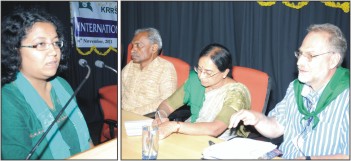
Caption: KRRS General Secretary Chukki Nanjundaswamy speaking at the seminar on natural farming held in city this morning. Picture right shows the pioneer of zero-budget farming Subhash Palekar, Nandini Jairam and Peter Rosset of La Via Campesina on the dais.

Mysore:

An international seminar on self-sustainable, zero-budget natural farming, propounded by international organisation La Via Campesina, was held under the aegis of Karnataka Rajya Raitha Sangha (KRRS) at Rani Bahadur auditorium in B.N. Bahaddur Institute here this morning.

Speaking on the occasion, Subhash Palekar, popularly known as Krishi Rishi, an exponent of natural farming and promoter of the concept of Zero Budget Natural Farming (ZBNF), said that the State Government’s Organic Farming Mission must be closed as it is against the interests of farmers and favours multinationals. He urged the government not to confuse the farmers between natural farming, organic farming and the conventional method of farming.

Pointing out the drought prevailing in north Karnataka region and the continued spells of rain in southern region of the State even during November, Palekar said that it was due to changes in the environment which if unchecked, would lead to disastrous implications.

KRRS General Secretary Chukki Nanjundaswamy, delivering the inaugural address, expressed regret that those in power were least bothered about the farmers resorting to suicide throughout the nation and said that there was a need for authorities to contemplate on why the farmers became entangled in debts and how to bail the Annadatha out of the severe financial constraints which force them to take the extreme step.

Deploring the conventional method of farming, she said that it required huge investments by way of seeds (from company brands claiming to be of superior quality and high-yielding), chemical fertilisers, weedicides, insecticides etc., but fetched no profit either because of crop failure due to vagaries of nature or crash in prices caused by over-production or other reasons.

Chukki termed the State Government’s Organic Farming Mission as capitalist agriculture and called upon farmers to take up pro-farmer agri-practices.

Peter Rosset, a member of La Via Campesina, addressing the gathering, said that the agri-scientists who work within the labs lack first hand experience of farming in the field and hence, their research works go waste.

They need to be practical, keeping in mind the farmers’ limitations and must ensure that their research works reach the farmers and properly implemented. He also deplored the use of hybrids and advocated for natural farming using original breeds. He also spoke in favour of polyculture (mixed farming).

KRRS President K.S. Puttannaiah, Nandini Jairam and farmer delegates from Sri Lanka, Indonesia, Combodia, Scotland, Philippines, Mexico, Korea, Nigeria and Nepal were present.

Natural Farming: It needs no tilling, no fertilisers, no pesticides and no weeding. For about 60 years, Fukuoka Masanobu, Japan’s authority on natural farming, honed methods based on his theories. His book One-Straw Revolution addresses not only natural farming but also causes of environmental deterioration.

Intl. campaign for natural farming

Via Campesina is an international movement which co-ordinates farmers’ organisations of small and middle-scale producers, farm workers, rural women, and indi-genous communities from Asia, Africa, America and Europe.

It is a coalition of over 148 organisations, advocating family-farm-based sustainable agriculture and was the group that first coined the term “food sovereignty” which refers to the right to produce food on one’s own territory. Via Campesina has carried out a Global Campaign for Agrarian Reform since 1999.

Organised worldwide into nine regions, the group has members in 69 countries, with about 150 million members globally. The organisation was founded in 1993 by farmers’ organisations from Europe and Latin America. Its headquarters is in Jakarta, Indonesia. Henry Saragih is the General Secretary.

source: http://www.starofmysore.com / General News / November 06th, 2011


Smashing serves

Despite star players giving it a miss, the Karnataka Badminton league holds promise


Ashwini Ponnappa

Ashwini Ponnappa commanded a price. The Commonwealth Games gold medallist (in the women’s doubles alongside Jwala Gutta) has star value and provided the glamour quotient to the inaugural edition of the Karnataka Badminton League (KBL). She fetched a whopping Rs 2.5 lakh for her appearance in the first week of the league, which runs from November 5 to 19.

“She has a star value and will keep the rest of the team motivated. That is why we bid for her,” says Vishal Vincent Tony of the Aratt Fighters, the franchisee that successfully bid for Ashwini. “Her presence in the team, even if it is only going to be for the league stages (Ashwini leaves for the Hong Kong Super Series on November 12) should do wonders to the morale of youngsters in the team. She is only participating in the mixed doubles category. We have also bagged Jacqueline Rose Kunnath, who commanded the second highest bid of Rs 1.06 lakh to play the women’s singles, there is no reason why we cannot do well,” says Vincent.

Beside the two women stars, Rohan Castellino was picked to provide the thrust in the men’s singles.

If Aratt Fighters spent huge sums on women players, franchisees such as Fly Power Warriors and Li Ning Lions did not invest on big names and instead opted for a balanced team. “This being the inaugural year, there was a lot of apprehension and uncertainty. We chose a couple of young guns to deliver for us and hopefully they will,” says Choudhary, a member of the Fly Power Warriors, for whom Rajas Jawalkar and Sindhu Bharadwaj will lead the singles challenge in the men’s and women’s categories respectively.

P. Kumar of Kumar Sports, owner of the Li Ning Lions, said: “Li Ning is the leading shuttle-cock manufacturer in China and is making its presence felt in the Indian market. This league could provide the perfect platform. We are happy with the team.”

Agarwal and Bhandari joined hands to form the AB Chargers and picked the top ranked men’s singles player, Mohit Kamath, alongside women’s player Mahima Aggarwal and doubles specialist Vineeth Manuel. “There were some hiccups but overall, I am quite satisfied,” says Bhandari after the players auction that lasted nearly six hours.

With Aditya Prakash and Prakash Jolly going to White Peacock and K2 Smashers respectively, one felt the Hennur Banaswadi Cosmopolitan Club (HB Challengers) were the ones to lose out, with just Rishiket Yeligar and B.S. Phalgun leading the challenge in the men’s singles. But Srinivasan (Secretary) and Krishna Kumar (coach), who once formed a strong doubles combination with George Thomas in the ’90s, felt the players would deliver. “We win some and lose some. It is a learning curve for us. We will be better equipped next time,” says Manjesh, who represented the K2 Smashers.

“There were too many caps,” was the general feeling and the phenomena resulted in active players like Poorvisha Ram and Ruth Misha going unsold. On the flip side were the withdrawal of the eighth team, Team Victor, from the fray and some internationally renowned names like Aravind Bhat and Anup Sridhar giving the league a miss for varied reasons.

source: http://www.thehindu.com / MetroPlus> Life & Style / by Avinash Nair / November 02nd, 2011


Women who sow innovation

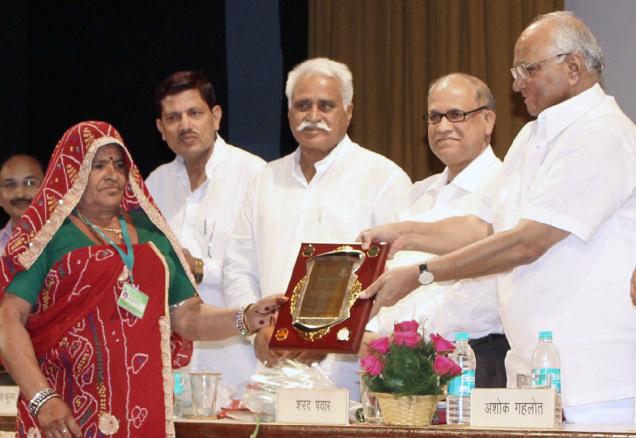
Women farmers shine: Bhagwati Devi, honoured for innovative farming by Union Agriculture Minister Sharad Pawar and Rajasthan Chief Minister Ashok Gehlot. WFS
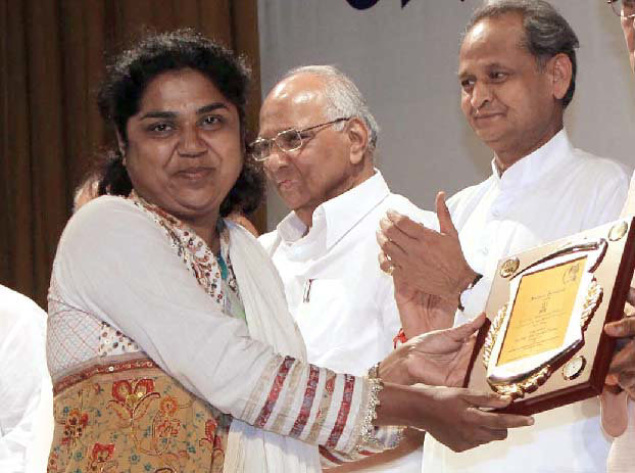
Laxmi Lokur

Three women farmers were recently felicitated for their scientific approach and acumen.

Laxmi Lokur is 38 and single. “I have no time for marriage,” she says, before moving on to her favourite subject, agriculture, and all the projects she has undertaken to attract youngsters to the field, quite literally.

Laxmi is from Karnataka’s Belgaum district and lives on her 22-acre farm. With her team of eight, which includes three women, she grows organic vegetables and fruits. Her focus is more on sowing, planning marketing networks and utilisation of the by-products of vegetables. She also runs a dairy.

Like Laxmi, Teilang Rani, 30, is also passionate about the land. Although a teacher by profession, she spends about four hours a day in the fields. Her family owns 11 acres in the village of Umden Arka, in Meghalaya’s Ri Bhoi district, on which she and her grandparents grow vegetables and paddy. The family cultivates bamboo on an additional acre. About a decade ago, Teilang began fermenting tender bamboo shoots to make curries, soup, pickles and chutneys, and has now developed this as a business model.

Bhagwati Devi from Sikar, in Rajasthan, has invented a way to protect crops from termites by planting a variety of wood, locally known as safedi ki lakdi.

Their love for agriculture and acumen for innovation recently fetched Laxmi, Teilang and Bhagwati national recognition. They were the only women felicitated alongside 28 other “farmer scientists” from 18 States by the Centre for International Trade in Agriculture and Agro-based Industries (CITA) and the Department of Agriculture, Rajasthan. The Union Agriculture Minister and Rajasthan’s Chief Minister were also present at the function held in Jaipur, where the women were honoured for their innovative practices and scientific research to enhance crop yields, improve seed varieties and scale up soil productivity.

For Teilang, this was only the second time she had ever ventured out of Meghalaya. She lives with her grandparents, husband, sister and an uncle. “Ours is a matrilineal society. I got married in January and my husband came to live with me. He works in a church 80 km from my village and visits me only twice a month,” she says. Teilang teaches English to students from Std V to X, but before going to school, she works for an hour in the fields.

Elaborating on her award-winning business model, she says, “We select 45-60-cm-long tender bamboo shoots for fermentation. These are stunted shoots, which are not likely to produce good quality bamboo for use in construction. The shoots are sliced and immersed in large jugs of water after their sheaths have been removed. They are kept like this for about a month when they ferment. We use this bamboo as pickle, add it to fish or pork curry and even soups.” Teilang has taken her bamboo shoot pickle to village exhibitions and other marketplaces, and makes about Rs 10,000 a year from her produce.

Laxmi, on the other hand, gave up a flourishing bag manufacturing business in Mumbai to return to farming in her native village of Udikeri, nine years ago. “I have two older sisters and a younger brother. In 2002, my father, a health inspector, fell ill. My sisters were married and my brother was busy studying. So I returned home to take care of my ailing father. But even after my father recovered, I decided to stay on. I had lived on our farm with my father since I was three, so I was naturally drawn to agriculture although I had no formal training. Since I wasn’t a particularly good student, I did not complete my graduation, but later explored the possibility of a short-term course in agriculture,” she says.

Laxmi’s family owned about seven acres when she first put her hands to the plough. “For one year, my father came to the fields with me to guide me. I started with a nursery, but we were unable to meet our day-to-day expenses. Then I bought a buffalo to sell milk. The next year, I bought four more. In 2005, I took a loan of Rs 6.4 lakh from the State Bank of India to procure 18 Murrah buffaloes from Haryana for dairy production. Simultaneously we worked on developing vermicompost. By 2006, we were selling vermicompost. Today we grow vegetables, which we supply to Bangalore and neighbouring districts. I have now developed my own marketing network.”

When she realised that seeds were getting too expensive, she started collecting local seeds. Three years on, she has been able to collect 22 varieties of local vegetable seeds. She now owns 19 acres, and has taken another three acres on lease.

She also conducts spoken English classes on weekends. “These are school-going children who come to me for vocational training. I have six boys and five girls as students. Once a month, I even train farmers in innovative farming, in making vermicompost the natural way and on using organic hybrids to increase harvests,” Laxmi says.

She now plans to register a non-governmental organisation and has already decided on the name: Prerna (inspiration). Apt indeed, seeing how she has inspired at least 20 young people over the last nine years to give up business activities and take up agriculture.

Laxmi, Teilang and Bhagwati are women with their hands on the plough and an instinct for the land. In a predominantly agrarian country like India, they can help transform the landscape.

© Women’s Feature Service

source: http://www.thehindubusinessline.com / by Renu Rakesh

To the zone and back

They stood facing each other, shuffling from side to side like prize fighters sizing up what lay ahead. The younger man, shorter and of a slighter frame, Olympic gold medallist Abhinav Bindra, sparing with words, and Indian cricket’s stickiest commuter Rahul Dravid, who listened more than he smiled, waited rather than waded, held court on the strikes and strokes that make up the sporting universe.

Bindra, 29, who made history in the 2008 Beijing Olympic Games, recounted his obsessive journey to greatness in a book ‘A Shot At History’, which Dravid launched before a glittering audience that included bowling great Anil Kumble, sprint queen Ashwini Nachappa, basketballers Nandini Basappa and Jayawanthi Shyam and swim star Nisha Millet. Dravid, slow batsman, sharp with words, said of Bindra’s historic effort, “He gave us one of those I-was-there, it-happened-during-my-lifetime moments.”

The evening, an education on the pursuit of sporting excellence, saw the iconic stars attempt to define that moment in time athletes like to call ‘the zone’. A smiling Bindra called it ‘fantasy’. “For me,” he said, “it is all about being in the present. When you are able to sustain that focus over a period of time.”

Dravid said, “Whenever great athletes meet, this (the zone) topic always comes up for discussion, you want to know if the other guy has been there, experienced it, you feed off each other. When Abhinav and I met earlier, we discussed it. Like he said, it is about being in the present, when you don’t have one eye on the score or the pitch or what’s coming at you. I’ve been fortunate to have glimpsed and tasted it in my career.”

For Bindra, whose sport is about attaining a stillness of state and spirit, said that while perfection was the goal, it’s also about what you are able to sum up on an imperfect day. “You have to have a Plan B and then it’s about how you make it work.”

Dravid said, “It’s not about how you do on a good day because you will do well, but how you come through when you are struggling. When things are not going your way and you’re wondering what you’re doing out there embarrassing yourself, but you stick around and make a 100. There’s great satisfaction in that.”

Bindra’s ‘A Shot At History’ is a stirring narration of the journey of an Olympic athlete. The autobiography written with sportswriter Rohit Brijnath, grabs the attention of the reader as much with the voice as with the words that make up the 200-odd pages of the book which takes on the tone of a conversation. It’s as if the champion shooter is narrating his story to you at a neighbourhood cafe. From the moment he wakes up, battling his mind on a winter morning in Chandigarh, to the final pages of the book, where he tells you that he’s ‘learning to suffer again’, readying himself for the 2012 test, you’ve probably downed many mugs of coffee, run through several tissues and finally thumped the table in triumph.

source: http://www.timesofindia.indiatimes.com / by Prajwal Hegde / TNN / Home> City> Bangalore / November 01st, 2011

Promote Organic Farming, suggests RAITHA SANGHA President


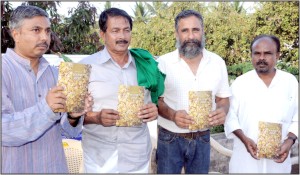
Raitha Sangha President K.S. Puttannaiah, Dr. V. Rajendra and Progressive farmer Vivek Cariappa releasing the book Huruli Parisay at Nisarga Organic Food Products Centre in Kuvempnagar yesterday.

Mysore  Oct. 31:

– Raitha Sangha President K.S. Puttannaiah has urged the government to commence a diploma course in organic farming sans any usage of chemical fertilisers.

He was speaking at an interaction programme with farmers also marking the release of the book Huruli Parisay organised at Nisarga Organic Food Products Centre in Kuvempunagar here yesterday.

“With the increase in use of chemicals in agriculture, deadly diseases like cancer and heart-related ailments have been observed even among children. Accordingly, more medical colleges and nursing homes have been cropping up. Good food should be consumed to maintain good health,” he said.

Huruli or horsegram is one and the only crop cultivated without the use of any chemical fertiliser. If Americans knew about Huruli they would have patented the product long back. The country should evolve a food policy to maintain the health of the citizens which necessitates a well-organised movement,” opined Puttannaiah.

He also suggested marketing of organic food products through mobile vans.

Dr. V. Rajendra of Government Ayurveda College released the book Huruli Parisay.

Progressive farmers Vivek Cariappa, Basavaraj and others were present.

The farmers later had an interaction with the consumers.


source: http://www.starofmysore.com / General News / October 31st, 2011