Israeli tech whets once-barren farm

Dry farming techniques gave a new twist to organic farming on this land
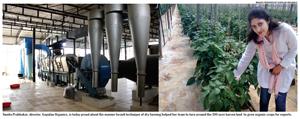
Sunita Prabhakar, director, Gopalan Organics, is today proud about the manner Israeli technique of dry farming helped her team to turn around the 100-acre barren land to grow organic crops for exports

Away from the hustle and bustle of Bangalore city areas, in Uttari and surrounding villages, falling under Kagalipura post, a silent socio-agronomics revolution, inspired and propelled by Israeli farming techniques, is slowly gaining momentum. Spearheading the campaign from a 100-acre organic farm is one young entrepreneur, a graduate in environmental science and in her 30s, determined to make organic a mass movement.

Every morning before the crack of dawn a vehicle leaves the organic farm and reaches out to the adjacent villages to pick up enterprising men and women for training in production of organically grown vegetables and high-value export quality herbs like basil, chives, sage, tarragon, rosemary, parsley, thyme, mint etc. at the sprawling organic farm located in the foothills of the nearby Uttari Hills.

“After training in organic farming, many of them have begun growing organic vegetables. We purchase their produce after ascertaining their quality. Some of these organic vegetables are sold at our Gopalan Organics outlet at Old Madras Road in Bangalore. A portion of the produce makes it to the export markets in Dubai and European markets after stringent quality checks”, says Sunita Prabhakar, the brain behind the grassroots organic farming movement. “My mission is to remove the elitist tag off organic vegetables and make them available to common households at affordable rates. After all everyone is entitled to organically grown, healthy, chemical fertilizer and pesticides free farm produce,” explains Director of Gopalan Organics, Sunita Prabhakar, who started her organic unit in 2003, in what was then a barren land, bought by her real estate developer husband’s family in Bangalore heading the ‘Gopalan Enterprises’.

However, although today the organic vegetables and culinary herbs company exports dry, natural herbs and fresh vegetables to a large number of markets in Western Europe and Dubai respectively and employs over 200 workforce including farmers, agronomists and agricultural scientists, 10 years ago when Sunita threw the idea of starting her organic venture on the rocky, godforsaken land, many did not take her seriously.

She had seen for herself how Israelis mastered the art of dry agriculture with minimal use of water. She was determined to bring the technology to India.

The conviction and determination paid off.

In the summer of 2000 a group of Israeli dry farming experts from Netafim Irrigation System landed at the barren, undulated rocky piece of land.

They examined the prospect of turning it into fertile land for growing organically produced vegetables, herbs and fruits. A mammoth and uphill task awaited them as for the next six months they devoted their time in preparing, planning and executing the organic farm project.

It took another year for the first crop to grow at the newly developed farm.

Alongside Israeli advanced farm management expertise in water conserving irrigation, desalination, and compost enriching the farm, Sunita also adopted biodynamic farming methods pioneered by Australian thinker Rudolf Steiner to grow crops both inside temperature-control green houses and in the open fields, applying scientific soil testing methods for optimum yield per acre.

A network of drip irrigation pipes and sprinklers were laid both inside the green houses and in the open farm land.

The farm land was bifurcated for growing crops under controlled climatic conditions inside the green-houses, and tunnels in the open. “Those days very few people were doing organic farming. There was hardly any infrastructural or technical support available in the country to do dry organic farming. The greatest challenge was to export the basic infrastructure from Israel and then transport them to this remote village from Bangalore Airport. But we managed it all,” says Sunita.

The organic farm today produces 800 to 900 Metric Tonnes of vegetables and fresh and dry culinary herbs under the brand name of ‘Naturale’.

“Of the total volume, we exports 300 to 400 MT of mainly fresh and dry herbs to Germany, Amsterdam, Vienna, Munich, Frankfurt, Belgium, etc. places. To ensure strict adherence to European quality control norms, the vegetables and fresh herbs undergo tests at all levels- from farmland to packaging table-at the analytical lab.

Scientific soil analysis and preparation, soil-enriching using organic manure, plant analysis, bio-degradable poly packaging, processing and storing to retain temperature levels are undertaken,” says K Babu, the agricultural scientist at the farm. Babu further said for the protection of crop bio agents and other Integrated Pest Management (IPM) practices were being followed as against indiscriminate use of harmful chemical pesticides. Each consignment can also be tracked back right down to the date and green house in which it was grown.

Sunita explains: “To ensure freshness of the produce till they are handed over to customers in Germany and other European countries an uninterrupted cold chain from farm to the customer is maintained. The produce is subjected to pre-cooling treatment that increases the shelf life and reduces break down of the nutrients. The air-conditioned pack houses are equipped with all necessary equipment and facilities in consonance with international standards.”

Sunita, who has visited organic farms in Europe, feels the government must support adoption of automation and IT to streamline and modernise organic farming.

​DRY FARMING

It is a type of farming practised in arid areas without irrigation or with drip irrigation and maintaining a fine surface tilth or mulch that protects the natural moisture of the soil from evaporation. Dryland farming involves quite a struggle to set the crop cycle going.

HOW AND WHERE IT ORIGINATED

Dry farming originated in the 19th century in the Great Plains of USA to accelerate production of certain crops, most notably wheat. It should be practised in areas where rainfall averages less than twenty inches a year. Hardy Webster Campbell, a South Dakota homesteader, invented a subsoil packer circa 1890 and thereafter operated demonstration farms for railroads. By the end of the century dry farming was championed as the solution to the agricultural problems of the Great Plains.
(Source: Encyclopaedia of Oklahama History and Culture)

source: http://www.bangaloremirror.com / Bangalore Mirror / Home> Others> Sci-Tech / Agencies / by Dipankar Chakraborty / October 29th, 2014

Kush Maini becomes first Indian to win a World Series Karting race

New Delhi :

Kush Maini created history when he became the first Indian driver ever to win a WSK ( World Series Karting) race at the La Conca international Circuit in Muro Lecce in the southern Part of Italy on Sunday the 3rd Feb 2013.

Kush who drives for Team Baby Race was third overall in qualifying out of over 41 entries in the 60 Mini category. All the participants were divided into 4 groups for the elimination heats as once 34 would Race in the Finals.

Kush was in Group C and won two of the heats while coming second in one of them. This entitled him to the Pole Position for the Start of the prefinal Race which was once again the first time for an Indian to start on Pole Position.

The Prefinal which was run over 8 laps of the 1.25 km circuit was extremely well fought with the top 4 drivers. Kush struggled a bit on the pace and finished third in the Prefinal. The Finals started with Kush in the third Place and on the very first Corner Kush moved into second Place behind Martinez.

Martinez pulled off an early lead and Kush was maintaining a distance of about 6 kart lengths as both were lapping at the same Lap times. Meanwhile Pagano who was in third showed extremely fast pace and was catching up to Kush. Soon Pagano overtook Kush and was on his way to catch up with Martinez. Kush played the waiting game and followed Pagano as both of them started to close on Martinez.

On the Eight lap Pagano overtook Martinez and on the 9th lap, Martinex took the lead again except that all the three drivers were driving like a train with no gap in between.

The three of them had broken away from the Pack and it was a very close and exciting race. On the very last Corner Pagano tried to make a move on Martinez and they both touched slowing down Martinez momentarily and also forcing Pagano off the track. Kush who was right behind Seized the opportunity and made a brilliant Pass on martinez which went all the way to the chequered flag where Kush finished just a mere.019 seconds ahead of Martinez in the most exciting nail biting finish of the weekend.

Kush was extremely happy with the win and was continuously punching the Air to celebrate his victory.

On the Podium Kush was looking up again and again to make sure that he saw the Indian Flag that was rising behind him at the Podium Ceremony.

Kush with the three other European Champions for the other 3 events were then invited for a Press Conference to share their experience for the day.

Kush was very happy and said “I have been driving Karts from the age of 5 and started racing at the age of 7. I spent last year racing in Italy which was a great learning experience for me as I also got several podium finishes in many of the races. However WSK is the biggest race for me and to win here is fulfilling the start of a Dream to become one of the best Drivers. I am now looking forward to the balance three races of the Master Series as well as the two races of the Euro Series.”

Kush was very happy to share the same platform as Max Verstappen, Bocallachi and Alesio Lorandi.

Kush’s Elder brother Arjun Maini did not have a good start to the event as some Kart issues prevented him from Qualifying in the front. He had a bad crash on the first Heat and followed it with a top 10 position in the second. However he has to be content starting the prefinal A in 23rd Position.

Earlier in the day Arjun was 3rd fastest and this gave him some hope to fight his way from the back of the grid. He drove brilliantly to make 10 positions and finally finish 13th in the KFJ category. This meant that he would be starting in 25th position in the finals that was run over 16 laps. Once again he had an excellent drive and finished 14th.

Still in pain from the crash on Saturday Arjun said, “It was a very tough weekend as I had a very bad start on Friday and Saturday but was very happy with the way I drove on Sunday to finish 14th from over 60 of the world’s best drivers. I will work hard to come in the top 5 for the races to follow.”

source: http://www.timesofindia.indiatimes.com / The Times of India / Home> Sports> Racing / by Arani Basu, TNN / February 09th, 2013

Cong leader V S Koujalgi no more

Former president of Karnataka Pradesh Congress Committee (KPCC), former minister and veteran Congress leader Veeranna Shivlingappa Koujalgi, 77, (in pic) passed away at a private hospital here on Wednesday. He had been ailing for the past few months. He is survived by wife, son and three daughters. 

Koujalgi was born on September 21, 1938 at Deshnur village in Bailhongal taluk. A mechanical engineer, he had served in the Indian Navy and had taken part in the 1965 Indo-Pak war.  He joined politics in the year 1972 and got elected from Arabhavi Assembly constituency and also became minister in Devraj Urs Cabinet. He was re-elected from the constituency in the 1978, 1983, 1989, 1994 and 1999 elections. After being denied Congress ticket for the 1985 elections, Koujalgi contested as an Independent and lost. He lost the elections twice again in 2004 and 2008.

Koujalgi was also the Speaker of the Legislative Assembly from February 15, 1993 to December 26, 1994. He was made KPCC president during 1999 and was minister in the S M Krishna Cabinet. As KPCC president he had successfully conducted All India Congress Committee convention in Bangalore in 2001.

source: http://www.deccanherald.com / Deccan Herald / Home> State / DHNS, Belgaum – October 29th, 2014

Equestrian: Appachu rides to second place

Indians Ajai Appachu and Fouad Mirza of the Embassy International Riding School (EIRS) secured second and fourth place at the Hopetoun International horse trials in Scotland which launched the first Commonwealth cup in June.

According to an EIRS press release here Monday, Appachu finished second in the CCI event of the Commonwealth Cup with a cumulative score of 45.6 on Orleans II.

Mirza, who has been competing in the Junior National Equestrian Championships since 2002, won fourth place in the same event with a cumulative score of 49.2 on Penultimate Vision, the release added.

source: http://www.business-standard.com / Business Standard / Home> News-IANS> Sports / IANS / Bangalore – July 07th, 2014

Stepping back in time

Photo exhibition at Halasuru Metro Station displays rich heritage of the area

On Saturday afternoon, the staircase at Halasuru Metro Station turned into a mini-auditorium as a group of people sat there listening to each other’s narration about Ulsoor’s history. The concourse also exhibited Ulsoor’s rich heritage through photographs.

Halasuru, a bustling area in the heart of the city, has a tower built by Immadi Kempe Gowda, son of Hiriya Kempe Gowda, the founder of Bangalore. The tower is among the four built by him to mark the extent to which Bengaluru would grow. The lake in Halasuru is manmade, which served as a source of drinking water in the past. Now, it is an important water body for the city, an ecological landmark.

There are several streets named after the Mudaliars, a group that migrated from Arcot, Tamil Nadu, and took up posts in the British administration or became contractors, mining barons, merchants and philanthropists. One philanthropist was Rai Bahadur Arcot Narrainswamy Mudaliar, who founded RBANMS.

Meera Iyer, Co-Convener, Indian National Trust for Art and Cultural Heritage (INTACH), said the exhibition included oral history traditions.

Memory wall

Excerpts taken from people who spoke of what they remembered were posted on a ‘memory wall’.

One, written by Damodaran Sekhar, said, “In the 1950s, Halasuru lake was completely dry. Except for an island near MEG and Centre, all islands were accessible. We would go there by foot and it was a wonderful sight. The area around the Kempe Gowda tower was a picnic spot.”

Another post said the chariot of Someshwara Temple was made of rock. Yet another said that peacocks were seen every day in the temple area.

Exhibition

The exhibition has been organised by INTACH and Rangoli Metro Art Center, Bangalore Metro Rail Corportaion Ltd.

Vasantha Rao, General Manager, BMRCL, said the project could be replicated in other areas, such as Malleswaram and Basavanagudi, which have a history.

source: http://www.thehindu.com / The Hindu / Home> News> Cities> Bangalore / by Renuka Phadnis / Bengaluru – November 02nd, 2014

Preparations on for Datta Mala Abhiyan

Chikmagalur :

Deputy Commissioner B S Shekarappa and SP R Chetan paid a visit to the Datta Peeta atop the Bababudangiri Hills on Thursday, to inspect the security measures taken by the district administration in the wake of Datta Mala Abhiyan at the Sri Guru Dattatreya Bababudan Swamy dargah on Sunday.  The DC said devotees  will be allowed to have a glimpse of the Datta Padukas inside the cave from 8 am to 4 pm.

He directing the PWD assistant executive engineer to expedite the repair of roads on the way to the Peeta.

source: http://www.newindianexpress.com / The New Indian Express / Home> States> Karnataka / by Express News Service / October 31st, 2014

Director Nagabharana’s Films are of Universal Character : Actor Sundar Raj

Two-day seminar ‘Nagabharana-Cinemaavarana’ begins

Actor Sundar Raj, Lyricist Jayant Kaikini and Director T.S. Nagabharana are seen symbolically clapping the board to inaugurate the two-day seminar titled ‘Nagabharana-Cinemaavarana’ organised by Gubbigoodu Samskrutika Siri Samasthe at Rani Bahadur Auditorium in Manasagangotri this morning as Gubbigoodu Ramesh, Karnataka Nataka Academy member B.M. Ramachandra, DDPUE K.M. Puttu and film Director Prakash Belawadi look on.

Mysore :

“Director T.S. Nagabharana is known as a ‘strict master’ in the Kannada film industry. His films, most of whom have a universal appeal, have made a mark for themselves in the film industry,” opined senior Actor Sundar Raj.

He was speaking after inaugurating a two-day seminar on director T.S. Nagabharana’s films titled ‘Nagabharana-Cinemaavarana’, organised by the city’s cultural group Gubbigoodu Samskrutika Siri Samasthe at Rani Bahadur Auditorium in Manasagangotri this morning.

Pointing out that both he and Nagabharana grew up under theatre giant B.V. Karanth, Sundar Raj said Nagabharana grew up in the film industry step by step, working hard without much publicity.

“That 16 of his 35 films he has directed have bagged national awards, while 9 others have earned State awards, speaks volumes about Nagabharana’s efforts,” Sundar Raj said while underlining the success of Nagabharana’s films in reaching out to the audience.

Noting that Nagabharana’s success lies in sheer hard work and immaculate planning, Sundar Raj observed that success can be achieved only through hard work.

Writer Jayant Kaikini, who was the chief guest, regretted the declining quality of cinemas, with the universal transformation that is taking place.

Expressing disappointment over the quality of cinemas being produced today, Kaikini called upon the current crop of cine directors to choose the best from the new lot of novels that are hitting the stands today. He lauded Nagabharana’s efforts in making cinemas that appealed to everyone.

Kaikini sent the audience into peels of laughter by lending a humorous touch to his speech. Director Prakash Belawadi also spoke on the occasion.

Journalist Rajashekar Koti, DDPUE K.M. Puttu, Karnataka Nataka Academy member B.M. Ramachandra, Gubbigoodu Samskritika Siri Samsthe President Gubbigoodu Ramesh and others were present.

The auditorium was jam packed with students, theatrists, literary and cinema enthusiasts and members of the public.

The seminar, featuring six sessions, with 3 sessions each on both the days, will conclude tomorrow.

source: http://www.starofmysore.com / Star of Mysore / Home> General News  / Tuesday,  October 28th, 2014

KA Hospitality to open Yauatcha Dim Sum restaurant in Bangalore

KA Hospitality which has pioneered introducing international luxury dining restaurants in the country is to open Yauatcha in Bangalore.

The company in short span has brought Hakkasan and Yauatcha, the Michelin Starred restaurant from London in to India. The first restaurant opened in Mumbai, a couple of years ago and now company has ventured into Bangalore. “Yauatcha is a Michelin-starred Dim Sum restaurant from London and the uniqueness of the restaurant is the very concept of being a tea and dim sum house with a modern interpretation of the traditional Chinese teahouse,” Nitin Motwani, CEO, KA hospitality told Business Line.

The restaurants specialises in offering over 50 different types of dim sums, special vegetarian delights and an array of desserts. Motwani said “The uniqueness of the restaurant is the very concept of being a tea and dim sum house with a modern interpretation of the traditional Chinese teahouse which offers over 50 different types of dim sums, special vegetarian delights and an array of desserts. Yauatcha a 150 seat restaurant offers an all-day dining with dim sums, wok preparations, macaroons and petit gateaux. The restaurant is located at 1 MG Road Mall, MG Road.

anil.u@thehindu.co.in

source: http://www.thehindubusinessline.com / Business Line / Home> News> National / by  Anil Urs / Bangalore – September 15th, 2014

Making their mark in stone

King Edward VII statue installed (1919) at the North-Western point of the Queen’s park at Cubbon Park . Photo:G R.N. Somashekar / The Hindu

The statues of Cubbon Park bear testament to conquerors who left more than just a memory in the country

They came. They saw and they conquered. But ironically, the conquests and achievements of many great people are only but a memory. People rise and people fall. Only their memories remain buried in the annals of history. However, some are more fortunate and are remembered better – thanks to monuments and places named after them or in this case – having a statue erected for them.

The city of Bangalore boasts an array of interesting statues of phenomenal people and one of the prime locations to spot them is the historic Cubbon Park. The large lung-space in the heart of the city bears testament to five of the most remarkable personalities to have etched a mark in Bangalore and India’s histories. With a history of its own – the park is home to the statues of Queen Victoria, King Edward VII, Major General Sir Mark Cubbon, Rajya Dhurandhara Sir K. Sheshadri Iyer and Sri. Chamarajendra Wodeyar.

The Hindu
The Hindu

The Queen Victoria statue welcomes visitors to the park near the corner of Mahatma Gandhi Circle. Sculpted by Thomas Brock in England and shipped to India in 1905, the 11-foot statue was inaugurated by George Frederick Ernest Albert, the Prince of Wales (later King George V), on February 5, 1906. The Queen, who used the additional title of Empress of India, is the most notable sight in the garden.

Victoria statue at Cubbon Park. Photo: K. Murali Kumar / The Hindu

A noble tribute to the member of the royal family of Great Britain to hold the prestigious crown for the longest time from the age of 18 for almost 64 years, the statue has the Queen holding a scroll and an orb. Alexandrina Victoria was given the title Empress of India after the dissolution of the East India Company following which she took reign of the administration of the subcontinent. Marked for restoration, the statue has a finger missing while the orb has lost its cross.

On the other corner of Queen’s park is the King Edward VII statue. Often ignored due to the stagnating Metro construction that has overridden the park’s beauty, the statue of the King of the United Kingdom and the British Dominions and Emperor of India between 1901 and 1910, lies neglected in a layer of dust and dirt. The statue was unveiled by Frederic John Napier Baron Chelmsford, the Viceroy and Governor General of India, in November 1919.

The bearded king, who was responsible for modernisation of the British Home Fleet and reorganisation of the British Army, was known to be a peacemaker. But with the World War I beginning just four years after his death, many believe the Germans paranoia increased because of the British King’s massive transformation of the forces. He toured the subcontinent while being the Prince of Wales in 1875 but King Edward VII never visited India after he took over the throne. His short reign and subsequent passing over of the mantle to his second son George V saw only a time of peace, often credited to be the golden age for the upper class in Europe and America. He was also one of the first Kings to become social with people believing in the seeing and being seen by the people.

The statue of Major General Sir Mark Cubbon adorns the terrace garden and is part of the Karnataka High Court. The British Army officer who became the British Commissioner of Mysore state moved the capital from Mysore to Bangalore and is respected for creating a prosperous government here. The statue of Sir Cubbon seated on a horse was unveiled by the Commissioner of Mysore Lewin Bowring.

A fading tribute to these foreigners who left a lasting impression on the destiny of the country, these statues may not stand the test of time, but they will remain in the weathered memories of Bangalore’s residents.

source: http://www.thehindu.com / The Hindu / Home> Features> MetroPlus> Society / by Allan Moses Rodricks / October 31st, 2014