Maya Rao’s Whirlwind World

Bangalore :

Entering the Realm of Dance

My father Hattangady Sanjeeva Rao, a reputed architect, was so bowled over by Uday Shankar’s performance that he wanted to encourage learning dance in our house too. However, this excitement of his was unfortunately not for me. As mentioned earlier, like all young girls, I too was taught music, Hindustani vocal and the dilruba, but dance was strictly taboo!

MayaRaoBF06dec2014

My music guru, Rama Rao, introduced Sohan Lal to our family. Sohan Lal was a Kathak exponent from Jaipur who was then working in Bangalore for Ram Gopal. Ram Gopal, a renowned dancer, had a studio in Benson Town in which experts from various styles of dance taught as well as performed. Sohan Lal was in charge of the Kathak Section.

Sohan Lal was requested by my parents to teach my younger sisters Uma and Chitra, who were then six years and four years respectively. I was twelve years old, considered too old and so not allowed to learn dance. My brother Ramesh was allowed to dance and was even part of Sohan Lal’s troupe. I was totally smitten and it took me two years to persuade my father to let me dance as well.

Two years later, I was allowed to learn dance with a promise that I would not dance professionally or perform on stage, a promise that I fortunately did not keep! I enjoyed studying dance immensely and requested Guru Sohan Lal to teach me some unique items, as I was not satisfied with the popular dance sequences that he taught others like Kite Dance, Radha Krishna and Snake Charmer. Sohan Lal taught me The Birth of Music using the shadow technique and Usha, an abstract piece in nritta on the theme of dawn. The Birth of Music had a complicated set up. My resourceful mother, Subhadra Bai, sewed twelve bedsheets together to create a screen large enough for the show! I practised assiduously behind the screen, being careful not to distort my shadow image. Sohan Lal adapted linear movements and paid great attention to spacing. After labouring for six months, we presented it just once, that too solely for a Saraswat Samaj community occasion at the Town Hall in 1944.

But these performances were important. They were my first brush with choreography. My mother supported my passion for dance despite societal resistance. She had great aesthetic sensibility and encouraged me by stitching costumes, hosting the rehearsals, tolerating the nakhras of the musicians and all this alongside her household chores. I wonder how she managed it, despite being educated only till middle school; she was popular in our community for her profound wisdom.

In 1946, we lost my father. He was cheated by his business partners and incurred massive financial loss. This affected his health, which rapidly deteriorated and he passed away. Our palatial family home, Sanjeev Villa, was auctioned in a year and we became tenants of a one-room house. At that juncture, my bother, Manohar and I took charge of sustaining the household. The same dance that was once forbidden turned out to be our source of livelihood, I started teaching dance and I was all of seventeen.

Choreographic Netramilan

While in Maharani’s College, some of us interested in dance formed a club where we would present modest dance-dramas. We created a college fund for students who came from economically challenged backgrounds for which we organised cultural programs to raise funds. For one such event, we wanted to perform “Sita Haran” where our only guides were Max Muller’s translation of the Ramayana and Bharata’s Natyashastra. I would sit for hours and study mudras to compose the dance-drama.

Sita Haran was to be premiered in Town Hall but the musicians did not show up. We were all completely distraught. Our Principal felt sorry for us as we were sitting helplessly, all dressed up and in tears! As luck would have it at that moment, M S Natarajan breezed in with his Saraswathi Orchestra in tow, wafting the fragrance of expensive cologne. Tall, handsome with an imposing personality, he was playing for one of our friends, Sundara Malaradhya, who sand movie songs. Our Principal requested Natarajan to help us, and he magnanimously agreed. We had a rushed half hour rehearsal in the green room after which we presented the programme on the stage. To our surprise, it was a huge success.

This is how Nataraj and I came to meet one another. You can call it a “choreographic netramilan”! Both Nataraj and I had the same position for the arts and were on the same wavelength. He was eight years older than me and already a reputed music director who worked with the likes of Ram Gopal, U S Krishna Rao, Chandrabagha and Mrinalini Swaminathan (now Sarabhai). Nataraj’s Saraswathi Orchestra was South India’s first and largest oprchestra and it was created by him by bringing together all young vidwans of that time.

Natya Meets Saraswathi

Around 1947, Nataraj and I set up the Natya Saraswathi Dance and Music Centre. We chose the Natya Saraswathi figurine from the ancient temples of Belur as our logo. Dance was till not too popular with the respectable families and they would not readily send their daughters to learn the art. Even the tuition fee was small, parents were reluctant to let their children learn this art form. We managed to get a small space at the Canara Union where a lot of children from the Saraswat families joined the class. I was not interested in just teaching the regular ta thai thei tat combined with just the technique of Kathak; I was keen on understanding what would interest children. I therefore selected fairy tales to render them as ballets. Some of these were Charu Chanda based on the fairy tale of Hansel and Gretel and The Song of the Colours  based on Taj Mohammad’s Persian poem of the same title.

Nataraj knew many renowned writers and musicians. He introduced T R Subbarao to us, known popularly as Ta. Ra. Su. who wrote the lyrics for our ballet. And another famous musician, Vidwan Mysore Subba Rao, scored the music. Back in mid-1949, we were all into small productions. We even presented children’s productions in Victory Hall (Bal Bhavan). Those days were hectic as I was simultaneously experimenting with choreography as well as studying.

Dancing with Maharaj

I must mention my debut with Maharajji, which was quite eventful. This was in 1955, at the National Film Seminar, with Devika Rani as the convener. It was attended by luminaries of Indian cinema like Raj Kapoor, Nargis and others. Shambu Maharajji was asked to perform for a twenty-minute slot. Nirmalaji thought if he danced alone he would take a lot of stage time, as his practice was to take the entire evening for a routine performance. Even when he won the Akademi award, all the awardees were given half hour slots to perform and a cautionary red light would blink five minutes before the finale but Maharajji ignored it completely and continued! Nirmalaji suggested that he perform a duet, Niratat Dhang, a composition by Maharaj Bindadin in which the salient features of Kathak are visualised in Krishna’s dance with the gopis. Maharajji very graciously offered to have me as his dance partner. I barely had two months of training!

I was excited and nervous at the same time because our accompanying artists were all stalwarts in their own fields like the Dagar Brothers singing, Ustad Ishtiaq Ahmed Khan Saab plating the sarod, Ustad Ghulam Sabir the sarangi, Shanta Prasadji and Prem Vallabhji on the tabla and pakhawaj respectively. You can imagine my condition amidst all these big names! It was a wonderful opportunity but I was so scared. Maharajji said, “Tum ham ko dekho, ham tumko dekhenge, bhagwan ham donon ko dekhenge.” In this programme, we were performing a gat bhav on  Indra Kop, a famous tale from Krishna Lila repertoire. We were portraying the story in gat bhav, where each of us was representing more than one character. Maharajji as Krishna was so involved in this that at one point when he started his tatkar, everyone from the audience cheered him saying “Wah! Wah!” So he promptly forgot his character and started performing virtuoso Kathak instead and would not stop! I did not know what to do. I took two paltas, exited and waited in the wings.

(Excerpted with permission from ‘Maya Rao – A Lifetime in Choreography’. Call 2334-8645 for details.)

source: http://www.newindianexpress.com / The New Indian Express / Home> Cities> Bangalore / by Maya Rao / September 02nd, 2014
Snake Shyam’s documentary on snakes released

SnakeShyamBF06dec2014

Mysuru :

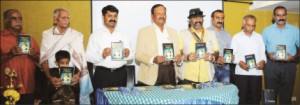
The DVD of the documentary on snakes by city’s snake rescuer and wildlife conservationist S. Balasubramanya, popularly known as Snake Shyam was released at a function organised at Rajendra Kalamandira on Ramanuja Road in city yesterday.

The DVD was released by Additional Principal Chief Conservator of Forests C. Srinivasan in the presence of DCF V. Karikalan, Wildlife Warden Dr. Santrupth and others. The 40-minute long documentary provides information of about 35 species of snakes rescued in and around Mysuru in the last 10 years.

Snake Shyam said that the DVDs would be distributed free to schools in the district from January to create awareness on snakes. The documentary was screened for the benefit of the public. Snake Shyam can be contacted on Mob: 99805-57797.

source: http://www.starofmysore.com / Star of Mysore / Home> General News  /  Sunday , November 30th, 2014

Gommatagiri comes alive

Mahamasthakabhisheka performed

GommatagiriBF06dec2014

Mysuru :

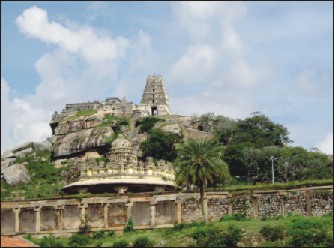
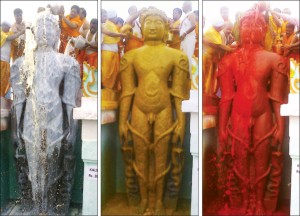
With thousands of Jain pilgrims chanting “Gomateshwara Maharaj Ki jai” and “Bhagavan Bahubali Ki Jai” to the accompaniment of chanting of vedic hymns by priests, the pilgrim town of Gommatagiri located off Mysuru-Hunsur Road today came alive during the 65th Mahamasthakabhisheka to the statue of Lord Gommateshwara.

During the Mahamasthakabhisheka, the grey granite statue of Gommateshwara went from white to red to golden yellow within minutes as it was anointed with turmeric, kumkum, sandal paste, milk, curds, vermilion honey and other fragrant fluids.

The rituals were held under the supervision of Sri Devendra Keerthi Bhattaraka Pattacharya of Hombuja Jain Mutt.

The granite statue, considered to be from the earlier Vijayanagar period located atop a 50 metre tall hillock, closely resembles its famous counterpart Shravanabelagola.

Though it is not clear who installed that statue, scholars opine that the influence of Jainism in the region was unmistakable and was perhaps one of the reasons for its installation at Gommatagiri.

S. Jithendra Kumar, President, Karnataka Jain Association, was the chief guest on the occasion.

At the function in which retired Registrar of Karnataka Lokayukta – M.J. Indra Kumar, Assistant Registrar of Lokayukta – A.C. Vidyadhar, Gommatagiri Kshetra Seva Samithi President Dr. Prabha Mandal, Hon. President G.A. Suresh Kumar, Secretary Dr. M.V. Shanthakumar were among those present

source: http://www.starofmysore.com / Star of Mysore / Home> General News  /  Sunday , November 30th, 2014

Pages from History : Why Mandyam Iyengars do not observe Deepavali ?

MandyamIyengarsBF05dec2014

by Prof. A.V. Narasimha Murthy, former Head, Department of Ancient History & Archaeology, University of Mysore

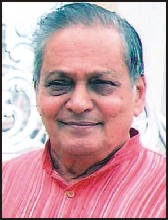
Recently I received an email from Janaki Krishnamurthy through N. Ramanuja. Actually, she had forwarded a note on the Mandyam Iyengars. Janaki is known to Mysoreans at Gokulam by the famous Andal Mandiram of which she is the Trustee and practically its sustainer. She is also connected with Lakshmi Venkataramanaswamy temple at Vontikoppal and there also she is active in socio-religious fields.

In fact, I first met her some years ago when Mathoorji’s discourses were being held at this temple. She was taking a prominent part in making it a great success by giving enough publicity and making excellent arrangements. Thus she is a good leader and organiser.

Now, let me come back to the note regarding the Mandyam Iyengars. They belong to a group of the Iyengar community which has a history going back to the times of Sri Ramanujacharya who is said to have converted Hoysala king Bittideva from Jainism to Vishnuvardhana of Vaishnavism. Melkote or Melukote became a stronghold of Mandyam Iyengars who belonged to Bharadwaja Gotra. They lived happily by performing vedic rituals and worship in temples. It is said, they migrated in a group to Melkote. They all belonged to Thangalai group of Iyengar sect. They spoke Tamil in addition to Kannada.

It is desirable to know something about this place Melkote. Situated in Pandavapura taluk, Melkote is famous as one of the four places: the remaining three being Sriranga, Tirupati and Kanchipuram. Melkote has antiquity going back to mythological times wherein it was referred to as Narayanadri, Vedadri, Yadavadri etc. During the Treta Yuga, Lord Dattatreya performed vedic discourses and it became famous as Vedadri. In Dwapara Yuga, Sri Krishna lived here and hence it became famous as Yadavadri and in the Kali Yuga it became famous by the consecration of Vishnu temples. In inscriptions it is referred to as Thirunarayanapura and Vaikuntavardhana Kshetra. While writing these sentences, my mind went to almost a decade back.

Vidya Bhavan’s Chairman Justice E.S. Venkataramaiah, who belonged to this place Tonnur, used to take lot of interest in the development of this area and I went for the first time to Tonnur and Melkote in his company and got a VIP treatment. During his life-time he used to arrange a lunch for the whole village along with special guests and I had the good fortune of being a participant twice in these lunches. I have another reason to be grateful to him. It was he who appointed me as the Chief Editor of the publication of 25 volumes of History and Culture of the Indian People in Kannada which is hailed as an important landmark among the Indian History series, originally edited by Kulapathi K.M Munshi. This runs into 15 thousand pages. Venkataramaiah is the first Chief Justice from Karnataka to adorn that coveted position. Thus he made Karnataka proud.

The seeds of Melkote are found in antiquity. According to history, the Cholas were the rulers of Tamil Nadu and were champions of Saivism. They were not well disposed towards Ramanujacharya who propagated Vaishnavism. Fearing for life, Ramanujacharya is said to have left Tamil Nadu and came to Karnataka. First he came to Tonnur or Tondanur where some disciples joined him. Subsequently, he went to Melkote. It is believed that he stayed at Melkote for twelve years. The Cheluvanarayana Temple is the most important temple here. It is a huge temple with an enclosure of 290 feet with many Mantapas. The Navaranga in front of the garbhagriha has three entrances. It also has a shrine for Ramanujacharya and the image therein is said to have been consecrated by his disciples when Ramanujacharya left for Srirangam. It is of importance to note that rituals and worship are done here as per the regulations and rules as promulgated by Ramanujacharya himself.

During the 14th Century, Melkote suffered an attack by the Muslims. However, during the Vijayanagara period, Thimmanna Dandanayaka repaired and rebuilt temples. The story of Baby Nacchiyar is very interesting. The processional image of Cheluvapillai (Narayana) was in the possession of Delhi Sultan’s daughter. Ramanujacharya, on learning about this, went to Delhi and brought back that image. Unable to bear this separation, Sultan’s daughter also came to Melkote and finally merged in God Narayana. This traditional account is not supported by facts of history. In connection with this event, even now a day is reserved for Delhi Utsava (Delhi festival).

God Cheluvanarayana continued to be important during the later periods also. The kings of Vijayanagara patronised this temple and gave many grants to it. Mysore Wadiyars were great devotees of this God. Raja Wadiyar was a great patron and donated lands and jewels. Ornaments Rajamudi and Krishnamudi are very famous. Tipu Sultan also gave many grants. Shamaiah Iyengar allied himself with dowager queen Lakshmammanni and secretly corresponded with the British. Tirumala Iyengar also helped the British. Finding two Iyengars against him, Tipu thought of destroying the Iyengars who were living in Melkote. The day he selected for this was Naraka Chaturdashi. When all Mandyam Iyengars were immersed in Deepavali celebrations, Tipu’s men entered Melkote and massacred at least 800 persons. The survivors abandoned Melkote and ran away and the town became a ghost town. Friends and relatives of Tirumala Iyengar were killed in cold blood. Thus Naraka Chaturdashi became a day of Sraddha or death ceremony.

As it happened on a Deepavali day, the day is considered as mourning day in almost all the houses. That is why the Mandyam Iyengars of Melkote do not celebrate Deepavali. This practice continues even to this day.

As one historian aptly remarked, most historians write that Tipu killed a tiger though they never saw it, but do not write about the massacre of Mandyam Iyengars though they have seen it or heard of it from authentic sources. Just for information, one of the most important Mandyam Iyengars today is the former Chief Minister of Tamil Nadu J. Jayalalithaa.

source: http://www.starofmysore.com / Star of Mysore / Home>  Feature Articles  /  Saturday , November 29th, 2014

Rotary Olympics – 2014 begins in city

 Participants playing carom at Sports Pavilion Indoor Stadium of University of Mysore in city this morning
Participants playing carom at Sports Pavilion Indoor Stadium of University of Mysore in city this morning

Mysuru :

Over 700 participants from nearly 50 Rotary Clubs of different parts of Karnataka, including Kundapura, Udupi, Mangaluru, Puttur, Madikeri, Mysuru, Hassan, Chikmagalur, Shivamogga, Chamarajanagar and other places are taking part in the two-day Rotary Olympics-2014 — a sports event for Rotarians and their families — that began in city this morning.

The event was declared open by Rtn. Dr. S. Bhaskar, District Governor, RI Dist. 3180, Rtn. M.S. Jayaprakash, Assistant Governor, Zone-7 and RI Dist. 3180 by playing shuttle badminton at the Indoor Stadium of Sports Pavilion of the University of Mysore. The event is being held under the Chairmanship of Rtn. A.R. Ravindra Bhat of Rotary Central Mysore.

Rtn. N.P. Vishwanath, President, Rotary Central Mysuru, in his welcome address, said that the Rotary Club will be celebrating it’s 1000th club meeting this evening and added that the Rotary Olympics-2014 has been organised to increase fellowships by attracting more people to join the Rotary Club.

Rotary Olympics-2014 features Cricket, Tennis, Volleyball, Mini Football, Tug of War, Throwball, Shuttle Badminton Singles, Shuttle Badminton Doubles, Table Tennis Singles, Table Tennis Doubles, Carrom Singles, Carrom Doubles, Chess, 100m Sprint, 50m Sprint, 200 metres Sprint, 400m Run, 4x100m Relay, 4x50m Relay, Shot-put, Swimming and Slow Cycle Race.

City’s Cricket Coach Ramesh will be the Chief Referee to lead a team of 50 officials who will be referees of various sports events.

Cricket is being played at three venues — Railway Ground, Coffee Board Ground and JK Grounds. Swimming competition will be held at University Swimming Pool in Saraswathipuram and Track & Field events at Oval Grounds. A walking competition has also been arranged for people above 55 years.

Events for Children: The events for Annettes (Children of Rotarians) include 100m sprint, shot-put, lemon and spoon race, cricket ball throw, fun games and swimming, will be held tomorrow.

Rotary Olympics-2014 Organising Committee Secretary Rtn. Vinod and Organising Committee Chairman Rtn. Vivek Attavar were present.

Track & Field events: The track and field events will be formally inaugurated by Rtn. Dr. S. Bhaskar, District Governor, RI Dist. 3180 tomorrow at Oval Grounds. R. Ananth, former Ranji Cricket Player of Karnataka and Rtn. M.S. Jayaprakash, Assistant Governor, Zone-7, RI Dist. 3180, will be the guests of honour. There will also be a march-past by all the participant clubs after which, athletes would formally take an oath. Valedictory of the event will be held at the venue tomorrow at 4 pm.

source: http://www.starofmysore.com / Star of Mysore / Home>  General  News  /  Saturday , November 29th, 2014

Litterateur CPK releases two books

Litterateur Dr. C.P. Krishnakumar (fourth from left) is seen releasing the books ‘Kacha Sanjeevini’ and ‘O Manuja’ authored by Dr. Malali Vasanthkumar (third from right) and Dr. Leela Prakash (second from right) respectively at an event held in Ramakrishna Ashram in city recently. Also seen are (from left) Prof. K. Bhyravamurthy, Dr. Kabbinale Vasanth Bharadwaj, Dr. G. S. Bhat, Swami Muktidanandaji of Ramakrishna Ashram, Prof. Dejagow and Dr. D. Thimmaiah.

Mysuru :

Litterateur C.P. Krishnakumar (CPK) released two books ‘Kacha Sanjeevini’ by Dr. Malali Vasanthkumar and ‘O Manuja’ authored by Dr. K. Leela Prakash at a function organised jointly by Vidyuth Prakashana and Karnataka Vichara Vedike at Ramakrishna Ashram auditorium in city recently.

The function, which was held in the presence of Swami Muktidanandaji, President, Ramakrishna Ashram, Mysuru branch, was presided by former Mysore University VC and litterateur Prof. Dejagow.

Yakshagana artiste G.S. Bhat and Dasti Education Trust President Dr. D. Thimmaiah were the chief guests.

Litterateur Dr. Kabbinale Vasanth Bharadwaj spoke about ‘Kacha Sanjeevini’ while writer Prof. K. Bhyravamurthy spoke about ‘O Manuja’

source: http://www.starofmysore.com / Star of Mysore / Home>  General  News  /  Saturday , November 29th, 2014

Natl. Seminar on Tribal Education begins at CIIL

Prof. T.T. Basavanagouda, Director, Karnataka State Tribal Research Institute, Mysuru, is seen addressing the gathering. S. Prathibha, Research Officer, Karnataka State Tribal Research Institute, Mysuru, Kumuda. B. Susheelappa, AEE and Writer, 110 KV Sub Station, Jog Sagara Taluk, Shivamogga district and Prof. C. G. Hussain Khan, Retired Professor, Dept. of Anthropology, Karnatak University, Dharwad are seen on the dias. Picture right shows a section of participants.

Mysuru :

A two-day National Seminar on ‘Tribal Education in India – A Special Focus on 50 Scheduled Tribe Communities in Karnataka’ organised by Karnataka State Tribal Research Institute, Mysuru began at Central Institute of Indian Languages (CIIL) on Hunsur Road in city this morning.

The major theme of the workshop is ‘Socio-Economic and educational aspects of Scheduled Tribes in Karnataka.’ The seminar is being attended by Students, Research Scholars, Lecturers and Professors of Departments of Ancient History and Departments of Anthropology of various Universities.

The programme was inaugurated by Kumuda. B. Susheelappa, Assistant Executive Engineer and Writer, 110 KV Sub Station, Jog Sagara Taluk, Shivamogga district.

Kumuda, in her inaugural address said “Nowadays, most of the youth in India are following Western culture which is not a good sign. We should respect and follow our Indian culture rather than following the culture of Western countries.”

Prof. T.T. Basavanagouda, Director, Karnataka State Tribal Research Institute, Mysuru who presided over the function said, “There are 43 lakh tribal people in Karnataka, out of which 20 lakh tribals stay in forests.” He regretted that these tribal people are illiterate and uneducated. “There are various schemes and funds available from Central and State Governments for the welfare of Tribal people. But awareness has to be created among the tribal people to utilise these funds,” he added.

Prof. C. G. Hussain Khan, Retired Professor, Department of Anthropology, Karnatak University, Dharwad, in his keynote address said “Karnataka has 4.1% of the country’s scheduled tribes.” He regretted that most of the tribal children are malnourished. He also spoke about female foeticide and urged the government to take strict action against those who indulge in female foeticide. “Education is the most important social input for the economic development of any society. But low educational status of tribal community adversely affects the socio-economic condition of tribal people.” he added.

Valedictory function

The valedictory function will be held tomorrow at 4 pm at the same venue. Prof. T.T. Basavanagouda will preside and Prof. C. Basavaraju, Registrar, UoM will deliver valedictory address.

source: http://www.starofmysore.com / Star of Mysore / Home>  General  News  /  Friday , November 28th, 2014

Karnataka Yakshagana Academy Award for G.S. BHAT

BhatBF04dec2014

Bengaluru :

Renowned yakshagana artiste from Mysuru G.S. Bhat is among the three personalities who have been conferred Karnataka Yakshagana Academy’s Parthisubba Award-2014.

The award carries a cash prize of Rs. 1 lakh and a citation.

Announcing the awards at a press meet here yesterday, Academy Chairman Belagallu Veeranna said the Parthisubba award-2012 goes to Dr. Seemanthuru Narayana Shetty (Yakshagana) of Mangaluru while M.R. Ranganatha Rao (Sootrada Salike Gombe) of Bengaluru gets the award for 2013.

Veeranna also said that 20 persons, including Nelegeri Thimmappa Achar of Mandya and Sathyappa of Hassan have been selected for the annual (2013-2014) award.

The annual award carries a purse of Rs. 10,000 and a citation.

Speaking to SOM after the announcement of the award, G.S. Bhat said he felt very delighted on being selected.

Profile of G.S. Bhat: Parthisubba awardee Bhat has made exemplary contribution to the field of Yakshagana and Bayalata for over 40 years. Born to Subbaraya Bhat and Saraswathi couple at Sirsi in Uttar Kannada district on May 6, 1943, Bhat secured his post-graduate degree in history from Karnatak University, Dharwad.

Inspired by litterateur Prof. Dejagow, he joined the Humanities Department of the University of Mysore in 1969, as the editor of encyclopaedia.

He is credited for bringing out 14 volumes of the encyclopaedia in his 33-year stint with the University.

Even after retirement, Bhat continued with his work on Kannada encyclopaedia. He has 75 Kannada works to his credit including many on Yakshagana and Bayalata. He has also served as the editor of the Quarterly brought out by KSOU. He was also involved in folklore works brought out by Hampi Kannada University.

He chaired the 9th Akhila Bharat Yakshagana and Bayalata Sammelana that took place in Mysuru.

Bhat resides in T.K. Layout, Mysuru, with his wife Tilottamma. He has two children Anitha and Dr. Rajeev Bhat.

Dr. Rajeev Bhat is a teaching faculty at Penang University, Malaysia.

source: http://www.starofmysore.com / Star of Mysore / Home>  General  News  /  Friday , November 28th, 2014

Indian scientists find key to PTSD

Bengaluru-based researchers have found that a tiny almond shaped region in the brain is responsible for post-traumatic stress disorder, a discovery that could lead to a potential cure

Post-Traumatic Stress Disorder (PTSD), a condition of persistent mental and emotional stress occurring as a result of injury or severe psychological shock, typically involving disturbance of sleep and constant vivid recall of the experience, with dulled responses to others and to the outside world.

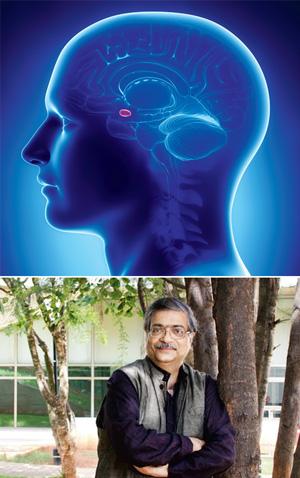
For the first time in the history of neuroscience, two scientists from National Centre for Biological Sciences (NCBS) in Bengaluru have conducted a detailed study on why and how one suffers from PTSD. They have pinpointed precise roles played by certain neurons in the part of the brain called amygdala, an almond-shaped structure located deep inside the brain, which acts as the centre that controls emotions and stores memories of fearful experiences.

Top: An illustration showing the location of the amygdala in the human brain/  Below: Sumantra Chattarji lead author of the Nature Neuroscience study
Top: An illustration showing the location of the amygdala in the human brain/
Below: Sumantra Chattarji lead author of the Nature Neuroscience study

In doing so, they have unraveled the so-far mysterious reasons behind the fear and precisely how that fear develops to make way for PTSD. The research, which appeared on Nature Neuroscience Web site, has paved the way for scientists the world over to study ways to reverse PTSD or even develop medical aids to cure the condition – a boon for many victims of sexual or child abuse, accidents, or soldiers/ combatants who are commonly afflicted by this condition.

NCBS neuroscientist, Sumantra Chattarji and his student Supriya Ghosh, discovered that PTSD sets in when individual neurons in the amygdala lose their capability to discriminate between dangerous and safe stimuli. They found that this happens when the danger stimuli is particularly intense, as in a life-threatening situation.

In normal circumstances, they found, most of the neurons are able to detect the safe signals; but when the danger levels are much increased they lose their capability to discriminate between danger and safety. This results in such neurons sending danger signals even when faced with a safe stimulus.

They also identified the precise biochemical signaling mechanism inside the amygdala neurons which caused fear and PTSD – cyclic adenosine monophosphate (cAMP)/protein kinase A (PKA) signaling. This potentially serves as a target for designing new treatments against PTSD, said Chattarji.

Chattarji and Ghosh conducted experiments on live rats, the amygdala and the neural functioning of which are similar in humans.

The two neuroscientists now plan to conduct research on the mechanism of reversing PTSD, apart from hoping that researches are undertaken to develop drugs, having identified the precise biochemical signaling mechanism that causes PTSD.

source: http://www.punemirror.in / Pune Mirror / Home> Others> Scitech / by Nirad Mudur / December 02nd, 2014

City neuroscientists decode the anatomy of fear

Discovery by NCBS could help find therapy for post traumatic stress disorder

Decades after the Vietnam war, a US army veteran recounts the intense flashbacks he still gets of the battlefield, triggered by something as innocuous as a thunderclap: “I am back in Vietnam. It is the middle of the monsoon. My hands are freezing and yet I am sweating… Suddenly I see my buddy Troy, his head on a platter, sent to our camp by Viet Cong,” he says in a well-documented case study.

Now, two city-based neuroscientists have decoded the anatomy of fear and show how sometimes this vital and primal response to danger can go completely awry, morphing into post-traumatic stress disorder (PTSD) seen often in soldiers and also in people who have been in near-fatal situations: sexual assault, natural disaster or accidents.

A study published in Nature Neuroscience, by Sumantra Chattarji and Supriya Ghosh, neuroscientists at National Centre for Biological Sciences, reveals how a certain set of neurons in the amygdala (the brain’s emotional hub), which once distinguished between safe and dangerous stimuli, begin responding even when there is no sign of threat.

For the experiment, the researchers trained rats to distinguish between two sound frequencies. One frequency was accompanied by a foot shock and the other was not. “When the shock was elevated, we found that one set of excitatory neurons that once responded only to the sound associated with a shock now began firing indiscriminately even to sound not accompanied by a shock,” said author Prof. Chattarji.

The scientists also found that a certain bio-chemical pathway — cAMP–PKA — was activated during this process of generalised fear. “This opens up neuronal and biochemical targets for therapies for PTSD, and this will be our next stage of research,” Prof. Chattarji said.

source: http://www.thehindu.com / The Hindu / Home> News> Cities> Bengaluru / by Divya Gandhi / Bengaluru – December 02nd, 2014