Mysuru MP Pratap Simha performs sky diving

Mysuru MP Pratap Simha diving from a height of over 10,000 feet during a sky diving event at the Mysuru airport on Monday. Photo: M.A.Sriram

Mysuru MP Pratap Simha on Monday took a daring jump from a height of about 13,000 feet as part of his maiden sky diving at the Mysuru airport.

“When I boarded the four-seater Cessna aircraft and reached the desired height for the jump, it was a bit scary. But, when I took the plunge and floated in the air, it turned out to be my lifetime experience. The dive was beyond belief and enormously thrilling,” the BJP MP told The Hindu, after the dive.

This was the 38-year-old first-time MP’s maiden attempt in sky diving. Accompanied by an instructor from the United States, Mr. Simha took the jump, which was conducted by Su Kakini Enterprises Private Limited, the country’s only certified agency for sky diving.

The agency is holding sky diving at the airport since April this year.

Incidentally, Mr. Simha is one of the few MPs in the country to perform sky diving. “I am the first MP in the 16th Lok Sabha to perform this adventure,” he claimed.

Mr. Simha jumped from the sky around 8:45 am and was airborne for over 10-15 minutes before reaching the ground. “I was falling at a speed of 220 km but never felt it,” he said.

With Mysuru possessing ideal weather, the MP said efforts will be made to promote Mysuru as a sky diving hub and thereby boost tourism in a big way.

source: http://www.thehindu.com / The Hindu / Home> National> Karnataka / by Shankar Bennur / Mysuru – September 28th, 2015

Advani pockets 14th World title

India’s most successful cueist Pankaj Advani today added another feather to his cap by winning the IBSF World Billiards Championship after outplaying his opponent in the final to take his world title count to 14 here.

AdvaniBF27sept2015

Advani, 30, left the spectators spellbound with his prolific play and indisputable mastery over the 3-ball game, demolishing Singapore’s Peter Gilchrist by 1168 points.

On lifting his 14th world crown in style, the Indian ace said, “I was determined to get even with Peter (Gilchrist) after losing the point format final to him. A productive chat with my sports psychologist brother Shree and a good night’s sleep did the trick. We discussed my strategies and mental approach the night before the big final and it all panned out perfectly.”

Bengaluru’s ‘Golden Boy’ was in roaring form and appeared keen to not only defend his Time format world title but also avenge his loss of the Point format championship to Gilchrist, which happened under a week ago.

In the opening visit, Advani fired in a quick century (127) to take the initial lead. Failing to capitalise, Gilchrist handed over an opportunity to the Indian star and it was taken full advantage of.

The 2015 6-red snooker world champion showed his fine prowess in billiards by smashing in two back-to-back triple centuries (360 and 301), making the match a foregone conclusion in the first hour itself.

With a comfortable 700-point lead, India’s posterboy of cuesport continued to add insult to injury with breaks of 284, 119, 101 and 106 in quick succession to extend his lead to 1100 points at the halfway mark of the 5-hour final.

On resumption in the second half, Advani continued to punish his opponent with two more centuries but a spirited fightback by the Singaporean in the form of a big double century (284) along with a couple more centuries reduced his deficit.

But Advani was not quite done yet. He continued his devastating form with some aggressive scoring. The last nail in the coffin was a fluent and flawless 430 break that was unfinished as the match reached the end of its 300 minutes duration.

Advani has stamped his authority yet again in billiards at the world level for a few years now. After annihilating England’s Mike Russell in the final of 2012 edition of the Time format, Advani went on to win twin titles in both Point and Time formats in 2014.

The champion further added, “I’ve been on the move last couple of months competing in many tournaments back to back, in both snooker and billiards. The stint started with winning the world 6-red snooker championship and ended with this world title in billiards making it a very satisfying phase of the year for me.”

Result:

Pankaj Advani (India) defeated Peter Gilchrist (Singapore) 2408 – 1240 (final of Time format)

Breaks: Pankaj Advani (127, 360, 301, 284, 124, 101, 106, 171, 114, 430*)
Peter Gilchrist (102, 156, 249, 107, 198).

source: http://www.deccanherald.com / Deccan Herald / Home> Sports  / PTI / Adelaide – September 27th, 2015

A dance through royal history

The legacy of the 600-year-old Wodeyar dynasty is the subject of the Bharatnatyam dance presentation, Under The Double Eagle. Choreographed and performed by Lakshmi Gopalaswamy and Satyanarayana Raju, exponents of the dance form, it is being presented as part of the Bangalore International Arts Festival to celebrate the 40th anniversary of the International Music and Arts Society.

Talking about the genesis of the production, Gopalaswamy shares that the two of them were commissioned by the Chennai-based Narada Gana Sabha Trust to do a piece on the Mysore royal family in 2013. “Natyarangam, the dance wing of the sabha, holds a thematic dance festival every year and in 2013, the programme was called Bhoopala Bharatam and focused on good Indian kings who had ruled their provinces efficiently. The Wadiyars were among the dynasties that were chosen and it was the trust members who suggested that Satyanarayana Raju and I collaborate. That’s how Under the Double Eagle was conceived,” recalls Gopalaswamy. Considering the historical nature of the theme, preparation for the presentation entailed delving into quite a bit of research into the royal family, to ensure authenticity. “To begin with, the sabha put us in touch with Vikram Sampath who’d written the book, Splendours of Royal Mysore. But besides accessing and reading books on the royalty’s 600-year-long history , a major challenge was to use lyrics and music pieces that were relevant to the time,” explains Gopalaswamy who according to Raju, “sat and did all the research because I am not someone who can read texts.”

“To get the right music, we met composers who have studied the Mysore royal family’s contribution to classical music.We also had Lakshmi’s mother, Dr Uma Gopalaswamy , who is a musician, giving us inputs on what ragas to use,” informs Raju. Gopalaswamy adds, “Prof Srikantam Nagendra Shastry was another key source of information. He even shared certain authentic Javali compositions with us.” While the research took them two months to finish, Raju informs the pair managed to complete the choreography in 15 days. The story of the production, if one may call it that, charts the life and times of 8 Wadiyars kings. “With the Wadiyar dynasty spanning generations, it was almost impossible to show all the rulers. Instead we chose the rulers based on their cultural contributions,” says Gopalaswamy.

Starting with Yaduraya Wadiyar, who founded the dynasty in 1399, the kings who are depicted in the production are Narasaraja Wadiyar I (Ranadhira Kantheerava), Chikka Devaraja Wadiyar, (Immadi) Krishnaraja Wadiyar II, Chamarajendra Wadiyar X, Nalwadi Krishnaraja Wadiyar IV and Jayachamarajendra Wadiyar.

About the choreography itself, Raju says that what proved quite the challenge was, “translating contemporary subjects into Bharatanatyam movements. For in stance, we had to work a lot to choreograph the portion that talks about the construction of the Krishna Raja Sa gara (KRS) Dam by Krishnaraja Wadi yar IV. I mean, how does one show something like this through simple hand movements and little else?” Gopalaswamy believes that the production will be nothing short of an education for the audience. “You learn about the kind of visionaries, and good leaders the kings were. You will also realize how the subtle influence of the Mysore royalty may have played its part in cultivating Kannadigas in to the gentle, cosmopolitan and culturally-oriented community we are.”

source: http://www.timesofindia.indiatimes.com / The Times of India / News Home> City> Bengaluru / by Mahalakshmi P, TNN / September 26th, 2015

Book on Kerala’s Cultural Symbols Launched at KMB

Writer Sethu handing over ‘Virali Pattu, Valampiri Shankhu, Kannadi Bimbam’ to Biennale director of Programmes Riyas Komu. Artist Balan Nambiar and writer-journalist Jose Panachippuram are also seen

For the past four decades, veteran artist Balan Nambiar has been researching on three key religious and cultural symbols of Kerala. Now, their key features found compilation as a book that was launched at a function at the ongoing Kochi-Muziris Biennale (KMB).

‘Virali Pattu, Valampiri Shankhu, Kannadi Bimbam’ was released at KMB ‘14 ‘History Now’ event last weekend, when writer Sethu handed over a copy of the multi-colour work to Biennale director of Programmes Riyas Komu. The book has been translated into Malayalam by writer-journalist Jose Panachippuram.

The tastefully published work looks at the history of the three iconic objects and their cultural and artistic evolution. The ‘virali pattu’ is a silk double ikat or Patola textile, which was traditionally hand-woven in Gujarat, Maharashtra and Karnataka. It has been used for centuries in Kerala as garments by priests, theyyam dancers and to clothe deities. Even in the kalam art portraying Bhagavathy, the goddess is depicted wearing the distinctive ‘virali pattu’ design.

“The weavers calculated the design through the warp and weft as if on a mental computer,” said Bengaluru-based Nambiar, who is a native of North Malabar.

“It was believed that silk cloth was unpolluted; so it was ideal for ritual use. Today, there are only five Jain families in Gujarat who still possess the weaving skills,” the 77-year-old artist noted at a function in Aspinwall House, the main KMB’14 venue, at Fort Kochi.

The ‘valampiri shanku’ is a sacred Hindu conch, in which spiral twists right when the spout is pointed up.  Nambiar, who is from Kannapuram near Kannur, has exhibited at the Venice Biennale, has used this and the ‘kannadi bimbam’ as inspirations in his many sculptural works, which have been exhibited around Europe and in India. The ‘kannadi bimbam’ is a metal mirror used as the deity in some temples in upstate Kerala, where devotees meditate upon their own reflection.

Sethu, also former chairman of the National Book Trust, suggested that the internationally renowned artist was giving back to his home-state through the book.

“It is sad that he has not got due recognition in Kerala, where none of his sculptures are exhibited,” he said. “But through this book, he is giving back stories of our tradition to our people.”

The evening ended with artist Shiva Shankaran rendering songs from the medieval ‘vadakkan pattu’ (ballads from north Malabar), which makes reference to the ‘virali pattu’ in the context of a baby’s cradle, and in the dressing up rituals of warriors’ Thacholi Othenan and Unniarcha.

source:  http://www.newindianexpress.com / The New Indian Express / Home> States> Kerala / by Express Features / March 27th, 2015

NITK students design virtual lab

Surathkal  :

A take-home lab complete with equipment, albeit in a virtual avatar. SOLVE (Students Online Lab for Virtual Experimentation), a virtual lab designed by students of National Institute of Technology (NITK), Surathkal, can be accessed using smartphones and computers which have internet connectivity.

“Students of four streams came together to make V-lab a reality and, that too, after two years of hard work. The lab was introduced with the primary objective of experiential learning of basic concepts in engineering technology and science. SOLVE makes the labs available as per the learner’s time, pace and place, and makes it easier to conduct experiments,” said Prof KV Gangadharan, HoD, mechanical department and the lab’s co-coordinator.

SOLVE’s website (solve.nitk.ac.in or vlab.co.in) has over 1 lakh active users across the world over. NITK is among the 12 institutions to set up the lab, eight among which are IITs. “We are essentially providing a take-home lab where we share costly laboratory equipment through remote-triggered lab infrastructure,” said Gangadharan.

Simulation labs related to chemical, civil, electrical and mechanical engineering are available at NITK, while other subjects are made available through IITs. “We have around 100 simulation labs on the virtual lab website (vlab.ac.in) and 30 remote-triggered labs. A remote-triggered lab is where an actual experiment at one location can be accessed by students anywhere, and they can make changes remotely while the experiment in on,” he said. The ambitious project is an initiative of human resource development ministry under the national mission on education through information and communication technology (ICT).

source: http://www.timesofindia.indiatimes.com / The Times of India / News Home> City> Bengaluru / by Kevin Mendonsa, TNN / September 26th, 2015

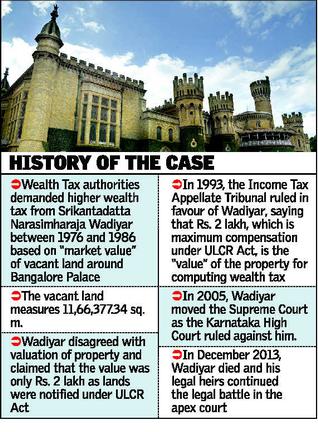
Wadiyar wins wealth tax case after a 38-year-long battle

Issue was valuation of vacant land around Bangalore Palace

Nearly two years after his death, the then scion of the Mysore royal family Srikantadatta Narasimharaja Wadiyar has finally won the legal battle, which lasted 38 years, over the valuation of vacant lands around the Bangalore Palace for the assessment of wealth tax between 1977 and 1986.

CaseHistoryBF26sept2015

The Supreme Court, in its September 21 verdict, held that total market value of the vacant land, which came under the Urban Land (Ceiling and Regulation) Act, 1976 will have to be considered as Rs. 2 lakh, which was the maximum compensation payable while taking over the land under the ULCR Act, for computation of wealth tax. The tax authorities had assumed the value of the land in the range between Rs. 13 crore and Rs. 31 crore during the period (between 1977 and 1986) for calculating the wealth tax.

The Supreme Court did not agree with the claim of the tax authorities and the Karnataka High Court’s 2005 finding that value of the vacant land had to be estimated to be the price, which in the opinion of the wealth tax officer, the land would fetch if sold, hypothetically, in the open market on the valuation date even though the land was notified under the ULCR Act during the assessment period.

There was no dispute with regard to valuation of residential, non-residential structures and appurtenant land thereto as Wadiyar had paid the wealth tax accepting the valuation for them. The dispute was only with regard valuation of vacant land that was notified under the ULCR Act.

A Bench, comprising Justice A.K. Sikri and Justice Rohinton Fali Nariman, wondered how one could assume the hypothetical sale for the valuation purpose when the land was under the clutches of the ULCR Act and the authorities had already determined the maximum compensation of Rs. 2 lakh for the entire land.

‘Ordinary way’

Stating that it was not oblivious of those buyers who purchased “disputed properties” for higher rates by taking risks, the apex court said it had to consider only “ordinary way” of the presumptuous sale and conduct of a reasonable person, who would not offer more than Rs. 2 lakh when knowing well about the compensation.

source: http://www.thehindu.com / The Hindu / Home> News> Cities> Bengaluru / by KrishnaPrasad / Bengaluru – September 26th, 2015

Love for light houses, permanent picture cancellations

PhilatelyBF26sept2015

K Sridhar, who works as Chief Manager in Information Systems Department for Mangalore Refinery and Petrochemicals Limited (MRPL) is known for his love for lighthouses among philatelists.

He drew attention of public with his collection of permanent picture cancellation
s, during the exhibition at Head Post Office on Sunday, oganised by Mangalore Philatelic and Numismatic Association.

Sridhar said: “what makes permanent picture cancellations unique is that they are available in a particular post office. The picture cancellation with postal index number 11004 is available only in Rashtrapati Bhavan post office”.

“There are approximately 205 permanent picture cancellations in India and I have collected around 180 PPCs. Nineteen states and seven union territories have released PPCs. I have collected PPCs of 15 states and four union territories. Karnataka has released most number of PPCs with 39 followed by Kerala with 36 and Tamil Nadu- 33.

The three southern states have 108 PPCs among them contributing 60 per cent of the PPCs of India,” he said.

Interestingly, Mangaluru also has permanent picture cancellation for Mangalore light house.  Permanent picture cancellation is a postmark which replicates the place or thing with religious, historic or tourist importance.

The oldest permanent picture cancellation- ‘Qutab Minar’ was released in November 29, 1960 and latest- ‘Malpe’, ‘Nadalike’ and ‘Kattale Basadi’ were released in January 17, 2015. Around eight PPCs including ‘Madikathi- Odikathi and Peechikathi’ and ‘Gumbaz’ or ‘Sword and headgear of Tipu Sultan’ of Karnataka have multiple designs.

K Sridhar is stamp collector on lighthouses and oil and gas and hails from Erode of Tamil Nadu. He joined Mangalore Philatelic and Numismatic Association in 1999. He is now its patron member. He won silver medal in Karnataka Philatelic Exhibition four times and silver medal at National-level. He is also member of Trichy Philatelists Association, Gujarath Philatelic Association, Karnataka Philatelic Club (Bengaluru) and UK’s Lighthouse Stamp Society.

Sridhar has collected around 3,000 stamps on lighthouses and oil and gas. “I started collected stamps on light house after watching Surathkal light house. India has only four stamps on lighthouse- Minicoy lighthouse of Lakshadweep, Mahabalipuram of Chennai, Alape of Kerala and Aguda of Goa. We get lighthouse stamps at Estonia, Germany, Croatia, Spain, US and other countries.

source: http://www.deccanherald.com / Deccan Herald / Home> District / Mangaluru – DHNS, July 13th, 2015

Belagavi foundry cluster bags one more UNIDO project

Belagavi :

One more project has been sanctioned to the Belagavi Foundry Cluster (BFC) on behalf of United Nations Industrial Development Organization (UNIDO) and Bureau of Energy Efficiency (BEE) in the union power ministry.

Project is about promoting energy efficiency and renewable energy in energy intensive foundry units in Belagavi. Project aims at implementing energy efficiency practices and technologies, besides providing renewable energy options to help achieve higher energy performance to foundry industries.

In this regard, team from UNIDO will be visiting BFC on Friday. The team lead by Ayumi Fujino, representative of UNIDO and regional director for South Asia.

source: http://www.timesofindia.indiatimes.com / The Times of India / News Home> City> Bengaluru / by Ravindra Uppar, TNN / September 24th, 2015

A first of its kind

Naanu Avanalla, Avalu by B.S. Lingadevaru Halemane, which bagged two-national awards, is claimed to be the first such film for the Kannada film industry.

“Of course there were films on transgenders. But they dealt their issues as a sub-text, not a main-text. Our film is inspired by I am Vidya, a transgender’s journey , an autobiography of Living Smile Vidya”, said Mr. Lingadevaru.

Sanchari Vijay, who essayed the role of the protagonist, won the best actor award, which came to Kannada after a gap of 27 years. For the first time in the history of Kannada cinema, the film got the award in the make-up category.

Initially, he thought of casting a transgender for the role of Madesh, who transforms later as Vidya in the film, but that did not materialise. Many transgenders have acted in various roles, including that of Sharada Nani and Danamma.

source: http://www.thehindu.com / The Hindu / Home> News> Cities> Bengaluru / by Muralidhara Khajane / Bengaluru – September 24th, 2015

‘Nooru Rupayi’ made by city’s architects to be screened at fest in Washington DC

‘Nooru Rupayi’ is directed by architect Prashanth Raj.

Directed by Prashanth Raj, the 20-minute film with a budget of Rs. 2 lakh

Why do you think a group of young Bengaluru architects are rejoicing? Not an award for one of their best designed projects, but global appreciation for a well-made short film in Kannada, Nooru Rupayi(‘Hundred Rupees’) with English sub-titles.

The 20-minute film, directed by architect Prashanth Raj of Arch Venture in Sanjaynagar, has been selected to be screened at the Washington DC South Asian Film Festival on September 27, after bagging the Runner Up Award at the 5th Bangalore International Short Film Fest last month, and Special Awards at Mumbai, Calcutta, and UK Short Film Fests earlier.

Nooru Rupayi , with a budget of Rs. 2 lakh, was made by Prashanth Raj (director), Shilpa Patel (art director), Nitin (cinematographer), Guruswamy (Editor) along with the production team Raghav, Abhilash Pallaki, John Joseph, and Pramod Chandru (sound recording) and Abhijeet (music) — architects and engineering professionals who have a passion for films beyond their drawing board. The film, which revolves around a message to stand up against corruption and make a social change, was conceived and written by Prashanth, whose passion for “short films with a strong message” became easier after he took up a course at the Indian Institute of Moving Images.

The film took nearly four months to shape up, and has been entirely shot in the pastoral Thimmanahalli near Tumakuru, at the Chikkanayakanahalli hamlet, a four-hour drive from Bengaluru. “While I was raring to handle this subject of corruption revolving around a story of ‘puppy love’, a struggling village family and socially relevant issues of corruption that seem an accepted norm, it is the protagonist primary school boy Arvind’s (played by Srinivasa Murthy) early realisation of the gloom of dishonesty that makes him comprehend the power of the Hundred Rupees which sports Gandhi on it. When the young are made to realise that straightforwardness and sincerity maketh a good man, it’s a strong message,” says Prashanth.

The film’s endeavour is not just in its message, but the team’s effort in having the entire cast of 25 taken raw from the innards of Thimmanahalli. “We went to the village to uncover bundles of raw talent during child auditions. Finding a lady for the mother’s role was a challenge as local conservative women shied away from the camera. Our acting coach, John Joseph, helped them overcome inhibitions,” says Prashanth.

The film’s aesthetics also brings in Karnataka’s folk Veeragase showing intense energy-sapping dance movements to represent expressions of conflict and resolution for the young hero. That Prashanth is interested in his potent message is evident when you consider that his first short film Psycho’s Jury — which brings out the travails of an architect to practice what he preaches — bagged the Indian Institute of Architects Award.

source: http://www.thehindu.com / The Hindu / Home> News> Cities> Bengaluru / by Ranjani Govind / Bengaluru – September 24th, 2015