Pages from history : The gold coins of tirumala

by Prof. A.V. Narasimha Murthy, former Head, Department of Ancient History & Archaeology, University of Mysore

Who has not heard of Lord Venkateswara of Tirumala at Tirupathi. Perhaps he has become the most popular Hindu deity in the whole world. Money-wise he is the richest god in India. He is so rich that he supports the entire town, its administration, colleges, guest houses, feeding thousands of devotees daily in an unprecedented manner. The Lord of Seven Hills has become international as can be seen with people from all over the world having darshan of the Lord, may be for two or three seconds.

For this glorious three seconds, pilgrims wait for hours together in the queue. These pilgrims offer gold, silver and cash into the hundi or offer box. These boxes get filled up almost daily. They are emptied, the coins are counted and stacked in treasury safely. Thus thousands of bags of gold and silver coins were stacked and kept in the T.T.D. Treasury. At that point of time, the authorities decided to get all these gold coins examined by ancient coin experts, generally referred to as numismatists. It was my good fortune that I was asked to be the leader of a team of experts to examine gold coins deposited in the ‘Srivari hundi.’ This was conveyed to me through a young epigraphist Dr. Muniratnam Reddy and we began the work. Soon I realised that one life is not sufficient to complete the work and as a pilot project selected about 1,200 gold coins for our study. They were photographed, studied, notes prepared and the first volume of these coins has been published. Subsequent volumes are in preparation.

It is interesting and puzzling to find that the earliest gold coin in this collection was a Roman coin minted by emperor Nero who ruled from 54 to 68 AD. The present gold coin of 7.6 gms in weight has a bust of Nero with writing in Roman script. The next coin from the chronological point of view belongs to Gangas of Talkad. These coins contain on the obverse (main side) a decorated elephant and a floral design on the reverse. The next issues belonged to the Hoysalas. The famous king Vishnuvardhana defeated the Nolambas and assumed the title ‘The conqueror of the Nolambas’ (Nolambavadigonda) and minted gold coins to commemorate this victory. These coins contain Goddess Chamundi on the main side and the writing Nolambavadigonda on the reverse. Such coins being found in Tirupathi hundi shows that devotees from Karnataka had visited Tirupathi at least 800 years ago. There is a single coin of the Alupa dynasty which ruled in South Kanara in the ancient times. It has a fish symbol and writing in Nagari.

The Vijayanagar Kings had very close relations with Tirumala from the beginning. This is reflected by the discovery of gold coins of Vijayanagar Kings like Harihara I, Harihara II, Devaraya I, Devaraya II, Krishnadevaraya, Achyutaraya, Sadashivaraya and Kings of the Aravidu dynasty such as Srirangaraya, Venkatapatiraya, etc. More than 350 gold coins of the Vijayanagara dynasty have been found in the hundi. The most interesting are those of Krishnadevaraya representing Balakrishna on the obverse. Coins of Achyutaraya have Gandabherunda on the obverse. Coins of King Sadashivaraya have seated Siva and Parvathi on the main side. The coins of Aravidu Kings are highly interesting. They contain Lord Venkateswara under an arch holding sankha, chakra and gada in his hands. They contain on the reverse the writing ‘Sri Venkateswarya namah’ (salutations to Lord Venkateswara). In fact Krishnadevaraya performed Kanakabhisheka to Venkateswara by minting special gold coins which contain the portrait of Lord Venkateswara on the main side. All these gold coins represent close relationship of these rulers with Tirumala.

Consequent on the downfall of the Vijayanagara empire, Nayakas of Keladi became important. Their capital Ikkeri assumed importance. Keladi rulers followed the Vijayanagara pattern in minting gold coins. Sadashiva Nayaka minted gold coins which became famous as Ikkeri Varahas. They contained on the obverse Siva and Parvathi seated; Siva holds a trident in his right hand and a deer in his left. The reverse has the writing Sadashiva in Nagari script.

Then we enter into the era of Mysore Wadiyars who ruled from 1399 AD till the modern period, when it was amalgamated into the independent union. Only one coin of Chikkadevaraja Wadiyar has been found which has dancing Balakrishna on the main side. All the remaining coins belong to Krishnaraja Wadiyar III. These coins have on the main side seated Siva and Parvathi while the reverse has the writing Sri Krishnaraja in Nagari. It is of interest to note that about 200 gold coins of this King have been found in the hundi showing that pilgrims from the Mysore State were visiting Tirumala in large numbers.

Princely States of Jaipur and Jodhpur are represented by three gold coins. Many Ramatonka gold coins (tokens) with Sri Rama, Sita, Lakshmana with Hanuman have been found in this collection. South Indian Kings minted small gold coins called panams or fanams. They are very tiny and contain one or two symbols. They are also referred to as Viraraya Panams. Such Panams minted at Coorg, Thanjavur and Travancore have been found in this hundi.

Many gold coins issued by Muslim dynasties arrest our attention. Eleven coins of Akbar have been found here which are circular and square in shapes. They contain good calligraphic writing and are very elegant. Aurangazeb is represented by three gold coins in this collection. They have writing ‘Badshah Aurangazeb Alamgir.’ They have writings on both sides. 84 gold coins of the Asaf Jahi dynasty belonging to different Sultans have been seen in this hundi. They represent dates from 1803 to 1915 AD. This includes the last Nizam of Hyderabad.

110 gold coins of Haidar Ali have been found in this collection. All of them belong to only one type; they contain on the obverse seated Siva and Parvathi while the reverse side has the Persian letter ‘he’ on a granular surface. Siva holds a trident in his right hand while the left hand holds a deer. The other hand is on the waist of Parvathi. It is worth noting that Haidar though a follower of Islam did not hesitate to mint gold coins in Hindu tradition which his son Tipu did not follow. 40 coins of Tipu are found in this collection which belong to Ahmadi, Sultani, Faruqui and fanam denominations. Arcot Nawabs are represented by two gold coins which have Lord Venkateswara on the main side.

Then we come to the early modern period represented by East India Company. They established mints at Madras, Bombay and Calcutta. To please the Hindus they minted pagodas with Lord Venkateswara with Sridevi and Bhudevi on either side. They became famous as Three Swamy Pagodas. Another type has Lord Venkateswara with a star at the reverse. Then came queen Victoria type of coins which contained the bust of the queen with her name on the main side and reverse showing a lion moving in front of a palm tree. Indo-Dutch coins contained Lord Venkateswara on the main side.

In addition to these local coins, the hundi contained, gold coins of foreign countries like Great Britain, France, Spain, Germany, Italy, Venice, Netherlands, Austro-Hungarian monarchs, USA, Iran and Turkey. It is amazing how these gold coins came to the Tirumala hundi. Perhaps Indians living in these foreign lands might have visited Tirumala as devotees and offered the currency of their countries to Lord Venkateswara. At any rate the gold coins are spectacular in Tirumala hundi. That is the greatness of Lord Venkateswara of Tirumala Tirupathi.

source: http://www.starofmysore.com / Star of Mysore / Home> Feature Articles / August 24th,  2014

Teresian college bags cross country race trophy

Mysore :

City’s Teresian College bagged the rolling trophy for women at the University-level Cross Country Race held this morning at Hunsur.

ZP President Dr. Pushpavathi Amarnath inaugurated the event at Hunsur Government First Grade College for Women.

Navya Shri, B.G. Anusha, S.P. Bhagya and Likhita, all from Teresian College, Mysore, bagged first, second, fifth and sixth place respectively, thus enabling the college to bag the rolling trophy.

K.R. Pet Government First Grade College bagged the trophy for men.

More than 500 participants from over 100 colleges coming under the University jurisdiction took part in the Cross Country event.

The race was 6 kms for women and 12 kms for men.

source: http://www.starofmysore.com / Star of Mysore / Home> General  News / August 23rd,  2014

Kolkata Vocalist Gets Pandit Rajguru Award

Dharwad :

Classical singer Padmashri Pt Ajoy Chakraborty of Kolkata has been conferred the Pt Basavaraj Rajguru National Award-2014.

Pt Ajoy Chakraborty
Pt Ajoy Chakraborty

Dr Ravikiran Nakod (tabla) of Dharwad and Apoorva Gokhale of Mumbai (vocal) were honoured with annual youth award given by the Swarsamrat Pt Basavaraj Rajaguru National Memorial Trust here on Monday.

While the national award carries a cash prize of `1 lakh, youth awardees were given `25,000 each.

Deputy Commissioner P Rajendra Cholan presented the awards.

Chakraborty saluted the musicians and artistes of the region and said he was blessed by an award from the land which has produced many luminaries in the field of arts, music and culture.

Later, he enthralled the audience with his vocal rendition in Rag Bhairav. Pt Raghunath Nakod (Tabla) and Dr Panchakshari Hiremath (Harmonium) accompanied him. Apoorva Gokhale and Dr Ravikiran Nakod also performed.

The award ceremony scheduled on August 24, was postponed to Monday following the death of Jnanpith awardee U R Ananthmurthy.

source: http://www.newindianexpress.com / The New Indian Express / Home> States> Karnataka / by Express News Service / August 26th, 2014

And the State Film Awards Go To…

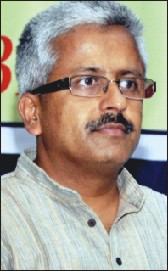
Chairman of the State Film Awards selection committee, K C N Chandrashekhar (left), handing over the list of winners to Information Minister Roshan Baig on Monday

Bangalore :

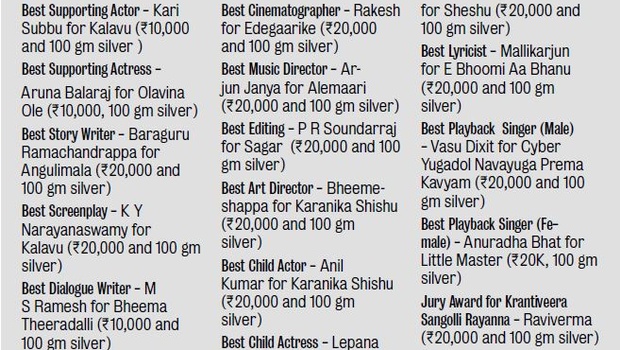
The state film awards for 2012 were announced on Monday. The Best Actor award goes to Darshan for his role in Kranti Veera Sangolli Rayanna and Nirmala Chennappa has been adjudged the Best Actress for her role in Tallana.

Announcing the winners, K C N Chandrashekhar, the chairman of the State Film Awards selection committee, said 58 films vied for the top honours of 2012.

He said M Bhaktavatsala has been chosen for the Dr Rajkumar Award and Chi Dattaraj for the Puttanna Kanagal Award. The Dr Vishnuvardhan Award will be bestowed on senior actor Rajesh. All these awards carry a purse of `2 lakh and a gold medal.

And the Top Films Are

Tallana, directed by N Sudarshan, has been chosen as the best film of the year, followed by P Sheshadri’s Bharath Stores and D Suman Kumar’s Edegaarike. While the winning film gets a cash prize of `1 lakh and 50 gm gold, the second and the third best films will get `75,000 and `50,000, respectively, in addition to 100 gm silver.

C Lakshman’s Karanika Shishu has been adjudged the best movie with a social concern. Naganna’s Kranthi Veera Sangolli Rayanna and K Shivaram Krista’s Little Master have been chosen as the best entertainment and children’s movie,  respectively. Santosh’s directorial effort Alemari has been chosen as the best debut film while Umesh Naik’s Konchavaram has been chosen as the best regional movie.

‘Awards Will be Given on Time’

ActorsBF27aug2014

Information Minister Roshan Baig said from next year onwards, the awards will be given for the same year.

“We are yet to constitute a selection committee for 2013. Awardees will be finalised soon. The date for the 2012 award ceremony will be fixed after consulting CM Siddaramaiah,” he said.

source: http://www.newindianexpress.com / The New Indian Express / Home> States> Karnataka / by Express News Service / August 26th, 2014

MCICIT weight-lifting competitions 2014: MANU bags top honours

S.Manu of CAVA, Mysore, who was selected as the Best Lifter in the MCICT Weight-Lifting Championships 2014 is seen in action in the 62kg category.

Mysore :

S. Manu of CAVA bagged the top honours in the Mysore City Inter-Collegiate Weight-Lifting Competitions 2014, conducted by the Department of Physical Education, University of Mysore here on Thursday after being adjudged as the Best Lifter of the championships.

Manu had earlier excelled by winning the first place in the 62kg category with a total lift of 153 (70+83).

National Institute of Engineering, Mysore won the team championship title with 21 points and Amritha School of Arts & Science, Mysore finished second with 13 points.

Results: Weightlifting (Men): 56Kg: 1. V.Pranav (45+55=100 – Amritha School of Arts & Science); 2. K. Vikas (50+30= 80- ATME); 3. P. Vachan (30+35=65- NIE, Mysore); 62Kg: 1. S. Manu (70+83=153- CAVA ); 2. M. Vishal Sharbidar (55+65=120 -NIE, Mysore); 3. M. Raghunath (57+47=104 -NIE, Mysore); 69Kg: K. Puneeth Kumar (65+85=150 -Vidya Vikas FGC ); 2. K. Kamaraju (55+82=137- NIE IT);3.Varun Mohan( 57+65=122- Amritha School of Arts & Science); 77Kg: 1. N.K. Giridhar (57+70=127- NIE IT ); 2. S.P. Lakshman (48+65=113 -GFGC, Kuvempunagar); 3. Akshay Madhav Soodhanam (50+62=112- Amritha School of Arts & Science); 85Kg: 1. Harish Tarikere ( 67+82=149) -NIE Mysore ; 2. C.V. Kiran C (58+75=133 – NIE IT);3. M. Nithin (50+75=125 -NIE Mysore); 94Kg: 1. S. Suhruth ( 57+82=139- NIE, Mysore ); 2. G. Suraj (48+60=108 – DBCC); 3. Abil Jose (49+58=107 -Amritha School of Arts & Science); 105Kg: 1.Ashwin Kumar (47+50=97- NIE,Mysore); 2.H.S. Santhosh (35+50=80 – Yuvaraja’s College); 3. S. Chandan Kumar (30+42=72 -Sheshadripuram FGC); 105 + Kg: 1. Avinash Prasad (46+60=106 -Amritha School of Arts & Science); 2. Vinay Kumar (35+50=85 -B.Somani College). Team Championship: NIE College, Mysore -21 points.

Best Lifter: S. Manu, CAVA Mysore.

source: http://www.starofmysore.com / Star of Mysore / Home> Sports News / August 22nd, 2014

Nagaraj is ‘Mr. MCICIT 2014’


 Nagaraj (second from left) of Govt. First Grade College, Siddarthnagar, Mysore was crowned as the “Mr. MCICT 2014” in the Best Physique Competitions 2014, conducted by the Department of Physical Education, UoM at the University Gymnasium Hall on Thursday. Seen in the picture from left are B.D. Kantharaj, Dr. C Krishna, Director, DPE, UoM (third from left), Prof. Seshanna, Anthony Moses and Lohith, Physical Education Director, GFGC, Siddarthanagar, Mysore.
Nagaraj (second from left) of Govt. First Grade College, Siddarthnagar, Mysore was crowned as the “Mr. MCICT 2014” in the Best Physique Competitions 2014, conducted by the Department of Physical Education, UoM at the University Gymnasium Hall on Thursday. Seen in the picture from left are B.D. Kantharaj, Dr. C Krishna, Director, DPE, UoM (third from left), Prof. Seshanna, Anthony Moses and Lohith, Physical Education Director, GFGC, Siddarthanagar, Mysore.

Mysore:

Nagaraj of GFGC, Siddartha Layout, Mysore, hogged the limelight by winning the ‘Mr. MCICIT 2014’ title, in the Mysore City Inter-Collegiate Best Physique competition 2014, conducted by the Department of Physical Education, University of Mysore at the University Gymnasium hall here on Thursday.

Nagaraj had earlier won the first place in the 60kg category and later in the title round excelled with his display of triceps and biceps to bag the title. Government First Grade College, Siddarthnagar, Mysore won the team championship title with 15 points.

Results

Category 60 Kg.:1.Nagaraj (GFGC Siddartha Layout); 2. S. Suchitha (VVK FGC, Mysore); 3. M.R. Shreyas (ATME College, Mysore ).

Category 65 Kg: 1. S. Harish (D Banumaiah College); 2. Y.K. Nuthan Kumar (NIE College, Mysore); 3. N. Prasanna (SBRR Mahajana’s FGC).

Category 70 Kg: 1.S. Vasanth Kumar (GFGC Kuvempunagar, Mysore); 2. Aditya Pandith (Amrita School of Arts & Science, Mysore); 3. G. Akshay Kumar (NIE College, Mysore).

Category 75Kg:1.Girisha (GFGC Siddarthanagar, Mysore); 2. K. Buvaneeth (NIE IT, Mysore); 3. S.S. Vimal (Vidya Vikas FG. C, Mysore).

Category 85 Kg: 1.Wasim Akram (GFGC, Siddartha Layout, Mysore); 2. Shaik Wajahath (VVFGCollege, Mysore).

Mr. Mysore City Inter Collegiate 2014-15: Nagaraj, GFGC, Siddartha Layout, Mysore.

Team Championship: Government First Grade College, Siddarthanagar, Mysore-15 points.

source: http://www.starofmysore.com / Star of Mysore / Home> Sports News / August 22nd, 2014

Every mile was a memory

It did not take much to get a picnic going during the ‘60s and ‘70s. A few cycle trips to friends’ homes and the word was passed around as telephones were rare then. 

JacquelineColacoBF26aug2014

Someone would arrange a bus or truck if we were going beyond 20 km, else we would cycle to nearer destinations. Later, we rode our own scooters.

Each would bring mother’s specially-made goodies to be shared around, that had to last us through the day. This required loads of water and juice, sandwiches and cake to say the least! There were no fast foods on offer those times beyond perhaps potato chips and peanut chikki, and maybe a roadside coffee or tea, biscuits, vadais etc rather suspect for cleanliness.

Our destinations could vary from Hesaraghatta to Nandi, or Pearl Valley or Thippegondenahalli; the latter boasting Bangalore’s Water Supply Works!

At times, we would hop into a train at Banaswadi Station and spend a day under the fruit trees near Whitefield Station, which short of the main road, was mostly just a wilderness then!

Departing around 8 am, as soon as we reached our destination, we’d settle ourselves under some trees offering a shady private space; then break into various age groups each in search of particular pursuits. Young boys would take off with their catapults to shoot at anything from bloodsuckers to squirrels to birds and fruit.

They would climb trees, fall off them, bully one another, come back for a break and tuck into whatever was on offer, devouring sandwiches and chips like they’d never seen food before! The energetic would play games like seven tiles, holly colly and dog ‘n’ the bone. If there happened to be a lake nearby (and those days they were clean!) we’d dip our feet in, while some swam.

After lunch we would relax, exchanging yarns or play some more ‘sit down games’ like dumb charades and coffee potting.

A ‘singsong’ accompanied by a guitar was an absolute must. Flirtations would flourish and many of these couples are celebrating golden decades of married bliss today! Before dark, we would head for home, tired and happy singing ‘Show Me The Way To Go Home’!

source: http://www.deccanherald.com / Deccan Herald / Home> Supplements> Metrolife / by Jacqueline Colaco / DHNS – August 25th, 2014

World Konkani Centre institutes two awards after Vishwa Konkani Sardar

Mangalore :

World Konkani Centre, Shakti Nagar here has announced two annual awards in name of ‘Vishwa Konkani Sardar’ Basti Vaman Shenoy who completed 80 years recently. The awards are constituted to recognize outstanding contributions by Konkani-speaking individuals or organizations managed by Konkanis in fields such as education, governance, social service, health care, science, journalism, literature (Non Konkani), performing arts, industry, and so on.

There are separate awards for men and women and are constituted as part of ‘Vision TVM’ which dreams of one strong Konkani community by 2020. Both awards carry a purse of Rs1 lakh apart from a citation. The nominee can be an individual/individuals/institution. Mother tongue of nominee should be Konkani and age of awardee should be more than 18 years. Self nominations are allowed by individuals and institutions.

In case of Institutions, the same should be managed by Konkani people and founders should be Konkani speaking. In case of an institution it should be in service for a minimum period of five years at the time of considering its nomination for the award. For nominations forms, log on to www.vishwakonkani.org and send it to the chairman, BVS Vishwa Konkani Seva Puraskar Selection Committee, Vishwa Konkani Kendra, Konkani Gaon, Shakti Nagar, Mangalore – 575016 before September 15, a communique from WKC states.

source: http://www.timesofindia.indiatimes.com / The Times of India / Home> City> Mangalore / by Jaideep Shenoy, TNN / August 23rd, 2014

Voices from the grassroots : Measuring development …..

DrBalasubramaniamBF25aug2014

by Dr. R. Balasubramaniam

Being in the development sector, I have been fascinated by the evolving obsession of practitioners, donors, academia, and the community in measuring and evaluating. The tools, methodologies and the people involved in this activity are getting better and better. Everyone seems to be so preoccupied and engaged that many consider a programme a failure or bad, if some acceptable form of measurement is not undertaken. I have written numerous proposals and implemented many projects in different sectors of health, education, and community development that I have found myself questioning not just the validity but also some of the metrics and the fundamental premise that drives these measurements. I am not saying that measurements by themselves are wrong; all that I am trying to point out is that we need to understand the programme being measured, the competence of the people measuring, the tools deployed and the metrics of measurement and more importantly the context — before one indulges in this activity.

I would like to explain this a little more clearly with a personal example. I first came to the tribal area in the forests of Heggadadevanakote in Mysore district of South India in 1987 and began running a small dispensary. Obstetrics being one of my favourite subjects, it was only natural that my focus was on maternal health and mortality. Being concerned by the high maternal mortality in the area, I started exploring how one could bring it down. Public health knowledge and practice has established maternal mortality to be an important indicator of health of a community and one always believed that this indicator could measure health outcomes.

It was also the time when everyone including the WHO and the Government of India focused heavily on maternal health and safe motherhood initiatives. The whole health sector was being pushed towards Institutional deliveries and we also got caught up in this excitement. Over the next many years we campaigned for Institutional deliveries and ensured that we created adequate facilities for safe childbirth at our hospitals. We even had a World Bank funded project in 2001-02 to ensure improved maternal and child health outcomes amongst the tribals in the area.

Sometime ago, my wife Bindu, an obstetrician who has been long associated with the programme, was remarking how she was seeing a huge positive change amongst the health seeking behaviours of the tribal women. She told how challenging it was 20 years ago to motivate the tribal women to have Institutional deliveries but now the women sought the hospital on their own. Institutional deliveries, which were non-existent when I first came to the area, had grown to 40% by the end of the World Bank funded project in 2002.

Today, virtually every tribal woman in the area comes to our hospitals to deliver their babies. Our RCH programmes have been written about and studied; World Bank considers the RCH project that they funded us as one of their best; Public Health practitioners and academicians are impressed with the falling maternal mortality and improved health outcomes. It is indeed very reassuring when so many people and institutions with their sophisticated tools and methods call us a public health success.

In 2009-10, I had taken a year away from our projects and this gave me the space, the energy and the willingness to re-look critically at all that we had been doing. I was assessing what it was that I first came to the tribal areas to do and how I had been doing it. Using the metric of improved health outcomes and the falling maternal mortality and morbidity rates; we were definitely an unqualified success. But was this the right metric to measure our work and intent. Can this metric capture everything that exists in this ecosystem? How honest would it be if we did not try and engage ourselves in outcomes that unintentionally emerged because of our programmes, but were not given any attention, as they were not readily visible or worthy of measurement? Or is it that we were ignorant of the metrics that one needed to deploy?

In our intent to reduce the maternal mortality by increasing institutional deliveries, had we not unintentionally taken away the community’s ability to cope and manage this natural phenomenon without any dependence on people or a system outside their community and tradition? We today have a generation of young women who have mostly delivered their babies in our hospitals but who have neither the knowledge, nor the attitude or the skill-sets to ensure that they can continue their century-old tradition of delivering children at home. What if we changed the metric to building the capacity and competence of the community to have cost effective and rational health practices that did not need an expensive health care system that they could neither afford not sustain with their resources.

Isn’t building the capacity and competence of communities to ensure a workable health system that they can run and sustain with their own resources and abilities more important than running a sophisticated health care programme that needs doctors, nurses and managers to come from faraway cities. Well, the metric of measuring what is important for communities is what the development sector needs to focus on rather than what is easily measurable or merely the programmatic and managerial aspects. And the metric needs to be something that attempts to capture what is happening in the whole eco-system rather than just the piece that is the most evident.

[e-mail:drrbalu@gmail.com]

source: http://www.starofmysore.com / Star of Mysore / Home> Feature Articles / August 20th, 2014

Legendary yoga guru B.K.S. Iyengar passes away

BKSIyengar25aug2014

Pune :

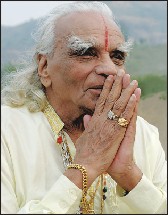
The world renowned legendary Yoga Guru Bellur Krishnamachar Sundararaja Iyengar (96), popularly known as B.K.S. Iyengar, passed away at a private hospital here at about 3.15 am today following poor heart functioning and difficulty in breathing.

A recipient of Padma Shri, Padma Bhushan and Padma Vibhushan awards, the Yoga Guru was ill for three weeks prior to hospitalisation but refused to get himself admitted and was treated at home by his family physician. He was even put on intravenous fluid at home.

His family members finally persuaded him to get admitted after his condition worsened. Though he was admitted to the hospital on Aug. 12, his condition had deteriorated a lot by that time. He was put on non-invasive ventilator for a day but he refused to undergo intensive treatment and hence, he was taken off the ventilator.

Iyengar’s heart muscles had become very weak following which there was less amount of blood being pumped by the heart, according to doctors. Last rites will be held later today.

Profile

Bellur Krishnamachar Sundararaja Iyengar (96) was born into a poor Iyengar family at Bellur, Kolar District in Karnataka and was the 11th of 13 children of Krishnamachar, a school teacher and Sheshamma.

His father died when he was only nine-years-old. As a result, he went to live with his brother in Bangalore. His childhood was further marked by serious illnesses including malaria, tuberculosis and typhoid along with malnutrition.

At the age of 15, Iyengar moved to Mysore to live with his eldest sister and her husband T. Krishnamacharya, an accomplished yogi and Sanskrit scholar, who ran a yoga school in the Mysore Palace and introduced Iyengar to some of the basic yoga postures (asanas) as a method to improve his health.

At the beginning, Iyengar struggled from day-to-day which gradually paid off, as he mastered some of the postures and as a result, his health improved.

In 1937, after two years of study, Krishnamacharya asked Iyengar to go to Pune to teach yoga where he arrived nearly penniless, knowing no one and speaking little English. Iyengar’s only way to make a living was by teaching yoga. With limited experience and almost no theoretical knowledge, he decided to practice with determination.

In the beginning, he would train himself as many as 12 hours each day, usually surviving on only stale bread and tea. Sometimes, he would suffer great pain through incorrect technique, often having to place heavy weights on his body to relieve the aches. However, refusing to give up, he gradually developed a deep personal understanding of the techniques of each posture and their effects. More yoga students began to seek him to learn yoga.

In 1943, he married Ramamani, to whom he had been introduced by his brothers and together they raised five daughters and a son. Both his eldest daughter Geeta and his son Prashant have become internationally-known teachers in their own right. The other children of B.K.S. Iyengar are Vanita, Sunita, Suchita and Savita.

Slowly they worked their way out of poverty and gradually Iyengar’s fame as a yoga teacher spread. In 1952, world renowned violinist Yehudi Menuhin became a student of yoga during a visit to India. Menuhin then arranged for Iyengar to teach in many cities in Europe and he made his first visit to the United States in 1956.

In 1975, Iyengar established the Ramamani Iyengar Memorial Yoga Institute in Pune, in memory of his departed wife, where he resided and taught yoga till his end. By that time, his eldest children, Geeta and Prashant, had also started teaching yoga under his guidance. The Institute quickly became an international centre, attracting thousands of people from all over the world.

Iyengar attracted his students by offering them just what they sought — which tended to be physical stamina and flexibility. He conducted demonstrations and later, when a scooter accident dislocated his spine, he began exploring the use of props to help disabled people practice Yoga. He was awarded Padma Shri in 1991, the Padma Bhushan in 2002 and the Padma Vibhushan in 2014. In 2004, Iyengar was named as one of the 100 most influential people in the world by Time magazine.

B.K.S. Iyengar condoled

Mysore Zoo Executive Director B.P. Ravi, who spoke to SOM, condoled the death of the Yoga Guru and said that B.K.S. Iyengar was an animal lover and he was an inspiration to many across the globe. He said that whenever Iyengar visited Mysore, he never failed to visit the Zoo. He never used to talk unnecessarily but used to speak with his eyes, he said and added that very recently his family members had come to the Zoo and had adopted two tiger cubs. With his demise, the Zoo lost a great animal lover and the world lost a legendary Yoga exponent.

Sharath Jois, grandson of K. Pattabhi Jois, who is running Shri K. Pattabhi Jois Ashtanga Yoga Institute at Gokulam in city, in his condolence message, said that an era has come to an end. Iyengar’s contribution for yoga was immense and the yoga community across the globe has lost a legend.

source: http://www.starofmysore.com / Star of Mysore / Home> General  News / August 20th, 2014