His fascinating musical journey from Devalapura to San Francisco Bay area

AmmaRamachandraKF05nov2014

by S.N. Venkatnag Sobers

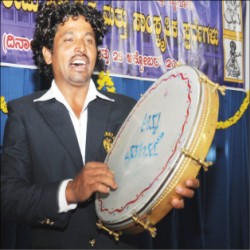
At a time when western culture and western music has captured the world, here is a person who is on a mission to popularise folk music among the younger generation. His popularity in the recent past has grown to a level that he was invited to perform at the AKKA festival held at San Francisco Bay Area, USA, during August 2014.

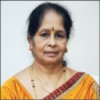
Meet, Amma Ramachandra, a talented singer from Devalapura in H. D. Kote taluk. A student of Folklore at the University of Mysore, Ramachandra has reached great heights as a singer. Having been accorded with many awards, Ramachandra remains humble to his teachers and friends.

Ramachandra, who recently performed at the Yuva Sambhrama, created magic along with his group comprising Ningaraju and others. His melodious voice takes the audience to a folk music journey and back to the era when such songs were popular. The specialty of Ramachandra is that he has never undergone formal training in music nor has he consulted any of the singers. The songs have been learnt by him all on his own like Ekalavya in the epic Mahabharata.

“I always wanted to be a singer since my childhood. Having come from a rural background I grew up listening to folk songs and watching many folk arts. My mother also wanted me to become a singer. Today, if I have reached this level it is only because of my mother’s blessings and teachers who encouraged me throughout,” says Ramachandra.

The story behind Ramachandra having a prefix ‘Amma’ to his name is also interesting. Ramachandra who loves his mother Devamma added a prefix ‘Amma’ (Mother) to express his affection to his mother. Since then he is popular as ‘Amma Ramachandra.’

His affection towards folk music grew during his Pre-University days at VSS College in Ratnapuri, Hunsur Taluk. Ramachandra was supported by his teachers and friends to perform on stage and he never looked back since then. After joining Maharaja’s College, his talent got a boost with getting selected to represent the University of Mysore at South Zone Inter-University Cultural and Literary competitions organised under the aegis of Association of Indian Universities (AIU).

Ramachandra has represented the University in South Zone competitions on three occasions during which he secured gold medal once and silver in the other occasion. He was also the member of the gold medal winning team of University at the National-level.

Ramachandra, who is of a shy nature, says he felt afraid when he went on stage for the first time. “Encouragement from my teachers and friends gave me the courage and strength to perform on stage. Even today I feel butterflies in my tummy when I walk on to the stage but once I see the crowd and start singing I forget everything and continue to entertain the audience,” added Ramachandra.

Ramachandra owes a lot to his teachers Prof. Ramaswamy, Administrative Officer, University of Mysore and Dr. M. Rudraiah, Director, Directorate of Students Welfare, who have constantly encouraged him to perform at the highest level.

This talented singer was also among the top 5 contestants in Star Singer, a reality show conducted by Suvarna Channel. This apart, he is the recipient of 13 different awards including District Youth Award-2009, State Youth Award-2013-14 and so on to name a few.

According to Ramachandra, western music and film music just come and go but the folk music which originated decades back will live for centuries to come and continue to entertain people.

Amma Vasundhare Trust, started by Ramachandra, who presently resides in Bogadi, Mysore, has been working to popularise folk music among the youth. Ramachandra conducts folk and light music classes at his residence in Bogadi. He also plans to conduct folk music workshop for colleges in city on every Sunday free of cost.

With a little more encouragement from the concerned authorities, Amma Ramachandra can reach greater heights in the field of music. Every such talent must be encouraged like the University of Mysore has in the case of Ramachandra. SOM wishes him good luck.

source: http://www.starofmysore.com / Star of Mysore / Home> Features Articles  / Friday,  October 31st, 2014
Karnataka Kanmani State Award presented

KanmaniBF05nov2014

Mysore :

As part of its eighth anniversary, the city-based CREDIT-I felicitated achievers from various fields yesterday.

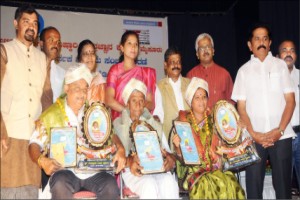
Rangayana Director Janardhan (Janni) presented ‘Karnataka Kanmani’ State-level award to Music Director Hamsalekha, progressive farmer from Bangalore Rural District L. Narayana Reddy and Community Development Institute, Belgaum’s Shobha Gasti at a function held at Jaganmohan Palace.

Speaking after receiving the award, Music Director Hamsalekha said he comes from a rural background and as such he is very much aware of rural problems. Pointing out that he could understand the rural life much better because of his drama background, Hamsalekha complimented the CREDIT-I for its rural development initiatives.

Observing that urban areas too have a rural background, he called upon voluntary organisations to sensitize the rural people of the various facilities extended to them by government and other agencies and to encourage them to make best use of the schemes meant for them.

Coming up with his plans for providing education and job opportunities to poor children, Hamsalekha said 100 PU failed students sensing in CREDIT-I, can join his Hamsalekha Desi College, by paying only the fees of first year, while the fees for the remaining 4 years would be borne by him. This apart, he would provide them ample job opportunities, he added.

Earlier, ZP President Dr. Pushpa Amarnath, who spoke after inaugurating the programme said unemployment and underemployment have been haunting the youth, who constitute 60 percent of the country’s population. Youth from rural areas have been migrating to urban areas in search of jobs which are less rewarding. The youth should stop this tendency and instead look at taking up progressive farming for happiness and betterment of their lives, she said.

Swami Vivekananda Youth Movement founder Dr.R. Balasubramanyam and MLA M.K. Somasekhar presided.

CREDIT-I Managing Trustee Dr. M.P. Varsha, Treasurer M.R. Manjunath, Vasantha and others were present on the occasion

source: http://www.starofmysore.com / Star of Mysore / Home> General News  / Friday,  October 31st, 2014
City’s Danseuse Pankaja elated over Rajyotsava Award

DanseusePankajaBF05nov2014

Mysore :

Danseuse Pankaja Ramakrishna is popular figure among the fine arts community in city. A resident of Vijayanagar, Pankaja started Sarveshwara Nritya Kalamandira in the year 1984 and since then she has been training students in different dance forms in both classical and folk.

Recognising her services over the past 21 years, the Karnataka State Government has accorded her with this year’s prestigious Rajyotsava Award.

Speaking to Star of Mysore, Pankaja expressed her happiness over her being recognised by State Government. “I am thankful for the State Government for recognising my services which I have done from the past 21 years. The award has increased my responsibility and I will continue to serve the society by popularising dance forms in both classical and folk”, she added.

Pankaja is currently training around 85 students in different art forms such as classical and folk dance and classical vocal. Students trained under Pankaja have settled in USA, Canada and other countries and have been conducting classes.

source: http://www.starofmysore.com / Star of Mysore / Home> General News  / Friday,  October 31st, 2014

Winners of Face of the Year – 2014

FacesBF04nov2014

Mysore :

The following are the winners of the ‘Face of the Year- 2014’ fashion event, organised by Arris Ventures at a resort in city recently.

In the girls category, Shilpa Irdal was declared winner, Deekshitha – 1st runner-up, Priya – 2nd runner-up, Rooshan bagged ‘Miss Beautiful’ award and Nathasha bagged ‘Aspiring Model’ award.

In the boys category, Ali Sher was declared the winner. Daryl D’Souza – 1st runner-up, Faizan Khan – 2nd runner-up, Yaseen bagged ‘Mr. Handsome’ award and Salman bagged ‘Aspiring Model’ award.

The event was choreographed by Nousheer.

source: http://www.starofmysore.com / Star of Mysore / Home> General News  / Thursday,  October 30th, 2014

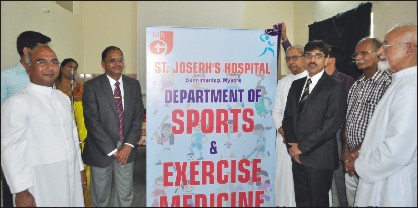
Department of Sports and Exercise Medicine inaugrated at St. Joseph’s Hospital

Seen in the picture are (from left) Fr. Mari Raj, Administrator, St. Joseph’s Hospital, Dr. C. Krishna, Director, PE Department, University of Mysore, Fr. Marie Joseph, Vicar General, Diocese of Mysore, Dr. R. Girish Chandra, Consultant, Arthroscopic Surgeon, St. Joseph’s Hospital, Dr. J.S. Hegde, Consultant, Orthopaedic Surgeon and Fr. Denis Noronha, Sr. Member, St. Joseph’s Hospital.

Mysore :

The Department of Sports and Exercise Medicine of St. Joseph’s Hospital in city, which is said to be first of its kind in Mysore, was inaugurated by the chief guest Dr. C. Krishna, Director, Department of Physical Education, University of Mysore, this morning at the hospital premises.

In his inaugural speech, Dr. Krishna said: “Doctors are like God because they save the lives of people.”

He recalled Mother Teresa’s service towards society and appreciated St. Joseph’s Hospital management for starting this new department.

Dr. J.S. Hegde, Consultant Orthopaedic Surgeon, who was also one of the guests, said, “Mysore city was in need of a Department of Sports and Exercise Medicine. St. Joseph’s Hospital has taken the initiative in starting the same.”

Enlightening the audience about the Department, Dr. Girish Chandra, Consultant Arthroscopic Surgeon of the Hospital, gave a power-point presentation on ‘Sports and Exercise Medicine.’

“The Department of Sports and Exercise Medicine at St.Joseph’s Hospital provides expert consultation and advise on a certain type of activity relevant to an individual, prescription of precise exercise and promotion of general health,” said Dr. Girish.

He further explained that the said department offers a complete range of services focusing on preventing and treating injury and illnesses and helping athletes. Thus, enabling them to perform to optimum level.

St. Joseph’s Hospital is offering surgical management of the following common injuries such as ligament injuries of the knee joint (Anterior and Posterior Cruciate ligaments), Meniscus tears of the knee joint, Cartilage damage, Patella dislocation, Shoulder recurrent dislocations, Tennis Elbow/Golfer’s Elbow, Fractures around the shoulder, elbow, wrist and knee joints among others.

The Department also has plans to start exclusive Minimal Invasive Operation Theatre, Research on cartilage culture and transplant, Treatment with platelet rich plasma injection and start a sports medicine training institute among others.

Mr. Xavier D’Souza, Medical Superintendent of the Hospital, welcomed. Fr. Mari Raj, Administrator of the Hospital, proposed a vote of thanks.

Fr. Marie Joseph, Vicar General, Diocese of Mysore, Sports persons, sports coaches and doctors were present on the occasion.

source: http://www.starofmysore.com / Star of Mysore / Home> General News  / Thursday,  October 30th, 2014

Rotary Midtown presents Best Industrialist Award

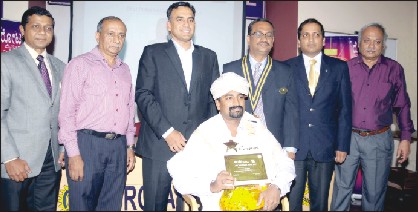
Abhilash Nair, MD of Zeus Biotech, Mysore, who was conferred the Best Industrialist Award by Rotary Midtown yesterday, is seen with (standing from left) Rtn. Rakesh (MC of the Programme), Rtn. M.R. Srivatsa (Vocational Service Director), chief guest Arjun Ranga (Partner of NR Group), Rtn. R. Venkatesh (Club President), Rtn. T.N. Mohan Kumar (Secretary) and Rtn. P.K. Ramakrishna (Award sponsor).

Mysore :

Arjun M. Ranga, Partner of NR Group, Mysore, presented Rotary Mysore Midtown’s Best Industrialist Award to Abhilash Nair, Managing Director of Zeus Biotech, Mysore, at a function held at Rotary Centre on JLB Road in city last evening.

Rotary Midtown President Rtn. R. Venkatesh, Hon. Secretary Rtn. T.N. Mohan Kumar, Vocational Service Director Rtn. M.R. Srivatsa and others were present on the occasion.

Profile of the Awardee

Zeus Biotech, Mysore, was started by Dr. Jay Prakash Nair in 1991 to manufacture and sell animal feed supplements. He brought in innovative concepts to the animal feed industry in India. Dr. Jay Prakash Nair’s youngest son Abhilash Nair, 35, joined his father in the year 2000 after his graduation. Abhilash took over the company’s reins as Managing Director after his father’s demise 5 years ago.

The company, having 3 production units in Mysore with a full-fledged Laboratory and R&D section with scientists working with full dedication, has the presence in overseas market like Malaysia, Phillipines, Brunei, Bhutan, Nepal, Nigeria, Jordan and Middle East.

Abhilash is married to Chaitra and blessed with a son and a daughter. His brother Avinash works for an MNC in Bangalore.

source: http://www.starofmysore.com / Star of Mysore / Home> General News  / Thursday,  October 30th, 2014

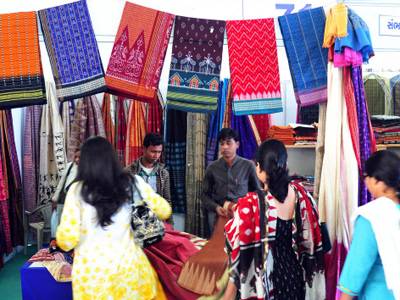
Trademark war: ‘Khadi’ registered in Germany, Spain

Within the country there are around 90 trademarks which have been registered by several entities which includes brands and labels such as ‘Khadi’, ‘Khadi Gramudyog’ and ‘Khadi Bharat

New Delhi :

The government’s efforts to promote ‘khadi’ are facing a trademark hurdle with the brand having been registered abroad, in countries such as Germany, as well as in India.

After haldi and basmati, this is the latest instance of infringement of intellectual property rights, which is essentially traditional knowledge. What makes the task more difficult for the government is that ‘khaddar’ and ‘khadi’ are common across the Indian sub-continent — from Bangladesh to Pakistan.

While the micro, small and medium enterprises (MSME) ministry has noticed ‘khadi’ being registered in Germany, sources said registrations have taken place in Spain and Hungary too. In fact, some of the ‘khadi’ products manufactured abroad, such as aamla shampoos and heena, can be purchased online too.

Within the country there are around 90 trademarks which have been registered by several entities which includes brands and labels such as ‘Khadi’, ‘Khadi Gramudyog’ and ‘Khadi Bharat’.

Khadi2BF04nov2014 

The government is contemplating future course of action, including taking up the issue with the European authorities. “We have noticed that there have been some IPR infringements and that is why we are trying to have our own trademark,” said a senior MSME ministry official, adding that the khadi logo is a step in that direction.

The development comes at a time when Prime Minister Narendra Modi is pushing khadi and on Sunday said that sales have more than doubled since he made his first radio address last month.

While experts are still worried over India’s ability to get its IPR rights back, the MSME ministry official said that khadi is not just a way of life in India for centuries but also enjoys legal backing under the Khadi & Village Industries Commission (KVIC) Act, at least since 1956.

The official, however, ruled out seeking Geographical Indication registration like Darjeeling tea of champagne, which is based on the specific characteristics of a product and is linked to a particular part of the world where it comes from.

The department of industrial policy and promotion has suggested that KVIC should seek an international trademark under the World Intellectual Property Organization’s Madrid Protocol. But for that KVIC and the government need to ensure that the brand is not registered elsewhere.

source: http://www.timesofindia.indiatimes.com / The Times of India / Home> Business> India Business / by Sidhartha, TNN / November 04th, 2014

Stopping by Double Road…

In the late 40s, we moved to Bangalore having bought a house owned by a departing Britisher, a Charles Marsh and the house was called ‘The Marshes’. It literally lay in the marshes, all one acre of it, wedged between the two lakes, one of which when it overflowed ran over the bund that was our access road. There wasn’t much habitation as it lay in close proximity to two graveyards, one a huge Hindu one and the other a smaller Muslim one. Though the mud road that lay between the two graveyards connected our road to the Lalbagh, it was never used except to cart dead bodies. 

DoubleRoadBF04nov2014

The City Corporation at some point in the early 50s decided to put life into that road and thought up an ingenious idea. Why not divide the road and mark out uniform sites on either side allowing for bigger sites in the corners? Well, of course, it had to be called ‘Double Road’, the first in town to carry that sobriquet. The grand day arrived for testing the waters. A man went round with a drum announcing the sale of sites for homes by auction on the following Sunday. The mud road, now divided into two mud roads, were cleared of the debris collected over years and in the middle, a platform was erected for the great occasion. The District Magistrate arrived with his minions, who set up a podium and chairs, as the drummers drummed louder and louder…nothing happened except for some grave diggers stirring out to see whether fresh bodies had arrived.

Realising that this is a no-go situation, the District Magistrate enquired whether there was any noted (monied) person living close by. His heart swelled with hope when my father was mentioned as the only money bag around. He knew him from excise auctions. Thus my father was summoned and addressed with great grace. My father’s generation treated these exalted gentlemen of the Government as next only to God. ‘Appane aaga beku’ (orders your grace), ‘Nodi, saukarre namma mana ulisa beku’ (you must save my honour) ‘ayyo yenubekadaru heli’ (anything you say) “ondu site adaru marde nanu hogoke agalla. Nimma hesaralli ondu 5 site nanu register madtini” (I can’t go without selling a single site. I will register five in your name). Thus my father had five sites, two on either side, and one larger one in the corner. Returning home, he called up his friends – a lowly bank manager, a retired Thasildar, a poor relative. On arrival, they were told they owned sites. As they demurred, he cut them short ‘Did I ask you for money?’ Watching the sites going at such a pace, mother could not but put in her bit. “I don’t have anything in my name”. So one went to her and the other to the quietest brother in the family. The purchase value of the sites? Rs 4,500 for the regular and Rs 6,500 for the corner.

Years passed. I went abroad and when I was there, my father had a stroke. Though he recovered, he was never the same again becoming increasingly immobile. A few years later he passed away. One morning, a man sat in our yard and wished to meet my mother. He spent a long time with her and did not have time enough to unburden his gratitude to us, particularly to father. When he retired from the bank, he had nothing much in terms of the severance pay but he had the burden of getting his daughter married. He had borrowed on pledging the site father had gifted. And then had settled into retirement that is, until a few months ago, he woke up to the fact that the piece of land he owned now was the prize of princes, for the Double Road had become the main arterial road to the burgeoning Bangalore South. Overnight, he was rich enough not only to buy a place but also build a comfortable two-storied bungalow that gave him permanent income from the renting of one floor and living in another… a place of his own. He had tears in his eyes as he recounted the tale. That patch of land, which made him a fortune, was now on Kengal Hanumanthaiah Road connecting downtown with a vast extension called Jayanagar and other extensions beyond.

source: http://www.deccanherald.com / Deccan Herald / Home> Supplements> MetroLife / by M Bhaktavasala / DHNS – November 04th, 2014

Walkers get glimpse of military legacy

Walkers are treated to a sprawling, lush MEG campus served up with a dash of history

Vijay Thiruvady guides a tour through the halls of the Madras Engineer Group campus. The entire walk is a trip through a venerable and heroic history.

With the army commemorating the first centenary of the First World War where many Indian soldiers sacrificed their lives, a part of the cantonment area opens up for the public to know its great history of which we can all be proud of. The Bengaluru walks, which have created a brand new way of rediscovering the city’s glorious past, has now added the Military Heritage Walk that takes you into the Madras Engineer Group (MEG) campus. The walk is actually a talk on the rich history of the military in which the Madras Sappers won wars from China to Egypt.

For the walkers, it is literally a treasure-trove of history. For example did you know the source of malaria was discovered in the army mess! Malaria, considered as one of the biggest killers mankind had ever known, was earlier believed to come from breathing in bad air from miasmic swamps. Ronald Ross had two stints in Bangalore. During his stay in the city, he used to dine at the Sappers and Miners officers’ mess where he observed larvae (on empty food trays left outside the mess) developing into mosquitoes. He suspected that the malaria vector was transmitted by the female anopheles mosquito. This observation, together with a number of experiments carried out later, and the publication of his papers led to him bagging the Nobel Prize for medicine/physiology in 1902 and subsequently to be knighted.
Vijay Thiruvady, who is known for his Lalbagh walks, introduced the Military Heritage Walk that takes us through the history of MEG, a history that traces back from 1780. The Sappers were affectionately called “Thambis” (meaning younger brothers in Tamil) by Major General Arthur Wellesley who went on to be the Duke of Wellington. Vijay says that the walks began in October this year and have garnered a lot of interest among Bengalureans. As this walk is held in the military area, which was not opened up to civilians previously, a strict security procedure is carried out.
The Sappers and Miners as an engineering enabling unit constantly used latest developments in their work. Bailey bridges developed by Sir Donald Bailey in the middle of the Second World War were quickly adapted by the Sappers. Post-independence, they built the highest Bailey bridge in the Khardungla pass at 18,300 feet. They have used Bailey bridges on every occasion including replacing the ineffective bridges at the New Delhi Common Wealth Games. Bengalureans can see the construction and dismantling of Bailey bridges on a continuing basis at Ulsoor lake.
The walk goes through selected areas of the MEG and Centre that reflect the history of the city. For example, Vijay says, the Britishers were very perceptive in their recruitment requirements. In fact, they recruited coconut gatherers and toddy tappers for their tough abdominal muscles. They had great skills, especially in scaling ladders for investing in fortification. The technique was used very successively in their operations at Savanadurga, Magdala, Burma and elsewhere. They also recruited fishermen for their exposure to sunlight, salt water and humidity that made their services invaluable and for their watermanship.
The highlight of the heritage walk is remembering the fallen at the war memorial to honour the brave Madras Sappers who laid down their lives in the First World War. None can ignore the horses that seem to pay their respects to the martyrs by not batting even an eyelid till the ceremony is over!
The best part about the walk is the serene climate of the cantonment because of the many trees there.
The tranquil atmosphere is a pointer to the city’s original charm of a Garden City. It leaves one wondering how nice it would be if the entire city was as green as the cantonment area. The MEG campus shows us how well the city could be maintained ecologically with care for greenery. For example, the oldest tree in MEG and Centre is a grand banyan planted in the 1820s, which is still giving plentiful shade.

A BRIEF HISTORY

WAR MEMORIAL
Erected in 1923, the Madras Sappers’ war memorial originally stood in a tree-shaded spot overlooking the Ulsoor lake. However, then it was decided to move the memorial to a less congested and more befitting surrounding. 

DOOPTA
The head gear is one of the most attractive things of the MEG. Called the Doopta, it is adaptation of old Shakos without the peak and the chin strap. In the battle of Meanee in 1843 (today’s Pakistan), the Cheshire regiment were totally outnumbered in their fight against Balochis and Sindhis and were losing ground steadily till the Thambis, armed with just pikes, came to their rescue. Honouring their courage, troops of Cheshire regiment spontaneously removed their shakos (headgear) and presented them to the Thambis.

THE GREY MULE
It was the 150th anniversary of the pensioner’s reunion in the city during 1930 when a grey mule led the march. Wondering why a mule? Well, mules have been used worldwide. However, the story of this special Grey mule is remarkable. Commissioned into the service in 1891, the Grey mule served in Tirah, Chitral, Malakand, Tibet, Palestine and Egypt. In 1921, before the Sappers and Miners returned to India from Egypt, all the mules were sold off to the Egyptians. Colonel Basset requested to make an exception of the Grey mule, which was pensioned off and given freedom in the lines in our city. Hence, during the anniversary of the pensioner’s reunion, the Grey mule led the march-past accompanied by his Sapper handler and driver who had led him up the Malakand (North West frontier province in the Pakistan-Afghanistan border) 33 years earlier. 

Amrit Mahal Bull
The Madras Sappers and Miners used the Amrit Mahal bull (a dwarf of the species) in the first Afghan War (1839-1842) for transporting a cannon and ammunition over the Bolan pass in Baluchistan. Major General Arthur Wellesley used it to great effect in the Battle of Assaye and elsewheree.

source: http://www.bangaloremirror.com / Bangalore Mirror / Home> Bangalore> Others / by Sridhar Vivan, Bangalore Mirror Bureau / November 03rd, 2014

Israeli tech whets once-barren farm

Dry farming techniques gave a new twist to organic farming on this land

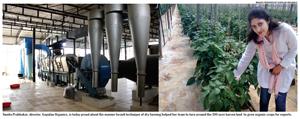
Sunita Prabhakar, director, Gopalan Organics, is today proud about the manner Israeli technique of dry farming helped her team to turn around the 100-acre barren land to grow organic crops for exports

Away from the hustle and bustle of Bangalore city areas, in Uttari and surrounding villages, falling under Kagalipura post, a silent socio-agronomics revolution, inspired and propelled by Israeli farming techniques, is slowly gaining momentum. Spearheading the campaign from a 100-acre organic farm is one young entrepreneur, a graduate in environmental science and in her 30s, determined to make organic a mass movement.

Every morning before the crack of dawn a vehicle leaves the organic farm and reaches out to the adjacent villages to pick up enterprising men and women for training in production of organically grown vegetables and high-value export quality herbs like basil, chives, sage, tarragon, rosemary, parsley, thyme, mint etc. at the sprawling organic farm located in the foothills of the nearby Uttari Hills.

“After training in organic farming, many of them have begun growing organic vegetables. We purchase their produce after ascertaining their quality. Some of these organic vegetables are sold at our Gopalan Organics outlet at Old Madras Road in Bangalore. A portion of the produce makes it to the export markets in Dubai and European markets after stringent quality checks”, says Sunita Prabhakar, the brain behind the grassroots organic farming movement. “My mission is to remove the elitist tag off organic vegetables and make them available to common households at affordable rates. After all everyone is entitled to organically grown, healthy, chemical fertilizer and pesticides free farm produce,” explains Director of Gopalan Organics, Sunita Prabhakar, who started her organic unit in 2003, in what was then a barren land, bought by her real estate developer husband’s family in Bangalore heading the ‘Gopalan Enterprises’.

However, although today the organic vegetables and culinary herbs company exports dry, natural herbs and fresh vegetables to a large number of markets in Western Europe and Dubai respectively and employs over 200 workforce including farmers, agronomists and agricultural scientists, 10 years ago when Sunita threw the idea of starting her organic venture on the rocky, godforsaken land, many did not take her seriously.

She had seen for herself how Israelis mastered the art of dry agriculture with minimal use of water. She was determined to bring the technology to India.

The conviction and determination paid off.

In the summer of 2000 a group of Israeli dry farming experts from Netafim Irrigation System landed at the barren, undulated rocky piece of land.

They examined the prospect of turning it into fertile land for growing organically produced vegetables, herbs and fruits. A mammoth and uphill task awaited them as for the next six months they devoted their time in preparing, planning and executing the organic farm project.

It took another year for the first crop to grow at the newly developed farm.

Alongside Israeli advanced farm management expertise in water conserving irrigation, desalination, and compost enriching the farm, Sunita also adopted biodynamic farming methods pioneered by Australian thinker Rudolf Steiner to grow crops both inside temperature-control green houses and in the open fields, applying scientific soil testing methods for optimum yield per acre.

A network of drip irrigation pipes and sprinklers were laid both inside the green houses and in the open farm land.

The farm land was bifurcated for growing crops under controlled climatic conditions inside the green-houses, and tunnels in the open. “Those days very few people were doing organic farming. There was hardly any infrastructural or technical support available in the country to do dry organic farming. The greatest challenge was to export the basic infrastructure from Israel and then transport them to this remote village from Bangalore Airport. But we managed it all,” says Sunita.

The organic farm today produces 800 to 900 Metric Tonnes of vegetables and fresh and dry culinary herbs under the brand name of ‘Naturale’.

“Of the total volume, we exports 300 to 400 MT of mainly fresh and dry herbs to Germany, Amsterdam, Vienna, Munich, Frankfurt, Belgium, etc. places. To ensure strict adherence to European quality control norms, the vegetables and fresh herbs undergo tests at all levels- from farmland to packaging table-at the analytical lab.

Scientific soil analysis and preparation, soil-enriching using organic manure, plant analysis, bio-degradable poly packaging, processing and storing to retain temperature levels are undertaken,” says K Babu, the agricultural scientist at the farm. Babu further said for the protection of crop bio agents and other Integrated Pest Management (IPM) practices were being followed as against indiscriminate use of harmful chemical pesticides. Each consignment can also be tracked back right down to the date and green house in which it was grown.

Sunita explains: “To ensure freshness of the produce till they are handed over to customers in Germany and other European countries an uninterrupted cold chain from farm to the customer is maintained. The produce is subjected to pre-cooling treatment that increases the shelf life and reduces break down of the nutrients. The air-conditioned pack houses are equipped with all necessary equipment and facilities in consonance with international standards.”

Sunita, who has visited organic farms in Europe, feels the government must support adoption of automation and IT to streamline and modernise organic farming.

​DRY FARMING

It is a type of farming practised in arid areas without irrigation or with drip irrigation and maintaining a fine surface tilth or mulch that protects the natural moisture of the soil from evaporation. Dryland farming involves quite a struggle to set the crop cycle going.

HOW AND WHERE IT ORIGINATED

Dry farming originated in the 19th century in the Great Plains of USA to accelerate production of certain crops, most notably wheat. It should be practised in areas where rainfall averages less than twenty inches a year. Hardy Webster Campbell, a South Dakota homesteader, invented a subsoil packer circa 1890 and thereafter operated demonstration farms for railroads. By the end of the century dry farming was championed as the solution to the agricultural problems of the Great Plains.
(Source: Encyclopaedia of Oklahama History and Culture)

source: http://www.bangaloremirror.com / Bangalore Mirror / Home> Others> Sci-Tech / Agencies / by Dipankar Chakraborty / October 29th, 2014