Mysore Fashion Week : A visual treat for Fashionistas in city

MysoreFashionBF12sept2015

The fashion aficionados in the city got to witness some of the best designers in the country showcasing their designs at Season 2 of Mysore Fashion Week which was held at Country Inn & Suites in city from Sept. 4 to 6. The event attracted people from all age groups who thronged the venue to catch a glimpse of some imposing designers.

Mysore Fashion Week, presented by C. Krishniah Chetty & Sons, was the brainchild of city-based fashion designer Jayanthi Ballal who along with her colleagues worked hard to come out with the event which has now put our city among the cities known for fashion extravaganza.

Following the success of season 1, Jayanthi had been working for the past six months for season 2 holding meetings with the sponsors, partners, fashion designers and others involved.

Speaking to Star of Mysore, Jayanthi Ballal said that organising fashion week needs a lot of hard work and dedication. “Everything, right from the ramp, models, music has to be perfect. People working in the backstage are the most important. The entire fashion week is dependent on them,” added Jayanthi.

The season 2 of Mysore Fashion Week witnessed a total of 40 models, including 13 super models from Mumbai, walking the ramp for various designers during the three-day extravaganza. Among the super model was also Gazi (Rouhalllah Quazim) who is popularly known as Raymond Gazi.

“Gazi just flew down to Mysuru for Mysore Fashion Week. During our interaction over phone, he said that Mysore Fashion Week-1 had been lucky for him that fetched him the famous Raymond Ad and he just wanted to walk the ramp again in Mysuru,” adds Jayanthi.

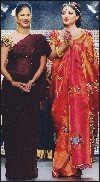
This season witnessed celebrity show-stoppers such as Amala Paul, Sanjana, Parul Yadav, Vidyut Jamwal and others. The show also featured fashion designers including Yogesh Choudary from Delhi, Mona Shroff from Hong Kong, Reshma Kunhi, Pinky Kachhela and others. The highlight of the three-day event was the grand finale by Jayanthi Ballal, who showcased a traditional collection as a tribute to Mysuru’s heritage. Bollywood actress Soha Ali Khan, the show-stopper for Jayanthi Ballal, flaunted a gorgeous red Kanjeevaram saree which had the embroidery of the Dasara procession. Speaking about the saree, Jayanthi Ballal said that it took around 25 days for her to complete the embroidery works and added that every designer loved the works of the fellow designers which is special.

She also added that the season 3 of the Mysuru Fashion Week would be much bigger and better.

We also hope that Mysuru gets a place in the fashion world with bigger fashion week next year.

source: http://www.starofmysore.com / Star of Mysore /Home> General News / Saturday – September 12th, 2015

‘We want to solve unmet medical needs’

Stempeutics Research is India’s leading regenerative medicine (stem cell) company. B N Manohar, its MD and CEO, recently sat down with Deccan Herald’s Georgy S Thomas to explain how regenerative medicines give hope to people who have no other options. Excerpts:

ManoharBF12sept2015

What are stem cells?

The human body is made up of three categories of cells: germ cells, somatic cells, and stem cells. Somatic cells, which have two copies of each chromosome, make up most of the human body. There are 220 types of somatic cells. Germ line cells are any line of cells that give rise to eggs and sperm. The rudimentary stem cells normally transform into somatic cells. But for some reason, some stem cells are still found as leftovers in adults. They have the ability to regenerate other cells. Also, stems cells can be allogenic, which means your stem cell can go to anyone in the world; whereas your blood cannot be of use to others without a match.

When was your company formed?

In 2006.

Who are the promoters?

Manipal Group, initially. Subsequently, in 2009, we entered into a strategic alliance with Cipla. Manipal  Group is well known in education and healthcare. What we are doing is novel product development. So we felt the need to have a good pharma partner. Cipla owns 49 per cent equity, and Manipal Group is the 51-per cent majority partner.

How much capital have you raised?

So far around Rs 200 crore. Every quarter, I raise funds from the promoters in proportion to their equity stake.

What are your revenues?

Zero. Today we are still a pre-revenue company and we are likely to generate revenues in this financial year. So far we have been spending money to develop this product for about eight years.

What is the difference between biotech and stem cell technology?

Traditional medicines are derived from chemicals. Biotechnology makes use of biology: you have vaccines, then gene therapy, cell therapy, and tissue engineering. That’s how the whole  field is advancing. Ours is a part of biotech, but in a niche area.

Which is the biggest stem cell firm?

There are different biotech and pharma companies entering the stem cell area. The biggest pure-play stem cell company is probably Australia’s Mesoblast. It is not making much of revenues (AUD 23.75 million) yet, but the market value of the listed company is more than a billion AUD, probably in recognition of its potential.

Do you have any competitors in India?

In India, there is Reliance Life Sciences. But it is not focused like us in bringing out a New Biological Entity or NBE. Our NBE is MSC or mesenchymal stromo cell.

How many drugs are you working on?

We are working on only one drug called Stempeucel. Unlike chemicals, stem cells are multipotent. Like the embryonic stem cell which can turn into any of 220 different somatic cells, our MSC derived from bone marrow is pluripotent, meaning it can do multiple jobs in our body.

Which stage is this drug in?

Stempeucel has completed pre-clinical safety tests in animals, and Phase-1 and Phase-2 trials in more than 200 humans. We have now moved the drug controller general of India (DCGI) to directly go into production and marketing by skipping Phase-3. DCGI is actively considering it.

In pre-clinical trials, we had to prove the drug’s safety and efficacy. The safety trials were done at National Institute of Nutrition (NIN), Hyderabad, and Syngene, Bengaluru. While we were doing this, being the first to attempt an NBE in India, we chose to work with DCGI to form a regulatory framework.

Is there a regulatory framework now­­­­­?

It is there now. Over a period of 7-8 years we worked with the DCGI to create the framework.The guidelines have been published and feedback has been received from the public. Now Parliament will have to amend the Drugs and Cosmetics Act to bring in the changes.

What disease is Stempeucel targeting?

We are focusing on a condition called CLI or critical limb ischemia.

What is it?

Like a heart attack, it is known as leg attack. The arteries get blocked, you will have severe pain and will not be able to walk. Even when you sit, there will be severe pain and any ulcers won’t heal because there is no proper blood flow. Ultimately, it may lead to amputation. More than 10 million people suffer from CLI in India.

Is Stempeucel an injection?

Yes. We give around 40 injections around the leg in a one-time administration, and also around the ulcer.

How many milligrams?

Each one is 0.5 ml, and 2 ml around the ulcer. We have measured at the six-month interval and seen dramatic results. So based on this we went to the government to fast-track the approval process. Something similar to the orphan drug designation (ODD) and ATMP (advanced therapy medicinal product) processes in Europe. Incidentally, we have received both ATMP and ODD approvals.

It seems you have received some patents too. What are they all about?

The patents are for our novel process in making the NBE. We have applied in 18 countries and has so far received patents in seven countries — the US, Australia, China, New Zealand, Singapore, Japan, and South Africa.

How much will a Stempeucel vial cost?

We are yet to finalise the price. For instance, one 100-million cell vial of stem cell drug Prochymal by US company Osiris costs about $15,000. Our goal is to reduce the price to between $2,000 and $3,000.

How many employees are there in your organisation?

Currently 39. The mix is seven PhD biotechnologists, 30 scientists, two medical doctors.

Do you need a fresh infusion of funds?

We are looking for a strategic partner. After receiving ODD and ATMP approvals, we have been asked to do a pivotal trial in Europe. It costs up to $30 million to do even a simple clinical trial there. So we need a bigger partner, preferably a pharma.

What is your five-year goal?

Ultimately, our goal is to provide solutions for major unmet medical needs. For that, we have to be financially strong as well. We hope to become a $100-million company in five years.

source: http://www.deccanherald.com / Deccan Herald / Home> Supplements> Economy & Business / by Georgy S Thomas / DHNS – September 07th, 2015
Pathologists working out global plan in city

Leading plant pathologists and bio-technologists of the world have assembled in Bengaluru for consultations on evolving a global action plan for a strong bio-security system. About 200 scientists from 20 countries have put their heads together at a four-day international symposium on Phytophthora being organised by the Kasargod-based Central Plantation Crops Research Institute (CPCRI) at the Indian Institute of Horticultural Research here from September 9 to 12.

CPCRI Director P. Chowdappa told The Hindu that the proposed action plan would have measures to prevent the spread of plant diseases from continent to continent and country to country.

source: http://www.thehindu.com / The Hindu / Home> News> Cities> Bengaluru / by Special Correspondent / Bengaluru – September 11th, 2015

V Commonwealth Games : Dhruthi bags grand Double

Mysuru girl Dhruthi T. Venugopal and Sasi Kumar Mukund seen in the winner’s podium with the Indian flag after they clinched the Mixed Doubles title in the V Commonwealth Games 2015 tennis event held at Samoa Islands on Thursday.

Samoa :

Mysuru girl Dhruthi T. Venugopal, representing India in the V Commonwealth Youth Games 2015 at Samoa Islands, won a grand double by clinching the girls singles and mixed doubles titles on the concluding day of the tennis championships on yesterday.

Top-seed Dhruthi won the girls singles title beating Lesedi Jacobs of Namibia 6-3, 6-0 to win the gold. Dhruthi completed a fine double when she teaming up with India’s Sasi Kumar Mukund won the mixed doubles title with a 7-6 (4), 6-3 win over the Scottish pair of Louie-Ada Mccelland and Ewen Lumsden in the final.

Sasi Kumar Mukund continued his fine run as he also won the youth boys singles gold with a 6-1, 6-2 win over Ewen Lumsden of Scotland in the final.

Incidentally, Dhruthi had beaten Violet Apisah (Png) 6-2, 0-6, 6-2 in the youth girls singles semi-finals. In the quarter-finals, Dhruthi got the better of Joely Lomas of Wales 6-1, 6-3 to progress further.

Daughter of Venugopal and Vanamala Venugopal, residents of Mysuru, Dhruthi is a product of the Mysuru Tennis Club. Presently, she trains under former India Davis-Cupper Nandan Bal at Pune.

India made a clean sweep in the tennis event by winning three golds in three events they participated.

source: http://www.starofmysore.com / Star of Mysore / Home> Sports News / Friday – September11th, 2015

B’luru lab to co-develop Ebola drug with Public Health England

(Representative Image)

Bengaluru :

Nine months after two novel compounds or drug candidates for Ebola from the Jawaharlal Nehru Centre for Advanced Scientific Research (JNCASR) were shortlisted among 20 globally by the Public Health England (PHE), one of them has made it to the final three.

And having realised the potential, PHE, which built and commissioned the first bio-safety level (BSL)4 facilities in the world (1976), designed the world’s first Class III safety cabinets, and used them to co-discover and characterise the Ebola virus, has signed a memorandum of understanding with JNCASR to co-develop the drug.

This contribution to the world from Dr Jayanta Haldar and two of his students–Chandra Dhish Ghosh and Mohini Mohan Konai–will be the first serious one from a developing nation.

The two drugs which were shortlisted, codenamed NCK-8 and D-LANA-14, were lead candidates from two classes of peptide mimics (a molecule global researchers have created to fight the virus) with high activity against a range of multi-drug resistant bacteria and malarial parasites, including clinical isolates.

TOI was the first to break the story in its December 20, 2014 edition under the title “Drugs for Ebola likely to have an Indian connection”.

Speaking TOI on Tuesday, Haldar said: “After extensive trials, one of them along with another from PHE proved to be very active in in-vivo (guinea pig) tests, which has prompted PHE to sign the MoU. From here on we will be working together and we hope to bring out a drug soon.”

Haldar while refusing to still disclose the exact materials used in NCK-8 and D-LANA, reiterated that they are made in three steps with easily available and inexpensive starting materials which do not require any difficult conditions for synthesis.

Dr Seshadri Vasan of PHE had said in December that PHE has a track record of scientific innovation and development, and the funding from Wellcome Trust will allow it to utilise our experience and expertise to assist in the fight against Ebola.

source: http://www.timesofindia.indiatimes.com / The Times of India / Home>City> Bengaluru / by Chethan Kumar, TNN / September 08th, 2015

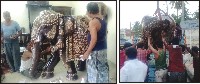
City artisans sculpt 5 feet tall elephant from a single block of rosewood

20 craftsmen took three years to create the 900-kg sculpture

RosewoodMPOs09sept2015

by S. Kenneth Shishir

City artisans, who are also recipients of State Awards, have sculpted a five feet tall elephant from a single block of rosewood.

Artisans Khalil ur Rahman Khan alias Parveez Khan, Fazlur Rahman Khan alias Touseef Khan, Hafeez ur Rahman Khan alias Tanveer Khan and Habeeb ur Rahman alias Asif Khan, sons of late A. Majeed Khan, a recipient of Karnataka State Award in 1985 and National Award in 1991, have sculpted this wooden elephant at their workplace Majeed Fine Arts on Anegundi Road in Mandi Mohalla in city.

Khalil ur Rahman, the eldest among the four brothers, speaking to SOM, said that Mysuru is the birth place for inlay work and is famous for rosewood inlay craft all over the world.

He said that to promote rosewood inlay work and to keep the tradition alive, his father late A. Majeed Khan, established Majeed Fine Arts in city in the year 1972 and since then many artisans have been trained in the inlay work by his father, who have made big names now.

Khalil further said that the Karnataka Government recognising the outstanding and excellent inlay works made by his late father awarded him with a State Award in 1985 and a National Award in 1991.

He said that his brother Fazlur Rahman Khan is a recipient of Karnataka State Award in 1995 and a National Award in 1997 while another brother Hafeez ur Rahman is a recipient of Karnataka State Award in 2003.

Khalil said that his younger brother Habeeb ur Rahman is also a recipient of the State Award in the year 2003 with himself being a recipient of the State Award for the year 2004-05.

When asked why did he and his brothers choose to sculpt an elephant when they could have sculpted anything, Khalil said that getting a single piece of rosewood was very rare and added that he procured the rosewood at an auction in Kushalnagar about three years ago. He further said that he and his brothers decided to sculpt a big elephant from the single piece of rosewood as Mysuru is famous for the world famous Dasara in which elephants play an important role especially during the Jumboo Savari.

When asked whether it was he and his brothers alone sculpted the elephant? Khalil said that they took the help of 20 craftsmen to complete their dream project and sculpted the elephant from a single solid block of rosewood.

He said that to decorate the sculpture they used inlay work. While 60% of the inlay work has been done using ‘Mother of Pearls,’ the remaining 40% work was done using natural wood colours for further decoration of the wooden elephant.

He said that to represent Karnataka, we have used the logo of the State along with our National Emblem on the side and a Gandaberunda on the forehead of the elephant besides birds, animals, flowers, etc.

When asked about the procedure of sculpting the elephant, Khalil said that as the first step, we made a design and drew an outline image and patterns on the solid rosewood block. Then the rosewood was carved into proper shape and cut into three parts (Head, body and tail) to give proper shape. The motifs that had to be inlaid were hand-cut and the area where the motifs had to be inlaid were carefully scooped out and the motifs were inlaid and fixed, he said and added that the sculpture was then smoothened using sandpaper and polished to give a bright look and joined together.

Khalil said that after the elephant was sculpted, it was 5 ft. tall, 3 ft. wide, 6.6 ft. in length and weighed about 900 kgs. The wooden sculpture has been shifted to Cauvery Emporium on Sayyaji Rao Road where it is kept on display now.

source: http://www.starofmysore.com / Star of Mysore /Home> Feature Articles / Wednesday – September 09th, 2015

Indian e-mail tech start-up strikes it big

The Strike team which won the regional round of Seedstars World competition.

Wins Swiss-based Seedstars World regional competition

Strike, a start-up which helps people do research inside their Gmail App, has won the regional round of Seedstars World, a global start-up competition.

Based in Geneva, Switzerland, and founded by Alisee de Tonnac and Pierre-Alain Masson, the competition is supported by the venture builder Seedstars. It promotes, connects and invests up to $1.5 million (Rs 9.9 crore) in start-ups in emerging markets, ranging from Shanghai to Cairo.

The Strike team will now travel to Geneva in March 2016 and win up to $500,000 (Rs. 3.3 crore) in equity investment. It will compete with regional winners from 55 countries as part of the Seedstars World final event in front of top investors and an international jury.

“We have developed a global product in India. Seedstars’ network will help us to target almost every market in the world,” said Aishwarya Jain, 25, chief executive at Strike. “It is rare to find product start-ups getting funded by venture capitalists in India.”

Mr. Jain cofounded Strike last September along with Akshay Katyal, his former colleague at tech company HackerEarth. The start-up has developed a technology that provides insights to users about people while checking mails on mobile. For example, how they look like, where they work, their social profiles and public updates. The start-up aims to provide all the public information about anyone through its app.

Ten start-ups from different parts of the country pitched their ideas to an audience of angel investors and industry experts at the one-day event held in Bengaluru on Saturday.

“Strike, by its unique idea of giving an outlook of personalities of people with one tap on your phone, has won the chance to represent India,” said Mahesh Bhalla, president at gift card tech firm QwikCilver. Mr.Bhalla was one of the jury members at the event.

EventsHigh, a local event discovery platform that brings all the events and things to do in a city, was placed second in the competition. The firm was founded by former WalmartLabs engineers Nikesh Garera, Arvind Batra and Parag Sarda last year. Another start-up, SayPay Technologies, co-founded by Ramsyam Missula was placed third in the competition. The firm enables users to make bill payments and online purchases on their mobile device by using their voice.

Last year, Scandid, a Pune-based shopping technology start-up, won the regional round of Seedstars World. The venture enables shoppers do price comparison by scanning the product barcodes with their mobile phones.

source: http://www.thehindu.com / The Hindu / Home> News> Cities> Bengaluru / by Peerzada Abrar / Bengaluru – September 08th, 2015

The Kasaragodu spark

Work is my God: Kaiyyara Kinhanna Rai worked tirelessly and did not lose hope till his end Photos: courtesy family album

For six long decades Kaiyyara Kinhanna Rai kept his movement alive – Kasargod had to become part of Karnataka. RAHMAT TARIKERE writes that the meaning of all the writings of this writer who passed away recently is to be found in his social activism

My meeting with Kaiyyara Kinhanna Rai was an accident. There was a programme at the Kannada Sahitya Parishath in Bangalore. Kinhanna means little brother, but our Kaiyyara Kinhanna Rai was a strapping six and a quarter feet, well-built man. Dressed in his trade mark white khadi kurta and dhoti, he was sitting all by himself in the last row. With the sweet memories of his poem I had learnt in school Neenanagiddare Naaninage, which unfolds as a dialogue between a horse and a donkey, I walked up to him and greeted him. Holding my hand he ushered me to the chair beside, pulled out a four page resume from his bag and gave it to me. In that resume the list of his non-literary activities outnumbered his literary activities. For instance, his participation in Quit India Movement, submission of a memorandum to the Unification committee urging that Kasargod should be absorbed into Karnataka, winning the Best Teacher national award, his administration for 15 years as the chairman of Badiyadka village panchayat, the two schools and community hospital he built, the Swadeshabhimani newspaper of which he was editor, president of Weaving and Weavers Khadi Co-operative society… so on and so forth. It felt unusual that the resume of a Kannada writer read like this. Everything in it said that Kaiyyara Kinhanna was more a political activist than a writer. Once I had finished reading it, Kaiyyara Kinhanna Rai started speaking about Kasaragodu. Now, even the programme had begun. He was speaking softly, just for me, but his gravelly voice overpowered the speaker’s voice and was audible to everyone in the auditorium. Some of the audience members turned back impatiently and gave us dirty stares. I didn’t know how to stop this senior writer, nor was I in a state to listen to him – I was getting restless. By this time, the writer Boluvar Mohammad Kunhi walking straight up to us, in a brusqueness that is unique to Coastal people, said: “If you want to talk, please go outside.” I fled from there. That was my first and last meeting with Kaiyyara Kinhanna Rai.

***

Between 1930-40, Coastal Karnataka was tense with three major movements. Foremost of them was to free the country from the clutches of the British. Second was to unify the regions that shared a common language but had been distributed among various presidencies, the Unification movement. Third was the communist movement that was fighting against the ruthless zamindars who had the support of the colonial rulers, and then there were other social movements like untouchability, caste system etc. For Karnad Sadashiv Rao the country’s freedom was most important. For someone like Kudmal Rangarao who had been ostracised by the Brahmin community, building a free hostel and school for the Dalits was of utmost importance. For B.V. Kakkilaya and Niranjana, labour movement was important. B.M. Shrikantaiah, Kuvempu, Alur Venkatarao and others felt that Unification was more important than Independence. Kaiyyara Kinhanna Rai had twin obsessions – freedom and Unification. After Independence in 1947, his only mission was Unification. When Potti Sriramulu fasted for three weeks and gave up his life, the Nehru government, unwillingly constituted a committee for the linguistic reformation of States. The committee recommended that Kasargod, Dakshina Kannada and Bellary which were a part of Madras presidency, should henceforth become a part of the Mysore presidency. What eventually happened was however different – they included Kasaragod in Kerala. The Kannadigas of Kasargod were heartbroken. It was at this juncture that Kaiyyara Kinhanna Rai began his movement for Kasargod’s absorption into Karnataka. This became a question of life and death for him. A full-time preoccupation, he discussed this with all and sundry, and in every place. But death has terminated his relentless struggle of a lifetime. His dream remains unfulfilled.

***

It is a matter of surprise that Kaiyyara Kinhanna Rai kept this spark burning in him for six long decades. His commemorative volume, in fact, is called Kasaragodina Kidi. There is a story behind calling it a spark. When he realised that Kasargod did not become a part of Karnataka, in anger and sorrow he wrote a poem, Manege. He tried to ignite everyone else with the fire that had caught him. In every public forum this was what Kaiyyara Kinhanna Rai spoke. Once, chief minister Gundu Rao was present at the function. “We, two and a half lakh Kannadigas, have been orphaned. Our language and culture is getting erased. The water that flows in Payaswini is our tears,” Kaiyyara Kinhanna Rai had cried in public. Kaiyyara Kinhanna Rai belonged to that generation which dedicated its entire life to a cause it believed. The question is however, why could he not realise his dream? To get absorbed into Karnataka, or to get separate statehood is perhaps a political dream, and it can bear fruit only when it becomes the dream of the community.

If the dream does not have economic and political dimensions, and is merely an emotional one, it is even more difficult to keep it alive. For the new generation of Kannadigas in Kasargod, Kaiyyara Kinhanna Rai’s dream must have seemed unrealistic. When there are more important questions than Unification, the poor or the locals will not make this a significant issue of their lives. Also, Kerala tops the country for its administration, education and other vital issues; it may have therefore appeared to them that they do not want to be a part of Karnataka. There was no political outfit like MES in Belgaum to fight the case of Kasargod. Kaiyyara Kinhanna Rai therefore became lonely in his struggle. That he could keep this Unification dream alive in him for six long decades became his achievement.

***

Born in Peradala in Kasargod (1915-2015), Kaiyyara was a school teacher. Writing was his hobby, though not a very powerful writer. The other important writers from this area are Govinda Pai, Parvatisubba, and K.V. Tirumalesh. His best writings are his poems for children. His other poems tended to be verbose and heavy with idealism — it lacked creative energy. One has to recognise this as the limitation of a Kannada school teacher. Gourish Kaikini is among the few teachers who could transcend this limitation. Even his autobiography that contains many intense and intimate experiences of his life is bland.

Yet, his writing has a historic importance. It becomes important because of its dynamic social and political consciousness. And this was shaped by Gandhianism. Gandhi’s visit to Mangalore filled youngsters with new ideals. By refusing to enter the Udupi temple that denied entry for the Dalits, Gandhi had stirred up the consciousness of the society. By then, Kudmal Rangarao had already been ostracised. Narayana Guru had launched his temple agitation against the upper class. People had laid down their lives in the communist movement in this part of Karnataka. Shivarama Karanth’s Chomana Dudi had been written. Kaiyyara Kinhanna Rai’s social writing was an extension of this. He, however, was not critical of the society, but instead glorified the tolerance of Dalits who put up with these social evils.

***

Truly Kaiyyara Kinhanna Rai’s contribution should not be sought in his writing. It has to be seen in his social activism. This trait could also be found in B.M. Idinabba. We can see it in H.N. Doreswamy too. In fact, the title of his autobiography Work is my God suggests this.

At a time when governments have absolved themselves of community responsibility, a corporatized education that is available only to those who have money, the hospital, and school Kaiyyara Kinhanna Rai built as panchayat chairman is important. Freedom fighter, social activist, journalist, poet Kaiyyara is no more. With him, we have lost the link to a generation that dedicated its life for a cause.

Translated by Deepa Ganesh

source: http://www.thehindu.com / The Hindu / Home> Features> Friday Review / by Rahmat Tarikere / Bengaluru – August 27th, 2015

Ambika and Afsana strike it rich

Mysuru's V. Ambika was dominant in the girls' under-16 shot put event. Photo: C.V.Subrahmanyam
Mysuru’s V. Ambika was dominant in the girls’ under-16 shot put event. Photo: C.V.Subrahmanyam

Mysore’s V. Ambika heaved the iron ball to a distance of  11.98 metres to win the gold medal in the under-16 girls’ shot put event in the three-day Shriram Properties National inter-district junior athletics meet (NIDJAM), at the Port Diamond Jubilee Stadium, here on Saturday.

Mumbai’s Poorna Rao Rane (11.94) and Chennai girl S.V. Visruti (11.08) settled for silver and bronze respectively.

In the four other finals held on the inaugural day, Tripura’s Afsana Aktar threw the javelin to a distance of 33.37m to take the top honours in the under-16 girls’ event.

Varanasi’s Versha Verma (32.18) and Cuttack’s Priyanka Toppa (30.95) took the silver and bronze medals respectively.

Mohit of Rewari (16.64m) was away ahead of his rivals in under-14 shot put. Thane’s Abhijit Nair (15.93m) and Panipat’s Sourabh (15.76m) were the other podium finishers.

Ranga Reddy’s Manan Venkatesh, with his impressive second leap (6.11m), bagged the coveted yellow metal. Delhi’s Sumit Rohila and Ernakulam’s Aadhinath took home silver and bronze respectively.

AP Chief Minister N. Chandrababu Naidu gave away the medals to the winners.

In the morning the event was inaugurated by a host of ministers and Athletic Federation of India officials including president Adille Sumariwala and Olympian Anju Bobby George.

The results:

Boys: Under-14 long jump: 1. Manan Venkatesh (RR) 6.11m, 2. Sumit Rohila (Delhi- NW) 6.01, 3. M.V. Aadinath (Ernakulam) 5.97.

Under-16 shot put: 1. Mohit (Rewari) 16.64m, 2, Abhijit Nair (Thane) 15.93, 3. Sourabh (Panipet) 15.76.

Girls: Under-14 long jump: 1. Rabina Khatun (Nadia) 4.80m, 2. Pratiksha Sanas (Aurangabad) 4.58, 3. E. Manisha (Thoothukudi) 4.50.

Under-16 shot put: 1. V. Ambika (Mysuru) 11.98m, 2. Poorna Rao Rane (Mumbai) 11.94, 3. S.V. Visruti (Chennai) 11.08.

Under-16 javelin: 1. Afsana Aktar (Sepahijala) 33.37m, 2. Versha Verma (Varanasi) 32.18, 3. Priyaka Toppa (Cuttack) 30.95.

source: http://www.thehindu.com / The Hindu / Home> Sports> Other Sports / by  J.R.Sridharan / Visakhapatnam – September 06th, 2015

She helps washed-up families start over

Hubballi  :

Suma Jeevannavar isn’t your textbook entrepreneur. From being a restless but diffident homemaker worried about letting her BSc education go to waste to rescuing women in financial distress, the 54-year-old’s journey of self-discovery and social entrepreneurship is, nevertheless, inspirational. In just a few years since the launch of her startup – Elukoti Traders, manufacturer of low-cost detergent powder – Jeevannavar has taken under her wing 30 hard-up women and has been helping them rebuild their lives.

Jeevannavar was moved by the struggles of women from poor families who consulted her husband, a general physician with a modest practice of his own in the city. These served as lessons in self-reliance. She cobbled up an investment of Rs 50,000, bought a mixer and began manufacturing detergent powder at home in 2001. No sooner had she set foot in the world of entrepreneurship than she was stonewalled: She incurred heavy losses as few people were keen on buying an unbranded, homemade detergent powder. Jeevannavar, though, was relentless. She kept supplying her products to hotels and lodges in the city for two years.

Business was slow; yet she summoned the courage to branch out into the manufacture of detergent soaps.

Her husband’s patients were the ones who helped turn the tide. “They began buying the detergent soaps and liked them,” she explains. Marketing began by word of mouth. “Since we don’t spend on advertising, middlemen or expensive packaging, the price of the soap is low – Rs 2.50 per bar – against the cost of others in the market – Rs 5. But, we make no compromise on quality or quantity,” she clarifies.

For someone who started off with a staff of just two women, Jeevannavar has come a long way. Today, she sells soaps to over 100 households in a month in Hubballi-Dharwad, has 30 women employees on the rolls and the startup earns Rs 5 lakh a month.

The entrepreneur’s husband was her pillar of strength through the tough times. Government aid, too, improved the chances of her startup’s survival. “Prior to introducing Ganga Detergent Bar, I was trained by the Small Scale Industries Association. I also got a subsidy of Rs 40,000 from the industries and commerce department,” she says.

For Kasturavva, who has been working at the company for the last 10 years, Elukoti Traders is her second home. “Working here helped my family and I overcome our financial crisis,” she says.

Mangala Patrot, a resident of Anand Nagar who, too, is an employee, says her salary has become a steady source of income for her family. “My husband used to be a bootlegger, and was often arrested. After alcoholism took a toll on his health, we started selling these soaps. Now, I earn Rs 300 a day.”

Rayappa Mishrikoti, a senior citizen in Ravi Nagar who, too, goes door-to-door to sell the soaps, says Jeevannavar’s startup has given him a new lease of life.

source: http://www.timesofindia.indiatimes.com / The Times of India / News Home> City> Huibballi / TNN / September 06th, 2015