PM Health and Life Care (PMHLC), promoted by former iGate CEO Phaneesh Murthy, on Monday launched India’s first health exchange website Zigy.com.
Hemant Bhardwaj, CEO, MD and co-founder of PMHLC, said, “With our business model which is a win-win for each stakeholder in the ecosystem, we anticipate achieving one million transactions within 12 months of operations. Zigy.com will connect chemists and druggists with consumers.”
Zigy.com, integrated with Zigy HealthVault, is a first-of-its-kind patient-controlled electronic health record system that will use technology to connect Indians needing health products and services with doctors, clinics, hospitals and other healthcare providers.
Zigy HealthVault provides a highly secure and completely confidential way of storing all health-related information for patients and family members. Zigy facilitates its easy retrieval, upon the patient’s authorisation, to enable doctors and other healthcare providers to fully understand the case history. This structured flow of information will result in better diagnosis.
Phaneesh Murthy, co-founder and executive chairman of PMHLC, called Zigy the first step towards realising “our dream of a Swastha Bharat”.
The online marketplace will initially serve customers in five cities – Bengaluru, Chennai, Hyderabad, Mumbai and Delhi. The product portfolio on the marketplace will include allopathic, homeopathic, ayurvedic and other wellness products.
The operations will be extended to 50 cities within 18 months, and PMHLC expects Zigy to serve rural India after a while.
Zigy is available on both the web and mobile platforms.
source: http://www.newindianexpress.com / The New Indian Express / Home> Cities> Bengaluru / by Express News Service / August 25th, 2015
Four personalities of the City — District Co-operative Union President H.V. Rajeev, Journalist Amshi Prasannakumar, Kannada Sahitya Parishat Mysuru President M. Chandrashekar and Beautician Uma Jadhav — will be conferred ‘Sri Raghavendra Ratna’ award at ‘Raghavendra Mahadarshana’ book release function organised under the aegis of Sri Raghavendra Prakashana at Rotary Hall on JLB Road in city on Aug. 31 at 11 am.
Prof. Bhashyam Swamiji of Yoga Narasimhaswamy Temple, Vijayanagar, Dr. V. Bhanuprakash Sharma, cultural patron K. Raghuram, former member of All India Handlooms & Textiles Corporation G. Ravi will be the chief guests.
For details, contact Mob: 99648-86981.
source: http://www.starofmysore.com / Star of Mysore / Home> In Brief / Saturday – August 29th, 2015
by Prof. A.V. Narasimha Murthy, former Head, Department of Ancient History & Archaeology, University of Mysore
India and China had cultural relations with each other in the early centuries Before Christ (BC). In fact, the name China or Cheena is a Sanskrit form of a dynasty named Tsin, which ruled in China. Thus China owes its modern name to India and this is a great Indian contribution.
India and China had political and cultural relations around third century BC. According to traditional stories, King Ashoka is said to have sent 18 Buddhist monks to China for the propagation of Buddhism there. One such group reached China in 218 BC. The story of Bodhisattva was quite popular in China around the second century BC. By about third century, the Hanas invaded China and the Chinese King requested help from many countries including India. During that period, he saw cotton cloth which the Indian merchants had brought for trade, and they liked the cotton cloth and traded in them. In fact, China was famous for silk (Chinambara) which is mentioned in our epics and puranas.
During the rule of Ming dynasty, the Buddhist monks, Dharmaraksha and Kasyapa Matanga were taken to China and they translated many Buddhist works into Chinese language. Those Buddhist monks passed through Bamiyan, Kashgar, Kuchi, Karashahar and they became great Buddhist centres.
People from India used to go to China through two routes which were full of risks. More than 500 years later, devotees used to go through Nepal and Tibet and it became quite popular. Special mention should be made of great saints like Dharmaraksha, Kumarajiva, Vimalaksha, Punyatrata etc. In fact, many great Buddhist scholars of Nalanda went to China to get better recognition there. The celebrated travellers Fahien and Huentsang made everlasting contributions towards Buddhism in China. The latter stated that he is unwilling to go back to China leaving the sacred land of Buddhism. Gradually, Buddhism declined in China and Tao and Confucian leaders became more important and began giving trouble to Buddhists. Sacred Buddhists texts like Vinayapitaka, Sutrapitaka, Abhidamma- pitaka were translated into Chinese language. In fact, some of these are not available in India and Buddhists had to depend upon Chinese texts. This glorious period came to an end in early medieval period. It never saw such a glory again.
Under this background, a Chinese inscription found in Karnataka may be examined. There is an inscribed stone in the Shantika Parameshvari Temple in Kumta, North Canara district of Karnataka. It contained letters which were neither Brahmi, Nagari or Kannada and created a furore among the local people. But the people were helpless and even the traditional epigraphists were of no avail. Today people do not know how this stone came to the local temple. At that juncture, a photograph and a estampage were taken and they were sent to Prof. Noboru Karashima of Tokyo University, who was studying Indian inscriptions. In fact, Tokyo University had a course of study on Indian epigraphy under Dr. Karashima. The latter conducted an international conference on Indian epigraphy at Tokyo, which I had the good fortune to attend.
After getting the estampage of the inscribed stone, Karashima deciphered it and read it as ‘Guong Dong Kaiyi Kasshong Ven Veng Jhima.’ It means that this is the Samadhi (tomb) of Guong Dong Ven Veng who established this township. Further Guong Dong is a town in Southern China. He established this in honour of the great God. This information is not sufficient to write more about the saint whose tomb was established here. Obviously, it was meant for worship in those days but it lost its significance and importance in course of time. Suryanath Kamath had published a note in a newspaper.
Further research on this problem yielded some more interesting information. By about 1850, the British were scary of the Chinese individuals who were known to be robbers and were deported to an Island as life sentence. By about 1833 roughly, fifteen men and ten women were freed. Among them some were Buddhists while others were Christians. The Christians married Goan girls or boys and began working as labourers in tea estates, some took up basketry. However, they continued to do thefts and hence local Police kept a strict eye on them and their movements. It is said that most of these people, both men and women, went and settled in Karwar. The bamboo and basketry work done by these people was famous till recently.
Now, we may come back to the saint whose Samadhi has been described above. Hence, it is quite likely that the Samadhi stone which was set up there might have been brought to Kumta where it is now lying.
According to the local people, some of the Chinese merchants who were moving from place to place for the purpose of trade noticed a Chinese inscription and out of respect for the saint brought it to Kumta. It was lying somewhere in the town. In India, local people play an important role in the preservation of our ancient relics in general and inscriptions in particular. As there were no museums in those days, inscribed stones used to be brought to the local temples and kept in a corner. The same thing should have happened to this stone also. In the early days the Chinese merchants used to visit Kumta and had a temporary settlement there.
In other words, this confirms that the Chinese merchants used to visit Kumta for the purpose of trade. They used to be in good numbers and spread themselves in different parts. Thus Kumta became an important centre for the Chinese merchants.
The North Karnataka gazetteer prepared over a hundred years ago, quotes many elders of Kumta who had seen Chinese merchants staying there. In fact, they used to develop friendship with young and beautiful local girls and paid them heavily to be with them. This also made the local Chinese merchants closer to the local people, for their generosity in paying money. This normally happens with foreign visitors. Having come to India and settled down here, the Chinese elevated their saint to greater heights and began worshipping them. In fact, they must have converted them to the level of Gods. In that way, this Chinese inscription though short, is significant and adds a page in the cultural history of Karnataka. The tradition continued till recently is a point of importance, in spite of the present political scenario. Let us bow to saint Guong Dong.
source: http://www.starofmysore.com / Star of Mysore / Home> Feature Articles / Saturday – August 29th, 2015
Swami Vivekananda was never tired of repeating his clarion call to the youth of India, ‘You are the master of your own destiny.’ Many social reformers too have given similar calls to the youth to dream and work diligently to improve their social, academic, economic and political conditions despite being oppressed under adverse social conditions. Some listen to these spiritual and social reformers, pursue their exhortation and succeed.
Top : Narayan with wife Jayamma, son Jayaramu, daughter-in-law Shwetha (extreme left) and grandson Amith. Below : Narayan (extreme left) with his political mentor Siddharamaiah.
One such person to succeed in our city, I do not know if inspired by such noble souls, is Narayan, who was the Mayor of our city (in 2000-01) and now, at age 60, is the Chairman of the Karnataka State Safai Karmachari Commission.
Born into a community which, under our enlightened and secular Constitution, is called Scheduled Caste of Madiga community in Karnataka, Narayan’s parents lived in a slum and worked as Safai Karmacharis, manual workers, that included manual scavenging work as well.
As a child, he lived with his parents and six siblings in an atmosphere and milieu that would not even allow one to dream for a better future. Poverty and hunger haunted him. Poverty forever degrades a person, never enables nor ennobles one unless made of a sterner stuff. Narayan apparently was made of a sterner stuff. He decided to change the course of his destiny.
Beginning as a manual scavenger at Mysuru Railway Station for about eight months, by age 16 he managed to study ending up as a class X drop-out. He got a job in the famous Ideal Jawa motorcycle factory of Farrokh Irani, a liberal, generous industrialist of our city. Many underprivileged had benefited from Farrokh Irani’s egalitarian approach to an enterprise and Narayan was certainly one such beneficiary.
From a paltry salary of Rs. 180 a month he got from the Railways for doing that dirty job, he got a decent, dignified salary of Rs. 1,800 a month at Jawa factory. Of course, in between these two jobs he had worked as a domestic help and also at the silk factory to supplement income.
From 1978 when he became a permanent employee at Jawa, he never looked back. It was a turning point in his life made possible by people who belonged to the upper class with a heart. The popular english weekly ‘The Week’ of Aug. 30, 2015 has written about him in its ‘The Indian Hero’ column under the headline “Clean sweep — One man’s inspiring journey from a manual scavenger to a Mayor and more” where Narayan has expressed his experience as a domestic help that shows his employer in poor light. May be the meaning of domestic work is different to different persons.
Nevertheless, for Narayan that was a springboard to get into Ideal Jawa that changed his life forever, for better. The service at the upper-caste house seemed better than the one Railways offered him. More than that the upper-caste family head kept his word and got Narayan the job in the factory.
Be that as it may, what is most admirable in Narayan was that despite a respectable salary in his pocket, he did not forget to help his fellow-men, the Safai Karmacharis. Whenever there were attempts to evacuate his fellow-men from their slums without showing them an alternative place, he would protest and take the lead to meet politicians and officials to get help. He was even imprisoned about four times, he says. That was when he came close to Vedanta Hemmige, MLA of Janata Parivar who made him the Director of Karnataka Slum Development Board when Ramakrishna Hegde was the Chief Minister. Later he became close to Siddharamaiah, then of Janata Parivar and thereafter never looked back. As a politician he rose to become the Mayor of Mysore City in 2001-2002. And now he has risen higher as the Chairman of Karnataka Safai Karmachari Commission drawing a salary of Rs. 1 lakh a month, riding an air-conditioned Toyota Innova car, functioning from an air-conditioned office in Bengaluru.
The Commission is a quasi-judicial body, not an implementing agency. Narayan has persuaded the Chief Minister Siddharamaiah to set up a Development Board for the over-all development of Safai Karmachari in Karnataka whose number, according to Narayan, is over 35,000. The Board is likely to be set up soon. If so, let us hope, Narayan will be its first Chairman.
‘Fame is the by-product of success,’ says the actor-poet Ayushmann Khurrana. Our Narayan is one local example where his success as a politician has brought him this fame. Let a thousand flowers bloom, like Narayan, in the garden of Safai Karmacharis and spread the fragrance of human kindness and compassion all around.
e-mail: kbg@starofmysore.com
source: http://www.starofmysore.com / Star of Mysore / Home> Abracadabra ..Abracadabra / by K.B. Ganapathy / Saturday – August 29th, 2015
As an eight-year-old, Ravindra Katoti visited harmonium artiste Rambhau Bijapure with his parents. When he heard Bijapure’s mesmerizing music, Katoti decided he had found his calling.
“My brother used to learn the flute from him (Bijapure). It all began with a casual conversation. While we were at his house in Belagavi, he asked me what I would like to learn. And, just like that, I said, ‘Harmonium,’ ” recalls Katoti.
Now, 38 years later, Katoti contributes to popularising harmonium solo concerts through the Harmonium Habba in Bengaluru. Its ninth edition, held on June 28, saw a Hindustani solo (on the harmonium) by Sudhir Yardi, while R Paramasivan played Carnatic compositions and old songs from the Gubbi Veeranna drama company. The event ended with Colours of Harmonium, an exploration of Hindustani classical, light classical and devotional genres by Ravindra Katoti.
The annual fest is organised by the Bijapure Harmonium Foundation, set up by Katoti, as are a few more concerts and lecture demonstrations round the year. BHF has also brought out audio recordings of the harmonium, a DVD titled Learn to Play Harmonium, aimed at beginners, and a documentary on the maestro it is named after.
The foundation’s efforts to project the harmonium as an independent instrument have paid off. “Earlier, people would be astonished if you mentioned a harmonium concert, even though the violin, sarangi and many other instruments have featured as the main ones in concerts for ages. Now, at least, people are aware,’’ says Katoti.
Before he shifted base from Belagavi to Bengaluru, he found that Bengalureans were largely unacquainted with the instrument. “When I was called, performances where the harmonium took centre-stage were few and far between,” he says.
But he has witnessed people gradually develop a taste for it. “It has been 13 years since I started the foundation, and slowly I find them supporting my cause,” shares Katoti. Solo performances even have dedicated listeners these days, he says, adding, “This is an instrument that originated in France and is thriving in India,” he says.
Harmonium is a global instrument, Katoti declares. It lends itself to many genres: Hindustani, Carnatic, devotional, light-classical and even Western.
An A-grade All India Radio and Doordarshan artiste, Katoti has played in venues across India and the globe. “In places like Pune, Mumbai and Kolkata, people come from a rich cultural background and it’s always a pleasure to perform in these cities,” he says.
Concerts abroad—Europe, US and the Middle East—are another question altogether. People patronise a variety of arts, and the audiences there are far more disciplined. “Unlike in India, they listen to the concert rapt in attention and complete silence,” he says. But this makes it harder for artistes like him to gauge their response.
Scholarships and awards have punctuated Katoti’s musical journey. He was awarded a three-year scholarship by the Karnataka Sangeet NrityaAcademy in 1986. In 1993, following his brilliant performance at South Central Zone Cultural Centre’s Yuva Sangeetotsav held at Ujjain, the then Maharashtra governor P C Alexander honoured him for his top-notch performance. The following year, he was conferred the title of Sur Ratna by Bhatkande Lalitkala Academy, Raipur. He also has a doctorate in commerce from Karnataka University, Dharwar.
On the question of how he wants to further his guru’s legacy—who passed on five years ago—he says he wants to “continue doing what he is doing: teaching and performing”.
This apart, he wants to mark Bijapure’s birth centenary year, 2017, with harmonium concerts across the country. He remembers his guru as, “someone who taught me the gist of music, with harmonium as the medium”.
Though known for his gaayaki style of rendition, where the musician uses the instrument to achieve a human voice-like quality with the music, he has also shared the stage with the greats of Hindustani music, including Gangubai Hangal, Bhimsen Joshi and Pandit Jasraj.
Ask him how different playing independently and accompaniment are, and he responds with, “When you accompany someone else you follow the other artiste’s thoughts; when you perform solo, you play out your own thoughts.”
And the art of accompaniment cannot be taught, he believes. “You can teach them how to play, but accompaniment is their prerogative. It has to be habituated.”
Katoti has also composed his own music, for bhav geets and devotional songs, besides two raga maalikas. This is an entirely different ball game, for “you have to keep in mind the lyrics and the musicians who will sing or play it.”
source: http://www.newindianexpress.com / The New Indian Express / Home> Magazine / by Chetana Divya Vasudev / August 08th, 2015
Krishna Byre Gowda, Minister of State for Agriculture, has said that the government has decided to develop seed potato at the Indian Institute of Horticulture Research Station at Hesaraghatta in Bengaluru and distribute them to growers in Hassan and other places in the State.
The institute would develop disease-free seeds which would assure a better yield to growers, provided it was cultivated in a scientific way, the Minister said at the drought review meeting here on Wednesday.
He was reacting to the allegations of H.D. Revanna, Janata Dal (Secular) MLA, that substandard seeds were distributed among growers in Hassan district in the past two years and the growers had incurred crores of rupees losses.
The Minister said that the production might begin in a year or two. Till then, the government would get quality seeds from Punjab, he said.
Mr. Revanna alleged that many traders and commission agents in Hassan had sold table potato as seed potato to farmers in the last few years and cheated growers.
He alleged that the district administration had failed to initiate action though he had written to the Deputy Commissioner and the Chief Executive Officer of the Hassan Zilla Panchayat.
Mr. Revanna said that the growers were discouraged by the fall in the prices of potato every year and the area under potato cultivation had come down considerably in Hassan district.
T.B. Jayachandra, Minister for Law and Parliamentary affairs, asked the Deputy Commissioner of Hassan to make a list of potato growers in the district and their requirement of seed potato. The government would get seeds from Punjab and distribute it among growers.
The Minister also said that the government might not hesitate to distribute them at subsidised rates to encourage growers.
source: http://www.thehindu.com / The Hindu / Home> National> Karnataka / by H.S.Narasimha Kumar / Mysuru – August 28th, 2015
The historically significant war memorial ‘French Rocks’ at Harohalli in Pandavapura of Mandya district is in a pathetic condition.
Officials start evicting encroachers of the area
Evicting the encroachers from the historical war memorial at Harohalli in Pandavapura taluk of Mandya district has finally begun.
The memorial, known as ‘French Rocks’, was set up in memory of French soldiers, who had come to Pandavapura to help Tipu Sultan during his battles against the British. Tipu Sultan had granted a plot to the French army for establishing a burial ground for soldiers.
The war memorial once had at least 65 graves of different styles and structure.
As the graves were architecturally significant and contained the details of names of deceased soldiers, age and their ranks and file etched in marble plaques.
Nevertheless, the local people had encroached a major portion of the graveyard by demolishing several graves.
Historians had been requesting the district administration to protect the memorials by evicting the encroachers.
A team of revenue officials, led by Assistant Commissioner of Pandavapura (Revenue) H.L. Nagaraju and tahsildar B. Shankaraiah visited the war memorial on Wednesday and cleared the encroachments. The team had destroyed various crops cultivated at the graveyard. Mr. Nagaraju said the taluk administration would initiate steps to facelift the memorial soon.
“We will first remove the weeds and then protect the graves,” he said.
source: http://www.thehindu.com / The Hindu / Home> National> Karnataka / by M.T. Shiva Kumar / Mandya – August 27th, 2015
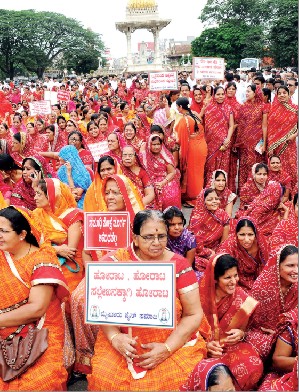
Over 2,000 members of Jain community comprising all the four sub-sects — Sthanakvasi, Moortipujak, Terapanth and Digambar Jain Samaj — took out a huge rally in the city here today to protest against the Aug. 10 ruling of the Rajasthan High Court that Sallekhana or Santhara, a religious practice of Jains, is illegal and a punishable offence.
The agitating members said that the order had deeply hurt the religious sentiments of the entire Jain community and it should be reconsidered. They noted that the Sallekhana could not be termed as an act of suicide nor it can be construed as ‘death by willingness.’ Sallekhana was a vow which was accepted by mendicants or householders according to their own wish as per the strength of the body and in tune with religious scriptures. It was a practice that was being followed since time immemorial.
Leaders of Jain community stated that as per Article 25 of the Constitution, to accept any religion, to profess it and or to propagate, is the fundamental right of any Indian citizen. Hence, the act of performing Sallekhana should be accepted as Fundamental Right of Jains.
Earlier in the morning, the members of the Jain community — men dressed in white and women representing various Mahila Mandalis attired in different hues — assembled at the Mysore Palace North Gate from where the rally commenced. Later, it passed through Ashoka Road, Mahaveer Circle, Gandhi Square, Shivarampet, D. Devaraj Urs Road and reached Deputy Commissioner’s Office to present a memorandum.
In the memorandum, they urged the Deputy Commissioner to apprise the authorities concerned to see that the Jains were not barred from following their religious rights.
The Terapanth Jain Muni Gyanendramuniji Maharaj said in his discourse that members of the Jain community would not commit violence on themselves or on others by taking recourse to Sallekhana. It was a practice to purify one’s soul and for destroying the ‘karmas.’ Prohibiting it would amount to denial of the fundamental rights allowed in the Constitution.
Calling upon the members of the community to unite on this score, he said the community would challenge it legally. Munishree Sujethakumar Maharaj was also present.
Jains regard Sallekhana or Santhara to be the highest form of passage or death and in a way not the same as suicide. It is done in full consciousness and in peace and it does require that the practitioner fast unto death. Jain texts say it is the ultimate route to attaining Moksha and breaking free from the whirlpool of life and death. The vow of Sallekhana or Santhara is taken when one feels that one’s life has served its purpose. The rationale behind Sallekhana comes from the Jain belief in karma, rebirth, asceticism and spiritual purification.
source: http://www.starofmysore.com / Star of Mysore / Home> General News / Thursday – August 27th, 2015
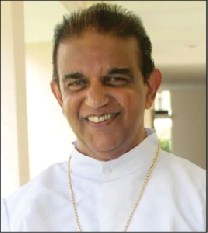
Fr. Dr. Antony Kariyil has been appointed as the new Bishop of the Mandya Diocese of Syro Malabar Church.
Antony Kariyil was born in Chalil near Cherthala, Alappuzha district in Kerala, in 1950 and became a priest in the year in 1977. Fr. Kariyil has a doctorate in Social Sciences and had decorated various Ecclesiastical positions of significance.
He has been serving as the Director of Rajagiri Engineering College in Kochi prior to the current appointment. An researcher of merit, Fr. Kariyil has several publications to his credit, including two books ‘Church and Society in Kerala: A Sociological Study’ and ‘Thiruvayassu.’
source: http://www.starofmysore.com / Star of Mysore / Home> General News / Thursday – August 27th, 2015
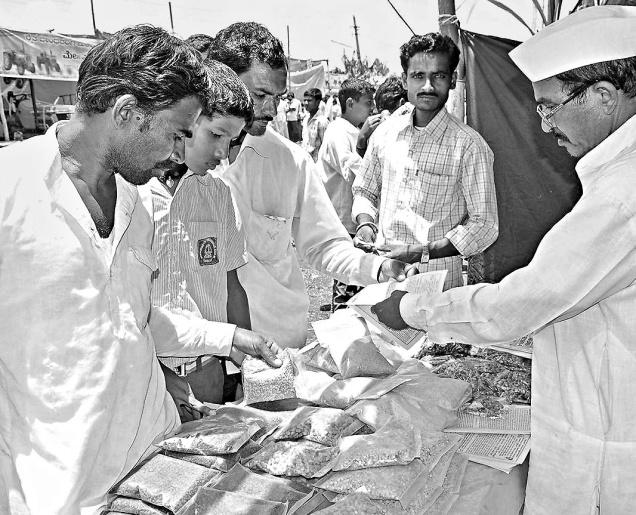
Farmers looking at various organic products displayed at the stalls during the agriculture fair at Kolhar town in Vijayapura district on Monday.— PHOTO: RAJENDRA SINGH HAJERI
For the last five years, Kolhar town of Basavanabagewadi taluk is witnessing a unique type of jatra. During the fair, an association of progressive farmers arranges a Krishi Mela (agriculture fair) for educating the farming community about the importance of organic farming.
“It is a one-of-its-kind event which is purely by the farmers, of the farmers and for the farmers. Unlike any other agriculture fair which organised by government, here, only the farmers contribute to the event,” said Siddu Balagonda.
The progressive farmer who is behind the unique event says that for the last five years he has been organising the fair with the help of other farmers in the town during the Uppashappa temple fair. He said that they noticed that during the annual religious fair, hundreds of people, mostly farmers were arriving to the temple.
“We thought of using the opportunity to hold an event which could help the farming community.
Thus, we chose to organise an agriculture fair on the issue of organic farming as it has become the need of the hour,” Mr. Balagonda said.
Winner of ‘Krishi Pandit’ and a recipient of many such awards, he said that owing to excess and unabated use of chemical fertilizer, the soil is losing fertility and commodities are becoming unhealthy.
‘Save soil’
“The best way out to save soil and have healthy food is to switch over to organic farming.
“The fair essentially focuses on this critical aspect where every year we call the experts and progressive farmers to make farmers aware of its significance for the present and future generation,” he said.
To a question, he said that the farmers have contributed around Rs. 7 lakh for holding the event.
source: http://www.thehindu.com / The Hindu / Home> National> Karnataka / by Firoz Rozindar /Kolhar (Vijayapura Dist). / August 25th, 2015