She had been engaged to pilot Rajiv Hoskote who perished in a Pawan Hans chopper crash in Arunachal Pradesh 3 months ago and cremated in city on Aug.14
Mysuru :
Nischitha Ramakrishna,who was engaged to marry city based pilot Rajiv Hoskote, who perished in a Pawan Hans Chopper crash in Arunachal Pradesh on Aug.4, 2015, passed away at a private hospital in city following brief illness.
It may be recalled that Rajiv Hoskote, a resident of Ramanuja Road was engaged to marry the Delhi-based techie Nischitha, daughter of Ramakrishna, a resident of Srirangapatna in Mandya district and the reception of their wedding had been slated for Oct.4 in Mysuru.
Pilot Manjunath, a friend of Rajiv told Star of Mysore that Nischitha, who could not bear the loss of Rajiv had slipped into depression for which she had been treated at several hospital but in vain.
Manjunath also said that Nischitha’s last rites were performed at Srirangapatna yesterday.
source: http://www.starofmysore.com / Star of Mysore / Home> General News / November 29th, 2015
The centuries old Kayani at Hinka village which is being renovated by the Yuva Brigade and the villagers.
Mysuru :
Villagers of Hinkal on Hunsur road in the city have pledged to save the centuries old Kalyani (water pond), a portion of which was about to become the property of someone else due to the negligence of MUDA authorities.
The historical Nanneshwara Temple of the village originally had an area of 42 acres, out of which only about 3 acres is now remaining with the temple. The MUDA after acquiring a portion of this land, sanctioned it to an educational institution. The land sanctioned by MUDA included centuries old Kalyani (water pond) measuring 100ft x 100ft.
The Kalyani had shrunk to a large extent as time went by, with mud and shrubs covering more than half of the pond, posing a threat to the very existence of the Kalyani. The villagers drew the attention of the people representatives about the status of the pond. But the people’s representatives including the MLA, MP and other local leaders did not pay much attention to saving the Kalyani then.
The Yuva Brigade along with Hinkal villagers taking keen interest in saving the pond, visited almost every household in the village seeking co-operation.
A few days later, the villagers led by Yuva Brigade leader Lohit Urs, started a voluntary Shramadan to save the pond.
MP Pratap Simha who came to know of the villagers resolve to save the pond, visited the spot and summoned MUDA officials, who later took up works on cleaning the pond of weeds, mud and filth by deploying excavating machines.
But the MUDA which began renovation works with great enthusiasm a few days ago, stopped the works all of a sudden yesterday, which angered Hinkal residents.
Strongly condemning the MUDA’s action of abruptly stopping the renovation works, thousands of Hinkal residents staged a demonstration at the site yesterday.
MUDA member Rakesh Papanna, who hails from Hinkal, held talks with MUDA officials and asked them to resume renovation works immediately, it is learnt.
MUDA Commissioner Dr. N. Mahesh reacting to the protest, admitted that the CA site allotted to the education institution included a portion of the Kalyani and added that the confusion arose as the Kalyani’ appeared to be a small water pond.
Meanwhile, MUDA Chairman K.R. Mohan Kumar speaking to SOM said that “As soon as we came to know of the existence of the Kalyani, we cancelled the allotment of sites around the pond and took possession of the Kalyani. The MUDA sent a JCB to excavate the pond for development and added that measures are taken to develop the Kalyani.
source: http://www.starofmysore.com / Star of Mysore / Home> General News / November 29th, 2015
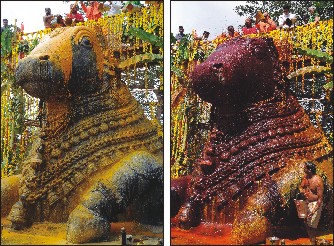
The more than 360-year-old monolith of Nandi, located mid-way on Mysuru-Chamundi Hill Road, was today, bathed in more than 30 items like milk, honey, curds, kumkum, ghee, dry fruits, tender coconut, sandal, turmeric, rice flour, etc., as devotees performed ‘Mahabhishekha’ to it.
It may be recalled that the event is being jointly organised annually by the members of ‘Bettada Balaga’ (a group of regular morning walkers to the hill) and ‘Srikshethra Chamundi Bettada Sri Nandiya Puja Mahotsava Samiti’ since 2006.
Legend has it that performing the ritual on third Sunday of Kartikamasa of the Hindu calendar enhances the life of the stone statue. It is also said that the practice of performing Mahasbhishekha to the monolith existed during the reigns of Wadiyars.
Prior to the Mahabhishekha, the statue was cleaned with water before a group of over a dozen priests conducted the abhishekha, which was witnessed by thousands of devotees and tourists.
The ritual, which began at around 10.30 am with Suttur Seer Sri Shivaratri Deshikendra Swamiji performing the ‘abhishekha’ in the presence of Pramoda Devi Wadiyar, Yaduveer Krishnadatta Chamaraja Wadiyar, Datta Vijayananda Swamiji, Junior Pontiff of Ganapathy Ashram, Chidananda Swamiji of Hosamutt, Jamanagiri Swamiji, Vyaghramukharudrapada Cave in Nandi premises and others, continued for more than four hours.
Interestingly, both Pramoda Devi and Yaduveer also performed abhishekhas.
It is said that this is the 10th Mahabhishekha being performed by the ‘Bettada Balaga’ which spends more than Rs. 2 lakh for the ‘Mahabhishekha’ annually.
Organisers had arranged lunch for more than 5,000 devotees and visitors while the employees of JSS Hospital have organised a Deepotsava at the Nandi premises on Nov.30 at 6.30 pm.
Samiti Convenor S. Shivakumar, Balaga President S. Prakashan, Working President N. Govinda, Secretary H.S. Jagannath, Treasurer V.N. Sundhar were among those present.
Scenes of foreign tourists and locals clicking pictures of the celebrations on their mobile phones and cameras were common at the venue which had been provided tight security with vehicular traffic being restricted.
source: http://www.starofmysore.com / Star of Mysore / Home> General News / November 29th, 2015
IGU Western India Ladies & Junior Girls Amateur Golf
Pranavi S. Urs winner of the ‘Category ‘C’ title in the IGU Western India Ladies & Junior Girls Amateur Golf Tournament seen with her trophy.
Mumbai :
Pranavi S. Urs of JWGC, Mysuru, taking part in the IGU Western India Ladies and Junior Girls Amateur Golf Championship held at the Bombay Presidency Golf Club, won the ‘Category C’ title with a three-day aggregate score of 220 (74+76+70) yesterday.
Pranavi S. Urs returned with a card of two-under 70 on the final day to clinch the title by four strokes. Nayanika Sanga of Maharashtra with three-day aggregate score of 224 (77+75+72) finished second and the over-night leader Anika Verma of Delhi secured the third place with a three-day aggregate score of 226 (73+75+78).
Mysuru girl Dyuthi K. Urs finished 17th in the Category ‘B’ with a three-day aggregate score of 271 (97+85+89). Diksha Dagar of Delhi with a three-day score of 227 won the Category ‘B’ title.
Tvesa Malik of Delhi with a three-day card of 228 won the Ladies title, while Sehar Atwal of Delhi with a three-day score of 218 won the Category ‘A’ title.
source: http://www.starofmysore.com / Star of Mysore / Home> Sports News / Friday – November 27th, 2015
B. Manush, a X std student of CFTRI School, set a record in State-level shot put by winning first place with a throw of 14.29 mts in the Inter District Junior Athletic Championship held at Bidar recently.
Previously, he won gold medal in Karnataka State Junior and Senior Athletic Championship held at Bengaluru in August.
Manush is the son of Balaram and Dharanishakthi. He is trained by Benaka Prasad and Srikanth.
source: http://www.starofmysore.com / Star of Mysore / Home> Sports News / Friday – November 27th, 2015
City’s and Karnataka’s top junior athlete P.S. Uma, representing Karnataka in the 31st National Junior Athletic Championships which concluded at Ranchi on Wednesday, won the silver medal in the U-20 girls Shot Put event.
Uma a product of DYES, Mysuru, and a student of Teresian College of Women, Mysuru, threw the shot put to a distance of 13.17 mts to clinch the silver. Meghana Devanga of Maharashtra won the gold with a throw of 13.73mts. Nidhi of Uttar Pradesh took the bronze with a throw of 11.83 mts. In the U-20 women’s 4×400 mts relay event, Mysuru girl M.Likitha, R.A. Chitra, H.R. Navami, G.K. Vijayakumari, representing Karnataka ‘A’ team, won the bronze medal with a timing of 3:58.46 sec.
source: http://www.starofmysore.com / Star of Mysore / Home> Sports News / Friday – November 27th, 2015
Chandrasekhara Kambar’s “Shivarathri” is a complex work of dramatic art.
Chandrasekhara Kambar, a Kannada poet and playwright, is one of the most significant dramatists of India who catapulted to national fame because of his rare gift to explore mythical and folk characters to recreate and reinterpret them to evolve a distinct modern Indian theatre idiom. He has also invented a format based on the folk form known as Bayalata which invests his dramatic art with intensity and lyricism.
A scene from the play
An innovator of Indian theatre, Kambar creates plays which are frequently seen in Hindi versions on the Delhi stage. Some of the notable productions include “Jokumaraswami” as “Aur Tota Bola” directed by Rajinder Nath and “Siri Sampige” as “Aks Tamasha” produced by the National School of Drama Repertory Company under the direction of Bhanu Bharti. These two productions have been treated as the masterpieces of contemporary Indian theatre. Recently, we have seen several versions of his Mahamayi.
The discerning theatre audience of Delhi had the opportunity to watch his “Shivarathri” in original Kannada at the festival of performing arts organised by Sangeet Natak Akademi at LTG auditorium recently under the direction of C.R. Jambe, an eminent theatre personality of Karnataka and the recipient of SNA award for 2014 for his contribution to Indian theatre as a director.
Transcending the language barrier, “Shivarathri” is a complex work of dramatic art with the narrative moving through action to climax logically and coherently which is at once disturbing and provocative, signally the end of darkness and dawn of a humane social order.
The play recreates the 12t Century radical movement in Karnataka led by Basavanna, a religious leader who wants to establish his system of universal brotherhood, replacing a social system dominated by Brahminical culture, perpetuating the inhuman Varana system. The playwright explores the inherent antagonistic contradictions of a society based on the exploitation of Dalits. The ruling classes headed by Brahmins and kings resorts to violence means to crush the movement of Basavanna. Endowed with the gift of presenting his social thesis through dramatic conflict, playwright Kambar opens his play on a tense note with every event contributing to reinforce the conflict between the values of Brahminical system and the values of Dalits. In the backdrop here is a social turmoil and violent agitation against the marriage of a Brahmin girl with a Dalit boy, destroying the colony of the Dalits. The social backdrop is formed by a vast landscape – the theft of a precious necklace by a Brahmin boy from the palace of the king to please a prostitute, the menacing distant sounds of march of Brahmins towards Dalit colony.
With a view to give a proper dramatic form to the narrative the entire action takes place in the brothel of prostitute Saavanthri. Fierce polemics starts as soon as Bijala, the king of the land, is informed by Saavanthri that his favourite prostitute is not available to serve him because she has another client to entertain. King Bijala is a frequent visitor to the brothel who comes in the night in disguise. He considers his favourite prostitute his personal property.
In the course of fierce debate, Saavanthri exposes the hypocrisy of the ruling class, asserting the values of her own class which follows values free from pretentions. They earned their bread after working hard physical labour. Her class has no value for necklace adored by the ladies of the royalty. She tells the king that the necklace kept under heavy security in the royal palace is just thrown in the garbage in her brothel.
A scene from the play
Director Jambe has aptly designed his production. The main action takes place on the centrestage. Dowan staged on either side are seen as human images with weapon evoking the sense of suspense, worry and fright. As the curtain goes up, a huge piece of cloth spreads out covering the whole space. In the dim light a huge giant like image emerges. The image tends to be an allegorical statement that the seeds of destruction are present in the womb itself of an exploitative system.
The production is aptly cast throughout. Suguna M.M. as Basavanna gives an excellent performance. The serenity of his soul and his convictions of the essential goodness of all humans is reflected in his gestures, gait and steadied style of dialogue delivery. Here is a man at peace with his inner-self to create a new social order. Lingaraju R. as king Bijala faces the indignity at the hands of a prostitute and defiance of his own minister, trying to retain a brave face. Sheela R. as Saavanthri vividly displays the courage of her convictions to confront the king, asserting her human dignity.
source: http://www.thehindu.com / The Hindu / Home> Features> Friday Review / by Diwan Singh Bajeli / November 26th, 2015
Disha Karigar demonstrating her bicycle generator.— Photo: VAIDYA
Event is an initiative of Ministry of Science and Technology
The project to generate electricity from a stationary bicycle developed by Disha Karigar, a class VII student of Mythri Higher Primary School at Shikaripur, has been selected for a national-level science exhibition, being conducted as part of Innovation in Science Pursuit for Inspired Research (INSPIRE) launched by the Ministry of Science and Technology.
The State-level exhibition (INSPIRE) was held at B.K. School at Belagavi, recently.
The model displayed by Ms. Karigar won the first place and thereby, she was chosen for the national-level event scheduled to be held at New Delhi on December 5.
The title of the project is Homemade bicycle generator. K.R. Dayanand, administrative officer of the school, said in a press release that the generator worked on Faraday’s law of electro-magnetic induction. The rim of the bicycle wheel is attached to the shaft of the DC motor of 12-volt capacity with a driving belt. When the bicycle is peddled, the belt and the shaft revolve concurrently, creating an electromagnetic field. With the effect of the electromagnetic field, electricity is generated. In this project, 150 Watts of power can be generated with 1,500 revolutions a minute (RPM).The electricity generated here could be used for domestic lighting and recharging of mobile sets. The stand and the rim of the bicycle has been fabricated to suit the purpose. Peddling of this bicycle is good for health, besides generating power through environment-friendly method, he said.
Ms. Karigar hails from Gagri, a village in Shikaripur taluk. Her father Nagaraj Karigar is a lecturer in a private Industrial Training Institute here and her mother is a homemaker.
source: http://www.thehindu.com / The Hindu / Home> National> Karnataka / Veerendra P M / Shivamogga – November 26th, 2015
The Bidar Heritage Marathon organised by GoUnesco is an interesting package for runners and history buffs.
It included a 100-km cycling trip from Hyderabad to Bidar and a visit to ‘karez’ or ‘surang bavi’, the under ground drinking water aquaduct network of the Behmani era, on Saturday and the run on Sunday. On Saturday, resource persons V. Govindan Kutty, groundwater expert and Anuradha Reddy of INTACH, Hyderabad, spoke on the cultural significance of the ‘surang bavi’.
Around 40 people attended the talk in Saharda guest house in Naubad, near the mouth of the ‘surang bavi’ in Bidar on Saturday.
“We don’t aim at making the Bidar marathon a competitive event. It is a fun run for families, young runners and heritage and archaeology lovers,” Ajay Reddy, founder of GoUnesco, said.
source: http://www.thehindu.com / The Hindu / Home> National> Karnataka / by Special Correspondent / Bidar – November 23rd, 2015
Jyoti Hegde, India’s only woman rudraveena artist, talks to Sowjanya Peddi about conquering the unconventional rudraveena and storming a male bastion
On a quiet farm away from the glitz of the urban art world, in a village near Sirsi about 125 km from Dharwad in Northern Karnataka, lives a young woman with her husband. Her name is Jyoti Hegde and she might not be splashed on newspapers but she is the first woman performing artist of the rudraveena in India. Rudraveena is a world heritage instrument, protected and promoted by the UNESCO. Jyoti follows the Khandarbani school of Dhrupad and her guru is the illustrious Ustad Asad Ali Khan.
Jyoti Hegde with Ustad Asad Ali Khan. Photo: Special Arrangement
In the rustic peace and unpretentious but generous hospitality of her home, she talks about her life and her views on Dhrupad and the rudraveena with Sowjanya Peddi. Here are the translated excerpts.
I was born in Dharwad, Karnataka, where my father was a range forest officer. I grew up in Belgaum and Sirsi. I liked dance and was particularly talented in drawing. I might have become a painter if a chance encounter with the rudraveena had not transformed my life. I was learning the sitar from my first guru Dr. Bindu Madhav Pathak and in a lec-dem one day, he played the rudraveena. The sound of the instrument haunted me. The gambhirta (sonorous resonant sound) of its tones was very different from the chanchalata (playfulness) of the sitar. I requested Pathakji to teach me, but he refused, saying it is not a woman’s domain. I persisted. I told my father about my wish. Initially, Pathakji refused my father too, but later he relented and said that “playing the rudraveena is not a woman’s forte but since she is so insistent, let us give her an old rudraveena that is lying at my house. Once she plays it for a while, she will give up the idea of her own accord”. This was like a secret pact between my father and him, unknown to me. But when Pathakji saw my commitment and determination, he eventually advised my father to get me a new rudraveena, at the age of 16, which I continue to play even today. I would go to Pathakji’s house by 7 a.m so that he could set me an exercise for the day.
He would return at 5.30 p.m. The entire day I would practise the single phrase he had taught me that morningI was so focussed that he once said I had gained the expertise of 10 years within a year. Within a year I won the first prize for rudraveena in the Akhil Bharatiya Akashvani Sangeeth Spardha in 1981-82. I was also enrolled as a regular artist at All India Radio. I also won the first prize in the Karnataka Youth Festival for three consecutive years from 1981 to 1983.
My gurus chronicle my journey from Khayal to Dhrupad. I learnt from Pathakji in the Khayal tradition. He used to compliment me, saying “she knows how to get knowledge from me”. Now after many years of teaching, I understand this was the biggest compliment. An early review commented that “the artist did not spare enough time for bandish rendition with sat sangat (jointly) on pakhawaj”. I felt the most prominent attribute of the rudraveena is its capability for nadopasana through alap. Playing with the accompanist is less important. I understood then that this instrument is not best supported by the Khayal. I discovered a book on Dhrupad by Thomas Marcotti titled The Way-Music: How to conjure with sounds? The book had a 90-minute music cassette attached to it. I was transfixed by the depth and richness of the notes and its emphasis on slow measured movement. I was drawn to Dhrupad from then on. Whenever an artist performs in the Dhrupad ang, whether sitar, surbahar or rudraveena, it will entail more emphasis on alap than on bandish.
I studied with Pt. Indudhar Nirodi for three years, who gave me a deeper understanding of Dhrupad through vocal training and taught me the subtleties of Dhrupad. After he left Dharwad, I approached Ustad Asad Ali Khan where I learnt for five years.
Rudraveena is known as the king of instruments. All string instruments are shaped after it. According to Hindu mythology, Shiva is said to have taken inspiration from Parvati’s form and created this instrument. Shiva was the first to play this instrument and he taught it to Parvati who in turn taught it to Saraswati. It was restricted initially to the dev loka and was used for aradhana (devotion) alone. Later, Narad learnt it from Saraswati and brought it down to earth. In earlier times, it was used as accompaniment for veda mantra pathan (vedic recital) and with the yaga yagna (vedic rituals) of the rishi munis (sages). It held a place of reverence equivalent to that of the shank (conch) or jagate (circular plate/gong used in temples) that produce sounds during worship rituals but are not specifically used for producing music. It was treated with the same sanctity accorded to the sacred idol. Only select people were allowed to touch it and that only after purifying themselves.
Rudraveena is considered a measure to weigh the principles and grammar of the Dhrupad style of music. As Dhrupad evolved out of Sama veda chanting, the rudraveena also came to be considered the instrument to accompany Dhrupad. The shift must have been sharp and swift, as the music left temples and entered the Mughal courts. This brought a change in lyrics, tempo and style of playing. Dhrupad lyrics were chiefly based on the varnanas (description) of deities following the earlier devotional context. In the new context, more preference was given to prakriti varnana (nature description), shringar ras (romantic feelings) and songs praising the emperor/royalty. Both the rudraveena and Dhrupad rose to popularity from the 8th to the 15th and 16th centuries. This is the golden period for rudraveena, which produced artists such as Swami Haridas, Miya Tansen, Baiju Bawra, Gopal Nayak, Nayak Bakshu and Nayak Charju among others.
In Akbar’s times the instrument was very popular and prevalent. The rise of Khayal can be seen as a development of the above context. With Khayal, the sitar emerged as a more apt accompanying instrument its playful and rapid explorations. The rudraveena receded from the scene.
The rudraveena is a large and heavy instrument. Its strings are thick and plucking them requires strength. In addition, the original posture requires keeping the instrument on the body, which means carrying 3.5 kg to 5 kg for two or three hours in one sitting. Also, the sacred context of the instrument conventionally permitted only select classes of men to play or even touch it. It was a superstition that if women played it they will not be able to conceive children. One reason could be that the Vajrasan posture might have been considered harmful for the uterus. When my mother heard this she asked me to stop playing, but I was already so much in love with it that I could not think of leaving it. Eventually I got married and conceived a son. But some controversies persist. I could not play in the Vajrasan posture during my pregnancy and adopted the Sukhasan posture. After delivery, I continue to play in Sukhasan. I don’t believe earlier restrictions on women are valid in present times. The measure of what is sacred and pure is redefined in every era. We should interpret cultural norms and injunctions as indicative of demanding inner purity from the artist.
We live a quiet life on our farm. I get much support from my husband, son and daughter- in-law who help me with modern technology to take my art forward. I relish the peace and rhythm of farm life; it brings depth and anubhav (experience) to my music.
Dhrupad is the foundation for Hindustani classical music. Unless young people take it up, it will be lost to us. The rudraveena is also disappearing because no new generation is passionate enough to learn this demanding skill. They find it difficult to support themselves [financially]…. they look for quick fame. But the foundation of our newness should be based on our own culture. If we just rush into modernity that is not our own, it will be meaningless.
The instrument
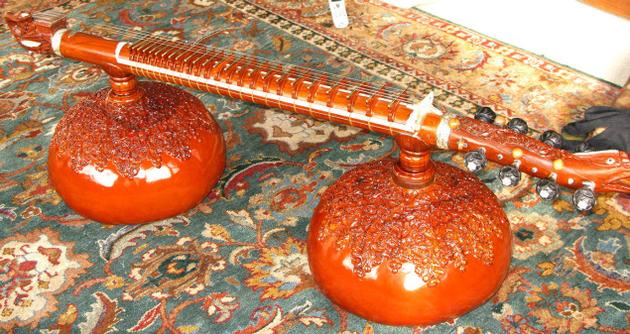
The rudraveena cannot be bought off the shelf. Its making is unique, as it is connected to the player’s body. For instance, its length should be 11 times the hand span of the player. The tuning can be completed only after it is placed on the body. The playing is connected to the player’s breathing rhythm. Traditionally, it was played only in the vajrasan pose.
One tumba (gourd) is kept on the right thigh and one on the shoulder, the right hand plucks the strings going over the right tumba and the left holds the strings with the left ear touching the left tumba. Khanji used to associate this posture with the sacred Swastika.
The instrument’s centre falls between the navel and the heart. The vibrations circulate in our inner body with the sound of ‘om’ entering the left ear from the left tumba. The right tumba’s vibrations go through the lower body through the right thigh. These vibrations produce inner well-being and tune us to the universal nada (sound). The instrument is itself a tool of pranayam and yoga. For those who have not mastered breathing, it is a difficult instrument to learn.
source: http://www.thehindu.com / The Hindu / Home> Features> Friday Review> Music / Sowjanya Peddi / November 26th, 2015