Jumboo Savari, the finale of Dasara festival is no doubt the prime attraction in city especially the golden howdah being carried by a mighty humble elephant.
Many are unaware of the intricate preparations to be made before the howdah could be mounted on the back of the elephant.
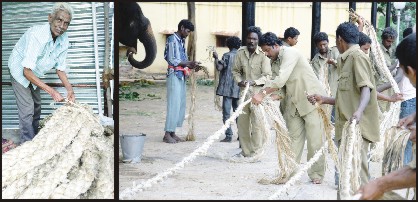
The howdah is actually placed on a thick mattress which is fastened to the back of the elephant using jute ropes.
The mattress is actually a combination of three different layers colloquially called Gaadhi, Namda and chapu.
The bottom layer Namda is actually a combination of gunny cloth and white cotton cloth woven together to get a soft texture.
Over Namda is Gaadhi which is a huge square gunny sack stuffed with wild grass grown on the bank of lakes.
Chapu is the top most layered thick cloth cover.
In short the three layer mattress is supposed to provide a firm soft support for the howdah and make the bearer elephant comfortable to carry the heavy load for a good distance.
The unsung hero instrumental in making the mattress is Pasha, a mahout of elephant Sarala who retired in 2006 but has also been doing this job of stitching the three-layer mattress right from 1971. His passion for the job and love of elephants has been recognised by the Forest Department to still keep him on the rolls. Pasha’s father Sultan too was a mahout for the Pattada Aane Hamsaraja of Jayachamaraja Wadiyar.
Pasha does not just make Namda, Gaadhi and Chapu but also weaves the thick jute rope from strands which takes about three days to make.
Speaking to SOM, Pasha said that he would begin making the jute rope ten days before Dasara. He added that he has been training other mahouts to make the mattress and rope. However he said that he was not happy to be in the forest all through and wanted his son Mansoor not to step into his shoes.
source: http://www.starofmysore.com / Star of Mysore / Home> General News / September 12th, 2013
A basketful of yum: Fusing recipes from the USA and Europe with Indian flavours / Photo: Murali Kumar K. / The Hindu
Martha Kohlhagen, who settled down in Bangalore and runs a gourmet enterprise. She makes preserves, sauces, and desserts
Chicken breast stuffed with apple and onion relish, lemon tarts made with lemon curd, pannacotta vanilla cream dessert using caramel sauce, fresh vegetable salad with orange vinaigrette and chicken and pesto pastry. Such delicious food was prepared at Foodhall in 1 M.G. Road recently by Martha Kohlhagen with Chef Lynn Clemente, from Vivanta by Taj Whitefield. They also shared insights on what goes into preparing a good continental meal.
Martha, from Colorado in the United States, made Bangalore her home six years ago. “I first came to the city with an IT firm,” says Martha. But her interest in food led her to start her own company, Martha’s Preserves, in the city, which offers gourmet preserves, sauces, and desserts.
With continental restaurants mushrooming at every corner of the city and shows like MasterChef becoming increasingly popular, the interest in continental cuisine has been growing.
“There’s a huge market and interest in continental food. It’s a question of how you go about it. Where do you get ingredients? You have to pay attention to and look for what products are available in the market,” says Martha, who launched Martha’s Preserves in December last year.
“I have taken traditional recipes from the US and Europe and blended Indian flavours within them. My most popular products are my pineapple chilli jams, pomegranate orange marmalades, chocolate and pesto sauce. I have introduced French caramel sauce and fig and raisin jam. All of my products are an infusion of flavours of different cuisines.”
All the products of Martha’s Preserves are a 100 per cent natural, with no preservatives. “And it’s good, good food. I don’t compromise on the quality of my products. Each bottle is full of fruit and vegetables” adds Martha.
Gourmet food to her is about using the best ingredients to bring out the best flavours. “There is a difference between eating and really enjoying food. Gourmet food is about enjoying what you eat and saying ‘wow, that’s really good!’ It goes back to the quality and care in making the product.”
Martha speaks of what constitutes continental cuisine, and says depending on how you prepare it, there is something for vegetarians in it too. “It’s primarily preparations of meat and vegetable. If you are a vegetarian, you can expand on the vegetarian part — it’s a good balance of various types of food in one meal. The main course must be as good as the accompaniments and vice-versa. You can stuff the same things in a zucchini as you do in a chicken and it tastes equally good. All my products are vegetarian. But the lemon curd does have egg.”
Martha’s facebook page, Martha’s Preserves, also has recipes, which suggest ways in which you could use her products. You could also visit her website www.marthasfoods.com
source: http://www.thehindu.com / The Hindu / Home> Features> MetroPlus> Food / by Sravasti Datta / Bangalore – September 01st, 2013
After technology sector, it’s the health sector in Bangalore that is witnessing a reverse brain drain. Across fields-nephrology, general medicine, pathology, orthopaedics and oncology among others, doctors are returning to India in general and Bangalore in particular.
On an average big medical hospital chains in the city each get 8 to 10 applications every month from Indian doctors in the US, the UK, Canada, Australia and Singapore. “I interview one doctor a week. And in the last six months I have got 12 applications for jobs from doctors abroad. They are all in their 30s,” says Dr H Sudarshan Ballal, medical director, Manipal Hospitals.
The scene is no different at Sparsh Hospital on Narayana Health City campus where chief orthopaedic and hospital head Dr Sharan Patil scrutinizes at least 10 applications every month from doctors in the UK, Australia and the US.
“There is no bigger canvas to paint yourself than in medicine. Two decades ago when doctors left India, the opportunities were few. Today opportunities outweigh frustrations. After the training, they want to return,” says Dr Patil, who himself spent five years in the UK before returning to the city to become a doctor-entrepreneur.
Ten of the 40 orthopaedicians at Sparsh are those who have returned from abroad. “I began to feel I was making no difference in my job and decided to leave Australia. I find it more satisfying here. But it is good to study and train abroad for some time,” says Dr A Thomas, spine surgeon, who practised for five years at St George Hospital, University of South Wales.
Hospital honchos are seeing the trend only in the past five years. In many hospital chains of Bangalore, the entrepreneurs are doctors themselves who left practice in the dream country where they were and came back home.
For Dr Ajai Kumar who worked at the Anderson Cancer Hospital in the US, India is evolved and it’s an experience doctors don’t want to miss out on. “The country I left in the 1970s is astounding now. It has all the infrastructure and there is no dearth of training. So what is the excuse now?” says the oncologist, who started the HCG chain of hospitals in India after spending nearly two decades in the US.
The alarming growth of cancer is also one factor drawing doctors to Bangalore. Dr Ajai gets about 15 applications from doctors in the 30-40 age group every year. From paediatric oncologist to hepato biliary surgeon at HCG, the specialists who have returned to Bangalore are from across the spectrum.
Ask Dr Pallavi Rao, pathologist, who got back to Bangalore from the UK with her radiologist husband Dr Srikanth Narayanaswamy, why she took the call. “We were there from 2005 to 2012. We chose to come back home as it stopped exciting us there,” she says.
Ditto with Dr Rekha Bhatt who joined the Manipal hospital after winding up her practice in the US. “Go there to study but get back here. India is the place to put your studies to use,” says the pathologist.
For many, it is the learning experience that matters. There is no TB, dengue or malaria in western countries. “For doctors, especially youngsters, treating diseases that are prevalent means more exposure. India is a great lab for doctors because of the sheer size and the number of surgeries we do,” says cardiologist Dr Devi Shetty.
“Coming back was no compromise for me. I began to feel that Bangalore was in no way inferior to other countries, especially in my area of specialization,” says endocrinologist Dr Karthik Prabhakar who left for the UK in 1998 only to get back to the city.
For many the dream of foreign shores is over. As a child, one of India’s top nephrologists Dr Ballal dreamt of going to the US and working there. He worked towards his dream and at 21, got his green card to do his MD in nephrology and critical care. “I was not keen on coming back. In 1991, I reluctantly returned. I told myself I will give two years to decide if I want to go back. The first few months were miserable. Twenty years on, I have no regrets. I will never leave India.”
source: http://www.articles.timesofindia.indiatimes.com/ The Times of India / Home> India> HCG / by Seethalakshmi, TNN / September 03rd, 2013
The Mudhol hound, which was on the verge of extinction, has become a source of livelihood for hundreds of families in Bagalkot district. The breeding of these hounds has helped improve the living standards of several poor dalit families after the government set up a separate research centre in Timmapur village of Mudhol taluk. These hounds are one among the 32 such breeds recognised at the international level.
The Mudhol Hounds Research and Information Centre has been encouraging breeding and reproduction by providing puppies to more than 300 dalit families in Bagalkot.
The centre is also supplying food and free medical care to these hounds apart from training the beneficiaries who can sell the puppies. The families involved in the breeding exercise is on the rise as there is a heavy demand for Mudhol hounds from various parts of the country and abroad.
“A family can easily earn upto `3 lakh a year if it has three female and a male hound. The cost of each puppy has gone up to `7,500 from just `1,000 two years ago. We will help more dalit families become self-reliant by breeding the hounds and selling them if the government provides more assistance”, said head of Mudhol Hounds Research and Information Centre Dr Venkangouda Doddagoudar.
These dogs were brought to India by Persians, Arabs and Afghans several centuries ago. The hounds are known for their ability to endure extreme weather and for their hunting skills. There are people involved in breeding of hounds in several villages in Mudhol, Bilagi and Jamkhandi of Bagalkot district. People arrive from various parts of the country to buy these hounds during the dog show held every year.
“The maintenance of Mudhol hounds is economical as these hounds eat very less. They sleep less during the night and can identify a scent quickly”, said Rajendra Chandanshiva who belongs to a family involved in the breeding of these hounds for the last three centuries since the Mughal era.
source: http://www.deccanchronicle.com / Deccan Chronicle / Home> News> Current Affairs / DC / by Vittal Shastri / September 04th, 2013
The team of 25 students participated in competitions in Germany and Czech Republic; bagged second prize in cost and manufacturing.
Members of Formula Manipal 2013 team with the formula racing car designed by them. – DNA
Formula Manipal 2013, an annual student project of building their own formula racing cars for international racetracks students of Manipal Institute of Technology (MIT), has earned the second prize in a prestigious event in Germany.
This year, for the first time, the team comprising 25 students, participated in competitions in Germany and the Czech Republic. The team did well in both places and even bagged the second prize in cost and manufacturing in the content in Germany.
The team consists of 25 undergraduate students led by Aakhilesh Singhania (team leader) and Rishu Raj Singh (team manager). Over 23 countries participated in Germany. This was the first-ever podium finish for a Formula Manipal team.
This was the fifth time formula cars have been built and tested by the students of MIT on the international racetracks. The competition was been organised by the Society of Automotive Engineers (SAE).
Improving upon last season’s design, the team innovated and came up with a more compact design this year with reduced weight and lighter bodywork. The students used a Honda CBR 600RR engine and also incorporated a Drexler Differential along with electro-pneumatic gear shifting. The team also used a custom made driveline and uprights, thus giving them a competitive edge.
Before participating in the competition, the team carried extensive testing on the FMX3 both in India and abroad. In India, they tested the car at a local karting track. Testing was also done in Austria at the Red Bull Ring with Joanneum Racing Graz of UAS Graz, which has helped the team perform at the competitions.
In the Cost Event, the team had to make a cost report including a bill of materials and components used. This report is then scrutinised by the judges and a discussion at the competition with the Cost Judges around the team’s vehicle is held.
This evaluates not only the cost of the car, but also the team’s ability to prepare accurate engineering and manufacturing cost estimates. And finally, a ‘real case’ scenario is held and students will have to respond to a challenge related to cost or manufacturing of the student vehicle.
The team cleared tech inspection on the very first day and also did quite well in the dynamic events. They achieved an acceleration of 4.62 seconds in the acceleration at FSG.
Formula Manipal also participated in Formula Student Czech Republic and made history by becoming the only Indian team to complete in endurance for the Formula Student Season 2013, fetching them an overall rank of ninth in the event.
Doing so, it also became the only Indian team to complete endurance with electro-pneumatic gear shifting.
The ambassadors were applauded and appreciated by renowned judges of the formula world including Claude Rouelle, the president of Optimum G and Pat Clarke, renowned bike racer.
Formula SAE (FSAE) is a competition organised by the SAE for students. The challenge for the students is to design and manufacture a formula race car with specific design and safety considerations as per the guidelines laid down by FSAE. The different cars competing at the event are evaluated on quality of design and performance.
Competitions is held in 10 different zones around the globe.
More than 2000 engineering students participate from over 23 countries to showcase their technical.
source: http://www.dnaindia.com / DNA / Home> Bangalore> / Report / by DNA , Place:Manipal, Agency:DNA / Tuesday – August 27th, 2013
Vishwaprasad Alva (right), Managing Director, Skanray, is seen with Alex Vieux, Chairman, Red Herring, at the awards ceremony in Hong Kong.
Mysore :
Skanray Healthcare, located at KIADB Industrial Area in Hebbal here was declared winner of 2013 ‘Red Herring top Asia award’ at a ceremony held in Hong Kong on Sept.5.
Vishwaprasad Alva, Managing Director, Skanray, received the award from Alex Vieux, Chairman, Red Herring.
Red Herring announced its Top 100 awards in recognition of the leading private companies from Asia, celebrating these startups’ innovations and technologies across their respec- tive industries.
Red Herring’s Top 100 Asia list has become a mark of distinction for identifying promising new companies and entrepreneurs. Red Herring editors were among the first to recognise that companies such as Facebook, Twitter, Google, Yahoo, Skype, Salesforce.com, YouTube, and eBay would change the way we live and work.
“Choosing the companies with the strongest potential was by no means a small feat,” said Alex Vieux, publisher and CEO of Red Herring. “After rigorous contemplation and discussion, we narrowed our list down from hundreds of candidates from across Asia to the Top 100 winners. We believe Skanray embodies the vision, drive and innovation that define a successful entrepreneurial venture. Skanray should be proud of its accomplishment, as the competition was the strongest it has ever been.”
About Red Herring
It is a global media company, which unites the world’s best high technology innovators, venture investors and business decision makers in a variety of forums, including print, online and exclusive events worldwide. Red Herring provides an insider’s access to the global innovation economy, identifying new and innovative technology companies and entrepreneurs. Its Red Herring 100 awards for North America, Europe, Asia and Global have recognised more than 5,000 companies in their early stages, including Baidu, Google, eBay, Skype.
About Skanray
It is one of the fastest growing medical devices and solutions company that is spreading globally and aims at becoming the world’s largest primary and Mass healthcare devices, technology and solutions company. It recently set up a design centre in Europe for advanced product technology just after announcing its investments into its Brazil operations.
source: http://www.starofmysore.com / Star of Mysore / Home> General News / September 10th, 2013
In 1992, legendary Hindustani classical khayal-style vocalist Padma Vibhushan Pandit Mallikarjun Mansur was diagnosed with cancer. While doctors gave him 48 hours, he lived for another 15 days, in which he packed two concerts. He became one with his art and the last concert, which marked an end to a career spanning over six decades, was aired on the radio. Pandit Mansur sang in Raag Malhaar for his final performance.
To commemorate his death anniversary, sarod player Pandit Biswajit Roy Choudhury and vocalist Priyadarshini Kulkarni will perform at Rang Malhaar, an annual tribute concert being held today in the city. The concert is being organised by The New Age Foundation.
“I would undoubtedly rank him among the top five vocalists of all time,” says Roy Choudhury, who trained with Ustad Amjad Ali Khan, and then became associated with Mansur until the latter’s demise. Recounting his first encounter with Mansur, Roy Choudhury says, “I was training under Ustad Khan in Delhi. In 1981, Mansur came to Delhi for a concert and my guru asked me to take care of Mansur’s hospitality. I had gone to receive him at the station and on our way back, I asked him a few questions about music. Gregarious as he was, he engaged in an insightful conversation and made me feel as though we were on the same plane of knowledge and consciousness. He could simplify the most complicated things.”
Roy Chowdhury adds, “Mansur had a similar effect on music. He sang ragas that were rarely touched. Ragas such as Sakh and Bhaduri Todi, which are an amalgamation of ragas, were the kind of sounds Mansur dabbled with. He sang the signature ragas of the Jaipur-Atrauli gharana and made them sound simple.”
Kulkarni says that the Jaipur-Atrauli gharana, to which Mansur belonged, is known for intellectual singing. He adds, “Though the singing is intellectual, because of the complexity, it is aesthetic. Mansur simplified notes by singing them effortlessly. I became witness to his mastery when during a concert, he lingered on a higher octave of ‘sa’, and the sound that rose from his mouth was one with the note being played on the tanpura. Once could barely tell the difference.”
source: http://www.indianexpress.com / The Indian Express / by Rushil Dutta / Sunday – September 01st, 2013
Beat-Boxing, a rare form of art, is becoming popular in city, with S.Ranjith Gowda who has performed at a number of occasions is attracting large crowds now in city.
Well, it has nothing to do with gloves and boxing, but yes, with a mike.
Beat Boxing is a form of vocal percussion primarily involving the art of producing drum beats, rhythm, and musical sounds using one’s mouth, lips, tongue, and voice. An evolving art form in India, beat-boxing created a space for itself, particularly amongst youngsters, through online videos and live gigs. In contemporary pop music, the relatively young vocal art form of beat-boxing is an element of hip-hop culture.
Ranjith Gowda, a second year BBM student of Vidyaashram College in city speaking to Star of Mysore said that he actually wanted to be a drummer, but as the drum sets were expensive, he started Beat Boxing after being fascinated by watching it on TV.
He said whenever people listen to beat-boxing, there are two big questions that come up in their minds, What are those noises? And how are they being made? He said the truth about beatbox sounds is that most of them are just tweaked-up or combined sounds of the kind we use in speech, and nearly all the rest are sounds we could use in speech but usually don’t. Anyone can imitate a drum by making “tikatikatikatika poom poom poom” sounds. But when beatboxers do it actually sounds worth listening to.
He said that important elements in becoming a beatboxer are mastering when to breathe. This is a different situation than talking or singing. With so many explosive sounds pushing air out, breathing has to be carefully planned. Another crucial element is the proper way to hold the microphone, if you choose to use one. Different grips are used in the production of different sounds, and in some cases two mikes are used.
Ranjith said that Beat-boxing may also include body percussion as well as vocal percussion, depending on which definition one goes by. However, Human Beatbox defines beat-boxing ‘as the art of producing drum beats, rhythm, and musical sounds using one’s mouth, lips, tongue, voice, nasal passage and throat.’
Claiming to be the only Beat Boxer in city, Ranjith said that he has performed in Mysore, Bangalore, Tumkur and other places, and said that he would be performing in Mumbai next month.
Ranjith spends most of his days performing and during the weekend, he conducts beatbox workshops in city.
Having performed at college fests, Mall of Mysore and private parties, this talented youth in his early 20s has imbibed this art without knowing the ABC of music.
A Music Reality Show on TV, where in this fascinating art form was presented inspired him to learn. To gain further knowledge, Ranjith browsed and listened to Beat Boxing.
Rigorous practice has now made him the only Beat Boxer in city, thus earning him the name ‘Ranjith Gowda Beat Boxer.’
Beat Boxing was his favourite time pass and hobby until he first performed at the College Day function wherein he received a lot of appreciation and turned him into a professional Beat Boxer. Thus began his journey as a beat boxer.
He says, his big moment was during the performance at Dasara Exhibition which fetched him the ‘Best Artiste of the Year’ award and also gave him ample opportunities and kept him busy all the time performing at fests, restaurants, private parties and gigs.
Ranjith has also introduced his own new way of Beat Boxing with Harmonica and Flute in free style and has been given a direct entry to participate in India’s Got Talent Fifth Season for which he will be travelling to Mumbai in the month of November or December for the shoot.
In his advice to youngsters who want to be beat boxers, he said that one should not smoke or consume alcohol as one cannot perform with these addictions and says “Every experience you have is designed to make you stronger.”
You can follow him on facebook or watch his videos on Youtube.
In the realm of taking Mysore to National and International levels, he has stood out in winning the hearts of the crowd wherever he performs.
Ranjith is the son of Shiva, a businessman and T.N.Shantha, a housewife and a resident of Bannimantap.
Ranjith can be contacted on Mob: 89712-57704 or e-mail: ranjith.gowda43@gmail.com.
source: http://www.starofmysore.com / Star of Mysore / Home> Feature Articles / by S. Kenneth Shishir and Shalini / September 10th, 2013
A three-day Thai exhibition to improve bilateral trade ties between Thailand and India concluded here today.
Visitors were enthralled by a wide variety of items in the 25 stalls put in the trade fair, ranging from jewellery, footwear, decorative items to eateries.
“There are lots of fresh juices and natural pulp kind of juices so that you can enhance the flavours. There are very nice cute dolls, the artificial jewellery and the real gem stones, which are very expensive and the accessories suits the needs, whatever the ladies are interested in,” said Anisha, a visitor.
The first two days of the exhibition were reserved for display of the products, and sale of these items was opened on the last day of the event.
The sellers from Thailand felt that it was a great opportunity for their market to be spreading wings in India.
“This is the first time that we have come here to Bangalore, India. Our policy is that we would like to expand in the overseas market and last our company expanded to Indonesian market and the ASEAN market already. And right now this is why we would like to try to Indian market. And I think it is a big opportunity for the Thailand market,” said Tania, the owner of a toy stall.
The two Asian countries have maintained diplomatic relations since India gained Independence from the British rule in 1947.
India and Thailand have worked towards strengthening their trade relations in the past few years. Thailand is aiming at increasing trade with India to 16 billion $ by 2014.
According to media reports, bilateral trade between Thailand and India grew substantially in the last 15 years, reaching 8.6 billion $ in 2012.
India is in a free trade agreement (FTA) with ASEAN countries since 2010 that facilitates trade between the ASEAN countries, including Thailand. (ANI)
source: http://www.newstrackindia.com / News Track India / Home> Economy> by ANI / Bangalore – Saturday, August 31st, 2013
City’s Varsha S. Puranik, a talented roller skater who is a National Champion in the women’s category for the last five successive years, was awarded the prestigious Ekalavya award by the Govt. of Karnataka in a grand function at Raj Bhavan, Bangalore last week. She recently represented India in the World Games 2013 at Cali, Colombia and fared well (finished 16th in 500m road race). She is our “Star This Week.”
Varsha S. Puranik, 25, is a II Year M.D. Microbiology student, JSS Medical College, Mysore. She is the proud daughter of R. Srirama Krishna (retd. IOB) and Thara Srirama. Her elder brother Sri Harsha’s roller skating exploits inspired her also to take up to this sport.
Starting skating at a young age of 3, Varsha began her basics at Bal Bhavan Roller Skating rink under the guidance of Ravi in 1990. She jointed Vishwamithra Roller Skating Club in 1993 and started to train under the guidance of late K. Sridhar Rao at J.K. Grounds. Presently, she is trained under R. Srikanta Rao, a Ekalavya awardee at the Rao’s Roller Skating Club.
Varsha has represented Karnataka in 17 National championships and has emerged as a top roller skater in the junior and senior sections. She emerged as the fastest skater in the country in 2008 and 2010 Nationals.
Varsha first represented the country in the International level in 2001 in the World Inline Speed Skating Championships at France in 2001 (10km race- finished 16th). She got her first Intl. medal when she was part of the Indian relay team which won bronze in 5km relay at the Asian Roller Skating Championships.
In 2003, she represented India in the World Junior Championships at Venezuela (5km race-finished 15th). In 2004, representing India at the 10th Asian Championships at Japan, she finished 4th in the individual event. In 2010, she represented India in the 16th Asian Games at Guangzhou, China (3000m-finished 7th).
source: http://www.starofmysore.com / Star of Mysore / Home> Sports News / September 08th, 2013