Vaidya Sahitya Award to Mysore Doctor

Gulbarga, Nov. 16

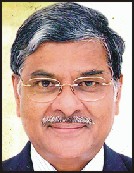
The book ‘Madhumeha: Dashavyadhigala Mula’ written by well-known Diabetician of Mysore Dr. V. Lakshminarayana and published by Kuvempu Bhasha Bharathi Authority has been selected for the Dr. P.S. Shankara Shreshta Vaidya Sahitya award for the year 2012.

The award carries a cash prize of Rs. 5,000, certificate and a plaque. The award will be presented to Dr. Lakshminarayana at the Dr. P.S. Shankara Pratisthan’s 13th anniversary function to be held at Gulbarga on Jan. 1, 2013.

Dr. Lakshminarayana has the credit of having served Rashtrakavi Kuvempu as his personal doctor for a decade. In his book, Dr. Lakshminarayana has explained in simple language his research experience and about the practical treatment.

source: http://www.StarofMysore.com / General News / November 16th, 2012

Start up boom: Now, Vinod Khosla sets up incubator in Bangalore

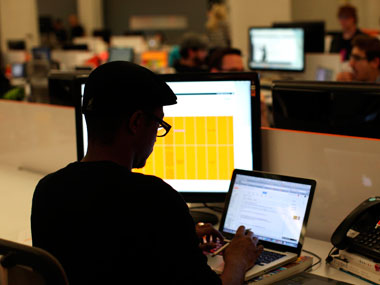
In another fillip to the start up ecosystem in India, veteran Silicon Valley venture capitalist and Sun Microsystems co-founder Vinod Khosla has set up an incubation centre in Bangalore, according to a Business Standard report.

Srikanth Nadhamuni, the head of technology at the Indian government’s Unique Identification Authority of India (UIDAI) will head the incubator as its CEO.

The Business Standard report added that the incubator will help in creating ventures that can solve issues like social inequality, governance issues and public grievances in India.

Picture: Reuters

Firstpost had earlier elaborated  on the problems incubators in India face starting from making technology innovations commercially viable to the lack of acquisitions of these start ups by bigger companies.

The article also questioned the success of some Indian incubators which are run by academicians and not entrepreneurs themselves.

Most entrepreneurs are of the view that incubators set up by entrepreneurs themselves tend to have better success rates because the portfolio companies benefit from the mentors’ business connections, experiences and mistakes. They also tend to have a sound understanding of the market they cater to.

The rising number of incubators including the Start up village in Kochi spearheaded by Infosys’ Kris Gopalakrishnan and Angel Prime, set up by serial Silicon Valley entrepreneur Bala Parthasarathy are seeing a tremendous opportunity in India which has made the Indian entrepreneurs and investors through out the world sit up and take notice of the booming entrepreneurship scene here.

What remains to be seen is if the government will welcome them with investor-friendly regulations and policies.

source: http://www.FirstPost.com / Firstpost> Business / by FPStaff / November 12th, 2012

No way to maintain our heritage at Halebidu

These are the days where countries with honest and intelligent rulers are quick to capitalise on their God-given and history created tourist destinations. Even small countries like Seychelles, Maldives, Mauritius and Bhutan, so also many in other parts of the world have more per capita income, GDP and foreign exchange reserve considering their small size compared to many bigger countries like India. It is indeed sad that India, with so many wondrous historical ruins, monuments and scenic nature with the very Himalayas standing tall, is very poor in exploiting the ever increasing tourist business.

To come to the point, I am impelled to write on the subject after listening to the laments of an artist, a well known painter, who had just returned from a visit to Belur and Halebidu, a four hours journey from Mysore.

Belur was the capital of the Hoysala empire near Hassan in Karnataka. The Belur Chennakeshava temple complex embellished with sculptures and carvings of female dancers and scenes from epics and puranas was built by Shantaladevi, herself a danseuse par excellence and queen of the king Vishnuvardhana. The work on the temple was started in 1117 BC and completed later on by Vishnuvardhana’s grandson Veeraballala II, taking some 103 years. The renowned sculptor of the period Jakanachari was credited with the carving of most of the sculptures. There are the sculptures of many celestial beauties from puranas, epics and mythology. According to my friend, the upkeep of the temple complex has always been poor and presently it has worsened.

However, the bad news is from Halebidu, which is 16 kms from Belur. Its earlier name was Dwarasamudra and was the capital of the Hoysala empire and the temple complex has Hoysaleshwara as the main deity. The temple dates back to 1121 BC and is astounding for its wealth of sculptural details. The walls of the temple are covered with an endless variety of depiction from Hindu mythology which includes animals, birds, shilabalikas and dancing figures similar to those found in Belur Chennakeshava temple. It appears this temple took 86 years to complete. This temple is now being proposed as UNESCO World Heritage Site.

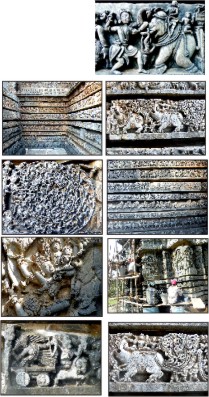
Unfortunately, such an important historical and cultural centre of great tourist interest is not looked after with care and concern by the Archeological Survey of India which is entrusted with this task. At the Halebidu temple, my friend saw 20 agricultural labourers perched on scaffoldings, busy cleaning up the sculptures of figurines carved on soap stone [see picture]. They were hired by the authorities on the basis of daily wages.

My friend was aghast looking at the way the scaffolding of wooden poles was constructed. The scaffoldings were held in place by tying them up in ropes around the carved figures of animals and mythological characters [see picture No. 4 above] which would definitely damage the sculptures and it was possible some of the carved images would either get chipped or broken. Such irresponsibility even in such a simple matter of providing scaffolding. These days, scaffoldings made of iron pipes or slotted angles are easily available. These iron scaffoldings stand on their own without being tied to the building, as they have done in the present case.

As regards the cleaning of those images, the authorities do not seem to have applied their mind regarding the liquid and the brush used for the purpose. The so called chemical cleaning seems to be just an excuse to justify billing, says my friend. He found ammonium soap oil was being used and he says the soap stone used in the sculpture will tend to melt gradually. Worse was, they were using a toothbrush for the purpose, which was bound to damage the delicate carvings on the wall.

He also noticed the guides touching the images on the wall while describing them to the tourists. Apparently, they were not qualified and trained guides. In the Sun Temple at Konark in Odisha, much care is taken in this regard to avoid the guides and tourists from touching the statues and figurines, forcing them to keep distance. Rope barricades are used.

According to my friend, the three important temples in this region, namely those at Belur, Halebidu and Somanathapura (which is near Mysore) are built using soap stone and therefore, they need to be well protected from vandalism cau-sed in the manner mentioned above by the tourists and the Department of Archaeology.

In these days of privatisation of many public sector units and public works, the government may well consider outsourcing experts to protect and maintain our ancient heritage structures and ruins to save them for posterity. Otherwise, if they are maintained the way they are maintained today, before long, these temples would become just archaeological sites of ruins and find their place only in our history books and coffee table books. The Government of Karnataka must wake up to the dangers these great heritage temples and other structures are facing and take steps to protect them and not allow civil contractors to destroy them in the name of cleaning, maintenance and restoration.

Tailpiece: My friend had travelled all the way to Halebidu temple to take pictures of the mighty behemoth of an elephant belonging to the lineage of the vehicle of Lord Vishnu, the famed Airavata, being ridden by a king Bhagadatta mentioned in Mahabharata and who fought on the side of Kauravas.

e-mail: kbg@starofmysore.com

source: http://www.StarofMysore.com / Home> Feature Articles / by K.B. Ganapathy / November 12th, 2012
Country’s first intelligent transport system launched in city

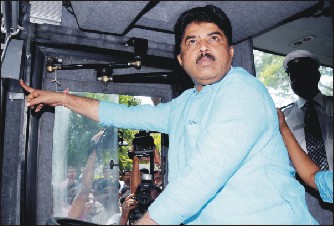
Caption: The Transport Minister R. Ashok is seen switching on the Intelligent Transport System (ITS) in a KSRTC bus in front of Senate Bhavan, Manasagangotri in city this morning.

Mysore, Nov. 17

The Intelligent Transport System (ITS), a first of its kind in the country, was launched by Deputy Chief Minister and Transport Minister R. Ashok here this noon.

Speaking after launching the ITS system at a function held at Sri Nalwadi Krishnaraja Wadiyar auditorium, Senate Bhavan in Manasagangotri, Ashok said that the system is provided at a cost of Rs. 30 crore.

“It will facilitate passengers to get information such as arrival of buses to the stops and details of bus movement from select bus stops by sending SMSes,” he said and added that the ITS system would be extended to other cities in future.

“The State Government is working towards extending transport facilities to every village,” Ashok said and added that plans are on the anvil to introduce intra-city buses in Tumkur, Gulbarga and Mangalore also, in order to prevent people from spending more on private or personal transport.

“The ITS is a game-changer,” said the Minister and added that it will make public transport more efficient and transparent.

Automatic Vehicle Location (AVL) information has been provided to track all city buses in real-time, Passenger Information System (PIS) have been installed at 193 locations, in-bus Display and Automated Voice Announcement System have been provided in all city buses, Central Control Station with Video Wall, Servers, Workstations and Software and MIS reports on fleet management providing performance of the bus system and drivers.

Informaiton can be obtained from the 167 LED display boards and 26 LFD boards at terminals, stops and others strategic locations.

For Interactive Voice Response System (IVRS) — dial 1800 4255220.

SMS 98700-11012 to get bus arrivals and departures in real-time at all bus stops in the city.

Log in to http://mitra.ksrtc.in for real-time bus location map.

Chamaraja MLA H.S. Shankaralingegowda presided over the function.

MLC Siddaraju, Karnataka Zoo Authority Chairman M. Nanjundaswamy, MUDA Chairman L. Nagendra, Karnataka Exhibition Authority Chairman B.P. Manjunath, KSRTC MD Manjunath and others were present on the occasion.

source: http://www.StarofMysore.com / Home> General News / November 17th, 2012

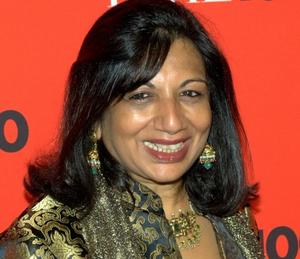
Kiran Mazumdar-Shaw: From motor garage to a $800 mn business

If you don’t know her, you’re oblivious of one of India’s richest women and that too a self-made millionairre.

Kiran Mazumdar-Shaw, who owns the $800million biotech giant, Biocon (one of India’s leading drug companies) didn’t make it to the Forbes Magazine’s 100 ‘Most Powerful Women’ in the world list just like that. But, it took her a lot of her sweat and blood to attain the unprecedented success that she has.

Interestingly, many won’t know that the businesswoman started her humble journey out of a garage in 1978 and that too in less than $200. Well, that’s what a report on CNN has divulged about the entreprenuer.

“I had a lot of foolish courage because when I started up the company I found I had huge credibility challenges to overcome. I was a 25-year-old woman with no business experience, I was trying to pioneer a sector called biotechnology which nobody had heard of. I therefore had huge challenges from getting financial backing to even getting people to work in the organization,” CNN quoted Kiran as saying.

“I was finding it very difficult to get a job as a brew master,” she said.

“It was a chance encounter with a biotech entrepreneur from Ireland that got me started as an entrepreneur in India, because I partnered this Irish company in setting up India’s first biotech company. It has taken me over 30 years to get from a garage to the huge campus that we have today. And it’s been a long journey — it’s been a very exciting journey,” she added.

Interestingly, Kiran was India’s first qualified master brewer, but she turned to setting up her own business after failing to find a job in the brewing sector.

Being a woman, the lady has ensured that she helps fellow women, in fact, she employs around 5,000 scientists, 40 percent are women.

“One of my objectives when I started Biocon was to make sure that I create a company for women scientists to pursue a vocation,” said Mazumdar-Shaw.

Photo courtesy: blog.shankbone.org

source: http://www.DailyBhaskar.com / Home> New Woman / November 16th, 2012

Strides Arcolab Limited : Strides Arcolab Receives US FDA Nod To Commercialize First Liquid Injectable Product From Its New Facility

• First shipments to commence in April 2011

Bangalore:

Strides Arcolab Limited (Strides) today announced that it has received approval from the US FDA to commercialize the first liquid injection sterile product from the Company’s new Sterile Injectable complex in Bangalore. The approved product has been facing prolonged shortage in the USA and approval from the new facility will offer Strides unconstrained capacities to meet the market demand.

With this approval, significant capacity will be released from the existing site enabling

Strides to commercialize additional liquid injectable products.

Strides had earlier announced approval for Vancomycin Injection from its new facility in Bangalore in a lyophilized format and the Company has already started supplies to the US market in March 2011.

Commenting on this development Venkat Iyer, CEO, Agila Specialties, said, “The US FDA approval for the product from the new site will go a long way in ameliorating product shortages in critical therapeutic areas. Two significant product approvals from the new facility augur well for the launch of a series of products in the USA during 2011”

For reasons of confidentiality, the Company is not in a position to disclose the name of the product.

Additional information is available at the company’s website at www.stridesarco.com  www.stridesarco.com.

source: http://www.4-traders.com / Home Page> Shares> National Stock Exchange of India> News / Press Release – Strides – PR Consultancy / November 10th, 2012

The return of roaring Jawa Yezdis

Bangalore:

There could be nothing more exciting than the roar of a motorcycle running full throttle. And if the bike happens to be yesteryear’s Yezdi Jawa variety, it is not only about nostalgia but also a power-packed performance.

Ask Toby Phillippe, an American expat, who restored a rusty 1970 model Jawa bike he took a great liking to three years ago. He has since been riding his favourite motorcycle every day.

Toby is one of the hundreds in the city, who belong to the Jawa Yezdi Motorcycle Club, and rode towards Tumkur on Sunday morning to celebrate the 10th International Jawa Yezdi Day.

Members of this club are passionate bike enthusiasts and owners of the rare Jawa bikes, that lead a pack of rare bikes, whose production was discontinued in India in 1996. “The Jawa Day is celebrated on the second Sunday of July every year. This year we are riding out of the city to have a get-together in Shiva’s Farm near Shivagange,” said John Samuel, a co-founder of Bangalore Jawa Yezdi Motorcylce Club. Samuel owns two Jawa bikes – a 1975 model B and and 1980 classic.

Over 80 rare bikes were present at the event, which started from St Mark’s Road, outside Bowring Institute. “The best part of the bike is its roar. It makes me feel very good to be on the bike,” said Toby.

Shanta Kumar, who works for ITC, has been riding Jawa bikes for more than 20 years now. He said, “Jawa bikes have a better road grip and pollution control than most other bikes. The best thing about the bike is that your back doesn’t ache even if you ride the entire day.”

For Mysoreans, Jawa is more than a bike

About 150 vintage Jawa Yezdi models like the 1945 Czech Jawa model, Jawa Bison, Yezdi 350, Tankswitch Jawa, Roadkings, Oilking, Yezdi ‘B’ type, Pionyr’s, Jet Jawa and Yezdi Colt hit the roads in Mysore to mark the International Jawa Yezdi Day on Sunday.

Jawa Yezdi bikes were made in India at Yadavagiri in Mysore. Today, apartments are coming up on the land where the plant was once situated.

Jawa was coined using the first words of Czech founder Janeek, Frantisek and Wanderer, the German bike he started producing at his plant in Prague. But for Mysoreans, Jawa is also the acronym for its ruler Jayachamarajendra Wadiyar.

Raian Irani, founder Faroukh Irani’s son, said, “Wadiyar was keen on setting up the bike unit in Mysore. Pune was a contender. As governor of the then Mysore state, Wadiyar inaugurated Ideal Jawa (India) Limited in 1961 with the slogan: The forever bike, forever value.

The company closed down in 1990s in face of challenge from the new generation of 100 cc Japanese bikes.

source: http://www.articles.timesofindia.indiatimes.com / Home> City> Bangalore> Mysore / TNN / July 09th, 2012

College to open innovation lab

Mangalore:

To provide a platform for engineering students and researchers to innovate, the Sahyadri College of Engineering and Management  (SCEM) has set up four centres – government research and development, incubation, placement and training.

Manjunath Bhandary, chairman of SCEM told reporters here on Thursday that the centres were started with the support of Visvesvaraya Technological University (VTU) and the state government.

Minister for higher education CT Ravi will inaugurate the centres in SCEM premises on Saturday. “The minister will also inaugurate a centre of excellence and an innovation lab set up with the assistance of IIIT- Allahabad on the campus,” he added.

“Students of all colleges in the region can make use of these centres. The objective of opening such centres is to promote innovative ideas. In the innovation laboratory experts will guide students about designing various products. The centre of excellence aims at bridging the gap between the industry and academia and will train students according to the needs of the industry,” he added.

source: http://www.timesofindia.indiatimes.com / Home> City> Mangalore / TNN / November 10th, 2012

Canada PM concludes India visit with hockey game in Bangalore

Canadian Prime Minister Stephen Harper wound up his six-day trip to India with a visit to a leading local school, where he played a game of hockey enthralling students on friday. Accompanied by wife Laureen Harper, he visited the Bishop Cotton Boys School where he was received by school captains. Students of Bishop Cotton Girls School were also in attendance to welcome the visiting dignitaries.

The Boys school principal, Prof John P Zachraiah, briefed him about the school, its pupils and their achievements.

At the playground, Harper had a feel of the cricket bat, but chose not to face a single delivery though Prithvi of Class XI was practicing vigorously to bowl.

Harper then joined Cotton Girls Camp led by Nandini S Patil of Class X to play a 10-minute hockey match, while Canadian sports minister Baljit Singh Gosal joined forces with boys’ team led by Yash Gopalka, studying in Class XII.

Boys’ team beat the rival camp which included Harper 2-0.

The Harpers then drove straight to Bengaluru International Airport at Devanahalli and boarded the Manila-bound Royal Canadian Air Force special aircraft.

source: http://www.HindustanTimes.com / Home> Punjab> Canada / by PTI / Bangalore, November 10th, 2012

Mysore Maharaja’s carriage to be auctioned at UK

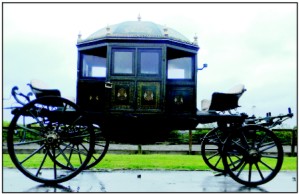
A magnificent 19th century State carriage which belonged to the Mysore Maharajas, is set to be auctioned in the United Kingdom by historics auctioneers.

Used exclusively by the royal family of Mysore and to transport European royalty including the Prince of Wales, the carriage is expected to sell for £70,000 to £100,000. This horse or elephant-drawn State carriage is thought to be of British origin and dates from arou-nd early to mid-19th century.

It features an imposing and ornately finished cruciform body with a vaulted, domed roof situated atop double elliptic springs and iron bound artillery patterned wheels. The basic colour is olive green embellished with delicate meander boarders, floral and heraldic motifs and the family coat of arms. Most of the 16 windows offer drop-down, decorated panels and shutters for privacy.

The interior is upholstered in beige damask and the roof has decorative paintwork, carved border moldings and finials.

The exterior houses two seats perhaps used by servants and courtiers and given the detailing and design throughout, could easily be described as a work of art, as can be seen in a wall painting of it at the Mysore Palace Museum. It is thought to have been last used at the Cha-mundeshwari Festival in 1927.

The Wadiyar dynasty, established by Vijaya, ruled the Kingdom of Mysore from 1399. Vijaya took on the name and ruled Mysore, then a small town, from 1399 CE to 1423 CE. From 1760 to 1799, the rule of the dynasty was essentially nominal, with real power in the hands of successive Dalwai, or Commanders-in-Chief, Hyder Ali and his son Tipu Sultan, who expanded the kingdom aggressively, but clashed with the East India Company.

After Tipu Sultan was killed when the British stormed Seringapatnam in 1799, the Wadiyars were restored to power by the British.

It was offered at auction by an Australian firm, Leonard Joel, on Feb. 22. It is believed to have been offered by a private British collection. It was later exhibited at Sotheby’s Olympia on 1991, and was acquired by historians.

The carriage will be auctioned on Nov. 24, 2012 at the Brooklands Museum in the United Kingdom.

[For more details, contact Dr. Rahul Sharma on email: drrahulsharmaji@yahoo.com.]

source: http://www.StarofMysore.com / Home> Feature Articles / November 07th, 2012