City boy is second in State (Science)

Mysore, May 24

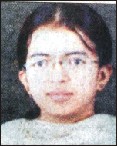
“I did not slog the whole year, but for the last five months. Otherwise I might have scored some more,” said Shreyas A. Nayak, a student of Marimallappa’s PU College who secured highest marks in II PU (Science) in the district and is 2nd in State.

Shreyas who scored 590, is the son of Akshata and Ananth Nayak, Manager, Bank of Maharashtra, Devaraj Urs Road.

Sharing his happiness with a section of the press, Shreyas said he aspires to become an engineer.

source: http://www.StarofMysore.com / General News / Thursday, May 24th, 2012

She reads lips to excel


Mysore, May 24

Profound hearing loss did not deter this girl who secured 82 % in the II PU exam.

Kautilya Vidyalaya’s Sushma is the daughter of Minor Irrigation Assistant Executive Engineer H.F. Rayanagoudar and Uma, Headmistress of Rotary School for the Hearing Impaired.

She joined tuitions during the initial classes but when she found difficulty in understanding the concepts in class, she preferred to study on her own.

In class, Sushma would try to to understand lessons by lip reading what the teachers said which had to be in a slow manner for her to grasp.

Says her brother Praveen, their mother played a major role in her achievement and adds that Sushma was planning to pursue computer science engineering. Sushma had secured 91% in SSLC exam.

source: http://www.StarofMysore.com / General News / Thursday, May 24th, 2012

Expo of Pencil Sketches to conclude

Mysore, May 29

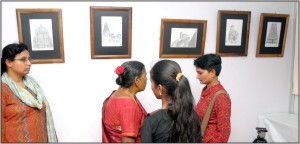
Be it a temple in Halebeedu, Kailas Temple at Ellora, Krishna Temple in Dwaraka, Swami Vivekananda Centre in Kan-yakumari, Rajagopura of Virupaksha Temple in Hampi and Golden Tower at Tirupathi Temple, the pencil sketches of all these monuments can now be seen under one roof in city.

The venue is the Mysore Art Gallery where the young artist R.Veerendra Kumar has put up an exhibition of rare drawings which drive a common man through the annals of temple structures drawn with the help of pencils while the art of pencil art is facing extinction.

Veerendra Kumar, who has drawn these sketches, has dedicated the same to his guru —senior artist C.Kuppachar as Guru Kanike.

The sketches of temples at Karnataka, Tamil Nadu, Mahabalipuram, Jalakante-shwara Temple, Siddeshwara Temple at Haveri, Sharada Devi Temple at Sringeri, Rama-Lakshmana Temple at Sripura and Jagganatha Temple at Puri, Bruhadeshwara Temple at Tanjore, Malagatti Temple at Badami, Kedarnath Temple, Meenakshi Temple at Madurai and Jain temples catches the attraction of each and everyone who enter the exhibition of pencil sketches in which more than 30 art works sketched by Veerendra Kumar for over three years are on display.

Veerendra Kumar has said that advancement in modern art, colour pictures with special effects had forced the pencil art to the backseat and claims that he undertook the mission to save the pencil art which was on the verge of extinction. He further said that only pencil art would ensure proper depiction of historical structures as colour paintings fail to project the intricate carvings in these structures.

Veerendra Kumar’s mentor Kuppachar inaugurated the expo in the presence of founder of Mysore Art Gallery S. Shivalingappa, Convenor Prabha Shivalingappa and others. The expo, which began on May 26, concludes today at 6 pm.

source: http://www.StarofMysore.com / General News / May 29th, 2012

Composed and Controlled Rendering

Mysore:

In olden days, a student of music had to learn the art by staying in the house of his guru, according to Gurukula system. Thus their academic education took a back seat. But as they become proficient in music, they also would acquire the knowledge of Sanskrit, Kannada, Telugu, Tamil and other languages required for music. They would also become scholars in Philosophy, Veda, Tarka (logic) and such other ancient Shastras in Sanskrit.

There may be some exceptions here also, like Maharaja Jayachamaraja Wadiyar who was a post-graduate in philosophy from Mysore University and an alumni of Trinity College of London, who after graduating in music, balanced music and the responsibility of ruling his land magnificently; or T.V. Shankaranarayana, who was a lawyer, who left the law profession and became a full-fledged musician or the case of vocalist R.K. Pad-manabha, who left a well-paying Bank job and dedicated himself for the cause of music.

If the Maharaja managed both profession and music, the remaining two left the profession for the sake of music. There are a few others who fall in these categories, but they can be counted on fingertips.

It is interesting to note that in our time, many well-educated youth, in particular, are choosing music either as a profession or as a hobby. H.K. Venkata Ram, Manasa Nayana, Manasi Prasad, Pattabhi Rama Pandit, Saketh Raman are only a few names who are highly educated and acquired good status in music. Many even have a Ph.D in music.

Once again as we scan the list, we see the names of Dr. Udaya Kiran and Dr. Hamsini Nagendra (both visually impaired), Dr. Mysore M. Manju-nath, Dr. Sukanya Prabhakar, Dr. R.N. Srilatha, Dr. C.A. Sridhar, Dr. Jayanthi Kumaresh, Dr. S. Geetha, Dr. Meera Rajaram etc. This douses the fear that our culture is being neglected and instills confidence that the future of classical music is safe.

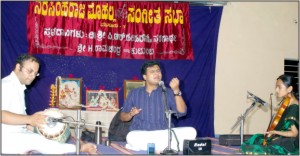
V. Bala Krishna, an Engineering graduate, working in an IT company in Bengaluru, is one among them, who has taken music as a hobby, balancing both the profession and the music. He is a disciple of Delhi Rama Murthy Bhagavatar. He had performed in Mysore once earlier, though it was a short kacheri. In fact I was curious to listen to his full concert. This young lad, bestowed with a rich voice, has tamed it superbly, with good training. His concert had been organised by NR Mohalla San-geetha Sabha on May 19. The accompaniments, violin (Adithi Krishna Prakash) and mrudanga (Sai Shiva Lakshmi Ke-shava) were the same as that of his previous short kacheri at Bidaram Rama Mandira during March, which may be a pure coincidence. In any case, the impressive presentation proved that he is a promising singer.

Bala Krishna set the tone of the concert with a Thodi Varna Eraa Naapai of Patnam Subramanya Iyer, serenely in two speeds. This was embellished with a brief Swara. The next number, a piece on Lord Ganapathi, was the Siddhi Vinayakam Seveham (Mohana Kalyani-Adi-Muthaiah Bhagavatar), which was prefixed with a brief Alapane and a not-so-brief, but leisurely Swara Prasthara.

The subsequent Padmavathi Ramanam (Purvi Kalyani-Mishra Chapu-Ootthukkadu Venkata Kavi) also contained a good Alapane and a Swara Prasthara.

The singer’s control over his voice came to fore in the unhurried rendering of Sujana Jeevana (Khamach-Rupaka-Tyagaraja). He chose Latangi for the Madh-yma Kala Kruti in between two Vilamba Kala Krutis, with Apara-dhamulanni (Latangi-Adi-Patnam Subramanya Iyer), with a Neraval at the Sahitya line Krupajesi Naa Manavyaala, in the same speed.

Mangalampalli Balamurali Krishna has composed a good number of krutis. Though some of them are in popular ragas, the composition of the sahitya and the original sangathis, with which he has composed, pose difficulty to emulate. Bala Krishna chose one such Kruti Kaavave Kanya Kumaari in Shahana. The difficulty comes in inter-mixing the pieces of sahitya in Vilamba and Madhyama Kalas, which this singer successfully executed.

Kalyani was his main melody of the concert. He leisurely went through all the subtle nuances in its delineation. The raga expansion is worth mentioning, as it turned out to be a well-patterned essay in all the three octaves. The use of Akaras, interlacing with Birkas and judiciously using Gamakas was the highlight of the Alapane. He then chose to render the popular number Kamalambaam Bhajare (Vilamba Adi-Muthu Swamy Dikshitar). His lucidity of sahitya is appreciable.

After some interesting san-gathis, he took up a Neraval with the Pallavi line itself Kamalaam-baam Bhajare Re Manasa. Even here, he used the technique of inter-mixing some phrases in Vilamba and Madhyama Kala appealingly. The Swara Prasthara was with superb smoothness and in pleasing progressions, based on pure Manodharma.

The concert concluded with three more numbers, Vanchato-nunaa (Karna Ranjani-Trishra Nade Adi-Muthaiah Bhagavatar), Sada Enna Hrudayadalli (Behag-Rupaka-Vijaya Vittala Dasa) and a Lalgudi Tillana in Brundavani.

The violinist Adithi was a well match for this singer. Both her follow-up and the Tani were superb. Sai Shiva expressed his versatility through his media, mrudanga. The Tani Avartana by him was a clear rhythmic affair.

I may add here that Adithi will be moving to Bengaluru in a few days, as this engineering graduate got a job there.

Mysore will be poorer by one more established violinist. All the best to her.

—S.R. Krishna Murthy

source: http://www.StarofMysore.com / Feature Article / May 30th, 2012

Prof. N.S.Ramegowda to be feted on his 70th Birthday on June 2

Seminar on ‘Contemporary Challenges of Higher Education’ to be inaugurated by External Affairs Minister S.M. Krishna

Mysore, May 30- For-mer Vice-Chancellor of Karnataka State Open University (KSOU) Prof. N.S. Rame-gowda who turns 70, will be feted at a function to be held on June 2 at Kalamandira in city. A seminar on ‘Contemporary Challen-ges of Higher Education’ will also be held on the occasion.

Disclosing this to press persons at Pathrakarthara Bhavan here yesterday, MP and President of the Dr. N.S. Ramegowda Felicitation Committee, A.H. Vishwanath said the felicitation programme and the seminar will be inaugurated by Union Minister for External Affairs S.M. Krishna at 11 am.

Vishwanath said Dr. Ramegowda, who is at present the Chief Executive Officer of Sri Kshetra Adichunchanagiri, was being honoured in recognition to his contributions to the field of education.

He also said that former MP and scion of the Royal family Srikantadatta Narasimharaja Wadiyar will felicitate Dr. Ramegowda and former Chief Minister H.D. Kumaraswamy will preside over the function.

Housing Minister V. Somanna will release the felicitation volume in Kannada and English and Prof. Krishnegowda St. Philomena’s College will deliver the felicitation address.

The seminar on ‘Contemporary Challenges of Higher Education’ will begin at 2.30 pm.

Bangalore University former VC N.R. Shetty, who is also the President of the Forum of Former Vice-Chancellors’ of Karnataka Universities, will chair the seminar on the issue ‘Relevance of higher education: Context of societal and national growth’ and the seminar will be addressed by University of Mysore former Vice-Chancellor Dr. N.S.Hegde.

Kuvempu University Former Vice-Chancellor Dr. P.Venkataramaiah will speak on the topic ‘Access and equity: Gross enrolment ratio in India and Karnataka’ and Bangalore’s University of Agricultural Sciences Vice-Chancellor Dr. K. Narayana Gowda will speak on the topic ‘Quality crises in higher education.’

At 4 pm, Dharwad University of Agriculture Sciences former Vice-Chancellor Prof. M. Mahadevappa, University of Mysore Vice-Chancellor Prof. V.G. Talwar, KSOU Vice-Chancellor Prof. K.S. Rangappa and Rani Chennamma University Vice-Chancellor Prof. B.R. Ananthan will participate in the discussions.

Felicitation Committee General Secretary N. Puttegowda, Shivaprasad, Puttaswamy and Govindegowda were present at the press meet.

source: http://www.StarofMysore.com / General News / May 30th, 2012


When healthcare seeks help

Even as hospitals increasingly adopt cloud computing, there are still a lot of hurdles in the way.

Dr Devi Shetty, Chairman and MD, Narayana Hruduyalaya(NH) wants to change the dynamics of healthcare in India. He is changing the dynamics of hospitals by setting up beds at the lowest cost, in as little time as possible. To facilitate this, NH recently tied up with HCL Infosystems to leverage cloud computing technologies for various applications. Dr Shetty reckons this partnership will help them to set up 10,000 affordable beds and keep healthcare costs low.

Similarly, last year, HCG set up Centre of Excellence for cancer care with the help of Siemens. As a part of this collaboration, Siemens will work with HCG to develop software, undertake R&D and conduct training programmes. These will provide better alternatives to clinicians and more effective treatment to patients.

Last year, Mumbai-based SevenHills Hospital opted for a high performance network from CommScope. The 20 million sq. ft. hospital has more than 15,000 network outlets. The hospital has many vital systems connected to its networks and needed a constant, real-time view of what is happening robust cabling system. In May, Max Healthcare deployed Dell’s services and created an information technology ecosystem with the adoption of Healthcare Information and Management Systems Society (HIMSS). According to Max Healthcare, it has achieved ‘Stage 6′ on the Electronic Medical Record (EMR) adoption model, which indicates that a large portion of patient records are electronic with minimal usage of paper charts. “Max Healthcare’s physicians receive evidence-based alerts as they enter electronic orders for their patients and a closed-loop medication administration system to maximise safety processes,” said Dr Ajay Bakshi, CEO & MD, Max Healthcare.

This is a change from earlier days when hospitals preferred to develop their own IT systems and manage it. However, due to lack of skill sets and costs associated with engineers, healthcare providers have resorted to outsourcing. “We feel that technology is best managed by specialists and at the same time reduce our capex which is consistently going up,” said Dr Shetty.

As hospitals start adopting IT, the market for technology in India is growing. ‘A recent trend in healthcare is the use of mobile devices to review medical images,” said a senior official from Siemens Healthcare.

Specialist hospitals face a huge problem in terms of training their physicians and all this adds considerably to a hospital’s costs, which in turn is passed on to the patients. “The earlier trend used to be of clinicians travelling overseas for training and research and development. Now they will be trained in India at HCG. The collaboration with Siemens is a step in this direction,” said Dr B.S. Ajaikumar, Chairman, HCG.

According to management consulting firm Zinnov, cloud computing in the Indian healthcare sector will be an estimated $600 million by 2020. Current healthcare spending stands at $54 billion and is expected to reach $164 billion by 2019-20. Also, the estimated annual IT spending within existing hospitals in India is approximately $191 million currently and is expected to reach a $1.5 billion by 2020. Hospital chains like Apollo, Fortis and others have adopted IT and are looking at newer ways to provide healthcare services.

Other factors that are driving the adoption of IT systems are the emergence of medical tourism, accreditation and the increasing use of health insurance. Electronic Healthcare Record Communication (EHRs) and Picture archiving and communication system (PACs) are likely to be the biggest opportunities in the market. Patient administration systems will also see high interest. The Confederation of Indian Industry (CII) estimated that the medical technology market in India is at $2.75 billion in and pegged it at $5 billion by the end of 2012.

TECHNOLOGY STILL AILING

Despite the adoption of technology there is still considerable room for more that can impact all the stakeholders in the ecosystem, according to Mr Harsh Chitale, CEO, HCL Infosystems. Hospitals can provide better care and manage costs better internally and patients can look for lower healthcare costs (in case of regular checkups).

“In India a majority of the healthcare providers do not talk to each other. So, there is no way a large blood bank puts out information on shortages in real time or exchange patient related information,” said Nitin Khanapurkar, Executive Director, Advisory Services, KPMG India. Agrees Mr Laxman K. Baliga, COO, Anthelio Business Technologies. Indian healthcare market is underpenetrated for IT systems and services. “It is also a highly price-sensitive market. Vendors will need to have India-specific strategies and pricing. The spending will be largely driven by large corporate hospitals and government,” he said.

This problem is accentuated when you look at the numbers. About 90 per cent of secondary and tertiary healthcare facilities in India are in cities and towns, far away from the rural areas where 68 per cent of the population lives. Hence, remote areas continue to suffer from the absence of quality healthcare facilities. What’s more, due to the poor conditions of rural health centres it becomes impossible to retain doctors in villages.

Telemedicine was touted as an answer to some of the ills. It refers to the use of telecommunications for the diagnosis and treatment of diseases using technologies like video conferencing from distant places. However, telemedicine has not taken off as expected. In the majority of cases, the requisite infrastructure has yet to be laid down and, even in places where it is already available, the costs are high. Bandwidth constraints lead to the non-transmission of images or very low quality ones being beamed. In most cases, doctors would settle for viewable images, but some require high definition ones, according to the head of a leading hospital chain who did not wish to be named.

There are power shortages in rural areas and this in turn makes patients to go to the closest town for undergoing a diagnosis. Hospitals on their part say that technology costs are high and they are grappling with manpower shortages.

India has one doctor for every 1,700 patients while the ideal doctor-patient ratio is about 600 patients for every doctor. Even in China and Brazil, a doctor attends between 900-950 patients while in the US the doctor-patient ratio is 1:390. This throws up a gap of 1.4 million doctors and 2.8 million nurses, according to World Health Organisation (WHO) norms. The gap in demand-supply scenario becomes starker in rural areas when you consider the fact that 60% of healthcare resources including doctors, skilled nurses and paramedics reside in the urban centres as per the India Health Ministry Report 2010.

The per capita spend on medical technology in India is about $2 as against $5 for China and $231 for Germany. Also, CII rues poor legal backing for medical technology segment. “It has no separate legal status and is regulated by Drug Controller General of India,” according to a CII official. As per the Planning Commission, India is short of 6 lakh doctors, 10 lakh nurses and 2 lakh dental surgeons.

Then there is the issue of privacy of patient records that risk being stolen or lost. Despite most companies following international information security norms for healthcare like HIPPA, HL7 and DICOM, technologies like cloud throw up these challenges and make it more complicated than in the earlier days when IT infrastructure was within the premises of a hospital.

Some hospitals like NH who plan to work on newer models that have the potential to change the economics of healthcare services as conventionally known are hoping that technology could aid them in their journey. As Victor Hugo once said, “Nothing is powerful as an idea whose time has come”. Indian care givers should take note of that.

(With inputs from K.V. Kurmanath)

venkatesh.ganesh@thehindu.co.in

source: http://www.TheHinduBusinessLine.com / Home> Features> EWorld / by Venkatesh Ganesh
Playing to change the world

Bangalore:

Brutal, insane, heavy, melodic, loud, energising, powerful and talented, these are few words to describe a local band ‘Desat’. In order to give a platform and encourage young artists and musicians, Avaroha organised a gig for the metal heads and music lovers to promote local bands in the city. It was a truly head bangers paradise on Sunday at Italia, when Desat played their hearts out and kept the crowd wanting for more.

The band played over 12 songs among which they had few heavy covers from bands like Lamb of God, Children of Bodom and Cradle of Filth, and with their original compositions they brought the roof down.

The band’s own compositions have lyrics based on humanitarianism and love. The band proved to be so good that, even Santa Clause who came to distribute sweets ended up head banging with few others from the gathering.

There is a perception that metal is just noise or drug addicts playing the so-called music. But, this band tells a different story. Their metal is unlike any other metal bands in our city. Apart from playing heavy riffs and double bass beats, the band also has flautist, who is a major at Carnatic classical. It’s a perfect balance of heavy distortion, soft melodies and to add the magical touch, the band also has a keyboardist.

The band Desat is a seven-piece band, which was formed two years back. They have played a number of shows around the city and spread the message of metal and power to the crowd.

The band was formed in an unusual way as well. Victory who had a jam room used to rent it out for bands to practice, that’s when he met Sunil and Sri Kiran.

They soon started to jam for fun, this led to introducing new member in the band, and before they set of for their first performance, they had seven people in the band contributing their talents in creating good music.

Victory, one of the founding members of the band says, “We formed this band with an idea to free the world from all the civic and political issues. We all want a change in this world, we feel that, we can achieve that through our music and that is what we are doing.”

The band has one more element that isn’t found in so many bands.

They have an element of experiential metal in their music, along with heavy vocals, they also have soft vocals which is sung by two different people.

Avinash says, “Victory plays the lead guitar and sings as well, but he sings in a softer tone. I growl in the band. This makes our genre experimental progressive metal.”

Even if one doesn’t like metal, seeing the band having fun on stage will automatically put a smile on your face, that is if your not heading banging to their music.

The band wouldn’t be complete if it wasn’t for the keyboardist. Even though the drummer and the guitarists do a good job, the keyboardist adds a special touch the their music with leads and rhythm and vocals just takes it all out.

Victory says, “I think our secret element is, we record all our jamming sessions, we just get a rough sketch about how our song should sound like and we start working on it. While we are jamming we come up across, few notes which turn out to be brilliant. With the recordings, we also correct our mistakes and work on our timing.”

He adds, “Be there, be metal. Support local band in the city, not all of us can be like Justin Bieber, for us metal is just more than music, it is our doorway to happiness.”

source: http://www.ibnlive.in.com / South> Southern News> Bangalore / by Jaikishan Janardhan / The New Indian Express / March 28th, 2012

KEA has a tech trick up its sleeve: Online admissions to PU colleges

The Karnataka Education Board is all set for a virtual revamp. With the Karnataka Pre University Education Board giving its nod to the online admission process of PU Colleges, the era of online progression seems to have dawned upon the state. Following the success models of Andhra Pradesh, Delhi and Chandhigarh, the Karnataka Examination Authority (KEA) has shed light on its plans of making CET counselling for seat allocation online.

The objective is to increase transparency and reduce hassles for students and parents. Online admission into PU colleges, which has already seen implementation with application forms available online, has been lauded by many as a preferred change. But will a similar fate await the proposed CET online counselling too?

The proposed process involves annual verification of documents and testimonials of students in helpline centres after the declaration of CET results; issue of an individual ID and password to each student through which the online portal can be accessed; entry of a student’s choices in terms of college, category, course and discipline. He can opt for more than one course too though he will be required to prioritise his options. For example, a student can enter options of engineering and medicine, but he must prioritise if he should enter engineering or medicine as his first option.

This will happen in three rounds, with a seven-day gap to exercise the available options, during which a student can either take admission, seek a better option or surrender his seat to apply in the next round of counselling. The surrendered and non-allocated seats will be pooled in for the next round of counselling. Seat allotments will begin with medical, followed by ISMH (Indian Systems of Medicine and Homeopathy), engineering and architecture.

Though the suggested process seems infallible, the big question is its practicability. Students across the state have their anxieties and confusions, which are leading to unfounded speculations.

Reflecting the concerns of many students, Anagha K, a student of Deeksha Integrated PU College (PCMB), who is awaiting her CET results, said: “The primary concern is the list of choices that one has to provide. A lot of thought must be put in, and several permutations and combinations must be done with regard to the priority list. If we go wrong in preparing this list, our future is at stake.”

Piyush Sharma, a student of Kumaran’s PU College (PCME) said: “There is uncertainty as we wouldn’t know whether or not we’re really in merit for a particular course in a particular college. The only source we have of finding out is the previous year’s seat matrix, which has its set of limitations”.

The FAQs on the website clarify doubts. But a lack of confidence in the ability of the process, apprehension owing to its first time and uncertainty of technical glitches have caused alarm and panic among students.

According to the website, a student can enter as many options as she likes. Also, she can change his options as many times, within the stipulated date.

Ameen Mudassar, career counsellor and director, CIGMA India, said that this kind of options list would result in a superficial demand for top colleges, for every student, irrespective of his merit, would want to try his luck at getting into the top colleges.

He said: “The KEA should roll out the process much in advance. They must ensure there is no deficiency in communication of the procedure to students. Infrastructure issues like the software, servers, etc should be taken care of.”

There seems to be unequivocal optimism over one aspect though. This step would solve the issue of seat blocking. Elaborating, Mudassar said: “Previously, a student could block seats in various institutions simultaneously. Such unclaimed seats would eventually become management seats, much to the disadvantage of meritorious students.”

The current proposal aims to solve this.

Another major concern is about students who are not fortunate enough to acquire computers or computers with internet facilities and those without the know-how of using them. A total of 6 lakh students appeared for the II PU exams this year, of which 1,83,093 were from rural areas. Of a total of 1.2 lakh students who appeared for CET this year, a major chunk was from the rural parts of the state. These students will be left in the lurch if the process of online counselling does not implement modalities for a horizontal inclusion of these factions. Helpline centres and kiosks for aiding such students are proposed.

The country has seen much of the education process shifting gears to go virtual. It is time saving, convenient and reduces spatial divide of many students. Exams like IIT- Humanities (IIT HSEE) and CAT have gone online. Though there were initial glitches, experience is honing them for the better. Common Law Admission Test (CLAT) and AIEEE counselling have also gone online, without many hiccups. Online processes are definitely a move forward, but proper and handy information, accessible communication and helplines putting in that extra effort for an inclusion of the disadvantaged student community and finally, but most importantly, ensuring a fail-proof technology and software are the ingredients that would make it an effective potion.

source: http://www.dnaindia.com / Home> Analysis> Report / by Pragati KB / Place: Bangalore / Agency: DNA / Monday, May 28th, 2012

Where fear ends, learning begins

As frustrated students turn their backs on the many marvels of science, it wouldn’t be too far from the truth to say that theory can really bog down even the most enthusiastic spirit. So, children digress from the idea of innovation, preferring to pick an engineering degree or a media course over a life of research and discovery.

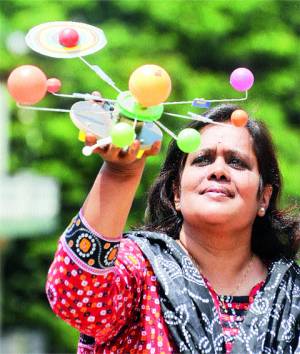
When Dr Sujata Virdhe discovered the many joys of experiential living, there was no stopping her on her journey to her dream. She quit a job at the Indian Space Research Organisation where she worked as a scientist in the fields of satellite power systems, solar energy and indigenisation of electronic components for two decades, and decided to follow her dream.

Dr Sujata Virdhe —R. Samuel

To open the eyes of every child to the magnificent universe of which we are all a part, where miracles happen every day should we choose to see them.

Catering to children between the ages of 10 and 15, the Sunday Science School (SSS) has already received a wonderful response from Maharashtra, where it was first started. The first branch in Bengaluru was set up in Domlur, with the second being inaugurated in Vijayanagar on Sunday. Dr Virde is looking at centres in Mysore, Dharwad, Hubli, Mangalore and Udupi.

“Eminent educationists feel that there is a need for hands-on learni of science, which is made unduly complicated by definitions and descriptions. This takes away the real beauty of the subject and students not only lose interest but become terrified by science,” says Dr Virdhe.

Hence, the science-by-doing module, which is aimed at kindling a love for science and research in every child. “Trained science communicators can communicate science using our readily available practical material to prepare our children for logical, rational and scientific thinking,” Dr Virdhe says.

It all started when Dr Virdhe met students whose parents were very worked up about their children being unable to grasp even the simplest scientific concepts. “I took them to the kitchen and taught them, which was when I discovered experiential learning and how important it is,” says Dr Virdhe.

Driven by a deep interest in the subject, Dr Virdhe began to collect information from textbooks for 7th grade to 12th grade children, designing her own syllabus to make learning science as hands-on and fun as possible. “The SSS wouldn’t have happened without my brother, Suyash Dake, who quit a lucrative IT job in Pune to help me realise my dream,” she says.

As a hobby, Dr Virdhe began designing tools and toys that would teach children science in the most fun way possible. “I happened to give some students a practical workshop on photovoltaic cells, which is how I knew that my passion was designing toys to teach children.”

While there are many, many products out there that can help children learn, most don’t reach them at all, for parents are simply too busy to bother. “We want to fill this gap in parenting because many parents don’t really have the time to spend with their kids,” she says.

At SSS, children are provided with all the materials they need and asked to conduct experiments with them. While the kids are given the help they need, they are, for the most part, allowed to
figure things out on their own. “We have two hours a week and when I see how engrossed the children become, it makes me want to take this to schools, too.”

Parents these days, feels Dr Virdhe, simply don’t have the time to run around for their children. Even if they are willing to do what it takes, finding materials is so hard to do and involves so much
running around that the task is given up on even before it is begun.

The first level makes sure that the children are given a strong foundation, while Level 2 has more
in-depth experiments in electronics, electromagnetism, apex microscopes and the like. “It’s like high school science and a lot more,” explains Dr Virdhe.

Dr Virdhe says the response in Maharashtra was overwhelming and has motivated them to push the dream even further. As children are allowed to explore their boundaries at their own pace, the ultimate aim of education is slowly achieved, for kids are not left with truckloads of information through which they must navigate. Instead, they are left with a tool far greater than that — imagination.

source: http://www.DeccanChronicle.com / Home> Channels> Cities> Bengaluru / by Darshana Ramdev / DC, Bengaluru / May 28th, 2012


“Develop latent talent to be a successful Entrepreneur ”

Caption: Ashita Prabhushankar, a successful entrepreneur in the US, delivering a special lecture at JSS Women’s College in city yesterday.

Mysore, May 25

“Listen to your conscience if you want to become a successful entrepreneur. Shed all your inhibitions and come out of social confinements. Learn to take embarrassing situations in your stride and learn from your failures,” adviced Ashita Prabhushankar, a successful entrepreneur in the USA.

She was delivering a special lecture on the topic, ‘My experiences as a woman entrepreneur in US’ at JSS Women’s College in Saraswathipuram yesterday.

Ashita, daughter of noted Kannada litterateur Dr. Prabhushankara, is an alumnus of the college.

“Each individual will have a latent talent which needs to be identified and developed. Thus, anyone can attain success in any endeavour,” she said.

“However, to become a successful entrepreneur, he or she must have worked under another entrepreneur for at least five years,” said Ashita, adding that during her years as a student, her leadership traits were more prominent than academics.

College Principal Prof. N.P. Padaki welcomed. Student Pratheeka compered. Director Dr. K.S. Rajashekar was present.

source: http://www.StarofMysore.com / General News / May 25th, 2012