All-woman crew steers Tipu Express

It’s part of International Women’s Day 2020 campaign launched by Indian Railways
An all-woman crew was in charge of the Mysru-Bengaluru Tipu Express on Thursday as part of the International Women’s Day 2020 campaign launched by the Indian Railways.
It is being held from March 1 to 10 and the Mysuru division is organising various activities including health checkups, yoga camps, trekking, cultural and sports competitions, to build a gender-equal workplace and to salute the spirit of women empowerment.
The loco pilot was B. Shiva Parvathi; the assistant loco pilot, Rangoli Patil; guard Richamani Sharma; and Travelling Ticket Examiner, Gayatri. The women ticket checking staff were Pushpamma, Rajeshwari, K.M. Hani, N.S. Anitha and Betsy. The Railway Protection staff were Getha Latha Naik, Devaki, Bharati and Renuka.
Greeting the all-women contingent at Mysuru station, Divisional Railway Manager, Mysuru, Aparna Garg, said that over 10% of the workforce in the division was women and the primary focus was to bring about a qualitative change in the work culture by creating a gender-equal environment. She said infusing collective consciousness among staff to achieve higher productivity at all levels was one of the ethos of the division.
The DRM reminded the large gathering of women employees present that work speaks more than words and called upon everyone to excel in their respective fields so that the there would be perceptible change in standard of service provided by the railways.
Additional Divisional Railway Manager, Mysuru, A. Devasahayam, senior branch officers and supervisors were present on this occasion.
source: http://www.thehindu.com / The Hindu / Home> News> States> Karnataka / by Special Correspondent / Mysuru – March 05th, 2020
Fiery tales of women bravehearts
Speaking about the challenging task, firefighter Priyadarshini B emphasised that while the field has always been male-dominated, the training provided to them was on equal grounds.

Bengaluru :
With International Women’s Day around the corner, Bangalore International Airport Limited (BIAL) – operator of Kempegowda International Airport – marked the occasion by celebrating its women firefighters. On Tuesday, the 14-member women firefighting team who underwent certified training at the Airports Authority of India Fire Service Training in Kolkata, demonstrated their learnings and emergency response skills in a mock fire drill held in the premises of the airport. The 14 women, who are a larger part of the Aircraft Rescue and Firefighting (ARFF) unit, were recruited from across Karnataka, showcased their strength and resilience while performing their duties while operating the Austrian-made Rosenbauer Panther 6×6, a rescue vehicle exclusively designed for airport emergency operations.
Speaking about the challenging task, firefighter Priyadarshini B emphasised that while the field has always been male-dominated, the training provided to them was on equal grounds. “Everyone says women are not the right fit for this job but we took it as a challenge and aimed to achieve success instead. My family was convinced that it is a field role, which is quite unique and motivated me to achieve my goal. While the first month of our training was hectic, gradually the team pushed themselves, including helping each other in their highs and lows,” said Priyadarshini, adding that going forward she would like to see more women joining the field of firefighting.
Another firefighter Lakshmi P V emphasised that the four-month training in Kolkata was followed by a two-month training in Bengaluru and additional on-the-job training which she claims as rigorous but fruitful. She added, “We are proud to be the first batch of all-women firefighter group in Asia and we have been entrusted with saving lives during emergencies. It’s a known fact that the fire department, including civil and aviation, was male-dominated but that has now changed with the training on equal grounds. This maintains the gender neutrality in the field.”
While BIAL works towards increasing the ratio of women in the organisation, which currently stands at 15 per cent, Thomas Hoff Anderson, Chief Operating Officer, BIAL, said they have set an example by creating a path for women to break into what has been a male-dominated bastion. “Training and practising is a part of everyday life for a firefighter especially at an airport and we do various drills to be prepared for emergencies. What we have seen from the women’s team ascertains that there is nothing a male can do that a female cannot do, that is an important statement.”
Rosenbauer Panther 6×6
120 KMPHTop Speed
12,500 Litres Water Tank 9000 LMP
Pump Output 1,500 Litres
Foam
Tank 70 metres Throw
source: http://www.newindianexpress.com / The New Indian Express / Home> Cities> Bengaluru / by Express News Service / March 04th, 2020
Mysureans Excel At Dwaraka Trophy Inter-District Open Rapid Chess
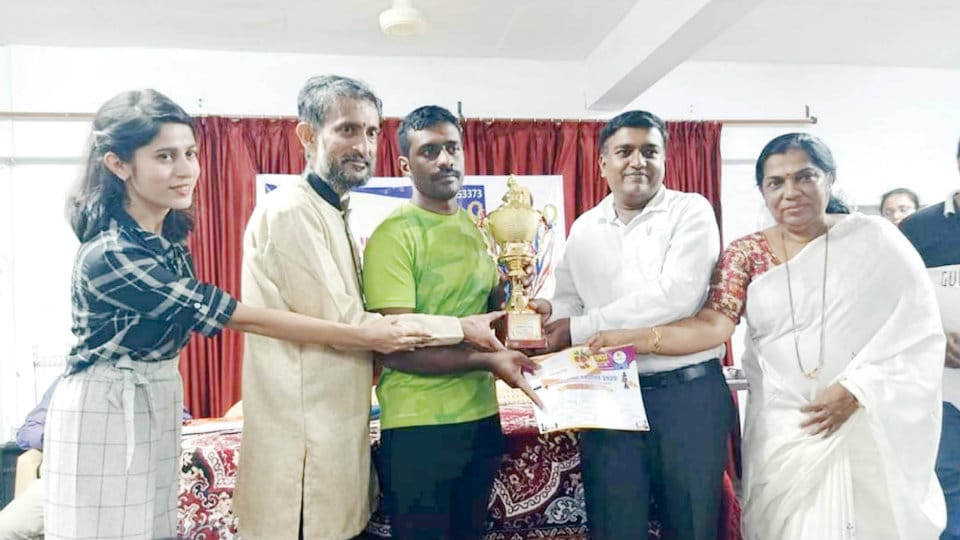
Mysuru lad M.D. Chiranth with 6.5 points from seven round clinched the title in the Dwaraka Trophy 2020 Inter-District Open Rapid Chess Tournament held at Royal Diamond English School premises in Shivamogga yesterday.
Mysuru lad M.P. Ajith finished second with 6 points from seven rounds.
Final Placings
- M.D. Chiranth (6.5), 2. M.P.Ajith (6-36.5), 3. Ramachandra Bhat (6-33.5), 4. K. Shantaram (6-32.5), 5. N. Thejasvi (6-26.5), 6. S.M. Ajay (5.5-32.5), 7. J. Deekshith (5.5-32.5), 8. Leelajai Krishna (5.5-31), 9. A. Sathwick (5.5-28.5), 10. G. Hariprem (5.5-27).
source: http://www.starofmysore.com / Star of Mysore / Home> Sports / March 02nd, 2020
City Kickboxers Shine At Intl. Championship
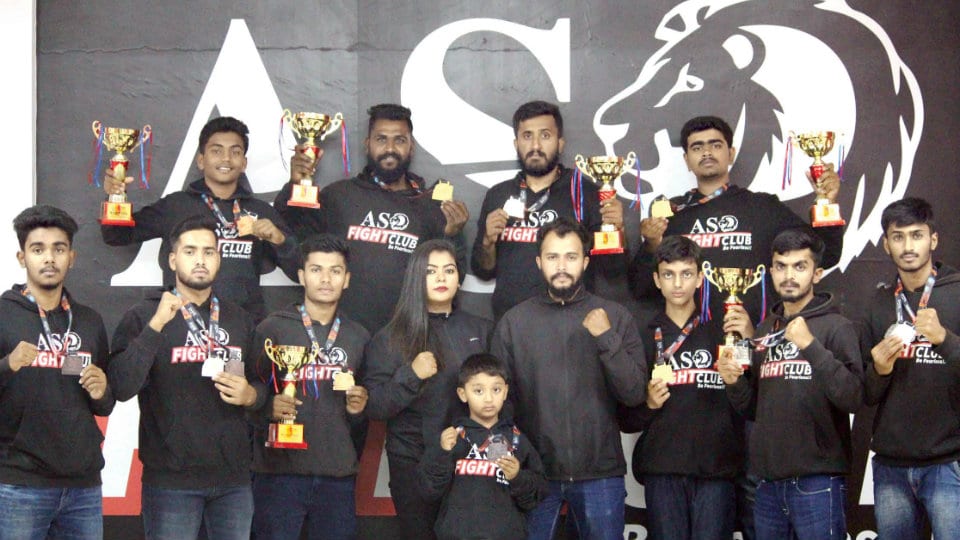
The following kickboxers of ASD Fight Club, Mysuru, have bagged medallist the WAKO Indian Open International kickboxing Championship held at Talkatora Indoor Stadium in New Delhi recently:
K.P. Abhishek – Gold Medal in 81 kg in K1; M. Srivatsav – Gold in 60 kg in K1; Ritvik Nagabhushan – Gold in +94 kg in Kick Light and Gold in +94 kg in Light Contact; A. Ranjith – Gold in 84 kg in Kick Light and Bronze in 84 kg in Light Contact; Sidharth Gowda – Gold in -47 kg in Light Contact and Silver in -47 kg in Kick Light; B.T. Tejas – Gold in -63 kg in Light Contact and Silver in -63kg in Kick Light; S. Tarun – Silver in -63 kg in Light Contact and Bronze in -63kg in Kick Light; H.M. Srihari – Silver in -57 kg in Light Contact and Bronze in -57 kg in Kick Light; Suhas – Silver in -79 kg in Kick Light and Bronze in -79 kg in Light Contact; T.P. Dushyanth – Bronze in -25kg in Point Fighting; D. Pruthvi – Bronze in -74 kg in Kick Light.
Over 700 athletes participated in this mega event and countries like Jordan, Kazakhstan, Iran, Ukraine, and Nepal took part in the Championship.
The WAKO International Referee Seminar was held during the Championship and 8 kickboxers of ASD have been qualified as an WAKO International Referee and Judges. They also received there Black Belt during the occasion
source: http://www.starofmysore.com / Star of Mysore / Home> Sports / March 02nd, 2020
UAHS graduates set sights on civil services
Many of the meritorious students who bagged gold medals at the convocation of the University of Agricultural and Horticultural Sciences (UAHS), Shivamogga, on Saturday want to carve out careers in civil services as they believe it offers an excellent opportunity to bring about positive change in society.
Poornima Sajjan from Challakere, who was awarded two gold medals for emerging topper in B.Sc (Horticulture), is now pursuing M.Sc (Horticulture) and has also commenced preparations for the civil service exams. Darshan H.M. from Adichunchanagiri, who received two gold medals for his performance in B.Sc (Forestry), is now preparing for the Indian Forest Service (IFS) exam. He told The Hindu that as part of the course, he was involved in field work in Nagarahole and Anshi national parks. “I have also participated in tiger and elephant census. Conservation of forest and wildlife is necessary to maintain the ecological balance,” he said.
Mohammed Thamseer from Madikeri, who won two gold medals for his performance in B.Sc (Agriculture), is a good singer and has represented the university at many cultural festivals. At present, he is pursuing M.Sc (Agriculture) at Choudhary Charan Singh Haryana Agricultural University. Gayathri R., who was awarded four gold medals for her performance in B.Sc(Horticulture), is pursuing postgraduation in the same discipline. After the completion of the course, she wants to take up research on pests and fungal infections affecting vegetable crops.
Kavitha Hegde was awarded two gold medals for her Ph.D thesis on managing pest infections in potato crop. She hails from a family engaged in arecanut cultivation at Kodanamane in Sirsi taluk. She is now working as an agriculture officer in Tirthahalli taluk. “This year, arecanut crop in Tirthahalli taluk has witnessed many pest and fungal infections owing to climatic factors. As I hail from a family involved in arecanut cultivation, I can understand the problems faced by farmers. I will continue to work at the ground level to mitigate the problems faced by farmers,” she said.
source: http://www.thehindu.com / The Hindu / Home> News> States> Karnataka / by Staff Reporter / Shivamogga – February 29th, 2020
IISc.’s biochemistry department turns 100
Established in 1921, it is one of the oldest in India and Asia
The Department of Biochemistry of the Indian Institute of Science (IISc.) stepped into its centenary year in 2020. Established in 1921, it is said to be one of the oldest departments not only in India, but in all of Asia. Around 850 students have graduated from the department so far.
P.N. Rangarajan, Chairperson, Department of Biochemistry, told The Hindu that the major achievement has been its students, many of who are now leaders in industry and academia. “One of them J. Padmanabhan – alumni and faculty – became the director of IISc. M.R.S. Rao went on to become the president of the Jawaharlal Nehru Centre for Advanced Scientific Research, and Ram Rajasekharan became the Director of CFTRI-Mysuru,” he said.
The department has planned a major conference and alumni reunion in December, as well as a centenary lecture series that will be held almost every month. On the IISc.’s Open Day on Saturday, it is organising an exhibition highlighting its past and current activities.
Prof. Rangarajan’s own research has led to the development of the hepatitis B vaccine. “At least four vaccines are currently in the market. The hepatitis B component in these vaccines came from the lab of the Department of Biochemistry,” he added.
In a recent issue of the journal Current Science, Prof. Rangarajan lists out the progression of research in the department. This includes ‘research of societal relevance’ in the early years which resulted in the development of methods for conversion of municipal waste into organic manure and fluoride removal from drinking water, to name a few.
The article makes note of key contributions in basic research such as the identification of yeast chromosomes and nuclear membrane.
Ongoing research
At present, a novel drug combination for extremely drug resistant and multi-drug resistant TB, as well as new blood-based biomarker signatures of host genes for diagnosis of tuberculosis and for detecting response to anti-tubercular therapy are being developed, he told The Hindu. “A novel inhibitor of DNA repair enzyme called SCR7 has also been developed in our laboratory. It has the potential to develop as a cancer drug,” said Prof. Rangarajan.
source: http://www.thehindu.com / The Hindu / Home> News> Cities> Bengaluru / by K.C. Deepika / February 28th, 2020
This Udupi autorickshaw driver ensures you’re well sheltered
However, if you ever chance upon the bus shelter in Vaddarse village in Udupi district, don’t worry, it’s not the sun playing tricks with your eyes.

Udupi :
Think of bus shelters and the first thing that comes to mind are ramshackle structures with a broken roof and stone benches with cracks or wooden ones with splinters sticking out. The lack of maintenance and official apathy leave most of these structures a sorry sight. Without cabs or Metro trains as in cities, buses are of paramount importance in villages as they are the only way to go from one place to another for those who don’t own a vehicle. But the condition of these shelters forces people to brave the hot sun or pouring rain while waiting for their bus.

However, if you ever chance upon the bus shelter in Vaddarse village in Udupi district, don’t worry, it’s not the sun playing tricks with your eyes. As you enter the shelter, which is spick and span, you’ll find a stack of newspapers and magazines neatly arranged on a rack, a dustbin in a corner, a pot filled with drinking water and a trough filled with flowering plants outside. This shelter is a model bus shelter for the village. The person responsible for its upkeep is 35-year-old autorickshaw driver Raghu Vaddarse. For the past one year, he has been sweeping the shelter clean, replacing the water and arranging the magazines every morning. Thanks to his efforts, people can comfortably wait for the bus.
Raghu has only studied till Class 8. Hailing from a poor family, he had to discontinue his education so that he could earn for his family. He has four siblings — his elder brother Tej, his younger brother Dinesh, his younger sister Hema and elder sister Prema. When he told his siblings that he wanted to maintain a bus shelter in the village, all four of them wholeheartedly supported him. Even his parents, Venkata Poojary and Parvathi, are proud of his initiative. Raghu decided to take it upon himself to maintain the bus shelter because of the effort it took to get it built.
Last year, people had asked their local elected representative to provide them with a properly maintained bus shelter because there was no proper shelter in the area and that some of them in the area had become a den of anti-social activities. However, the local representatives kept dilly-dallying on the matter. It was then that Raghu spoke to the gram panchayat officials and said that he would take care of the shelter if one was built. Finally, things started moving when a shelter was sanctioned under the Members of Parliament Local Area Development Scheme.
Since then, Raghu and a group of volunteers have been diligently taking care of the shelter. Speaking to The New Sunday Express, Raghu says, “I am doing this because I feel it is my small contribution to the society. Some of the magazines and books in the shelter are mine and some were donated.” Despite the rains ending in October, the plants have not dried as he waters them regularly. Now, the villagers of Vaddarse can sit and read a magazine or have a sip of water as they wait for their bus. Raghu says that he did this because he wanted to inspire others. “I will be happier if youths in villages come forward to do their bit for the cause of social service,” he says.
Bus, a boon
The village of Vaddarse is about about 18 km from Kundapur and 4 km from Kota. About 100-150 villagers use the bus to get around. When Raghu decided to beautify the shelter, local shopkeepers helped him plant saplings.
source: http://www.newindianexpress.com / The New Indian Expres / Home> States> Karnataka / by Prakash Samaja / Express News Service / February 27th, 2020
28 b
Settar: An untiring historian with a literary flourish

‘He was a model for all historians because of his wide-ranging interests and his multidisciplinary approach to research’
S. Settar, 85, historian, who breathed his last early on Friday in Bengaluru, was known for his multidisciplinary work, encompassing linguistics, epigraphy, anthropology, study of religions, and art history.
Family sources said he was suffering from respiratory problems and was hospitalised for over a week. Dr. Settar is survived by his wife and two daughters.
Born in 1935 at Hampasagara, Ballari district, he went on to study at Cambridge University and started his career as a professor of History at Karnatak University, Dharwad, his alma mater.
Dr. Settar worked till the very end and never rested on his past laurels. “A day before he was hospitalised, he was proof-reading and giving final touches to a book,” said N. Ravikumar of Abhinava Prakashana, who has published several of Dr. Settar’s recent publications in Kannada. Dr. Settar had also said he would need two more years of research to finish some of the projects he had taken up recently. He leaves behind many important works ready for publication.

Early Buddhist Artisans and their Architectural Vocabulary, a result of his recent research at Kanaganahalli near Sannati, Kalaburagi district, is set to be published by Manipal University Press. For the first time, he had put together all Kannada inscriptions of the first millennium in an eight-volume work, covering 220 inscriptions. He had also compiled a dictionary of every word for over 25 classical Kannada poetry. All these works will be published this year, Mr. Ravikumar said.
Dr. Settar’s early and important works in the 1970s were in the realm of Jain philosophy and ritual death (Sallekhana), with critically acclaimed books such as Inviting Death: Historical Experiments on Sepulchral Hill.
He also wrote extensively on Hoysala and Vijayanagar sculptural heritage. He edited several scholarly volumes on various epochs of Indian and Karnataka’s history. He served as director of the National Museum Institute of the History of Art, Conservation and Museology in 1978 and as chairperson of the Indian Council of Historical Research in 1996. He was also a visiting professor at the National Institute of Advanced Studies, Bengaluru.
It was in recent years that Dr. Settar shifted focus to studying the evolution of the Kannada language and literature with multidisciplinary approach and had chosen to write in Kannada. He believed that his choice of language made his work more accessible. Dr. Settar’s works in Kannada, including Shangam-Tamilagam Kannada Naadu Nudi, and Halagannada Lipi Lipikaara Lipi Vyavasaya are regarded as landmarks. His most recent work was Prakrita Jagadwalaya in 2018.
Noted historian and his student S.K. Aruni said Dr. Settar was “a model for all historians” because of his wide-ranging interests and his multidisciplinary approach to research. He drew from art history, linguistics and philosophy, and strictly followed an evidence-based approach to history, often revising popularly held notions and sometimes changing his stands when new evidence came up. For instance, his 2007 work Shangam-Tamilagam …, which won the Bhasha Samman from the Sahitya Akademi, proved many of the poets of the Sangam period in Tamil were Kannadigas.
“Using linguistics and epigraphy, he re-imagined the ancient history of Karnataka,” Dr. Aruni said.
A polymath, he had a keen interest in music, art, and cinema as well. He even wrote several short stories under the pen name ‘Priyadarshini’ through the 1970s and 1980s. He had a wide collection of art and sculpture.
source: http://www.thehindu.com / The Hindu / Home> News> States> Karnataka / by K V Aditya Bharadwaj & Aditya Bharadwaj / Bengaluru – February 28th, 2020