Biggest ever’ Aero India opens with tribute to deceased pilot

12th edition brings back civil aviation, ‘India as global runway of opportunities’

Karnataka CM HD Kumaraswamy, Defence Minister Nirmala Sitharaman and Minister of Commerce and Industry and Civil Aviation Suresh Prabhu at the launch of Aero India Show 2019, Bengaluru, February 20, 2019   | Photo Credit: K. Bhagya Praksh
Karnataka CM HD Kumaraswamy, Defence Minister Nirmala Sitharaman and Minister of Commerce and Industry and Civil Aviation Suresh Prabhu at the launch of Aero India Show 2019, Bengaluru, February 20, 2019 | Photo Credit: K. Bhagya Praksh

Defence Minister Nirmala Sitharaman rolled out a red carpet of opportunities in local defence and aerospace manufacturing to global investors as she launched Aero India 2019 here on Wednesday.

As the 12th edition of the biennial international military and civil expo and air show opened at the Air Force Station Yelahanka, the gathering and airmen showered tributes to Wing Commander Sahil Gandhi, who was killed during a rehearsal on Tuesday.

“Aero India 2019 endeavours to put India as the global runway of a billion opportunities,” Ms. Sitharaman told a gathering of a few thousand invitees. Ministers, heads of global defence aerospace companies, corporate and government policymakers, military brass, entrepreneurs, delegates and exhibitors from across the world were at the event.

The chiefs of the three Armed Forces — Air Chief Marshal B.S. Dhanoa, Admiral Sunil Lanba and General Bipin Rawat — were in attendance at the show organised by the Ministry of Defence.

Minister of State for Defence Dr. Subhash Bhamre, Union Ministers D.V. Sadananda Gowda and Suresh Prabhu, Defence Secretary Sanjay Mitra, Secretary-Defence Production Dr. Ajay Kumar and Defence Research and Development Organisation (DRDO) Chairman Dr. G. Satheesh Reddy were at the event.

Chief Minister H.D. Kumaraswamy highlighted Bengaluru’s establishment of itself as the country’s capital in design, research and production in aerospace and defence.

After many years, the edition brings civil aviation back to a largely military show. The Ministry said it was the biggest so far, with 403 exhibitors and 61 aircraft in static or flying displays.

‘Missing man’

Three IAF fighter jets and a Rafale aircraft paid an aerial tribute to Wing Commander Sahil Gandhi, who was killed in a midair mishap during a rehearsal on Tuesday. The Indian jets Tejas, Sukhoi Su-30MKI and Jaguar flew past in a formation called Missing Man. The pilot of a French Rafale fighter in a flying demonstration made a sombre flypast for the killed airman.

Light Combat Aircraft (LCA) did a jaw dropping vertical climb called the Charlie in memory of the late Atal Behari Vajpayee.

source: http://www.thehindu.com / The Hindu / Home> News> Cities> Bengaluru / by Madhumathi D.S / Bengaluru – February 20th, 2019
3D frame launched to assist minimal invasive neurosurgery

According to Venkataramana, the cost of this machine is one-third the cost of the other machines available in the industry.

Bengaluru :

Medical science and engineering technology have come together to bring out a stereotactic frame, 3DR Stereotactic System, which will be used in performing stereotactic and functional neurosurgery. Bengaluru-based Brains Hospital, a neuro spine centre, in association with Mahalasa Medical Technologies, has designed the 3DR Stereotactic System.

According to Dr N K Venkataramana, founder chairman of Brains Hospital, and a chief Neurosurgeon, “This is a versatile machine which can be used during MRI, CT scans, and during surgeries that are carried out for treating tumours, epilepsy and other brain-related diseases.”

According to Venkataramana, the cost of this machine is one-third the cost of the other machines available in the industry. “I can proudly say this is manufactured under Prime Minister’s Make in India concept,” he added.

Launching the product on Tuesday, Union Defence Nirmala Sitharaman Minister said, “One should look at funders from India and not outside India. Bengaluru is blessed as it has all kinds of people, including funders.”

How this frameworks

This is used to carry out minimally invasive surgery. This frame is fixed to the head that guides the surgeon to reach specific targets in the brain. Stereotactic surgery or stereotaxy makes use of a three dimensional coordinates to locate small targets inside the brain and to perform procedures on them such as ablation, biopsy, lesion, injection, stimulation, implantation, and radiosurgery.

source: http://www.newindianexpress.com / The New Indian Express / Home> Cities> Bengaluru / by Express News Service / February 20th, 2019

Latha Puttanna on her wearable gardens

LathaPuttanna01BF19feb2019

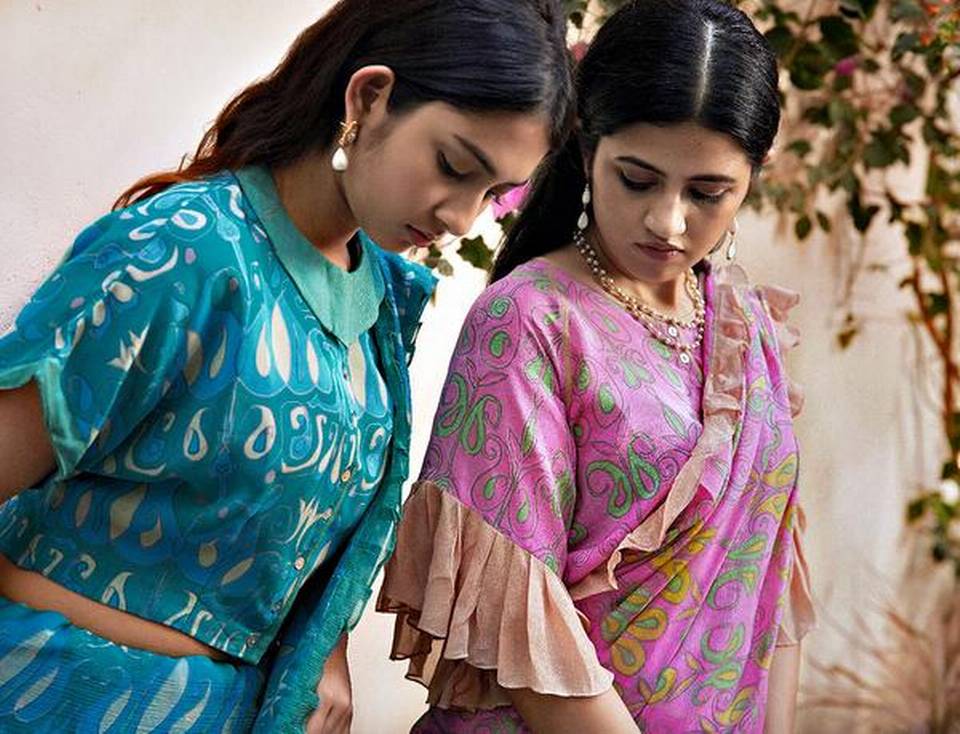
Bengaluru-based designer Latha Puttanna’s summer collection, Bougainvillea, is light, bright and airy

With 27 years of design experience and revival work, Latha Puttanna has often been described as the Design Queen. Known for constantly re-inventing both the sari and blouse, Latha’s work reveals a fine instinct for design doctrine.

“Look at this,” she says pointing to the wall of Srishti, her factory, studio and store at Siddapura. The re-purposed family bungalow has several photos of the women of her family dressed in traditional saris. “I look to these time-honoured saris for inspiration and re-invent their prints and weaves for a present day resonance.”

Latha is passionate about the traditional textile, and aggrieved that a good many crafts are near extinction. “My mission is to revive them all with my designs.”

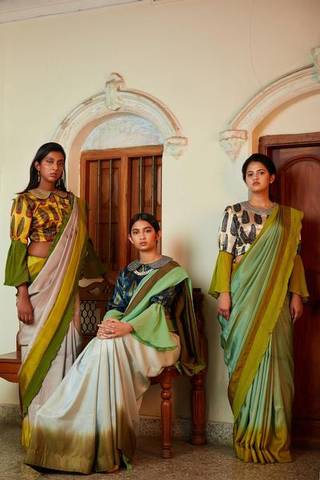
The collection, Yashoda, which Lata named after her mother, uses six vivid hues in rare combinations for functional saris, salwars, and has taken a cue from the South Indian langa for design and silhouettes. “The flowing, lightweight fabrics use texture-rich weaves on crepe, tissue, Georgette and pure silk yarn. Even if these photos are black-and-white, you can see the colours bursting out.”

In her spring-summer 2019 collection, Bougainvillea, Latha, will also showcase her recently-introduced line of blouses. “There was a demand and I created an equal number of blouses to go with saris, skirts, parallels, trousers and salwars. I decided to create this line with design elements from my work over the past 25 years.”

Latha’s blouses feature kalamkari, ajrakh, bandini, appliqué and aari work on Chettinad cotton, tissue and knit fabric, mix-and-match with embroidery and Orissa weaves. “As I swam through the ocean of fashion and design, I perfected the aari technique. So there is also thread, gold and silver work in this collection,” she says.

LathaPuttanna02BF19feb2019

On what else she has for the hot days ahead Latha says, “The sari does not cease to interest me. I am always in awe of this beautiful outfit with endless possibilities. This is not available anywhere in the world. We should celebrate our sari? We are an end-to-end design house with skilled weavers, artisans and craftspersons from all regions of the country.”

Bougainvillea brings in range of kurtas and tunics in hand-woven mulmul cotton, linen, and pure silk Georgette. They are all done up with bright hand embroidery, not to miss the gold and silver zari-beaten work. “Designed for the hot season, these can be paired with crop-pants and organza dupattas. Bougainvillea also has a collection of tops, shirts, dresses, and pants,” she says.

Speaking of the name of the collection Latha says, “As the name suggests, it is evocative of the freshness of seasonal blooms in the city.

The intricate floral prints or embroidery all sit snugly on hand-woven textiles that I source from my weavers in Kannur, Kerala. Chiffons, silks and Georgettes are used for their lightness and vibrancy.”

The collection has traditional wear, made from natural dyes. “The soft silk saris with table dye in contrast colours are paired with blouses featuring bell-sleeves for a retro-70’s look. A range of light and breezy Ajrak saris are paired with embroidered blouses, while soft silks in striking hues embellished with block dyes are paired with Orissa Ikkat blouses.

“Some of my prints have been digitally transferred on to the fabric from hand-drawn designs.”

The Bougainvillea collection will be showcased on February 19 and 20 at Raintree

source: http://www.thehindu.com / The Hindu / Home> Life & Style> Fashion / by Ranjani Govind / February 18th, 2019

Village in Gadag spreads warmth by making quality quilts

The village has more than 200 families who are into this business.

Women of Jantli Shirur village in Gadag district sew quilts outside their homes. The village is home to more than 200 families who are into this business | D Hemanth

Gadag :

It takes a village to sew quilts.As you enter Jantli Shirur village, you see womenfolk sitting outside their houses busy sewing colourful patterns.People of Gadag and surrounding districts visit the village to buy quilts as the winter starts. This winter too saw the village engaged in stitching these winter warmers.But the ‘yarning gap’ between their hard work and the price they get is a matter of concern, say the villagers.

The village has more than 200 families who are into this business. They sell one quilt for Rs 650 to Rs 1,000 depending on the fabrics they get. They take four days to make one quilt and need four workers to coordinate. The thread they use is Rs 300 per kg and they source it from Mumbai. It is called ‘noolu daara’, a strong thin thread, which cannot be broken easily by hand. Nearly half a kg of thread is used to make one quilt.

They get about 1,000 to 2,000 orders from Huvin Hadagali, Hubballi, Dharwad, Belagavi, Gadag, Benagaluru and even from Andhra Pradesh and Maharasthra.A quilt is made by sewing two or more layers of fabric together to make a thicker padded material. These are used in every house in North Karnataka.
Nirmalavva Navalagund, a resident, says, “We get orders from some agents who supply us with the cloth. They pay us Rs 800 to Rs 1,000 per quilt for sewing and sell it for Rs 2,000 to Rs 2,500, making a neat profit. Though we are not paid much, what brings satisfaction is the praise that our quilts have a long life.”
In the Metros, these quilts are sold in the price range of Rs 3,000 to Rs 4,000.

Basavva Alur, another quilt maker, says, “We finish our daily work in the morning and start stitching quilt from morning 9 to evening 6. We stitch one big quilt in a span of two days and sometimes it takes four days depending on the size. We do not know any other work than this. We request the government or NGOs to help us to get a good platform and also protect this heritage of our village.”

If you stitch the pieces of history together, you find that the art of quilt making in this village dates back to over 150 years. Those days, people in other parts became commercial and used to use cheap material.  Soon, they lost customers. But the ancestors of this village seized the opportunity and used good materials and showed expertise in sewing. Their unique style of making small stitches soon spread and their business blossomed. Thus, the villagers continued this tradition.

But today they are concerned that they don’t get a fair price for their hard work. What bothers them equally is that youngsters giving up this traditional occupation and moving to cities for a better livelihood.

How they get orders 
Jantli Shirur villagers go to nearby villages and collect clothes, some new and some old, to make quilts. Some businessmen visit the village and place orders and give clothes and get the quilts made while some people buy readymade quiltsmade with new fabrics. The price varies from Rs 800 to Rs 1,000

Common thread 
These  villagers who stitch their lives together with the little money they get making quilts say they don’t get a fair price. Though they are paid Rs 800 to Rs 1,000 per quilt, these bright and colourful products are sold by agents for Rs 3,000 to Rs 4,000 per piece in the Metros, and Rs 2,000 to Rs 2,500 in towns.

source: http://www.newindianexpress.com / The New Indian Express / Home> States> Karnataka / by Raghottam Koppar / Express News Service / February 17th, 2019

Community radio: making waves in Karnataka’s countryside

Shamantha and Sunil at Sarathi Jalak, all set to go on air. Sudhakara Jain

Sarathi Jhalak, a radio station in rural Karnataka run almost exclusively by women, takes on everything from menstruation to lake pollution

The only thing that sets apart the nondescript building from other houses in Anungondanahalli village in Karnataka’s Hoskote district is a board announcing the radio station. RJ Sunil has been waiting for us and shows us around.

The living area is bare save for a big board on the wall; the kitchen has a medium-sized, all-important transmitter; and the bedroom serves as the radio station. There is a wooden door with a glass window through which I can see the RJ. On top of a large table that occupies most of the room are the mixer and microphones. Sensible shelving against a wall has a small portable radio on it.

This is Sarathi Jhalak, a community radio station, run almost exclusively by women and one that has forged a vital connect with its largely rural audience, hosting programmes on everything from menstruation and lake pollution to alcoholism and finance.

“Even before Mann Ki Baat, we had Manadallada Matu (Talk of the heart),” chortles Shamantha D.S., the journalist who started the station in 2012. It reaches some 100 villages within a 30 km radius. This particular show, which aired at night “had so many female listeners,” says Shamantha; “they would call and speak about all their issues.”

Sunil sits behind the desk. The journalism graduate tells us that he barely spoke for the first three months that he worked here. “I was so scared.” It’s hard to tell, looking at him run the station with confidence now.

RJ Nagamani joins us and prepares for the afternoon show. Nagamani has studied till Class X, but says her work with Sarathi has made her “ articulate and knowledgeable.”

Friendly neighbourhood

Sunil decides to interview our photographer. He puts on his headphones and after a silent countdown with his fingers Sarathi Jhalak goes on air.

As they chat, a farmer drops in with his son and sits down with me outside the studio. “I want my son to do better than me,” the farmer says, “I work in the hot sun for ₹400 a week. Maybe Sunil can get him a job.” I am told that another farmer had walked in the other day to complain about a government hospital doctor who had wanted money for treatment. Parents bring their children to the station so the RJs can give them a pep talk.

Shamantha has trained Sunil and the three women RJs to speak simply and from their heart. “Instead of using clichéd phrases like ‘mahila dourjanya’ or sexual harassment of women, I tell the RJs to use a story that highlights it. That way people will listen.”

Nagamani tells me about a programme she did with girls from a nearby high school. They discussed menstruation and the disposal of sanitary pads. When there were reports from another part of the country of children falling sick from their midday meals, the RJs urged parents to check if the vegetables and vessels were being washed well. The women RJs are looked upon as friends by the villagers.

Speaking out

Some like Kala, (who has now quit for other opportunities), became minor celebrities. Nagamani’s children’s friends and their parents hold her in high regard. “My husband is very proud of what I do,” she says.

Shamantha recalls the time she had first come to the region with a group of journalists to conduct a media literacy programme nearly 15 years ago. Almost every woman was illiterate here. “I would tell them to listen to the radio while doing the housework.” After thorough background checks by at least seven different government departments, Sarathi Jhalak got its licence in 2012 and a funding of ₹5 lakh from the government. Hoskote was the obvious choice of location because Shamantha had worked there earlier. Around the same time the Women and Children’s Department of Anugondanahalli wrote asking her to start educational programmes for women. “It became easy for me,” says Shamatha.

Cost factor

But there have been hurdles too. For one, recurring expenses are high. The radio station has been approaching nearby schools and colleges to advertise with them. Though community radio is for and by the people, Shamantha believes that it is not fair for the government to expect RJs to work without pay. Her family pays Sunil ₹15,000 while Nagamani gets a token ₹3,000 a month. The station is always cash-strapped and requires at least ₹2 lakh a month to run. “We could then hire technical support, more RJs with better pay, better equipment, and document our popular programmes.” Encouraging stations like Sarathi Jhalak makes sense at the grassroots level.

As Shamantha says, “A community radio station like ours is not an alternative medium, it is a powerful one.”

The freelance writer believes that everything has a story waiting to be told.

source: http://www.thehindu.com / The Hindu / Home> Society / by Jayanthi Madhukar / February 16th, 2019

Poverty didn’t deter golden girl of Kuvempu varsity

Hailing from Chikkamagaluru, Nethravathi is a student of IDSG Government College.

Nethravathi with parents Annappa and Tangavva | Shimoga Nandan

Shivamogga :

Poverty did not come in the way of this ‘golden girl’. Meet K A Nethravathi,  who bagged seven gold medals in MA Kannada at the 29th convocation of Kuvempu University, Shankaraghatta, Bhadravati taluk, on Friday.

Hailing from Chikkamagaluru, Nethravathi is a student of IDSG Government College. Her father Annappa and mother Tangavva are both agricultural labourers and the trio are residents of  SC Colony at Kuravangi in Chikkamagaluru taluk. Nethravathi completed her schooling from Kuravangi government school and her pre-university from Chikkamagaluru Government PU College.Till her second PU, Nethravathi did not get distinction in her academics. She developed an interest in academics only after she joined IDSG College for her graduation. “I did well in my graduation examination and that gave me an opportunity to continue my higher education in Kannada. My teachers supported me and that pushed me to work hard,” she said.

Talking about his daughter’s achievement, Annappa said, “We (he and his wife) could not study. Our daughter should not struggle the way we struggled.”Nethravathi said, “I did well in the examination and expected high marks. But I never thought that I will emerge at the top.”

source: http://www.newindianexpress.com / The New Indian Express / Home> States> Karnataka / by Ramachandra V. Gunari / Express News Service / February 16th, 2019

NTSE: Mysuru student tops in State

MeghanBF15feb2019

Meghan H.K., a student of Class X in Vidya Vardhaka Sangha’s B.M. Sri Educational Institution in Kuvempunagar, has bagged the first rank in National Talent Search Examination (NTSE) 2018-19 in the State.

Meghan, who was also a student of Foundation Science and Technology programme offered by BASE coaching institute in Mysuru, secured 180 out of 200 to become first in State.

With a score of 94/100 in GMAT and 86/100 in SAT, Meghan also secured the second highest marks in both the tests and is the only student to have scored above 90 in Karnataka in GMAT.

NTSE is one of the oldest and prestigious national-level scholarship programmes conducted by the National Council of Educational Research and Training (NCERT).

“Conducted at the secondary school level, the exam aims to identify and recognise students with high intellect and academic talent. The exam was introduced in 1963, with the objective of acknowledging intelligent students and nurturing their talent at a very young age. It is considered to be one of the toughest exams held across India at the high-school level,” said a press statement.

source: http://www.thehindu.com / The Hindu / News> States> Karnataka / by Special Correspondent / Mysuru – February 15th, 2019

Take a walk to discover ‘hidden gems’ of Malleswaram

The guided walk in Malleswaram will be held on February 24 and will be led by Sujatha Balakrishnan, a history teacher, counsellor and theatre actor.

Participants at a previously held walk

Bengaluru :

Built as an alternative to the old Mysuru region, Malleswaram, formed in 1889, is awash with history and has since then shaped into a hub of vibrant industrial economy. It has a number of superior academic institutions; restaurants that provide gastronomic delights; resplendent  temples; and a thriving flower market. Another famous part of Bengaluru, the Kempegowda fort and the surrounding ‘Pete’ also have fascinating tales to tell visitors. Both these areas will be showcased through guided walks to be held as part of the ongoing India Heritage Walk Festival.

History buffs can visit the Venugopalaswamy and Kadu Malleshwara temples
History buffs can visit the
Venugopalaswamy and Kadu
Malleshwara temples

The guided walk in Malleswaram will be held on February 24 and will be led by Sujatha Balakrishnan, a history teacher, counsellor and theatre actor. “Participants can stroll across the Sampige and Margosa Roads and visit the 8th Cross Shopping Street. They will also visit the Venugopalaswamy and KaduMalleshwara temples, and experience the delights of the Malleshwaram fruit and vegetable market,” the organisers, Sahapedia, said.

On February 17, participants of the other heritage walk will be taken through the various ‘petes’ or areas which came up around the Kempegowda Fort in the city market area.

Participants will visit the  Yelahanka Gate, Anjaneyaswamy, Maramma and Ranganathaswamy temples, rice Memorial Hall and Mohan Building.

source: http://www.newindianexpress.com / The New Indian Express / Home> Cities> Bengaluru / by Express News Service / February 14th, 2019

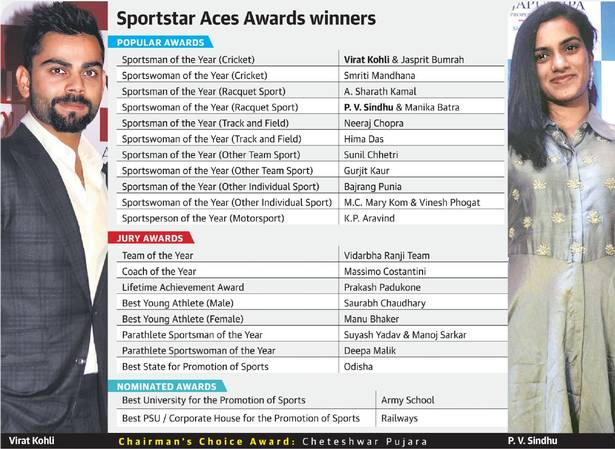
Sportstar Aces Lifetime Achievement Award for Prakash Padukone

A night to remember: Prakash Padukone with his family members after receiving the Sportstar Aces lifetime achievement award. | Photo Credit: Vivek Bendre

Kohli and Bumrah share the Sportsman of the Year (cricket) accolade

Prakash Padukone was honoured for Lifetime Achievement while Virat Kohli and Jasprit Bumrah shared the Sportsman of the Year (cricket) accolade at the Sportstar Aces Awards ceremony at the Taj Mahal Palace here on Thursday. It was to warm, heartfelt applause that Padukone received his award, before an audience of stars on a grand evening.

“This is an absolute fanboy moment,” confessed Sunil Gavaskar, chairman of the Awards jury, as he feted Padukone on stage. “For me you’re the greatest Indian sportsman ever. You paved the way for the badminton generation we now see.”

Padukone, while being typically self-effacing, hailed the growth of Indian badminton. “I don’t think I deserve that much of praise. There are so many who’ve done so well. But I accept the award with all humility,” he said, before he was joined on stage by wife Ujjala, daughter Deepika and son-in-law Ranveer Singh.

Guts and glory: Deepa Malik is presented the parathelete sportswoman of the year award by M.M. Somaya. | Photo Credit: Vivek Bendre

“Around 10-15 years ago, Indian players would look at the draw for major tournaments and worry about facing the Chinese and Indonesians. Today, it’s the other way around.”

The Sportstar Aces Awards, supported by the Qatar Supreme Committee for Delivery and Legacy for the 2022 FIFA World Cup and MRF, recognised the wonderful sporting year Kohli and Bumrah had enjoyed.

Bull's eye: The 16-year-old Manu Bhaker receives her award from ace shooter Anjali Bhagwat. | Photo Credit: Vivek Bendre
Bull’s eye: The 16-year-old Manu Bhaker receives her award from ace shooter Anjali Bhagwat. | Photo Credit: Vivek Bendre

“As a child, I used to buy Sportstar every month for the posters. So, getting this award from Sportstar is like reviving childhood memories,” said Kohli as he received his award, in absentia, from Shane Warne.

The former Australian leg-spinner and Rajasthan Royals brand ambassador hailed the fact that Kohli placed primacy on Test cricket. “Virat is a very inspiring cricketer all around the world. He stands up for what he believes in and speaks his heart,” he added.

It was a golden 2018 for Bumrah, Ishant Sharma and Mohammed Shami, who became the most successful pace trio in a calendar year in Test cricket.

“That an Indian pace trio broke the record of the great West Indies pacers is a very proud thing for us,” said Bumrah. “We wanted to win abroad. For that, you have to have a good bowling attack.”

The Awards, which were previously held between 1994 and 2003 in their first avatar, were revived as Sportstar completed 40 years in 2018.

Alongside Gavaskar on the Awards jury were sporting legends M.M. Somaya, Anju Bobby George, Anjali Bhagwat, and N. Ram, Chairman, The Hindu Group of Publishing.

Cheteshwar Pujara became the first recipient of the Chairman’s Choice award, for his exploits in a historic Test series win for India in Australia. “Pujara is the last of a dwindling tribe of pure Test batsmen,” said Ram.

“He has shown that he has all the credentials to step into Rahul Dravid’s shoes.”

Pujara spoke of his parents’ role in moulding his life. “I lost my mother to cancer at 17. When I was young, she told me, ‘You’ll have a great career but it’s important to be a nice human being. It hardly matters whether you are famous or not.’

“My father has been a strict coach; but I’m grateful he has been there for me.”

Sunil Chhetri, P.V. Sindhu, Neeraj Chopra, Mary Kom, Hima Das, Smriti Mandhana, Sharath Kamal, Bajrang Punia, Manu Bhaker and Deepa Malik were some of the other awardees on the occasion, an event graced by sporting greats of the likes of Viswanathan Anand, Gagan Narang, Mithali Raj and Kamlesh Mehta, and Odisha Chief Minister Naveen Patnaik, whose State was declared the best for promotion of sports.”

Ayon Sengupta, Editor, Sportstar, welcomed the awardees while N. Murali, Chairman, KSL, also addressed the gathering.

The Hindu’s Editor Mr. Mukund Padmanabhan was also present.

SporstarAcesAwardsjpg

source: http://www.thehindu.com / The Hindu / Home> Sport / by Shreedutta Chidananada / Mumbai – February 14th, 2019

Sahitya Academy awards 2018 announced

The Academy also announced book awards for 19 writers

The Karnataka Sahitya Academy on Thursday announced special awards for 2018 to five writers B.A. Vivek Rai, H.S. Venkateshmurthy, Deshamsha Hudagi, Saisuthe and A.K. Hamppanna — for their contribution to Kannada literature.

It has also chosen 10 writers for Sahityasri Award 2018. The winners are: K.C. Shivappa, Purushotham Bilimale, C.P. Siddashrama, Parvathi G. Ithal, G. Krishnappa, Satish Kulkarni, Rangaraja Vanadurga, Abdul G. Basheer, Gangaram Chandala and H.L. Pushpa.

While the writers will be presented a cash prize of ₹50,000 each, a citation and a certificate, the Sahityasri award winners would be given ₹25,000 each, a citation and a certificate.

According to a release, they were chosen at a meeting chaired by Academy Chairman Aravind Malagatti. The Academy also announced book awards for 19 writers for books published during 2017.

The book award winners are Chandrashekar Talya, Renuka Ramananda, Guruprasad Kaginele, Nagaraja Ramaswamy Vasthare, Basavaraja Sabarada, Prajna Mathihalli, Indira Heggade, Amrutha Rakshadi, H. Shashikala, F.T. Hallikeri, Sharada V. Murthy, Somashekar B.S., H.T. Pothe, J.M. Nagaiah, R. Sheshashastri, Gopala Mahamuni, Vinaya Okkunda, P.V. Nanjaraj Urs, and Mangala C.

The book award winners will be given a cash prize of ₹25,000 each and a certificate, the release stated.

source: http://www.thehindu.com / The Hindu / Home> News> Cities> Bengaluru / by Staff Reporter / February 07th, 2019