Nandini, the well known milk brand of Karnataka Cooperative Milk Producers Federation (KMF), has introduced buffalo milk.
File Photo of a buffalo (PTI)
Belgavi :
Nandini, the well-known milk brand of Karnataka Cooperative Milk Producers Federation (KMF), has introduced buffalo milk. Speaking to reporters, KMF chairman Vivekrao Patil said buffalo milk is considered ‘A2 milk’ that has high content of calcium and vitamin D which help burn calories effectively.
“We have released half litre packs… One litre of buffalo milk will cost Rs 60 for consumers while farmers are being paid Rs 38 per litre including the incentive of Rs 5”, Patil said.
About 60,000 litres buffalo milk is being collected every day from 35,000 farmers in various parts of the district. As much as 35,000-litre milk packed in flexi packets is being supplied to Bangaluru and local markets while the remaining milk is used to make kunda, penda, paneer and other products, he said. “We have also got orders for buffalo milk from Goa, Sangli and Pune”, he added.
There are several private milk organisations which indulge in adulteration and the Deputy Commissioner should take action against them, he urged.
source: http://www.newindianexpress.com / The New Indian Express / Home> States> Karnataka / by Express News Service / December 23rd, 2018
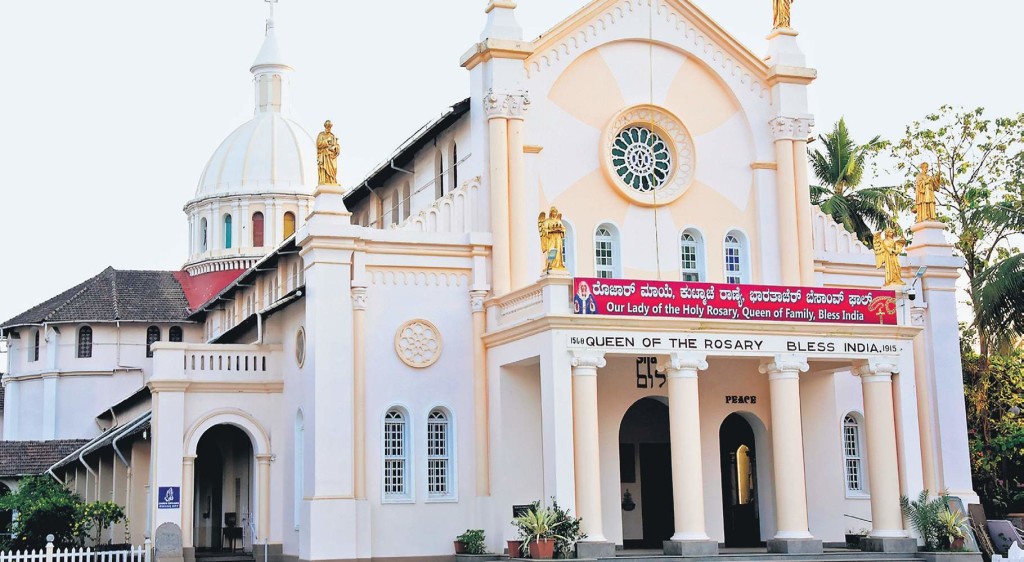
Hailed as the Rome of the East, Mangaluru is known for its beautiful churches with the oldest one, Rosario Cathedral, dating back to 450 years.
As Christianity started spreading roots, places of worships also started being established with Rosario Church (Our Lady of Rosary) in AD 1568. (Photo | EPS)
Mangaluru :
Hailed as the Rome of the East, Mangaluru is known for its beautiful churches with the oldest one, Rosario Cathedral, dating back to 450 years. A testament to the cultural, religious and architectural history of the city, these magnificent churches with their pinnacles and structures and jaw-dropping design and interiors hold you spellbound.
Christianity came to the Canara region by the 15th century and probably the Franciscans and Our Lady of Mercy missionaries working at Kerala coast would have visited Mangaluru during this time. With Portuguese taking Goa in AD 1510 and reinforcing it as their stronghold, the Christian community from Goa started migrating to Canara region. In AD 1526, a group of Franciscan Missionaries opened their mission in Mangalore and the first batch of Jesuits arrived by AD 1570 when evangelization started full scale. And by 1609, the region was under the jurisdiction of Goa Archdiocese.
ST Paul’s Church
As Christianity started spreading roots, places of worships also started being established with Rosario Church (Our Lady of Rosary) in AD 1568 – 69 followed by Milagres (Our Lady of Miracles) in AD 1680. And, as Christian population grew, the sub-stations became parishes and churches were constructed in these parishes with each church dedicated to either Mother Mary or prominent Saints of Catholic Church.
Since the early missionaries were from Europe, predominantly from Portugal and Rome, they brought in their architecture to the churches constructed here. “Churches are nothing but larger halls (nave) with an altar and most of them were replicas of the European churches. But not of that grandeur, as missionaries and local community constructed them with whatever material they could get here. The style was definitely Roman and Gothic,” says Mangalore Diocese Bishop Peter Paul Saldanha.
A major blow came when Mysore ruler Tipu Sultan captured Mangaluru from the British in 1784 and Tipu believing that the local Christian community aided the English, decided to punish them, taking them as captives to Srirangapatna. Thus began the long exile of the Christian community from Mangaluru between 1784 and 1799 till Tipu fell to the British East India Company. Tipu’s army ravaged several churches in the region, including the Milagres church. “However, the local Hindu community was benevolent towards the Christian places of worship protecting them till the community came back to erect the churches again,” says Lawrence Cutinha of Design Palace specialising in designing churches in Dakshina Kannada, Udupi and Chikkamagaluru districts.
“Catholic churches fall mostly into two categories, Roman and Gothic, where the former is dominant. Even today, most of the churches are designed in the same old design like a cross -with a nave and wings- though other shapes like circle and hexagon are also presently being considered. The facets in front of these churches give their traditional look,” he states.
With a good number of churches crossing 100 years, several of them have undergone renovation. “Old churches have a lot of interiors like carvings which we don’t replicate. It needs masonry skill and a lot of money. The old lime plaster is replaced with cement. The altar and tabernacle designs correlate with the type of the church, either Gothic or Roman style,” Cutinha says.
Author and journalist John Monteiro says that old churches have been conceived keeping in mind that there was no electricity or microphones in those days. “During the days without microphones, the voice of the priest had to reach the last man in the church. So they have been designed to echo the voice. There were special provisions like pulpits and lofts for choirs to sing. All have disappeared after the advent of microphones,” he says.
Further, the church architecture took a notable change when the Second Vatican Council in 1962 – 65 changed the way liturgy was conducted. From facing away from the laity, the priest turned towards them and altar was brought as a separate structure from tabernacle or sanctum. The council also brought in the vernacular language into worship in place of Latin, Monteiro says.
Compared to Roman Catholic church, Protestant church came to Mangaluru later – during the Basel Mission when missionaries from Germany and Switzerland evangelized in the area starting from AD 1834. The oldest of Protestant churches is Shanti Cathedral at Balmatta constructed 154 years back and other older churches of the denomination are Kanthi Church at Jeppu and Vishranti Church at Bokkapattna as well as St Paul’s Church near State Bank — all established between AD 1843 and 1888. “The early missionaries from Basel Mission conceived these churches on the models back in their hometown Basel,” says Winfred Amanna, pastor of Vishranti Church.
Eastern Catholics or Syro – Malabar or Malankara rites from Kerala came to Dakshina Kannada around the 1950s catering to the spiritual needs of people from Kerala migrating to the region. The style of churches resembles mostly Syrian churches in Kerala with a special distinction of the cross known as St Thomas Cross.
source: http://www.newindianexpress.com / The New Indian Express / Home> States> Karnataka / by Arockiaraj Johnson / Express News Service / December 23rd, 2018
The art of hand block printing has crossed regional borders and is creating a niche for itself in the city hub.
Bengaluru :
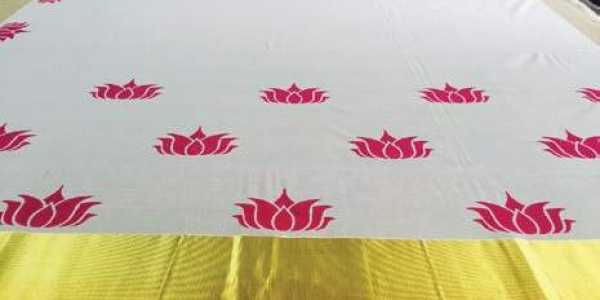
The art of hand block printing has crossed regional borders and is creating a niche for itself in the city hub.This century-old art form utilises a hand carved teak wood that is dipped in dye and stamped by hand onto cotton or silk.
In Bengaluru, Pooja Gokul a 32-year-old keeps this ancient art new and driven by conducting workshops regularly. She is also the founder of Block Beauty, an organisation specialising in block printing, which makes products such as sarees and handbags.
“The time taken to make a block depends on the design and size,” says Pooja. “It takes about six hours to create a saree with any desired design by our professional printers,” she adds. Popular in South India, the process, though artistic, is rather slow.
It is an ancestral skill, passed down from one generation to the next. The process begins with carving the block in a desired design, followed by the application of colour paste. The dye is pat before being pressed onto the fabric. Next step is removing the starch, which makes the fabric undergo soft bleaching. The last step is printing cloths and letting it dry in the sun.As complicated the art might sound, Pooja Gokul, a graduate from Chitrakala Parishat says it is can be mastered through workshops and YouTube tutorials.
“ I was passionate about art and design and it was always my dream to make block printing a popular art form in my own style. My initial years as an artist was a combination of learning and creating art,” shares Pooja. She further adds that it was important for her to create a balance between expressing her art and being accepted as an artist. “Thus began my teaching career,” she explains.
Handmade wooden blocks can be made of box, lime, holly, sycamore, plane or pear wood. But Pooja prefers teak since she believes in the idea of strength and indestructibility of wood. A lot of traditional, modern and popular culture designs are carved into blocks and designs are inspired by nature.
As an artist of block printing, she adores the work of Gustav Klimt, an Austrian symbolist painter and says she is intrigued by the use of gold foil in his art.
The workshops are conducted twice a month and the next one is scheduled on November 15 at the Block Beauty studio located in Domlur Layout. The beginners will learn about the origins and process of hand block printing besides familiarising themselves with the procedure of making blocks and the social symbolism of motifs.
Hand-on workshop of block-printing on paper and cloth will be conducted. “This will give an insight on the challenges of this fun art,” says Pooja. Starter kits are available online on their e-commerce website.
source: http://www.newindianexpress.com / The New Indian Express / Home> Cities> Bengaluru / by Zoya Nasir / Express News Service / November 14th, 2017
The aquaponics model that was developed by the University of Agricultural Sciences, Bengaluru | Photo Credit: H.S. Manjunath
Vegetables are grown over an aquarium in it
One can grow vegetables without soil in three separate trays kept on top of an aquarium using the water drawn from below. The water from these vegetable trays goes through pipes back to the aquarium.
This model of aquaponics — a form of aquaculture — developed by the Inland Fisheries Unit of University of Agricultural Sciences, Hebbal, Bengaluru, was among the exhibits that drew attention of people at the exhibition held on Friday at the College of Fisheries as part of its golden jubilee celebration.
Chief Scientific Officer of UAS’s Inland Fisheries Unit B.V. Krishnamurthy said they developed the model to popularise aquaponics in Karnataka. This form of aquaculture was popular in Kerala, he said. Mr. Krishnamurthy said seven different types of fishes, including Nile Tilapia, which is available in the unit, can be used in the acquarium. Lettuces and other high value short duration leafy vegetables can be grown in the trays, he said.
Among the others exhibits that attracted attention included the estuarine cage farming model developed by Central Marine Fisheries Research Institute, Mangaluru.
Scientist Purushottama G.B. said their cage farming model developed in 2009 has been adopted by several fishermen to harvest snapper (locally called Kemberi) and few other fishes available near estuaries. “Such harvesting helps fishermen earn income during the off season when they do not go to the sea for fishing,” he said.
The exhibition was inaugurated by in-charge Vice-Chancellor of Mangalore University Ishwar P. He also inaugurated the two-day All India Fisheries Colleges Cultural and Sports meet.
Speaking on the occasion, Mr. Ishwar said the Mangalore University was among the few universities in the country that has a separate sports policy. A separate sports and culture policy was necessary to support younger generation, he said.
Dean (Fisheries), College of Fisheries, H. Shivananada Murthy, said it was the first time that a sports and culture meet of the 30 fisheries colleges in the country was being held. Because of short notice of the event, only eight colleges were attending the meet. Mr. Murthy said the sports and culture meet of fisheries colleges would be an annual feature.
source: http://www.thehindu.com / The Hindu / Home> News> Cities> Mangaluru / by Special Correspondent / Mangaluru – December 15th, 2018