41
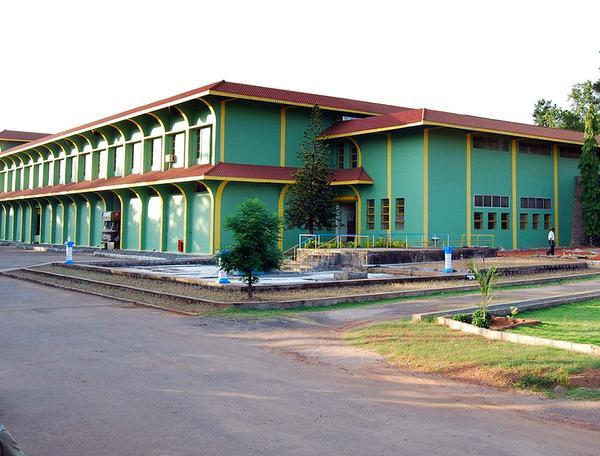
Campco chocolate factory gets new building
Mangaluru :
A new amenity building of the Central Arecanut and Cocoa Marketing and Processing Cooperative (Campco) Ltd at its chocolate factory in Puttur of Dakshina Kannada district will be inaugurated on January 21.
Addressing presspersons in Mangaluru on Tuesday, SR Satishchandra, Campco president, said the new building is being added to meet the international food safety standards and zoning of processing area as per FSSAI (Food Safety and Standards Authority of India) standards.
Built at a cost of ₹13 crore, the building is spread over 42,000 sq ft. Commerce Minister Suresh Prabhu will inaugurate it, , he said.
On January 21, the foundation stone for a master godown for arecanut, pepper and rubber will be laid at Kavu in Puttur taluk of the district.
To be built at a cost of ₹19 crore, the godown will have a built-up area of 1 lakh sq ft. The completion period for the building is 24 months, Satishchandra said.
Suresh Bhandary, Managing Director of the cooperative, said Campco would also introduce a premium assorted gift box containing four variants of its chocolate products on that day. These gift boxes will be marketed in airports and malls, he said.
DV Sadananda Gowda, Union Minister for Statistics and Programme Implementation, will unveil the bust of the late Varanashi Subraya Bhat, founder-president of Campco, on January 21, Satishchandra said.
source: http://www.thehindubusinessline.com / Business Line / Home>Economy> Agri Business / by The Hindu Bureau / Mangaluru – January 16th, 2018
39
New buzz in town
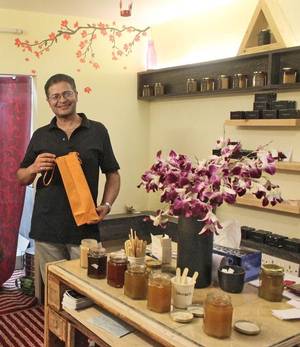
One man’s quest to find different types of honey and educate people on its consumption led him to start one of the country’s first honey boutiques
It was an amalgam of experience, education and desire to offer something unique, safe and wholesome that got Sudarshan Rao thinking about honey. His love for honey began in Northeastern India where he was working on a tea project. After tasting the local honey, Rao was surprised at its depth of flavour. Thus was born HoneyRus in a bid to change people’s outlook towards the nectar.
The genesis
“The foundation of HoneyRus has been research,” says Rao. “I aim to be a source of information on the fascinating and evolving world of bees and honey. For example, honey is now used in surgical bandages for its capacity to heal wounds that have become resistant to antibiotics. In that context it is called surgi honey.” Rao spent almost three years before they put their product out in the market. “We wanted to be really sure about our products so our research continues to be multidimensional.” They specifically provide single flower honey, educate people on what makes it unique, health benefits, and its usage.
Why honey
“Your question is your answer!” he exclaims. “Honey is a complex food product, it is antibacterial, antiviral, and it’s hygroscopic (absorbs moisture). The fact that people wonder “why honey’ “what is so different about it” is what drove us to research more on the topic. It is a rather underrated food product in India that has health benefits and gourmet potential.” “We go where the bees go!” says Rao. “A bees’ job is to pollinate and the honey, a building block for hive building, and we’re the thieves. Jokes apart, the best way to source honey is to let the bees do what they do best.” As an agribusiness professional, Rao feels that there is no substitute to the real thing. The closest one can get to the source, the better.
More than just one
The Honey Board of USA recognises about 300 monofloral varieties. Polyfloral varieties are infinite. When we say a honey is monofloral we mean the bees have foraged mostly on one particular crop. “If your honey doesn’t taste, look, feel, and flow differently each time you buy one, you aren’t eating the right honey! There’s hundreds of flower species so it’s not possible for your honey to taste the same each time.
There are mono and poly flora honeys, blended ones, processed and unprocessed variants. At HoneyRus we carry seasonal honey and predominantly single flower source variants.” HoneyRus has a generous collection of raw and infused varieties such as neem, acacia, wild borage and rainforest honey (from the Sunderbans). In the variant they have ginger, cinnamon and tulsi.
A green connect
Since the team at HoneyRus works so closely with nature, they are invariably affected by the levels of wastage witnessed on a daily basis. Which is why when it came to building the boutique they kept two things in mind; Simple and Recycle. “We have used-reused wood and engaged small and independent professionals for assistance and the build-up,” says Rao.
A delicate eco-system
The honey industry is severely exposed to consumerism, so the need for honey and honey-based products is constantly high. “There is also a growing demand for honey internationally, due to their colony collapse and consumption,” he says. “The challenge this poses to an intricate ecosystem is the burden it places upon these angels of agriculture. Be it indiscriminate use of pesticides, poor management of bee colonies, rapid spread of diseases among bees, and in some cases declining floral resources, increasing costs of food testing, an item consumer demands, but is not always willing to pay for, and inadequate consumer awareness.”
In the long run, HoneyRus hopes to show people what can be done with honey as food, a healthy alternative and a cosmetic applicant. They are also planning to sell honey-based products sooon. They deliver across India and are located at 14th A Main Road, Indiranagar, Bengaluru. Call 7022224850
source: http://www.thehindu.com / The Hindu / Home> Life & Style> Food / by Rehna Abdul Kareem / April 06th, 2017
37
4,850 college students create a record

They all wear the same badge and sing Vande Mataram on Malpe beach
A new record of the “Largest congregation of people wearing the same badge” was created and entered into the Golden Book of World Records on the Malpe beach here on Saturday.
This record was created by 4,850 students from 23 degree colleges, who wore the same badge with the slogan “Save nature for the future” and sang the full version of the national song, Vande Mataram.
Vivekananda birth anniversary
As many as 23 singers also joined the students in singing the full version of Vande Mataram. The event, organised by a voluntary organization, Samvedana Foundation, aimed at creating awareness for saving nature.
This event was organised to mark the 155th birth anniversary of Swami Vivekananda.
Certificate
After the students wearing the badges sang Vande Mataram, the representative of Golden Book of World Records, Santhosh Agarwal, handed over the certificate of “Largest congregation of people wearing the same badge” to Prakash Malpe, coordinator of the programme and the head of Samvedana Foundation.
The certificate was handed over in the presence of Pramod Madhwaraj, Minister for Fisheries, Youth Empowerment and Sports.
Earlier, the students brought a 1,750-ft long and nine-feet wide national flag in a procession from the Gandhi Shatabdi Grounds to the beach here.
Meenakshi Bannanje, president of the Udupi City Municipal Council, Dinakar Babu, president of the Udupi Zilla Panchayat, Raghupati Bhat, former MLA, and G. Shankar, philanthropist, were present.
Speaking to presspersons here, Mr. Santhosh Agarwal said that the record of “Largest congregation of people wearing the same badge” was a new one which was created here.
source: http://www.thehindu.com / The Hindu / Home> News> Cities> Mangaluru / by Special Correspondent / Udupi – January 13th, 2018
35
How areca farms in Karnakata are nurtured by the bounties of foliage forests

Soppinabettas are vital sources of mulch and manure, fruit and fodder
The small, door-less thatched hut — only large enough to shelter one person — looks out of place, standing alone on the forest’s edge. As we approach it, an acrid smell hits us. Grey smoke wafts from a wood fire on the floor, above which is a large batch of uppage or Malabar tamarind halfway through the process of curing.
Rudra Gowda, an areca and paddy farmer in Hukkali village in Karnataka’s Uttara Kannada district, collected the uppage from a soppinabetta (a forest patch allocated to him) nearby. “We get only ₹80 per kilo of uppage now, but it is very useful,” he says. “The oil from the seeds is good for cooking and we make alcohol with the fruit.”
The soppinabettas of northern Karnataka harbour a staggering diversity of trees, and fruit extraction is just one of the economic activities that these heavily-managed forests support. Areca (and sometimes paddy) farmers in districts including Shimoga, Chikmagalur and Uttara Kannada have usufruct rights over these foliage or leaf manure forests: they collect green foliage and dry leaf litter to use as crop manure.
The foliage also arrests weed growth and soil erosion, while maintaining soil moisture. Wood collected from these forests are a primary source of fuel. And as for medicine, “everyone in our village knows what plant to harvest from the forests for common illnesses,” says Rudra.
Post-monsoon bounty
Soppinabettas often comprise savannahs and grasslands, where farmers graze their livestock. Post-monsoon, several grasses — locally known as karada (often a mix of native grass species like Themeda triandra) and prized as a mulch plant for areca – grow in the bettas. Farmers take special care to fence off their livestock from the bettas during this time. Dry grass is harvested between December and May every year and also used as cattle fodder during the trying summer months.
While farmers have extracted these resources and nurtured these forests for around 2,000 years, they got official rights to use them in the late 1860s when the British allocated patches to farming households to prevent them from harvesting vegetation from natural forests. “The British gave us these lands,” says Raghunath Gowda, who owns a 25-acre areca farm in Ammenalli village in Uttara Kannada and has rights over almost 225 acres of soppinabetta. “Now the forest department has given us papers to support our rights after a re-survey.”
On paper, for every acre of areca crop, farmers have access to up to nine acres of forest; paddy cultivators receive up to four acres for each acre of rice in some areas.

Scientists studying the soppinabettas of Sringeri hill town (Chikmagalur district) in 2011 found that individual farmers collect around 31 metric tonnes of leaf litter and approximately 19 metric tonnes of green foliage every year.
Yet, despite such high resource extraction and human activity, soppinabettas remain crucial habitats for biodiversity. Scientists observed as many as 114 bird species in the areca-betta landscape of Uttara Kannada; other teams have recorded more than 220 species of trees and 41 orchid species in Sringeri. Then there are the mammals: Raghunath says he has seen wild boar, leopards, gaur and sambhar in these lands.
But today, encroachment and over-extraction threaten the bettas. Legal provisions to create more agricultural areas have also caused reductions in betta lands in some areas, says Sharachchandra Lele, Senior Fellow at Bengaluru’s Ashoka Trust for Ecology and Environment, who has studied the soppinabetta system in Uttara Kannada. “In some districts, there has been extensive conversion to coffee or other plantation crops,” he says.
A sense of ownership
In 2012, scientists found that areca plantations consume six times more compost than paddy fields but generate almost four times more revenue; so farmers in Sringeri were increasingly converting paddies to areca plantations, putting a strain on bettas.
And yet, “It turns out that betta use is sustainable because there is individual control over them,” says Lele. “It has belied the claims of British and Indian foresters that such rights would, or has, led to outright forest degradation.”
“The tragedy of the commons has been largely averted because of the sense of ownership each farmer has over his betta,” says Indu K. Murthy, consultant scientist at the Centre for Sustainable Technologies, Indian Institute for Sciences. “A lot depends on the individual farmer and how he manages his soppinabetta.”
To ensure that farmers do not extract too much vegetation, Karnataka’s forest laws mandate that every hectare of betta should contain a minimum of 100 trees, of which 50 should be forest species. Raghunath however, claims he does not know of such conditions. And yet the importance of conserving the land is clear to him.
“Without soppinabettas, our areca plantations will not be productive. So we make sure it is well maintained and that we extract vegetation from different areas of the betta each year.”
source: http://www.thehindu.com / The Hindu / Home> Sci-Tech> Agriculture – Field Notes / by Aathira Perinchery / January 06th, 2018