A doctor who gets a kick out of fighting

Meet a doctor, who recently won an MMA bout at the Rampage Fighting Championship in Malaysia

Twenty-five -year-old Kajal is an Ayurvedic medicine graduate from Mysuru. She is not someone you would associate with an argument, let alone a fight. In fact, last year she started going to a gym in the hope of putting on some weight, as she “was underweight”.

But this December, she surprised everyone by taking part in the Rampage Fighting Championship, Malaysia. She was picked for an MMA (Mixed Martial Arts) bout in the 56 kg flyweight category against a local girl. And, she won the 3-round contest in the 2nd round on a technical knock out. Her opponent had no reply to her relentless punches. That is a far cry from the general perception of Dr Kajal Naresh Kumar.

Now, instead of mending bones and prescribing medicines, this doctor is keen to pursue her passion in the cage (the fighting arena of MMA bouts)

Her relatives are trying to understand how Kajal, a budding doctor, transformed into a fierce fighter in a matter of months. She played tennis and was into skating, but fighting was not something her family ever associated her with. Nevertheless, they were rooting for her when she was throwing punches at her Malaysian opponent. The win was the icing on the cake.

It all started when Kajal joined a gym in April 2016, where she was fascinated by those practising kick-boxing. She was hooked and joined kick-boxing classes in June. Her trainer, Samith Bhat, says, “She expressed an interest in learning kick-boxing. She is a sincere pupil and regular for classes. So, I asked her if she would like to compete.”

Kajal’s first fight took place in the club in November 2016.

Samith says, “When she took a few punches, she did not back off. She went right back into the fight and I knew she was a fighter in her heart.”

The doctor won the bout. Later she participated in the National kick-boxing championship in Patna in December 2016, organised by the Kickboxing Federation of India. The event had over 1,500 participants — men and women — in various categories. Kajal won the gold in kick-boxing in the 56 kg category that had 10 participants.

More contests followed and her first MMA bout was held in April 2017.

But while her bouts were giving her a high, her family was getting uncomfortable seeing her return home with bruises.

Anyone who has watched an MMA fight will understand that the only protection for fighters in this full-contact combat sport —that allows striking and grappling — is a pair of gloves.

However, the family did not put hurdles in her path. In fact, the first time she lost a fight, her parents and siblings rallied around her.

Samith says, “Kajal is good. She is now a member of Team Genesis, which I formed to participate in domestic bouts.” The sport has a huge following in the North-East. However, in India, MMA is a niche sport and is not officially recognised by the Government. Bouts are organised and overseen by enthusiasts and fans.

As of now, the country has few fighters, but the number is growing. The size of the crowd is also increasing. The events are being covered by local television channels, which is helping popularise the sport and draw crowds to contests.

However, this sport is not all about fighting. Suraj Shetty, who runs the Grounds Sports Fitness in Mangaluru, says, “People who come to me focus on fitness. Most are in the 25 to 35 age group. For such people, after a hard day’s work, it is a good stress-buster. Some women too joined my classes for fitness and realised some of the techniques can be employed for self-defence. Some companies have even organised classes for their employees — for fitness and self-defence.”

Samith adds, “Muay Thai, Jiu Jitsu, kick-boxing and MMA come as a breath of fresh air for people who were put off by dumbbells, barbells and weight plates. It is also about correct posture. The age range in my classes is 15 to 40. Actually, one of my pupils is 41.”

Kajal is eyeing the ultimate prize — participation in the Ultimate Fighting Championship (UFC), which is one of the most high-profile contact sports events, thanks to the real fighting.

Her inspiration is fellow fighter and Team Genesis member Basavesh — a 25-year-old, who a clinical psychologist in Mysuru. He started much before Kajal and is now a veteran of several bouts and contests. The young man is among those aiming for the UFC too.

So next time, you visit a hospital or travel by a BMTC bus, you might be tempted to take a closer look at the body and posture of a doctor or the conductor. People like Kajal make you wonder if there is a fighter underneath every uniform.

source: http://www.thehindu.com / The Hindu / Home> Life & Style / by Dhiraj Shetty / January 10st, 2018

Five meritorious medical students get scholarships

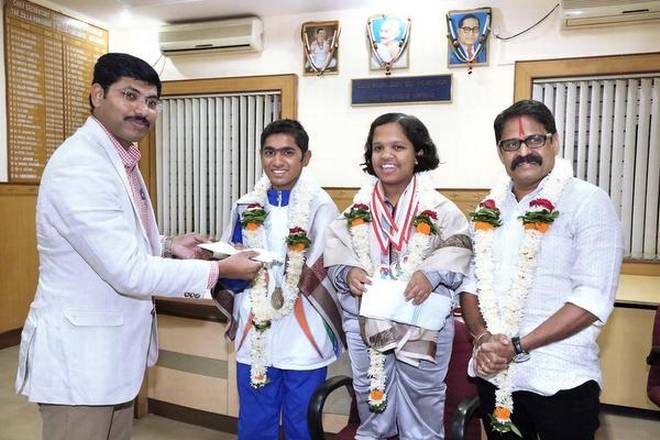
The five meritorious students selected for the Dr. P.S. Shankar Medical Students Scholarship after being felicitated in Kalaburagi on Monday.

They will get ₹ 1,000 each for 54 months

Five meritorious students of first year MBBS from poor economic background selected for the Dr. P.S. Shankar Medical Student Scholarship were felicitated during the 18th anniversary celebrations of the pratishthan in Kalaburagi on Monday.

A physically challenged meritorious girl Soundarya Pon Moliyan was the cynosure of all eyes during the function. Ms. Moliyan did not let a 75 % disability come in the way of her academic pursuits. She scored 86.60 % in the SSLC examination and 76.66 % in PU examinations and got a medical seat in the Shimoga Institute of Medical Sciences.

Nagaveni Vishnukumar Jinde and Shivashankar Reddy A. Doddakamanna, students of Gulbarga Institute of Medical Sciences, Sagar Bhairappa Maali of Karnataka Institute of Medical Sciences, Hubballi, and Sharanabasappa N. Beeda of Mysore Medical College and Research Institute were felicitated on the occasion. All the five students studied in Kannada medium up to SSLC. The selected meritorious students would receive scholarship of ₹ 1,000 each for 54 months till they complete their medical course.

Award

Medical Director of Dr. N.R. Acharya Memorial Hospital, Udupi, N. Bhaskar Acharya received the Dr. P.S. Shankar Shreshta Vaidya Sahitya Prashasti Award for the year.

A.H. Rajasab, former Vice-Chancellor of the Tumkur University was the chief guest.

Ambika Shankar, president of the prathisthan, and H. Veerabhadrappa, vice-president of the prathisthan, were present.

source: http://www.thehindu.com / The Hindu / Home> News> States> Karnataka / by  Staff Reporter / Kalaburagi – January 02nd, 2017

A neurology topper who wants to join government service

Achievers all: Some of the gold medal winners at the 22nd convocation of NIMHANS in Bengaluru on Saturday.

Sai Deepak Yaranagula, who bagged the Dr. Ansiya Vasanth Memorial Award for the Best Postgraduate Resident in Neurology – 2017 on Saturday, said he was keen to join government service because that is where there are a lot of patients from different backgrounds.

“I am disturbed and concerned over the increasing mistrust between doctors and patients. I want to create awareness through my patients that medicine is an imperfect science and that it is not like calculative mathematics. Sometimes things can go wrong but that does not mean it is done intentionally,” he told The Hindu.

“Communicating with patients in government hospitals to create awareness about our relationship is the best way,” the young doctor said.

All toppers that The Hindu spoke to owed their success to their alma mater. Dressed in their convocation robes, the bright young minds spoke enthusiastically about taking forward their skills to serve the community. Bharath S., who bagged the Dr. Usha Punja Award for Best Outgoing Student in DM Neuroanaesthesia – 2017, said his inspiration was his alma mater.

“I always wanted to pursue higher studies in NIMHANS, and this is the culmination of my dream,” he said, and added that he wants to do further research in his speciality.

Lakshmi S., who was awarded the Dr. D.L.N. Murthy Rao Memorial Prize for the Best Outgoing Student in MD Psychiatry – 2017, said there should be more institutions like NIMHANS in the country to meet the shortage of psychiatrists.

“Although neurology is tough and challenging, the training that I got at NIMHANS has made me confident of serving the community. It was my mother’s dream that I become a doctor and I am happy I have fulfilled her dream. We lost her two years ago,” she said.

source: http://www.thehindu.com / The Hindu / Home> News> States> Karnataka / by Special Correspondent / Bengaluru – December 30th, 2017

2,000 students to sing ‘Vande Mataram’ on Malpe beach

The Samvedana Foundation will organise the singing of the national song ‘Vande Mataram’ by over 2,000 degree college students, to create a recordon Malpe beach on January 13.

Addressing presspersons here on Monday, Prakash Malpe, coordinator of the programme, said by so doing, the foundation wanted to enter the Golden Book of World Records. This is being done as part of the 155th birth anniversary celebrations of Swami Vivekananda.

All the students will don white clothing while singing the national song. In addition, a 200 m long flag will be carried in procession from Gandhi Shatabhi ground to Malpe beach at 2.30 p.m. The singing would begin at 4 p.m. It would be sung in full with background musicAlready, about 2,000 degree college students from about 40 degree colleges in Udupi have volunteered to participate in the event.

A team of 30 musicians were visiting these colleges to prepare the students for the event. Playback singers, including Rajesh Krishnan, Sangeeta Ravindranath, Malini Keshav Prasad, Surekha Hegde, Shruti Tumkur, Yashwant, Jagadish Puttur and Vaishnavi Manipal, would join the students.

The students would also sport a badge with the slogan ‘Save Nature for Future’ during the event. The foundation would be launching a programme to create 100 forests in the State in May, Mr. Malpe said.

source: http://www.thehindu.com / The Hindu / Home> News> States> Karnataka / by Special Correspondent / Udupi – December 17th, 2017

National Education Society is 100 and counting

A file photo of the National High School in Bengaluru.

It runs 17 institutions now and is proud to have an illustrious alumni

A school that was started as part of the freedom movement to imbibe nationalist ideals among students eventually grew into one of the most reputed educational institutions in the State, running as many as 17 schools and colleges, and having an illustrious alumni.

This year, the National Education Society (NES) turned 100.

The first school — National High School — was started in 1917 near Tharagupet in Bangalore (and shifted to Basavanagudi the following year) by theosophist and Congress leader Annie Besant, along with 10 other schools across the country.

___________________________________

National Education Society
  • Started by theosophist Annie Besant in 1917, along with 10 other such societies across
  • the country
  • The first school, National High School, was started at Tharagupet in Bangalore in 1917 and shifted to Basavanagudi
  • the next year
  • NES started National College
  • at Basavanagudi in 1945
  • It started another college in Jayanagar in 1965
  • NES also runs several schools and colleges in Chickballapur and Kolar districts
  • Noted alumni of NES institutions include cricketers E.A.S. Prasanna, B.S. Chandrasekhar and Anil Kumble; ISRO chairman A.S. Kiran Kumar, industrialist P. Sadananda Maiya, and actors Vishnuvardhan, Srinath and Ramesh Arvind
  • _________________________________

The NES went on to start a host of other institutions, most famous among them being the National Colleges in Basavanagudi and Jayanagar.

The first school remains one of the few successful privately run Kannada-medium schools in the city today, with over 700 students. The NES also runs schools in Kolar and Chickballapur, which, put together, have over 1,600 students learning in Kannada medium.

D.V. Nagesh, headmaster of the National High School, Basavanagudi, however, said enrolment for the Kannada-medium section was slowly dwindling, though it continues to be “healthy” in rural areas.

A.H. Rama Rao, president of the NES, said what sets the institution apart from others is the fact that its governing council is elected once every two years without any sectarian bias, giving it a very democratic character.

As the NES has turned 100, old-timers fondly remember the days of H. Narasimhaiah, freedom fighter, rationalist and educationalist, whose 69-year association with the institution started as a student and went on till he held its reins. So much so the college’s name became synonymous with his.

Founding ideals

H.V. Venugopal, former principal, National College, Basavanagudi, said the framework of activities during the academic year set by “Dr. HN” — annual essay competition on scientific thinking, intersection drama competition, weekly science forum lectures, social science club lectures — was firmly in place. “While it is true that the flavour changes with different administrators, the institutions are committed to the founding ideals and also to those of Dr. HN,” he said. The science forum started by Narasimhaiah in 1972 has till date conducted over 2,800 science lectures, including many by Nobel laureates.

But there are some who disagree. A former teacher said that within two years of Narasimhaiah’s death, religious seers were called for programmes, something “unthinkable” when the educationalist led the society.

But one thing that the NES seems to be still leading in is in keeping up with the times in science and technology. Blackboards are a passé here. All boards in the National High School are digital display boards. Dr. Rao said the NES had always been at the forefront of change, especially in science education. “The next big thing is Blockchain technology. We are working to introduce a course on it,” Dr. Rao said.

The NES also has plans to retain the heritage building of the Basavanagudi National High School and rebuild the rest of the structure as a state-of-the-art education campus, following which they want to expand by starting several educational programmes.

Centenary celebration

President Ram Nath Kovind will take part in the centenary celebration of the NES on Saturday. The other dignitaries to be present include Governor Vajubhai R. Vala, Chief Minister Siddaramaiah, and Union Minister Ananth Kumar.

source: http://www.thehindu.com / The Hindu / Home> News> States> Karnataka / by K.V. Aditya Bharadwaj / Benglauru – December 30th, 2017

Kuppali Venkatappa Puttappa honoured with a Google doodle on his birth anniversary

KuvempuBF30dec2017

The epic poem, Sri Ramayana Darshanam, for which Kuvempu was awarded the Jnanpith is a verse rendering of the Ramayana, and remains his most enduring work.
The renaissance of Kannada literature on the national stage was heralded by the publication of Kuvempu’s Sri Ramayana Darshanam, which was awarded the Jnanpith Award, half a century ago. Google is honouring the contribution of one of Karnataka’s foremost man of letters by dedicating a doodle to the winner of the first Kannada Jnanpith on the occasion of his 113th birth anniversary. Incidentally, it is also the golden jubilee of the author’s novel Malegalalli Madumagalu.

Kuppali Venkatappa Puttappa, who is better known by the pseudonym Kuvempu, was born on December 29, 1904 in Shimoga district. He was initially home-schooled, but was later enrolled at the Anglo-Vernacular school in Tirthahalli following the death of his father when he was 12. After completing his primary education he moved to Mysore to attend the Wesleyan High School, and later the Maharaja’s College of Mysore from where he graduated, majoring in Kannada and English.

The bilingual education he received played an important part in his literary evolution. Kuvempu’s first work Beginner’s Muse, a collection of poems, was penned in English. However, his dalliance with the English language was short-lived.

Kuvempu took up a lecturer post at his alma mater Maharaja’s College in 1929 and also taught at the Central College in Bangalore before his second stint at Maharaja’s University, where he would go on to become the Principal. In the intervening years, he was at the vanguard of educational reforms in the State, and was a proponent of making Kannada the medium of instruction in institutions in the State.

Kuvempu was appointed the Vice-Chancellor of Mysore University in 1956. His reputation in academic circles closely mirrors the development of his literary career. The rigours of life in academia only fuelled his literary output. He published short stories, plays, two novels, and 25 collections of poetry during the course of his career.

He was staunchly opposed to casteism and many of his works explore political themes. Kuvempu also advocated gender equality and was opposed to superstition. The large body of work he left behind spans many genres, but he is primarily known for his poetry, the subject of his verses often being derived from nature. In the doodle, Kuvempu is seen surrounded by nature, the muse for many of his poems.

The epic poem, Sri Ramayana Darshanam, for which Kuvempu was awarded the Jnanpith is a verse rendering of the Ramayana, and remains his most enduring work. It also marks the beginning of Mahakavya, an era where contemporary writers took to telling epic tales in verse, adapting the stories of yore into modern settings, and in the idiom of the day.

Recognition and accolades started pouring in soon after. Following independence, and the reorganisation of States on linguistic lines, Kuvempu was conferred honorific of Rashtrakavi (national poet) by the Karnataka government in 1958. He is also the author of Jaya Bharata Jananiya Tanujate, which was adopted as the State anthem of Karnataka in 2004.

Kuvempu was awarded the Padma Vibhushan in 1988. His contribution to Kannada literature has been lauded by peers and has influenced a generation of writers including U.R. Ananthamurthy. He passed away in November, 1994.

source: http://www.thehindu.com / The Hindu / Home> Sci-Tech> Internet / by Rohan Abraham / December 29th, 2017

Siri and Shrestha organic brands to hit the market soon

Visitors at the two-day Millet Mela that was inaugurated in Mysuru on Wednesday.

People can now look forward to certified organic produce that will be promoted under the brand names Siri and Shreshta in the State.

This is a bid to ensure quality and authenticity of the produce, which will be certified by the Karnataka State Organic Certification Agency (KSOCA), which was established for the purpose and duly accredited as per the National Programme for Organic Productions, Government of India.

The certification and branding will help filter fake organic produce from the market. H.A. Suresh, assistant director of KSOCA, told The Hindu on the sidelines of the Millet Mela here on Wednesday that as per the new norms of the food safety regulator, organic produce should also sport a common logo which was unveiled recently. The produce will be branded and marketed by the organic federation constituted on the lines of the Karnataka Milk Federation, he said.

Over the past three years, ever since the KSOCA was established, an increasing number of farmers have shown an inclination to switch to the organic mode. As on date, there are 566 farmer groups, each with at least 100 members, across the State.

Besides this, there are four horticultural groups, while 100 individuals have taken to organic practices ina agriculture“Karnataka is among the leading States promoting organic farming. Area under organic production is 81,000 hectares,” said S.S. Parashivamurthy, quality manager at KSOCA.

The production is around 1.64 lakh tonnes of agricultural produce and it is expected to increase with additional area being brought under organic cultivation, he said.

“The Mysuru-T. Narsipur-H.D. Kote-Kollegal-Chamarajanagar belt has a good number of organic farmers and similar groups are active in Belagavi, Dharwad, coastal regions and parts of north and central Karnataka,” Mr. Suresh said.

In Nanjangud, a cluster of villages was identified where 48 farmers are practising organic farming on 100 acres of land, according to the group president Rangaswamy Naik. “Though the yield was initially low, it was compensated by the decline in investment and good income,” said Mr. Naik.

Horse gram, green gram, black gram and chilli are being cultivated under organic conditions. The KSOCA is confident of promoting organic farming as a viable practice and of increase the coverage area.

source: http://www.thehindu.com / The Hindu / Home> News> States> Karnataka / by R. Krishna Kumar / Mysuru – December 27th, 2017

Workshop on Vedic Maths begins in Mysuru

According to B Shilpa of the organisation, Vasista has been celebrating December 22, the birth anniversary of Srinivasa Ramanujan, the National Mathematics Day, every year to pay tribute to many accounted and unaccounted mathematicians of ancient India for their contribution to the field of Mathematics.

“To make the celebration worthwhile, this year, Vasista is conducting free workshops to 1,000 students of class 7, 8 and 9 of government and private schools. The workshop on ‘Vedic Maths and Indian Mathematics’ is being held at Vasista’s office at Kuvempu Nagar, in Mysuru up to February 15, for 30 students per day,” she said.

“Vedic Maths is an ancient system of mathematics, which was rediscovered from the Vedas between 1911 and 1918 by seer Swami Bharathi Krisna Thirthaji of Govardhana Pitha (1884-1960). According to his research, all kinds of calculations of Mathematics are based on a 16-word formulae or the sutras and 13 upasutras. It is the world’s fastest way of doing maths, where one can do complex calculations like 998X993 in less than five seconds and 7584656/9 in less than 9 to 10 seconds,” she said.

Shilpa said, “Vedic Maths is recommended for aspirants of competitive exams like UPSC, KPSC, banking, etc as it takes hardly 30-36 seconds to read, understand and solve a problem. The workshop aims at creating awareness about the importance of Indian Ancient Knowledge and its application in academics and also day-to-day life among the new generations. The participants acquaint themselves with the magic of Vedic Maths and uncover mental arithmetic and take home endless short one-line solutions for complex mathematic numbers, including addition, subtraction, multiplication and division by S Vinuthan, director of Vasista Eduventures.”

She said, “Since the inception of Vasista Eduventures in 2011, Vinuthan has been conducting Vedic Math classes in various parts of the country through franchises of Vasista. More than 10,000 students and over 700 teachers have been trained across 22 states. The workshop is conducted from 9.30 am to 4.30 pm. Each school is allowed to send one boy and one girl from class 7, 8 and 9 respectively to attend the workshop.”

source: http://www.deccanherald.com / Deccan Herald / Home> District / by T R Satish Kumar / DH News Service / Mysuru – December 27th, 2017

These swimmers are making waves

SwimmersBF28dec2017

One thing that inspires fitness enthusiasts not to miss their training sessions is Shridhar Malagi pumping weights at Jairaj Gym in Tilakwadi.

While others sweat it out, Mr. Malagi seems to do it effortlessly and that too with just one hand. Doctors had amputated his left hand after he met with an accident.

Mr. Malagi visits the gym only to keep himself fit. His real prowess is seen in swimming.  He is part of the State team that won several medals at the recent national para swimming event. He won five medals under various categories and plans to compete at the 2020 Paralympics.

Mr. Malagi remembers the fateful day when he lost his arm. He was returning home in Belagavi when his school auto met with an accident. Multiple visits to hospitals, before and after surgery, and many painful nights later, he returned to school. That was 12 years ago when he was in Class 1. “I was feeling down and out. We were poor and could not afford any special school. My father works as an assistant in a factory and mother a maid,” he told The Hindu. And then his swimming story began. Coach Umesh Kalaghatagi, who trains children at the JNMC swimming pool and the Rotary sports centre, spotted him at the edge of the pool, and asked him if he wanted to swim.

Mr. Malagi hesitantly said yes and brought his parents to meet the coach the next day.

“I have seldom missed my swimming classes since that day,” he says.

In his para swimming career of over five years he has won 27 medals at national events.

A similar inspiring story is that of Simran Gaundalkar who won two medals at the recent World Dwarf Games at Ontario in Canada. The 14-year-old girl has collected 24 medals at the national and international events.

Born with Achondroplasia, a genetic disorder that restricts growth and leads to dwarfism, she was ridiculed by neighbours and schoolmates. But her parents supported her and sent her to study in a normal school in Belagavi.

“Coach Kalaghatagi spotted me and initiated me into swimming. I never believed I would do it, but now I enjoy it,” she said. She has been training since she was in Class 2.

Zilla Panchayat CEO R. Ramachandran felicitated the swimmers on Monday. He promised all help to the swimmers and their coach Mr. Kalaghatagi.

“We will help them in their search for sponsors and try to provide them with other assistance,” he said.

source: http://www.thehindu.com / The Hindu / Home> States> Karnataka / by Rishikesh Bahadur Desai / Belagavi – December 27th, 2017

Once waste pickers, now successful managers

Kamakshipalya DWCC manger Annamma.

Most of the city’s waste managers, including pourakarmikas, are women. Of the 181 dry waste collection centres (DWCC), many are managed by women, who were formerly waste pickers. These women have not only transformed their lives, they are also helping other women move up. The batch of women managers have also earned the respect of the communities they work with.

Waste management experts say women have the drive and desire to do something good for the city and also improve their lives in the same process. “For this, they are ready to face all odds and circumstances,” they point out. These are some of the women waste managers who turned around their lives.

Annamma

Annamma has been managing the DWCC at Kamakshipalya for the past five years. From being a waste picker for nearly 30 years, Ms. Annamma now is no less than an entrepreneur, employing eight women who were also formerly waste pickers themselves. “Initially, I hesitated to take responsibility of managing a centre. Later, I changed my mind … I knew the basics of segregation. I’m happy that my decision has brought me thus far,” she said. Life as a waste picker was difficult and she is now leading a comfortable life. “What gives me immense satisfaction is that I have helped other waste pickers out of their situation,” she said.

Ms. Annamma’s centre collects nearly two tonnes of dry waste every day.

Subbamma

“I used to face verbal abuse on a daily basis, and also harassment from the police. People used to look at me with suspicion. I lived in a hutment and had no idea where my next meal would come from,” said Subbamma, a former waste picker. She now manages the Kamalanagar DWCC, sometimes guiding local residents about waste segregation.

“It has been a long five years. My journey has seen ups and downs. I now live with my three school-going sons, and my daughter and her husband in a rented house,” she said proudly.

Though she was earlier collecting dry waste going door to door in the ward, the garbage contractors now drop off the dry waste at the DWCC every day. “We get around 400 kg of dry waste on an average every day. Though I am not making much, I’m satisfied,” she said.

Geetha

Four years ago when Geetha was entrusted with the Rajagopalanagar DWCC, she faced a lot of difficulties for the initial three months. She used to work at another DWCC before she was asked to manage the Rajagopalanagar one. “I used to regret my decision … I didn’t have money for the vehicles, the contractors were creating problems. I was incurring a loss,” she said, and added that she persevered to overcome her problems.

Today, Ms. Geetha leads of team of eight men, who work with her at the DWCC. “With four vehicles, I am able to collect more than one tonne of dry waste going door to door every day. We have divided the area into blocks and have a rota for collection of dry waste from each of these blocks.”

Kumuda

As early as 6 a.m. every day, Kumuda and her team of 12 women, who were formerly waste pickers like her, come to the Katriguppe DWCC to start work. Ms. Kumuda, who manages the DWCC, instructs the three drivers on the areas they need to go to collect dry waste. “I have to start early. The DWCC is on the main road and the shops next to the centre raise objections. We are also grappling with limited space,” she said.

Despite the cramped centre, Ms. Kumuda manages to collect more than two tonnes of dry waste a day, earning her a revenue of around ₹1 lakh a month. “But that is hardly enough. After payment of wages and expenditure towards diesel and maintenance of the three vehicles, there is hardly anything left. Some months, I am forced to borrow to meet the expenses,” she said.

Sampangi

Over the past seven months, Sampangi’s confidence has grown by leaps and bounds. As a waste picker, she was wary of interacting with people. Today, she has no problems. She has been effectively managing a team of 10 former waste pickers at the Kumaraswamy Layout DWCC.

“I knew nothing when I started. Over the past few months, with a lot of cooperation from the BBMP’s health inspector and supervisor, I am able to collect around two tonnes of dry waste a day,” she said, and added that the local residents have also been cooperative.

The centre lacks water connection and does not have a functional toilet. That has not deterred Ms. Sampangi and her team. “The only problem I face is that most recyclables get picked by the pourakarmikas and contractors themselves and I’m left with low- value waste that just eats into the space at the centre,” she said.

source: http://www.thehindu.com / The Hindu / Home> News> Cities> Bengaluru / by Chitra V. Raman / Bengaluru – December 28th, 2017