6
5
4
3
2
Archiving the versatile sari

The Nivi drape, or the one where the pallu of a sari is worn on the left shoulder, is the most common type of sari drape in the country and the world over. But India has hundreds of such drapes, specific to region and culture, that have been forgotten over the years. To document these drapes and create a digital archive, Border&Fall, a city-based digital platform promoting the garment, textile and craft community of India, is making 80 short films as part of its project ‘The Sari Series: An Anthology of Drape’.
Each film will be two minutes long and will show how to drape a sari in a particular style. The archive, expected to be released this fall, can be accessed online for free .
“This project has been an idea for years, but we began proactively working towards it in early 2016. The aim is to create a cultural documentation of the sari through short films, which will give people access to various drapes, and to showcase the diversity and versatility of sari as a garment,” said Malika Verma Kashyap, founder of Border&Fall.
However, Ms. Kashyap said this was not an attempt to “revive” the garment. “The sari is not a forgotten tradition, it is worn my millions of women every day. But many are unaware of the different ways it can be worn. The Boggli-Possi drape from Andhra Pradesh for example is great to behold,” she said.
Some of the other styles to be documented are the Coorg drape, the Kalna Sari drape from West Bengal, Kuchipudi men’s sari drape from Andhra Pradesh, Yakshagana Kase from Karnataka, Purnia drape from Bihar, Warli drape from Maharashtra, and Ranchi Saiko drape from Jharkhand.
Apart from the 80 films, three independent films directed by Qaushiq Mukherjee, Bon Duke and Pooja Kaul will explore the sari’s past, present and future.
Some of the images of the drapes are part of the #WeWearCulture project by Google Arts & Culture.
source: http://www.thehindu.com / The Hindu / Home> News> Cities> Bengaluru / by Sarumathi K / Bengaluru – July 28th, 2017
Peering into the architecture hidden in a thriving market
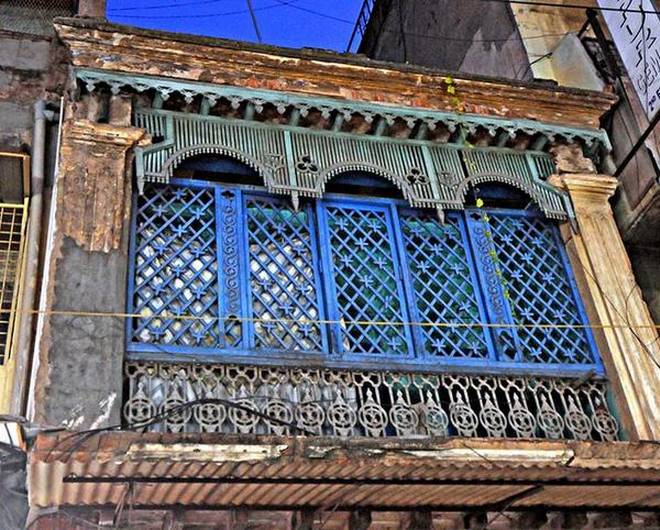
Photo: Sampath Kumar G P | Photo Credit: G_P_Sampath Kumar
INTACH’s heritage walk on Avenue Road today marks 10 years of ‘Parichay’ project
The cacophony that dominates Avenue Road is something that every Bengalurean knows only too well. The busy road is home to hundreds of shops and buildings. However, it also boasts small islands of period architecture, which are a rich source of knowledge about the city’s heritage.
This year, the historic road will host the 115th ‘Parichay’ Heritage Walk conducted by the Indian National Trust for Art and Cultural Heritage (INTACH – Bangalore Chapter) on Sunday. The walk will also mark 10 years of the Parichay project.
INTACH plans to conduct an ‘architecture walk’ that will give a historical perspective to the dime-a-dozen brick and mortar structures that pack the road. “To have people understand this through the eyes of an architect, we will have Vijay Narnapatti take people to heritage buildings,” said Meera Iyer, co-convener, INTACH.
“The walk will begin at Mysore Bank Circle and end at the Anjaneya temple. On the itinerary are the Rice Memorial Church (named after Benjamin Holt Rice, a missionary of the London Missionary Society), and Manik Mastan Saheb Dargah. The syncretic culture that has thrived for hundreds of years, much before the time of Hyder Ali, continues to flourish on this historic road,” said Mr. Narnapatti.
The thriving marketplace will remain a constant companion during the walk. The area was called Dodda Pete before being renamed Avenue Road.
“Possibly, owing the avenue of trees. We still have British colonial-style buildings here. If the government declares it a heritage road, it would be befitting its history,” said Mr. Narnapatti.
Avenue Road houses some of the best carved facades. Stone was used in most of the buildings, including Raja Market, and in the temple, church, and the dargah. “While stone was used as both a building material and for cladding and flooring, the colonial influences are seen in the windows with small columns on either side, arched windows, and pointed wooden shutters,” he said.
The markers on each of the side streets in stone can be seen even today. “There are remnants of the stone seats installed beneath a cluster of trees that are tucked away in the side lanes that had cobbled stones for a walk path, not visible from the main road,” said Mr. Narnapatti. But in the midst of all this beauty grew a monstrous market that erased most of its architectural heritage, he added.
source: http://www.thehindu.com / The Hindu / Home> News> Cities> Bengaluru / Ranjani Govind / July 30th, 2017