Reversing drug resistance made possible

Drug-resistant E. coli become sensitive to antibiotics when H2S synthesis is inhibited

Make them vulnerable: (From left) Dr. Saurabh Mishra, Dr. Amit Singh, Prashant Shukla and Dr Harinath have been able to reverse antibiotic resistance in E. coli.

Indian researchers have unravelled the mechanism by which hydrogen sulphide (H2S) gas produced by bacteria protects them from antibiotics and plays a key role in helping bacteria develop drug resistance. And by blocking/disabling the enzyme that triggers the biosynthesis of hydrogen sulphide in bacteria, the researchers from Bengaluru’s Indian Institute of Science (IISc) and Indian Institute of Science Education and Research (IISER) Pune, have been able to reverse antibiotic resistance in E. coli bacteria; E. coli bacteria were isolated from patients suffering from urinary tract infection. The results were published in the journal Chemical Science.

Antibiotics kill by increasing the levels of reactive oxygen species (oxidative stress) inside bacterial cells. So any mechanism that detoxifies or counters reactive oxygen species generated by antibiotics will reduce the efficacy of antibiotics. “Hydrogen sulphide does this to nullify the effect of antibiotics,” says Dr. Amit Singh from the Department of Microbiology and Cell Biology at IISc and one of the corresponding authors of the paper. “When bacteria face reactive oxygen species a protective mechanism in the bacteria kicks in and more hydrogen sulphide is produced.” Hydrogen sulphide successfully counters reactive oxygen species and reduces the efficacy of antibiotics.

The researchers carried out simple experiments to establish this. They first ascertained that regardless of the mode of action of antibiotics, the drugs uniformly induce reactive oxygen species formation inside E. coli bacteria. Then to test if increased levels of hydrogen sulphide gas inside bacteria counter reactive oxygen species produced upon treatment with antibiotics, a small molecule that produces hydrogen sulphide in a controlled manner inside the bacteria was used. “Hydrogen sulphide released by the molecule was able to counter reactive oxygen species and reduce the ability of antibiotics to kill bacteria,” says Dr. Singh.

The small molecule was synthesised by a team led by Prof. Harinath Chakrapani from the Department of Chemistry, IISER, Pune; he is one of the corresponding authors of the paper. “We designed the small molecule keeping in mind that synthesis should be easy, efficiency in producing hydrogen sulphide should be high and the molecule should release hydrogen sulphide only inside bacteria and not mammalian cells,” says Vinayak S. Khodade from the Department of Chemistry, IISER, Pune and one of the authors of the paper who contributed equally like the first author. The researchers were able to selectively increase hydrogen sulphide levels inside a wide variety of bacteria.

To reconfirm hydrogen sulphide’s role in countering reactive oxygen species, the team took multidrug-resistant, pathogenic strains of E. coli from patients suffering from urinary tract infection and measured the hydrogen sulphide levels in these strains. “We found the drug-resistant strains were naturally producing more hydrogen sulphide compared with drug-sensitive E. coli,” says Prashant Shukla from the Department of Microbiology and Cell Biology at IISc and the first author of the paper. So the team used a chemical compound that inhibits an enzyme responsible for hydrogen sulphide production. “There was nearly 50% reduction in drug-resistance when hydrogen sulphide production was blocked,” Dr. Singh says.

“Bacteria that are genetically resistant to antibiotics actually become sensitive to antibiotics when hydrogen sulphide synthesis is inhibited,” says Prof. Chakrapani. The multidrug-resistant E. coli regained its ability to survive antibiotics when hydrogen sulphide was once again supplied by introducing the small molecule synthesised by Prof. Chakrapani.

“As a result of our study, we have a found new mechanism to develop a new class of drug candidates that specifically target multidrug-resistant bacteria,” says Prof. Chakrapani. The researchers already have a few inhibitors that seem capable of blocking hydrogen sulphide production. But efforts are on to develop a library of inhibitors to increase the chances of success.

How H2S acts

The researchers identified that E. coli has two modes of respiration involving two different enzymes. The hydrogen sulphide gas produced shuts down E. coli’s aerobic respiration by targeting the main enzyme (cytochrome bo oxidase (CyoA)) responsible for it. E. coli then switches over to an alternative mode of respiration by relying on a different enzyme — cytochrome bd oxidase (Cydb). Besides enabling respiration, the Cydb enzyme detoxifies the reactive oxygen species produced by antibiotics and blunts the action of antibiotics.

“So we found that hydrogen sulphide activates the Cydb enzyme, which, in turn, is responsible for increasing resistance towards antibiotics,” says Dr. Singh. “If we have a drug-like molecule(s) that blocks hydrogen sulphide production and inhibits Cydb enzyme activity then the combination will be highly lethal against multidrug-resistant bacteria.”

This combination can also be used along with antibiotics to effectively treat difficult-to-cure bacterial infections.

The link between hydrogen sulphide and Cydb enzyme in the emergence of drug resistance is another key finding of the study.

source: http://www.thehindu.com / The Hindu / Home> Sci-Tech> Science / by R. Prasad / May 06th, 2017

Manipal Institute of Technology engineer receives patent for his invention

The Indian patent office has granted patent to the invention of Raghunath Manohar of Manipal Institute of Technology, Manipal University

Manipal :

The Indian patent office has granted patent to the invention of Raghunath Manohar of  Manipal Institute of Technology , Manipal University. His invention – a multi lens system which is a microscope and a component of a telescope – was approved recently. He had applied for it in 2009, and is the only inventor of the device. Earlier, he had received a US patent for ‘Marking Gauge’, for which too, he was the sole inventor.

Giving details about the invention Manohar, deputy engineer (lab), department of Mechanical and Manufacturing MIT said that the telescope has nine lens which form the erecting lens system using nine biconvex lenses of same focal length and diameter 10 cm and 50 mm respectively. The optical system in the apparatus has eight PVC tubes of the required size. This is called the distance tube pieces. The above are slid into a slightly larger PVC container pipe having a collar at one end with a hole at the centre to view the image.

This housing tube has external screw threads cut on it in order to focus and see distant objects clearly. This container tube is now the erecting eyepiece cum compound microscope. To use this as a telescope another bigger tube was used as an objective lens with larger diameter and focal length of 110 mm and 210 cms. This is called the objective tube. This objective tube is fixed to the container tube housing the 9 lens erecting lens system. Thus this now functions as a telescope.

Manohar says that this invention of his has certain advantages over existing microscopes and telescopes: It has a wider field of view about 3 times of existing ones; It can be used as a compound microscope of 80X while some existing ones in addition to giving inverted image give 10X magnification only when used as a simple microscope; This can be made using locally available lenses and PVC pipes; Color free image is obtained due to achromatism of the equivalent lenses which is the characteristic of the optical system.

source: http://www.timesofindia.indiatimes.com / The Times of India / News> City News> Mangalore News / by Kevin Mendonsa / TNN / May 02nd, 2016

The most heavyweight museum in India

A measure of history: The museum in Davangere has 3,000 varieties of weighing scales and measures.

In the heart of Karnataka, one man’s obsession has resulted in the first collection of weights and measures

The first museum of weights and measures in the country sits in the Chamarajpeth market area of Davangere, Karnataka. Called Tula Bhavan, its exhibits include more than 3,000 varieties of weighing and measuring devices, some dating back at least three centuries.

A visitor can see, for example, wire gauges and a depth-measuring tape made in Germany and folding scales from America and England. The bulk of the collection, though, originates in India, and includes devices from almost every part of the country, including from the times of the Nizams of Hyderabad, the Mysore Wadiyars, the Adil Shahis, and the Keladis. Among the prize pieces are wooden beam scales from Mysore, and weighing stones used during the Adil Shah period.

The museum is the creation of a family which makes its living in the trade.

Chennaveerappa Yalamalli had been in the business of selling weights and measures for 45 years. His son Basavaraj joined the family business in 1982. In 1997, he decided he wanted to set up a museum to create awareness of varieties of measuring devices. He began travelling across the country to collect information and models for his project. In 2006, he had enough to start the museum.

When his father died in 2012, he took over the running of the business; two years later, in 2014, he set up the Chennaveerappa Yalamalli Memorial Trust to run and grow the museum.

The museum entered the Limca Book of Records in 2016, and in January this year, the Department of Posts declared it the ‘first of its kind’ in the country in its in-house magazine.

Mr. Yalamalli told The Hindu that he is sad that he has had little help from local authorities or the government, but he is happy that his son, Sriraj, has joined him, not just in the business but also in the mission of developing the museum.

source: http://www.thehindu.com / The Hindu / Home> News> States> Karnataka / by Pradeepkumar Kadkol / Davangere – May 02nd, 2017

Book chronicles journey of unsung heroes of freedom struggle

Bengaluru:

Looking at the accused, the judge thundered: These five men are guilty of being ‘enemy agents’ and have to be hanged by the neck till they are dead. The five subsequently vanished off the face of the earth; there were no records to show where they were killed and buried. This was in 1943.

Cut to 2017: The five men have been resurrected as unsung heroes of the Indian Independence movement in the book titled Unsung Freedom Struggle, brought out by the Karnataka State Archives in Bengaluru on Tuesday. The book is based on the judgment delivered by special judge E E Mack (the then district judge in Ballari) on April 1, 1943 under the Enemy Agents Ordinance (Madras) against the five: V Mohammed Abdul Khadir, S A Anand alias Thanu Pillay, S C Bardhan, Boniface B Pereira and Fouja Singh.

These five men, along with 14 others, had been charged on two counts — for conspiring against the British empire by colluding with the Japanese government and for entering India as enemy agents of the Japanese government.

Historian Ko Chennabasappa, who has written the foreword, stated: “This case has been a well-guarded secret; it is not known to historians or the outside world. It is for the first time that this sacrifice for the country’s freedom is coming to light.”
The 19 accused were working in Malaya and Singapore when they were picked up by the Japanese army (following the fall of Singapore on February 15, 1942) to go to India and spy on the British. They were enrolled into the Malaya’s Swaraj Institute, a front for espionage training, where the Japanese tried to generate patriotic feelings in these men.

However, the British Empire was of the view that the Japanese adopted an insidious policy of preferential treatment towards Indians in order to capitalize and exploit the latter’s nationalist feelings for expansion of their military domination under the cover of a new order in East Asia. The Japanese employed Indians working in Malaya as Fifth Columnists.

The 19 men landed in India in three groups: While one group got off a Japanese submarine and arrived in two rubber boats at Tanur on the Malabar coast on the night of September 27,1942, another group comprising three men arrived in two rubber boats at Okhamadi village on the Kathiawar coast two days later. The rest entered India by land. However, some of the members were picked up the British military following suspicion and, subsequently, the cover was blown away.

While the five were convicted as they maintained they had arrived in India to gain independence, the rest were acquitted as they claimed they came to escape from the Japanese. The five martyrs included a muslim, a christian, two hindus and a sikh.

source: http://www.timesofindia.indiatimes.com / The Times of India / News> City News> Bangalore News / TNN / May 03rd, 2017

Get ready for a musical experience

IME’s Instrument Gallery, with collections from renowned musicians and music connoisseurs, will soon open its doors to the public

There are over 300 instruments native to India and more than 120 regional forms of music. Such nuggets of information will soon be available on touchscreen and computer-based interactive installations in the three-storey Centre for Indian Music Experience (IME). Spread over 50,000 sq. ft, the IME is expected to be ready later this year. It is located on a 2-acre property within the Brigade Millennium Enclave in J.P. Nagar.

“The Instrument Gallery will house items donated by renowned musicians and their families, and connoisseurs. Their generosity is touching,” said Manasi Prasad, project director, IME. The gallery will house 250 instruments, of which 108 will be part of the permanent collection.

Music as a shared experience

In September 2014, the family of Ustad Bismillah Khan donated one of his shehnais to the IME. Although giving away the family’s treasure was a heart-breaking moment, the maestro’s son Zamin Hussain is happy that it would become a “national treasure” once it becomes a part of the ‘Bharath Ratna Memorabilia’.

Later, the IME received Pandit Bhimsen Joshi’s silver paan box.

“Vocalist Sudha Raghunathan donated one of her antique tamburas, as she felt IME will help people re-discover Indian genres of music, both traditional and contemporary,” said Suma Sudhindra, director, Outreach, IME.

Chitraveena Ravikiran donated one of his gottuvadhyas so that people can see, feel and understand the instrument. “I have seen my father making this instrument at home. The Instrument Gallery will also be a tribute to the makers. Gottuvadhya’s history goes back a few centuries. It is mentioned in Bharata’s Natya Shastra by the name Maha Nataka Veena with 21 strings,” said Mr. Ravikiran.

Other valuable contributions include Bickram Ghosh’s tabla, B. Rajashekar’s three morsings, B.R. Ravikumar’s ghata and Palanivel’s nagaswara.

Memorabilia from Carnatic vocalist late M.S. Subbulakshmi, sitar maestro Ravi Shankar and singer Lata Mangeshkar are expected to reach IME soon.

“String instruments from Rajasthan, percussion pieces from Kerala and veena varieties such as the Bobbili, Tanjore and Mysore are part of our collection,” said Ms. Sudhindra, who has donated her Mysore veena. Non-Indian instruments, such as the clarinet, saxophone and mandolin, which are now integral to Indian music, will also be showcased.

The rare collection

“We have 28 instruments in the classical section and nearly 80 in the folk section of our permanent exhibits,” said Ms. Sudhindra.

Rare instruments include the Nagphani (wind instrument) from Bengal used in Garhwali folk; Gopi that preceded the Ektara used in Baul music; the deep resonators from Rajasthan Tarpi and Bankia; the stringed tribal folk Jogiya Sarangi; the stringed Surinda from Rajasthan; Timila from Kerala; Hudak from Bengal; Taus and the Mayur veena from Uttar Pradesh.

Bengaluru’s percussionist Anoor Anantha Krishna Sharma has donated four instruments, including a Thavil, Manipur Pung and a mridanga.

Vikram Sampath, who has written books on music, said, “IME will definitely enter the tourism map of Bengaluru. Foreigners will be surprised to see the different existing forms of music outside of Bollywood.”

First interactive music museum

The IME is touted as South Asia’s first interactive music museum. It is a ₹50-crore initiative designed by Gallagher & Associates who also worked on the Grammy Museum in Los Angeles and the Museum of Pop Culture in Seattle, and are familiar with the Indian aural culture.

IME will have 11 thematic spaces, including a sound garden, learning spaces, tribute to classical schools (some of them demonstrated by musicians Ranjani, Gayathri, and Ravikiran), folk traditions and several computer-based installations that allow visitors to experience the process of making music, including recording.

The contemporary section will have an autorickshaw in which people can sit and listen to individual bands. Melting Pot will showcase an amalgam of Indian and foreign melodies on touchscreen, including military bands patronised by the maharajas, which had a great influence on the army; shaadi (marriage) and jazz bands.

“The entire effort transcends the idea of IME being a mere artefact-driven museum,” said Ms. Prasad.

Listening to lore

Visitors are likely to enjoy the fascinating stories that accompany rare instruments. Take the case of the Surbahar whose predecessor is the Rudra Veena. Maestro Omrao Khan Beenkar is believed to have designed the Surbahar after being denied music lessons on the Rudra Veena. Over time, the Rudra Veena started to see a decline, as Dhrupad is said to have been easier on the Surbahar.

source: http://www.thehindu.com / The Hindu / Home> News> Cities> Bengaluru / by Ranjani Govind / Bengaluru – April 29th, 2017

Hitting the right notes

Rajendra Hosamani. | Photo Credit: ARUN KULKARNI

Seven years of practice and zeal to learn has enabled 28-year-old Rajendra Hosamani to see some success in the field of music. This self-trained guitar player brought laurels to the district by winning State-level cultural event held at Mysuru recently and also participated in national-level event at Haryana. He is also invited by colleges to perform during cultural events.

Mr. Hosamani, hailing from Kalaburagi city, is pursuing his Master of Science from Reshmi College in the city. His father is a retired government employee and mother works in Cooperative Dairy Federation. Though his family is in no way associated with music, he chose it.

Speaking to The Hindu, he said that he started learning guitar through Internet in 2010 and gradually started attempting to play song. He would spend hours trying to get the sound right. “Though I didn’t get any support from my parents towards my hobby, I dedicated 8-10 hours every day to learn the guitar. Today, I can play same song in different styles including free-hand, tapping, rumba style, flamenco and so on,” he said.

Rajendra is an ardent admirer of Spanish Guitarist Daniel Munoz and had a greater inclination towards his style. The rendition of Munoz’s Malita Mala and Madonna’s La Isla Bonita and Enrique Bailamos series by Mr. Hosamani have gone viral on the Internet.

Rajendra spends most of his time for learning new techniques adapted by guitar legends across the world. Mr. Hosamani prefers to master the basics. “One needs formal training in music theory to compose own music. But, being self-taught helps artist stand out and set new trends.”

source: http://www.thehindu.com / The Hindu / Home> News> States> Karnataka / by Staff Correspondent Kalaburagi / April 30th, 2017

Making profit out of an invasive weed called lantana

Soliga tribal community at MM Hills have been trained to use the invasive Lantana species to make furniture.   | Photo Credit: Bhagya Prakash K
Soliga tribal community at MM Hills have been trained to use the invasive Lantana species to make furniture. | Photo Credit: Bhagya Prakash K

Members of the Soliga tribal community on M.M. Hills use the plant to earn a livelihood by making furniture from them

Behind the innocuous, little, bright flowers that pepper much of the country’s landscape, lies a sinister tale that threatens to tip the fragile balance of the eco-sensitive forests.

The near-omnipresent Lantana Camara, originally from South America but introduced in the country during the British Raj, has invaded much of the country’s habitats. The “lantana problem” has forest officials stretched to contain the “invasion” that is blamed for increasing forest fires and choking out native grass and tree species which provide fodder for herbivores.

For the unassuming Mahadeva, 34, however, the “toxic” weed is now a resource to fuel his livelihood. For seven days in a month, he and around 16 others from the Soliga tribal community set off into the forests of M.M. Hills Wildlife Sanctuary in south Karnataka in search of lantana. The plant is uprooted, and the sticks collected in neat bundles weighing more than 30 kg each. The bundles are then boiled and the bark peeled off. In the next few weeks, the sticks are fashioned, bent, nailed, tied and glued on to form furniture — stools, sofas, beds, bookshelves and more — before the process is repeated.

“It not only resembles cane furniture, but matches it in durability and quality,” Mr. Mahadeva says.

His tryst with lantana started a decade ago when the concept of lantana furniture first entered the undulating forests of M.M. Hills — a key part of the contiguous forests that now host among the densest tiger populations in the world. Envisioned by researchers at Asoka Trust for Research into Ecology and the Environment (ATREE), Bengaluru, over 50 villagers were trained since 2004 to use lantana and develop market linkages for the furniture.

“At the time we started, the tribal community had lost their livelihood as the Forest Department had prohibited the extraction of bamboo. We taught them how to use lantana instead and helped form a society to market the products. Now, nearly 80% of their livelihood comes out of lantana itself,” says Harisha R.P. from ATREE who is coordinating the project.

For 30-year-old Madu, who has been working with lantana for over a decade, furniture-making has seen him settle down in his village rather than move around in an uncertain search for daily wage labour. “As demand rises, fewer people are going out to find work. Before, we would be affected when drought hits the farmlands. Now, we have work throughout the year,” he says.

The centres are set to expand, as workers are now struggling to complete an order to make 50 large elephant statues with lantana. “We are guaranteed ₹500 per day, and are even taking labourers for ₹300 a day. This sort of earning is unheard of in our tribal village,” says Narayana, who has taken charge of processing orders.

Though away from retailers for now, the demand — placed through direct orders only — is soaring, and production is only constricted by the logistics of transporting furniture from forests. At the three centres in M.M. Hills, over 50 types of products are made that eventually make their way to offices and resorts in urban centres.

Controlling lantana

While there have been no scientific studies on the ecological benefit of this work, anecdotal evidence suggests that lantana spread may have been contained locally.

There are now three centres at M.M. Hills itself, and Mr. Harisha estimates that more than three tonnes of lantana is extracted yearly. “Once uprooted, it takes lantana at least three years to come again. This window may give a chance for native species to thrive again,” he says.

In many patches of M.M. Hills, this “window” is evident. Ravi, a worker at Anehola centre, says during the early years, lantana could be extracted almost at their doorstep. “Now, we have to go 3 km into the forests to find usable lantana,” he says.

The expensive alternative would be to mechanically uproot the plant, which has become a threat second only to poachers in deciduous forests.

During the summer, the weed becomes brittle, turning forests into tinderboxes where fires spread with alarming rapidity. The fast-growing, near-drought-resistant lantana dominates the landscape, gradually outcompeting native plants that are crucial cogs in the forest biodiversity. To top off the seeming villainy of the plant, lantana is toxic to grazers and is actively avoided by elephants. The Forest Department states that in Bandipur Tiger Reserve — which is home to over 100 tigers and thousands of elephants, sambars, gaurs and deer — lantana is found in 80% of its nearly 874-sq.km. expanse. The cost of uprooting lantana in just 5 sq.km. has been estimated to be ₹1.8 crore — or, if one were to extrapolate for the entire reserve, more than ₹250 crore for what is still a temporary solution. It is easy to understand why ATREE pushes for this low-cost innovation that deals with two socio-ecological problems in forests: livelihood and containing lantana. So, why not profit through this proliferation?

Spreading the innovation

The success of the M.M. Hills experiment has seen the concept spread among other tribal hamlets. Over the years, ATREE as well as Soliga tribals are called to forests of south India to train others in making furniture. In 2009, The Shola Trust helped set up two lantana furniture centres in Mudumalai Forests — where lantana is found in more than 200 sq.km of forests. Lantana furniture is being made in the forests on the foothills of the Himalayas in Uttarakhand; while, a little more than a year ago, 70 persons from four tribal hamlets in forests of Siruvani Hills near Coimbatore were trained by Amrita University.

“This is just in the training phase now, but there has been considerable success. Just through exhibitions, we have sold ₹1.7 lakh worth of furniture already. We just can’t keep up with the demand,” said Maya Mahajan, Associate Professor, Centre for Sustainable Future at Amrita University. The university plans to expand this to other hamlets in the region, hoping to capitalise on the increasing demand from tourists.

source: http://www.thehindu.com / The Hindu / Home> News> States> Karnataka / by Mohit M Rao / M.M Hills (South Karnataka) – April 29th, 2017

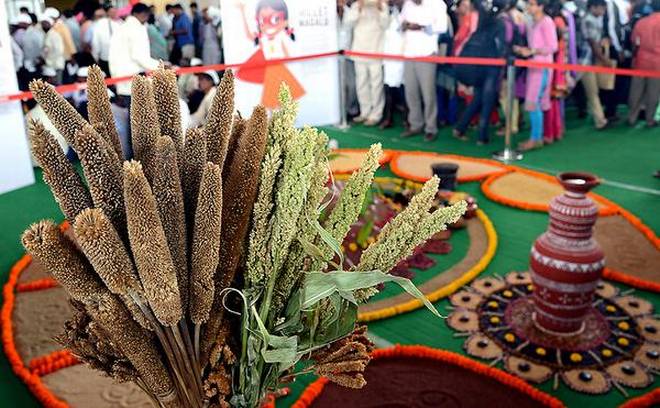
State launches indigenous organic and millets brands

MilletsBF30mar2017

Named Sresta Karnataka and Siri Karnataka, they aim to cater to the growing demand for millets

In a first of its kind, Karnataka has launched its own organic and millets brands to cater to the growing demand for millets. Sresta Karnataka (for organic produce) and Siri Karnataka (for millets) were launched by the government along with various organic federations in the State during the National Organic and Millets Trade Fair 2017 here on Saturday.

The brand names can be used only by those farmers who are certified or under the certification process for their products, Agriculture Minister Krishna Byre Gowda said during the launch. “While many farmers have already shifted to organic, they will be watched for three years so that there is no chemical residue found in their soil, and their products are organic as per regulation norms and global standards,” he said. Only after three years (IC 1, IC 2, IC 3) are they certified fully organic, as Karnataka has “the most stringent certification norms” compared to other States, he added.

Siri Karnataka was selected keeping in mind the richness of millets to human health and wellness.

The organic brand created for the regional federations is Sresta Karnataka. The brand-name was selected keeping in mind the importance of organic farming practices to nature, the environment, and ecology. Indicating that the move will facilitate organised marketing of these quality food items, the Minister said farmer groups will be trained on grading, packing, and quality aspects.

“This is a big step towards taking products from farmers to consumers for direct linkages,” he said. Brands — Siri Karnataka and Sresta Karnataka— were launched by 14 farmer federations representatives along with industry leaders Varun Berry, MD, Britannia Industries, Sanjay Malpani, VP, Future Foods, Hemanth Mallik, CEO- Foods, ITC, Sheshukumar, Big Basket, and Varun Gupta,CEO, Pro Nature. Next gen food startups, big organised and progressive retailers can get in touch with the organic cell that is running this programme, who will facilitate the transaction.

The fair is organised by the Department of Agriculture, Karnataka State Agricultural Produce Processing and Export Corporation Limited (KAPPEC), State agricultural universities, and the Jaivik Krishik Society.

source: http://www.thehindu.com / The Hindu / Home> News> Cities> Bengaluru / by Special Correspondent / April 30th, 2017

An entire Karnataka village turns to cooking to eke out a living, tastes success

Food for thought: Cooks of Kondrahalli in Kolar are in demand in Andhra Pradesh and Tamil Nadu, besides Bengaluru.   | Photo Credit: Special Arrangement
Food for thought: Cooks of Kondrahalli in Kolar are in demand in Andhra Pradesh and Tamil Nadu, besides Bengaluru. | Photo Credit: Special Arrangement

Faced with odds like unemployment, drought and parched lands, households of Kondrahalli village have made this an alternative source of income

On a hot afternoon in March in a sleepy village in Malur taluk of Kolar district, 40-year-old Sathish Kumar discusses his family ‘business’. “I have studied up to SSLC, and now I work as a cook at auspicious functions,” he says. “My younger brother Rajesh, who like me studied up to the class 10, is a cook. My older brother Nagaraj, who is 46-year-old, is also cook,” he keeps on explaining.

Sathish and his brothers are not the only family of cooks in their village. There are 60 households that call Kondrahalli village home, and all but one have taken up cooking to eke out a living. The oldest member of the 60th family that has yet to pick up spatulas, is a retired government school teacher.

There are villages that nurture at least one wrestler in every household. Others take pride in ensuring that one member is a teacher or a government employee.

But this is the story of an entire village whose residents, when faced with unemployment, drought and parched lands, turned to cooking as an alternative source of income.

In Karnataka, Kondrahalli village goes by the moniker ‘Banasigara grama’ (cooks’ village). A majority of the people here are landless and many worked on fields owned by farmers in surrounding villages. But with every passing generation, finding agricultural work and sustaining a livelihood from it was becoming increasingly difficult.

Career change

The struggles of two generations of families served as a catalyst for this career change. “Instead of depending on others and blaming nature, we opted to take up cooking,” says Nagaraj, who holds Bachelor’s degree, but prefers working as cook.

“We are happy with our profession as it feeds our families. It gives us pleasure to feed other people and get paid for his,” Sathish adds.

Most villagers, like Sathish and his brothers, are second-generation cooks having learned the tools of the trade from their fathers.

Only the men cook, and their profession for the most part takes them to Bengaluru and other parts of Karnataka, Andhra Pradesh and Tamil Nadu. Be it marriages, house warming ceremonies, political functions or birthdays, the cooks of Kondrahalli are in demand.

Not all 60 families cook for one event. “An order comes in, and depending on the size of the event, a team of 15 to 20 male cooks will go to the venue,” says a villager, adding that on an average they charge ₹40,000 to ₹60,000, which is then divided up among the cooks. The leader of the team — the person who brings in the order — usually gets takes home ₹4,000-₹5,000; for big assignments he can earn as much as ₹10,000.

“We have experience cooking for even 40,000 people particularly during functions organised by politicians,” says Sathish.

The cooks of Kondrahalli are adept at different cuisines, but their holiges are in great demand, they say. (Holiges, like puran polis, are sweet flat breads with delicious stuffings made from sugar and peanuts to coconuts and tur dal, cooked on a hot girdle with liberal helpings of ghee.) Mysore Paak is another speciality.

Regular contracts

Their fame guarantees them regular contracts from tour operators across north and south India. “None of us have any formal training. Practice makes us good cooks,” says villager Basavaraj, who is of course, a cook. During peak marriage and grihapravesha seasons, the men leave the village to go on “cooking missions”.

“The men folk will be away for months on end working in far-off places like Kuppam, Punganur and Ramasandra in Andhra Pradesh and Alangai, Kaveripatna, Karimangala, Ambur and Baragur in Tamil Nadu,” says Sathish’s sister-in-law, Saritha.

At home, women help with preparatory work. “We prepare masalas on grinding stones when the power goes off,” Saritha adds. But when the men return to Kondrahalli from their missions, it is the women who prepare their food. Some gender roles are hard to break.

source: http://www.thehindu.com / The Hindu  / Home> News> States> Karnataka / by Vishwa Kundapura / Kolar – April 29th, 2017